Shipbuilding Anti-Vibration Market Size, Share and Trends 2026 to 2035
Shipbuilding Anti-Vibration Market (By Product Type: Bearing Pads, Bellows, Mounts, Washers, Others; By Material: Elastomer, Composites, Plastic/Polymers, Metals, Others; By Function Type: HVAC , Generators & Pumps, Engines, Others; By Application: Fishing Boats, Cruise Ships, Tugs, Yachts, Motorboats, Sailboats, Container Ships, Oil Tankers, Others) - Global Industry Analysis, Size, Trends, Leading Companies, Regional Outlook, and Forecast 2026 to 2035
 Get a Sample
 Table Of Content


What is the Shipbuilding Anti-Vibration Market Size in 2026?
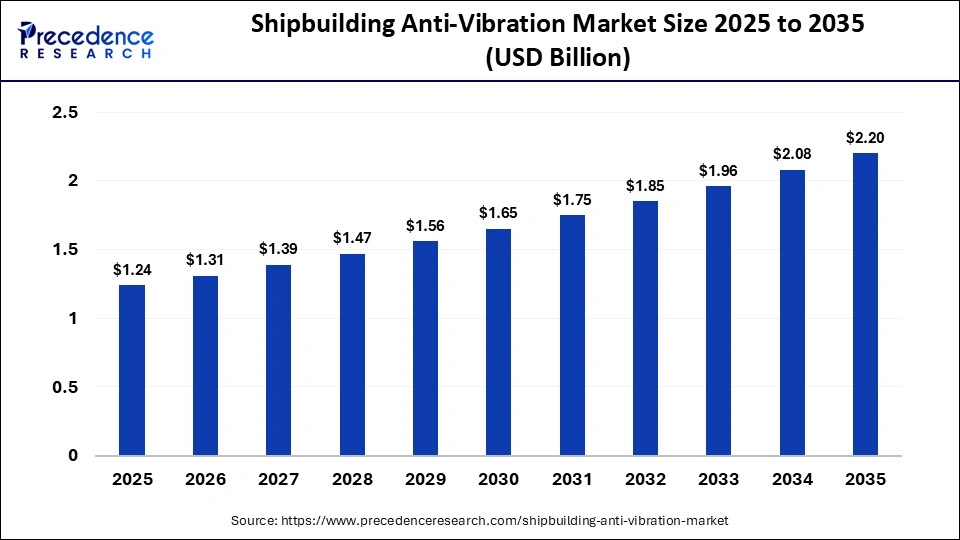
The global shipbuilding anti-vibration market size was calculated at USD 1.24 billion in 2025 and is predicted to increase from USD 1.31 billion in 2026 to approximately USD 2.20 billion by 2035, expanding at a CAGR of 5.92% from 2026 to 2035.The rising use of rubber vibration systems in modern vessels, along with the growing sales of fishing boats, has driven industrial expansion.
Key Takeaways
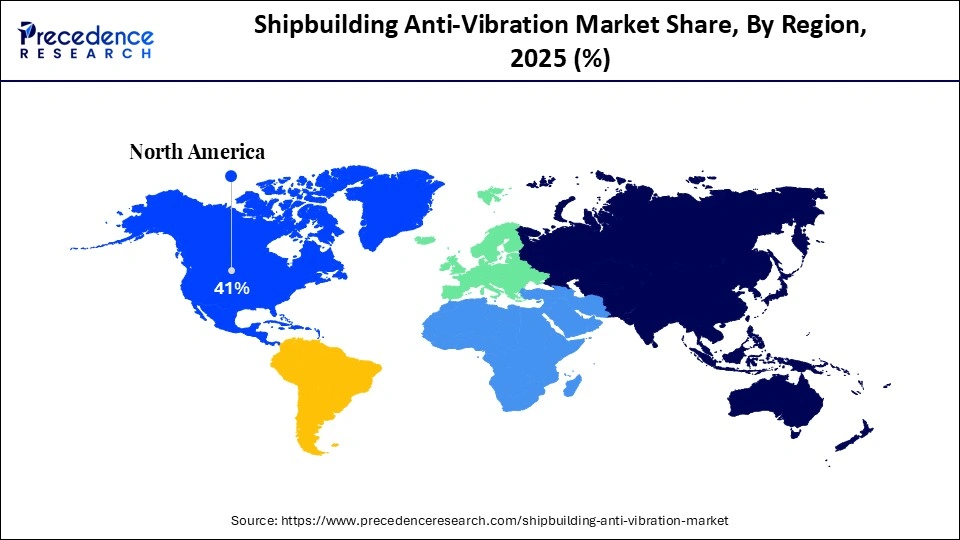
- North America led the shipbuilding anti-vibration market with the largest market share of 41% in 2025.
- Asia Pacific is expected to grow with the highest CAGR during the forecast period.
- By product type, the bearing pads segment held the largest share of the market in 2025.
- By product type, the bellows segment is expected to expand at the highest CAGR during the forecast period.
- By material, the elastomer segment dominated the market in 2025.
- By material, the composites segment is expected to expand with the fastest CAGR during the forecast period.
- By function type, the HVAC category segment held the largest share of the market in 2025
- By function type, the generators & pumps segment is expected to grow at the highest CAGR between 2026 and 2035.
- By application, the fishing boats segment held the highest share of the market in 2025.
- By application, the cruise ships segment is expected to grow at the fastest CAGR during the forecast period.
Market Overview
The shipbuilding anti-vibration market deals with producing and distributing advanced technologies, high-quality materials, and engineering solutions to reduce noise, vibrations, and structural stress from marine engines, propulsion systems, and HVAC systems. Shipbuilding anti-vibration enhances crew comfort by protecting sensitive equipment from external damage and improves vessel longevity by mitigating disturbances from vessel components, such as engines, propellers, and HVAC systems. The surging demand for vibration control systems from ship manufacturers to enhance the performance and durability of vessels is boosting market expansion. This market is expected to rise significantly with the growth of the defense sector globally.
What is the Role of AI in the Shipbuilding Anti-Vibration Industry?
AI plays a prominent role in shaping the shipbuilding anti-vibration industry in a positive direction. AI enables real-time monitoring of mechanical vibration levels, enhancing predictive maintenance and delivering active damping. AI improves the performance of ships by analyzing a wide range of data for detecting anomalies and lowering maintenance costs. Additionally, AI extracts data to detect structural stress or fatigue, which helps in preventing long-term damage to sensitive equipment, including sonar systems on fishing vessels.
In June 2025, HII partnered with C3 AI. This partnership aims to deploy an AI-enabled platform to increase the shipbuilding capabilities in the U.S.
Shipbuilding Anti-Vibration Market Trends
- Inauguration of Shipbuilding Centers: Numerous ship manufacturers are engaged in opening new shipbuilding capacities to increase ship production. For instance, in June 2025, BAE Systems announced to open a shipbuilding facility in Glasgow, U.S. This center was inaugurated to increase the production of ships.
- Product Launches: Various market players are engaged in launching a wide range of shipbuilding components. For instance, in May 2025, Volvo Penta launched an electric IPS platform. This platform is designed to deliver zero-emissions performance without compromising the safety, handling, or reliability.
- Collaborations: Several vessel-building companies are collaborating with research organizations for designing research vessels. For instance, in July 2025, VARD partnered with Inkfish. This partnership aims at designing and constructing modern research vessels.
- Regulatory Compliance and Safety Standards: Stricter international maritime regulations and industry standards on vessel safety, noise, and structural integrity are pushing shipbuilders to adopt certified anti-vibration solutions that meet compliance requirements.
- Rising Retrofit and Modernization Activities: Aging fleets are undergoing retrofit programs to upgrade vibration control systems, especially in regions focused on reducing maintenance costs and extending vessel life.
Market Scope
| Report Coverage | Details |
| Market Size in 2025 | USD 1.24 Billion |
| Market Size in 2026 | USD 1.31 Billion |
| Market Size by 2035 | USD 2.20 Billion |
| Market Growth Rate from 2026 to 2035 | CAGR of 5.92% |
| Dominating Region | North America |
| Fastest Growing Region | Asia Pacific |
| Base Year | 2025 |
| Forecast Period | 2026 to 2035 |
| Segments Covered | Product Type, Material, Function Type, Application, and region |
| Regions Covered | North America, Europe, Asia-Pacific, Latin America, and Middle East & Africa |
Segment Insights
Product Type Insights
Why Did the Bearing Pads Segment Dominate the Shipbuilding Anti-Vibration Market?
The bearing pads segment dominated the market with the largest share in 2025, owing to their role in lowering mechanical shock and enhancing vibration transmission in modern ships. Bearing pads are generally used to absorb high-frequency vibrations from engines, pumps, and HVAC systems by reducing noise throughout the vessels. These components withstand heavy loads in harsh environments, making them suitable for use in commercial ships. Top companies dealing in the manufacturing of bearing pads comprise GMT Rubber-Metal Technic, Trelleborg Group, and Hutchinson.
The bellows segment is expected to grow with the fastest CAGR during the forecast period. This is due to their growing use in modern ships for flexible vibration isolation and noise attenuation capabilities. Bellows are also used in exhaust systems, propulsion assemblies, and piping networks to absorb angular movements caused by engine operations. Nowadays, the vessels are integrated with bellows to prevent structural fatigue and manage dynamic stress. These components are useful in enhancing fuel efficiency, lowering onboard noise, and meeting strict maritime regulations.
Material Insights
What Made Elastomer the Leading Segment in the Shipbuilding Anti-Vibration Market?
The elastomer segment led the shipbuilding anti-vibration market in 2025 due to its superior damping properties, enhanced durability, and cost-effectiveness. Elastomers are used in the production of different shipbuilding components, such as pads, mounting, and bushings. These elastomer-based components are used to reduce vibrations generated by generators, engines, compressors, and propulsion systems. It also offers strong resistance against saltwater corrosion, chemical exposure, and temperature variations.
The composites segment is expected to expand at the highest CAGR during the forecast period, owing to the growing demand for lightweight and corrosion-resistant materials from the shipbuilding industry. Composite-based vibration control components deliver superior fatigue resistance and enhanced damping performance as compared to metallic solutions. The advanced composite materials help in lowering vessel mass to improve fuel efficiency.
Function Type Insights
What Made HVAC Category the Leading Segment in the Shipbuilding Anti-Vibration Market?
The HVAC category segment led the shipbuilding anti-vibration market in 2025, due to the rapid installation of air conditioning systems in commercial and naval ships. HVAC systems operate constantly to maintain onboard air quality, facilitating temperature control, and enhancing passenger comfort. The HVAC assemblies are integrated with anti-vibration mounts to reduce cabin noise and enhance the longevity of vessel equipment.
The generators & pumps segment is expected to grow at the highest CAGR between 2026 and 2035, owing to the growing complexities and power requirements in modern vessels. Generators and pumps are used for fluid circulation, ballast management system, fluid circulation, and onboard power generation. With the increasing adoption of hybrid vessels in developed nations, the application of energy-efficient pumps has increased significantly to manage fire suppression, transfer, and cooling.
Application Insights
Why Did the Fishing Boats Segment Dominate the Shipbuilding Anti-Vibration Market?
The fishing boats segment dominated the shipbuilding anti-vibration market in 2025, due to the presence of well-established commercial fishing fleets in different countries, such as India, Sri Lanka, Argentina, and Canada. Fishing boats are highly dependent on diesel engines, pumps, hydraulic winches, and refrigeration systems. These components are highly dependent on vibration isolation solutions to prevent structural fatigue and enhance crew safety during extended voyages in international waterways.
The cruise ships segment is expected to expand with the fastest CAGR during the forecast period, owing to the surging investment in luxury fleet development and the rapid expansion of cruise tourism globally. Cruise vessels require superior comfort with lower noise and minimal vibration levels. These requirements are fulfilled by the surging adoption of advanced anti-vibration dampers and auxiliary machinery, thus fostering the industry in a positive direction.
Regional Insights
North America Shipbuilding Anti-Vibration Market Size and Growth 2026 to 2035
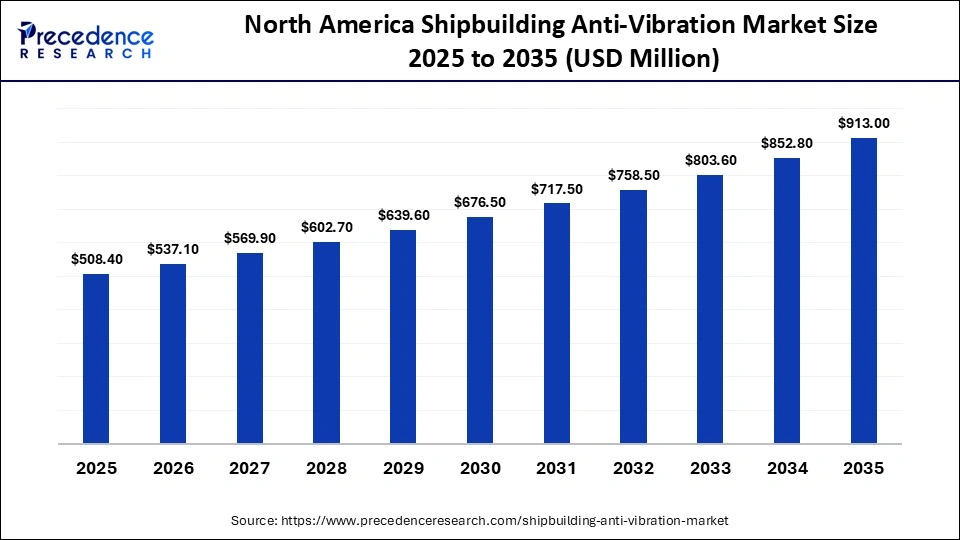
The North America shipbuilding anti-vibration market size is estimated at USD 508.40 million in 2025 and is projected to reach approximately USD 913.00 million by 2035, with a 6.03% CAGR from 2026 to 2035.
Why Did North America Dominate the Shipbuilding Anti-Vibration Market?
North America dominated the shipbuilding anti-vibration market with the largest share in 2025, owing to the increasing research and development in the shipbuilding sector, coupled with the expanding maritime trade network. This region is home to numerous top market players, such as Parker LORD, Barry Controls, ITT Inc., and Fabreeka International. These companies are constantly engaged in designing and distributing anti-vibration components for the end-users. Additionally, the surging emphasis of the government on deploying warships in the Caribbean region for improving regional security, as well as stringent government rules for enhancing crew safety, has driven the market expansion.
- In January 2026, ITT launched a new range of shock and vibration isolation solutions. These solutions are designed for the naval sector in the U.S. region.
U.S. Shipbuilding Anti-Vibration Market Size and Growth 2026 to 2035
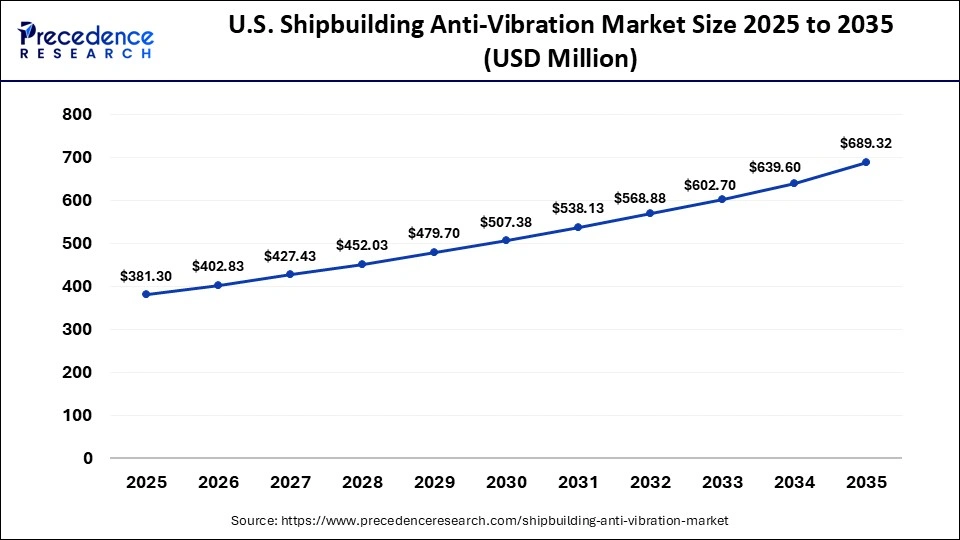
The U.S. shipbuilding anti-vibration market size is calculated at USD 381.30 million in 2025 and is expected to reach nearly USD 689.32 million in 2035, accelerating at a strong CAGR of 6.10% between 2026 and 2035.
U.S. Shipbuilding Anti-Vibration Market Trends
The U.S. leads the shipbuilding anti-vibration industry in North America. This is due to the rising sales of yachts, coupled with the growing use of elastomer-based bearing pads in commercial vessels. Also, the surging investments by the shipbuilders in integrating high-quality damping materials in modern vessels, coupled with increasing focus on naval modernization, have bolstered industrial development.
Why is Asia Pacific Expanding with the Highest CAGR in the Market?
Asia Pacific is expected to expand with the highest CAGR during the forecast period. This is due to the modernization of naval networks in several prominent nations, including China,
India, and South Korea, coupled with the rapid investment by oil and gas companies for operating offshore exploration activities. The growing consumer preference to travel through waterways, as well as the surging use of plastic-based anti-vibration components in modern ships, has helped the industry to prosper in a positive direction. Moreover, the increasing sales of sailboats and container ships in Singapore and Australia, along with the availability of essential raw materials at reasonable rates, have boosted the market expansion.
- In December 2025, the Ministry of Defence in India launched a 15-year plan for the modernization of naval networks. This new plan is expected to enhance the Indian Navy's task of protecting a vast maritime area that spans from the Persian Gulf, as well as Africa's eastern seaboard, along with the Indian Ocean and South China Sea.
China Shipbuilding Anti-Vibration Market Analysis
China is a major contributor to the Asia Pacific shipbuilding anti-vibration industry, owing to the increase in the number of shipbuilding companies, as well as technological advancements in the maritime sector. Additionally, the rapid investment by private sector entities for developing the polymer industry, along with numerous government initiatives aimed at strengthening the naval sector, is accelerating the industry in a positive direction.
Which Factors Drive the Shipbuilding Anti-Vibration in Europe?
Europe is expected to grow at a considerable CAGR in the upcoming period due to its strong shipbuilding industry and advanced maritime technologies. Shipyards across the region increasingly use modern vibration and noise reduction systems to improve vessel performance and operational efficiency. The use of advanced vibration control technologies also helps reduce machinery wear, lower maintenance costs, and improve fuel efficiency.
Germany Market Trends
Germany is another prominent participant due to its marine engineering and shipbuilding capabilities. It places great importance on highly sophisticated anti-vibration systems in warships, cruise ships, and merchant ships. More money is being invested in technologically sophisticated components and efficient marine equipment, thus boosting the demand for anti-vibration technologies.
Will Latin America Grow in the Shipbuilding Anti-Vibration Market?
Latin America is considered to be a significantly growing area, due to investments made in its shipping infrastructures and maritime energy operations. Ship companies utilize anti-vibration technology to enhance ship efficiency while minimizing maintenance costs. The increase in trading along coastlines and advancements in marine fleets lead to increased market demands.
Brazil Market Trends
Brazil occupies an important place in the regional market owing to the offshore oil and gas industry and the shipbuilding industry. The need for antivibration systems grows in support vessels, tanker ships, and offshore oil rigs. Moreover, infrastructure investment and improvement in marine transport can contribute to market development.
Will the Middle East and Africa Grow in the Shipbuilding Anti-Vibration Market?
The Middle East and Africa are expected to grow at a considerable CAGR in the upcoming period. This region will continue to make heavy investments in infrastructure and maritime logistics. With ongoing developments in naval construction, there will be an increasing demand for shipbuilding anti-vibration products.
UAE Market Trends
One of the largest markets in this region is that of the UAE, thanks to its advanced shipbuilding and shipping industry. A growing number of commercial and naval ships are now being equipped with state-of-the-art anti-vibration technology.
Competitive Landscape
The shipbuilding anti-vibration market is moderately consolidated, as it involves the operation of global players, marine equipment providers, and vibration control vendors. Competitiveness in the industry stems from the quality of products, adherence to marine legislation, and durability, whereas technical skills and certification are factors that hinder market entry. Major competitors in this space include Trelleborg Group, Hutchinson SA, Vulkan Group, GMT Rubber-Metal-Technic Ltd., and LORD Corporation. The current trend among firms operating in this market segment entails the utilization of innovative elastomeric components, sophisticated insulation methods, and smart monitoring capabilities. Developments in the industry pertain to predictive maintenance solutions, sensors, and noise control technologies.
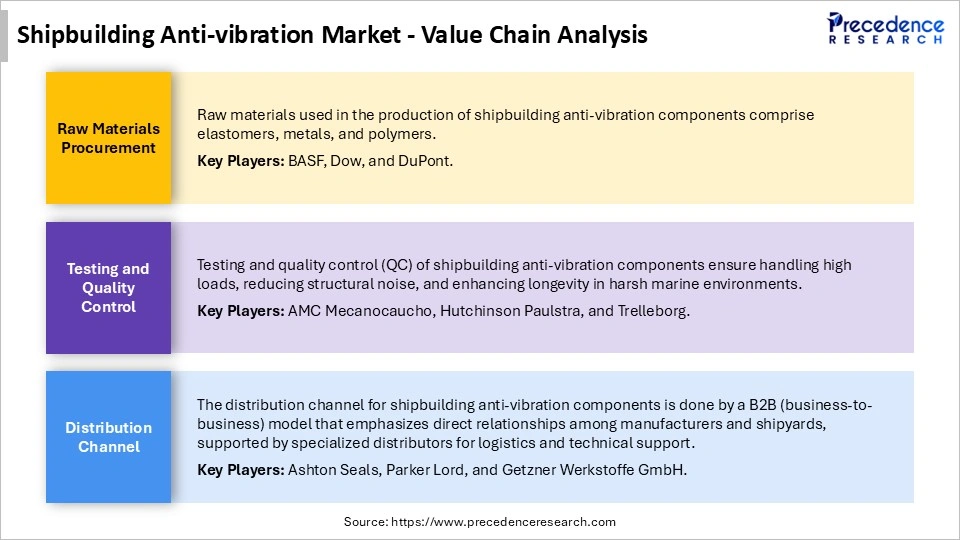
Shipbuilding Anti-Vibration Market Value Chain Analysis
Shipbuilding Anti-Vibration Market Companies
- Trelleborg
- Parker LORD
- Hutchinson Paulstra
- GMT Rubber-Metal-Technic Ltd.
- Continental
- Vibracoustic
- ITT Inc.
- Bridgestone Corporation
- Sumitomo Riko Company Limited
- Eaton Corporation
- Barry Controls
- Fabreeka International
- Meggitt PLC
- Tech Products Corporation
- VMC Group
- VibraSystems Inc.
- Enidine Inc
- Silentblok
- Advanced Antivibration Components (AAC)
- Karman Rubber Company
Recent Developments
- In December 2025, Master Boat Builders invested around US$ 60 million. This investment is made to build a defence-based shipbuilding plant in the U.S.(Source: https://www.marinelink.com)
- In September 2025, the government of India invested US$ 3.4 billion. Through this investment, the government aims to set up a shipbuilding hub in Tamil Nadu, India.(Source: https://www.wionews.com)
- In September 2025, ZF Marine launched the POD 4900. The POD 4900 is the latest propulsion system designed for recreational and commercial ships.(Source: https://www.workboat.com)
Segments Covered in the Report
By Product Type
- Bearing Pads
- Bellows
- Mounts
- Washers
- Others
By Material
- Elastomer
- Composites
- Plastic/Polymers
- Metals
- Others
By Function Type
- HVAC
- Generators & Pumps
- Engines
- Others
By Application
- Fishing Boats
- Cruise Ships
- Tugs
- Yachts
- Motorboats
- Sailboats
- Container Ships
- Oil Tankers
- Others
By Region
- North America
- Latin America
- Europe
- Asia-pacific
- Middle and East Africa
For inquiries regarding discounts, bulk purchases, or customization requests, please contact us at sales@precedenceresearch.com
Frequently Asked Questions





Ask For Sample
No cookie-cutter, only authentic analysis – take the 1st step to become a Precedence Research client




 sales@precedenceresearch.com
 Schedule a Meeting