



Small UAV Market Size, Key Companies, Company Production Capacity, Manufacturing Efficiency, Production Output, Supply Chain Metrics, Cost Structure, Company Expansion Strategies, and Growth Opportunities
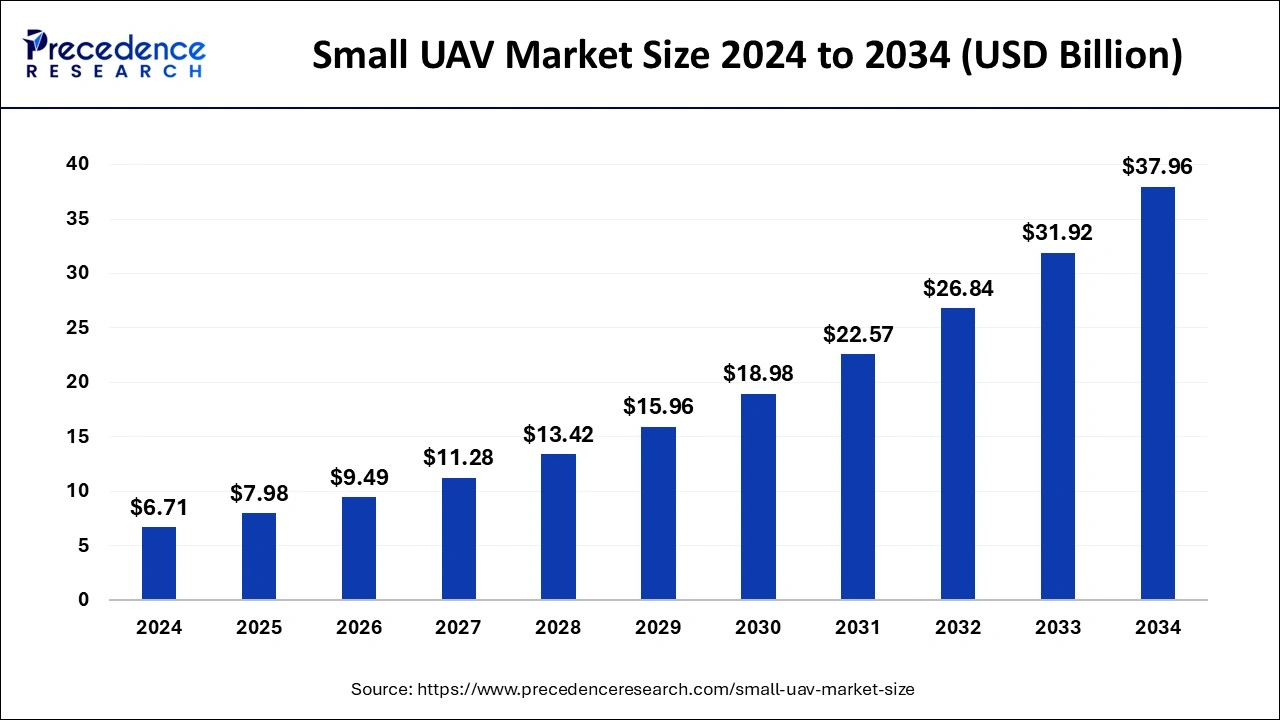
Valued at USD 9.49 billion in 2026, the global small UAV market is expected to reach USD 40.15 billion by 2035, growing at a CAGR of 17.54% from 2026 to 2035. The market is expanding rapidly due to rising demand for drones in defense, agriculture, logistics, infrastructure inspection, environmental monitoring, and public safety. Advancements in AI, autonomous flight, and imaging technologies, coupled with increasing military investments and supportive government regulations, are accelerating adoption worldwide. North America leads the market, while Asia Pacific is projected to witness the fastest growth during the forecast period.
Source: https://www.precedenceresearch.com/small-uav-market
 Get a Sample
 Table Of Content


What is the Small UAV Market Size?
The global small UAV market size is calculated at USD 7.98 billion in 2025 and is predicted to increase from USD 9.49 billion in 2026 to approximately USD 40.15 billion by 2035, expanding at a CAGR of 17.54% from 2026 to 2035. The small UAV market has seen a growth with rising demand for its applications across the military sector.
Small UAV Market Key Takeaways
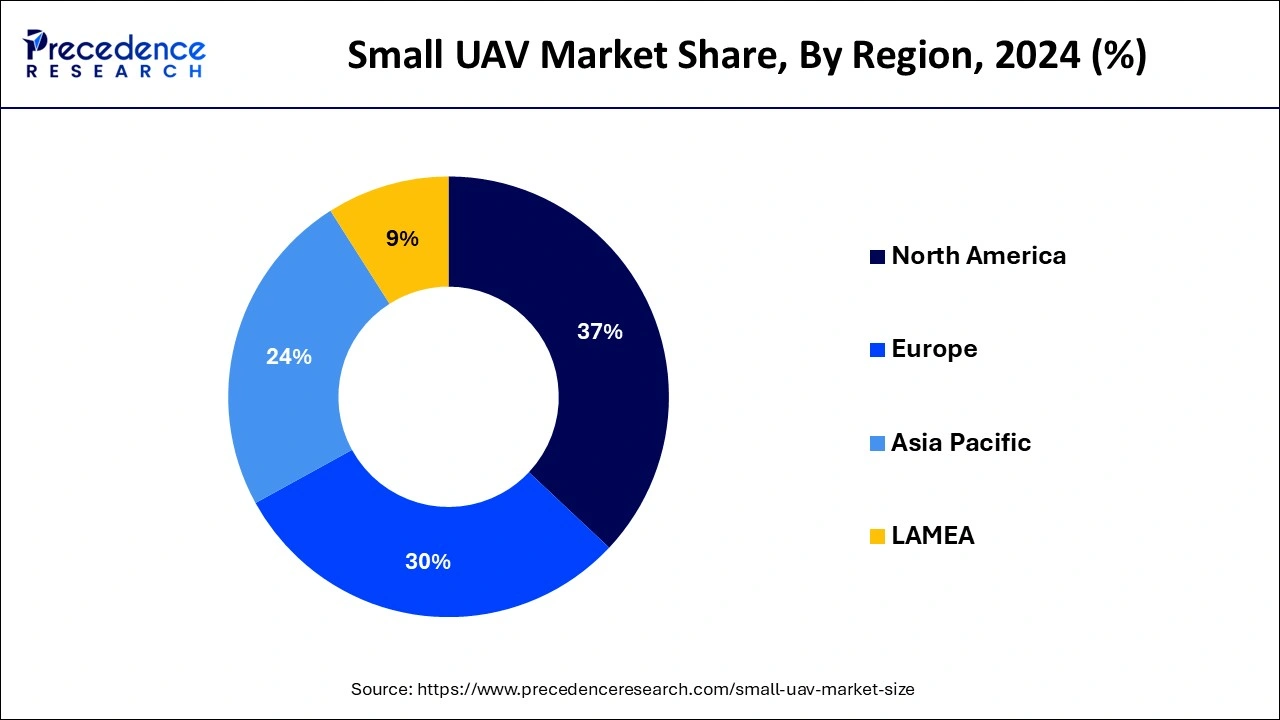
- North America dominated the global market with the highest market share of 37% in 2025.
- Asia Pacific is growing at a notable CAGR over the forecast period.
- By Type, the Rotary Blade Segment Dominated the Small UAV Market in 2025 due to its cost-effectiveness, vertical take-off and landing (VTOL) capability, and ease of operation in confined spaces.
- By Type, the Fixed Wing Segment is Expected to Grow at the Fastest CAGR during the forecast period, driven by longer flight endurance, extended operational range, and superior aerodynamic efficiency.
- By Application, the Defense Segment Dominated the Small UAV Market in 2025 owing to increasing military surveillance requirements, cost-effective deployment, and enhanced battlefield situational awareness.
- By Application, the Commercial and Civil Segment is Expected to Grow at the Fastest CAGR between 2026 and 2035, supported by rising demand for cost-efficient aerial data collection, infrastructure inspection, logistics, and inventory management.
Mapping UAV landscape: Small UAV Market Overview
The intensifying realization of the UAV implementation in military operations has encouraged vendors to present UAVs that can be employed in plentiful commercial applications. These UAVs are also receiving receptions in other applications such as aerial photography, internet provision in remote places, and video recording, document wildlife and survey, and public service missions. Numerous corporations mainly offer small-UAVs that are utilized in aerial photography, agricultural, and data collection applications. As numerous nations seek to upsurge their military surveillance capability, enormous investments are being made in the advancement of small drones. The market growth is also driven by an increasing need for efficient monitoring and data collection in agricultural practices. The expanding applications of small UAVs in industries like environmental monitoring, public safety, inspection of infrastructure etc. are further pushing the demand for the small UAV market.
Smart Flight: AI Powering the Future Drones
Artificial Intelligence (AI) has many applications in UAVs. They can help these machines interact in an intelligent way. AI technology can easily combine with other technologies like Internet of Things (IoT) and machine learning (ML) which further widens its scope of application. AI technology can help enhance aerial imaging, data collection, predict patterns etc., which can be extremely useful for different sectors. For example, in defense industry, AI enabled small UAV can detect thermal signatures and objects that can prove crucial for the military objective. The other application of AI technology in small UAV includes crowd counting, tracking, compliance checking, license plate reading, face recognition, smoke detection etc. The integration of AI technology into small UAV infrastructure could change the landscape of the small UAV market in the forecast period.
Small UAV Market Growth Factors
- Rising implementation of small UAV's for commercial applications
- High Frequencies of Terrorism compelling the usage of UAV's for its anti-terrorism competences
- Technological progression in the arena of drone payloads
- Budding demand of UAV's for cutting-edge patrolling of marine borders
- Investments in unmanned aerial vehicles (UAVs) and drones
Small UAV Market Outlook: The Future of UAV
- Industry Growth Overview: The increasing adoption, technological advancements, growing favourable government regulatory frameworks, and rising military expenditure for surveillance are driving the industrial growth in the market.
- Major Investors: Large venture capital firms, global investment companies, and strategic corporate investors are the major investors in the market. Accel, Andreessen Horowitz, and NVIDIA are some of the major investors.
- Startup Ecosystem: The startup ecosystem is focusing on the development of AI-powered solutions. Zipline, Flytrex, Skydio, and Skylark Drones are some of the startups participating in the market.
Market Scope
| Report Highlights | Details |
| Market Size by 2035 | USD 40.15 Billion |
| Market Size in 2026 | USD 9.49 Billion |
| Market Size in 2025 | USD 7.98 Billion |
| Growth Rate from 2026 to 2035 | CAGR of 17.54% |
| Largest Market | North America |
| Base Year | 2025 |
| Forecast Period | 2026 to 2035 |
| Segments Covered | Type, Application, Region |
| Regions Covered | North America, Europe, Asia-Pacific, Latin America, and Middle East & Africa |
Market Dynamics
Driver
Growing demand for aerial data collection
The growing necessity for aerial data collection is a major factor driving the small UAV market. Different organizations are utilizing and realizing the importance of drones in order to gather data that can assist in decision making as well as operational efficiency. Many organizations are seeking ways to streamline their operations and lower their costs. The adoption of UAV for the purpose of data collection is significantly increase. According to the World Bank, precision agricultural practices powered by UAV technology could rise the crop yields by almost 20%. Agriculture is one of sectors that is leveraging UAV technology for aerial data collection the most presently.
Restraint
Limitations in infrastructure
A crucial challenge for the small UAV market is the lack of supportive or limited infrastructure. The lack of air traffic management systems that are designed to incorporate drones and their efficient operations in urban areas are lacking. These systems are traditionally designed for aircrafts and are not suitable to accommodate operations for drones. There is ongoing research for development of systems that can work for smooth drone operations. For example, the National Aeronautics and Space Administration (NASA) is working on systems of unmanned aircraft traffic management. These systems will require time for wide scale implementation. This s a major challenge for the small UAV market to tackle during the forecast period.
Opportunity
Regulations and Safety Standards
The ongoing efforts being taken to ensure safety and regulation by government and other agencies will help organizations. There is no specific set of compliances or standards for small UAV manufacturers. A proper framework will help create a quality standard to maintain for small UAV companies. The key players can improve upon their safety, reducing any operational errors. The consistent quality will automatically help improve operations and efficiency of these systems. The Federal Aviation Administration (U.S.) is working diligently on creating a standard of regulations and compliances that will help small UAV improve in quality and operate safely. The opportunity for enhancement in operational efficiency as well as technological innovations will be an easier task for the key players.
Segmental Insights
Type Insights
Which Type Segment Dominated the Small UAV Market?
The rotary blade segment held a dominant position in the market in 2025 due to its cost-effectiveness and ease of use. The vertical take-off and landing of rotary blade small UAVs makes them a suitable choice as they require minimal space. They also reduce vibration and noise in helicopters using a hybrid system. Rotary blades allow the engine to operate more efficiently.
The fixed wing segment is expected to grow with the highest CAGR in the market during the studied years. Fixed-wing UAVs are widely preferred over rotary blades due to their enhanced operational efficiency, leading to longer flight times, extended operational range, and the ability to cover more ground per mission. Fixed-wing UAVs also have better aerodynamic performance, providing high stability and efficiency during flight.
Application Insights
Why Did the Defense Segment Dominate the Small UAV Market?
The defense segment held the largest market share in 2025 due to the growing defense requirements and the cost-effectiveness of small UAVs. The cost-effectiveness of such drones allows defense entities to deploy larger fleets, enhancing situational awareness on the battlefield without the budget constraints associated with bigger models. Small drones democratize defense capabilities, fostering innovation and opening the door to unprecedented tactical options.
The commercial and civil segment is expected to gain the highest market share between 2026 and 2035, as small UAVs provide rapid and cost-effective data collection and task execution. Small UAVs eliminate human risk in hazardous environments and perform tasks more quickly and affordably than traditional manned aviation or ground-based aviation methods. In addition, drones can be used to complete inventory assessments, reducing time and cost requirements.
Regional Insights
How did North America Dominate the Small UAV Market?
North America dominated the small UAV market in 2024. The growing investment in drone technology and strong government support for commercial drone applications help in the market growth. The presence of military and government agencies increases demand for small UAVs. The growing demand from various applications like logistics, agriculture, and construction fuels the adoption of small UAVs. Additionally presence of major UAV manufacturers and research institutions supports the overall growth of the market.
U.S. Small UAV Market Size and Growth 2026 to 2035
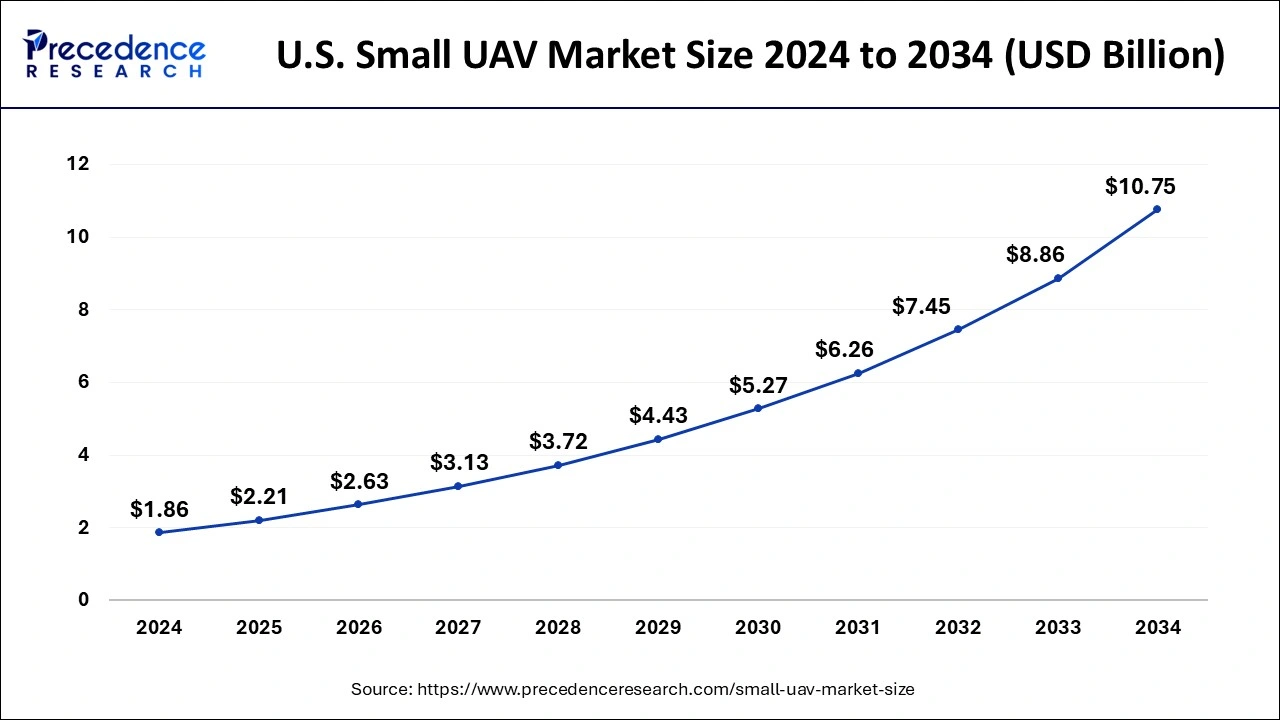
The U.S. small UAV market size was evaluated at USD 2.21 billion in 2025 and is predicted to be worth around USD 11.01 billion by 2035, rising at a CAGR of 17.42% from 2026 to 2035.
United States Small UAV Market Trends
The United States is a major contributor to the small UAV market. The presence of a robust defense industry and growing demand for drones in commercial sectors increases demand for small UAVs. The favorable regulatory environment for drone operations and growing innovation help in the market growth. The strong government investment in drone development & research, and a thriving ecosystem for manufacturing drones, fuels market growth. Additionally, the growing integration of small UAVs in operational workflows in major companies like Google & Amazon, and technological advancements in small UAVs development support the overall growth of the market.
Rise of Small UAVs in the Asia Pacific
Asia Pacific experiences the fastest growth in the market during the forecast period. The growing modernization in the military, like border patrol, surveillance, and reconnaissance, increases demand for small UAVs. The growing infrastructure development increases demand for small UAVs for efficient management and monitoring solutions. The growing demand from commercial applications like logistics, agriculture, and construction drives the overall growth of the market.
China's Small UAV Market Trends
China is a key contributor to the small UAV market. The strong government support for civilian drones and growing investment in the UAV sector help the market growth. For instance, Shenzhen is a major hub for drone innovation and manufacturing. The growing innovation and interconnecting AI applications to enhance drone capabilities fuel market growth. The growing expansion of the e-commerce sector and the extensive logistics sector increases demand for small UAVs. Furthermore, growing demand from applications like agriculture, package delivery, and infrastructure inspection contributes to the overall market growth.
Europe's Small UAV Market Driven by EASA Regulations and Industry Adoption
The region of Europe was the second biggest market for the small UAV market in 2025. It held approximately 30% of market share. European Union Aviation Safety Agency has established proper regulations and compliances for safe operations of drones which has increased their applications across different industries. Germany, UK and France are the countries which are adopting small UAVs on a larger scale for different sectors like agriculture, infrastructure inspections and defense.
The Strong Defence Fuels the UK Growth
Due to the presence of a strong defence sector in the UK, innovations in small UAVs are increasing. They are widely used for security processes by the military, where they are also being used in the agricultural and construction sectors for various applications. Moreover, the government support is increasing their advancements.
UAV Transforming South America's Agricultural Fields
South America is expected to grow significantly in the small UAV market during the forecast period, due to the expanding agricultural sector, where they are being used for precision farming, irrigation management, crop monitoring, etc. They are also used for surveillance and inspection of the infrastructure and mining projects. The growing government initiatives for environmental monitoring or disaster management are also increasing their adoption.
Urbanization Revolutionizing Brazil UAV
Growing urbanization in Brazil is increasing the demand for small UAVs, which are being used for construction monitoring and urban planning. They are also being used in the agricultural and mining sectors for various applications. The companies are focusing on enhancing their features, where the government support is also driving their innovations and adoption.
Will the Middle East and Africa Grow in the Small UAV Market?
The Middle East and Africa region is expected to grow at a considerable CAGR in the upcoming period due to the need for counter-insurgency operations and border surveillance. The recent U.S.-Iran war has further strengthened the demand for small UAVs. The Middle East was an early adopter of UAVs and remains a source of UAV innovation while also seeing continued UAV use.
UAE Market Trends
The UAE market is growing due to the rising adoption of advanced technologies and stringent regulations. Booming commercial operations and advanced military manufacturing augment market growth. The UAE government has launched the General Civil Aviation Authority to regulate civil aviation affairs and provide necessary services, ensuring safety and security regulations.
Building Flights: Small UAV Value Chain Analysis
- Raw Material Sourcing - Different types of raw materials, like carbon fiber composites, aerospace-grade aluminum, engineering plastics, and lithium-ion batteries, are sourced globally in the raw material sourcing of small UAVs.
Key Players: Mitsubishi Chemicals, DuPont, SABIC, LG Chem. - Testing and Certification - The testing and certification of small UAVs involves ensuring the safety and performance standards, along with compliance with airworthiness.
Key Players: UL Sloutos, SGS, DEKRA, Bureau Veritas. - Product Lifecycle Management- The product lifecycle management of small UAVs includes the management of the entire product journey from their design to disposal using integrated software systems.
Key Players: Siemens Digital Industries software, PTC, Aras Corp.
Competitive Landscape
The small UAV market is highly fragmented, with the presence of software and platform developers, Drone-as-a-Service (DaaS) providers, payload specialists, manufacturers, and training, licensing, and consulting companies. Key players, such as Lockheed Martin Corporation, Bayer Tech, Boeing, SZ DJI Technology Co., Ltd., and Thales Group, are major developers of small UAVs.
The market faces formidable challenges, such as technical limitations, complex airspace regulations, and environmental vulnerabilities. Despite these challenges, rapid miniaturization, full autonomy, and the integration of AI drive the future of small UAVs. Small UAVs are studied for multiple uses, including structural inspection, search and rescue, surveillance, and data collection.
The Leaders: Small UAV Key Players' Offering
- DJI: The company provides products like the Mavic series, Agras series, Matric series, and Phantom series.
- Parrot: ANAFI series is the product provided by the company.
- AeroVironment: Products such as Raven series, Wasp AE, Puma series, and Switchblade are provided by the company.
- Lockheed Martin: The company offers products such as Indigo II/III and Stalker.
- FLIR Systems: Black Hornet PRS is the product offered by the company.
Other Major Key Players
- Elbit Systems
- Textron
- Applied Aeronautics
- IAI
Recent Developments
- In April 2026, Teledyne FLIR OEM announced the launch of its new Prism C-UAS, a C-UAS software stack to push detection and tracking range beyond what conventional systems can deliver against small, hard-to-detect drones. The software combines patented thermal infrared image signal processing with AI-driven perception. (Source: https://www.commercialuavnews.com)
- In March 2026, Robinson Helicopter Company established a new business unit, Robinson Unmanned, focused on unmanned platforms. The unit brings together small UAVs built by subsidiary Ascent AeroSystems with larger uncrewed platforms based on Robinson's R44 and R66 helicopters. (Source: https://www.janes.com)
- In September 2023, IAI (Israel Aerospace Industries) signed two agreements with different countries for the supply of long-range loitering munitions drones.
- In May 2023, SZ DJI Technology Co. Ltd introduced their DJI Matrices 350 RTK. This is a commercial drone with maximum flight time of 55 minutes with a payload of 2.7 kgs.
- In June 2024, the Minister of Armed Forces of France, signed a UAV pact that is designed to keep the idea exchange between France's drone industry and military, but also to develop a strategic unmanned capacity in the category of under 150 kgs.
Market Segmentation
By Type
- Fixed Wing
- Helicopter
- Rotary Blade
By Application
- Defense
- Commercial and Civil
By Geography
- North America
- U.S.
- Canada
- Europe
- Germany
- France
- United Kingdom
- Rest of Europe
- Asia Pacific
- China
- Japan
- India
- Southeast Asia
- Rest of Asia Pacific
- Latin America
- Brazil
- Rest of Latin America
- Middle East & Africa (MEA)
- GCC
- North Africa
- South Africa
- Rest of Middle East & Africa
For inquiries regarding discounts, bulk purchases, or customization requests, please contact us at sales@precedenceresearch.com
Frequently Asked Questions
Tags





Ask For Sample
No cookie-cutter, only authentic analysis – take the 1st step to become a Precedence Research client
 Get a Sample




 sales@precedenceresearch.com
 Schedule a Meeting
