


Smart Electric Drive Market Size, Key Companies, Smart Electric Drive Market Size, Key Companies, Trends, Regional Outlook, and Forecast 2026 to 2034
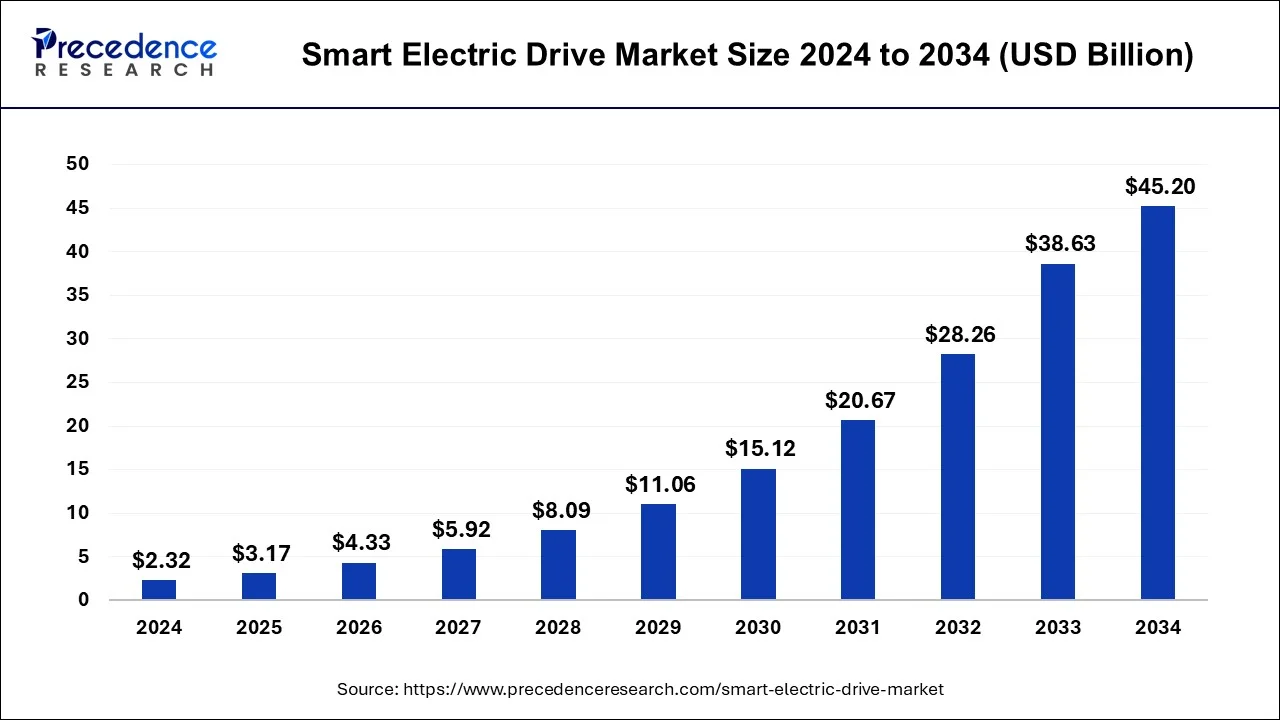
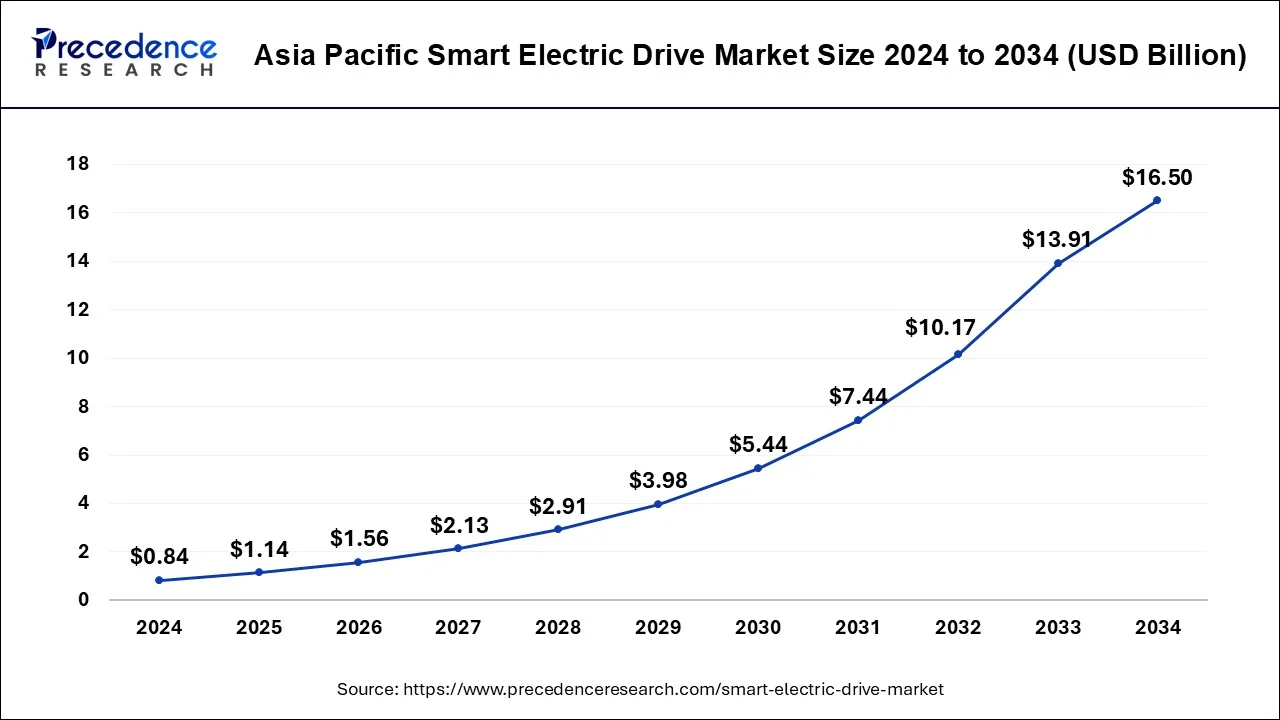
The global smart electric drive market size is estimated at USD 4.33 billion in 2026 and is predicted to reach around USD 45.20 billion by 2034, accelerating at a CAGR of 34.58% from 2026 to 2034. The Asia Pacific smart electric drive market size surpassed USD 1.14 billion in 2025 and is expanding at a CAGR of 34.69% during the forecast period. The market sizing and forecasts are revenue-based (USD Million/Billion), with 2024 as the base year.
Source: https://www.precedenceresearch.com/smart-electric-drive-market
 Get a Sample
 Table Of Content


What is the Smart Electric Drive Market Size?
The global smart electric drive market size was accounted for USD 4.33 billion in 2026, and is expected to reach around USD 45.20 billion by 2034, expanding at a CAGR of 34.58% from 2026 to 2034. The demand for smart electric drives is developing as they integrate power electronics, electric motors, and advanced software to grow vehicle range, energy efficiency, and driving securely. Such technology aligns with the current encouragement that comes from green mobility, which delivers intelligent power distribution and lower operating costs as compared to regular drives.
Smart Electric Drive Market Key Takeaways
- Asia Pacific region accounted for a market share of over 36% in 2026.
- The all-wheel drive segment is growing at a CAGR of 40% from 2026 to 2034.
- The E-axle application segment generated 59% revenue share in 2026.
- The lithium-ion segment has garnered a 33% revenue share in 2026.
Market Overview
Demand for smart electric drives is expected to increase as electric-vehicle adoption, vehicle electrification, advanced power electronics, and government support for zero-emission mobility expand.
The automobile electric vehicle sector has come to a standstill due to the stoppage of car manufacturing and supply interruptions. For the upcoming several months, declining auto sales following the epidemic will cause serious importance to automobile EV OEMs. Furthermore, the use of advanced integrated elements in an automobile is predicted to lead to a large growth in the smart zero emission industry in 2023. Before that, this epidemic would cause slower-than-expected growth of such a sophisticated electrically powered industry because of decreased EV auto sales and just a sudden halt inside the new technology development.
Smart Electric Drive Market Growth Factors
The demand for smart drive systems is expanding as a result of worldwide electrical vehicles. Smart electric drive systems integrate electric motors, power electronics, control systems, and software to efficiently transmit electrical power to the vehicle wheels. Compared to traditional electrical machines, smart power drives are faster and improve driving dynamics. As a result, there are growing global necessity for sophisticated drive systems due to rising vehicle safety and driving performance. and comfort standards. Furthermore, such motors guarantee optimized power use, leading to lower operating action costs than traditional e-drives, by utilizing cutting-edge elements like electrical machines, e-breaks boosters, and others. Moreover, the market for the best feature was projected to increase in the coming years because of the increased use of powered mobility owing to stricter environmental standards as well as a governmental drive to embrace EVs through offering subsidies & discounts for EV purchasing. Highly integrated electric drive systems can reduce component count, packaging requirements, and system weight compared with less-integrated architectures.
- The marketplace is growing as a result of increased Electric vehicle sales and accelerating vehicle digitalization.
- The adoption of the best feature by manufacturers in their forthcoming upgraded EVs is anticipated to promote new markets.
- Governmental prohibitions on traditional automobiles and incentives for the acquisition of new electric cars are expected to encourage industry expansion in the upcoming decades.
- Within the coming years, the growing demand might well be constrained by the severe shortage of Supply constraints affecting power semiconductors and other electronic components can limit production scalability
Smart Electric Drive Market Trends
- AI Will Change Energy Management: Artificial Intelligence (AI) is updating how many sectors are working. A study calculated 80-905 companies are now utilizing AI in at least one aspect of their business operations. The EV charging sector is also being transformed by AI-enabled energy management. As charging demand increases and energy costs change; AI is shifting to a complicated allowed of profitable and scalable charging infrastructure.
- Bidirectional Charging will reveal Current Revenue flows for Fleets: Vehicle-to-grid (V2G) technology is meant to change how commercial sites and fleets track energy and make revenue. Bidirectional charging, allowed by smart energy management systems, enables EV batteries to both draw energy from a mixture and return stored energy during peak time.
- Next-Gen Batteries and Ultra-Fast Charging will become main flow: Ultra-fast charging is receiving attention as the network ranges to align with growing EV acceptance and user demand for fast and easy charging. Some compatible EVs can reach approximately 80% state of charge in around 15–20 minutes under suitable high-power charging conditions
- Hydrogen and Multi-Fuel Infrastructure Can Complement Fleet Electrification: Hydrogen fueling is developing as an option and complements battery electric charging, specifically for long-haul fleets and heavy-duty. Battery-electric trucks should be ideal for shorter-range uses or when mixed periods are not an issue, but hydrogen fuel cell trucks can be perfect for longer range or run landscapes that need higher uptime.
Trade Analysis
- According to the worldwide smart electric drive import data, between the period June 2024 to May 2025, the buyers have globally imported 106 shipments of a Smart Electric Drive.
- Such shipments were being assisted by 106 exporters and bought by 271 official global buyers, which has shown a 286% development as compared to the last one-year period.
- Uzbekistan, Kazakhstan, and Russia were identified as the three leading importing countries in the cited Volza shipment dataset..
- China, Italy, and the United States are the leading 3 exporting countries.
(Source: https://www.volza.com)
- China recorded 137 shipments, followed by Italy with 114 and the United States with 41 shipments in the cited Volza dataset.
(Source: https://www.volza.com)
Market Dynamics
Key Market Drivers
- EVs with smart electrically powered innovation has reduced operational expenses: Compared to gasoline and certain other fuel sources, the electric car drivetrain is less expensive to operate. This is a significant contributing reason to the expanding market need for EVs, together with environmental preservation. Within upcoming years, this one will fuel the industry for best feature. Electricity costs for EV charging vary by location, tariff, charging location, and time of use. When compared with the typical gasoline prices for the exact range, this is significant savings. For road vehicle usage, this generates sizable savings for EV drivers. Once the pricing for EVs drops to be equivalent to Automobiles, it will lead to the need for commercial vehicles will rise more quickly.
- Utilization of recent technology in electric vehicles: The world utilized millions of barrels of petroleum daily in 2019, according to the U.S. Energy Information Administration (EIA). Forbes claims that the cost of gasoline is already increasing overtime on the global market. Being non-renewable commodities that might run over in the upcoming years, gasoline and diesel are highly popular worldwide. The price of gasoline has been rising over decades, even though the fact that numerous agreements were formed to restrict its cost in that worldwide industry. Because the fact that most nations buy gasoline, using it reduces the economic growth and trade balance. Auto manufacturers are now considering alternative fuel options for commercial automobiles due to the depletion of oil supplies and also the increasing cost of fuel.
- The government's initiatives are accelerating the market's expansion: The worldwide Smart e-Drive Industry is primarily being driven by the adoption of strict regulatory rules and guidelines as well as the increasing demands for hybrids and electric cars. Additionally, the growing demand is being fueled by the introduction of environmentally friendly automobiles and the adoption of tax advantages and incentives in different regions. To assist cities in getting ready with charging points or connector electric cars, and Department of Energy is engaged in 16 electric car initiatives around the district court and state. Government programs of this like are accelerating the industry's expansion.
Key Market Challenges
- Inadequate electric vehicle charging infrastructure in emerging nations will limit the market potential for advanced electric drives: As a result, the growth prospects of electric drives also the systems and parts they need in developing nations have been greatly impeded. It will cause the global market for intelligent e-drives to develop less quickly. Once the recharging network has indeed been put in place, the demand for electric vehicle technology would expand quickly among several fully Electric manufacturers in addition to a few existing players that have been around in the market for a while.
- High costs of the equipment: The high costs of the equipment and cutting-edge technology may provide difficulties for the worldwide industry for Smart e-Drive.
Key Market Opportunities
- Increasing EV adoption will boost growth for the industry for advanced electric drives: Major EV markets including the United States, China, and Germany are investing in EV charging infrastructure, battery technology, and electric powertrain development. Additionally, companies have been spending money on the advancement of electrical powertrain technologies. Auto manufacturers are anticipated to invest considerable investments to meet the growing demand for EVs. Several Asian nations, as well as those in the United States and Europe, enacted policies to cut emissions over the next few years and substitute existing vehicle fleets with low pollution models before 2035.
- Growing Demand for electric vehicles: Growing emphasis on electrical vehicles, improved fuel mileage, and general improvements in automotive effectiveness in passenger automobiles are significant elements that will create profitable prospects for such a company's major participants.
- Government initiatives to encourage the purchase of autonomous cars: The government's introduction of various policies and guidelines to minimize diesel emissions so over a recent decade has created numerous chances again for global the Smart e-Drive Industry. Coaster and Connected Transportation Systems Will Boost The market for Intelligent Electrical Motors.
Smart Electric Drive Market Segments Analysis
Smart Electric Drive Market by Vehicle Type 2026 Share & Size
| Segments | 2026 Share | Market Value (USD Billion) |
|---|---|---|
| Passenger Cars | 65% | 2.81 |
| Commercial Vehicles | 20% | 0.87 |
| 2-Wheelers | 15% | 0.65 |
Sources: Expert Interview, Secondary Sources, Precedence Research Database, Precedence Research Analysts and Researcher.
Passenger cars are estimated to lead due to increasing electric passenger vehicle production and demand for integrated electric propulsion systems.
Smart Electric Drive Market by EV Type 2026 Share & Size
| Segments | 2026 Share | Market Value (USD Billion) |
| Battery Electric Vehicles (BEVs) | 60% | 2.6 |
| Hybrid Electric Vehicles (HEVs) | 25% | 1.08 |
| Plug-In Hybrid Electric Vehicles (PHEVs) | 15% | 0.65 |
Sources: Expert Interview, Secondary Sources, Precedence Research Database, Precedence Research Analysts and Researcher.
BEVs are estimated to account for the largest share because they rely on electric propulsion systems as their primary source of vehicle drive.
Smart Electric Drive Market by Application 2026 Share & Size
| Segments | 2026 Share | Market Value (USD Billion) |
| E-Axle | 59% | 2.55 |
| E-Wheel Drive | 41% | 1.78 |
Sources: Expert Interview, Secondary Sources, Precedence Research Database, Precedence Research Analysts and Researcher.
E-axle systems hold the reported leading position with a 59% revenue share, supported by the integration of electric motors, power electronics and transmission components into compact drive units.
Smart Electric Drive Market by Component 2026 Share & Size
| Segments | 2026 Share | Market Value (USD Billion) |
| Electric Motor | 30% | 1.3 |
| EV Battery | 28% | 1.21 |
| Inverter System and Power Electronics | 32% | 1.39 |
| E-Brake Booster | 10% | 0.43 |
Sources: Expert Interview, Secondary Sources, Precedence Research Database, Precedence Research Analysts and Researcher.
Inverter systems and power electronics are estimated to represent the largest combined component category because they control power conversion and delivery within electric propulsion systems.
Smart Electric Drive Market by Drive Type 2026 Share & Size
| Segments | 2026 Share | Market Value (USD Billion) |
| Front-Wheel Drive | 35% | 1.52 |
| Rear-Wheel Drive | 30% | 1.3 |
| All-Wheel Drive | 35% | 1.52 |
Sources: Expert Interview, Secondary Sources, Precedence Research Database, Precedence Research Analysts and Researcher.
Front-wheel drive and all-wheel drive are estimated to hold comparable shares. All-wheel drive is expected to grow faster, with a reported CAGR of 40% from 2026 to 2034.
Smart Electric Drive Market by Commercial Vehicle Type 2026 Share & Size
| Segments | 2026 Share | Market Value (USD Billion) |
| Electric Buses | 55% | 2.38 |
| Electric Trucks | 45% | 1.95 |
Sources: Expert Interview, Secondary Sources, Precedence Research Database, Precedence Research Analysts and Researcher.
Electric buses are estimated to lead within the commercial vehicle category, supported by fleet electrification and growing adoption of electric public transportation.
Smart Electric Drive Market by 2-Wheeler Type 2026 Share & Size
| Segments | 2026 Share | Market Value (USD Billion) |
| Electric Scooters | 50% | 2.17 |
| Electric Motorcycles | 30% | 1.3 |
| Electric Cycles | 20% | 0.87 |
Sources: Expert Interview, Secondary Sources, Precedence Research Database, Precedence Research Analysts and Researcher.
Electric scooters are estimated to lead the two-wheeler category because of their suitability for urban commuting and short-distance travel.
Smart Electric Drive Market by Region 2026 Share & Size
| Segments | 2026 Share | Market Value (USD Billion) |
| Asia-Pacific | 36% | 1.56 |
| Europe | 28% | 1.21 |
| North America | 24% | 1.04 |
| Latin America | 6% | 0.26 |
| Middle East and Africa | 6% | 0.26 |
Sources: Expert Interview, Secondary Sources, Precedence Research Database, Precedence Research Analysts and Researcher.
Asia-Pacific leads with a reported share of over 36%, supported by electric vehicle manufacturing, battery supply chains and growing demand for electric mobility.
Vehicle Type Insights
According to the OICA, A passenger car is a motor vehicle designed primarily to transport passengers, generally excluding commercial vehicles. The Windows category, which encompasses hatchbacks, sedans, station wagons, sport utility vehicles (SUVs), cross vehicles, or other automobile types, seems to be the biggest in the automotive industry. Personal autonomous motors were automobiles that are powered by electricity rather than hydrocarbons like diesel, gasoline, or other types of gasoline. In addition to other powertrain elements, it utilizes Battery packs and steam turbines to drive the driver's rocket engine.
The clever electrically powered industry's electrical passenger vehicle category, which now commands the highest value, is anticipated to expand significantly over the next years. Owing to the growing popularity of powered mobility, there is a more need for transport vehicles. Electrical PCs are highly sought after in nations like China, whereas in H1 2021, Evs accounted for over 12% of total car sales. European nations intend to reduce their automobile pollution by 2035 as just a result of the tightening environmental standards. The main factors influencing the market are indeed the accessibility of a broad selection of devices, technological improvements, growing consumer knowledge, as well as the possibility of tax credits and subsidies.
Application Insights
E-wheel-drive systems integrate electric motors and associated powertrain components directly into or near the vehicle wheels, depending on the architecture. It incorporates every element required for safe accelerating and braking. An air conditioning system, controller, electrical generator, brake, and charge controller are among the parts built into the drivetrain. As numerous elements are shifted towards the wheeler, among the main advantages of electric-wheel driving is increasing car capacity (up to 50%, as per Silver Car Conference).
In particular, Gem Technologies' e-wheel driving package incorporates an EV powertrain technology that is 20% higher efficiency than typical EV powertrains. Nidec Company, Elaphe, Diverse, and Schafer are among further leading suppliers of e-wheel motors. An automobile that was designed for 2 individuals before may now accommodate four passengers thanks to the use of e-wheel power.
Additionally, because e-wheel power is integrated into the wheels, inputs to the system are delivered, allowing riding quick & secure. For example, the dual e-wheel motor from Design is placed inside the back wheel ring of a Ford Focus electrical. E-wheel power allows for agile and combustion travel. An e-wheel driving business is predicted to increase quickly as that of the automobile sector transitions to negligible automobiles and expands the capacity inside automobiles for those other uses.
Component Insights
Battery packs represent a significant component of an EV's powertrain cost and therefore have an important influence on electric-drive system economics. Organizations that have produced packs for inclusion in hybrid cars over decades include LG Chem, Samsung SDI, CATL, BYD, SK Innovation, and Panasonic. As a result, these currently supply a sizeable percentage of the economy's requirement for Energy storage technologies. Some EV battery companies, including BYD and Tesla, employ their Battery packs.
Asia - pacific region will see the greatest necessity for Battery cells since China is the most important EV market on the globe as EV demand continues to increase in South Korea, Japan, and India. The need for Battery systems would increase as more people embrace better-integrated integrated technology for smarter hybrid vehicles. Among all of the target markets, its batteries sector is expected to develop at a rapid speed and provide the highest Addressable Market over the projected timeframe.
Drive Type Insights
Front-wheel-drive vehicles typically integrate the transmission and final-drive components toward the front axle, which can improve packaging efficiency. Because the fact that FWD vehicles are often smaller and distribute the majority of their load over the rear tires, many current sedans, especially in the moderate and lower market segments, get this attribute. This offers a solid grip with superb balancing. Additionally, it aids in stopping. They also consume gasoline less effectively, irrespective of engine capacity, thanks to better grip.
FWD additionally offers more room for both freight and passengers. This FWD sector does have the largest market in comparison to the other two because of the benefits described previously, which will eventually increase a front-wheeled intelligent electrically powered industry for hybrid cars.
Regional Insights
Asia Pacific Smart Electric Drive Market Size and Growth 2026 to 2034
The Asia Pacific smart electric drive market size was estimated at USD 1.56 billion in 2026 and is predicted to be worth around USD 16.50 billion by 2034, at a CAGR of 34.69% from 2026 to 2034.
The United States is expected to remain an important market for advanced electric-drive systems, supported by EV adoption and investment in electrified powertrains. Because of significant need in a number of its regions, the United States and Canada's best-selling EVs would dominate the region's automotive market. Because of its powered mobility, leading OEMs like U.S. automakers including GM and Ford are investing in electric powertrain and charging technologies through a range of supplier and technology partnerships. As a result, in the upcoming years, the need for the industry for sophisticated drive systems would gradually rise. According to projections, its European regional industry will dominate the worldwide industry and account for just a strong competitive position during the projected timeframe.
The rapid development of battery packs, the implementation of stringent discharge controls by the govt, the rise in consumption for electrically charged battery packs, as well as the popularity of connector combinations as well as hybrid cars throughout the European region is just a slew of factors that contributed towards this country's increased growth. Additionally, the area is expected to prosper due to the forecasted market expansion in Europe thanks in large part to the electric car makers.
Europe Held a 21% Market Share in 2025
Europe held a 21% share of the liquid crystal polymer market in 2025 and is expected to grow from 2026 to 2035. The regional market growth is supported by the primary period, while bothering some of the technical details about a manufacturing design. Though the idea that further smart 2 are ready to enter at the Paris Motor Show this autumn, only the respective ideas of the vehicle were on the showcase in Rome, which has resulted in homologation designs from the manufacturing model which are still pending.
Germany Market Analysis
Germany is at the forefront of the European smart electric drive market, driven by bidirectional charging that allows surplus electricity from a photovoltaic (PV) system or electricity bought that is conveniently available under a time-of-allocation rule, which needs to be temporarily kept in an electric vehicle. This points to electricity that does not need to be fed into the grid immediately but can instead be used afterwards in place of more costly grid electricity (“vehicle-to-home”, or V2H) that can potentially be fed back into the public grid at a later stage.
How is the Opportunistic Rise of the Middle East & Africa in the Market?
The Middle East & Africa (MEA) held nearly a 6% share of the liquid crystal polymer market in 2025 and is expected to grow in the coming years. This growth is supported by growing application of autonomous technologies, machine learning models, and high-level analytics. The sectors such as automotive, healthcare, financial services, and retail companies are investing in high-quality training datasets to develop AI outcomes.
UAE Market Analysis
Salik Company PJSC (Salik), which is Dubai's current toll gate operator, has entered into a partnership with Schneider Electric, as the leader in the digital chase of automation and energy management, and lastly the Charge EV charging Point Operator, to serve a smart and Manageable Electric Vehicle (EV) charging infrastructure present across the UAE. This collaboration pushes the shared loyalty to all three companies to drive sustainable urban mobility with the assistance of electric vehicle charging and assist the UAE's national electrification aim.
What Drives the Market Within Latin America?
Latin America held nearly a 9% share of the liquid crystal polymer market in 2025 and is projected to grow in the coming years, driven by a rising shift to electric fleets with the assistance of supportive rules, as well as growing acceptance of electric vehicles (EVs), and growing funding in infrastructure. Many Latin American countries are reaching a decisive moment in moving from electric trucks to diesel-powered ones. The eco-friendly issues, regulatory pressure, and fast-moving technological developments have driven the region's transition, specifically in Chile, Colombia, and Brazil. With growing support for sustainable mobility, the scenario of EV fleet acceptance is developing quickly across such Latin American countries.
Brazil Market Analysis
The showcase has been delivered together by the companies with assistance from the Laneshift Charging Hub City-Business Alliance, which is a public-private collaboration in which fleets have used the centres to charge their respective vehicles while the sectors provide technical expertise to assist the pilot and further growth. During the pilot phase, participating fleets can make charging available at no cost, allowing real-time learning and testing.
Competitive Landscape
The smart electric drive market is consolidated, characterized by a fast competitive scenario, encouraged by shifting user demand and technological innovation. As electrification has continued to reshape the automotive industry, top players are aligning their strategies towards sustainable solutions and have high-level drive technologies, which shows strong industry growth ahead.
Smart Electric Drive Market Companies
- ABB
- Aisin Corporation
- Allison Transmission
- Borgwarner
- Bosch
- Continental Ag
- Dana
- Denso
- GKN (Melrose)
- Hexagon AB
- Hitachi
- Huayu Automotive Electric System
- Hyundai Mobis
- Infineon Technologies
- Jatco
- Jing-Jin Electric Technologies
- LG Electronics
- Magna International
- Mahle
- Meidensha Corporation
- Meritor
- Nidec Corporation
- Shanghai Automotive Smart Electric Drive
- Siemens AG
- Smesh E-Axle
- ZF Group
Segments covered in the report
By Vehicle Type
- Passenger Cars
- Commercial Vehicles
- 2-Wheelers
By EV Type
- BEV
- HEV
- PHEV
By Application
- E-Axle
- E-Wheel Drive
By Component
- EV Battery
- Electric Motor
- Inverter System
- E-Brake Booster
- Power Electronics
By Drive Type
- Front Wheel Drive
- Rear Wheel Drive
- All-Wheel Drive
By Commercial Vehicle Type
- Electric Buses
- Electric Trucks
By 2-Wheeler Type
- Electric Cycles
- Electric Motorcycles
- Electric Scooters
By Geography
- North America
- U.S.
- Canada
- Europe
- U.K.
- Germany
- France
- Asia-Pacific
- China
- India
- Japan
- South Korea
- Malaysia
- Philippines
- Latin America
- Brazil
- Rest of Latin America
- Middle East & Africa (MEA)
For inquiries regarding discounts, bulk purchases, or customization requests, please contact us at sales@precedenceresearch.com
Frequently Asked Questions
Tags





Ask For Sample
No cookie-cutter, only authentic analysis – take the 1st step to become a Precedence Research client
 Get a Sample




 sales@precedenceresearch.com
 Schedule a Meeting