



Smartwatch Battery Market Trends, Companies, Revenue / Sales Performance, Manufacturing Yield, Fab Capacity, Export & Import Dynamics, Supply Chain Analysis, Competitive Landscape, and Growth Forecast
Smartwatch Battery Market (By Rated Voltage: 3.7V, 4.2V, Others; By Application: iOS System Smartwatch, Android System Smartwatch) - Global Industry Analysis, Size, Trends, Leading Companies, Regional Outlook, and Forecast 2026 to 2035
Source: https://www.precedenceresearch.com/smartwatch-battery-market
 Get a Sample
 Table Of Content


What is the Smartwatch Battery Market Size in 2026?
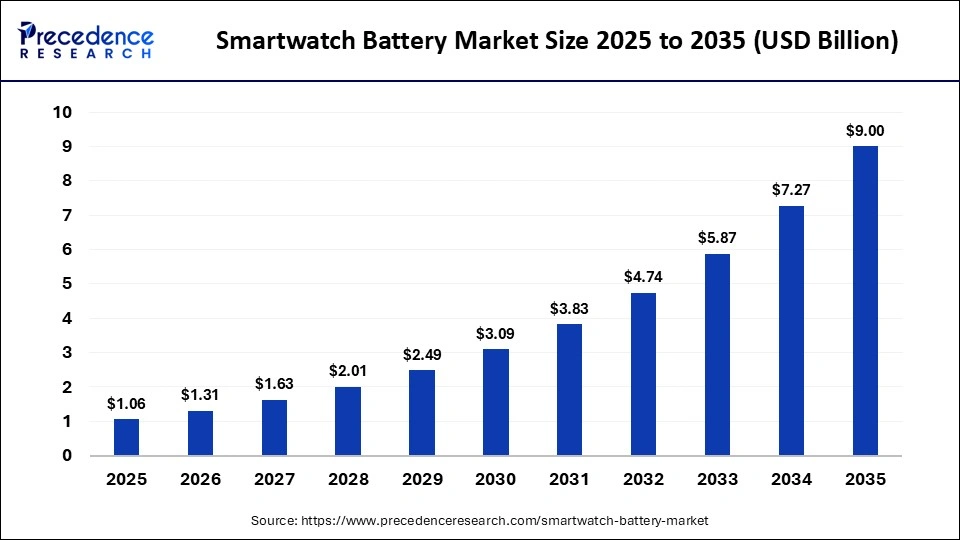
The global smartwatch battery market size was calculated at USD 1.06 billion in 2025 and is predicted to increase from USD 1.31 billion in 2026 to approximately USD 9.00 billion by 2035, expanding at a CAGR of 23.85% from 2026 to 2035. The market is expanding with the rising adoption of feature-rich wearables requiring compact, high-energy-density power solutions. Demand for longer battery life, fast charging, and efficient power management is driving lithium-ion and lithium-polymer innovations. However, miniaturization challenges, thermal management issues, lifecycle limitations, and sustainability concerns continue to shape product development strategies.
Key Takeaways
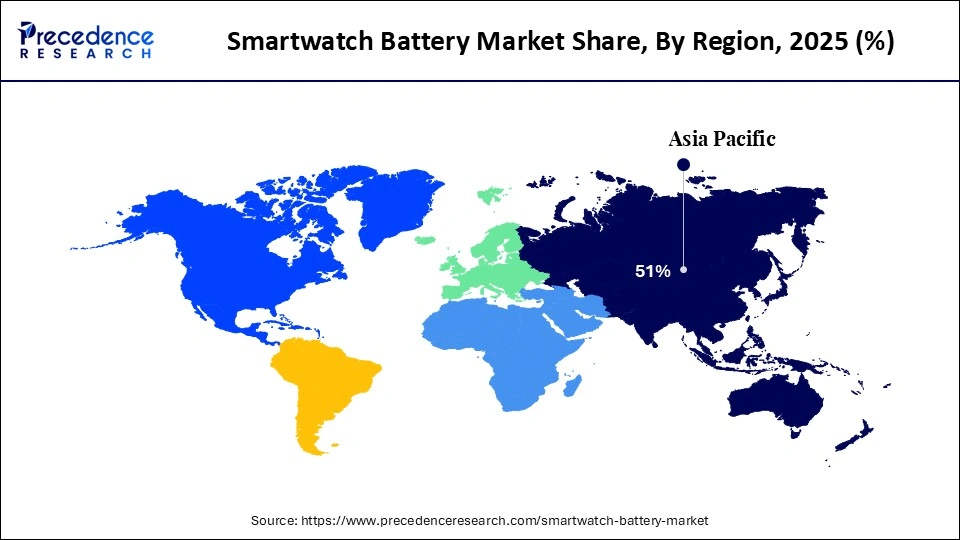
- Asia-Pacific led the smartwatch battery market with the largest share of 51% in 2025.
- North America is expected to expand at the highest CAGR in the market between 2026 and 2035.
- By rated voltage, the 3.7V segment held a dominant revenue share of 68% in the market in 2025.
- By rated voltage, the 4.2V segment is expected to grow at a notable CAGR between 2026 and 2035.
- By application, the iOS system smartwatch segment led the market in 2025.
- By application, the Android system smartwatch segment is expected to expand at the fastest CAGR from 2026 to 2035.
Why is the Smartwatch Battery Market Gaining Strategic Importance?
A smartwatch battery is a compact, rechargeable power unit typically based on lithium-ion or lithium-polymer chemistry designed to deliver stable energy within the limited space of a wearable device. It supports core functions such as health tracking sensors, Bluetooth connectivity, GPS, display operations, and app performance while maintaining safety and thermal efficiency.
The smartwatch battery industry is gaining strategic importance as battery life directly influences user experience, brand differentiation, and product competitiveness. With smartwatches integrating advanced health monitoring, AI-based features, and always-on displays, manufacturers are prioritizing high energy density, fast charging, and longer lifecycle performance. Battery innovation has become a critical enabler for slimmer designs, multifunctionality, and sustainable wearable development, positioning it as a core component in the evolving wearable technology ecosystem.
How Can AI Integration Transform the Smartwatch Battery Market?
AI integration is increasingly being used to optimize smartwatch battery performance through real-time power management and adaptive usage patterns. Companies are increasingly embedding on-device AI that analyzes sensor and app use to predict and reduce unnecessary processing, helping extend operational life without sacrificing functionality. Additionally, AI-driven updates in platforms like Wear OS tailor features based on individual behavior, balancing performance and energy draw for smarter, context-aware battery use.
Primary Trends Influencing the Smartwatch Battery Market
- Enhanced Battery Life and Energy-Dense Cells: Manufacturers are focusing on improving battery energy density and efficiency to meet consumer demands for longer usage between charges. This includes advancements in lithium-ion and emerging solid-state chemistries that can store more energy in compact form factors. Longer battery life enhances user experience, especially for health tracking and always-on features, making wearables more practical in daily life.
- Fast and Convenient Charging Solutions: Fast-charging and wireless charging technologies are becoming key differentiators in smartwatch designs. Users increasingly expect quick power-ups with minimal downtime, prompting brands to integrate rapid charging protocols and optimized power delivery systems. Efficient charging not only improves convenience but also supports deeper integration of power-intensive features without sacrificing usable battery life.
- Sustainable and Eco-Friendly Battery Focus: The smartwatch battery market is witnessing a strong shift toward sustainability, driven by regulatory pressures and consumer preference for eco-friendly products. Manufacturers are exploring recyclable materials, greener production methods, and strategies to reduce environmental impact. Sustainable battery innovation enhances brand value and aligns with global efforts to reduce electronic waste and resource consumption.
- Support for Advanced Smart Features: As smartwatches incorporate more sensors (health, GPS, connectivity), batteries need to support increased power demands without degrading performance. This trend pushes the development of higher-capacity and intelligent power-management systems that can maintain battery life even as features expand. Efficient energy solutions thus enable richer functionality while preserving daily usability.
- Emerging Solid-State and Next-Gen Technologies: Next-generation battery innovations, particularly solid-state and oxide-based cells, are poised to transform the smartwatch battery landscape. These technologies offer higher safety, greater energy density, and reduced size compared to traditional lithium-ion. The shift could significantly extend device autonomy and reliability, shaping future wearable capabilities and design possibilities.
Market Scope
| Report Coverage | Details |
| Market Size in 2025 | USD 1.06 Billion |
| Market Size in 2026 | USD 1.31 Billion |
| Market Size by 2035 | USD 9.00 Billion |
| Market Growth Rate from 2026 to 2035 | CAGR of 23.85% |
| Dominating Region | Asia Pacific |
| Fastest Growing Region | North America, |
| Base Year | 2025 |
| Forecast Period | 2026 to 2035 |
| Segments Covered | Rated Voltage, Application, and region |
| Regions Covered | North America, Europe, Asia-Pacific, Latin America, and Middle East & Africa |
Segment Insights
Rated Voltage Insights
Why Was the 3.7V Segment Dominant in the Smartwatch Battery Market?
The 3.7V segment held the largest revenue share of the market in 2025, due to its optimal balance between energy density, compact size, and compatibility with lithium-ion and lithium-polymer chemistries. It aligns efficiently with standard wearable power management systems, ensuring stable performance for sensors, displays, and connectivity features. Additionally, widespread industry standardization, cost-effectiveness, and proven safety profiles make 3.7 V batteries the preferred choice for most smartwatch manufacturers.
The 4.2V segment is expected to show lucrative growth in the market during the studied years, due to its higher voltage potential, enabling greater energy storage within similar form factors. This supports more power-intensive features like always-on displays, advanced health sensors, and continuous connectivity. Improved battery management systems and safer cell chemistries also enhance reliability, making 4.2V designs attractive for premium and next-generation wearable devices.
Application Insights
Which Application Segment Dominated the Smartwatch Battery Market?
The iOS system smartwatch segment contributed the biggest market share of the market in 2025 due to strong ecosystem integration, premium device positioning, and high consumer loyalty. Seamless synchronization between iPhones and smartwatches increases device usage frequency, driving demand for reliable, high-performance batteries. Additionally, advanced features such as continuous health monitoring, always-on retina displays, and robust app ecosystems require optimized battery solutions, encouraging large-scale procurement and technological advancements in compact, energy-dense battery systems.
The Android system smartwatch segment is expected to expand rapidly in the market in the coming years, due to broad device availability, diverse price tiers, and strong support from multiple manufacturers. Wide compatibility with various Android smartphones and rapidly improving Wear OS features drive adoption. Additionally, innovation in battery optimization and power management for Android wearables enhances user experience, encouraging expansion into emerging markets and increasing demand for efficient, long-lasting smartwatch batteries.
Regional Insights
Asia Pacific Smartwatch Battery Market Size and Growth 2026 to 2035
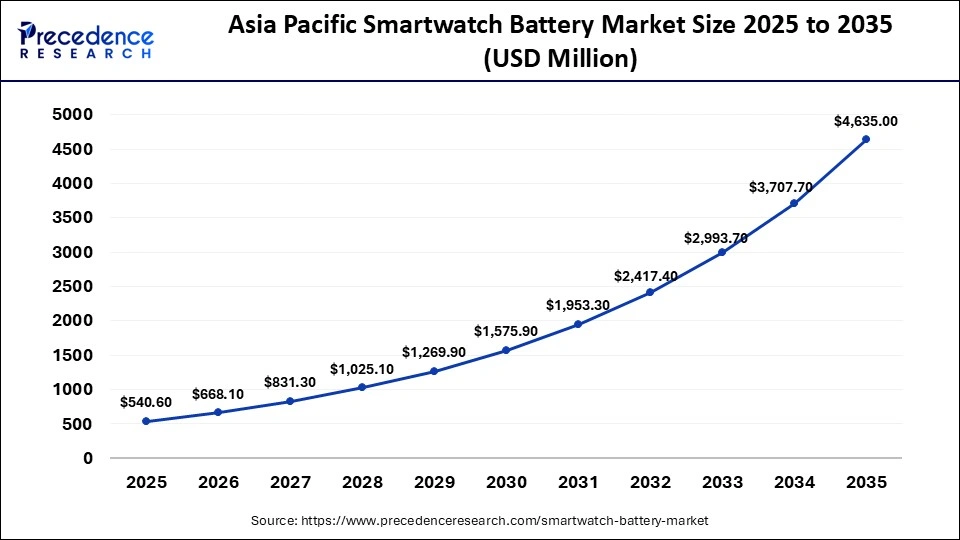
The Asia Pacific smartwatch battery market size is expected to be worth USD 4,635.00 billion by 2035, increasing from USD 540.60 billion by 2025, growing at a CAGR of 23.97% from 2026 to 2035.
Why Asia-Pacific Dominated the Smartwatch Battery Market?
Asia-Pacific held a major revenue share of the market in 2025 due to its strong electronics manufacturing ecosystem, cost-efficient production capabilities, and presence of leading battery and wearable device manufacturers. Countries like China, South Korea, and Japan host advanced lithium-ion cell production facilities and well-established supply chains. Rising consumer adoption of smart wearables, expanding middle-class populations, and growing health awareness further accelerate demand, positioning the region as both a major production hub and high-consumption market.
China Market Trends
China dominates the Asia-Pacific market due to its vertically integrated lithium-ion supply chain, large-scale cell manufacturing capacity, and strong presence of wearable device OEMs. The country benefits from advanced battery technology development, cost-efficient labor, and government support for energy storage innovation. Additionally, rising domestic demand for affordable smartwatches and rapid expansion of electronics exports strengthen China's position as both a leading producer and high-volume consumer in the regional market.
Why Is North America Experiencing the Fastest Growth in the Smartwatch Battery Market?
North America is expected to experience the fastest growth over the forecast period, driven by strong consumer demand for premium, feature-rich wearables. High adoption of health-monitoring technologies, increased use of AI-enabled smartwatches, and rapid advances in battery optimization are accelerating market expansion. Additionally, the presence of major smartwatch manufacturers, advanced R&D infrastructure, and a rising focus on fitness and digital health solutions further support sustained regional growth.
U.S. Market Trends
The U.S. drives trends in the smartwatch battery industry through high consumer demand for advanced wearables, a strong focus on innovation, and the presence of leading technology companies. Widespread adoption of health and fitness tracking accelerates the need for long-lasting, efficient batteries. Continuous R&D in AI-based power management, partnerships between tech firms and battery innovators, and emphasis on premium user experiences further reinforce the U.S. as a trendsetter in smartwatch battery performance and design.
How Big is the Opportunity for the Smartwatch Battery Market Growth in Europe?
Europe is expected to grow at a notable CAGR in the foreseeable future, due to rising health consciousness, increasing adoption of fitness wearables, and strong demand for premium electronic devices. Strict environmental regulations are encouraging innovation in sustainable and recyclable battery technologies. Additionally, the presence of established automotive and battery research industries supports advancements in energy storage solutions, while expanding digital health initiatives across countries further stimulate demand for high-performance smartwatch batteries.
UK Market Trends
The growing consumer preference for high-tech products, increasing disposable incomes, and rapid innovations in smartwatch battery systems propel the market. People prefer long-lasting and more efficient batteries at an affordable cost. The UK government is also at the forefront of regulating reliable and safe products for citizens.
- In October 2024, the UK NHS announced plans to distribute millions of smartdevices, including smartwatches, to patients to help them monitor their own health independently.
Smartwatch Battery Market Value Chain Analysis
- Raw Material Sourcing (Metals, Electronics)
This stage involves the procurement of lithium, cobalt, nickel, graphite, and electronic materials essential for battery production. Ethical sourcing, price volatility management, and long-term supply agreements are critical considerations.
Key Players: Albemarle, Glencore, Sumitomo Metal Mining
- Component Fabrication and Machining
Raw materials are processed into battery cells, electrodes, separators, and compact casings using precision manufacturing technologies to meet smartwatch miniaturization, energy density, and thermal safety requirements.
Key Players: LG Energy Solution, Panasonic Energy, EVE Energy
- Testing and Certification
Battery units undergo electrical, thermal, lifecycle, and safety validation to comply with international wearable device standards, ensuring reliability, transport safety, and regulatory approval before commercialization.
Key Players: TÜV SÜD, Intertek, and UL Solutions, among others
- Installation and Commissioning
Battery modules are integrated into smartwatch assemblies, configured with battery management systems, calibrated for software optimization, and tested for performance compatibility with sensors and connectivity functions.
Key Players: Apple Inc., Samsung Electronics, and Garmin, among others.
- Distribution and Sales
Completed smartwatch batteries and devices are distributed through global logistics networks, electronic component distributors, retail chains, and e-commerce platforms to reach consumer and enterprise markets.
Key Players: Arrow Electronics, Avnet, and Amazon, among others
- Maintenance and After-Sales Service
Post-sale services include diagnostics, battery replacements, warranty handling, and performance monitoring to extend product lifespan and maintain customer satisfaction across global service networks.
Key Players: Best Buy, Apple Authorized Service Providers, and Samsung Service Center, among others
- Product Lifecycle Management
End-of-life management focuses on battery recycling, material recovery, regulatory compliance, and sustainability reporting to minimize environmental impact and support circular economy initiatives.
Key Players: Call2Recycle, Battery Recycling Association, and Umicore amomg others
Smartwatch Battery Market Companies
- LG Energy Solution
- 4. Contemporary Amperex Technology Co., Limited
- 5. EVE Energy
- BYD Company Limited
- Sony Group Corporation
- Panasonic Energy
- Samsung SDI
- Murata Manufacturing Co., Ltd.
- TDK Corporation
- Amperex Technology Limited
- VARTA AG
- Maxell, Ltd.
- Toshiba Corporation
- Sunwoda Electronic Co., Ltd.
- Desay Battery
- Shenzhen Grepow Battery Co., Ltd.
- Shenzhen BAK Power Battery Co., Ltd.
- Guoxuan High-Tech Co., Ltd.
- Enovix Corporation
- BrightVolt
Recent Developments
- In February 2026, Meta Platforms confirmed plans to introduce an AI-enabled smartwatch. Reports suggest the device will integrate advanced health tracking and AI features, requiring optimized battery architecture. The announcement signals strategic investments in energy-dense cells and intelligent power management to support AI-driven wearable functionalities.(Source: https://www.croma.com)
- In January 2026, Motorola introduced its new Moto Watch featuring extended battery performance of up to 13 days on a single charge. The model integrates optimized power management software to support continuous health monitoring and Bluetooth connectivity. The launch highlights growing industry focus on multi-day battery endurance combined with efficient chipset and display optimization technologies.(Source: https://motorolanews.com)
- In May 2025, Itel introduced the Alpha Pro 2 smartwatch in India with claimed battery life up to 15 days. The model emphasizes cost-efficient battery capacity combined with essential health and fitness functions. This launch reflects growing competition in entry-level segments, prioritizing extended battery backup at affordable pricing structures.(Source: https://www.india.com)
Segments Covered in the Report
By Rated Voltage
- 3.7V
- 4.2V
- Others
By Application
- iOS System Smartwatch
- Android System Smartwatch
By Region
- North America
- Europe
- Asia-Pacific
- Latin America
- Middle East & Africa
For inquiries regarding discounts, bulk purchases, or customization requests, please contact us at sales@precedenceresearch.com
Frequently Asked Questions





Ask For Sample
No cookie-cutter, only authentic analysis – take the 1st step to become a Precedence Research client
 Get a Sample




 sales@precedenceresearch.com
 Schedule a Meeting
