



Solar Power Market Size, Electricity Generation, Capacity Utilization, Export & Import Analysis, Cost Structure, and Industry Outlook
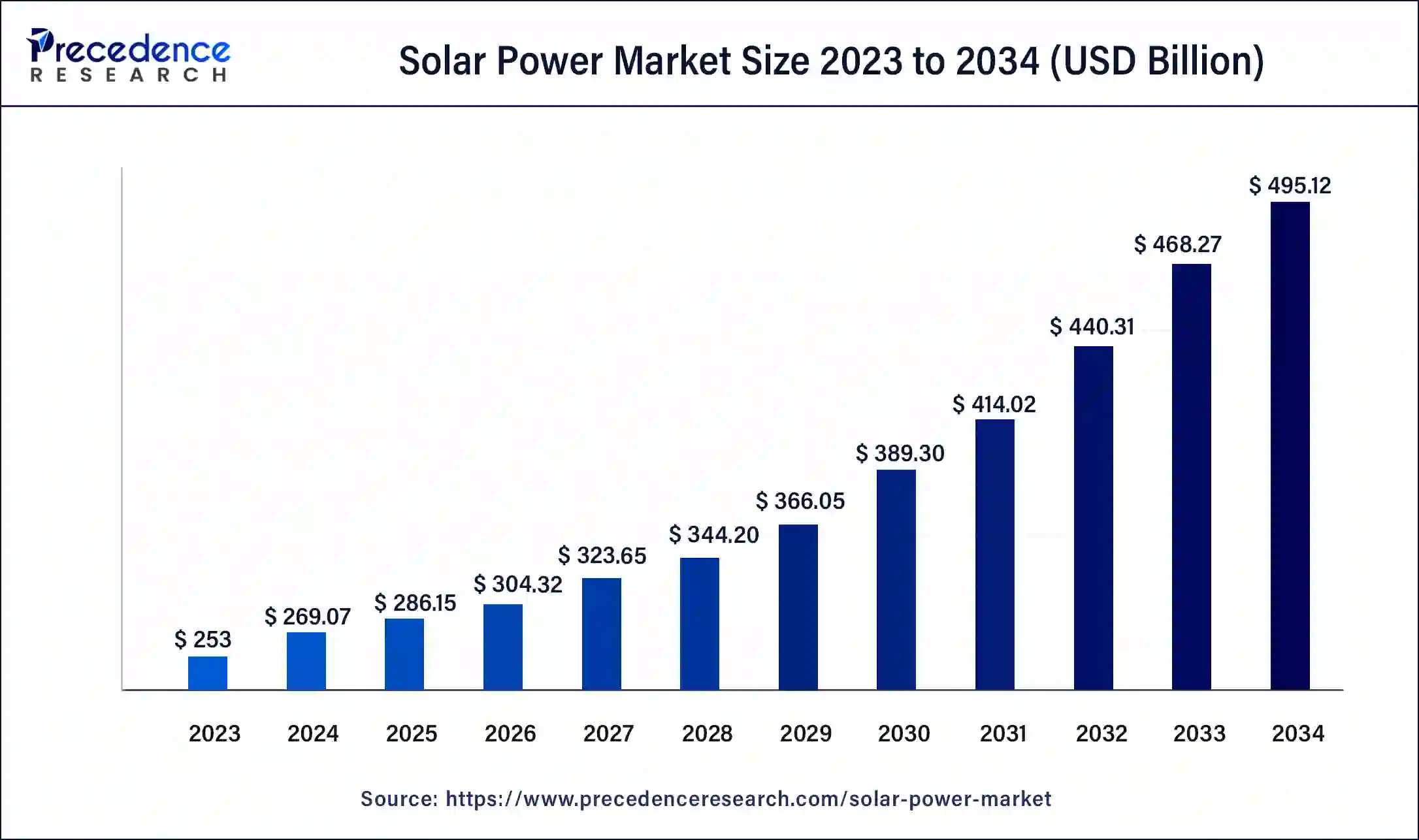
The global solar power market is projected to grow from USD 286.15 billion in 2025 to USD 522.71 billion by 2035, registering a CAGR of 6.21%. Growth is driven by increasing government incentives and tax rebates for solar installations, rising investments in renewable energy infrastructure, expanding deployment of photovoltaic (PV) systems, growing demand for clean and sustainable electricity generation, declining solar panel costs, and advancements in energy storage and grid integration technologies.
Source: https://www.precedenceresearch.com/solar-power-market
 Get a Sample
 Table Of Content


What is the Solar Power Market Size?
The global solar power market size accounted for USD 286.15 billion in 2025, and is anticipated to hit USD 304.32 billion by 2026, and is predicted to reach around USD 522.71 billion by 2035, growing at a CAGR of 6.21% from 2026 to 2035. The solar power market is driven by rising adoption of renewable energy sources and encouraging government policies.
Key Takeaways
- By Region, Asia Pacific held a majority revenue share of the solar power market in 2025.
- By Region, North America is expected to grow at the fastest CAGR in the market during the forecast period.
- By application, the industrial segment held a dominant position in the market with a share of 35% in 2025.
- By application, the residential segment is expected to grow at the fastest CAGR in the market between 2026 and 2035.
- By technology, the photovoltaic systems segment accounted for a considerable revenue share of 70% in the market in 2025.
- By technology, the concentrated solar power systems segment is expected to grow with the highest CAGR in the market during the studied years.
- By end use, the electricity generation segment led the global market with a share in 2025.
- By end use, the charging segment is expected to expand rapidly in the market with a CAGR in the coming years.
- By solar module, the monocrystalline segment registered its dominance over the global market with a share in 2025.
- By solar module, the cadmium telluride segment is expected to witness the fastest growth in the market with a CAGR over the forecast period.
Spotting Potentiality in the Solar Power Overview space
Solar energy is the radiant energy emitted from the sun, which is exercised by using numerous technologies similar as photovoltaic cells, solar heating, and others. It's an effective form of unconventional energy and an accessible renewable solution toward growing greenhouse emigrations and global warming. The growth of the solar energy market is majorly driven by rise governmental provision of impulses & duty rebates to install solar panels and environmental pollution. In addition, drop in footprint of water is associated with solar energy systems has propelled their demand in power generation sectors. The solar cells demand has gained huge traction due to rise in rooftop installations, which is further followed by rise in operations in the sector of architecture. Likewise, the demand for solar power halls and parabolic troughs in the generation of electricity is anticipated to propel the concentrated solar power systems demand in the market. One of the prominent factors contributing towards the growth of the global solar power market is the growing prices of fossil fuels. The growing environmental concerns regarding greenhouse gases and carbon emissions. In addition, the growing government initiatives and favorable policies in order to curb the adverse effects of the toxic gases emissions is driving the growth of the global solar power market during the forecast period.
Key AI Integration in the Solar Power Market
The energy sector is transformed by AI tools such as energy prediction, predictive maintenance, efficiency, and much more. Data from AI and analytics feeds in real-time weather, shading, and equipment health information to optimise the performance of panels. Machine learning algorithms are used by utilities to optimize electricity generation and consumption and maximize the use of renewable energy. Moreover, AI can be utilized in automated fault detection, further enhancing maintenance cost and downtime reduction.
Solar Power Market Growth Factors
The solar energy market growth is driven by rise provision of government incentives and tax rebates in order to install solar panels and growing environmental pollution. Furthermore, decrease in footprint of water associated with systems of solar energy has driven their demand in the sectors of power generation. The solar cells demand has gained huge traction due to rise in rooftop installations, which is further followed by rise in architectural sector applications. In addition, the demand for solar power towers and parabolic troughs in the generation of electricity is expected to propel the demand for concentrated solar power systems.
Solar Power Market Trends
- Extension of Utility-Scale Solar Projects: Solar PV ULS introduction: Australia's most significant developments of large PVs are upstreaming soon as they seek to increase their renewable energy generation, reduce their energy dependency, and reach their national decarbonisation targets.
- Increasing Number of Rooftop Solar Systems: As consumers of residential, commercial, and industrial use are expected to reduce their electricity bill, electricity dependence on the grid, and carbon footprint, rooftop solar power is becoming a popular choice among them.
- Energy Storage Technologies Integration: Energy Storage Technologies (EST) seem to be an important solution to the problems faced by the grid, such as grid power stabilization, intermittent solar energy utilization, and grid power security.
- Enhanced Solar Plant Performance through AI: Predictive maintenance, real-time data monitoring, and optimized plant IPs are contributing to better performance for solar plants implemented using AI, IoT, and Cloud Monitoring Platforms.
- Development of High-Efficiency Solar Modules: In an effort towards achieving high efficiency and low cost, the manufacturers have introduced new High-efficiency PV modules like TOPCon, HJT, and bifacial panels.
Market Outlook
- Start-up Ecosystem: The start-up growth in the solar power industry is accelerating due to the heavy demand for renewable energy installation and technology. The need for technological specialisation, grid integration, and intensified market knowledge is elevating the growth of the startup.
- Industry Growth Overview: Industry growth is witnessing heavy growth due to technological and sustainable shifts in the lives of individuals and the industry landscape. The offices, residential, and other huge industries' demand for solar power panels/energy is rising, and so is the industrial growth.
Market Scope
| Report Coverage | Details |
| Market Size in 2025 | USD 286.15 Billion |
| Market Size in 2026 | USD 304.32 Billion |
| Market Size by 2035 | USD 522.71 Billion |
| Growth Rate from 2026 to 2035 | CAGR of 6.21% |
| Largest Market | Asia Pacific |
| Base Year | 2025 |
| Forecast Period | 2026 to 2035 |
| Segments Covered | Technology, Application, End User, Solar Module and Region |
| Regions Covered | North America, Europe, Asia-Pacific, Latin America, and Middle East & Africa |
Market Dynamics
Driver
Rising Adoption of Renewable Energy and Government Incentives
The solar power market is driven by the worldwide demand for clean energy and government policies that are more favourable to the production of clean energy from renewables. The financial support for Solar Energy includes financial instruments, tax credits, feed-in tariffs, and targets for renewables. The falling cost of a PV module makes it an attractive solution for residential, commercial, and utility-scale applications. The world is converting to solar energy and educating the public about carbon emissions as a result of global climate change and carbon emissions.
Restraint
Intermittent Power Generation and High Initial Investment
Complementary energy storage or backup energy generation systems are needed for intermittent electricity generation. A few residential and small commercial consumers are still deterred by high upfront installation costs. Development of projects is also limited in areas due to limited land and limited grid connection. With the benefits of solar energy only coming through in the long run, these factors can hinder uptake.
Opportunity
Expansion of Energy Storage and Smart Grid Technologies
With investments in smart grid technology, the solar power market has plenty of opportunities. AI energy systems fine-tune energy source generation and storage, while minimizing energy losses. The markets anticipated to support access to electricity and energy security are highly pro-decentralised solar systems. Highly efficient solar panels are continuing to grow and expand, and the integration of multiple renewable energy technologies is continuously improving.
Segment Insights
Technology Insights
The Photovoltaic (PV) systems segment dominated the global solar power market, garnering a market share of around 70% in 2025. Photovoltaic systems can differ greatly in terms of size from portable systems or small rooftop to utility-scale generation plants massive in nature which is attributing to high market demand of photovoltaic system.
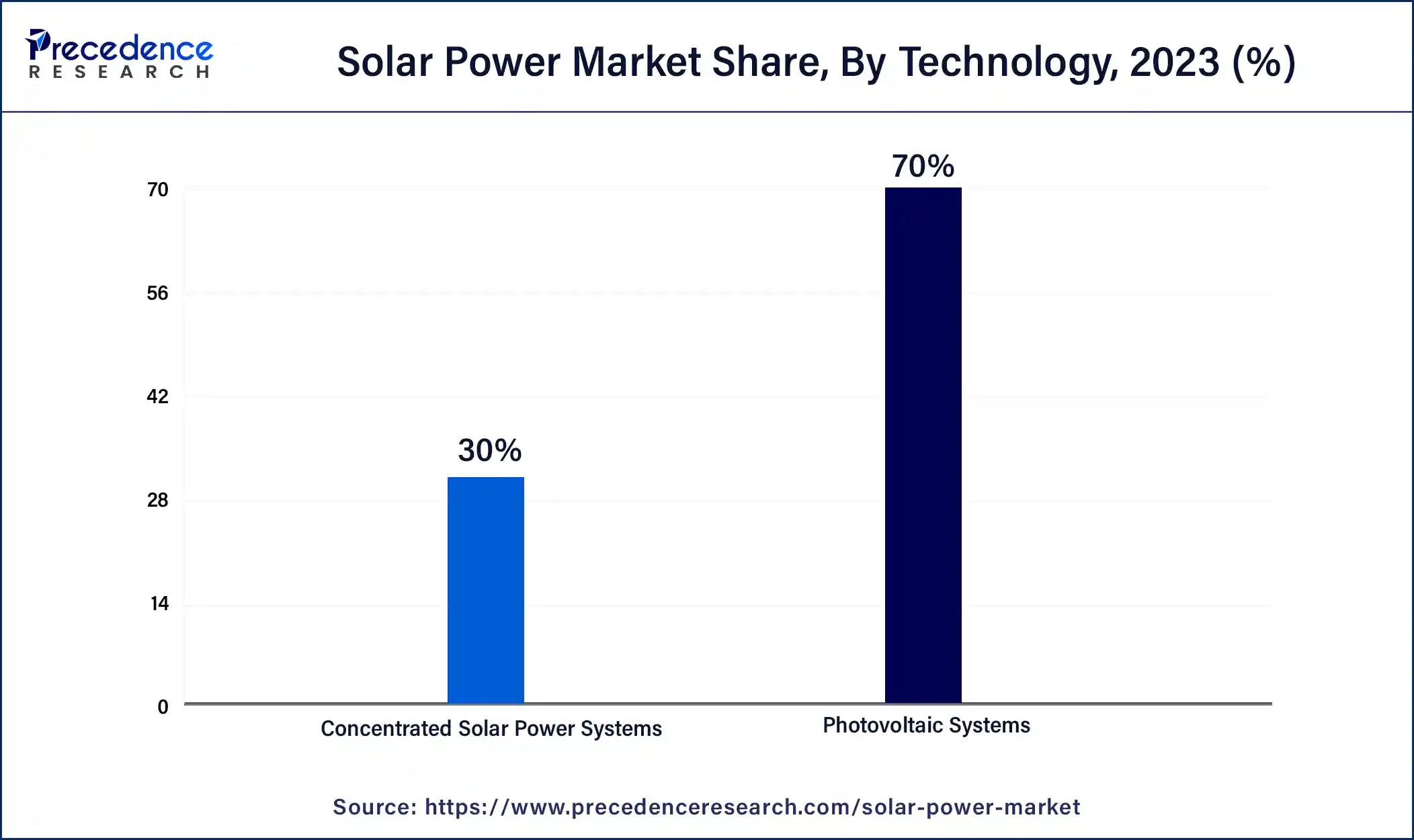
On the other hand, the concentrated solar power systems segment is estimated to be the most opportunistic segment during the forecast period. The growing requirement of solar energy is huge amount is making this segment the fastest growing in the solar power market.
Application Insights
The residential segment is expected to witness strong growth during the forecast period, driven by demand for rooftop solar installation by homeowners to reduce electricity costs. Government incentives and net-metering for residential installations. The surge of interest in clean energy is helping to expand uptake globally. As solar panel efficiencies are improved, homeowners want more of them. Household market growth is driven by rising desires for household energy independence.
The commercial segment is projected to grow at a notable pace as it enables the reduction of operating energy costs and the promotion of sustainability. Solar power at company sites and office roofs can be a way to achieve ESG goals. Solar financing facilitates business adaptation towards solar energy. The higher the electricity price, the more advantageous solar systems will be. Its segment is projected to continue to grow as companies increase their investments in renewables.
End Use Insights
How the Electricity Generation Segment Dominated the Solar Power Market?
The electricity generation segment dominated the market in 2025, as more utility-scale solar power plants became installed around the world. The government invests in renewable energy infrastructure to reduce carbon emissions. Bringing down the cost of PV modules makes it economic. Modernisation of the grid to accommodate renewables. The growing demand for electricity in turn fuels the dominance of segments such as:
The charging segment is expected to grow steadily during the forecast period as the number of charging station infrastructure powered by solar energy continues to increase. The expansion of EV use is driving up the need for renewable charging. Spaces for charging (sustainable charging networks) are being put in place for companies and local authorities. Improved integration for more reliable charging of batteries. Clean mobility schemes, private and public, follow the market growth.
The lighting segment is projected to grow at a healthy pace, with energy-efficient light fittings used in smart home and public infrastructure solutions powered by solar energy. Increased rural electrification applications are driving the uptake of the products. The government supports solar street lights as a solution in energy conservation. LED technology has greatly improved and provides highly efficient lighting as an advantage. The movement for sustainability takes a step forward with 'Sustainability'.
The heating segment is expected to experience considerable growth during the forecast period, due to the growing demand for the introduction of solar water heating and Industrial heating systems. Higher energy prices make renewable energy solutions for heating even more attractive to consumers. Commercial building markets invest in solar thermal. The government offers incentives for clean heating. The technology is rapidly progressing to further enhance the efficiency and reliability of the system.
Solar Module Insights
Which Monocrystalline Segment Led the Solar Power Market?
The monocrystalline segment dominated the market in 2025. The high conversion efficiency and excellent long-life performance. These panels are installed with less area compared to traditional panels. Technology has been continuously improved, which helped to reduce the cost of production. Studies in all markets were led, and demand was still high and ongoing, including residential, commercial, and utility-scale studies.
The cadmium telluride segment is expected to witness notable growth due to the thin-film technology and efficient capabilities at high temperatures. In larger-scale projects, CdTe modules are gaining popularity among utility-scale developers. Manufacturing costs do not yet reach those of other traditional techniques. New technology is continually developing that allows for the most efficient conversion. The continued investments already made in renewable energy will continue to support demand in the future.
The polycrystalline segment is expected to grow steadily, due to the low cost and availability of these in developing markets. These modules guarantee that they will be used in both households and offices. Those that are price sensitive are still transitioning to polycrystalline. Improving the efficiency of the products by improving their manufacturing. As the solar market penetrates more and more, the trend of installations getting bigger and bigger is key. Solar market size growth maintains and fuels.
The amorphous silicon cells segment is projected to witness stable growth during the forecast period due to flexible amorphous silicon and its suitability for lightweight applications. Well-suited for use in low-light-level applications. Increasingly used in portable electronics and photovoltaics built into walls. Collaboration with continuous innovation for durability and effectiveness of these. A sustaining contribution to the market demand is niche applications.
Regional Insights
Asia Pacific Solar Power Market Size and Growth 2026 to 2035
The Asia Pacific solar power market size was exhibited at USD 103.01 billion in 2025 and is expected to be worth around USD 178.24 billion by 2035, at a CAGR of 5.64% from 2026 to 2035
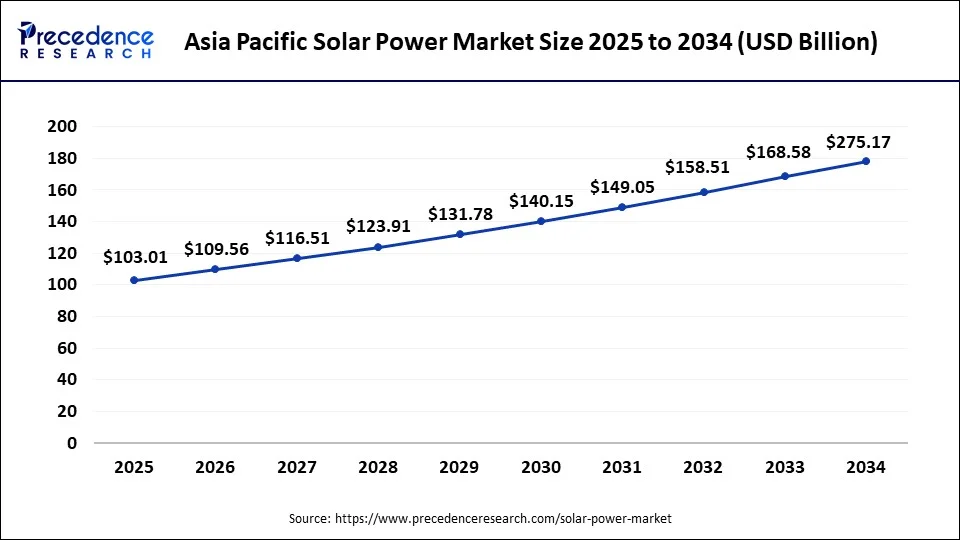
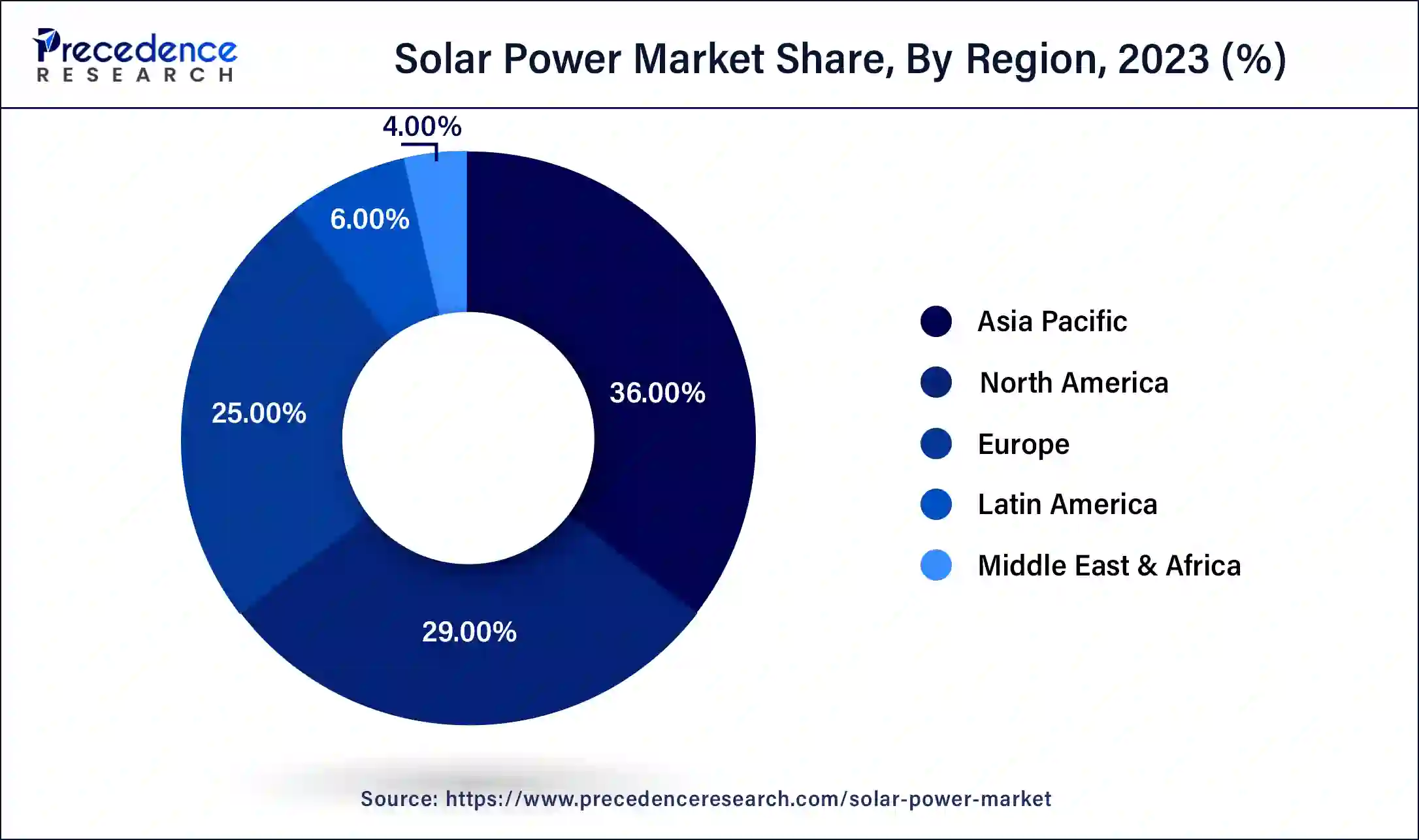
Asia Pacific was the leading solar power market that garnered a market share of more than 36% in 2025. Asia Pacific is the home to more than half of the global population which provides a huge consumer base. Furthermore, China, Japan, South Korea, and India are the top countries among the highly utilizing solar power countries. The rapid urbanization, rising disposable income, busy and hectic lifestyle, the rising penetration of the internet, and the increasing adoption of the smartphones are some of the significant macroeconomic factors that drives the growth of the solar power market in Asia Pacific. Moreover, the presence of huge youth population and the rising demand for renewable energy and sustainable development again fostering the market growth. The countries like China and India are showing promising growth opportunities for the market players owing to the strong economic growth in the region.
Why Is China Leading the Global Solar Power Market?
China is a major contributor to the solar power market. The strong government support for solar panel factories through various policies like land grants, subsidies, and low-interest loans helps the market growth. The growing investments in solar manufacturing capacity and higher production of solar panels drive the market growth. The growing production of various solar panel components like ingots, cells, polysilicon, modules, and wafers, and the growing export of solar panels support the growth of the market.
Why Is India Emerging as a High-Growth Solar Power Market?
India is growing in the solar power market. The strong government support for renewable energy through various policies helps in the market growth. The decreasing cost of solar panels and growing demand for energy increase the adoption of solar power. The presence of abundant solar resources increases demand for solar power. The growing foreign investment in solar power projects drives the market growth.
- In June 2025, Maruti Suzuki is to invest Rs 925 crore in solar power. The company aims to increase solar power capacity to 319 MWp and enhance the use of renewable energy.
- For instance, the initiative, like the Pradhan Mantri Suryodaya Yojana scheme, provides rooftop solar installations to 10 million households.
Why Is North America Emerging as a High-Growth Solar Power Market?
North America is estimated to grow at a considerable pace during the forecast period. U.S. is the prominent country with major share of solar power consumption in the region. In addition, increasing buying power, improved access to the digital technologies, higher penetration of internet, and increased adoption of the smart devices are some of the major factors that has propelled the growth of the North America solar power market.
U.S. Market Trends
U.S. market is anticipated to grow significantly, with a rise in investments in the infrastructure of renewable energy. Electricity demand is slowly increasing, and this is accelerating the uptake of rooftop solar and upscaled solar. Developments in technology are improving the efficiency of photovoltaics and its cost. Business renewable energy procurement is helping to drive the scale of project development. The more energy stored, the more reliable the grid will be. With favourable government policies long growth in the market can be expected.
What Latin America's Advancements are Fuelling Growth in the Solar Power Industry?
Latin America's advancement is visible in the growth volume of the market, with the 100 GW potential installed in the region's suitable areas, and due to demand. Learning the transition in the distributed generation, speedy capacity extension, and revolutionary storage unification, the advancement can be seen in Brazil, Chile, Colombia, and Mexico.
Mexico retains its 3rd position in the industry with around 7 GW solar, alongside Colombia freshly installed 4.4 GW solar capacity in fundamental energy auctions. Last year, Colombia also introduced its 144 MW project in Monteria.
Brazil Market Trends
Key players are actively involved in various projects all across the region. The market landscape is characterized by a mix of local and international companies, which helps in fostering innovation and boosting collaboration. As the region continues to invest in renewable energy, the CSP market is expected to grow steadily in the upcoming years.
Initiatives of Europe in the Solar Power sector
Europe's initiatives in this sector are determined and sharpened by the REPowerEU plan and the EU Solar Energy Strategy. This strategy was introduced in 2022 and contributed a lot to solar power. This popular initiative is a commendable regional move as it discards reliance on Russian fossil fuels. Solar is positioned as a popular energy source in the EU, proving this since last year.
The European Solar Rooftops Initiative is a mandate body for solar installations, mainly on buildings. From this year, the commercial and local buildings above 250m2 should have panel installation or be solar-ready. This initiative is an awareness call and responsible behaviour towards the use of natural resources and reducing electricity use.
Germany Market Trends
Germany's ambitious renewable energy targets and government investment. The focus is on a high-growth period with investments in rooftop as well as utility-scale solar projects. With continued rises in bills, solar power is now starting to make sense for both homes and businesses. Enhancing system performance through the development of solar modules with high efficiency. The energy transition policy continues to make substantial contributions towards the energy transition in the country.
How is the Middle East and Africa Region Growing in the Solar Power Market?
The Middle East and Africa region is poised for significant growth in the market, driven by abundant solar resources and increasing energy needs. Government initiatives and investments in renewable energy infrastructure are also helping in driving the development of CSP projects, making this region a promising frontier for solar energy. Countries such as the UAE, Morocco, and South Africa are leading players.
The UAE Market Trends
The country is seen to be investing heavily in solar projects in order to diversify its energy portfolio. The market landscape includes both local and international players, with several well-established companies contributing to the market.
Government Initiatives
- In May 2026, the Ministry of New and Renewable Energy (MNRE) released a list of projects for giving relief under the ALMM List-II for solar projects, along with a thrust to promote solar manufacturing from within the country. The idea is to continuously deploy renewable energies and to free up individual production of PV modules. (Source: https://www.pib.gov.in)
- In March 2026, the Government of India is witnessing remarkable growth in rooftop solar installations in the country, which was showcased in the report on PM Surya Ghar: Muft Bijli Yojana. It promotes adoption of clean energy for households and also promotes India's RE and energy security agenda. (Source: https://www.pib.gov.in)
- In February 2024, the Union Cabinet approved PM Surya Ghar: Muft Bijli Yojana for providing financial assistance for the installation of rooftop solar systems for one crore households. The programme aims at reducing electricity consumption by consumers and increasing renewable energy generation in India. (Source: https://www.pmindia.gov.in)
Solar Power Market-Value Chain Analysis
- Power Generation: Power generation involves sunlight absorption, electron flow, inversion, and various types of materials for PV generation. Apart from this, the Concentrated Solar Power (CSP) focuses on lenses or mirrors, heat generation, and electricity generation as well.
Key Players – NTPC Green Energy, Tata Power, Jinko Solar, First Solar. - Distribution Network Management (DNM): The DNM for solar power includes refinement of grids to manage diversified solar input, voltage changes, and adding on the distributed solar generation, such as rooftop panels, with the help of modern systems like ADMS and SCADA to look into other major operations.
Key Players – Hitachi Energy, ABB Ltd, Itron Inc., GE Vernova, and Schneider Electric. - Grid Maintenance and Monitoring: To check the functionality of the real-time monitoring of physical system health and energy output, the stability evaluation is important. With the help of digital tools, the expensive failures can be dodged.
Key Players – Waaree Energies, Sterling and Wilson Solar, KPI Green Energy, and Mitarsh Energy.
Competitive Landscape
Solar Power Companies consist of renewable power companies, which focus on renewable technology, and power-generation solution companies. Major companies in the industry include Canadian Solar Inc, Acciona S.A., eSolar Inc, United Renewable Energy Co, Ltd and Abengoa S.A., which are active around the world. The renewable energy sector has been investing heavily in solar cell technology to boost efficiencies and the integration of energy storage systems.
Moreover, market players are expanding through strategic partnerships, project realization, and geographical expansion to meet the expanding demand for clean energy in the worldwide market. Some of the greatest obstacles are disruptions to the supply chain, raw material price fluctuations, connecting to the electrical grid, and adapting to the rules and regulations.
Solar Power Market Companies
- Abengoa Se
- Acciona S.A.
- Canadian solar, Inc.
- Esolar, Inc.
- United renewable energy co. Ltd.
- Sunpower corporation
- Kaneka corporation
- Tata power solar systems ltd.
- Wuxi suntech power co., ltd.
- Brightsource energy, Inc.
Recent Developments
- In June 2025, Egypt launched its first solar power plant in Djibouti. The project aims to strengthen energy cooperation between the two nations and is a collaborative effort between Djibouti's Ministry of Energy and Egypt's Ministry of Electricity & Renewable Energy. The plant is located in Omar Kaji village and aims to support sustainable development. (Source: https://egyptianstreets.com)
- In June 2025, Credence Solar launched a 600 W N-type TOPCon PV panel. The power outputs of the panel range from 580W to 600W and are constructed using 144 half-cut TOPCon cells. The measurement of a solar panel is 2278 mm * 1134mm * 35mm, and its weight is 33.75kg. The module rear side gains up to 10% and front-side efficiency ranging between 22.45% to 23.25%. (Source: https://renewablewatch.in)
- In June 2025, Indonesia launched its largest integrated solar panel factory in Kendal. The factory is located in the Kendal Industrial Park, Central Java. The factory lowers its dependence on imported components and becomes a manufacturing base for high-efficiency solar technology. (Source: https://indonesiabusinesspost.com)
- In 13 January 2022, the key player named Billionaire Gautam Adani's logistics-to-energy conglomerate set up a new subsidiary, named ANIL in order to undertake projects of green hydrogen, manufacture of wind turbines and generation of low carbon electricity, batteries and solar modules as it looks to become the world's largest company of renewable energy and manufacture the very less costly hydrogen.
Segments Covered in the Report
By Application
- Residential
- Commercial
- Industrial
By Technology
- Photovoltaic Systems
- Moni-Si
- Thin Film
- Multi-Si
- Others
- Concentrated Solar Power Systems
- Parabolic trough
- Solar power tower
- Fresnel reflectors
- Dish Stirling
By End Use
- Electricity Generation
- Lighting
- Heating
- Charging
By Solar Module
- Monocrystalline
- Polycrystalline
- Cadmium Telluride
- Amorphous Silicon Cells
- Others
By Geography
- North America
- Latin America
- Europe
- Asia-pacific
- Middle and East Africa
For inquiries regarding discounts, bulk purchases, or customization requests, please contact us at sales@precedenceresearch.com
Frequently Asked Questions
Tags





Ask For Sample
No cookie-cutter, only authentic analysis – take the 1st step to become a Precedence Research client
 Get a Sample




 sales@precedenceresearch.com
 Schedule a Meeting
