



Solar Vehicle Market Size, Key Companies, Company Market Share, Power Generation Capacity, Energy Consumption, Pricing Trends, Investment Analysis, Competitive Positioning, and Demand Forecast
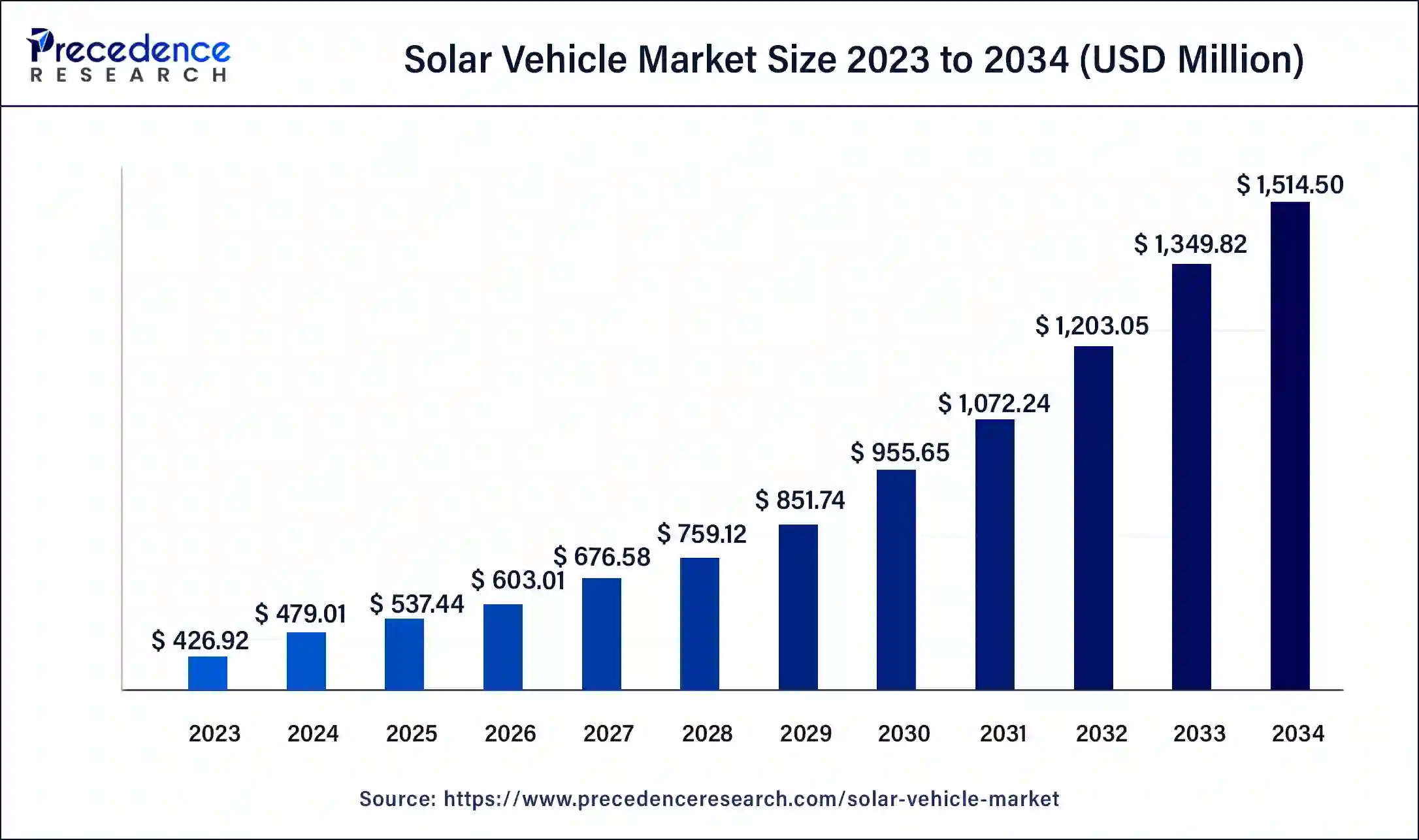
The global solar vehicle market was valued at USD 537.44 billion in 2025 and is projected to reach USD 603.01 billion in 2026, before expanding to approximately USD 1,667.24 million by 2035, registering a CAGR of 11.99% from 2026 to 2035. The market is experiencing steady growth due to rising demand for clean and sustainable transportation, increasing adoption of renewable energy, and continuous advancements in solar photovoltaic technology. Government initiatives supporting zero-emission vehicles, growing environmental awareness, and investments in electric mobility infrastructure are further accelerating market expansion. Innovations in battery technology and solar panel efficiency are also expected to create significant growth opportunities worldwide.
Source: https://www.precedenceresearch.com/solar-vehicle-market
 Get a Sample
 Table Of Content


What is the Solar Vehicle Market Size?
The global solar vehicle market size is accounted at USD 537.44 billion in 2025 and predicted to increase from USD 603.01 billion in 2026 to approximately USD 1,667.24 billion by 2035, representing a CAGR of 11.99% from 2026 to 2035. The market is driven by the increasing use of renewable energy, advancements in solar technology, and the burgeoning automotive industry.
Solar Vehicle Market Key Takeaways
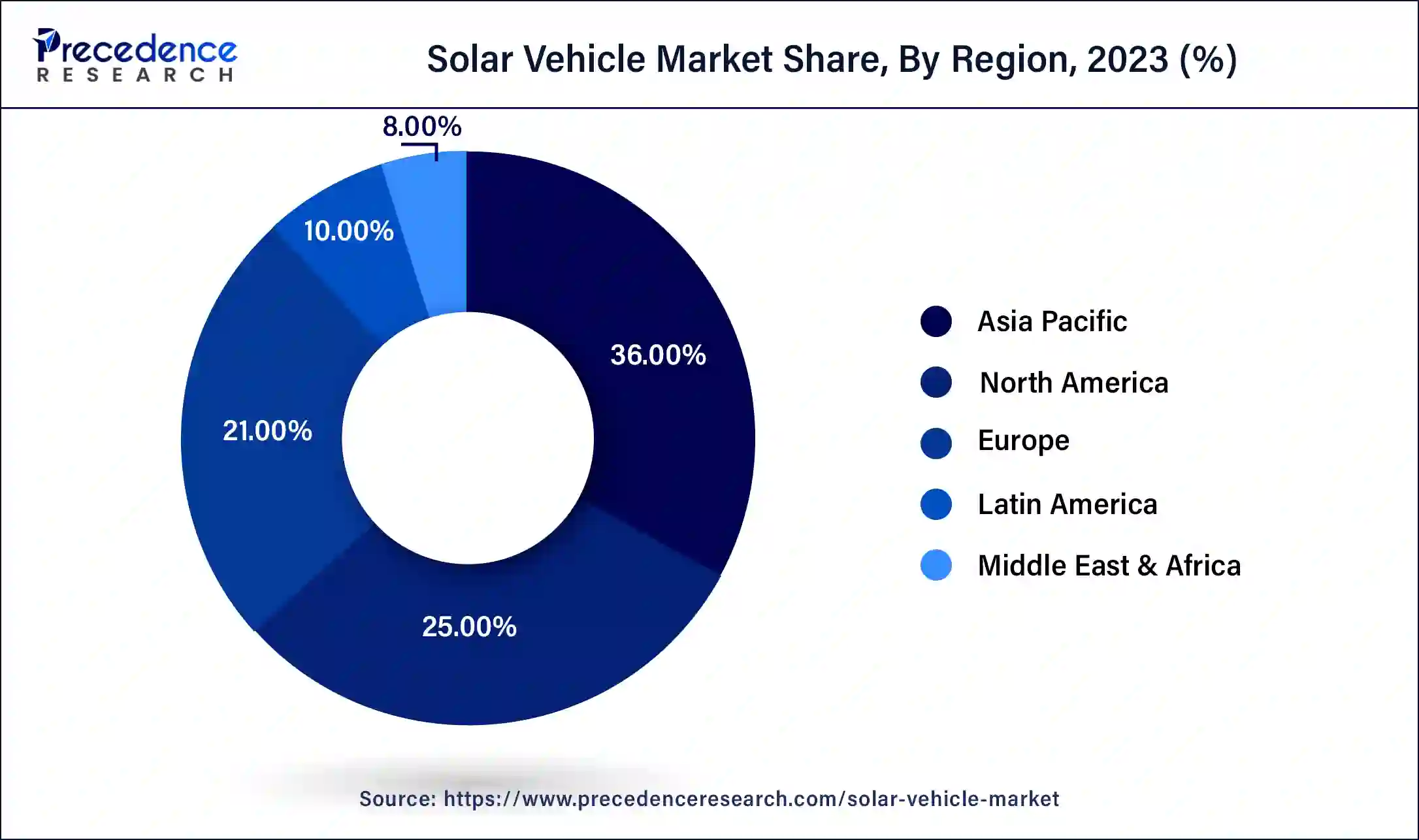
- Asia Pacific led the global market with the highest market share of 36% in 2025.
- By vehicle type, the passenger vehicles segment has held the largest market share in 2025.
- By electric vehicle type, the hybrid electric vehicle (HEV) segment captured the biggest revenue share in 2025.
- By battery type, the lithium-ion segment registered the maximum market share in 2025.
Market Overview
The solar vehicle market refers to the development and manufacturing of solar-powered electric vehicles (EVs) that convert sunlight into electrical energy. Solar vehicles extend the driving range of EVs, reduce dependency on charging stations, and decrease overall energy costs. Drivers can use an abundant and renewable resource that comes with minimal operating expenses. Solar vehicles reduce carbon footprint and pave the way towards a more sustainable and clean transportation future.
Solar Vehicle Market Growth Factors
Solar vehicle is an electric vehicle that is equipped with photovoltaic cells in the solar panels that converts the solar energy into electric energy. The technological advancements and growing adoption of innovative technologies in the automotive industry has fostered the growth of the global solar vehicle market. The higher dependence on the biofuels and the rising levels of air pollution owing to the carbon emissions has resulted in the adoption of the solar vehicles across the global markets.The automotive is a huge industry and the significant adoption of the vehicles among the population had highlighted the concerns over the depleting non-renewable energy sources. Therefore, the increased need to shift towards the renewable sources of energy and fuel is a prominent driver of the global solar vehicle market. The government initiatives to reduce carbon footprint and the rising investments on the research and development of the eco-friendly and renewables sources of energy have encouraged the growth of the solar vehicle market. Solar or electric vehicle is gaining rapid surge in the popularity among the global consumers which is expected to drive the growth of the global solar vehicle market.
The rising popularity of the self-charging vehicles have boosted the adoption of the solar vehicles. The rising demand for the emission free vehicle is a major factor that augments the market demand. The rising fuel prices results in the inflation and the majority of the daily used goods and services becomes more expensive. The surging need for the sustainable and affordable fuel sources is boosting the demand for the solar vehicles. Further, the development of the fuel efficient vehicles have fostered the growth of the commercial and passenger solar vehicles. The rising government investments for the development of alternative fuel vehicles like public buses and other transit vehicles for public is augmenting the growth of the solar vehicle. The stringent government regulations regarding the emission from the vehicles is positively impacting the market and is expected to boost the adoption of the solar vehicles across the globe.
Market Outlook
How Will the Solar Vehicle Industry Impact the Sustainable Future of Transportation?
- Industry Growth Overview: The solar vehicle industry was growing at a rapid pace due to the clean energy movement and the increasing adoption of electric vehicles, while improvements in photovoltaic technology have created an avenue for solar mobility to become a new segment within future transportation systems.
- Sustainability Trends: Automakers are increasingly integrating circular economy principles into their products for solar vehicles by integrating recyclable materials, utilizing low-carbon approaches to manufacturing and sourcing of renewable energy, thus solidifying the view of solar mobility for the long term as a sustainable transportation solution.
- Global Growth: The global growth of solar mobility is supported through favorable government incentive programs, pilot solar mobility projects, and collaborative R&D efforts that provide manufacturers the opportunity to build and test solar vehicles in all types of climates and within a variety of government regulations around the world.
- Startup Ecosystems: Startups are emerging to focus on developing solar-integrated platforms for electric vehicles, autonomous solar mobility & lightweight vehicle architecture, venture capitalists and traditional auto manufacturers are looking for ways to invest in these companies and form strategic partnerships.
Market Scope
| Report Coverage | Details |
| Market Size in 2025 | USD 537.44 Billion |
| Market Size in 2026 | USD 603.01 Billion |
| Market Size by 2035 | USD 1,667.24 Billion |
| Growth Rate From 2026 to 2035 | CAGR of 11.99% |
| Largest Market | Asia Pacific |
| Base Year | 2025 |
| Forecast Period | 2026 to 2035 |
| Segments Covered | Vehicle Type, Electric Vehicle Type, Battery Type, Region |
| Regions Covered | North America, Asia Pacific, Europe, Latin America, the Middle East, and Africa |
Segments Insights
Vehicle Type Insights
Based on the vehicle type, the passenger vehicles segment dominated the global solar vehicle market in 2025, in terms of revenue and is estimated to sustain its dominance during the forecast period. This is attributed to the increased adoption of the passenger cars among the population owing to the increased disposable income, increased environment consciousness, changing demographics, and increased demand for the sustainable personal commute solutions. Moreover, the rising popularity of the electric powered passenger vehicles across the globe is fueling the growth of the segment. The passenger segment will dominate in throughout the forecast period owing to the rising awareness among the population regarding the benefits of adopting renewable sources of energy as fuel for the vehicles.
On the other hand, the commercial is estimated to be the most opportunistic segment during the forecast period. The rising government investments in the development of the fuel efficient and sustainable public transport solution is resulting in the burgeoning demand for the alternative fuel vehicle across the globe.
Electric Vehicle Type Insights
Based on the electric vehicle type, the hybrid electric vehicle (HEV) segment dominated the global solar vehicle market in 2025, in terms of revenue and is estimated to sustain its dominance during the forecast period. This is majorly due to the ability of the HEVs to operate using different types and sources of fuel. The rising awareness regarding the drowning health of the environment owing to the rising level of vehicle emissions has significantly driven the adoption of the HEVs across the globe.
On the other hand, the BEV segment is estimated to be the most opportunistic segment owing to the rapidly growing infrastructure for the adoption of EVs across the globe. The market players are investing in creating an ecosystem for the EVs by setting up charging stations at various locations that may boost the growth of the BEV growth.
Battery Type Insights
Based on the battery type, the lithium-ion segment dominated the global solar vehicle market in 2025, in terms of revenue and is estimated to sustain its dominance during the forecast period. This is attributed to the increased adoption of the lithium-ion batteries in the EVs owing to its light weight high energy density. Lithium-ion batteries have become a prominent battery in the EVs in the past few years and is also expected to be the fastest-growing segment as it provides longer range to the vehicles.
Regional Insights
Asia Pacific Solar Vehicle Market Size and Growth 2026 to 2035
The Asia Pacific solar vehicle market size is estimated at USD 193.48 million in 2025 and is predicted to be worth around USD 600.21 million by 2035, at a CAGR of 11% from 2026 to 2035.
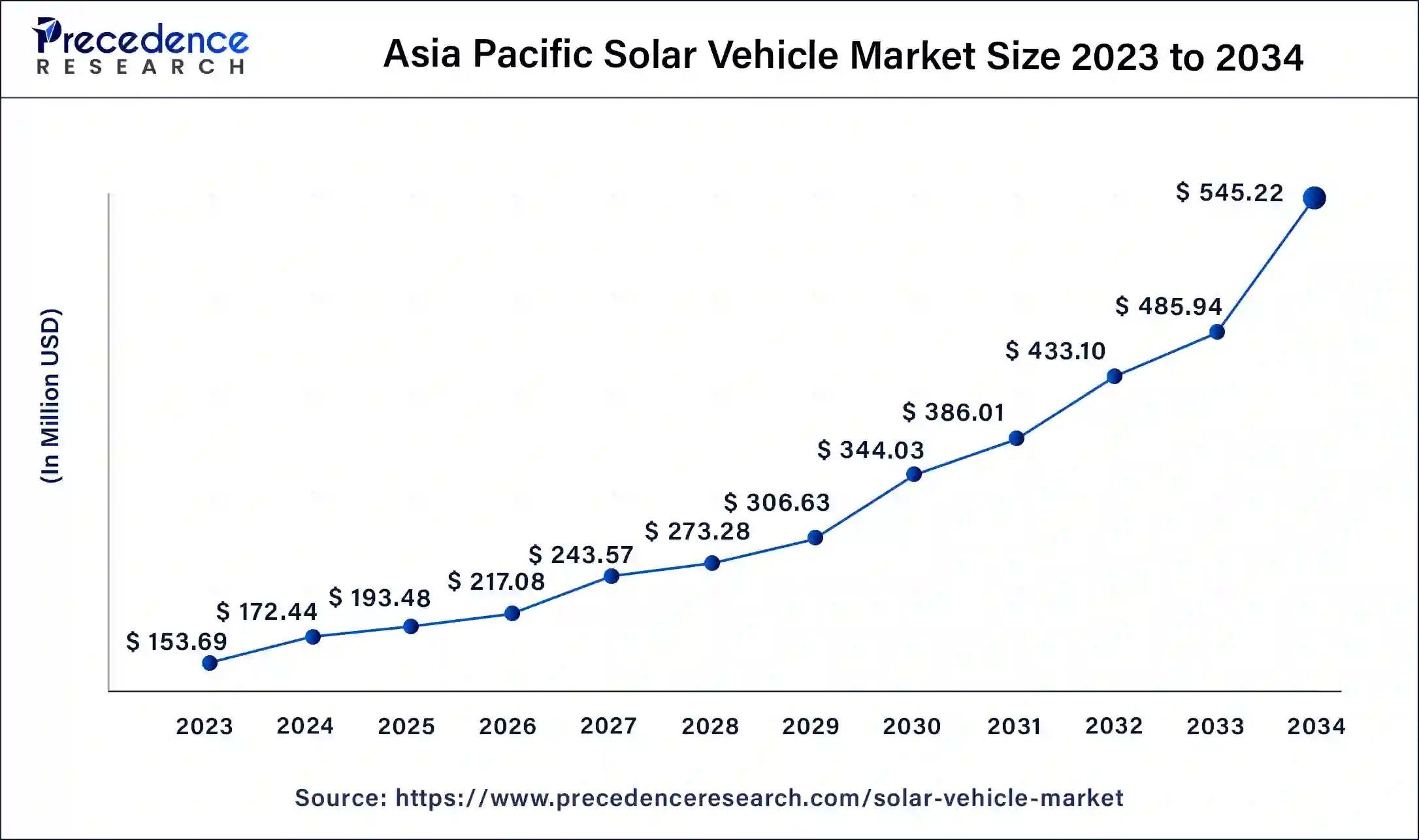
Based on region, Asia Pacific dominated the global solar vehicle market in 2025, in terms of revenue and is estimated to sustain its dominance during the forecast period.The stringent government regulations to restrict the carbon missions has significantly boosting the demand for the solar vehicle in the region. Moreover, the vehicle manufacturers are increasingly focusing on the production of the efficient solar vehicles that is expected to foster the market growth during the forecast period.
China Market Trends
The Chinese market is driven by the presence of robust manufacturing infrastructure and favorable government support. The shifting trend from petroleum-based vehicles to electric vehicles drives the demand for solar vehicles. According to the International Energy Agency (IEA) report, electric car sales increased by more than 20% year-on-year in 2025, rising to 21 million units.
What are the Key Trends of the Solar Vehicle Market in North America?
North America is expected to grow at a considerable CAGR in the upcoming period due to rising environmental concerns and favorable government initiatives. The market is also driven by university racing competitions and clean energy policies. The presence of key players and the increasing investments by government and private organizations augment the market. The growing research activities and the rising adoption of advanced technologies also contribute to market growth.
U.S. Market Trends
The U.S. leads the market in North America. Aptera Motors recently showcased the world's first self-charging solar car in San Francisco. Hyundai, Mercedes-Benz, and Nissan launched concept vehicles that feature integrated solar panels. The federal government has set a goal to make half of all new vehicles sold in the U.S. in 2030 zero-emissions vehicles.
Europe Emerges as the Fastest-Growing Solar Vehicle Market
On the other hand, Europe is estimated to be the most opportunistic segment during the forecast period. The presence of developed nations like Germany, France, and Italy, high disposable income, improved living standards, and increased awareness regarding the rising pollution levels are the major factors that propelled the growth of the solar vehicle market in Europe. Moreover, rising government initiatives to shift towards the clean transport is a major driving force that will fuel the growth of the market in this region.
Netherland Solar Vehicle Market Trends
The Netherlands has emerged as the fastest-growing country in terms of innovation in solar-powered electric vehicles, largely due to strong support from the government and a growing number of clean transportation start-ups based on solar technology. Strategic collaborations among automotive manufacturers, tech companies, and research institutes for solar integration, charging infrastructure, and smart energy management for hybrid and fully solar-powered vehicles.
Latin America: Solar Mobility Gains Momentum in High-Sunlight Economies
Solar vehicles are becoming more popular due to high solar irradiance, high fuel prices, and increased acceptance of electric vehicles. Solar-powered electric vehicles are gaining traction as options for last-mile logistics, shared mobility solutions, and alternative transportation methods that do not require dependence on fossil fuels in remote areas.
Chile is experiencing the fastest growth in the solar vehicle market, benefiting from its position as a renewable energy leader and the increasing investment in the sustainable transportation infrastructure.
Middle East & Africa (MEA): Solar-Powered Transport for Energy Independence
Countries in the MA region are looking at solar-powered electric vehicles to decrease their countries' reliance on fossil fuels and address issues created by extreme climate change. Many governments are exploring the use of solar vehicle technology in smart city designs, logistics in desert regions, and developing autonomous transportation systems using solar vehicle technology.
The United Arab Emirates continues to be the fastest-growing country in the MA region, largely due to its investments in smart cities and its commitment to the use of solar power for transportation.
Solar Vehicle Market Value Chain
- Sources of Advanced Materials and Solar Components: Advanced materials, including photovoltaic cells with the highest efficiency, crystalline composites (with the lowest weight), power electronics, high energy density batteries, are represented in the value chains.
Key Players: SunPower Corp, First Solar, Panasonic Holdings. - Integration of Vehicles, Power Management, and System Assembly: The integration of solar panels with electric drivetrains, intelligent energy management systems, and aerodynamically optimized vehicle builds are the main aspects of this step within the value chain.
Key Players: Lightyear, Aptera Motors, Sono Motors. - Distribution and Energy Ecosystem Enablement: The last layer of the value chain involves a direct-to-consumer (DTC) sales model, a pilot fleet deployment strategy, charging infrastructure alignment, and an online digital after-sales support platform.
Key Players: Tesla (energy ecosystem), Toyota Motor Corp, and Hyundai Motor Group.
Solar Vehicle Market Companies
- Volkswagen
- Toyota
- Lightyear
- Ford Motor Company
- Fiat Chrysler Automobiles
- America Cruise Car
- Venturi Automobiles
- Hanergy
- Mahindra
- The Solar Electric Vehicle Company
Key Companies Share Insights
The market is moderately fragmented with the presence of several local companies. These market players are striving to gain higher market share by adopting strategies, such as investments, partnerships, and acquisitions & mergers. Companies are also spending on the development of improved products. Moreover, they are also focusing on maintaining competitive pricing.
- In July 2021, Lightyear and Valmet Automotive entered into an agreement to manufacture solar vehicles together and agreed to produce around 1,000 solar vehicles per year.
The various developmental strategies like new product launches, acquisitions, and partnerships fosters market growth and offers lucrative growth opportunities to the market players.
Recent Developments
- In July 2026, CommunityEV Carshare, an innovative pilot program, was launched in Massachusetts to enhance access to a new, low-cost option for running errands or getting appointments: shared, solar-powered electric vehicles. The initiative offers discounted prices on hourly EV rentals at locations in Boston, Chelsea, Framingham, and Quincy. (Source: https://www.canarymedia.com)
- In December 2025, Colombia's energy ministry launched a new vehicle to deliver an initial 650-MW solar power portfolio on the Caribbean coast in a dual effort to decarbonize the region's state-owned generator Gecelca and combat energy poverty. The new vehicle will begin the decarbonization of thermal assets and support the expansion of clean energy generation to benefit more than a half a million families. (Source: https://renewablesnow.com)
Segments Covered in the Report
By Vehicle Type
- Passenger
- Commercial
By Electric Vehicle Type
- BEV
- HEV
- Plug-in HEV
By Battery Type
- Lithium Ion
- Lead Acid
- Lead Carbon
By Solar Panel
- Monocrystalline
- Polycrystalline
By Geography
- North America
- Europe
- Asia Pacific
- Middle East & Africa
- Latin America
For inquiries regarding discounts, bulk purchases, or customization requests, please contact us at sales@precedenceresearch.com
Frequently Asked Questions
Tags





Ask For Sample
No cookie-cutter, only authentic analysis – take the 1st step to become a Precedence Research client
 Get a Sample




 sales@precedenceresearch.com
 Schedule a Meeting
