



Solar Photovoltaic (PV) Market Size, Key Companies, Company Production Capacity, Electricity Generation, Capacity Utilization, Export & Import Analysis, Cost Structure, Competitive Landscape, and Market Outlook
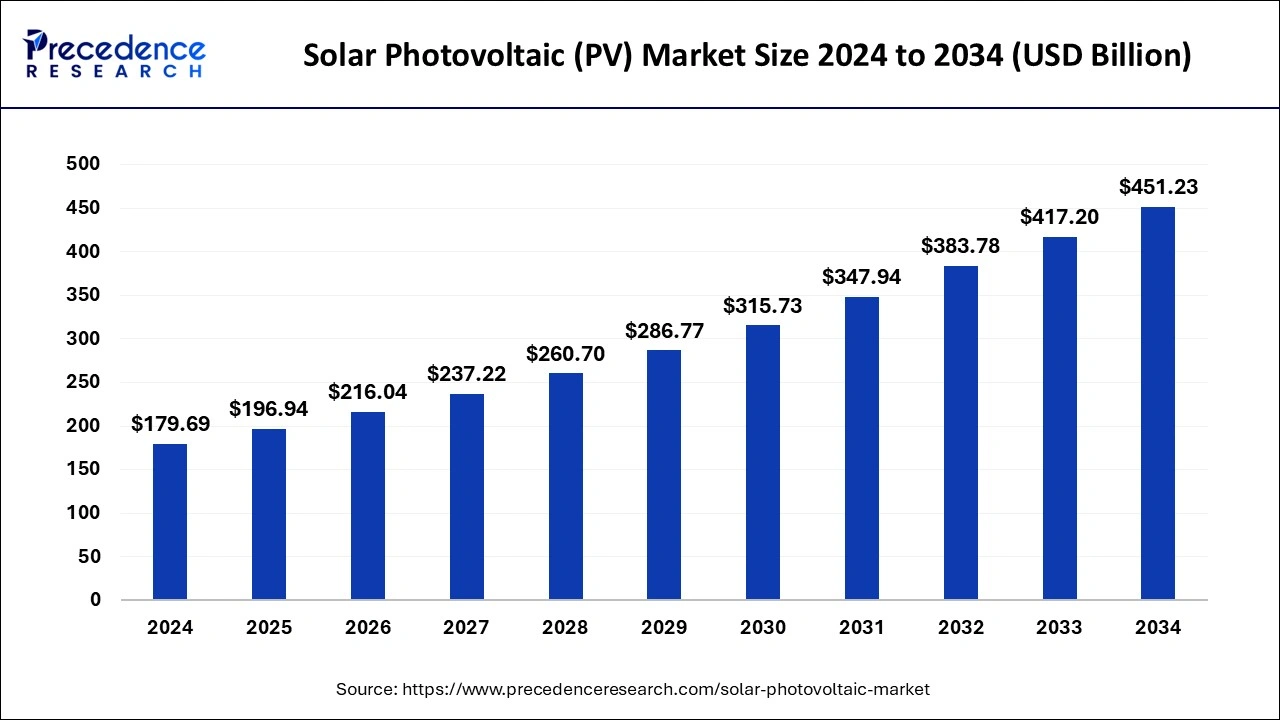
The global solar photovoltaic (PV) market size was calculated at USD 216.04 billion in 2026 and is predicted to reach around USD 484.85 billion by 2035, expanding at a CAGR of 9.43% from 2026 to 2035. The solar photovoltaic (PV) market is driven by government incentives and policies, such as tax credits, subsidies, and renewable energy mandates. AI-powered forecasting, energy management platforms, and smart grid integration are improving solar generation efficiency and accelerating adoption worldwide.
Source: https://www.precedenceresearch.com/solar-photovoltaic-market
 Get a Sample
 Table Of Content


The global solar photovoltaic (PV) market size was estimated at USD 196.94 billion in 2025 and is projected to increase from USD 216.04 billion in 2026 to approximately USD 484.85 billion by 2035, growing at a CAGR of 9.43% from 2026 to 2035. The expansion of gigawatt-scale manufacturing and rapid shift toward renewable energy are driving the market. Government incentives and technological advancements are also contributing to market growth.
Key Takeaways
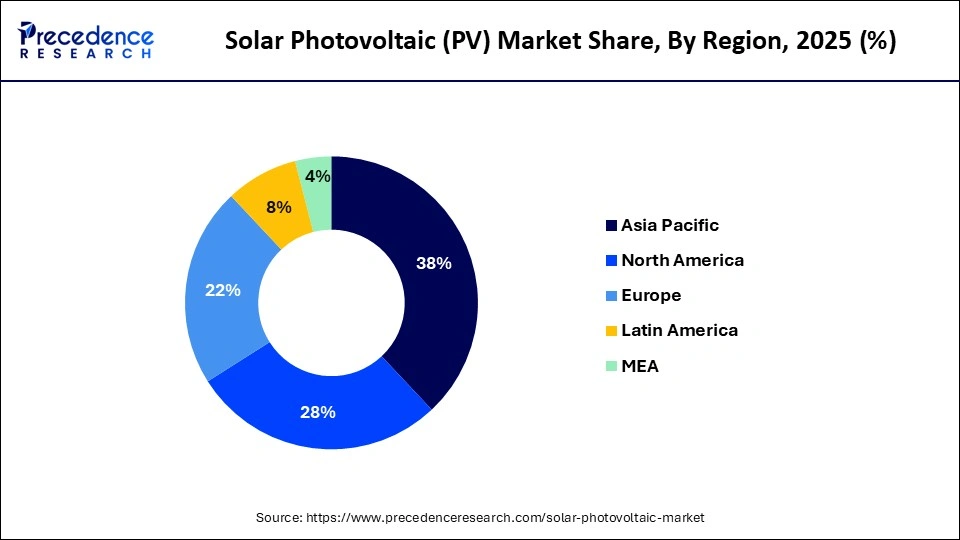
- Asia Pacific dominated the global market with the largest market share of 38% in 2025.
- North America is projected to expand at the notable CAGR during the forecast period.
- By technology, the monocrystalline silicon segment has held the largest market share in 2025.
- By technology, the thin film segments is estimated to be the fastest-growing segment during the forecast period.
- By installation, the ground-mounted segment captured the biggest market share in 2025.
- By installation, the rooftop segments is predicted to be the fastest-growing segment during the forecast period.
- By grid type, the on-grid segment contributed the highest market share in 2025.
- By grid type, the off-grid segment is expected to grow at a significant CAGR from 2026 to 2035.
- By application, the utility segment has held the largest market share in 2025.
- By application, the residential segments is expected to be the fastest-growing segment during the forecast period.
Global Solar Photovoltaic (PV) Market Overview
The solar photovoltaic (PV) market is experiencing significant growth driven by the growing need for clean and renewable energy around the world, the falling cost of solar modules, and government initiatives that support the production of sustainable power. Market expansion is being accelerated in both developed and emerging economies by growing investments in distributed rooftop installations, utility-scale solar projects, and energy transition programs. The performance and uptake of photovoltaic systems are being further improved by technological developments in smart grid infrastructure, energy storage integration, and high-efficiency solar cells.
Furthermore, governments, companies, and consumers are being encouraged to invest in solar energy solutions due to growing concerns about carbon emissions, energy security, and climate change. As a result, solar PV is one of the renewable energy industry's fastest-growing segments. The demand for eco-friendly energy is encouraging clean energy developers to promote the market.
Market Outlook
- Industry growth overview - The solar photovoltaic (PV) market is continuously growing as governments are expanding renewable energy targets, increasing electricity demand, and high electricity prices encourage wider adoption of solar photovoltaic (PV) across residential, commercial and utility scale installations.
- Global expansion - Solar photovoltaic (PV) deployment is increasing across Asia Pacific, Europe, North America, the Middle East, Africa, and Latin America. Governments across the regions are supporting solar energy generation and promoting large-scale renewable energy investments.
- Sustainability trends - Manufacturers are improving panel efficiency and reducing production emissions to meet sustainability goals. The integration of battery storage with solar systems is creating cleaner and more reliable renewable energy infrastructure.
- Startup ecosystem - Startup companies are developing AI based energy management platforms and smart inverters to improve affordability and efficiency.
- Major Investors - The major investors in the solar photovoltaic (PV) market include Jinko Solar, Trina Solar, LONGi, First Solar, Adani Solar, Tata Power Solar, Waaree Energies and Vikram Solar.
How is AI Revolutionizing the Solar Photovoltaic (PV) Market?
By enabling predictive maintenance, optimizing solar panel performance, and enhancing energy forecasting, artificial intelligence is revolutionizing the solar photovoltaic industry. AI-powered systems improve the efficiency of solar power generation and grid integration, maximizing energy output the lower operating costs. By identifying possible equipment failures before they happen, sophisticated machine learning algorithms can reduce maintenance costs and downtime. Additionally, AI helps utilities and solar operators enhance grid stability and overall system reliability by evaluating weather patterns and electricity demand. The rapid transformation in the market is driven by the integrated AI features and other tech-influenced approaches.
Solar Photovoltaic (PV) Market Trends
- Growing Adoption of AI and Smart Monitoring Systems - AI-powered analytics and predictive maintenance solutions are improving solar plant performance and reducing operational costs.
- Rising Deployment of Utility-Scale Solar Projects - Governments and private investors are increasing investments in large-scale solar farms to meet clean energy targets.
- Increasing Integration of Energy Storage Systems - Solar installations are increasingly being paired with battery storage solutions to ensure a reliable and continuous power supply.
- Advancements in High-Efficiency Solar Panels - The adoption of technologies such as TOPCon, HJT, and bifacial solar modules is improving energy generation efficiency.
- Expansion of Distributed and Rooftop Solar Systems - Residential, commercial, and industrial consumers are increasingly adopting rooftop solar to reduce electricity costs and enhance energy independence.
- Growing Demand for Floating Solar Photovoltaic Systems - Floating solar projects are gaining traction due to land constraints and their ability to improve panel efficiency through natural cooling.
- Increased Focus on Smart Grid Integration - Utilities are investing in smart grid technologies to better manage solar energy generation and improve grid stability.
- Rising Corporate Investments in Renewable Energy - Businesses across industries are procuring solar power through power purchase agreements (PPAs) and sustainability initiatives to reduce carbon emissions.
Solar Photovoltaic (PV) Market Growth Factors
- The demand for solar photovoltaic (PV) will rise because of recent technology developments and research & development operations for efficient power generation across large-scale solar applications.
- The market for crystalline solar photovoltaic (PV) will be boosted by a significant increase in solar deployment rates and favorable government renewable energy goals.
- The corporate landscape will be further impacted by a radical shift toward profitable new product developments, manufacturing precision, optimization, and standardized product methods for power production, lower emissions, and cheap installation costs.
- The polycrystalline silicon solar photovoltaic (PV) will be widely adopted in the near future due to their inexpensive production costs and simple manufacturing procedures.
- Furthermore, the product's broad applicability across large-scale solar power projects, as well as federal renewable energy integration mottos, will drive the demand for solar photovoltaic (PV) on a large scale. Moreover, the solar photovoltaic (PV) market will be enhanced by the lowered pricing structure coupled with tax credit schemes to support solar photovoltaic (PV) technology.
- Worldwide solar PV investments in capacity expansions rose approximately 30% in 2023, exceeding USD 480 billion and setting another record year. In 2023, investment in solar PV exceeded that of all other power generation technologies combined.
Market Report Coverage and Key Metrics
| Report Coverage | Details |
| Market Size in 2025 | USD 196.94 Billion |
| Market Size in 2026 | USD 216.04 Billion |
| Market Size in 2035 | USD 484.85 Billion |
| Growth Rate from 2026 to 2035 | CAGR of 9.43% |
| Largest Market | Asia Pacific |
| Base Year | 2025 |
| Forecast Period | 2026 to 2035 |
| Segments Covered | Product, Application, and Region |
| Regions Covered | North America, Europe, Asia-Pacific, Latin America, and Middle East & Africa |
Market Dynamics
Driver
Demand for Green Energy
The growing need for clean and renewable energy sources to lower carbon emissions and fight climate change is the main factor propelling the growth of the solar photovoltaic (PV) market. Solar PV systems are being widely adopted in residential, commercial, and utility-scale applications due to favorable government policies, tax incentives, renewable energy targets, and falling solar panel costs. Further propelling market expansion are rising investments in energy security programs and sustainable energy infrastructure.
Restraint
Unfavorable Weather and High Cost
The intermittent nature of solar power generation, which depends on weather and sunlight availability, presents challenges for the solar photovoltaic (PV) market. Adoption may also be hampered by high initial installation costs for large-scale projects and energy storage systems, especially in developing nations. Additionally, in some regions, grid integration issues and land availability restrictions for utility-scale solar projects may impede market growth.
Opportunity
Tech Expansion/Integration
The integration of solar photovoltaic systems with smart grids, artificial intelligence-based energy management solutions, and cutting-edge energy storage technologies presents significant opportunities. New growth opportunities for the market are being created by the increasing use of electric vehicles, the growing need for decentralized energy systems, and the growing investments in green hydrogen production. Solar PV deployment is anticipated to present significant opportunities in emerging economies with growing electricity demand and supportive renewable energy policies.
Market Segmentation Analysis
Technology Insights
The Monocrystalline Silicon Segment Dominate the Market in 2025
The monocrystalline silicon segment dominated the solar photovoltaic (PV) market with a major share in 2025 due to its high efficiency, superior purity, better electron mobility, and strong temperature tolerance compared with other PV technologies. The technology's space efficiency, improved power output, and compatibility with advanced solar solutions such as bifacial panels have supported its widespread adoption across utility, commercial, and residential applications. This form of solar panel is more prevalent in solar rooftop systems and is frequently utilized for large-scale installations, whether they are residential, commercial, or industrial.
The thin film segment is expected to grow at the fastest rate during the projection period. This is mainly due to its lightweight design, flexibility, and favorable temperature performance. Increasing adoption in applications such as building-integrated photovoltaics (BIPV), portable solar systems, and vehicle-integrated solar solutions is driving demand for thin film technologies.
Installation Insights
Why Did the Ground-Mounted Segment Held the Largest Share in 2025?
The ground-mounted segment held the largest market share in 2025 because of its suitability for large-scale solar farms and utility projects requiring high electricity generation capacity. These systems enable optimized solar tracking, better airflow, flexible tilt adjustments, and higher energy yields, making them preferred for large renewable energy installations.
The rooftop segment is expected to expand at the fastest CAGR over the forecast period, rising adoption among residential, commercial, and industrial users seeking energy independence and lower electricity costs. Integration with battery storage systems and reduced transmission losses are further increasing the attractiveness of rooftop solar installations.
Grid Type Insights
The On-grid Segment Held the Largest Share of the Market in 2025
The on-grid segment dominated the solar photovoltaic (PV) market by holding the largest share in 2025. This is mainly due to its affordability, simple installation process, and ability to supply electricity directly to existing utility networks. Increasing deployment across residential, commercial, and industrial sectors, supported by net metering policies and grid-connected renewable energy initiatives, strengthened its market position.
The off-grid segment is expected to grow at a rapid pace in the coming years, owing to increasing demand for decentralized energy solutions in remote areas, rural electrification projects, and industrial locations without reliable grid access. Growing adoption in telecom towers, mining sites, agriculture, and remote infrastructure is accelerating demand for standalone solar systems with battery storage.
Application Insights
What Made Utility the Dominant Segment in the Market in 2025?
The utility segment dominated the solar photovoltaic (PV) market with a major share in 2025, driven by the large-scale solar farm development, rising clean energy targets, and increasing investments in renewable power generation. Utility-scale PV projects benefit from power purchase agreements (PPAs), advanced grid management systems, and intelligent inverters that improve electricity reliability and grid stability.
The residential segment is expected to expand at the fastest CAGR in the upcoming period due to increasing homeowner interest in reducing electricity costs and adopting sustainable energy solutions. The integration of rooftop solar panels with battery storage systems, smart energy management, and building-integrated photovoltaics (BIPV) is expected to accelerate residential solar adoption.
Market Regional Analysis: North America, Europe, Asia-Pacific
Asia Pacific Solar Photovoltaic (PV) Market Size and Growth 2026 to 2035
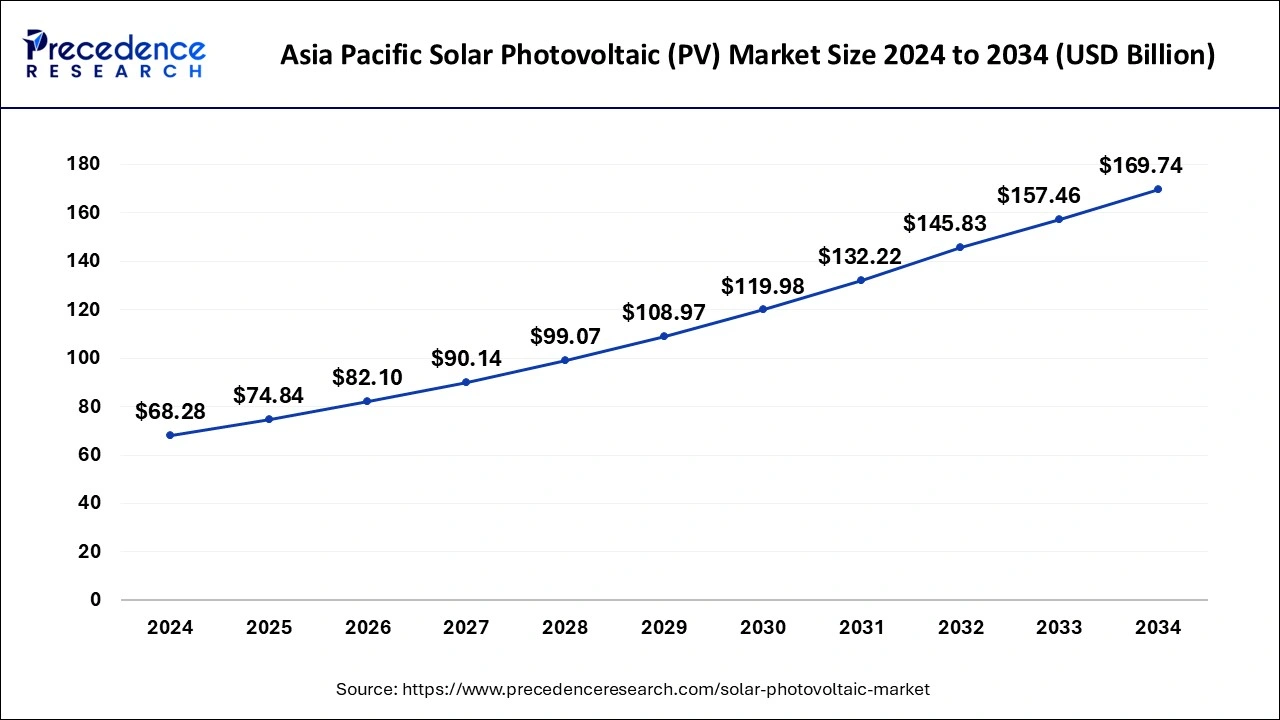
The Asia Pacific solar photovoltaic (PV) market was exhibited at USD 74.84 billion in 2025 and is projected to be worth around USD 181.58 billion by 2035, growing at a CAGR of 9.27% from 2026 to 2035
What Made Asia Pacific the Dominant Region in the Market in 2025?
Asia Pacific dominated the solar photovoltaic (PV) market by holding the largest share in 2025 due to rapid renewable energy expansion, large-scale solar farm development, supportive government policies, and strong manufacturing capabilities. The region benefits from the presence of major solar manufacturers such as JinkoSolar Holding Co., Ltd. and LONGi Green Energy Technology Co., Ltd., which are accelerating innovation in technologies such as n-type TOPCon and heterojunction solar cells. Increasing investments in energy storage, smart grid integration, AI-based monitoring, agrivoltaics, and building-integrated photovoltaics (BIPV) are further strengthening regional market growth.
India Market Trends
India is becoming a major contributor to the Asia Pacific market due to strong government renewable energy targets, growing solar park development, and increasing investments in domestic solar manufacturing. Expansion of rooftop solar, utility-scale projects, and initiatives supporting energy independence are accelerating solar adoption. The country's growing focus on solar manufacturing capacity, storage integration, and decentralized energy systems is expected to support long-term market growth.
Why is North America the Fastest-Growing Region in the Solar Photovoltaic (PV) Market?
North America is expected to grow at the fastest CAGR during the forecast period due to supportive government policies, domestic solar manufacturing initiatives, and increasing adoption of rooftop and utility-scale solar systems. Programs such as the Inflation Reduction Act (IRA), manufacturing incentives, and tax credits are encouraging investments across the solar value chain, including domestic production of cells, wafers, and modules.
The region is also witnessing rapid adoption of advanced technologies such as thin-film solar, perovskite solar cells, bifacial modules, virtual power plants, and AI-driven energy management systems. Increasing integration of solar PV with battery storage and smart grids is enhancing energy resilience and supporting market expansion.
U.S. Market Trends
The U.S. leads the North American solar photovoltaic (PV) market due to strong utility-scale solar deployment, expanding residential rooftop installations, and growing adoption of behind-the-meter battery storage systems. Increasing demand for grid resilience, renewable energy independence, and clean electricity solutions is accelerating solar adoption across residential, commercial, and industrial sectors.
Which Factors Made Europe a Significantly Growing Region in the Market?
Europe is expected to grow at a considerable CAGR in the solar photovoltaic (PV) market in the coming period. The growth is supported by increasing renewable energy targets, investments in domestic solar manufacturing, and rising demand for energy security. Countries such as Germany, Italy, Spain and France are increasingly installing and expanding rooftop solar adoption due to large utility scale projects. The region is advancing next-generation solar technologies such as tandem perovskite cells while promoting sustainable building solutions through BIPV integration. Favourable government incentives are further supporting growth of the market.
Germany Market Trends
Germany is a key contributor to the European solar photovoltaic (PV) market due to strong residential solar adoption, supportive incentive programs, and increasing demand for decentralized energy solutions. The growing popularity of balcony solar systems and rooftop PV installations is enabling urban households and renters to participate in renewable energy generation. Government support and simplified registration processes are further encouraging residential solar deployment.
How is the Middle East & Africa Solar Photovoltaic (PV) Market Gaining Momentum?
The market within the Middle East & Africa (MEA) is gaining momentum due to high solar irradiation levels, government-led renewable energy investments, and diversification strategies focused on reducing dependence on fossil fuels. Large-scale solar projects, domestic manufacturing initiatives, floating photovoltaic systems, and robotic solar panel cleaning technologies are supporting regional growth.
Saudi Arabia Market Trends
Saudi Arabia is emerging as a major market due to large-scale solar park developments, strong government investment, and efforts to build domestic renewable energy supply chains. The country's favorable solar conditions and focus on gigawatt-scale projects are accelerating solar deployment. Increasing localization initiatives are also encouraging the development of domestic solar manufacturing capabilities.
What are the Advancements in the Market in Latin America?
Latin America held a considerable share of the solar photovoltaic (PV) market in 2025, supported by abundant solar resources, growing renewable energy investments, and rising demand for clean electricity generation. Countries across the region, such as Brazil, Mexico, and Chile, are expanding utility-scale solar projects and distributed solar systems to improve energy security, reduce emissions, and diversify power generation sources. The governments in the region and private sectors are increasingly investing, which results in accelerated new installations of solar modules.
Brazil Market Trends
Brazil is leading the Latin American market due to strong solar potential, expanding distributed generation, and increasing investments in renewable energy infrastructure. Growth in residential, commercial, and utility-scale solar installations is supported by rising electricity demand and efforts to increase renewable energy penetration. The expansion of solar farms and the adoption of decentralized energy solutions are expected to continue driving Brazil's solar PV market growth.
Value Chain Analysis
- Raw Material Suppliers: The solar PV value chain begins with raw material suppliers providing key inputs such as polysilicon, silicon wafers, glass, aluminum frames, and other components.
- Key Players: Wacker Chemie AG, OCI Company Ltd., and Hoshine Silicon Industry Co., Ltd.
- Solar Cell Manufacturing: Solar cell manufacturers convert silicon wafers into photovoltaic cells using technologies such as monocrystalline, TOPCon, heterojunction, and thin-film technologies.
- Key Players: LONGi Green Energy Technology Co., Ltd., JA Solar Technology Co., Ltd., and JinkoSolar Holding Co., Ltd.
- Solar Module Manufacturing: Module manufacturers assemble solar cells into complete PV panels by integrating protective layers, frames, and electrical components.
- Key Players: Trina Solar Co., Ltd., Canadian Solar Inc., and First Solar, Inc.
- Installation and Operations & Maintenance (O&M) Providers: O&M providers ensure long-term PV system performance through monitoring, cleaning, repairs, and efficiency optimization.
- Key Players: SunPower Corporation and specialized solar service providers
Market Competitive Landscape Leading Companies and Strategies
The global solar photovoltaic (PV) market is highly competitive, with leading companies focusing on manufacturing expansion, technology innovation, strategic partnerships, and vertical integration to strengthen their market position. Market participants are investing heavily in advanced PV technologies, including TOPCon, heterojunction (HJT), bifacial modules, and thin-film solar solutions, to improve energy conversion efficiency, reduce production costs, and meet rising global renewable energy demand.
Major companies shaping the solar PV market include JinkoSolar Holding Co., Ltd., LONGi Green Energy Technology Co., Ltd., Trina Solar Co., Ltd., Canadian Solar Inc., JA Solar Technology Co., Ltd., First Solar, Inc., Hanwha Solutions Corporation, Risen Energy Co., Ltd., Astronergy, and Adani Solar. These players are expanding production capacities, strengthening supply chains, and improving research and development capabilities to capture increasing demand for solar power worldwide.
Top Companies in the Solar Photovoltaic (PV) Market and Their Offerings
- LONGi Green Energy - A leading producer of photovoltaic modules focused on advanced cell technologies.
- Key offerings include Hi MO solar modules, HPBC cell technology, utility scale PV solutions and recognition for TOPCon technologies.
- JinkoSolar - One of the world's largest solar module manufacturers with a strong presence across global markets.
- Key offerings include - Tiger Neo series, utility scale photovoltaic panels, bifacial panels, and N-type TOPCon modules.
- Trina Solar - A global solar company known for providing integrated photovoltaic and smart energy solutions.
- Key offerings - Vertex high power modules, trackers, smart energy storage, utility scale solar systems, and residential solar products.
- Canadian Solar - a well established international supplier delivering commercial, utility, and residential solar projects worldwide.
- Key offerings - High efficiency PV modules, battery energy storage systems, BiHiKu bifacial modules, utility scale solar project development and EPC services.
- Enphase Energy & SolarEdge - The company dominates the solar electronics and inverters landscape.
- Key offerings - IQ Microinverters, home energy management systems, and AC modules.
- First Solar - A leading Unites States based manufacturers specializing in advanced thin film photovoltaic technology.
- Key offerings - Cadmium telluride (CdTe) thin film solar modules, recycling services, and utility scale PV systems.
- SolarEdge Technologies - key offerings - DC power optimizers, intelligent inverters and EV charging integration.
- Sungrow Power Supply - it provides utility scale central inverters, string inverters, and liquid cooled ESS.
Solar Photovoltaic (PV) Market Companies
- Tata Power Solar Systems Ltd.
- Canadian Solar Inc.
- Wuxi Suntech Power Co. Ltd
- Nextera Energy Sources LLC
- BrightSource Energy Inc.
- SunPower Corporation
- Vivaan Solar
- Waaree Group
- Trina Solar
- Jinko Solar
Recent Developments
- In July 2026, Vikram Solar is investing Rs 15K crore in battery energy storage systems (BESS). The manufacturing facility will be built at the SIPCOT Industrial Park in Gangaikondan, Tirunelveli district (Nellai). This investment leads to the generation of 2,670 new jobs in the field.
- In June 2026, Engineering Projects confirmed the tender for Engineering, Procurement and Construction to pump a 250 MW AC grid-connected robust solar project. Furthermore, the project involves the polishing of robust operation and maintenance services. (Source: https://www.saurenergy.com)
- In June 2026, GREW Solar awaits the confirmation call for installing 3.5 GW TOPCon G12R solar PV cell manufacturing potential in Madhya Pradesh. This will help the market expand and drive valuable growth of the sustainable approaches. The country is ahead with the clean and green energy transition. (Source: https://www.energetica-india.net)
- In June 2026, EBRD, a popular sustainable dealer, confirmed a €18.9 million financing deal for the development of a comprehensive 32 MW solar photovoltaic project in Greece covering a broader part of the region. The renewable electricity to the Hellenic Halyvourfgia's production facilities via this financing package meets the environmental standards. (Source: https://solarquarter.com)
- In March 2025, the European Commission launched a new partnership focused on innovation in photovoltaics to enhance the region's standing in the global market. The Commission aims to collaborate with private partners to secure investments of up to $260 million each from 2025 to 2030 in the partnership. The aim is to increase the manufacturing capacity of solar PV in Europe, create a more robust value chain within the EU, and lessen reliance on fossil fuels by collaborating throughout the entire PV value chain.
- In January 2025, the United Arab Emirates initiated the globe's first extensive continuous gigascale energy storage project in Abu Dhabi, integrating solar energy and battery storage in a major advancement for the nation's energy industry. The initiative establishes the UAE as a frontrunner in renewable energy implementation, allowing renewable energy to be delivered continuously, every day of the week.
- In December 2024, Trina Solar declared a new partnership with AMEA Power. As part of this collaboration, Trina Solar will provide its advanced Elementa 2 platform for the 300MWh Abydos Battery Energy Storage Project in Aswan, Egypt. This project is a significant milestone, as it is Africa's largest solar energy initiative and Egypt's first to include a large-scale Battery Energy Storage System.
- In November 2024, German companies Indielux and EPP Solar started what they claim is the “world's largest” plug-in PV system, a residential array with an output of up to 6 kW.
Segments Covered in the Report
By Technology
- Monocrystalline Silicon
- Thin Film
- Polycrystalline Silicon
- Others
By Grid Type
- On-grid
- Off-grid
By Installation
- Ground Mounted
- Rooftop
- Others
By Application
- Residential
- Non-residential
- Utilities
By Region
- North America
- Europe
- Asia Pacific
- Latin America
- Middle East and Africa
For inquiries regarding discounts, bulk purchases, or customization requests, please contact us at sales@precedenceresearch.com
Frequently Asked Questions
Tags





Ask For Sample
No cookie-cutter, only authentic analysis – take the 1st step to become a Precedence Research client
 Get a Sample




 sales@precedenceresearch.com
 Schedule a Meeting
