



U.S. Clinical Trials Market Size, Key Companies, Company Market Share, Patient Volume, Treatment Adoption Rates, Pricing Analysis, Regulatory Landscape, Competitive Positioning, and Demand Forecast
U.S. Clinical Trials Market (By Phase: Phase I, Phase II, Phase III, Phase IV; By Study Design: Interventional, Observational; By Indication: Oncology, Autoimmune, Pain Management, CNS Conditions, Obesity, Cardiovascular, Diabetes) - Global Industry Analysis, Size, Trends, Leading Companies, Regional Outlook, and Forecast 2026 to 2035
Source: https://www.precedenceresearch.com/us-clinical-trials-market
 Get a Sample
 Table Of Content


What is the U.S. Clinical Trials Market Size?
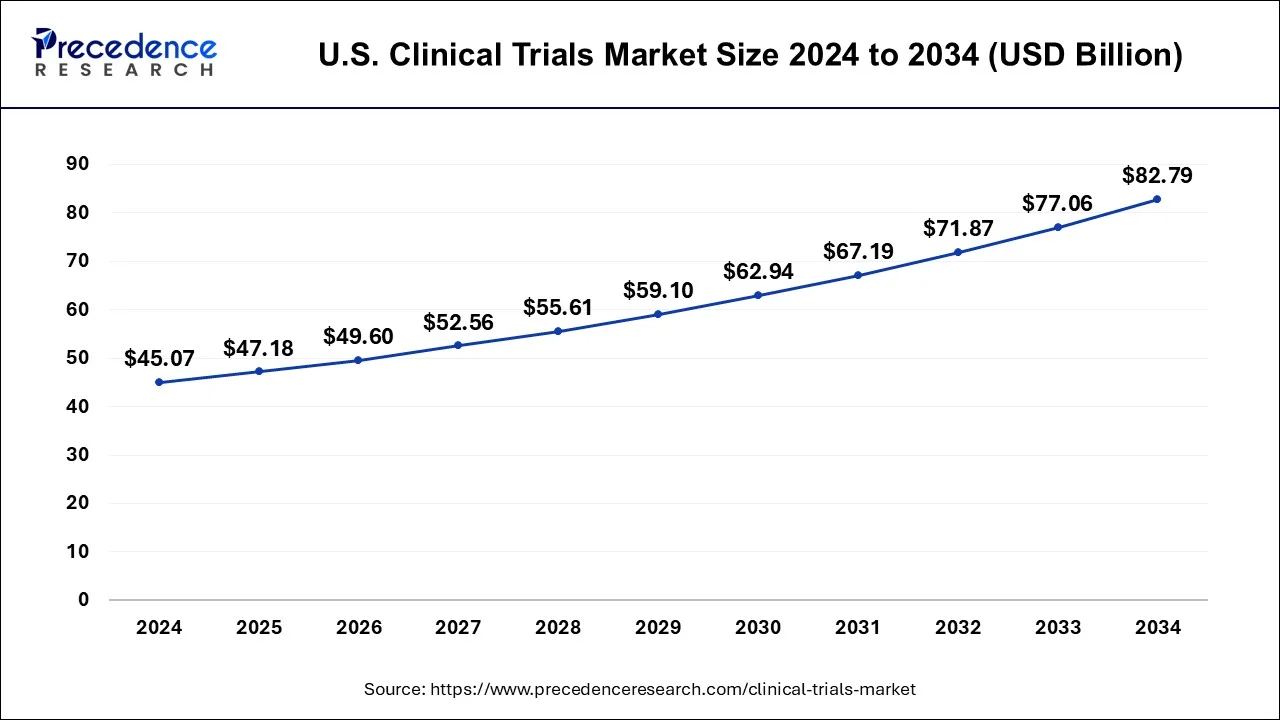
The U.S. clinical trials market size is calculated at USD 47.18 billion in 2025 and is predicted to increase from USD 49.60 billion in 2026 to approximately USD 88.16 billion by 2035, expanding at a CAGR of 6.45% from 2026 to 2035. Clinical trials are of immense importance due to the development of new treatments, safety, effectiveness, access to innovative treatments, and personalized medicine.
Key Takeaways
- On the basis of phase, the phase III segment accounted largest revenue share of more than 54% in 2025.
- On the basis study design, the interventional segment contributed the largest revenue share and is expected to dominate the market from 2026 to 2035.
- On the basis of indication, the oncology segment captured the largest share of around 26% in 2025.
U.S. Clinical Trials Market Overview
Clinical trials are a type of clinical research method that is guided by a specific protocol, which is carefully designed to resolve a specific patient care issue. Clinical studies are separated into five phases, each of which serves a specific purpose within the clinical trial. The clinical trials market is expanding due to factors such as the rising prevalence of chronic diseases, rising number of clinical trials in developing regions, increasing incidence of biologics, rapidly increasing demand for advanced treatments such as personalized medicines, viral disease outbreaks, rising cancer cases globally, rising geriatric population, and rising R&D expenditure.
How is AI Influencing the Market?
Artificial Intelligence (AI) is significantly impacting the U.S. clinical trials market by improving patient recruitment, optimizing study designs, and accelerating data analysis for faster, more accurate outcomes. Advanced machine learning algorithms help identify suitable participants and predict potential risks, reducing trial costs and timelines. Furthermore, AI-enabled tools support real-time monitoring and personalized treatment approaches, enhancing the overall efficiency and effectiveness of clinical research.
U.S. Clinical Trials Market Trends
- The growing prevalence of chronic and infectious diseases in the U.S. offers opportunities for researchers to develop new diagnostic tests, tools, vaccines, and drugs for early detection, prevention, and treatment.
- Increasing R&D investments for the development of innovative medications are expected to propel market growth in the upcoming years.
- The need for well-established contract research organizations for outsourcing clinical trials is expected to fuel the market growth over the forecast period.
- The market is also experiencing rapid advancements in technology and personalized medicine, which are driving the development of more targeted and effective therapies.
Market Outlook
- Market Growth Overview: The U.S. clinical trials market is growing rapidly, fueled by rising demand for innovative therapies, technological advancements in trial design, and increasing prevalence of chronic and lifestyle diseases. Supportive regulatory frameworks and enhanced investment in healthcare research further drive market expansion.
- Major Investors: Major investors in the market include pharmaceutical companies, contract research organizations (CROs), and venture capital firms focused on healthcare innovation. They contribute by funding clinical studies, supporting R&D infrastructure, and accelerating the adoption of advanced technologies for efficient trials.
Market Scope
| Report Coverage | Details |
| Market Size in 2025 | USD 47.18 Billion |
| Market Size in 2026 | USD 49.60 Billion |
| Market Size by 2035 | USD 88.16 Billion |
| Growth Rate from 2026 to 2035 | CAGR of 6.45% |
| Base Year | 2025 |
| Forecast Period | 2026 to 2035 |
| Segments Covered | By Phase, By Study Design, By Indication |
Market Dynamics
Drivers
Increased demand for clinical trial outsourcing
As the need for novel pharmaceuticals and enhanced medical technology rises, the demand for efficient, fast-paced, and trustworthy clinical trial programs also increases. Furthermore, the medicine development process is extremely risky for biotechnology and pharmaceutical companies, with substantially lower approval rates and associated high costs. As a result, it was concluded that outsourcing the clinical trials program to numerous contract research organizations (CRO) would save the pharmaceutical business time and money. Along with this, the spike in demand for clinical trial outsourcing is fueling the clinical trials market development throughout the forecast period.
Restraints
Expensive clinical trials procedures
The clinical trials market offers expensive services. Market labor expenses are a restraining factor for market expansion throughout the projection period. Patenting and contracting for clinical trials is a difficult procedure. As a result, labor costs in the clinical trials industry are high. Cost is a concern since it affects demand in a few markets. Clinical trial services should be cost-effective in most organizations. The high cost, on the other hand, boosts the overall operating costs of the industry. As a result, the high cost of clinical trials is limiting the clinical trials market's growth over the forecast period.
Opportunities
Technological advancements in predictive analytics and artificial intelligence
Several companies are already utilizing predictive analytics techniques such as artificial intelligence and machine learning to build models and provide suggestions. With the growing accessibility of health data to clinical trial investigators, predictive analytics tools can be utilized in clinical trial design to identify patient characteristics that are more likely to react to a particular treatment pattern, growing success rates, and lowering risk in large, multi-center clinical trials. As a result, the increasing usage of predictive analytics is opening up attractive prospects for market growth throughout the forecast period.
Segments Insights
Phase Insights
The U.S Clinical Trials are segmented into Phases I, II, III, and IV. The largest revenue share of more than 53% was for Phase III. The factor contributing to this is that the phase is most crucial as it involves 300-3000 participants and has a longer treatment period. This makes the Phase most expensive. Following this, Phase II is considered the second most expensive phase. Efficacy studies are carried out in Phase II trials. This phase also finalized the dose. Increasing investment in R&D by industry and non-industry sponsors is expected to increase the market growth of Phase II trials. For instance, there are 43 therapeutics under Phase II for COVID-19.
The Phase I segment is expected to grow at the fastest CAGR in the market during the forecast period due to the importance of Phase I clinical trials as the cornerstone of drug development. It prioritizes assessing pharmacokinetics, safety, tolerability, and pharmacodynamics.
Study Design Insights
The U.S Clinical Trials are segmented into interventional and observational. The interventional segment acquired the largest revenue share and is expected to dominate the market over the forecast period. The direct impact of the treatment and preventive measures, that can be taken to treat a disease, are estimated by using interventional methods. The weakness and strengths of a clinical trial are identified with the help of interventional designs. Furthermore, the rising occurrence of emerging viral infections and continuous technological advancements in clinical trials are important reasons for interventional studies' high revenue share.
The observational segment is estimated to grow at the fastest rate in the market during the predicted timeframe due to the key role of observational studies as a cornerstone of epidemiological research. They allow proper planning, conduct, and analysis, which provide insights about the performance of treatments in routine clinical practice.
Indication Insights
The U.S Clinical Trials are segmented into oncology, autoimmune, pain management, CNS conditions, obesity, cardiovascular, and diabetes. The largest share of the market is accounted by the oncology segment. The factor responsible for the growth is the growing cases of cancer. Thus, the largest amount is spent on oncology clinical trials. For instance, according to the report by US FDA, USD 38 billion and more is spent on the development of drugs for various cancer diseases by pharmaceutical companies. Cardiovascular illnesses are one of the diseases exhibiting a progressive increase in incidence globally.
Modern lifestyle changes are boosting the growth of CVD. These cardiovascular conditions can result in myocardial infarction, stroke, and heart attacks. According to the WHO (World Health Organization), strokes and heart attacks account for four of the five cardiovascular diseases (CVD)-related fatalities.
The cardiovascular segment is anticipated to grow at the fastest rate in the market during the upcoming period due to a shift toward cardiorenal metabolic therapies and surging global disease burden. It is also supported by the expansion of precision medicine pipelines with RNA-based drugs that are designed to silence genetic factors of cardiovascular risk.
Country-Level Analysis
The U.S clinical trials market is currently experiencing rapid growth, driven by factors such as advancements in technology and an increasing emphasis on patient-centric approaches. Regulatory bodies in the U.S. are keeping pace with rapid innovation, enabling the introduction of novel therapies and treatments. This approach improves trial efficiency, accelerates patient recruitment, and enhances study outcomes. Researchers are increasingly tailoring studies to specific patient populations, supporting more targeted interventions and aligning with the broader goals of precision medicine, which together are expected to further drive innovation and growth in the clinical trials market.
Government Initiatives in the U.S. Clinical Trials Market
China
- In June 2026, the National Medical Products Administration stated that China updated its drug clinical trial guideline to enhance biotechnology innovations. China has released a new edition of the Good Clinical Practice (GCP) for Drugs, which is a guideline designed to ensure the scientific and ethical conduct of clinical studies. It aims to support innovation in biotechnology and enhance the research ecosystem of the nation. (Source: https://english.nmpa.gov.cn)
United States
- In April 2026, the U.S. FDA announced major steps to implement real-time clinical trials. It addressed the challenges in drug development in the form of early-phase clinical trials. It was characterized by limited patient populations, high uncertainty, and inefficient decision-making processes. (Source: https://www.fda.gov)
Germany
- In March 2025, the German government introduced the Government proposal for a standard contractual clause for clinical trial agreements in Germany. The German Parliament presented the Medical Research Act as part of the national strategy to incentivise medical device and pharmaceutical research and production in Germany. (Source: https://www.hlc.com)
Brazil
- In August 2026, the Ministry of Health established the national clinical research program and strengthened Brazil's leadership role. This initiative built guidelines to integrate regulatory agencies, scientific institutions, and the private sector. It has strongly focused on transforming knowledge into practical solutions to drive public health. (Source: https://ensaiosclinicos.gov)
Saudi Arabia
- In May 2026, Saudi Arabia developed into a Middle East hub for clinical trials. It is driven by specialised clinical trial logistics and Vision 2030 reforms that enable multicentre, complex studies across the Kingdom. (Source: https://www.clinicaltrialsarena.com)
Investments/Revenue in the U.S. Clinical Trials Market
- In August 2026, Charles River Laboratory announced second-quarter 2026 results, which is the revenue of $1.00 billion. The company repurchased $100 million of common stock in the second quarter at an average price of $174 per share. It aims to refine and strengthen its portfolio and enhance shareholder value. (Source: https://ir.criver.com)
Collaborations in the U.S. Clinical Trials Market
- In September 2025, Parexel and Paradigm Health formed a partnership to expand efficiency and access in clinical trials. This collaboration will utilize AI to address trial delays and rising development costs. It will give sponsors potential advancements from protocol design through database lock. (Source: https://www.paradigmhealth.ai)
Supply Chain Analysis
R&D
- This stage involves preclinical discovery, in silico modelling, automated data management, protocol optimization, approvals, and regulatory strategy.
- Key Players: Merck & Co., Johnson & Johnson, AstraZeneca, Eli Lilly and Company, Novartis, IQVIA Holdings Inc., ICON Plc, Thermo Fisher Scientific, Medpace Holdings, Inc., and Charles River Laboratories.
Distribution to Hospitals, Pharmacies
- This stage is gaining traction due to the rise of hybrid and decentralized clinical trials and a shift toward direct-to-patient and hybrid distribution.
- Key Players: World Courier, Marken, DHL Supply Chain & Global Forwarding, Biocair, FedEx HealthCare Solutions, Thermo Fisher Scientific, Almac Group, Catalent Pharma Solutions, PCI Pharma Services, IQVIA, ICON Plc, Parexel International, and Almac Group.
Patient Support and Services
- This stage prioritizes AI-driven onboarding, simplified consent, pre-screening portals, logistical operations, and decentralized support to combat severe protocol complexity.
- Key Players: IQVIA, ICON Plc, Thermo Fisher Scientific, Syneos Health, Parexel, Science 37, Clariness, BBK Worldwide, Spectrum Science, TriNetX, Inovalon, Truveta, and Jumo Health.
Competitive Landscape
The U.S. clinical trials market is driven by surging R&D in high-burden therapeutic areas, digitalization, clinical trial technology, and favorable regulatory frameworks. The top clinical research organizations and service providers are IQVIA, ICON Plc, Thermo Fisher Scientific, Labcorp, Parexel, Syneos Health, and Medpace. The top clinical trial sponsors are Eli Lilly and Company, Pfizer, AstraZeneca, AbbVie, and Bristol Myers Squibb. The core product offerings are the IQVIA.ai platform, decentralized clinical trials program, connected site network model, healthcare intelligence suite, Syneos Health communications, oncology and neurology testing panels, and central laboratory services. R&D spending continued into late-stage clinical programs, obesity, oncology, and advanced technological integrations.
U.S. Clinical Trials Market Companies
- Parexel International Corp.
- Charles River Laboratory
- PRA Health Sciences
- Wuxi AppTec
- Eli Lilly and Company
- Novo Nordisk A/S
- Clinipace
- Omnicare
- Kendle
- Chiltern
U.S. Clinical Trials Market Top Companies and Their Offerings
- PRA Health Sciences: It provides comprehensive, full-service clinical development, phase I-IV trial management, and data solutions to the U.S. pharmaceutical and biotechnology industries. It specializes in decentralized trials and mobile or digital health platforms.
- Wuxi AppTec: WuXi AppTec offers an integrated, end-to-end platform for clinical trials, providing comprehensive services from preclinical toxicology and bioanalytical testing to clinical trial management, biometrics, and drug supply chain. Its U.S. services involve clinical sample management, regulatory support, PK/TK analysis, and even rapid clinical supply packaging and distribution.
- Eli Lilly and Company: It leverages AI, wearable sensors, and modern, decentralized, or hybrid models to raise efficiency, access, and patient inclusion. Its research heavily focuses on weight management, metabolic conditions, diabetes, and oncology, with extensive late-stage R&D initiatives.
- Novo Nordisk A/S: It develops innovative treatments for obesity, cardiovascular disease, diabetes, and rare blood or endocrine disorders, with a solid pipeline including Phase 1-3 trials for semaglutide, amylin analogues, as well as siRNA.
- Clinipace: It specializes in personalized clinical development, therapeutic expertise, and regulatory navigation. It emphasizes flexibility in managing complex trials, mainly in oncology, gastroenterology, nephrology, rare diseases, and women's health.
Recent Developments
- In July 2026, Precision IO Group launched the EpiOne robotic platform and remote intervention program at the annual meeting of the Society of Robotic Surgery. The group introduced global capabilities to advance minimally invasive cancer care by integrating AI, robotics, and remote-enabled interventions. (Source: https://finance.yahoo.com)
- In April 2026, Saphnelo, the first-in-class pen, was approved in the U.S. for subcutaneous self-administration as a new autoinjector for the treatment of systemic lupus erythematosus. It will offer greater flexibility and convenience and will reach a wider group of patients. (Source: https://www.astrazeneca.com)
- In September 2025, IQVIA (U.S.) launched a new analytics tool designed to streamline trial management and improve data accuracy. This tool is expected to provide sponsors with real-time insights, thereby facilitating quicker decision-making and potentially reducing trial timelines. The emphasis on data-driven solutions indicates a broader industry trend towards leveraging technology to enhance operational efficiency. (Source: iqvia.com)
Segments Covered in the Report
By Phase
- Phase I
- Phase II
- Phase III
- Phase IV
By Study Design
- Interventional
- Observational
By Indication
- Oncology
- Autoimmune
- Pain Management
- CNS Conditions
- Obesity
- Cardiovascular
- Diabetes
For inquiries regarding discounts, bulk purchases, or customization requests, please contact us at sales@precedenceresearch.com
Frequently Asked Questions





Ask For Sample
No cookie-cutter, only authentic analysis – take the 1st step to become a Precedence Research client
 Get a Sample
.webp)



 sales@precedenceresearch.com
 Schedule a Meeting
