



U.S. Color Cosmetics Market Trends, Leading Companies, Company Revenue / Sales Performance, Retail Sales, Production Volume, Consumer Spending, Market Penetration, Competitive Landscape, and Industry Outlook
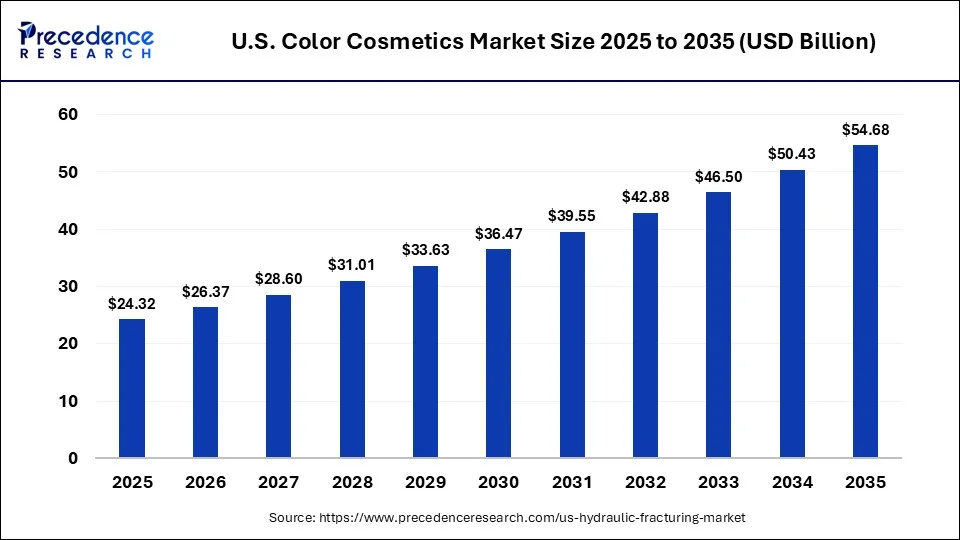
The U.S. color cosmetics market was valued at USD 26.37 billion in 2026 and is projected to grow at a CAGR of 8.44% through 2035. The market is driven by rising consumer spending on beauty products, increasing need for premium and masstige cosmetics, product innovation, and the growing influence of social media and even beauty creators. Major trends include the expanding adoption of makeup-skincare hybrids, multifunctional makeup, inclusive shade ranges, clean and vegan formulations, and also digitally enabled personalized beauty experiences, alongside rapid growth in e-commerce, DTC, and social-commerce channels. Increasing Gen Z and Millennial participation, creator-led product discovery, premiumization, and AI- and AR-enabled shopping experiences are anticipated to create new opportunities for color cosmetics brands, producers, and beauty retailers through 2035.
Source: https://www.precedenceresearch.com/us-color-cosmetics-market
 Get a Sample
 Table Of Content


Market Growth, Innovations, and Market Size Forecast 2035
The U.S. color cosmetics market is forecasted to expand from USD 26.37 billion in 2026 to USD 54.68 billion by 2035, growing at a CAGR of 8.44% from 2026 to 2035. Market expansion is being driven by premiumization, product innovation, shade inclusivity, multifunctional makeup, skinification, and the growing influence of social media and creator-led product discovery. Lip products, blush, complexion products, and makeup-skincare hybrids are emerging as key growth opportunities, while prestige, masstige, digitally native, and accessible-premium brands continue to reshape competitive dynamics.
 Key Takeaways
- The U.S. color cosmetics market is projected to grow from USD 26.37 billion in 2026 to USD 54.68 billion by 2035, registering a CAGR of approximately 8.44%.
- Makeup remained the largest prestige beauty category and grew by approximately 4%, demonstrating continued demand for color cosmetics.
- Lip products emerged as one of the strongest-performing makeup segments across both prestige and mass channels.
- The market is increasingly driven by premiumization, multifunctionality, shade inclusivity, skinification, and creator-led product discovery.
- The forecast identifies an approximately USD 35.5 billion market opportunity by 2030, according to the stated key coverage.
- The market's growth is being supported by prestige, masstige, digitally native, and hybrid makeup formats, alongside faster product innovation.
- Gen Z and Millennials are major contributors to category momentum through short-form video, beauty influencers, peer reviews, and emerging-brand discovery.
- Growth is increasingly shifting toward lip, blush, complexion hybrids, multifunctional products, and accessible-premium price tiers rather than relying solely on overall category scale.
Lip Growth, Premium Innovation, and Social-Commerce Discovery is Reshaping the U.S. Color Cosmetics Market
Prestige beauty retail reached approximately USD 26.37 billion in 2026, while mass beauty generated approximately USD 72.7 billion; makeup remained the largest prestige beauty category and grew around 4%, while lip products were among the strongest-performing makeup segments across both prestige and mass channels.
The structural opportunity is therefore shifting more towards premiumization, multifunctionality, shade inclusivity, lip-led routines, skinification, creator-driven discovery, and faster product innovation. At the same time, parts of the traditional mass color cosmetics market are experiencing pressure from discounting, retailer rationalization, elevated promotional intensity, and rapidly changing consumer preferences.
Key Coverage
- Prestige, masstige, mass, luxury, and digitally native positioning
- Offline, specialty beauty, drugstore, department store, DTC, marketplace, and social-commerce channels
- Consumer demographics, purchase frequency, premiumization, and price sensitivity
- Brand economics, innovation velocity, market share, and competitive positioning
The forecast reflects product launches, greater shade and undertone availability, continued migration toward hybrid makeup-skincare formats, expansion of prestige and masstige offerings, and increased digital discovery. The market also benefits from makeup's relatively low absolute ticket size compared with many discretionary categories, allowing consumers to trade between affordable and premium products.
Key Coverage
- Historical and forecast market value
- Incremental USD opportunity
- Base, upside, and downside scenarios
- Segment and channel forecasts
- Revenue contribution by product category and price tier
Segmentation Analysis - Lip and Hybrid Formats are Capturing a Disproportionate Share of Recent Momentum
Face products remain one of the largest revenue pools, reflecting the broad penetration of foundation, concealer, powder, blush, bronzer, contour, and complexion-enhancing products. However, lip products are emerging as a important growth engine, supported by lip oils, balms, liners, glosses, stains, treatment-color hybrids, and easier-to-use formats.
Eye makeup remains important, but demand has been more affected by changing consumer trends. Nail products continue to grow because they are easy to try and need frequent replacement. Hybrid products that combine skincare benefits with makeup are also gaining popularity, making makeup a more regular part of daily skincare routines.
Key Coverage
- Largest and fastest-growing product categories
- Lip, face, eye, and nail revenue pools
- Prestige versus mass economics
- Hybrid makeup-skincare penetration
- Segment CAGR and contribution to incremental growth
Market Dynamics - Innovation Speed and Consumer Discovery are Becoming as Important as Distribution Scale
The primary growth drivers are social-media discovery, creator influence, product innovation, premiumization, shade inclusivity, multifunctional products, and the normalization of beauty as an affordable form of self-expression. At the same time, competitive pressure is intensifying. Consumers can rapidly switch between brands following viral product launches, while retailers increasingly allocate shelf space toward products demonstration. This makes it harder for traditional brands to maintain their competitive advantage.
Mass category has its unique set of challenges in terms of promotional vigor and consumer demands. Past industry performance has further shown that the consumers in the beauty category are willing to purchase despite their growing preference for visible product outcomes.
Key Coverage
- Demand drivers and restraints.
- Social-commerce impact.
- Premiumization and value-seeking.
- Innovation velocity.
- Promotional intensity.
- Consumer switching behavior.
- Brand discovery and viral-product economics.
Companies and Brand Owners Shaping U.S. Color Cosmetics
| Company | Headquarters | Market Position | Core Strength | Major Applications/Segments |
| L'Oréal | France | Global leader | Scale & portfolio | Face, lip, eye |
| Estée Lauder Companies | U.S. | Prestige leader | Premium brands | Face, eye, lip |
| Coty | U.S. | Mass/prestige | Scale & distribution | Lip, face, eye, nail |
| e.l.f. Beauty | U.S. | Growth leader | Value & digital | Face, lip, eye |
| Shiseido | Japan | Prestige specialist | Premium innovation | Face, lip |
| LVMH | France | Luxury leader | Luxury beauty | Face, lip, eye |
| Chanel | France | Luxury leader | Brand equity | Makeup |
| Revlon | U.S. | Mass specialist | Color cosmetics | Face, lip, eye |
| Amorepacific | South Korea | Asian beauty leader | Innovation | Face, lip |
| Kao | Japan | Global beauty | Formulation | Makeup |
| KOSE | Japan | Prestige specialist | Asian cosmetics | Face, eye |
| Puig | Spain | Premium beauty | Brand portfolio | Makeup |
| Natura &Co | Brazil | Emerging global player | Clean/natural positioning | Makeup |
| Rare Beauty | U.S. | DTC/prestige challenger | Community | Face, lip, eye |
| Fenty Beauty | U.S. | Inclusive challenger | Shade breadth | Face, lip |
| Glossier | U.S. | DTC challenger | Minimalist beauty | Face, lip |
| Merit Beauty | U.S. | Premium minimalist | Convenience | Face, lip |
| Kosas | U.S. | Clean/prestige | Skinification | Face, lip |
| Saie | U.S. | Clean challenger | Hybrid makeup | Face |
| Tower 28 Beauty | U.S. | Clean challenger | Sensitive-skin positioning | Face, lip |
| Jones Road Beauty | U.S. | Mature-consumer specialist | Simplified makeup | Face |
| KIKO Milano | Italy | Value-premium specialist | Product breadth | Face, lip, eye |
| ColourPop | U.S. | Digital/value leader | Trend speed | Eye, lip, face |
| Haus Labs | U.S. | Prestige challenger | Complexion innovation | Face |
| Kylie Cosmetics | U.S. | Celebrity-led challenger | Social commerce | Lip, face |
Which Product Categories and Price Tiers are Capturing the U.S. Color Cosmetics Market?
The U.S. color cosmetics market is becoming increasingly differentiated by product category, pricing, and consumer needs. Lip, blush, complexion, and multifunctional makeup are emerging as key areas of opportunity, while more traditional single-purpose products are moving toward greater maturity. Prestige makeup continues to account for a significant share of market value; however, masstige and accessible-premium offerings are gaining traction as consumers increasingly look for enhanced performance and product benefits without consistently paying luxury-level prices. Channel dynamics are also shaping category performance, with digitally native brands benefiting from faster product discovery, creator-led influence, and frequent trend-driven purchasing.
Our analysis suggests that category growth is increasingly driven by innovation, affordability, and consumer relevance rather than by category scale alone. Products that deliver multiple benefits, including makeup-skincare hybrids, long-wear formulations, skincare-infused complexion products, and multifunctional color cosmetics, are particularly well positioned to generate incremental consumer spending. In our analysis, masstige and accessible-prestige segments have emerged as very critical battlefields, which will help firms retain fairly high average selling prices and deal with increased price consciousness and broaden their distribution base.
Strategically speaking, the most promising opportunities will stem from pursuing high-growth sub-segments rather than striving to compete on a broader level within the full makeup spectrum. Incremental market share gains are possible via innovation within categories such as lip, blush, complexion hybrid formulas, shades inclusivity, and multi-functional products, provided that differentiating products benefit from social commerce exposure. The key strategy issue then becomes matching product category, price point, consumer, and channel rather than viewing the U.S. color cosmetics market as one-dimensional demand.
The U.S. Color Cosmetics Market Is Shifting From Scale-Driven Competition to Agility and Innovation.
The U.S. color cosmetics industry is marked by fierce competition between the existing international beauty companies and the rising number of digitally native and challenger brands. The incumbent beauty houses are still enjoying the advantages of their diversified portfolios, retailer connections, production capacities, well-established distribution channels, and investment in research and development. However, the new brands are competing through quick reaction to emerging trends, narrowed portfolios, use of creators and social media for discovery, and customer engagement. Consequently, the competitiveness in the industry cannot be measured using the conventional performance criteria such as sales and market share but by product innovation speed, channel expansion, digital engagement, pricing strategy, and conversion of consumer attention into repurchasing.
Our analysis suggests that the basis of competitive differentiation is evolving from scale-driven advantage toward a model that combines scale with agility. Established players continue to hold meaningful structural benefits through their distribution reach, R&D infrastructure, regulatory expertise, manufacturing capabilities, and access to major retail channels. However, smaller and more specialized competitors can capture share by recognizing emerging consumer preferences earlier and translating those insights into differentiated products with shorter development and launch cycles. We believe masstige positioning, highly engaged digital ecosystems, inclusive product development, and rapid innovation are becoming increasingly important mechanisms for gaining market share, particularly within categories characterized by rapidly changing consumer tastes and strong social-media influence.
From the standpoint of strategy, it is important that global beauty players and digital challengers compete on the basis of different - but possibly synergistic - business models. While large firms have the financial resources and distribution systems to implement innovations rapidly across all channels, the challenger brands can leverage niche positioning and community-driven marketing efforts to compete against their rivals. These developments will provide new avenues for portfolio diversification, licenses, partnerships, acquisitions, and investments in newer brands, technologies, and products.
How are Consumer Behavior, Channel Shifts, and Digital Commerce Reshaping U.S. Color Cosmetics Growth?
Purchasing behavior among consumers in the U.S. color cosmetics category is becoming more influenced by digital product discovery, creator recommendations, social commerce, product reviews, and the convenience of integrated shopping journeys. On the other hand, purchasing behavior continues to be differentiated by income levels and price sensitivity among consumer segments. Gen Z and Millennials are especially active participants in the process of propelling category momentum due to their high engagement with short-form video, beauty influencers, peer reviews, and emerging brands. The development of e-commerce and brand-owned digital platforms will help to increase efficiency in guiding customers from product awareness to purchase while improving access to first-party consumer data and relationships.
Based on our research, customer acquisition is gradually transitioning from being driven by brand-controlled awareness into being a part of a more flexible discovery-to-conversion ecosystem. In such cases, consumers discover products through creators, social media, product reviews, recommendations based on algorithms, personalized digital content, etc., and eventually purchase through online or omnichannel channels. Technologies, such as AI-based product recommendations, virtual try-ons, digital shade matching, and personalized beauty discovery can reduce the path to purchase even more, especially for complexion products where shade selection uncertainty often results in lack of conversion. We believe that brands which manage to create synergy between creator visibility, efficient digital conversion, customer retention, and repeat-purchase strategy have potential to reach consumers in a disproportionate way without being dependent on expansion through traditional retail.
The bigger strategic implication here is that the decisions regarding distribution channels and customer engagement strategy become more interconnected. Specialty beauty retailers and mass-market channels still play an important role in product trial, physical discovery, and overall consumer access, but DTC platforms, retailer-owned e-commerce, online marketplaces, and social commerce channels become increasingly important factors in determining how fast a new product will be able to scale.
U.S. Color Cosmetics Market Segments
By Product Type
- Face
- Eye
- Lip
- Nail
- Other
By Price Tier
- Mass
- Masstige
- Prestige
- Luxury
By Distribution Channel
- Offline
- Online
By Product Format
- Liquid
- Cream
- Powder
- Stick
- Pencil
- Gel
- Balm
By Consumer Positioning
- Conventional
- Clean/natural
- Vegan/cruelty-free
- Multifunctional
- Makeup-skincare hybrid
By Consumer Demographics
- Gen Z
- Millennials
- Gen X
- Baby Boomers
- Other
By Country
- Northeast
- Midwest
- South
- West
For inquiries regarding discounts, bulk purchases, or customization requests, please contact us at sales@precedenceresearch.com
Frequently Asked Questions





Ask For Sample
No cookie-cutter, only authentic analysis – take the 1st step to become a Precedence Research client
 Get a Sample




 sales@precedenceresearch.com
 Schedule a Meeting
