



U.S. Data Center Cooling Market Size, Share and Trends 2026 to 2035
U.S. Data Center Cooling Market (By Component: Solution and Services; By Services: Installation & Deployment, Consulting & Design, Maintenance & Support, and Retrofit Services; By Cooling Technique: Air-Based Cooling and Liquid-Based Cooling; By Application: IT & Telecom, BFSI, Healthcare, Retail & E-Commerce, Energy & Utilities, Manufacturing, Media & Entertainment, Government & Defense, Education & Research, and Others; By Type of Data Center: Enterprise Data Centers, Hyperscale Data Centers, Colocation Data Centers, Edge Data Centers, and Cloud Data Centers; By Cooling Capacity: Below 20 kW, 20–100 kW, 100–500 kW, and Above 500 kW) Industry Size, Share, Growth, Trends 2025-2035
 Get a Sample
 Table Of Content


The U.S. data center cooling market size surpassed USD 25.6 billion in 2025 and is predicted to reach around USD 81.23 billion by 2035, registering a CAGR of 12.24% from 2026 to 2035. The market is mainly driven by increasing rack densities due to Artificial Intelligence (AI) and High-Performance Computing (HPC) tasks.
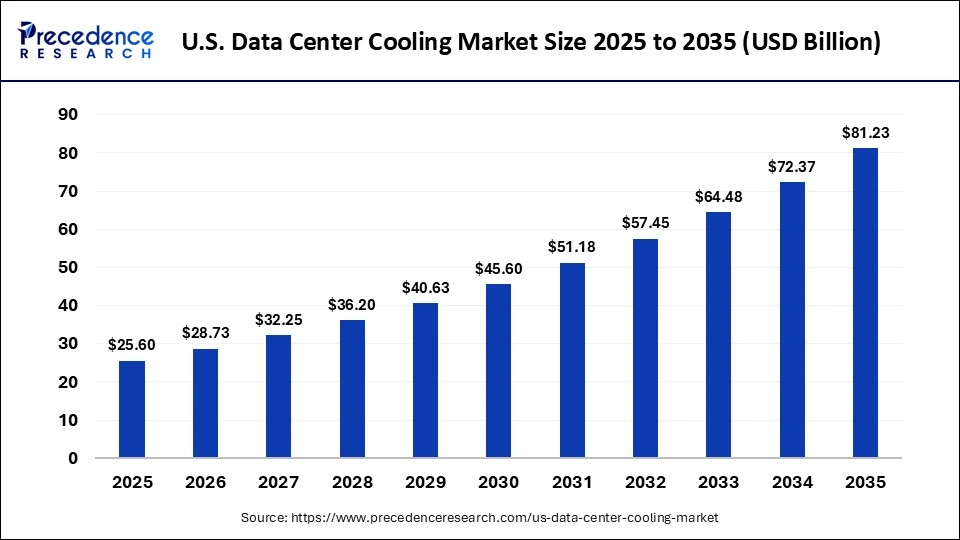
U.S. Data Center Cooling Market Statical Scope
| Reports Attributes | Statistics |
| Market Size in 2025 | USD 25.6 Billion |
| Market Size in 2026 | USD 28.73 Billion |
| Market Size by 2035 | USD 81.23 Billion |
| CAGR 2026 to 2035 | 12.24% |
| Base Year | 2025 |
| Forecast Period | 2026 to 2035 |
The market is crucial for supporting the growing AI and cloud infrastructure in the U.S., as it helps prevent server overheating and expensive downtime. It also plays a key role in lowering operational costs and reducing environmental impact by optimizing energy and water use, especially important since cooling of a data center's total electricity consumption is higher. With AI training pushing rack densities over 50 kW, traditional air-cooling systems are no longer adequate, making advanced liquid cooling methods (like direct-to-chip and immersion cooling) essential for maintaining efficient operations.
Cooling systems can represent up to 40% of a data center's energy usage. Transitioning to energy-efficient thermal management reduces power usage effectiveness (PUE) and assists operators in achieving corporate ESG objectives. Large facilities may use millions of gallons of water each day for evaporative cooling. Innovations in waterless or closed-loop cooling systems are vital for safeguarding local water resources in areas prone to drought. The market benefits significantly from federal initiatives like Section 179D deductions and various state rebates that help mitigate the high initial costs of next-generation cooling technologies.
U.S. Data Center Cooling Market, By Component, 2025 (%)
| Segments | Shares (%) |
| Solution | 73.40% |
| Services | 26.60% |
- Solution - The solution segment, with a share of 73.40% in 2025, leads the U.S. data center cooling market. This is essential as modern workloads that rely on AI and high-density computing require advanced hardware and integrated thermal systems to avoid overheating, lower energy use (PUE), and achieve sustainability goals.
- Services - The Services segment, with a share of 26.60% in 2025, is vital in the U.S. data center cooling market as the industry moves towards complex AI and liquid-cooled systems. With local facilities struggling to find specialized technical skills, companies are turning to outsourced installation, predictive maintenance, and calibration services to avoid outages and enhance energy efficiency.
U.S. Data Center Cooling Market, By Services, 2025 (%)
| Segments | Shares (%) |
| Installation & Deployment | 34.80% |
| Maintenance & Support | 29.60% |
| Consulting & Design | 23.50% |
| Retrofit Services | 12.10% |
- Installation & Deployment - The installation and deployment segment, with a share of 34.80% in 2025, plays a dominant role in the U.S. data center cooling market as the move towards high-density AI and hyperscale workloads requires intricate thermal systems. Accurate engineering and expert integration are necessary to prevent equipment failures, maintain constant uptime, and adhere to strict energy efficiency standards in operational settings.
- Consulting & Design - The consulting and design segment, with a share of 23.50% in 2025, is important in the U.S. data center cooling market as it guides the shift from traditional air systems to advanced liquid cooling. It reduces downtime risks, aligns new designs with strict sustainability goals, and ensures compliance with evolving environmental regulations.
U.S. Data Center Cooling Market, By Cooling Technique, 2025 (%)
| Segments | Shares (%) |
| Air-Based Cooling | 63.80% |
| Liquid-Based Cooling | 36.20% |
- Air-Based Cooling - The air-based cooling segment, with a share of 63.80% in 2025, continues to be the leader in the U.S. data center market due to its affordability, widespread legacy use, and suitability for standard, low-density enterprise servers. It remains the primary method for managing most deployed server racks that operate below 30 kW per rack.
- Liquid-Based Cooling - The liquid cooling segment, with a share of 36.20% in 2025, is essential in the U.S. data center market since traditional air cooling cannot manage the high thermal loads produced by modern AI and HPC chips. Liquid cooling transfers heat much more effectively, reducing cooling energy use by 30–50% and helping in compliance with strict U.S. carbon reduction goals.
U.S. Data Center Cooling Market, By Application, 2025 (%)
| Segments | Shares (%) |
| IT and Telecom | 24.60% |
| BFSI | 13.70% |
| Retail & E-Commerce | 10.90% |
| Healthcare | 9.80% |
| Manufacturing | 9.10% |
| Government & Defense | 8.80% |
| Energy & Utilities | 8.40% |
| Media & Entertainment | 5.30% |
| Others | 5.20% |
| Education & Research | 4.20% |
- IT and Telecom - The IT and telecom industry, with a share of 24.60% in 2025, leads the U.S. data center cooling market, as it supports hyperscale cloud providers, AI systems, and 5G networks, all of which create significant heat.
- BFSI - The BFSI sector, with a share of 13.70% in 2025, plays a vital role in the U.S. data center cooling market due to its high needs for real-time transaction processing, AI-driven fraud detection, and stringent uptime standards. This requires sophisticated thermal management to avoid expensive server failures and ensure reliable, uninterrupted operations.
Competitive Landscape
The U.S. data center cooling market is growing rapidly, driven by the rise of artificial intelligence (AI) and high-performance computing (HPC). Major players in the market include traditional HVAC companies transitioning to modular designs and specialized liquid cooling firms that are scaling up to manage densities over 50 kW per rack.
- Vertiv is a leader in both air and liquid cooling solutions. Their products feature the Liebert range of thermal management systems and advanced direct-to-chip and immersion liquid cooling systems designed for high-density AI clusters.
- Schneider Electric is recognized for its cooling-agnostic, modular, and AI-ready systems. Their offerings combine cooling distribution units (CDUs) with the EcoStruxure IoT software for real-time thermal management.
- Johnson Controls and Trane are key players in traditional HVAC, providing large-scale chillers and Computer Room Air Handlers (CRAH), now enhanced with predictive AI software to improve energy efficiency in upgrades.
- Specialized liquid and immersion cooling providers like LiquidStack, Green Revolution Cooling (GRC), and Submer focus on 2-phase and single-phase immersion cooling and coolant distribution units, allowing for zero water usage and significantly reduced Power Usage Effectiveness (PUE).
- Direct-to-chip innovators such as CoolIT Systems and Asetek offer high-density, direct-to-chip liquid cooling solutions tailored for server environments.
Segments Covered in the Report
By Component
- Solution
Services
By Services
- Installation & Deployment
Consulting & Design
Maintenance & Support
Retrofit Services
By Cooling Technique
- Air-Based Cooling
Liquid-Based Cooling
By Application
- IT and Telecom
- BFSI
- Healthcare
- Retail & E-Commerce
- Energy & Utilities
- Manufacturing
- Media & Entertainment
- Government & Defense
- Education & Research
- Others
By Type of Data Center
- Enterprise Data Centers
- Hyperscale Data Centers
- Colocation Data Centers
- Edge Data Centers
- Cloud Data Centers
By Cooling Capacity
- Below 20 kW
- 20–100 kW
- 100–500 kW
- Above 500 kW
For inquiries regarding discounts, bulk purchases, or customization requests, please contact us at sales@precedenceresearch.com
Frequently Asked Questions





Ask For Sample
No cookie-cutter, only authentic analysis – take the 1st step to become a Precedence Research client



 sales@precedenceresearch.com
 Schedule a Meeting



