Utility Vegetation Management Market Size, Share and Trends 2026 to 2035

Utility Vegetation Management Market (By Service Type: Tree Trimming, Herbicide Application, Hazard Tree Removal, Inspection & Monitoring; By Utility Type: Electric Utilities, Gas Utilities, Water Utilities; By End-User: Public Utilities, Private Utilities, Municipal Utilities) - Global Industry Analysis, Size, Trends, Leading Companies, Regional Outlook, and Forecast 2026 to 2035

Last Updated : 16 Dec 2025  |  Report Code : 7222  |  Category : Energy and Power   |  Format : PDF / PPT / Excel

List of Contents

Revenue, 2025
USD 30.18 Bn
Forecast Year, 2035
USD 52.24 Bn
CAGR, 2026 - 2035
5.64%
Report Coverage
Global

What is the Utility Vegetation Management Market Size?

The global utility vegetation management market size accounted for USD 30.18 billion in 2025 and is predicted to increase from USD 31.88 billion in 2026 to approximately USD 52.24 billion by 2035, expanding at a CAGR of 5.64% from 2026 to 2035. The utility vegetation management market is poised for significant growth, driven by rising power demand, stringent safety regulations, increasing outage incidents from vegetation-related hazards, and the adoption of advanced monitoring and vegetation control technologies.
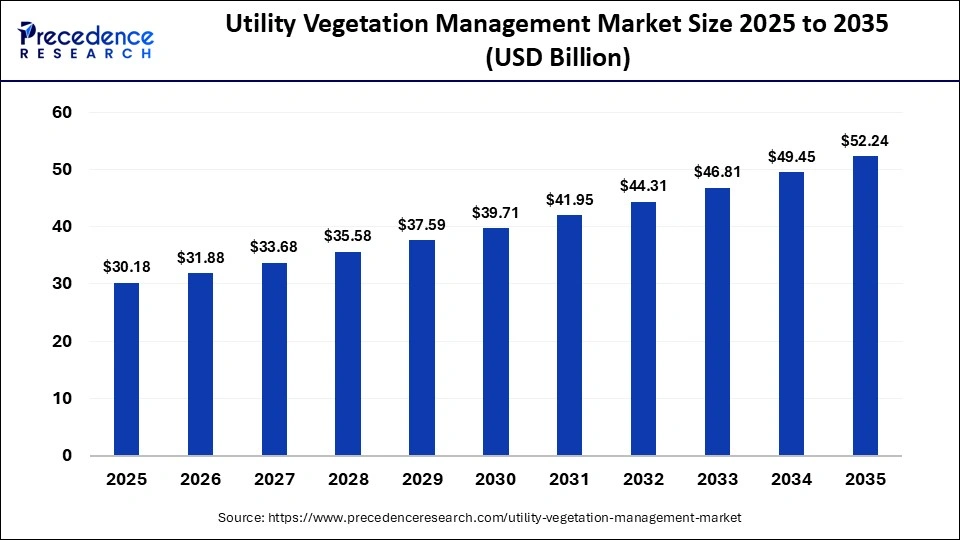
Utility Vegetation Management Market Size 2025 to 2035

Market Highlights

  • North America dominated the market by holding a more than 48.6% market share in 2025.
  • The Asia Pacific is expected to grow at a significant CAGR of 7.8% from 2026 to 2035.
  • By service type, the tree trimming segment contributed the highest market share of 35.8% in 2025.
  • By service type, the inspection & monitoring segment is growing at a significant CAGR of 6.7% from 2026 to 2035.
  • By utility type, the electric utilities segment captured the highest market share of 62.4% in 2025.
  • By end-user, the public utilities segment accounted for the highest market share of 56.8% in 2025.
  • By end-user, the private utilities segment is poised to grow at a solid CAGR of 7% from 2026 to 2035.

What is the Utility Vegetation Management Market?

The utility vegetation management market covers services, technologies, and solutions used by electric, gas, and water utilities to manage vegetation around transmission and distribution infrastructure. It includes tree trimming, hazard tree removal, remote sensing, LiDAR analytics, inspection services, and predictive vegetation intelligence platforms. UVM helps utilities reduce outage risks, prevent wildfires, ensure grid reliability, comply with regulations, and lower maintenance costs. Market growth is driven by climate threats, grid modernization initiatives, and increasing adoption of drones, AI, and GIS-based vegetation mapping.

Key Technological Shifts in the Utility Vegetation Management Market?

Several technologies are significantly influencing the market by enhancing efficiency and precision in vegetation monitoring and control. LiDAR technology provides accurate 3D mapping of vegetation, helping to identify potential risks to power lines and improve decision-making. GIS enables utilities to map and manage vegetation data geographically, optimizing maintenance schedules and reducing operational costs. The integration of AI & Machine Learning allows for predictive analysis of vegetation growth and potential outages, while drones & UAVs and remote sensing technologies enable real-time aerial surveys, improving vegetation management practices and ensuring safety with minimal manual intervention.

  • Digital Transformation: This trend is accelerating the adoption of enterprise vegetation management software as utilities seek to enhance operational efficiency and consistency.
  • Workforce Shortages: Increasing labor shortages in the UVM industry are driving the need for higher levels of mechanization and automation, including the use of robotic cutters and remotely controlled clearing equipment, which help reduce manual labor and improve efficiency.
  • Emphasis on Sustainability: Utilities are placing greater focus on sustainable practices by exploring eco-friendly trimming techniques, selective cutting, and habitat preservation strategies, which aim to reduce environmental impact while maintaining the safety and reliability of infrastructure.
  • Outsourcing to Specialized Service Providers: Many utilities are turning to specialized service providers to manage vegetation control, leveraging their expertise and advanced technologies like enterprise vegetation management software to improve workflow, enhance transparency, and optimize vegetation management activities.

Utility Vegetation Management MarketOutlook

  • Industry Growth Overview: The utility vegetation management market is expected to grow at a significant rate between 2026 and 2035 due to increasing power demand, rising outage risks from climate-related events, and stricter regulations requiring utilities to maintain safer and more reliable grid operations.
  • Global Expansion: The market is growing worldwide due to increasing grid reliability requirements, rising climate-related outages, and the need for utilities to maintain safe clearance around power infrastructure. Emerging regions offer strong opportunities, as expanding transmission networks, rapid urbanization, and the adoption of digital monitoring technologies create demand for efficient, modern vegetation management solutions.
  • Major Investors: Major investors include electric utilities, infrastructure asset managers, and technology companies specializing in LiDAR, drones, and AI-driven analytics. Their investments accelerate innovation, improve operational efficiency, and enable utilities to adopt advanced vegetation monitoring and maintenance systems that enhance grid safety and performance.

Market Scope

Report Coverage Details
Market Size in 2025 USD 30.18 Billion
Market Size in 2026 USD 31.88 Billion
Market Size by 2035 USD 52.24 Billion
Market Growth Rate from 2026 to 2035 CAGR of 5.64%
Dominating Region North America
Fastest Growing Region Asia Pacific
Base Year 2025
Forecast Period 2026 to 2035
Segments Covered Service Type, Utility Type, End-User, and Region
Regions Covered North America, Europe, Asia-Pacific, Latin America, and Middle East & Africa

Utility Vegetation Management Market Segment Insights

Service Type Insights

The tree trimming segment dominated the market with a 35.8% share in 2025 due to its critical role in ensuring the safety and reliability of power lines. As vegetation growth near power infrastructure poses significant risks, such as outages and fire hazards, regular tree trimming is essential to maintain clearances and prevent disruptions. Additionally, tree trimming is a highly established and widely practiced method that provides immediate, tangible results, making it a fundamental part of vegetation management strategies across regions, especially where extreme weather events are frequent.

The inspection & monitoring segment is expected to grow at a 6.7% CAGR over the projection period because drones, LiDAR-equipped aircraft, and satellite analytics enable utilities to identify problems before they occur. Rising wildfire risks have increased investments in high-frequency corridor inspections. Utilities are increasingly required to document vegetation conditions in detail, boosting demand for continuous monitoring. Digital inspection also streamlines audits and regulatory approvals. As technology advances, monitoring becomes not just a support function but a strategic one.


Utility Type Insights

The electric utilities segment dominated the market by holding a 62.4% share in 2025 and is expected to grow at a CAGR of 6.9% in the upcoming period. This is because they operate extensive distribution and transmission networks that are constantly exposed to vegetation risks. Their regulatory obligations require them to always maintain strict vegetation clearance. Grid reliability targets motivate electric utilities to invest heavily in both trimming and digital mapping. Their budgets also support large-scale inspection programs, unlike many smaller utility categories. All these factors make electric utilities the dominant utility type.

The water utilities segment is expected to grow at a notable rate over the forecast period. This is primarily due to increasing recognition of the importance of vegetation control around water infrastructure to prevent blockages, contamination, and operational disruptions. Overgrown vegetation can obstruct access to reservoirs, pipelines, and treatment plants, posing risks to water quality and supply. Additionally, regulatory pressure and a focus on maintaining ecosystem health have prompted water utilities to invest in sustainable vegetation management practices, further driving demand for effective and efficient solutions in this sector.


End-User Insights

The public utilities segment led the market with a 56.8% share in 2025 due to their extensive and aging grid networks, resulting in ongoing vegetation exposure. They adhere to strict public-sector mandates that focus on reliability and safety. Budget cycles frequently allocate substantial funds for vegetation management to prevent outages. Public utilities also operate across diverse geographical regions, which adds to the complexity of managing vegetation. Their need for compliance documentation further increases demand for monitoring solutions.

The private utilities segment is expected to grow at a 7% CAGR in the coming years due to their agility in adopting new technologies and outsourcing models. They often pursue aggressive modernization strategies to improve service quality. Many private companies are investing in AI-powered monitoring and drone inspections to reduce long-term operational costs. Their customer-focused approach encourages proactive vegetation management. They also tend to form long-term partnerships with specialized vendors for comprehensive encryption. As privatization expands in several regions, private utilities gain momentum.


Utility Vegetation Management Market Regional Insights

The North America utility vegetation management market size is estimated at USD 14.67 billion in 2025 and is projected to reach approximately USD 25.41 billion by 2035, with a 5.65% CAGR from 2026 to 2035.

North America Utility Vegetation Management Market Size 2025 to 2035

Why Did North America Dominate the Utility Vegetation Management Market in 2025?

North America dominated the utility vegetation management market, holding a 48.6% share in 2025. This is mainly due to increasing regulatory compliance and a growing focus on grid reliability. With a projected market growth rate, North America aims to benefit from advancements in technology and innovative vegetation management practices. As climate-related risks persist, utilities are prioritizing effective vegetation management strategies to reduce outages and improve safety.


The U.S. utility vegetation management market size is calculated at USD 11.00 billion in 2025 and is expected to reach nearly USD 19.19 billion in 2035, accelerating at a strong CAGR of 5.72% between 2026 and 2035.

U.S. Utility Vegetation Management Market Size 2025 to 2035

U.S. Utility Vegetation Management Market Analysis

The U.S. market is driven by a strong emphasis on sustainability and operational efficiency, with regulatory changes pushing utilities to enhance services to ensure compliance and mitigate risks from extreme weather events. Simultaneously, the ongoing digital transformation is pushing companies to adopt advanced technologies, streamlining operations and enhancing overall performance. Consequently, the market is positioned for sustained growth, adapting to both the challenges and opportunities of the changing landscape of vegetation management.

Utility Vegetation Management Market Share, By Region, 2025 (%)

Asia Pacific is expected to grow at the fastest CAGR of 7.8% during the forecast period because grids are increasingly experiencing vegetation interfering with power lines. Many countries in the region are simultaneously modernizing their electricity networks. Utilities are becoming more eager to find new products and technologies that help them manage vegetation in the most efficient and scalable way. This is especially true for APAC utilities, which are showing strong interest in next-generation inspection solutions such as drones, mobile workforce platforms, and automated reporting systems. Climate variability, including storms and monsoons, primarily drives them to adopt risk-based vegetation control strategies. As a result, the region is gradually moving away from basic trimming operations and adopting more advanced UVM frameworks supported by modern technologies.

China is undergoing extensive grid expansion and has diverse vegetation zones, which enable utilities there to deploy technology-driven and efficient maintenance strategies. Electrification in India is advancing rapidly, boosting the demand for outsourcing trimming services as well as low-cost digital monitoring solutions. Japan is a country highly focused on the reliability and accuracy of its power supply, leading it to adopt advanced aerial imaging and standardized UVM frameworks.


Europe is expected to grow at a notable rate in the upcoming period as utilities are making efforts to meet strict environmental and operational standards. The region's focus on sustainability drives efforts like selective clearing, habitat preservation, and minimizing ecological disruption during vegetation management. The shift to clean energy sources, particularly decentralized grids and wind energy zones, is driving growing demand for efficient vegetation monitoring. To meet transparency and documentation standards, European utilities are quickly adopting digital vegetation management platforms. Additionally, frequent storms in the region lead to a shift in focus from reactive to preventive trimming and risk mapping solutions.

Germany and France are leading the effort with well-coordinated vegetation policies and the extensive use of digital reporting tools. The UK focuses on reliability and storm resilience and is therefore expanding drone-based inspection programs. The Nordic countries favor ecological trimming and long-term vegetation planning because of their delicate ecosystems.


The market in the Middle East & Africa (MEA) is fueled by rapid infrastructure development and climate-related vegetation issues. Sandstorms and sparse vegetation in desert areas lead to different maintenance needs, while the growing development of power plants in tropical African countries requires more frequent clearing. Despite resource limitations, utilities are gradually adopting digital mapping tools into maintenance plans. Projects aimed at expanding the grid are consequently increasing the demand for well-organized programs.

What Opportunities Exist in Latin America for the Utility Vegetation Management Market?

Latin America presents significant opportunities in the market due to its rapidly expanding urbanization and increasing infrastructure development. As many countries in the region face challenges posed by dense, fast-growing vegetation, there is a growing demand for innovative, cost-effective vegetation control solutions, such as automated trimming and monitoring technologies. Furthermore, with a growing focus on sustainability and climate resilience, utilities are investing more in advanced vegetation management practices to minimize risks posed by extreme weather conditions and ensure grid reliability.


Top Companies in the Market & Their Offerings

  • Davey Tree Expert Company: It provides comprehensive vegetation management services, focusing on maintaining clearances around utility infrastructure to ensure safety and reliability.
  • Asplundh Tree Expert: It specializes in vegetation management for utilities, offering tree trimming and vegetation control services to prevent power outages and improve grid reliability.
  • ACRT Services: It delivers consulting and vegetation management solutions, using data-driven approaches to optimize utility operations and minimize risks from vegetation.
  • Corteva Agriscience: It offers innovative herbicides and vegetation control products that help utilities manage vegetation growth efficiently and sustainably.
  • CN Utility Consulting: It provides expert consulting services to utilities on vegetation management, helping to ensure compliance with regulations and improve operational efficiency.
  • Lewis Tree Service: It offers tree trimming and vegetation management services, focused on reducing outages and enhancing the reliability of electric distribution systems.

Other Major Companies

  • LineWise Solutions
  • ArborWorks
  • Vegetation Management Services Inc.
  • Clearion
  • Trimble
  • ENE.HUB
  • Quantum Spatial (NV5 Geospatial)
  • Leica Geosystems
  • Planet Labs

Recent Development

  • In March 2025, CATALYST launched INSIGHTS Vegetation Management, a satellite-based monitoring service designed to help electric utilities address key operational challenges. The service identifies high-risk areas to reduce outages and improve reliability. CATALYST highlights that vegetation is a major cause of power outages, infrastructure damage, and wildfires.(Source: https://internationalfireandsafetyjournal.com)

Utility Vegetation Management MarketSegments Covered in the Report

By Service Type

  • Tree Trimming
  • Herbicide Application
  • Hazard Tree Removal
  • Inspection & Monitoring

By Utility Type

  • Electric Utilities
  • Gas Utilities
  • Water Utilities

By End-User

  • Public Utilities
  • Private Utilities
  • Municipal Utilities

By Region

  • North America
  • Europe
  • Asia-Pacific
  • Latin America
  • Middle East & Africa

For inquiries regarding discounts, bulk purchases, or customization requests, please contact us at sales@precedenceresearch.com

Frequently Asked Questions

The utility vegetation management market size is expected to increase from USD 30.18 billion in 2025 to USD 52.24 billion by 2035.

The utility vegetation management market is expected to grow at a compound annual growth rate (CAGR) of around 5.64% from 2026 to 2035.

The major players in the utility vegetation management market include LineWise Solutions, ArborWorks, Vegetation Management Services Inc., Clearion, Trimble, ENE.HUB, Quantum Spatial, Leica Geosystems, and Planet Labs.

The driving factors of the utility vegetation management market are the rising power demand, stringent safety regulations, increasing outage incidents from vegetation-related hazards, and the adoption of advanced monitoring and vegetation control technologies

North America region will lead the global utility vegetation management market during the forecast period 2026 to 2035.

Ask For Sample

No cookie-cutter, only authentic analysis – take the 1st step to become a Precedence Research client

Meet the Team

With over 14 years of experience, Aditi is the powerhouse responsible for reviewing every piece of data and content that passes through our research pipeline. She ensures the accuracy, relevance, and clarity of insights we deliver. Her expertise spans ICT, automotive, and several cross-domain industries.

Learn more about Aditi Shivarkar

Related Reports