



Water and Wastewater Treatment Equipment Market Revenue, Leading Companies, Company Product Portfolio, Production Output, Material Consumption, Sales Performance, Pricing Trends, Distribution Analysis, Company Market Share, and Forecast
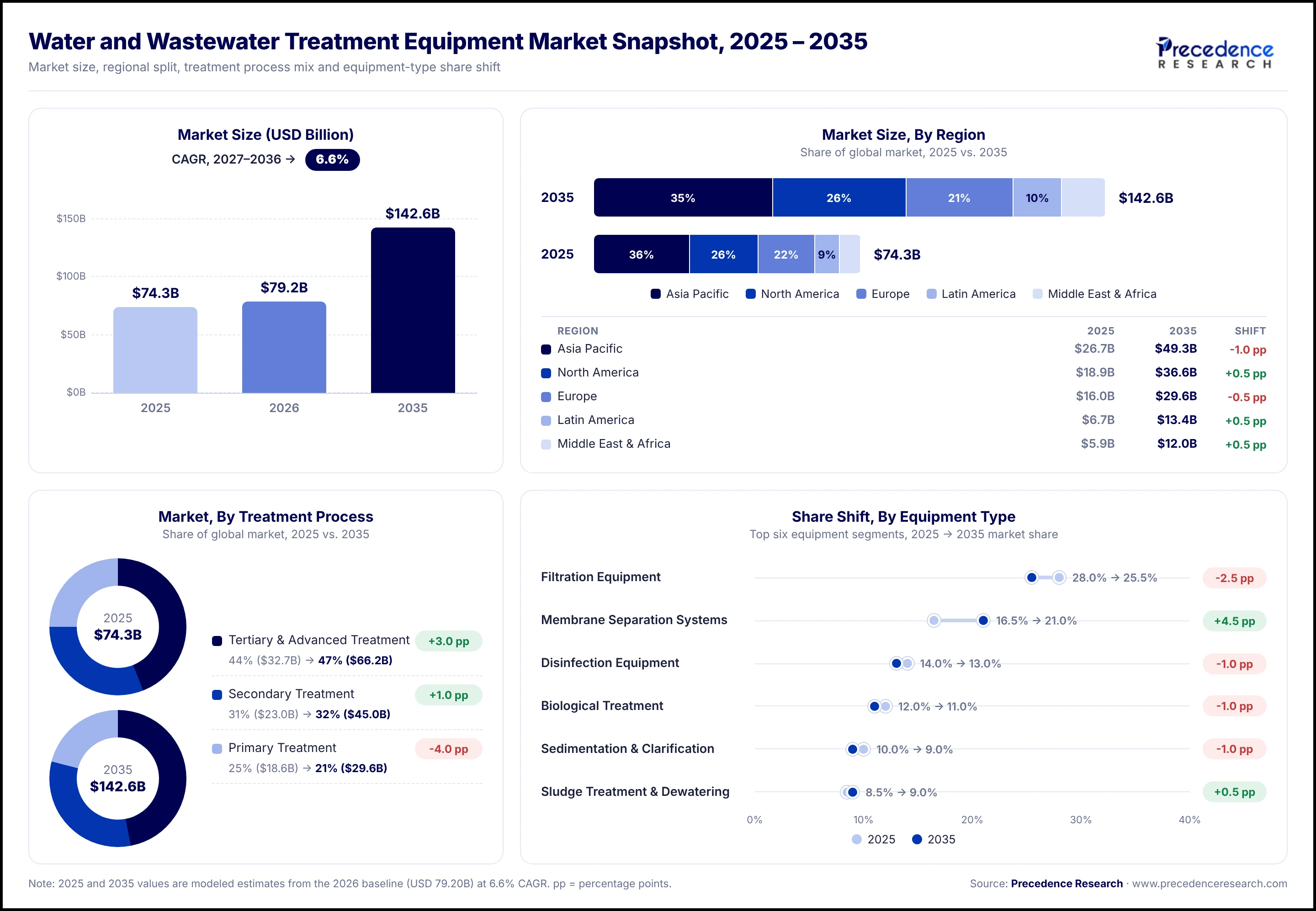
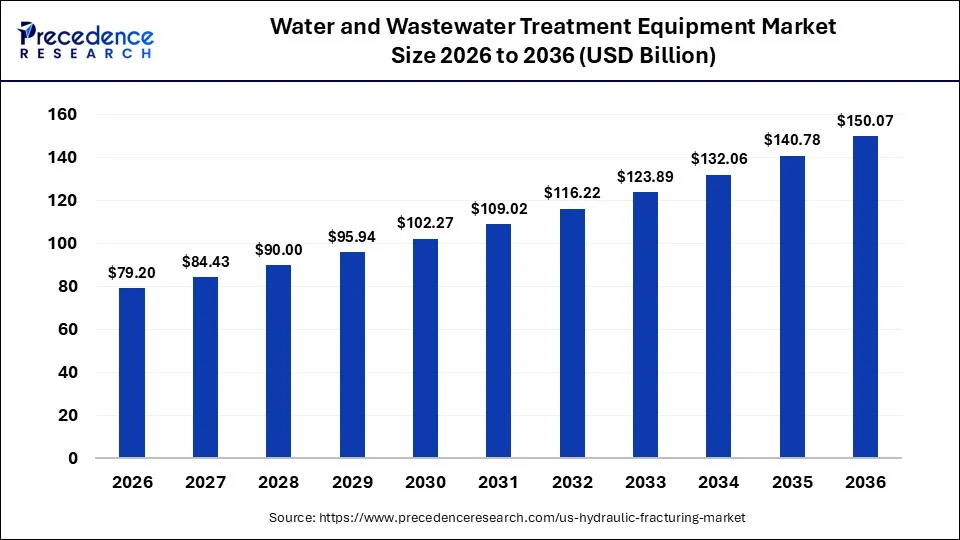
The water and wastewater treatment equipment market was valued at USD 79.20 billion in 2026 and is projected to grow at a CAGR of 6.6% through 2036. Market growth is driven by increasing water scarcity, rising need for clean water, stringent environmental regulations, and rising investments in water infrastructure. Key trends include expanding adoption of filtration systems, disinfection equipment, desalination systems, membrane technologies, and advanced biological treatment solutions, along with automation, IoT-enabled monitoring, and energy-efficient technologies. Rising industrialisation, wastewater reuse, urbanisation, and government initiatives to improve water quality and sanitation are expected to create new opportunities for equipment producers and water treatment technology providers through 2035.
Source: https://www.precedenceresearch.com/water-and-wastewater-treatment-equipment-market
 Get a Sample
 Report Description


What is the Water and Wastewater Treatment Equipment Market Size?
The global water and wastewater treatment equipment market size was estimated at USD 79.20 billion in 2026 and is predicted to increase to approximately USD xx billion by 2036, expanding at a CAGR of 6.6% from 2027 to 2036. This is driven by increasing water scarcity, strict regulatory standards, and a growing focus on sustainable practices. As urbanisation and industrialisation continue to rise, the need for effective water and wastewater management solutions is becoming vital.
Key Takeaways
- By region, Asia Pacific led the water and wastewater treatment equipment market, holding a major share of 36% in 2026.
- By region, North America held a 25% share of the market in 2026 and is expected to grow at the fastest rate during the projection period.
- By equipment type, the filtration equipment segment held a 27.5% share of the water and wastewater treatment equipment market in 2026.
- By equipment type, the membrane separation systems segment fastest growing held an 18% share of the market during the projection period.
- By treatment process, the tertiary and advanced treatment segment held a dominant position in the water and wastewater treatment equipment market, with a 45% share in 2026.
- By treatment process, the secondary treatment segment held a 31% share of the market during the projection period.
- By application, the municipal wastewater treatment segment held a dominant position in the water and wastewater treatment equipment market, with a 30% share in 2026.
- By application, the municipal water treatment segment held a 27% share of the market in 2026 and is expected to grow the fastest during the projection period.
- By technology, the conventional physical and chemical treatment segment held a dominant position in the water and wastewater treatment equipment market, with a 27% share in 2026.
- By technology, the membrane filtration and separation segment held a % share of the market in 2026 and is expected to grow the fastest during the projection period.
- By end user, the municipal water and wastewater utilities segment dominated the water and wastewater treatment equipment market with a share of 58% in 2026 in the coming years.
- By end user, the industrial manufacturing segment held a 17% share of the market in 2026 and is expected to grow the fastest during the projection period.
Market Overview
The water and wastewater treatment equipment market is a global industry that manufactures, sells, and then maintains the machinery and physical systems used to clean, purify, and manage water so it is safe for human consumption, industrial processes, or environmental release. It spans primary processes such as physical settling or screening, secondary such as biological breakdown of organic waste, and tertiary like advanced polishing, nutrient removal, and UV or membrane disinfection processes.
What are the Key Trends Influencing the Water and Wastewater Treatment Equipment Market?
- Energy-Efficient and Green Equipment: Conventional treatment operations are heavily energy-intensive and face strict regulatory, financial, alongside environmental pressures. Governments worldwide are enforcing tighter carbon-emission limits and wastewater discharge standards.
- Growth in Membrane Separation and Filtration: It delivers superior contaminant removal as well as water reuse capabilities in a smaller footprint than conventional methods. Membrane systems need a smaller physical plant footprint than traditional sand or media filtration.
- Decentralized and Modular Systems: Legacy centralized infrastructure is too slow, expensive, and then inflexible to keep pace with rapid urbanization, shifting regulations, and water scarcity. Modular equipment enables utilities and industries to scale capacity incrementally.
How is AI Transforming the Water and Wastewater Treatment Equipment Market?
Artificial intelligence is transforming the water and wastewater treatment equipment market by changing operations from reactive and manual practices to predictive, automated, and data-based systems. AI in wastewater treatment brings continuous, sensor-driven intelligence to every stage of the treatment process. From the inlet screen to the final discharge point, smart systems now monitor, predict, control, and then report around the clock, without human intervention at every step. Many states now need industries to treat and reuse wastewater internally. AI systems optimize treatment quality to meet reuse standards consistently. Finding and retaining trained wastewater operators is increasingly difficult. AI-assisted automation decreases dependence on manual expertise while improving treatment consistency.
Market Dynamics
Driver
- Stringent Environmental Regulations
Stringent environmental regulations act as a primary driver for the water and wastewater treatment equipment market by legally compelling municipalities and industrial facilities to upgrade, expand, or replace their infrastructure to meet strict pollution-control and water-quality standards. Moreover, aging public sanitation and municipal systems must expand and modernize to manage urban growth while complying with tighter ecological safety laws, generating multi-billion-dollar investments in plant equipment such as clarifiers, aeration units, and sludge-handling systems.
Restraint
- Complex Operational Requirements
Complex operational requirements act as a major restraint on the water and wastewater treatment equipment market because modern systems need high technical expertise, specialized maintenance, and continuous energy consumption. Equipment such as fine-pore membranes, high-pressure pumps, and polishing units need frequent cleaning, calibration, and timely replacement to prevent scaling, fouling, or system failure.
Opportunity
- Decentralized Treatment Systems
Decentralized treatment systems represent a major growth opportunity for the water and wastewater treatment equipment market as they lower infrastructure costs, enable rapid scaling, and support localized water reuse. Centralized systems require massive networks of pipes and pumps that often account for over 50% of total project capital expenses. Decentralized plants process water at or near the source, thus, eliminating expensive long-haul pipelines and difficult terrain routing.
Segmental Analysis
Equipment Type Insights
| Segment | Share 2026 (%) | Market Value 2026 |
|---|---|---|
| Filtration Equipment | 27.50% | USD 21.780 Billion |
| Membrane Separation Systems | 18.00% | USD 14.256 Billion |
| Disinfection Equipment | 14.00% | USD 11.088 Billion |
| Biological Treatment Equipment | 12.00% | USD 9.504 Billion |
| Sedimentation and Clarification Equipment | 10.00% | USD 7.920 Billion |
| Sludge Treatment and Dewatering Equipment | 9.00% | USD 7.128 Billion |
| Aeration Equipment | 5.00% | USD 3.960 Billion |
| Pumps, Valves and Conveyance Equipment | 4.50% | USD 3.564 Billion |
| Other Treatment Equipment | 0.00% | USD 0.000 Billion |
The filtration equipment segment dominated the market in 2026, accounting for 27.50% of the 2026 market, valued at USD 21.780 billion. It acts as a primary pretreatment method for raw water as well as a final polishing step in tertiary treatment, thus making it indispensable in virtually every treatment plant. Governments worldwide enforce tighter compliance thresholds on industrial effluent and also municipal wastewater discharge, forcing facilities to upgrade their mechanical and membrane filtration lines.
The membrane separation systems segment held an 18% share of the market in 2026 and is valued at USD 14.256 billion during the projection period. This is mainly due to the high separation precision, smaller facility footprints, and lower chemical usage compared to traditional methods. Moreover, membrane units require significantly less physical space than traditional settling basins and sand filters, thus making them ideal for land-scarce urban environments and decentralized facilities.
Analyst View: Filtration holds the largest overall market share because of its core role in removing suspended solids and particulates.
Treatment Process Insights
| Segment | Share 2026 (%) | Market Value 2026 |
|---|---|---|
| Primary Treatment | 24.00% | USD 19.008 Billion |
| Secondary Treatment | 31.00% | USD 24.552 Billion |
| Tertiary and Advanced Treatment | 45.00% | USD 35.640 Billion |
The tertiary and advanced treatment segment dominated the market in 2026, accounting for 45% of the 2026 market, valued at USD 35.640 billion. It is essential for meeting strict environmental standards, removing persistent contaminants, and then enabling water reuse. Growing freshwater shortages have transformed tertiary treatment from a simple final polishing step into a core strategy for recycling wastewater into irrigation, industrial processes, and also potable water.
The secondary treatment segment held a 31% share of the market in 2026 and is valued at USD 24.552 billion during the projection period. This is mainly because it targets the core pollutant-removal phase required by global environmental laws and manages the massive volume of municipal and industrial waste. Secondary treatment is a mandatory prerequisite for water recycling and reuse. Furthermore, as freshwater scarcity rises, industries and municipalities depend on secondary treatment equipment to clean water for non-potable uses such as agricultural irrigation, industrial cooling, and landscape watering.
Analyst View: The section mainly focuses on mechanical reliability and footprint reduction to catch gross solids and then protect downstream pumps from premature wear, and emphasizes energy efficiency and real-time microbial or sensor monitoring.
Application Insights
| Segment | Share 2026 (%) | Market Value 2026 |
|---|---|---|
| Municipal Wastewater Treatment | 30.00% | USD 23.760 Billion |
| Municipal Water Treatment | 27.00% | USD 21.384 Billion |
| Industrial Wastewater Treatment | 24.00% | USD 19.008 Billion |
| Industrial Process Water Treatment | 13.00% | USD 10.296 Billion |
| Desalination and Water Reuse | 6.00% | USD 4.752 Billion |
The municipal wastewater treatment segment dominated the market in 2026, accounting for 30% of the 2026 market, valued at USD 23.760 billion. It is driven by local and national governments prioritizing public health protection, driving continuous funding into municipal wastewater collection, primary treatment equipment, along with disinfection systems. Expanding cities and high population densities demand massive, continuous investments in clean drinking water supply and even large-scale sewage processing infrastructure.
The municipal water treatment segment held a 27% share of the market in 2026 and is valued at USD 21.384 billion during the projection period. This is mainly because many established municipal networks rely on decades-old pipelines and plant equipment, prompting large-scale capital investments to modernize headworks, clarification, and even ultrafiltration units. Environmental protection agencies and local governments enforce rigid water quality and pathogen reduction, alongside effluent discharge standards that compel municipalities to invest heavily in filtration, disinfection, and biological treatment systems.
Analyst View: The tertiary treatment segment represents the fastest-growing equipment category due to tighter environmental discharge limits and a rising emphasis on water reuse. Secondary biological treatment continues to hold the largest technical share.
Technology Insights
| Segment | Share 2026 (%) | Market Value 2026 |
|---|---|---|
| Conventional Physical and Chemical Treatment | 27.00% | USD 21.384 Billion |
| Membrane Filtration and Separation | 23.00% | USD 18.216 Billion |
| Biological Treatment Technologies | 20.00% | USD 15.840 Billion |
| Advanced Oxidation and Adsorption | 12.00% | USD 9.504 Billion |
| UV and Advanced Disinfection | 10.00% | USD 7.920 Billion |
| Smart Monitoring and Process Automation | 8.00% | USD 6.336 Billion |
The conventional physical and chemical treatment segment dominated the market in 2026, accounting for 27% of the 2026 market, valued at USD 21.384 billion. Heavy-polluting sectors, such as semiconductors, pharmaceuticals, chemicals, and power generation, rely heavily on physical-chemical processes such as coagulation, flocculation, chemical precipitation, and DAF (dissolved air flotation) to treat complex wastewater streams.
The membrane filtration and separation segment held a 23% share of the market in 2026 and is valued at USD 18.216 billion during the projection period. This is mainly due to the semi-permeable membranes filtering out everything from suspended solids and bacteria to microscopic salts, heavy metals, along with trace pharmaceuticals such as carbamazepine and diclofenac.
End User Insights
| Segment | Share 2026 (%) | Market Value 2026 |
|---|---|---|
| Municipal Water and Wastewater Utilities | 58.00% | USD 45.936 Billion |
| Industrial Manufacturing | 17.00% | USD 13.464 Billion |
| Power Generation | 7.00% | USD 5.544 Billion |
| Oil and Gas | 6.00% | USD 4.752 Billion |
| Food and Beverage | 4.00% | USD 3.168 Billion |
| Pharmaceuticals and Biotechnology | 3.00% | USD 2.376 Billion |
| Chemicals and Petrochemicals | 3.00% | USD 2.376 Billion |
| Other Industries | 2.00% | USD 1.584 Billion |
The municipal water and wastewater utilities segment dominated the market in 2026, accounting for 58% of the 2026 market, valued at USD 45.936 billion, as governments are enforcing tighter rules on wastewater discharge and water quality, thus forcing utilities to upgrade and adopt advanced treatment machinery. Moreover, water is increasingly viewed as a circular resource rather than disposable waste. Municipalities are deploying membrane bioreactors (MBRs) and tertiary treatment systems to recycle wastewater for non-potable or industrial use.
The industrial manufacturing segment held a 17% share of the market in 2026 and is valued at USD 13.464 billion during the projection period. This is mainly because untreated water causes severe scaling, corrosion, fouling, along with microbial growth in cooling towers, boilers, and machinery, thus leading to expensive breakdowns and high energy waste. Proper treatment protects capital equipment and cuts down procurement and disposal costs.
Regional Insights
| Segment | Share 2026 (%) | Market Value 2026 |
|---|---|---|
| North America | 25.00% | USD 19.800 Billion |
| Europe | 22.00% | USD 17.424 Billion |
| Asia Pacific | 36.00% | USD 28.512 Billion |
| Latin America | 9.00% | USD 7.128 Billion |
| Middle East & Africa | 8.00% | USD 6.336 Billion |
What Led the Global Asia Pacific Market to Grow in 2026?
Asia Pacific led the market by holding a major share of 36% in the 2026 market, valued at USD 28.512 billion. This is due to urbanization, industrialization, and large-scale water infrastructure investment. Moreover, heavy manufacturing, chemical processing, electronics hubs such as chip fabrication plants in Taiwan, South Korea, and China, and energy sectors generate large volumes of complex industrial wastewater that require advanced purification and ultrapure water systems.
China Market Analysis
China is emerging as a major supplier of water technology to parched countries across Asia, the Middle East and Africa, as shrinking natural supplies at home push Beijing to invest heavily in manufactured freshwater. Thus, Chinese firms are selling desalination membranes, filtration equipment, and engineering services to Egypt, Saudi Arabia, and the UAE, usually through the Belt and Road Initiative, which connects Chinese capital and infrastructure projects to developing markets.
North America: The Fastest-Growing Region
North America held a 25% share of the market in 2026 and is valued at USD 19.8 billion during the projection period, driven by infrastructure modernisation and stringent water-quality regulations. Substantial public and private capital injections, like the U.S. Bipartisan Infrastructure Law, are channelling hundreds of millions of dollars into upgrading municipal and then regional water systems.
U.S. Market Analysis
In the U.S., a large part of the growth is anticipated to be driven by the rising demand for efficient treatment processes. There is a high need for clean water in the industrial and municipal sectors. Moreover, the growing population is increasing the demand for potable water. Government regulations for water treatment have also increased awareness of the importance of clean water. Thus, water treatment chemicals are used in numerous industries and are used to alter the physical properties of water. Their use prevents scaling of various equipment, increases energy efficiency, and then helps in the removal of corrosion.
Europe: The Third-Largest Market
Europe held the second-largest share at 22% in 2026 and is valued at USD 17.424 billion during the projection period. The market is growing primarily because strict environmental regulations turn compliance into a mandatory, non-deferrable investment rather than an optional expense. Around half of the EU and the UK face seasonal or structural droughts, thus forcing industries to look beyond strained rivers and reservoirs. Currently, only about 2.4% of treated urban wastewater is reused across the EU, leaving a massive gap for recycling and desalination equipment.
UK Market Analysis
In the UK, the utilities are moving away from basic mechanical pumps toward intelligent, self-optimising pumping systems with real-time fault detection and variable-speed control to cut energy costs and prevent clogs. Water companies and industrial producers are investing in closed-loop recirculation, zero-liquid discharge systems, and turning wastewater sludge into agricultural fertiliser or energy.
What Drives the Market in Latin America?
Latin America held a 9% share of the market in 2026 and is valued at USD 7.128 billion during the projection period, driven by sanitation expansion and industrial wastewater treatment, due to population growth, climate pressures, and rising industrial demand. Chile, Peru, Brazil, and Mexico are at the forefront of this shift, each driven by unique socio-economic needs. Expanding cities and dense urban peripheries need large-scale municipal sanitation, drinking water access, and wastewater network upgrades.
Brazil Market Analysis
Over 33 million Brazilians lack safe water and 80 million lack sewage treatment, prompting massive state concessions and private-sector partnerships, like Aegea and major utility upgrades, to build out infrastructure. Intensifying water scarcity, especially in regions such as the Northeast, and stricter environmental enforcement are increasing the need for advanced disinfection, sludge treatment, water reuse, and energy-efficient systems.
How is the Opportunistic Rise of the Middle East and Africa in the Market?
Middle East and Africa held an 8% share of the market in 2026 and were valued at USD 6.336 billion during the projection period, driven by desalination, water scarcity, and wastewater reuse. Middle East economies have been driven largely by oil. Oil exports have built nations, funded infrastructure, and then fueled growth across a region that holds more than half of the world’s crude reserves. Water reuse can play a key role in energy transition sectors as well. Moreover, power plants, green hydrogen projects, and mining operations demand large volumes of water for cooling, refining, and chemical processes. By integrating water reuse systems, these facilities can significantly decrease their freshwater demand while contributing to the region’s broader decarbonization goals. Reusing treated water can reduce industrial freshwater need by up to 50% compared to desalination, depending on process requirements.
Saudi Arabia Market Analysis
Saudi Arabia is positioning itself as a major regional market for recycled wastewater to substitute desalinated water in non-potable applications such as agriculture and urban greening. The country has virtually no natural surface freshwater resources and depends heavily on energy-intensive desalination and non-renewable groundwater.
Supply Chain Analysis
Feedstock Procurement
It refers to the sourcing, acquisition, and even quality management of raw materials or influent streams demanded to run treatment processes, manufacture treatment media, or convert waste streams into valuable resources.
Key Players: Ecolab Inc., Solenis LLC, DuPont Water Solutions, Calgon Carbon Corporation, Dow Chemical, Veolia Environnement
Chemical Synthesis and Processing
It provides essential tools, reactions, and also chemical agents that alter waste composition, remove impurities, and make water safe for discharge or reuse.
Key Players: BASF SE, Dow Chemical, Kurita Water Industries, SNF Group
Compound Formulation and Blending
It provides precise chemical combination, uniform distribution, and also optimized performance for treatment agents such as coagulants, flocculants, and scale inhibitors.
Key Players: Kemira, Ecolab, Solenis, SNF Group
Competitive Landscape
The water and wastewater treatment equipment market is characterized by intense competition, technological innovation, along with strategic partnerships. Leading players compete through product efficiency, automation, energy optimization, conventional physical and chemical treatment, and comprehensive service offerings. Established companies leverage strong distribution networks, global presence, and even extensive research and development capabilities to maintain market positions. Meanwhile, regional manufacturers and emerging firms compete through cost-effective solutions and customized equipment. The growing need for sustainable water management, stricter environmental regulations, and industrial wastewater reuse are encouraging investment in innovative treatment technologies. Mergers, acquisitions, alongside collaborations remain key strategies for expanding market reach and strengthening competitive advantages. Key competitors include Xylem, SUEZ, Pentair, DuPont, Veolia, Ecolab, and Aquatech International, each offering specialized technologies and integrated treatment solutions.
Top Companies
- Xylem Inc.
- Veolia Environnement S.A.
- Ecolab Inc.
- DuPont de Nemours, Inc.
- Pentair plc
- SUEZ S.A.
- Evoqua Water Technologies
- Kurita Water Industries Ltd.
- Toray Industries, Inc.
- Aquatech International LLC
Competitive Quadrant
| Leaders | Strong Challengers |
|---|---|
| Xylem Inc. | Ecolab Inc. |
| Veolia Environnement S.A. | DuPont de Nemours, Inc. |
| SUEZ S.A. | Pentair plc |
| Kurita Water Industries Ltd. | Toray Industries, Inc. |
| Specialists | Specialists |
| Aquatech International LLC | Thermax Limited |
| Hach Company | VA Tech Wabag Limited |
| Trojan Technologies | Organo Corporation |
| IDE Technologies | Ovivo Inc. |
Leading Top 5 Players Market Share (Combined Top 5)
| Company | Estimated Market Share (%) |
|---|---|
| Xylem Inc. | 7.50% |
| Veolia Environnement S.A. | 7.00% |
| Ecolab Inc. | 5.50% |
| DuPont de Nemours, Inc. | 4.50% |
| Pentair plc | 4.00% |
| Combined Top 5 | 28.50% |
| Other Players | 71.50% |
Companies Ecosystem
| Ecosystem Stage | Relevant Companies / Participants | Role in the Market |
|---|---|---|
| Raw Materials / Inputs | DuPont, BASF, Kurita Water Industries, Kemira | Membrane materials, treatment chemicals, coagulants and flocculants |
| Components / Technology | Toray Industries, Pentair, Xylem, Grundfos, KSB | Membranes, filtration components, pumps, valves and fluid-handling systems |
| Manufacturing / Production | Xylem, Veolia, SUEZ, Ecolab, Pentair, Aquatech International | Treatment equipment, integrated systems and industrial water purification |
| Processing / Integration | Veolia, SUEZ, Kurita, Thermax, VA Tech Wabag, IDE Technologies | Engineering, procurement, construction, system integration and treatment plant commissioning |
| Distribution / Sales | Xylem, Ecolab, Pentair, Grundfos, regional equipment distributors | Equipment supply, replacement parts, technical service and maintenance |
| End Users / Buyers | Municipal utilities, industrial manufacturers, power plants, oil and gas operators, food and beverage companies, pharmaceutical manufacturers | Drinking-water production, wastewater treatment, process-water supply and water reuse |
Recent Developments
- In June 2026, Xylem’s launch of its Dissolved Air Flotation (DAF) solutions signals a step forward in how wastewater is treated, reused, along with valued. This recently launched technology introduces a compact, modular, and even highly efficient pre-treatment system programmed to remove suspended solids from wastewater streams across a broad range of industries. (Source: infrastructurenews.co.za)
- In May 2026, Veolia declared the launch of two innovative water treatment technologies at the IFAT trade fair in Munich, Germany. The Hydrotech cloth filter Confidence series, along with the Ozonia S ozone generator, represents a major leap forward in Veolia's mission to secure water resources for municipalities, industries, and even communities globally. (Source: veoliawatertechnologies.com)
Segments Covered in the Report
By Equipment Type
- Filtration Equipment
- Membrane Separation Systems
- Disinfection Equipment
- Biological Treatment Equipment
- Sedimentation and Clarification Equipment
- Sludge Treatment and Dewatering Equipment
- Aeration Equipment
- Pumps, Valves and Conveyance Equipment
- Other Treatment Equipment
By Treatment Process
- Primary Treatment
- Secondary Treatment
- Tertiary and Advanced Treatment
By Application
- Municipal Wastewater Treatment
- Municipal Water Treatment
- Industrial Wastewater Treatment
- Industrial Process Water Treatment
- Desalination and Water Reuse
By Technology
- Conventional Physical and Chemical Treatment
- Membrane Filtration and Separation
- Biological Treatment Technologies
- Advanced Oxidation and Adsorption
- UV and Advanced Disinfection
- Smart Monitoring and Process Automation
By End User
- Municipal Water and Wastewater Utilities
- Industrial Manufacturing
- Power Generation
- Oil and Gas
- Food and Beverage
- Pharmaceuticals and Biotechnology
- Chemicals and Petrochemicals
- Other Industries
By Region
- North America
- United States
- Canada
- Mexico
- Europe
- Germany
- United Kingdom
- France
- Italy
- Spain
- Netherlands
- Rest of Europe
- Asia Pacific
- China
- India
- Japan
- South Korea
- Australia
- Indonesia
- Rest of Asia Pacific
- Latin America
- Brazil
- Mexico
- Argentina
- Chile
- Rest of Latin America
- Middle East & Africa
- Saudi Arabia
- United Arab Emirates
- South Africa
- Egypt
- Qatar
- Rest of Middle East & Africa
For inquiries regarding discounts, bulk purchases, or customization requests, please contact us at sales@precedenceresearch.com
Frequently Asked Questions





Ask For Sample
No cookie-cutter, only authentic analysis – take the 1st step to become a Precedence Research client
 Get a Sample




 sales@precedenceresearch.com
 Schedule a Meeting
