



Web Application Firewall Market Size, Share and Trends 2026 to 2035
Web Application Firewall Market (By Deployment: Cloud-based, On-Premise, By Organization Size, Large Enterprises, Small & Medium-Sized Enterprises (SMEs); By Vertical: BFSI, Healthcare, Retail & E-commerce, Government & Defense) - Global Industry Analysis, Size, Trends, Leading Companies, Regional Outlook, and Forecast 2026 to 2035
Source: https://www.precedenceresearch.com/web-application-firewall-market
 Get a Sample
 Table Of Content


What is the Web Application Firewall Market Size?
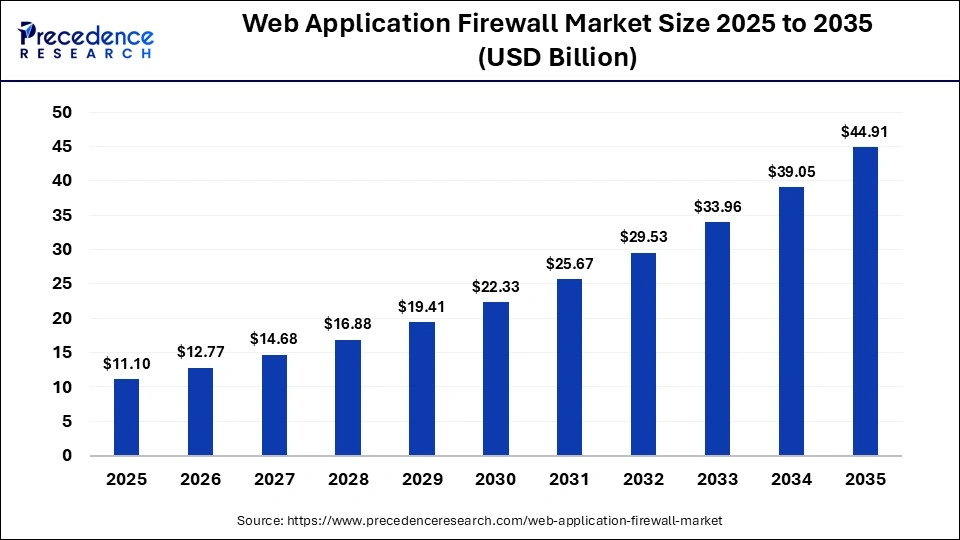
The global web application firewall market size was calculated at USD 11.1 billion in 2025 and is predicted to increase from USD 12.77 billion in 2026 to approximately USD 44.91 billion by 2035, expanding at a CAGR of 15.00% from 2026 to 2035.The web application firewall market is observing growth lately due to higher demand for web application security, strict norms and regulations to follow to prevent cyberattacks, and awareness regarding internet surfing and checking websites before downloading any information or application. Factors such as growing API-based cyberattacks, strict data security regulations, and widespread migration to cloud-based AI-powered security solutions.
Market Highlights
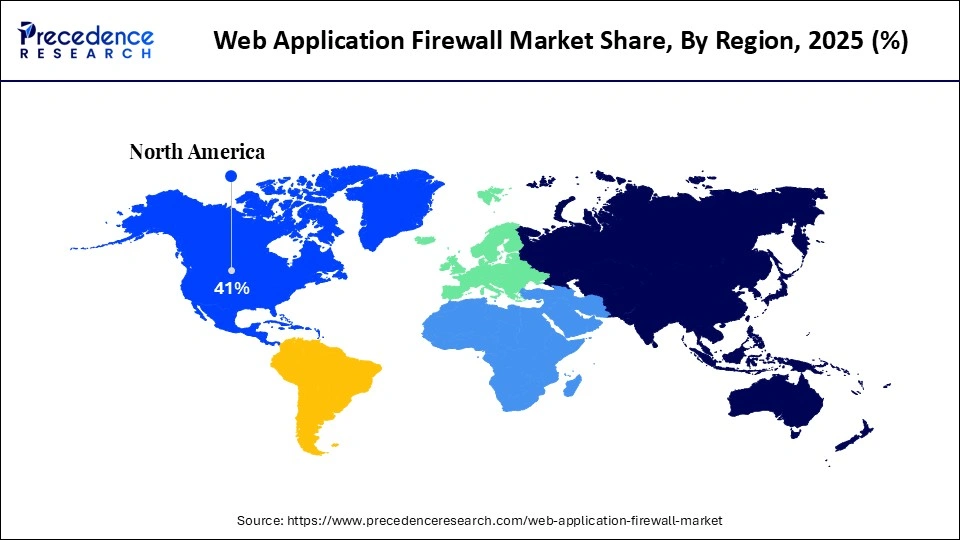
- North America led the global market with approximately 41% in 2025.
- Asia Pacific is observed to be the fastest-growing region in the foreseen period.
- By deployment, the cloud-based segment dominated the global market in 2025 with approximately 54.6% and is also observed as the fastest-growing segment in the forecast period.
- By deployment, the on-premise segment is estimated to grow significantly during 2026-2035.
- By organization size, the large enterprises segment led the market with approximately 55.6% share in 2025.
- By organization size, the small & medium-sized enterprises (SMEs) segment is observed to be the fastest growing in the foreseen period.
- By vertical, the BFSI segment led the web application firewall market in 2025 with approximately 31% share.
- By vertical, the healthcare segment is expected to be the fastest-growing in the foreseeable period.
What is the Web Application Firewall Market?
The Global Web Application Firewall (WAF) Market in 2026 is experiencing a critical shift from traditional signature-based filtering to AI-driven, behavioral-based protection. As of early 2026, the market is valued at approximately $8.5 billion to $10.1 billion, with a projected compound annual growth rate (CAGR) of ~16.5% to 19.4% through the end of the decade. This growth is fueled by the explosion of API-based architectures and the increasing sophistication of automated bot attacks. The market focuses on the use of security tools to keep the applications safe from cyberattacks and maintain the security of the data stored in applications, fueling the growth of the market. Such tools help to analyze each request and respond accordingly, along with ensuring the safety of the data stored in the application to avoid any form of attack.
Role of Technology in the Growth of Web Application Firewall Market
Technology plays a major role in the growth of the industry to maintain data safety and security. It serves as an in-line or reverse-proxy security barrier, analysing HTTP/S traffic to protect web applications and APIs from threats like the OWASP Top 10. Cloud-based security platforms also fuel the growth of the market as they allow easy deployment of security functions with automatic updates, which are ideal for modern and distributed applications.
Technological advancements in the form of AI and ML are helpful to establish behavioural baselines, which also help to fuel the growth of the market. It leads to grant access for automated, proactive detection of zero-day threats and reduces false positives, which is helpful for the market's growth. Locally deployed hardware for low latency, high performance, and on-premises elevated results are also some of the major factors fueling the growth of the market.
Web Application Firewall Market Trends
- Cloud Native Adoption- a major shift from on-premises applications to cloud-based and edge-deployed web application firewall solutions in organizations is one of the major factors propelling the growth of the market.
- Technological Advancements- technological advancements in the form of AI and ML integration in web applications help to counter sophisticated threats like zero-day attacks, and to enhance context-aware security, also help to fuel the growth of the market.
- API Security Focus- higher demand for API-specific protection in modern web application firewall solutions, due to being a prime target for attack, also helps to fuel the growth of the web application firewall market.
- Growing Various Forms of Threats- the increasing threats of various forms, such as data breaches, DDoS attacks, and ransomware, leading to higher demand for web application firewall in different domains, also help to fuel the growth of the market.
- Quicker Results- higher demand for services providing immediate, expertly managed solutions, lowering the need for internal security expertise, also helps to fuel the market's growth.
Market Scope
| Report Coverage | Details |
| Market Size in 2025 | USD 11.1 Billion |
| Market Size in 2026 | USD 12.77 Billion |
| Market Size by 2035 | USD 44.91 Billion |
| Market Growth Rate from 2026 to 2035 | CAGR of 15.00% |
| Dominating Region | North America |
| Fastest Growing Region | Asia Pacific |
| Base Year | 2025 |
| Forecast Period | 2026 to 2035 |
| Segments Covered | Deployment, Vertical, and Region |
| Regions Covered | North America, Europe, Asia-Pacific, Latin America, and Middle East & Africa |
Market Dynamics
Driver
Rising Cybersecurity Threats and Sophisticated Web Attacks
The increasing number of cyberattacks on web applications and web platforms is fueling the growth of the market, which includes SQL injection, XSS, DDoS, and credential stuffing. With regulations governing data privacy and cybersecurity compliance gaining momentum, enterprises are searching for the best WAF solutions. Further, with remote usage, API-driven services and mobile applications have widened the attack surface, demanding ongoing application-layer security. The widespread adoption of modern WAF solutions with artificial intelligence and machine learning capabilities that provide real-time threat detection and automation of response actions is also helping to drive up adoption.
Restraint
High Deployment Costs and Complex Configuration Challenges
The high implementation and operational complexity, and a swift drop in prices, are proving to be major obstacles in the market. The infrastructure, licensing, integration, and maintenance expenses of the advanced WAF solutions can be quite high for small and medium-sized businesses. Knowledge cybersecurity professionals are supposed to set up a WAF solution and manage, detect traffic patterns, and minimise false positives. Poor configuration can obstruct the flow of legitimate traffic, or it may not even detect more advanced attacks, impacting business activity and customer experience.
Opportunity
Increasing Adoption of Cloud-Based and AI-Driven Security Solutions
Adoption of cloud computing and digital transformation projects offers future market opportunity. With the increasing move to cloud environments, enterprises are driving a need for cloud native and scalable WAF solutions. Cloud-based WAF services can be used in a variety of different ways, can be more affordable, can be way simpler to manage, and can be instantly updated to keep pace with evolving security threats—no matter the size of the business. These advanced capabilities help organisations detect and recognise new threats, automate threat mitigation techniques, and enhance overall application security performance.
Segmental Insight
Deployment Insight
Why the Cloud-Based Segment Led the Web Application Firewall Market in 2025?
The cloud-based segment led the global market in 2025 with approximately 54.6% revenue, and is also termed as the fastest-growing segment in the forecast period. Factors such as improved scalability, flexibility, and real-time security with the help of cloud-based solutions help to fuel the growth of the market in the foreseeable period. The platform also helps to deal with sophisticated threats like SQL injections and DDoS, further fueling the growth of the market. Cost-effectiveness, ease of deployment, and automated real-time protection are also some of the major factors helpful in the growth of the market. Cloud-based web application firewalls have lower upfront costs compared to hardware, coupled with easy deployment, management, and immediate updates, which also help to fuel the growth of the market.
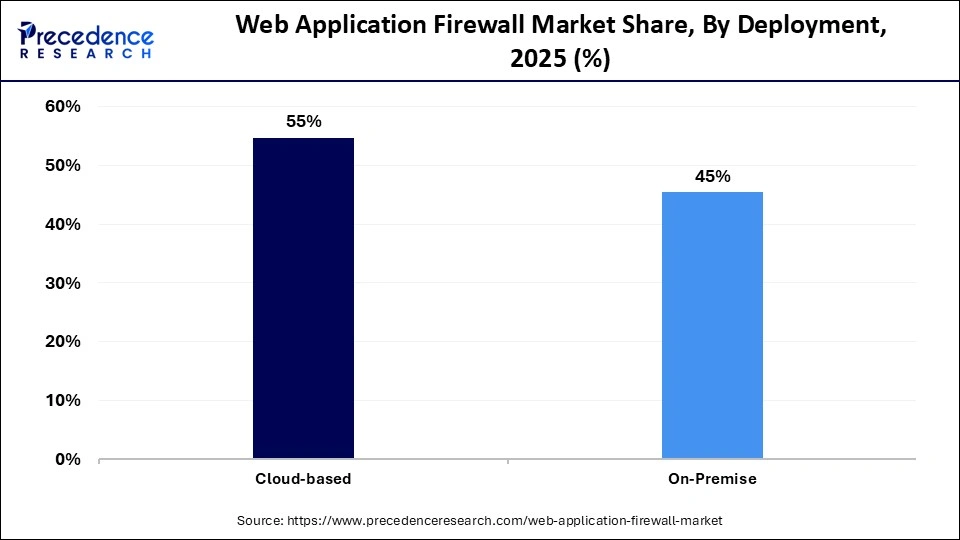
The on-premises segment is observed to have a notable growth in the foreseen period due to higher demand by organizations prioritizing high control, customization, and data security. Higher demand for strict compliance to protect sensitive data and in-house infrastructure also helps to fuel the market's growth. The segment also has a major consumer base of organizations and industries requiring deep control and customization of security, along with the requirement of robust protection of legacy and in-house data infrastructures, fueling the growth of the market.
Organization Insight
How did the Large Enterprises Segment lead the Global Web Application Firewall Market in 2025?
The large enterprises segment, with a revenue of approximately 55.6% revenue share, led the market in 2025 due to higher requirements for advanced, scalable, and AI-powered security. Hence, it helps to protect the enterprises' massive, complex digital infrastructures and sensitive data. Such organizations also prefer cloud-based solutions for manageable, technologically advanced, and scalable solutions, further fueling the market's growth. It helps them to keep their applications secured from various forms of cyberattacks. The technologically advanced techniques also help large organizations to deal with sudden, sophisticated, and automated attacks with ease and without major loss, aiding the growth of the market. Government and defence, BFSI, and E-commerce platforms are some of the major organizations forming the consumer segment.
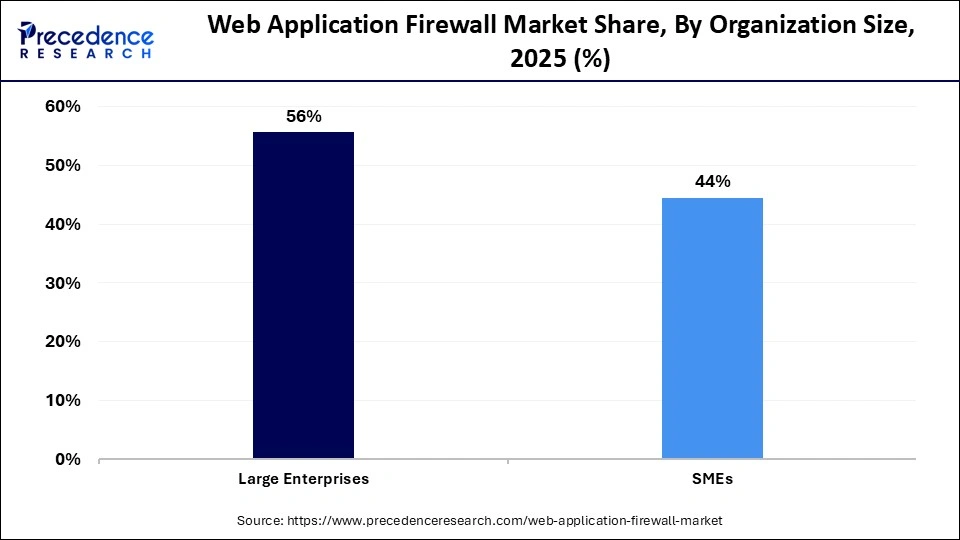
The small & medium-sized enterprises (SMEs) segment is observed to be the fastest-growing in the foreseen period with the highest CAGR. Factors such as higher demand for cloud-based security solutions, increasing number of cyberattacks, and higher demand for cost-effective solutions also help to propel the growth of the market. Such organizations are majorly shifting from on-premises solutions to subscription-based and easy-to-deploy cloud web application firewall services. Supportive factors of cloud-based solutions, such as automation and AI integration, also help to fuel the growth of the web application firewall market in the foreseeable period.
Vertical Insight
Which Component of the Vertical Segment led the Web Application Firewall Market in 2025?
The BFSI segment, with approximately 31% revenue share, led the global market in 2025. The growing need to secure digital banking, online transactions, and sensitive customer data against cyberattacks is one of the major factors fueling the growth of the market. Stringent government regulations, such as PCI DSS, coupled with the growth of internet banking and mandatory cloud-based web application firewall solutions, also help in the growth of the market. The segment also observes growth due to higher demand for online protection from rising cyberattacks such as SQL injection, cross-site scripting, and DDoS attacks on online platforms. Regulatory framework helpful to enhance the security of the BFSI segment, coupled with advanced cloud-based solutions, also helps to fuel the market's growth.
The healthcare segment is observed to be the fastest-growing segment of the web application firewall market in the foreseen period with the highest CAGR. Higher demand to keep the electronic health records, patient data, and wearables data connected with the health care facility, safely, is one of the major factors for the growth of the market in the foreseeable period. The segment also observes growth due to higher demand for rising ransomware attacks, telemedicine adoption, and strict compliance regulations. A web application firewall helps the healthcare segment to keep the data protected from malware, phishing, and application-layer threats. Digital transformation in clinical settings, a surge in IoT device usage, and the use of AI-powered security solutions also help to fuel the market's growth in the foreseen period.
Regional Insight
How Big is the North America Web Application Firewall Market Size?
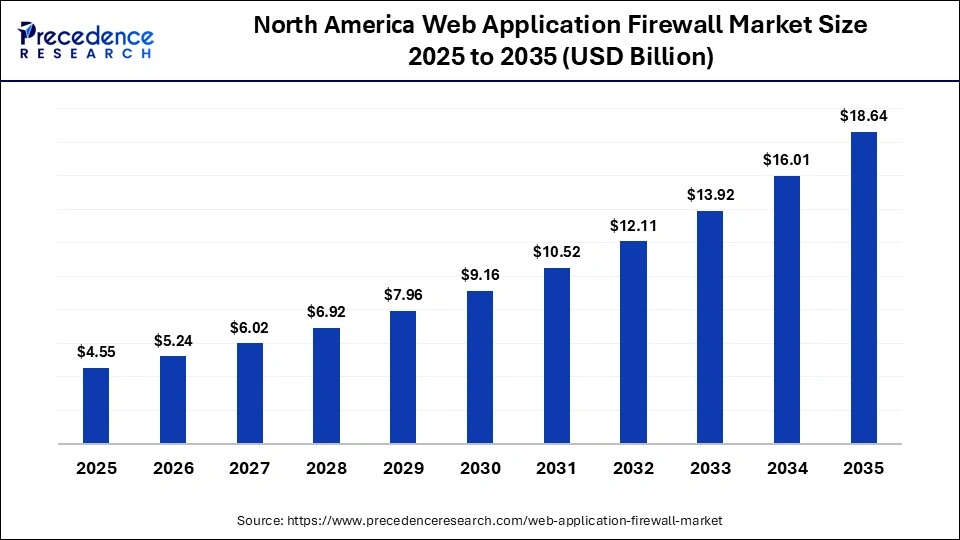
The North America web application firewall market size was estimated at USD 4.55 billion in 2025 and is projected to reach approximately USD 18.64 billion by 2035, with a 15.14% CAGR from 2026 to 2035.
Why did North America lead the Global Web Application Firewall Market in 2025?
North America led the global market with approximately 37% to 41% share in 2025, mainly due to rising cyberattacks and a strict regulatory framework in the region. Higher demand for cloud-based applications for flexible, scalable, and easy deployment solutions, along with on-premises solutions, also helps to fuel the growth of the market. Rising cyberattacks such as ransomware, API breaches, and SQL injections, leading to higher demand for web application firewall solutions, also help in the growth of the market. The market also observes growth in the region due to a strict regulatory framework to enhance the security framework and elevate the security solutions.
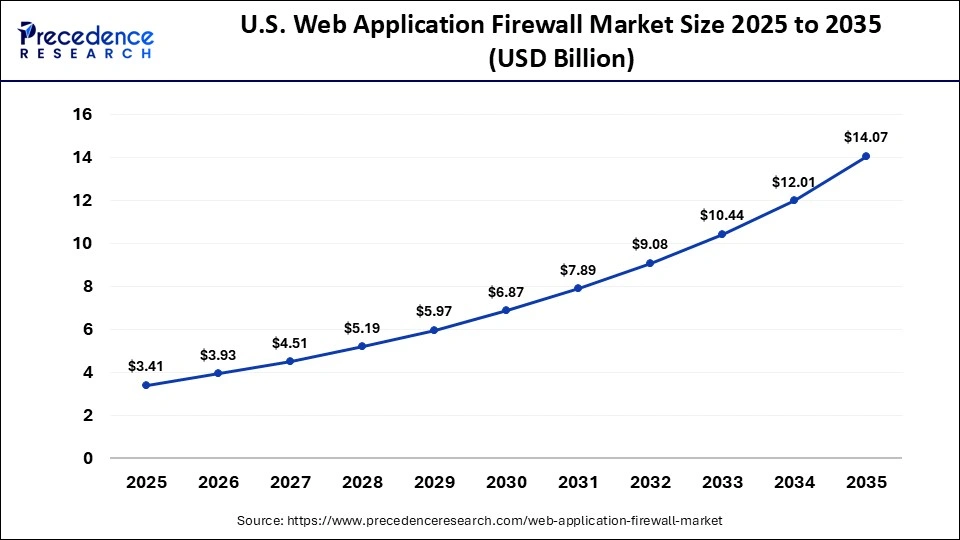
What is the Size of the U.S. Web Application Firewall Market?
The U.S. web application firewall market size was calculated at USD 3.41 billion in 2025 and is expected to reach nearly USD 14.06 billion in 2035, accelerating at a strong CAGR of 15.23% between 2026 and 2035.
The U.S. Web Application Firewall Market Trends
The U.S. has a major contribution to the growth of the market due to higher adoption of cloud-based solutions, strict data regulations, and increasing cyberattacks. The growing need to secure financial, healthcare, and e-commerce data is another major factor fueling the growth of the market. Growing technological firms, financial institutions, and stringent compliance requirements also help to elevate the growth of the market. The growing shift to cloud-based security solutions in the region also helps to enhance the growth of the market.
Why is the Asia Pacific region observed as the fastest-growing region in the Foreseen Period?
Asia Pacific is observed to be the fastest-growing region in the foreseen period with the highest CAGR, mainly due to factors such as growing digital transformation, growing use of e-commerce platforms, and stringent government regulations for data safety. Heavy investments in cloud-based and AI-driven security models in the region are also propelling the growth of the market in the foreseen period. Growing shift of organizations from on-premises hardware to pay-as-you-grow security models for elevated security also fuels the growth of the web application firewall market in the foreseeable period. Cloud-based solutions are affordable and have low upfront costs compared to traditional security setups, enhancing the growth of the market. Stringent laws of the region, such as GDPR-like frameworks, PCI DSS, and local digital security mandates, are also some of the major factors helpful for the market's growth.
China Web Application Firewall Market Trends
China has a major contribution to the growth of the market due to higher deployment of cloud-based security solutions along with a mandatory regulatory framework. Rapid adoption of cloud computing, digital transformation, and the need for robust protection against SQL injection and ransomware also help to fuel the market's growth in the foreseeable period. Cloud-based security solutions help to provide scalable, flexible, and easy-to-access platforms in the region.
What's Driving Web Application Firewall Market Growth in Europe?
Europe is expected to grow notably in the coming years due to the focus on securing user data. The growing API vulnerabilities and the need to secure the hybrid work infrastructure increase the adoption of WAF. Higher utilization of digital banking and the focus on threat detection increase the adoption of WAF. The growing malicious traffic and the need to combat sophisticated threats increase the use of WAF, driving the market growth.
Germany Market Trends
Germany is a robust contributor to the market. Rising ransomware attacks and the need for basic cyber protection increase the adoption of WAF. The integration of IoT in the manufacturing industry and the focus on protecting the connected ecosystem increase the adoption of WAF. Rising cybersecurity investment supports the overall market growth.
Why is Latin America's Web Application Firewall Market Growing?
Latin America is expected to grow at a notable CAGR over the studied period. The surging cyber attacks and the expansion of online banking increase demand for a web application firewall. The demand for protective technology and the shift to modern security solutions increase the use of web application firewalls. The rise in phishing attacks and the growing API-driven attacks increases the adoption of web application firewalls, which drives the overall market growth.
Brazil Market Trends
Brazil is rapidly expanding in the market. The rising number of internet users and the robust security needs in businesses increase the utilization of web application firewalls. The shift of banks towards digital channels and the growing complexities of threats increase demand for web application firewalls. The explosion of mobile banking supports the overall market growth.
Why are the Middle East and Africa Growing in the Web Application Firewall Market?
The Middle East and Africa region is considered to be a significantly growing area, due to the growth in cloud-based apps and the rise in application-layer attacks. Government regulations for national security and the focus on detecting threats in real-time increase the use of WAF. The expansion of mobile money services and the rising use of web applications across diverse industrial sectors increase the adoption of WAF, boosting the overall market growth.
United Arab Emirates Market Trends
The UAE is a key player in the market in the MEA region. The burgeoning cyber attacks in the private sector and the need for advanced security in businesses increase the adoption of WAF. The growing geopolitical tensions and the rising API vulnerabilities increase WAF adoption. The development of API-powdered security and the interest in managed WAF support the market growth.
Who are the Major Players in the Global Web Application Firewall Market?
The major players in the web application firewall market include Akamai Technologies (App & API Protector), Cloudflare, Inc. (Leading cloud-native WAF) F5, Inc. (BIG-IP Advanced WAF), Imperva (Thales Group) (Strong focus on data-layer defense), Amazon Web Services (AWS) (AWS WAF - Market leader for cloud-native workloads), Microsoft (Azure WAF)
Recent Developments
- In August 2025, Akamai Technologies, Inc. teamed up with LevelBlue to enhance web application and API security with the launch of LevelBlue's Managed Web Application and API Protection (WAAP) service. The new service delivers adaptive, always-on protection aimed at lowering risk.(Source- https://finance.yahoo.com)
- In June 2025, Amazon Web Services launched its AntiDDoS AMR feature. The new feature helps in the automatic mitigation of application attacks that involve HTTP request floods. It will also remove the increasing agile attacks.(Source- https://aws.amazon.com)
Segments Covered in the Report
By Deployment
- Cloud-based
- On-Premise
By Organization Size
- Large Enterprises
- Small & Medium-Sized Enterprises (SMEs)
By Vertical
- BFSI
- Healthcare
- Retail & E-commerce
- Government & Defense
By Region
- North America
- Europe
- Asia-Pacific
- Latin America
- Middle East & Africa
For inquiries regarding discounts, bulk purchases, or customization requests, please contact us at sales@precedenceresearch.com
Frequently Asked Questions





Ask For Sample
No cookie-cutter, only authentic analysis – take the 1st step to become a Precedence Research client
 Get a Sample




 sales@precedenceresearch.com
 Schedule a Meeting
