



Wellness Management Apps Market Size, Share and Trends 2026 to 2035
Wellness Management Apps Market (By Application: Fitness, Lifestyle and Stress, Diet and Nutrition, Others; By Subscription Model: Freemium, Premium, Others; By Delivery Mode: Mobile, Web, Others; By Marketplace: Google Play Store, Apple App Store) - Global Industry Analysis, Size, Trends, Leading Companies, Regional Outlook, and Forecast 2026 to 2035
Source: https://www.precedenceresearch.com/wellness-management-apps-market
 Get a Sample
 Table Of Content


What is the Wellness Management Apps Market Size?
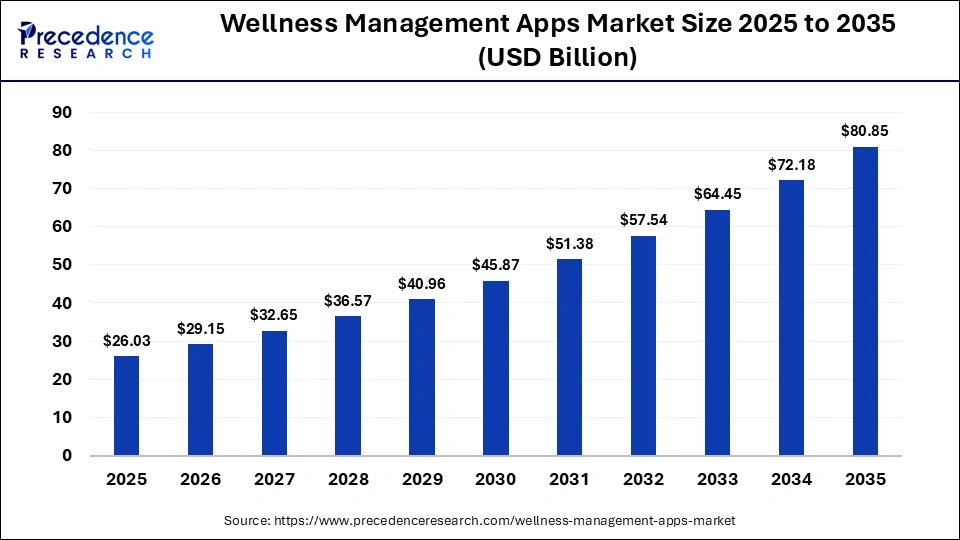
The global wellness management apps market size was calculated at USD 26.03 billion in 2025 and is predicted to increase from USD 29.15 billion in 2026 to approximately USD 80.85 billion by 2035, expanding at a CAGR of 12.00% from 2026 to 2035.This market is growing due to rising health awareness and increasing adoption of digital health solutions.
Market Highlights
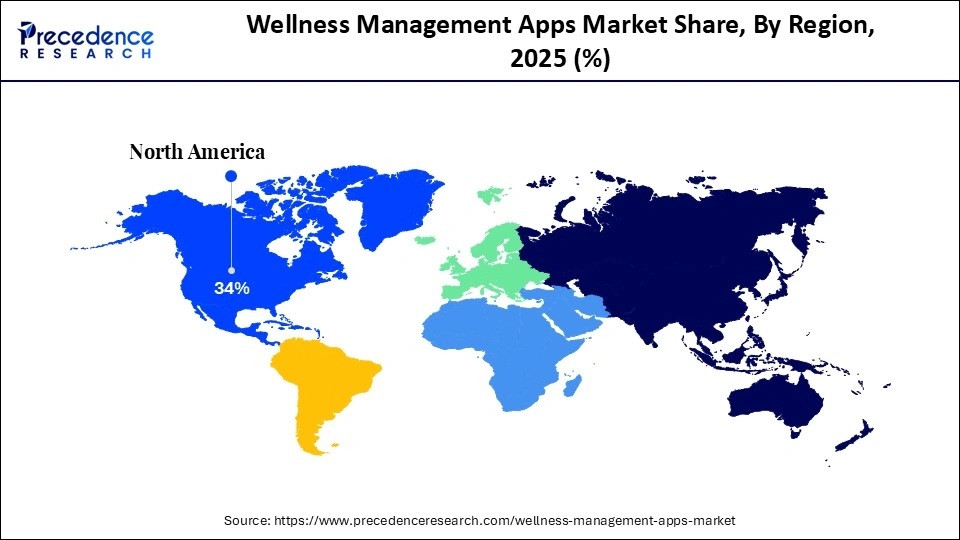
- North America dominated the global wellness management apps market with the largest market share of 34% in 2025.
- Asia Pacific is expected to grow at the fastest CAGR between 2026 and 2035.
- By application, the fitness segment generated the biggest market share in 2025.
- By application, the lifestyle and stress segment is expected to expand at the fastest CAGR between 2026 and 2035.
- By subscription model, the premium subscription model segment contributed the highest market share in 2025.
- By subscription model, the freemium segment is expected to grow at a strong CAGR between 2026 and 2035.
- By delivery mode, the mobile segment held a major market share in 2025.
- By delivery mode, the web segment is expected to expand at the fastest CAGR from 2026 to 2035.
- By marketplace, the Google Play Store segment generated the biggest market share in 2025.
- By marketplace, the Apple App Store segment is expected to expand at the fastest CAGR between 2026 and 2035.
Market Overview
What is Driving the Growth of the Wellness Management Apps Market?
The wellness management apps market is witnessing rapid growth as consumers place more emphasis on lifestyle management, mental health, and preventive healthcare. The market refers to digital applications designed to help individuals track, manage, and improve their overall health, fitness, and lifestyle habits through features such as activity tracking, diet monitoring, mental health support, and personalized health recommendations. These apps offer benefits such as increased engagement in health routines, real-time monitoring, improved adherence to wellness plans, and data-driven insights for preventive care.
The adoption of these apps is being driven by rising smartphone penetration, wearable device use, and growing awareness of stress management, nutrition, and fitness. Employers and healthcare providers are also pushing digital wellness platforms to lower healthcare costs and enhance long-term health outcomes
Wellness Management Apps Market Future Overview
- Growing demand for subscription-based and premium wellness app services.
- Opportunities in chronic condition wellness management.
- Rising interest in holistic wellness platforms combining fitness, nutrition, sleep, and mindfulness.
- Partnerships with employers, insurers, and healthcare providers to expand the user base
- Growing demand for personalized and AI-powered wellness solutions
- Increasing adoption of corporate wellness programs across enterprises.
- Rising focuses on mental health, emotional well-being, and stress management.
- Expansion of wellness apps in emerging markets with high smartphone penetration
- Strong integration opportunities with wearable devices and smart health ecosystem
What are the Key Regulations Impacting the Wellness Management Apps Market?
The market is strongly influenced by regulatory and legal requirements surrounding data security and privacy. Laws such as GDPR, HIPAA, and India's DPDP Act mandate explicit user consent, secure handling of personal health information, and transparency in data usage. Additionally, apps that make clinical or diagnostic claims may fall under FDA or EU MDR regulations, requiring rigorous validation and compliance approvals. Consumer protection laws also restrict misleading wellness claims, directly affecting app features, marketing strategies, and overall compliance costs. These regulatory pressures shape app development, adoption, and the operational strategies of market players.
How is AI Impacting the Wellness Management Apps Market?
Artificial Intelligence is playing a key role in advancing the wellness management apps market by making highly customized lifestyle and health experiences possible. AI-powered algorithms examine user behavior, activity levels, sleep habits, and wellness objectives to provide personalized exercise regimens, dietary advice, and suggestions for mental health. AI assists wellness apps in improving user retention outcomes and long-term value through predictive insights, real-time coaching, and ongoing engagement through intelligent notifications. This makes the apps more efficient and scalable across a variety of user groups. Additionally, AI-driven insights are helping users set smarter goals, track progress more effectively, and maintain long-term motivation, further propelling the market's growth.
Market Trends
- Increasing adoption of AI-driven, personalized wellness and fitness recommendations.
- Growing focus on mental health, mindfulness, and stress management features.
- Integration with wearable devices for real-time health and activity tracking.
- Rising demand for holistic wellness apps covering fitness, nutrition, sleep, and mental well-being.
- Gamification and community-based features to improve user engagement.
- Expansion of corporate wellness programs using digital wellness platforms.
Market Scope
| Report Coverage | Details |
| Market Size in 2025 | USD 26.03 Billion |
| Market Size in 2026 | USD 29.15 Billion |
| Market Size by 2035 | USD 80.85 Billion |
| Market Growth Rate from 2026 to 2035 | CAGR of 12.00% |
| Dominating Region | North America |
| Fastest Growing Region | Asia Pacific |
| Base Year | 2025 |
| Forecast Period | 2026 to 2035 |
| Segments Covered | Application, Subscription Model, Delivery Mode, Marketplace,and region |
| Regions Covered | North America, Europe, Asia-Pacific, Latin America, and Middle East & Africa |
Segment Insight
Application Insight
What Made Fitness the Dominant Segment in the Wellness Management Apps Market?
The fitness segment dominated the market while holding the largest share in 2025, driven by high demand for tools for nutrition planning, activity monitoring, and exercise tracking. Preventive fitness trends and rising health consciousness encourage broad adoption. Personalized fitness plans and at-home workouts are becoming more and more popular, which keeps increasing user engagement. The dominance of the segment is further strengthened by integration with wearables and smart devices in home-based fitness programs and virtual workout classes.
The lifestyle and stress segment is expected to grow at a rapid pace in the upcoming period, driven by growing work-life imbalance and mental health issues. Apps that track sleep meditation and mindfulness are becoming more popular among all age groups. Demand is also being accelerated by an increasing corporate emphasis on employee well-being. Segmental growth is also driven by the growing social acceptance of mental health solutions.
Subscription Model Insight
Why Did the Premium Segment Dominate the Wellness Management Apps Market?
The premium segment dominated the market in 2025 because it provides users with access to advanced features, personalized plans, and ad-free experiences that free versions cannot offer. Consumers are willing to pay more for ad-free experiences, professional advice, and personalized insights. For app providers, recurring revenue models increase their financial stability. Additionally, premium users exhibit greater rates of engagement and retention. The allure of paid subscriptions is further increased by regular feature updates and exclusive content.
The freemium segment is expected to grow at the fastest CAGR in the coming years because it allows users to access basic app features at no cost, lowering the barrier to entry and attracting a large user base. Many users start with free features and later upgrade to paid plans once they see the app's value, driving gradual revenue growth. Additionally, the freemium model encourages wide adoption, boosts brand visibility, and enables app developers to gather user data for personalized offerings, marketing, and retention strategies.
Delivery Mode Insight
What Made Mobile the Leading Segment in the Wellness Management Apps Market?
The mobile segment led the market with a major revenue share in 2025 because smartphones are the most accessible and widely used devices, allowing users to track fitness, nutrition, and wellness activities anytime and anywhere. Mobile apps offer real-time notifications, seamless integration with wearable devices, and personalized health insights, enhancing user engagement and convenience. The portability, ease of use, and constant connectivity of mobile platforms make them the preferred choice for consumers, driving their dominance in the market.
The web segment is expected to grow at a significant rate throughout the forecast period. This is because web platforms offer multi-device accessibility and scalability, making it easier for organizations to reach a larger audience. Employers are increasingly using web-based dashboards to monitor employee wellness engagement, while advanced data analytics and reporting features further drive adoption. This combination of accessibility, oversight, and actionable insights is boosting the popularity of web-based wellness management solutions.
Marketplace Insight
Why Did the Google Play Store Segment Dominate the Wellness Management Apps Market?
The Google Play Store segment dominated the market in 2025, backed by a sizable Android user base in both developed and developing nations. Increased download volumes have a big impact on market share overall. Wider access to wellness apps is made possible by inexpensive Android devices. Additionally, the low barrier for app installation and easy monetization options further strengthen its dominance in the market.
The Apple App Store segment is expected to grow at a rapid pace in the market due to the increasing adoption of iOS devices, particularly among premium users who prioritize quality, security, and seamless user experience. Its robust ecosystem allows apps to integrate smoothly with Apple Health, Apple Watch, and other iOS features, enabling advanced tracking, personalized insights, and real-time notifications. The store's stringent app review process also ensures higher trust and reliability, encouraging user adoption.
Regional Insights
How Big is the North America Wellness Management AppsMarket Size?
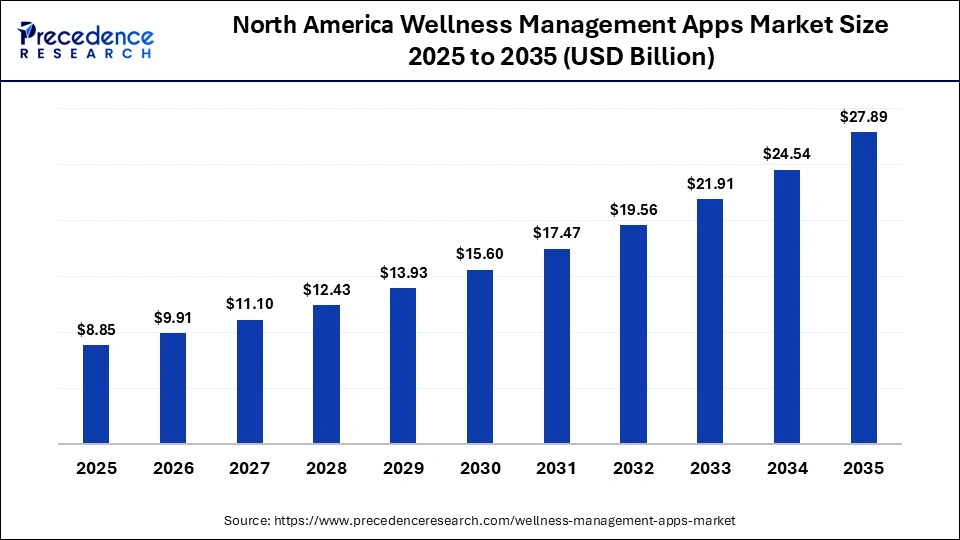
The North America wellness management appsmarket size is estimated at USD 8.85 billion in 2025 and is projected to reach approximately USD 27.89 billion by 2035, with a 12.16% CAGR from 2026 to 2035.
What Made North America the Dominant Region in the Wellness Management Apps Market?
North America dominated the market by capturing the largest share in 2025. This is because of high consumer spending power and widespread adoption of digital health solutions. The region benefits from a deep-rooted focus on preventive healthcare, which encourages sustained app usage for maintaining wellness. The strong local ecosystem, bolstered by key app developers and innovative wellness startups, fosters continuous growth. Corporate wellness programs further contribute to market dominance, as companies increasingly invest in employee well-being through wellness management apps.
What is the Size of the U.S. Wellness Management Apps Market?
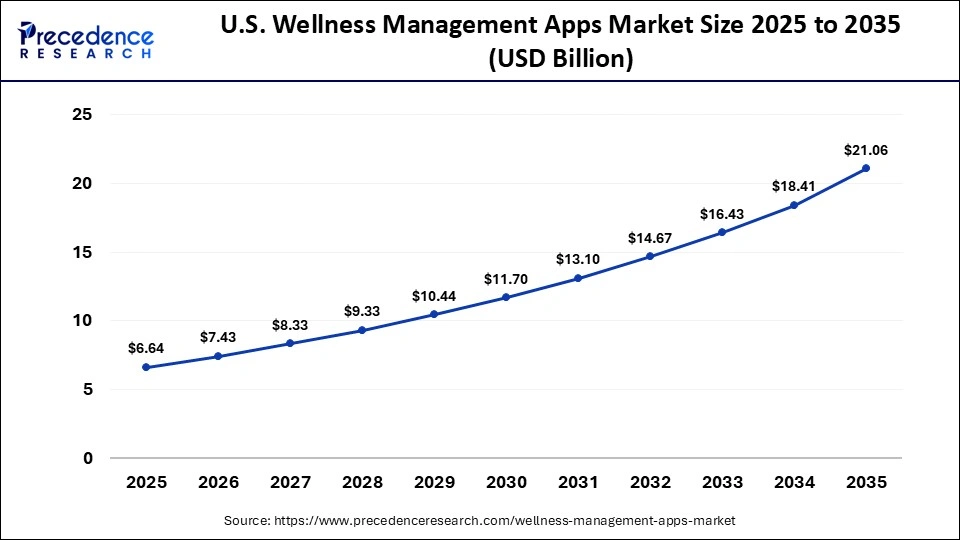
The U.S. wellness management appsmarket size is calculated at USD 6.64 billion in 2025 and is expected to reach nearly USD 21.06 billion in 2035, accelerating at a strong CAGR of 12.24% between 2026 and 2035.
U.S. Wellness Management Apps Market Trends
The U.S. wellness management apps market is highly mature and innovation-driven, supported by strong consumer spending on wellness solutions and widespread adoption of digital health technologies. Growing demand for personalized wellness programs and preventive healthcare has fueled the popularity of fitness and lifestyle apps, with consumers willing to pay for advanced features, professional guidance, and data-driven insights, making premium subscriptions the leading model. The market continues to expand through corporate wellness initiatives, integration with wearables, and an increasing focus on mental health solutions.
How is the Opportunistic Rise of Asia Pacific in the Market?
Asia Pacific is expected to grow at the fastest rate in the market, fueled by growing health consciousness and smartphone adoption. The demand for reasonably priced wellness solutions is being driven by the growing middle class. The use of stress-reduction apps is rising due to rapid urbanization and lifestyle changes. Increasing internet access speeds up market expansion even more.
India Wellness Management Apps Market Trends
In India, the market is growing, driven by a young, tech-savvy populace, growing smartphone adoption, and growing health consciousness. As work-related stress and lifestyle-related health problems rise, fitness and stress management apps are becoming more popular. In India, freemium models are especially successful because they allow for widespread user adoption and gradual monetization. India is positioned as a high-growth market thanks to expanding internet access, regional language support, and growing acceptance of digital health solutions.
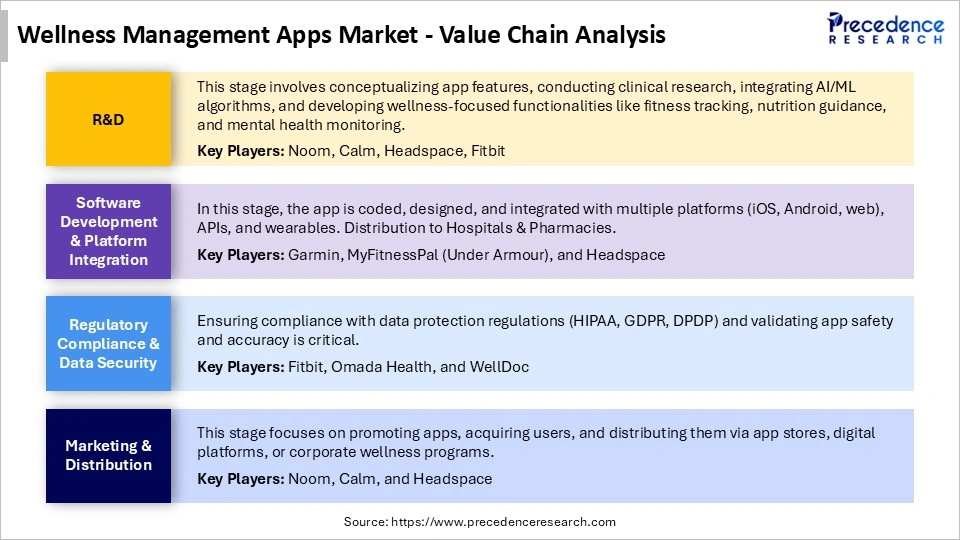
Wellness Management Apps Market Value Chain Analysis
Trends Shaping Next-Gen Health Apps
| Trend | Impact/Significance | Example/Future Vision |
| AI-Powered Personalized Health | Predicts health risks and customizes wellness plans for each user | Apps analyze DNA + wearable data to suggest diet, exercise, and lifestyle changes |
| Virtual Reality (VR) Wellness | Immersive stress relief, fitness, and meditation experiences | VR “digital retreats” or guided VR yoga/meditation programs |
| Gamified Social Engagement | Boosts motivation, adherence, and long-term app usage | Fitness challenges, leaderboards, and AR fitness competitions with friends |
| Wearables & IoT Integration | Real-time health tracking; seamless lifestyle management | Smartwatch + home devices syncing hydration, sleep, posture, and heart monitoring |
| AI Mental Health Coaches | Provides 24/7 personalized guidance for mindfulness and therapy | Chatbots/AI avatars guiding meditation, CBT, and stress management exercises |
| Corporate & Insurance Wellness Programs | Encourages healthier lifestyles and reduces healthcare costs | Employers track wellness scores; insurance incentives for active behavior |
| Telemedicine & Holistic Platforms | One-stop solution for physical, mental, and nutritional health | Integrated apps combining teleconsultation, fitness, nutrition, and AI |
| Data Privacy & Ethical AI | Builds user trust while leveraging sensitive health data | Blockchain or GDPR-compliant AI predicting lifestyle diseases without breaching |
| AR & Immersive Fitness | Interactive workouts, improved adherence, and engaging experiences | Augmented reality trainers, real-time performance analytics, gamified fitness routes |
| Global Expansion in Emerging Markets | Captures untapped populations; leapfrogs traditional healthcare | Apps tailored for Asia-Pacific and Latin America, combining local health |
Who are the Major Players in the Global Wellness Management Apps Market?
The major players in the wellness management apps market include Apple Inc, Google, Samsung Electronics, Garmin Ltd, Withings, Philips, Oracle, Strava, Peloton Interactive, Inc, Under Armour, Inc, WHOOP, Keep (China), Oura Health, Calm.com, Inc, Headspace Health, Talkspace, BetterHelp, Happify, Inc, Wysa, Sanvello Health
Recent Developments
- In December 2025, Apple expanded Apple Fitness+ to 28 additional countries, significantly increasing access to guided fitness and wellness content. The expansion supports Apple's broader strategy to strengthen its digital wellness ecosystem. Growing adoption of subscription-based fitness services continues to boost user engagement globally.
- In June 2024, the Cleveland Clinic partnered with FitNow Inc. to launch the Cleveland Clinic Diet App, offering evidence-based nutrition and fitness guidance. The app focuses on sustainable lifestyle improvement through structured meal planning and activity tracking. It reinforces the growing role of clinically backed wellness applications.
Segments Covered in the Report
By Application
- Fitness
- Lifestyle and Stress
- Diet and Nutrition
- Others
By Subscription Model
- Freemium
- Premium
- Others
By Delivery Mode
- Mobile
- Web
- Others
By Marketplace
- Google Play Store
- Apple App Store
- Others
By Region
- North America
- Europe
- Asia-Pacific
- Latin America
- Middle East & Africa
For inquiries regarding discounts, bulk purchases, or customization requests, please contact us at sales@precedenceresearch.com
Frequently Asked Questions





Ask For Sample
No cookie-cutter, only authentic analysis – take the 1st step to become a Precedence Research client
 Get a Sample



 sales@precedenceresearch.com
 Schedule a Meeting
