



Whole Exome Sequencing Market Size, Companies, Trends, Competitive Landscape, and Demand Forecast
Whole Exome Sequencing Market (By Product & Service: Sequencing Platforms, Consumables (Kits, Reagents), Services (Sequencing & Analysis); By Technology: Short-Read Sequencing, Long-Read Sequencing; By Application: Rare Genetic Diseases, Cancer & Oncology, Mendelian Disorders Research, Other Applications; By End User: Academic & Research Institutes, Clinical Laboratories, Hospitals, Pharmaceutical & Biotechnology Companies; By Workflow: Sequencing, Data Analysis & Interpretation, Sample Preparation) - Global Industry Analysis, Size, Trends, Leading Companies, Regional Outlook, and Forecast 2026 to 2035
Source: https://www.precedenceresearch.com/whole-exome-sequencing-market
 Get a Sample
 Table Of Content


What is the Whole Exome Sequencing Market Size?
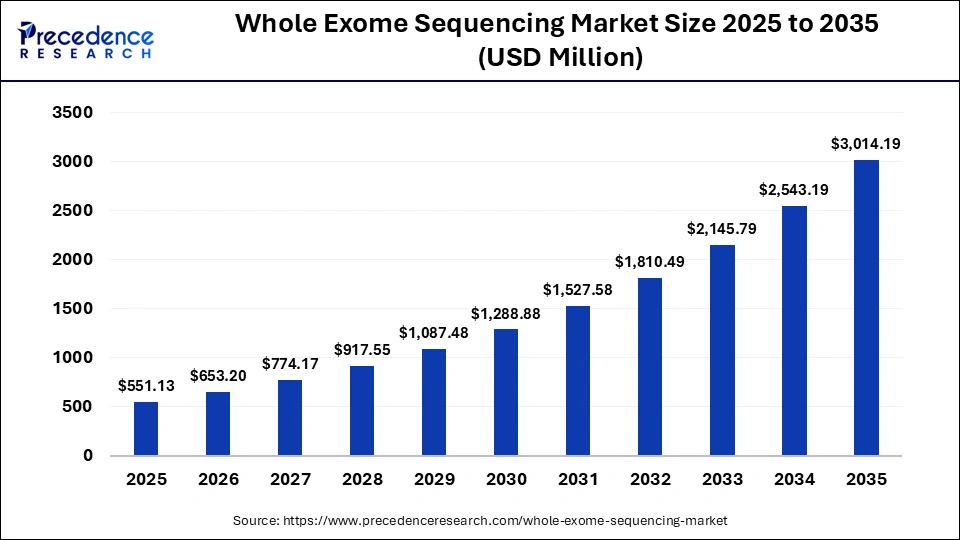
The global whole exome sequencing market size is predicted to increase from USD 653.20 million in 2026 to approximately USD 3,014.19 million by 2035, expanding at a CAGR of 18.52% from 2026 to 2035. The whole exome sequencing market is driven by rising demand for precision medicine and genetic disorder diagnostics.
Market Highlights
- By region, North America dominated the market, holding the largest market share of 45% in 2026.
- By region, Asia Pacific is expected to expand at the fastest CAGR of 18.5% between 2026 and 2035.
- By product & service, the sequencing platforms segment held the largest market share of 40% in 2026.
- By product & service, the services segment is expected to grow at the fastest CAGR of 17.1% during the forecast period.
- By technology, the short-read sequencing segment held the largest market share of 70% in 2026.
- By technology, the long-read sequencing segment is expected to grow at the fastest CAGR of 16.8% in the coming years.
- By application, the rare genetic diseases segment held the largest market share of 45% in 2026.
- By application, the cancer & oncology segment is expected to grow at the highest CAGR of 17.2% between 2026 and 2035.
- By end user, the academic & research institutes segment held the largest market share of 40% in 2026.
- By end user, the clinical laboratories segment is expected to grow at the highest CAGR of 16.7% between 2026 and 2035.
- By workflow, the sequencing segment held the largest market share of 50% in 2026.
- By workflow, the data analysis & interpretation segment is expected to grow at the fastest CAGR of 17.0% in the coming years.
Market Overview
The whole exome sequencing market encompasses technologies, platforms, and services designed to sequence the entire protein coding regions (exons) of the human genome, enabling the precise identification of disease-causing genetic variants. WES is gaining favor as an alternative to whole-genome sequencing, particularly in the diagnosis of rare diseases, oncology, pharmacogenomics, and clinical research. Key drivers of the market include the rising prevalence of genetic disorders globally and the growing demand for personalized and precision medicine. The adoption of WES is further bolstered by declining sequencing costs, government funding, favorable reimbursement policies, and increasing awareness among healthcare professionals.
How is AI Influencing the Whole Exome Sequencing Market?
The whole exome sequencing market is being transformed by the integration of AI, which enhances the analysis, interpretation, and clinical decision-making of genomic data in both research and diagnostics. AI plays a critical role in prioritizing genetic variants, annotating and filtering them, reducing false positives, and increasing diagnostic accuracy. Natural Language Processing (NLP) is also being utilized for automated literature mining, enabling the correlation of genomic discoveries with clinical evidence. Additionally, AI-powered applications streamline workflow automation, reducing time spent on analysis and making WES services more cost-effective for laboratories and hospitals.
Whole Exome Sequencing Market Trends
- There is an increasing adoption of WES in the diagnosis of rare and inherited disorders, which allows generating genomic information at a significantly accelerated and affordable rate. This significantly helps in making prompt decisions and carrying out further research activities worldwide.
- The significance of whole exome analysis in research and diagnostics lies in its ability to be performed faster, more accurately, and efficiently due to advancements in technology. Developments such as high-throughput sequencing systems, automated sample processing, and sophisticated bioinformatics tools have significantly enhanced the speed and precision of exome sequencing.
- The clinical adoption of WES is being witnessed across the globe, along with the rising number of hospitals, diagnostic units, and research centers. The growing screening programs for oncology, neurology, prenatal, and inherited disorders also drive the market.
Market Dynamics
Driver
Growing Public-Private Partnerships
Public-Private Partnerships (PPPs) have become excessively important for revealing the complete potential of healthcare data, which drives the developments in inventive therapies, global health, and tailored medicine. Because of stable financial pressures, public sectors are increasingly behind in completing highlighted features such as data capabilities, which makes partnerships with commercial entities a necessity. Furthermore, with developed dependency on bioinformatic computing software to update insights from overall biological data, PPPs can increasingly need to allow access to such costly computing strength. Due to this, the mixing of a profit-driven company can develop issues around public commitment and lead to the public industries. Despite such issues, they are precise as PPPs are the path for genomic programs in the near future.
Restraint
Technical Disadvantages
Whole Exome Sequencing (WES) has many strong technical, operational, and bioinformatic restrictions that limit its results as compared to the next-generation sequencing stages. Big chromosomal inversions, complicated repeats, and translocations that have repeated developments are usually invisible to WES. There are sensitivity falls present below 60% for CNVs, which are smaller than 50 base pairs, which makes them unavoidable for classifying microduplications or microdeletions without separate microarray checking.
Opportunity
Use of Bioinformatics
As sequencing technologies have developed over the past years, WES has seen crucial growth. The developments in terms of bioinformatics machines and the growth of big public databases have led to various comparisons and annotations, which are beginning to shape companies' predictions of variants sourced from WES and other sequencing studies. Additionally, possibilities in WES pipelines count developed on-target rates, transformed sample indexing, and effective hybridization histories have lessened the lower amount and developed multiplexing, as it enables more samples to be adjusted with multiplexing, as it enables more samples to be co-sequenced with constant read depth. The importance should be given to design machines like IDT's xGen probe design flow, which uses a crucial proprietary AI algorithm to lessen any kind of off-target link and develop exam coverage.
Segment Insights
Product & Service Insights
Why Did the Sequencing Platforms Segment Dominate the Whole Exome Sequencing Market?
The sequencing platforms segment dominated the market while holding the largest share of 40% in 2026 due to the high accuracy, scalability, and faster turnaround time of exome sequencing. Sequencing platforms are crucial in WES, enabling laboratories, hospitals, and research institutions to carry out comprehensive and targeted analyses. The efficiency and reliability of whole-exome sequencing platforms have been significantly improved through continuous innovations, including automated sample preparation, higher read accuracy, and high-throughput capabilities. Additionally, the presence of major global players offering robust systems, strong after-sales support, and comprehensive training programs has further driven the adoption of these platforms across research and clinical laboratories.
The services segment is expected to grow at the fastest CAGR of 17.1% over the forecast period. This is mainly due to the increasing outsourcing of the sequencing workflows and data interpretation to specialized service providers. Clinical labs, hospitals, and research institutes use these services as a way of obtaining high-quality sequencing without having to invest heavily in equipment. The increasing need for end-to-end solutions, which consist of sample processing, variant calling, annotation, and data reporting, also drives the segment. Moreover, service providers continually upgrade their analytical pipelines using artificial intelligence (AI) and machine learning (ML) to achieve more accurate variant interpretation, shorter turnaround times, and efficient management of large-scale genomic data.
Technology Insights
What Made Short-Read Sequencing the Leading Segment in the market?
The short-read sequencing segment led the whole exome sequencing market with the highest share of 70% in 2026. This is mainly due to its widespread use in most clinical and research applications, driven by its high throughput, cost-effectiveness, and proven accuracy. Short-read sequencing technology is excellent at detecting variants of single-nucleotide variants (SNVs) and small insertions and deletions, and is useful in diagnostics of rare genetic diseases, oncology panels, and in population genomics. Lower operational costs as well as wide availability of the platform have made technology popular among sequencing centers, academic institutions, and clinical laboratories.
The long-read sequencing segment is expected to grow at the fastest CAGR of 16.8% in the coming years. This is mainly because it has the ability to detect structural variants and complex mutations, which are challenging to identify using short-read sequencing. Long-read sequencing has become more useful in clinical studies and rare disease detection because it can sequence entire genomes, phase variants of haplotype more accurately, and also offer more characterization of difficult-to-sequence regions. Advances in accuracy, cost efficiency, and throughput continue to simplify the adoption of whole-exome sequencing. The introduction of AI-based bioinformatics tools has also made the analysis of long-read genomic data more effective and reliable.
Application Insights
Why Did the Rare Genetic Diseases Segment Lead the Whole Exome Sequencing Market?
The rare genetic diseases segment dominated the market while capturing a major revenue share of 45% in 2026. This is because WES is typically applied to detect pathogenic variants of the etiology of rare and inherited conditions and provide accurate diagnosis and treatment choices. It is more cost-effective, accurate, and has lower turnaround times than whole-genome sequencing, which makes it the preferred technique in clinical and research use in the identification of rare diseases. Adoption is also facilitated by the growing awareness of genetic testing among healthcare providers and patients, the government, and institutional funding programs. Strong bioinformatics pipelines of annotating, filtering, and interpreting variants also enhance the use of WES in the diagnosis of rare diseases.
The cancer & oncology segment is expected to grow at the highest CAGR of 17.2% during the projection period. This is because WES plays a crucial role in identifying genetic mutations that drive tumor development and progression. It enables precision oncology by helping clinicians select targeted therapies, monitor disease progression, and predict treatment response. The increasing incidence of cancer worldwide, combined with growing adoption of personalized medicine and the need for accurate molecular profiling, further fuels the demand for WES in oncology.
End User Insights
How Does the Academic & Research Institutes Segment Lead the Whole Exome Sequencing Market?
The academic & research institutes segment dominated the market while holding a 40% share in 2026, as these institutions rely on WES to discover novel genetic variants, understand disease mechanisms, and advance personalized medicine initiatives. The availability of advanced sequencing platforms, robust bioinformatics tools, and funding support for large-scale genomic studies further drives adoption in these institutes. Additionally, collaborations with hospitals, biotech companies, and government programs enhance their capacity to conduct high-throughput sequencing, making academic and research institutes key contributors to the market.
The clinical laboratories segment is expected to grow at a 16.7% CAGR throughout the forecast period. This is primarily due to the increase in WES adoption in routine diagnostics, rare disease detection, prenatal screening, and oncology. Outsourcing sequencing and bioinformatics is beneficial to laboratories, enhancing the turnaround time and operational efficiency. The increased clinical uptake of whole exome sequencing is further driven by growing awareness among healthcare professionals, the adoption of precision medicine, and favorable reimbursement policies. Technological advancements, automation, and AI-powered data interpretation are enhancing the speed, accuracy, and cost-effectiveness of sequencing, making WES an increasingly integral part of clinical protocols worldwide.
Workflow Insights
Why Did the Sequencing Segment Lead the Whole Exome Sequencing Market?
The sequencing segment led the market while holding a 50% share in 2026 because it forms the core of the WES workflow, enabling the accurate identification of genetic variants across the protein-coding regions of the genome. Advances in high-throughput sequencing technologies, improved read accuracy, and automation have increased efficiency, reliability, and throughput, making sequencing platforms highly adoptable in both research and clinical settings. Additionally, integration with AI and bioinformatics tools has enhanced variant analysis, reduced turnaround times, and lowered costs, further solidifying the dominance of the sequencing segment in the market.
The data analysis & interpretation segment is expected to expand at the highest CAGR of 17.0% throughout the forecast period. The increasing scale and complexity of exome sequencing data are driving the need for advanced bioinformatics tools, AI, and machine learning algorithms to accurately call, annotate, and prioritize genetic variants. Clinical and research laboratories are investing in integrated analytical pipelines to accelerate variant discovery, reduce errors, and support personalized medicine initiatives. The demand for data interpretation is further fueled by the expansion of sequencing services, precision oncology programs, and rare disease research worldwide.
Region Insights
How Big is the North America Whole Exome Sequencing Market Size?
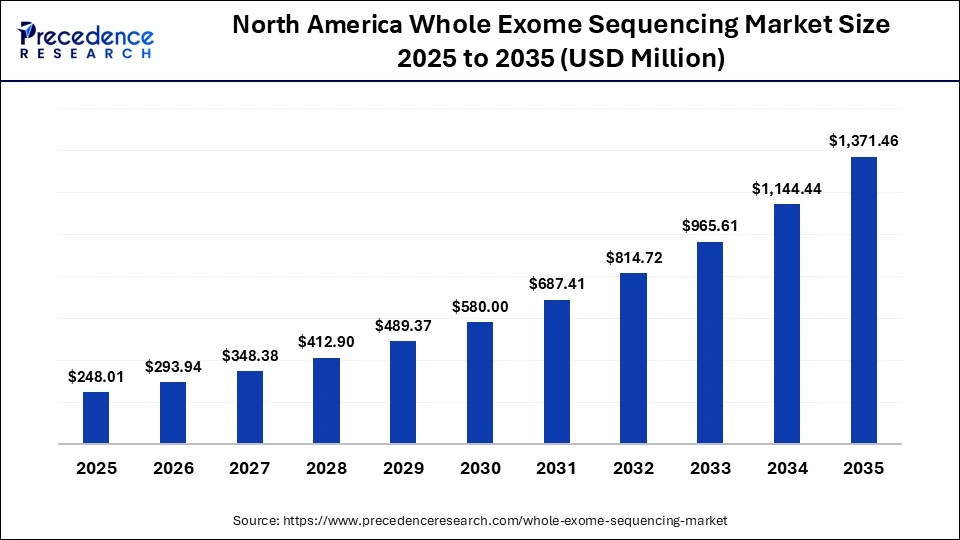
The North America whole exome sequencing market size is estimated at USD 293.94 million in 2026 and is projected to reach approximately USD 1,371.46 million by 2035, with a 18.65% CAGR from 2026 to 2035.
What Made North America the Leading Region in the Whole Exome Sequencing Market?
North America led the market with a 45% share in 2026. This is mainly due to its well-developed healthcare infrastructure, high use of genomic technologies, and substantial investments in research & development. The region's dominance is further supported by significant investments in genomics research, as well as well-established regulatory frameworks and favorable reimbursement policies. Growth is also driven by high awareness among healthcare providers and patients regarding genetic disorders and personalized medicine. The presence of leading market players, advanced sequencing facilities, and strong collaborations between research institutions and healthcare providers also ensures the long-term growth of the market in the region.
What is the Size of the U.S. Whole Exome Sequencing Market?
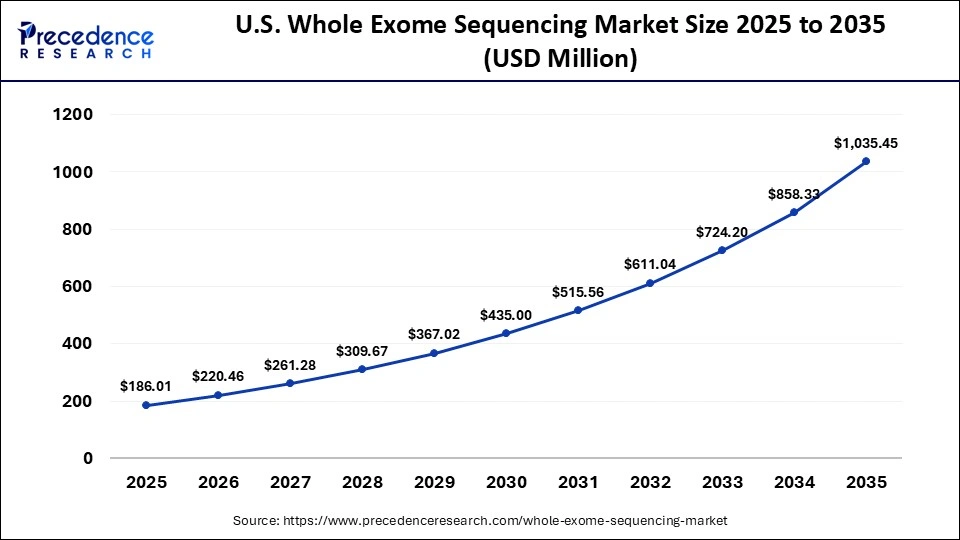
The U.S. whole exome sequencing market size is calculated at USD 220.46 million in 2026 and is expected to reach nearly USD 1,035.45 million in 2035, accelerating at a strong CAGR of 18.73% between 2026 and 2035.
U.S. Market Analysis
The whole exome sequencing market in the U.S. is growing due to increasing adoption of precision medicine and genomic research in clinical and research settings. There is a rising prevalence of genetic disorders, cancers, and rare diseases, which is driving the demand for accurate, cost-effective sequencing solutions. Additionally, collaborations between academic institutions, research organizations, and biopharma companies are expanding the use of WES for diagnostics, drug discovery, and personalized therapies, making the U.S. the leading market globally.
Why is Asia Pacific Considered the Fastest-Growing Region in the Whole Exome Sequencing Market?
Asia Pacific is expected to grow at the fastest CAGR of 18.5% in the coming years. This growth is driven by increasing awareness of genetic diseases, rising healthcare spending, and a surge in genomics research activities in countries such as China, India, Japan, and South Korea. Market expansion is further supported by government funding, public-private partnerships, and genomic medicine programs. Additionally, investments by both local and international sequencing firms are facilitating technology transfer, infrastructure development, and the availability of cost-effective services in the region.
China Market Trends
The Chinese market is growing due to extensive governmental support for local sequencing technology and bioinformatics sectors. China is very keen to achieve the goal of genetic testing self-reliance. The widespread use of whole-exome sequencing for rare disease diagnosis and for newborn screening is the main contribution. Companies are looking to offer full solutions due to increasing competition and offering much faster and more precise analysis services.
Why is the European Whole Exome Sequencing Market Experiencing Notable Growth?
The European whole exome sequencing market is growing at a notable rate, driven by robust healthcare systems, governmental programs, and increasing acceptance of precision medicine. The region benefits from strong financing schemes that promote genomics research, including initiatives aimed at mapping population-specific genetic variations. The presence of established sequencing companies and collaborations between academic and healthcare institutions further fosters technological innovation. Additionally, growing investments in bioinformatics, data analytics, and AI-powered interpretation tools are enhancing the efficiency and accuracy of exome sequencing in the region.
Germany Market Trends
Germany is using whole-exome sequencing for precision oncology and personal treatment with its high-quality hospitals and research institutions in order to detect genetic mutations and treat patients more precisely for cancer. The sequencing technology is being integrated into the public health system with support from the government. High co-operation among hospitals and biobanks enables the use of genetic data.
What Are the Driving Factors of the Whole Exome Sequencing Market in Latin America?
Latin America is expected to grow at a notable CAGR during the forecast period. The Latin American market for genetic testing is expanding as an emerging market with increasing investment in genetic research and testing in the private market. Especially Brazil and Colombia are expanding the accessibility of advanced genetic testing technology and the knowledge of common genetic diseases in a multi-population background. Partnership with global companies can facilitate the acquisition of advanced technology and further enhance testing capabilities in this region.
Brazil Market Trends
Brazil is the main emerging market in Latin America, and whole-exome sequencing is increasingly used in private labs. It has made it possible for the rapid diagnosis of genetic disorders in the case of complex genetic diseases. Co-operation with the global bioinformatics companies has enabled it to improve the data analysis and to enable more and more physicians to use genetic data in precision oncology, but it is still concentrated in urban areas and higher-income populations in terms of accessibility.
How is the Middle East and Africa performing in the Whole Exome Sequencing Market?
The Middle East and Africa are expected to grow at a significant CAGR during the forecast period, due to the increasing concerns towards genetic and heritable diseases. Many governments are providing support for the health system and personalized medicine to improve patient care and well-being. Carrier screening in some populations is highly in demand due to the inherent risks of diseases. UAE and Saudi Arabia have strong support for genomics and making advanced sequencing technology available for users.
Saudi Arabia Market Trends
Saudi Arabia is making significant advances in the development of whole-exome sequencing for genetic diseases linked with hereditary cases, with its country-wide genomics program for rare diseases. Furthermore, the sequencing technology is also used for research purposes in infectious diseases by institutions. Extensive government investment enhances laboratory infrastructure and the availability of advanced testing for users.
Who are the Major Players in the Global Whole Exome Sequencing Market?
The major players in the whole exome sequencing market include Illumina, Inc., Thermo Fisher Scientific Inc., Agilent Technologies, Inc., Roche, BGI Genomics, Eurofins Scientific, Macrogen, Inc., Qiagen N.V., Berry Genomics, CD Genomics, Novogene Co., Ltd., Genewiz, Oxford Nanopore Technologies, Pacific Biosciences, and Integrated DNA Technologies (IDT).
Recent Developments
- In February 2026, Volta Labs and Watchmaker Genomics launched the Callisto Complete Kit for DNA EF Library Prep at the 2026 Advances in Genome Biology and Technology meeting, combining next-gen sequencing sample prep with digital fluidics automation for a PCR-free workflow.
(Source: https://clpmag.com) - In January 2026, Agilus Diagnostics, a subsidiary of Fortis Healthcare, installed the Illumina NovaSeq X in Mumbai, enhancing India's capacity for large-scale next-generation sequencing (NGS). The addition of NovaSeq X significantly strengthens Agilus Diagnostics' molecular testing capabilities through high-throughput sequencing and scalable analytics.
(Source: https://theindianpractitioner.com)
Whole Exome Sequencing Market Segments
By Product & Service
- Sequencing Platforms
- Consumables (Kits, Reagents)
- Services (Sequencing & Analysis)
By Technology
- Short-Read Sequencing
- Long-Read Sequencing
By Application
- Rare Genetic Diseases
- Cancer & Oncology
- Mendelian Disorders Research
- Other Applications
By End User
- Academic & Research Institutes
- Clinical Laboratories
- Hospitals
- Pharmaceutical & Biotechnology Companies
By Workflow
- Sequencing
- Data Analysis & Interpretation
- Sample Preparation
By Region
- North America
- Europe
- Asia-Pacific
- Latin America
- Middle East & Africa
For inquiries regarding discounts, bulk purchases, or customization requests, please contact us at sales@precedenceresearch.com
Frequently Asked Questions





Ask For Sample
No cookie-cutter, only authentic analysis – take the 1st step to become a Precedence Research client
 Get a Sample
.webp)



 sales@precedenceresearch.com
 Schedule a Meeting
