



Smart Manufacturing Market Size, Key Companies, Company Market Share, User Adoption, Technology Deployment, Revenue Growth, Competitive Positioning, and Demand Forecast
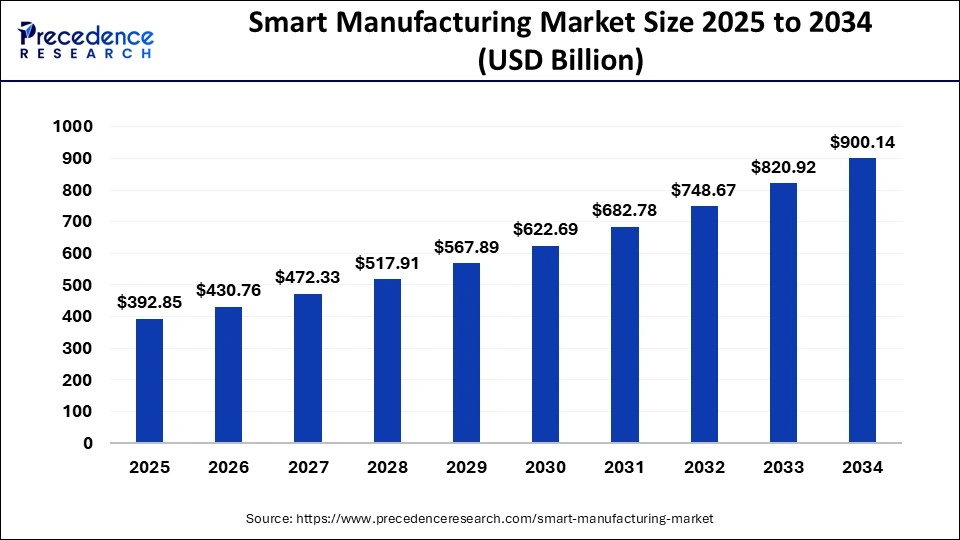
The global smart manufacturing market size is projected to grow from USD 430.76 billion in 2026 to approximately USD 974.71 billion by 2035, expanding at a CAGR of 9.51% during the forecast period. The market is driven by the rapid adoption of Industry 4.0 technologies, including artificial intelligence (AI), Industrial IoT (IIoT), robotics, cloud computing, digital twins, and advanced analytics, which enhance production efficiency, predictive maintenance, and real-time decision-making. Increasing investments in smart factories, industrial automation, and connected supply chains, along with supportive government initiatives for digital manufacturing, are further accelerating market growth across industries such as automotive, aerospace, electronics, healthcare, and industrial equipment.
Source: https://www.precedenceresearch.com/smart-manufacturing-market
 Get a Sample
 Table Of Content


What is Smart Manufacturing Market Size?
The global smart manufacturing market size is anticipated at USD 392.85 billion in 2025 and is projected to grow from USD 430.76 billion in 2026 to approximately USD 974.71 billion by 2035, growth rate CAGR of 9.51% from 2026 to 2035. The smart manufacturing market is driven by rising industrial automation and the adoption of Industry 4.0 technologies, such as AI and robotics.
Key Takeaways
- By Region, Asia Pacific accounted for the largest revenue share of the smart manufacturing market in 2025.
- By Region, North America is expected to grow at the fastest CAGR in the market during the forecast period.
- By technology, the 3d printing segment held a dominant position in the market with a share of 2025.
- By technology, the machine execution systems segment is expected to grow at the fastest CAGR of the market between 2026 and 2035.
- By component, the software segment accounted for a considerable revenue share of the market in 2025.
- By component, the services segment is expected to grow with the highest CAGR of the market during the studied years.
- By end-use, the automotive segment held the largest revenue share of the market in 2025.
- By end-use, the aerospace & defense segment is expected to show the fastest growth with a CAGR of over the forecast period.
Advancing the Smart Manufacturing Market Through AI, Automation, and Industrial Digitalization
smart manufacturing market covers advanced manufacturing systems that utilize the integration of automation, artificial intelligence, Industrial Internet of Things, robotics, cloud, Digital Twins, and data analytics to optimize manufacturing flows and increase efficiency. From the automotive industry to the electronics sector, aerospace to pharmaceuticals and food & beverages, smart manufacturing allows for real-time monitoring, predictive maintenance, better quality control, and maximization of production flexibility.
Key AI Integration in the Smart Manufacturing Market
AI has revolutionized the smart manufacturing industry, with its capabilities in predictive maintenance, smart automation, quality control, and real-time optimization of manufacturing processes. AI's algorithms, based on past analytics from IoT sensors on machines, predict future abnormalities, minimize downtime, and improve efficiency. CVS systems increase accuracy by computerizing the identification of a defect and are used to improve product quality. AI can improve the capabilities of digital twins, demand forecasting, supply chain optimization, and autonomous robotics, among other areas, allowing manufacturers to make quicker data-driven decisions.
Smart Manufacturing Market Growth Factors
The growth of market is driven by increasing demand for connected supply chains and knowledge-based manufacturing that are equipped with advanced modeling, sensing, control, and simulation capabilities. With the advent of Internet of Things (IoT) revolution, there has been significant transformation in the manufacturing sector in form of automation and digitization. Further, cloud technology, Industrial Internet of Things (IIoT), and industrial analytics anticipated to play an important role towards prosper growth of the market.
The industrial sector worldwide has been significantly impacted by numerous factors over the years that include uncertainties in supply chain, intense competition, and exponential operational costs. As a result, market players are actively searching a way that reduces cost and transform enterprises into efficient, accelerated, agile, and compliant with the product quality. Hence, smart industrial solutions estimated to boost the efficiency and productivity in years to come. As per GSMA intelligence report, the industrial IoT connections expected to reach around 13.8 Billion by the end of 2025 along with increase in number of IoT connections in the consumer sector. Growth in the number of IoT connections will stimulate the digitization and connectivity among enterprises. Moreover, different aspects of smart manufacturing predicted to offer additional benefits that include dynamic production and real-time optimization that in turn bolster the need for smart manufacturing at a rapid pace.
Market Outlook
- Industry Growth Offerings- Industry growth in the market is driven by rising demand for automation, IoT, and AI-driven analytics. Companies are delivering connected robots, predictive maintenance, digital twins, and smart sensors to increase efficiency, reduce downtime, and optimize operations.
- Global Expansion- Global expansion in the market is fueled by increasing industrial automation, rising adoption of Industry 4.0 technologies, and growing investments in digital factories. Key regions such as Asia-Pacific, North America, and Europe are scaling smart production through IoT, robotics, AI, and cloud-based industrial platforms.
- Startup ecosystem- Startups in the market are driving innovation through AI-powered robotics, IoT-enabled automation, 3D vision systems, and real-time analytics. They focus on predictive maintenance, process optimization, and intelligent factory solutions, complementing traditional industrial players.
Market Scope
| Report Highlights | Details |
| Market Size in 2025 | USD 392.85 Billion |
| Market Size in 2026 | USD 430.76 Billion |
| Market Size by 2035 | USD 974.71 Billion |
| Growth Rate from 2026 to 2035 | CAGR of 9.51% |
| Fastest Growing Market | Asia Pacific |
| Base Year | 2025 |
| Forecast Period | 2026 to 2035 |
| Segments Covered | Technology, End Use, and Region |
| Regional Scope | North America, Europe, Asia-Pacific, Latin America and Middle East & Africa |
Market Dynamics
Drivers
Rising focus on local production of goods
The Indian government has already started the ‘Make in India' initiative to promote the manufacturing in India in order to reduce the dependencies on importing goods from other countries. In order to boost local manufacturing, the government also offers production linked incentives (PLI) to manufacturers. The scheme also promotes the application and installation of products that are produced in India in various sectors. Many governments are actively promoting local manufacturing through policies, incentives, and funding. These initiatives often align with the adoption of advanced technologies in manufacturing processes. Localized production reduces dependence on far-flung suppliers and makes supply chains more resilient to global shocks. Smart manufacturing technologies enable companies to quickly adapt to changes in demand and supply, ensuring a faster response to market fluctuations. Local production encourages collaboration among manufacturers, suppliers, and customers within a region. Smart manufacturing technologies facilitate seamless communication and information sharing among stakeholders, leading to better coordination, innovation, and joint problem-solving. Thus, the rising focus on local production of goods is observed to act as a driver for the market.
Restraint
Infrastructural limitations
Smart manufacturing involves the integration of advanced technologies such as IoT devices, data analytics, artificial intelligence, and automation into manufacturing processes to improve efficiency, productivity, and flexibility. Smart manufacturing relies heavily on a robust and high-speed internet connection to transmit real-time data between devices, machines, and systems. In regions with poor internet infrastructure or limited connectivity, the adoption of smart manufacturing technologies can be hampered. Smart manufacturing involves the collection, storage, and transmission of sensitive data, making it vulnerable to cyberattacks. Inadequate cybersecurity infrastructure can expose manufacturing facilities to risks such as data breaches, intellectual property theft, and operational disruptions. Thus, infrastructural limitations are observed to act as a major restraint for the market.
Opportunity
Rising emphasis on supply chain optimization
Supply chain optimization combined with smart manufacturing provides real-time visibility into the entire production and distribution process. This visibility enables manufacturers to track the movement of raw materials, work-in-progress, and finished goods, allowing for quick response to any disruptions or delays. The integration of smart manufacturing and supply chain optimization supports agile manufacturing practices. Manufacturers can quickly adapt to changes in demand, product design, or market conditions by adjusting production schedules and processes in real time. This flexibility enhances a company's ability to respond to market fluctuations. Supply chain optimization encourages closer collaboration with suppliers. By sharing real-time data and insights, manufacturers and suppliers can work together to optimize inventory levels, reduce lead times, and enhance the overall efficiency of the supply chain. Thus, the rising emphasis on supply chain optimization aims to present potential opportunities for the market.
Challenge
Difficulties in adoption for small-scale industries
Large corporations often have access to extensive networks, partnerships, and collaborations that can facilitate the adoption of new technologies. Small-scale industries might lack these resources, making it harder to find guidance and support during the adoption process. Many smart manufacturing solutions are designed with larger enterprises in mind. Adapting these solutions to fit the specific needs and scale of small-scale industries can be difficult and might require customization, which can be expensive and time intensive. Thus, such complexities for small-scale industries are observed to pose a challenge for the market.
Segment Insights
Technology Insights
The programmable logic controller segment is projected to grow at a notable pace owing to the integral role that it plays in industrial automation as well as process control. PLCs ensure reliable, real-time control of manufacturing operations, thereby boosting production efficiency and reducing downtime. The surge in Industrial 4.0 technology is creating a demand for more sophisticated systems for PLCs, which are more connected and are more capable of analytics. The use of smarter production environments has begun with PLC technology in the Internet of Things, artificial intelligence, and cloud-based applications.
The enterprise resource planning segment is expected to witness steady growth during the forecast period owing to its potential to facilitate manufacturers' operations and business processes. With ERP applications, production, inventory, procurement, finance, and supply chain management data are all managed by a unified system. Shifting markets and real-time operational insight and data-driven decision-making provide momentum to market growth. It is easier to scale, access, and save costs for manufacturers having a cloud-based ERP system.
Component Insights
Why Did the Software Segment Dominate the Smart Manufacturing Market?
The software segment dominated the market in 2025 owing to its key function for managing connected manufacturing operations. Examples of these include ERP, MES, analytics, and digital twin platforms, offering real-time industrial data collection, predictive maintenance, and production optimization. The rise of widespread adoption of emerging technologies such as the Internet of Things, artificial intelligence, and blockchain has continued to bolster the demand for software.
The services segment is expected to grow significantly during the forecast period due to the rising demand for services like system integration, consulting, maintenance, and managed services. Professional services for smooth deployment, cyber security, and business continuity are being bought by businesses in the informatics space. With ever-increasing expectations on equipment for optimal performance, predictive maintenance and remote monitoring are becoming increasingly important.
The hardware segment is expected to experience considerable growth during the forecast period, as the number of industrial robots, sensors, controllers, and smart production equipment continues to increase. The operations data gathered in real time and powered by connected devices can help facilitate automation and insightful decision-making. Production facilities are upgraded using advanced production equipment to improve the level of efficiency, safety, output, and accuracy. Demand is safeguarded with greater investments in smart factories and infrastructure for industrial IoT.
End-Use Insights
The chemicals & materials segment is projected to grow at a healthy pace owing to the growing trend of uptake of smart manufacturing technologies among chemical manufacturers to be more efficient and safer in the production process. The use of advanced analytics and automation reduces loss of chemicals and energy whilst improving chemical processing. Real-time monitoring guarantees product line and regulatory compliance throughout the manufacturing process. Predictive maintenance reduces equipment breakdowns and downtimes.
The industrial equipment segment is expected to experience considerable growth during the forecast period, with the increasing demand for automated and intelligent manufacturing systems. Smart manufacturing technologies can support better use, more productive, and better performance of the equipment used in manufacturing processes. It uses artificial intelligence, Internet of Things, and machine learning techniques to ensure proactive maintenance and maximize operating efficiency. Production units are undergoing modernisation with a view to their flexibility and low cost of operation.
Regional Insights
U.S. Smart Manufacturing Market Size and Growth 2026 to 2035
The U.S. smart manufacturing market size is recorded at USD 88.00 billion in 2025 and is predicted to be worth around USD 224.48 billion by 2035, at a CAGR of 9.82% from 2026 to 2035.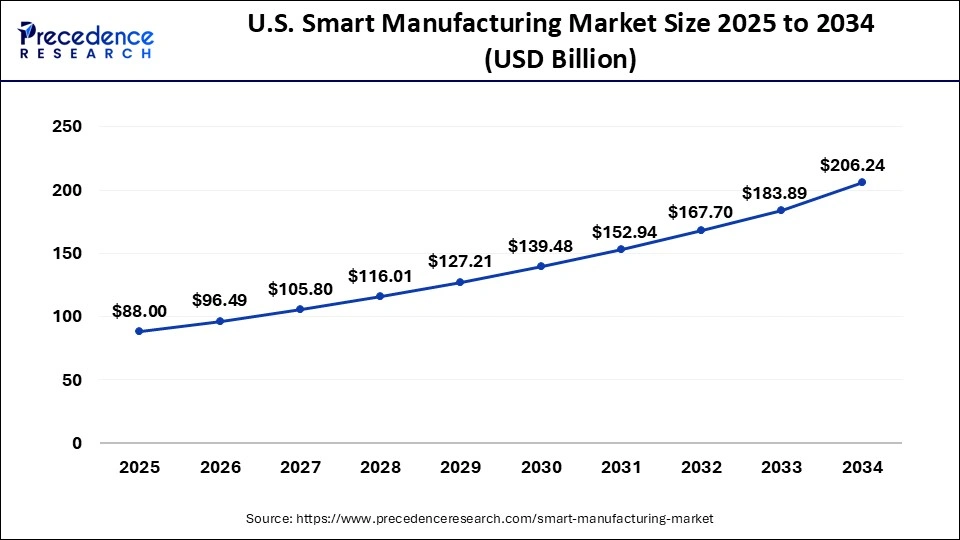
U.S. Smart Manufacturing Soars: Technologies Transform Production
The U.S. market is increasing due to growing adoption of advanced technologies such as IoT, AI, robotics, and industrial automation to improve efficiency, reduce costs, and enhance product quality. Government initiatives supporting Industry 4.0, rising investments in digital factories, and demand for predictive maintenance and data-driven decision-making are further driving market growth across sectors like automotive, aerospace, and electronics.
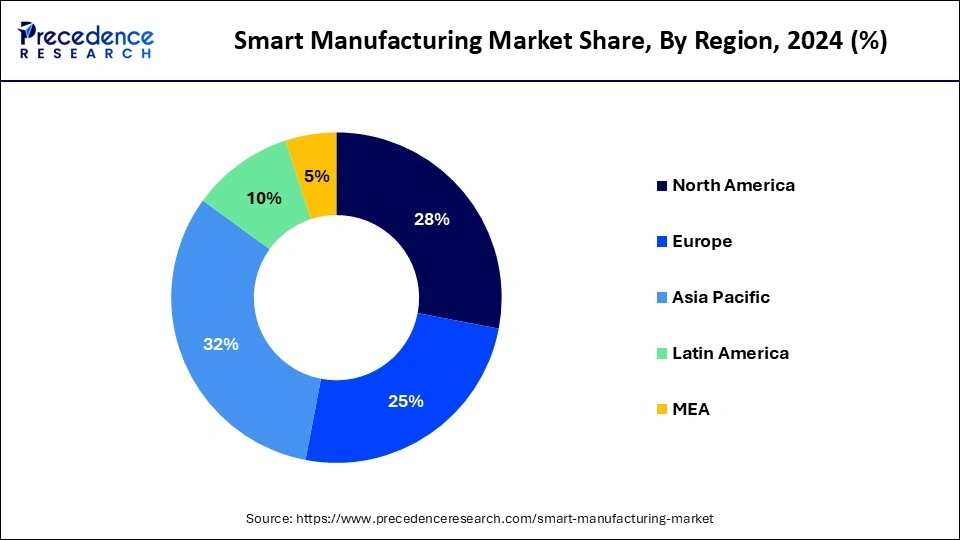
The Asia Pacific region holds the largest market share of around 32% in 2025 and is also predicted to hit as the fastest-growing region over the forecast period 2026 to 2035.
Every region is now investing predominantly in the smart manufacturing technologies, yet the level of maturity varies as per the region. Developed countries such as Germany, the U.S., and Japan have numerous on-going projects in support of the penetration of smart manufacturing or industrial IoT, whereas emerging countries for example China and India are struggling with the technological developments and advancements. For instance, in 2018, Alibaba cloud and Siemens form a partnership to bolster the adoption of industrial IoT in China. The partnership will offer innovative solutions for Chinese manufacturers to implement industrial IoT into their existing system.
Why is Smart Manufacturing Adoption Increasing Across Asia-Pacific?
The Asia-Pacific market is increasing due to rapid industrialization, rising adoption of Industry 4.0 technologies such as IoT, AI, and robotics, and supportive government initiatives promoting automation and digitalization. Growing demand for high-quality, cost-efficient products, coupled with investments in intelligent factories and predictive maintenance, is driving market expansion across key sectors like automotive, electronics, and machinery throughout the region.
China Accelerates Industry: Smart Manufacturing Drives Efficiency and Growth
China's market is growing due to rapid industrial automation, government initiatives like “Made in China 2025,” and rising adoption of IoT, AI, and robotics. Manufacturers are modernizing factories to improve efficiency, reduce costs, and enhance product quality. Additionally, the demand for data-driven decision-making, predictive maintenance, and intelligent production systems is driving investments in smart manufacturing technologies across key sectors such as automotive, electronics, and machinery.
North America Embraces Intelligent Manufacturing: Automation and AI Fuel Market Expansion
North America's market is expanding due to increasing adoption of automation, IoT, AI, and robotics to enhance productivity, reduce operational costs, and improve product quality. Strong investments in Industry 4.0 technologies, government support for advanced manufacturing, and rising demand for data-driven decision-making and predictive maintenance are fueling growth. Additionally, industries such as automotive, aerospace, and electronics are driving the integration of intelligent manufacturing solutions across the region.
Europe Advances with Smart Manufacturing: IoT and Automation Reshape Industries
Europe's market is growing due to increasing adoption of Industry 4.0 technologies, including IoT, AI, robotics, and automation, to enhance efficiency, productivity, and product quality. Supportive government policies, investments in digital factories, and the need for predictive maintenance and data-driven decision-making are fueling growth. Key industries such as automotive, aerospace, and electronics are driving the integration of intelligent manufacturing solutions across the region.
UK Accelerates Digital Factories: Smart Manufacturing Enhances Efficiency and Quality
The UK market is growing due to rising adoption of Industry 4.0 technologies, including IoT, AI, robotics, and automation, to improve productivity, efficiency, and product quality. Government support for digital transformation, investments in advanced manufacturing infrastructure, and increasing demand for predictive maintenance and data-driven decision-making are driving growth. Key sectors such as automotive, aerospace, and electronics are leading the integration of smart manufacturing solutions across the UK.
Key Trends in the Smart Manufacturing Market in Latin America
Latin America is expected to witness significant growth in the market with the growing process of industrial automation and digital transformation. The manufacturing industry is embracing modern technologies like the Internet of Things, big data, artificial intelligence, and robots, which improve production efficiency and reduce production expenses. Government initiatives towards the modernization of industries have increased the move towards Industry 4.0 solutions. The automotive, food & beverage, mining, and consumer goods sectors are the sectors to watch for the rising demand for smart manufacturing systems.
Brazil Market Trends
Brazil smart manufacturing market is anticipated to grow significantly due to the increasing amount of investments in digital manufacturing technologies and industrial automation. Digitalization through AI, IoT, and robotics is quickly catching on in the country's automotive, aerospace, food processing, and mining sectors. Manufacturers are investing in improving energy efficiency, the quality of their products, and their production capacity. In the industrial sectors, drivers for the digital transformation are also at the political level as governmental policies aim at competition and innovation. Cloud manufacturing platforms are set to keep driving market growth with their quick expansion.
Growth of the Middle East and Africa in the Smart Manufacturing Market
The Middle East and Africa region is expected to witness significant growth in the market with advanced manufacturing technologies. Digital Transformation Industrial 4.0/Smart Factory is being promoted by Governments. Oil & gas, chemicals, food processing, and industrial manufacturing are increasingly driving intelligent production systems. Businesses are seeking to leverage AI, IoT, and automation to optimise processes and manage costs, which is becoming more common. The market is expected to expand over the long-term as investments in digital infrastructure are expected to continue to rise.
Saudi Arabia Market Trends
Saudi Arabia market is anticipated to grow significantly due to the Vision 2030 projects such as industrial diversification and digital transformation. There has never been a more prevalent deployment of AI, industrial IoTs, robotics, and cloud-based automation in production facilities. Advanced manufacturing infrastructure and smart factories drive the competitiveness of the manufacturing industry. The market is expected to be steady with the government's backing of innovation and adoption of Industry 4.0.
Statistics, Data, initiatives, and investments
- By 2026, India is estimated to have approximately 1 billion smartphone users. On this basis, Samsung has planned to invest in smart manufacturing processes in its plant based in Noida India. the Korean major, Samsung aims to bring competitiveness in the production sector with this significant investment.
- While focusing on the smart manufacturing in the construction sector, the Obayashi Corporation completed its 3D printed demonstration building in Japan. The building is approved by the Ministry of Land, Infrastructure, Transport and Tourism and is considered to be the first building in the country with 3D printed cement-based material.
- A network of public and private sector organizations, Next Generation Manufacturing Canada received investment of $177 million from the Canadian government. The investment aims to focus on promoting Canada's manufacturing capabilities. The investment and funding by the government is renewed in February 2024 to scale up transformative solutions in manufacturing sector.
- Intel stated that by 2025, 80-100% manufacturing could be using Internet of Things (IoT) for operating sensors, machines and other manufacturing devices.
- The Japanese government in 2022 provided more than $930.5 million in order to support the country's National Robot Strategy.
- According to Deloitte's 2024 manufacturing survey, 62% of large companies plan to invest in robotics and automation for operational activities this year. Whereas 39% of large companies plan to invest in Internet of Things (IoT) platforms.
- The State of Smart Manufacturing Report by Rockwell Automation, 97% of manufacturers plan to invest in smart manufacturing technology to accelerate the transformation and manage risk factors in the manufacturing sector. Rockwell Automation surveyed 1353 global manufacturers for the survey.
- The Indian government has started Production Linked Incentive (PLI) scheme to promote the adoption of smart manufacturing. The scheme supports manufacturers in the country to adopt automated solutions for boosting their capabilities of production.
- According to the International Federation of Robotics, the automotive industry alone represents one-third of installed robots for working in factories around the world.
Competitive Landscape
Smart manufacturers include companies that sell automation, industrial software, robotics, and digital technology solutions to enhance manufacturing efficiency and productivity. To strengthen their market position, key firms across the globe such as Emerson Electric Co., ABB Ltd., Fanuc Corporation, Honeywell International Inc., and General Electric Co. are capitalizing on AI-enabled automation, industrial IoT solutions, robotics, and strategic partnerships to battle it out in the market.
The investments made by the leading companies are extending their solution portfolios with smart factory technologies, cloud-based platforms, and predictive analytics. Acquisitions, product innovation, and digital transformation services are also gaining traction in the market. The challenges include concerns about cybersecurity, high implementation costs, and integration with current manufacturing systems.
Top Vendors and their Offerings
- ABB Ltd: Through its ABB Ability™ platform, ABB provides intelligent robots, smart sensors, and digital twin solutions for predictive maintenance and optimized operations.
- Siemens AG: Offers automation, digital-twin technology, low-code app development, and IIoT tools via its Digital Enterprise suite and MindSphere cloud.
- Emerson Electric Co.: Delivers industrial software and control systems (via AspenTech) for real-time analytics, process optimization, and smart operations.
- Fanuc Corporation: Provides smart factory robotics, collaborative robots, and the FIELD open IIoT platform with edge computing and predictive analytics.
- General Electric Co.: Through GE Digital, offers Predix industrial IoT platform for edge-to-cloud analytics, asset performance, and condition-based maintenance.
Smart Manufacturing Market Companies
- Emerson Electric Co.
- ABB Ltd.
- Fanuc Corporation
- Honeywell International, Inc.
- General Electric Co.
- Mitsubishi Electric Corporation
- Rockwell Automation, Inc.
- Robert Bosch GmbH
- Schneider Electric SE
- Yokogawa Electric Corporation
- Siemens AG
Recent Developments
- In March 2026, ABB Ltd. announced its USD 75 million investment in expanding its manufacturing and R&D in India. The investment will help to increase production capacity, accelerate the development of more advanced solutions in fields such as renewable energy, data centers, transportation, and others in the electrification and automation sector.
(Source: https://www.abb.com) - In February 2026, Schneider Electric announced the first open, software-defined Distributed Control System (DCS) in the industry, EcoStruxure Foxboro Software Defined Automation (SDA). The solution replaces software with hardware, provides flexible, scalable, and interoperable industrial automation, and guarantees excellent system availability.
(Source: https://www.prnewswire.com)
Segments Covered in the Report
By Technology
- Programmable Logic Controller
- Machine Execution Systems
- Enterprise Resource Planning
- Discrete Control Systems
- SCADA
- Human Machine Interface
- 3D Printing
- Machine Vision
- Plant Asset Management
- Product Lifecycle Management
By Component
- Software
- Hardware
- Services
By End-Use
- Aerospace & Defense
- Automotive
- Chemicals & Materials
- Industrial Equipment
- Healthcare
- Electronics
- Oil & Gas
- Food & Agriculture
- Others
By Region
- North America
- Latin America
- Europe
- Asia-pacific
- Middle and East Africa
For inquiries regarding discounts, bulk purchases, or customization requests, please contact us at sales@precedenceresearch.com
Frequently Asked Questions
Tags





Ask For Sample
No cookie-cutter, only authentic analysis – take the 1st step to become a Precedence Research client
 Get a Sample




 sales@precedenceresearch.com
 Schedule a Meeting
