



Steel Market Trends, Leading Companies, Company Revenue / Sales Performance, Plant Utilization, Production Volume, Pricing Dynamics, Supply Chain Performance, Competitive Landscape, and Industry Growth
Steel Market (By Product: Flat, Long; By End-use: Building & Construction, Automotive & Aerospace, Railways & Highways, Others) - Global Industry Analysis, Size, Trends, Leading Companies, Regional Outlook, and Forecast 2026 to 2035
Source: https://www.precedenceresearch.com/steel-market
 Get a Sample
 Table Of Content


What is the Steel Market Size?
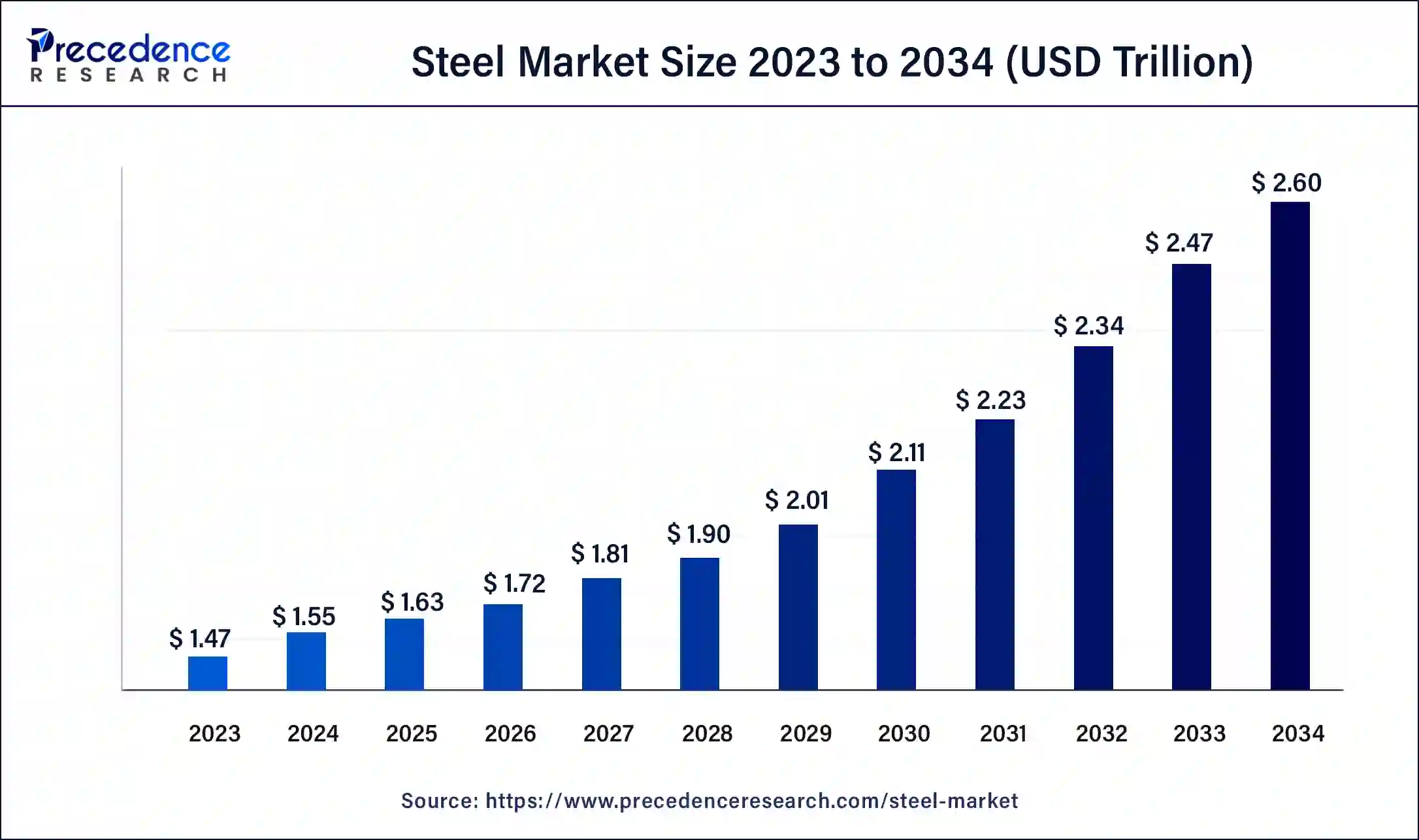
The global steel market size is accounted at USD 1.63 trillion in 2025 and predicted to increase from USD 1.72 trillion in 2026 to approximately USD 2.73 trillion by 2035, at a CAGR of 5.29% from 2026 to 2035. The rising use of steel from the various end-use industries such as automotive, healthcare, construction and buildings, manufacturing, and others due to its higher mechanical strength, durability, anti-termite, and corrosion resistance drives the growth of the steel market.
Steel Market Key Takeaways
- The global steel market was valued at USD 1.63 trillion in 2025.
- It is projected to reach USD 2.73 trillion by 2035.
- The steel market is expected to grow at a CAGR of 5.29% from 2026 to 2035.
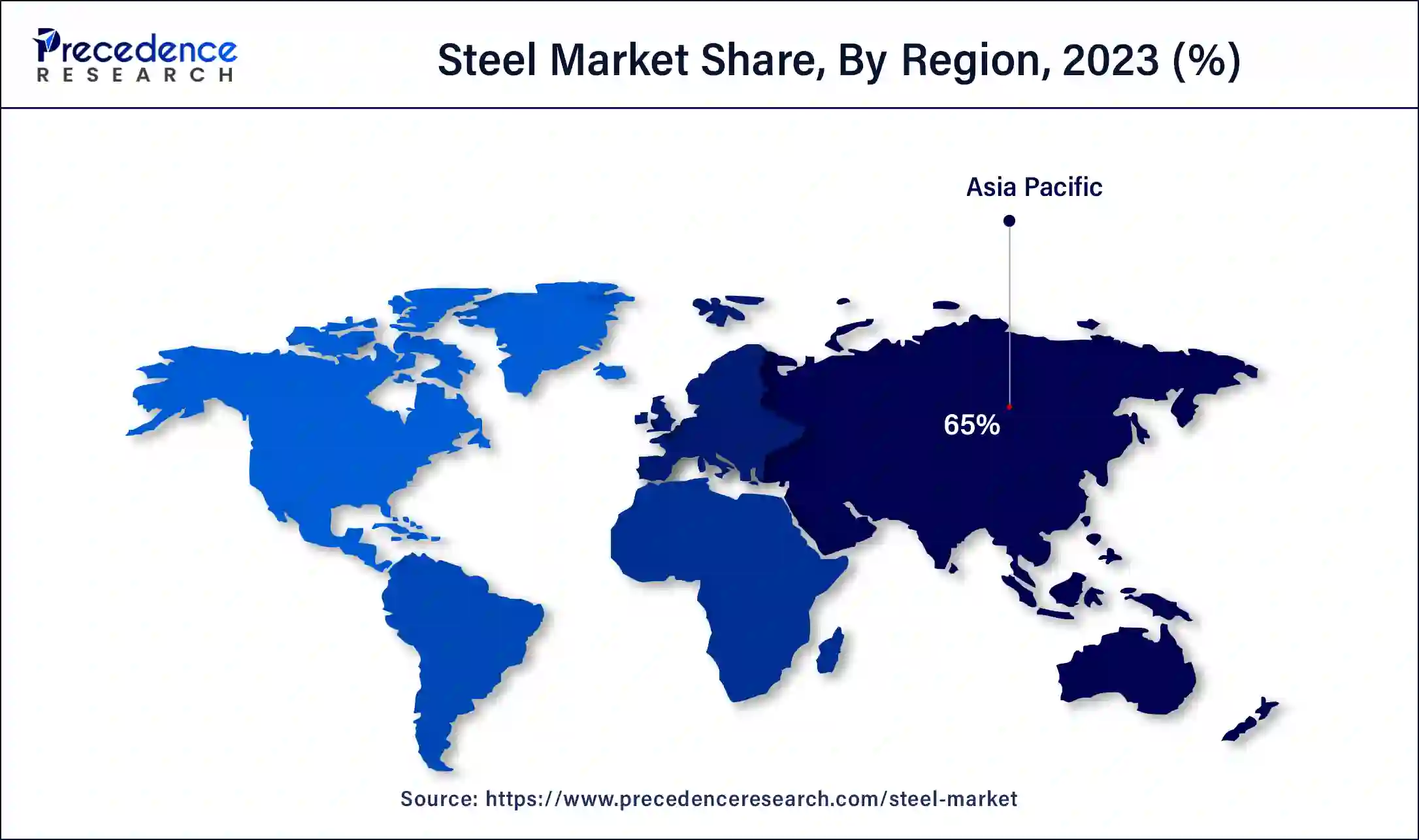
- Asia Pacific dominated the steel market with the largest market share of 65% in 2025.
- North America is expecting accountable growth in the market during the forecast period.
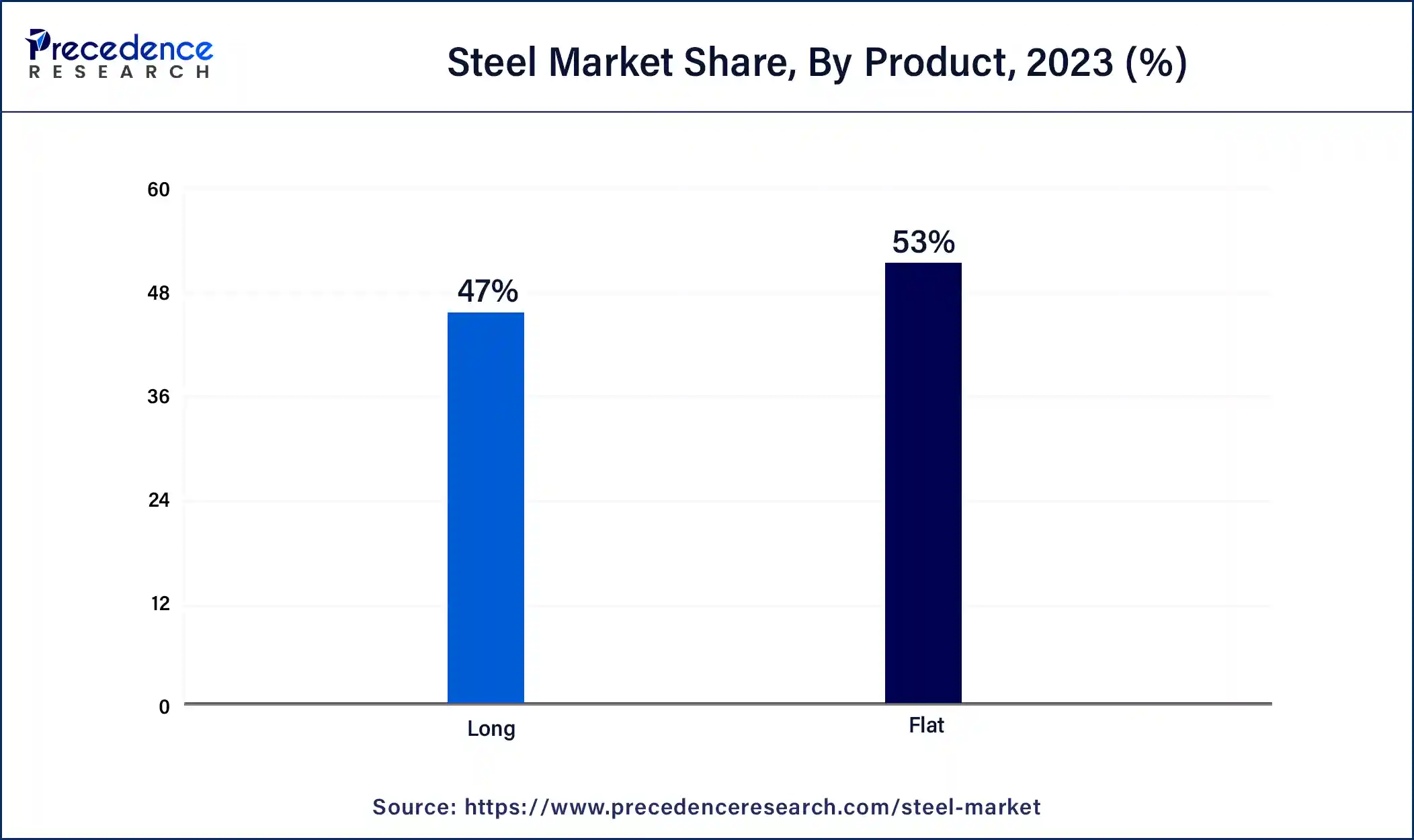
- By product, the flat steel segment held over 53% of market share in 2025.
- By end-use, the building and construction segment dominated the market in 2025.
- By end-use, the automotive and aerospace segment is projected to grow at a notable CAGR of 5.23% during the forecast period.
What is the Steel?
Steel is basically the composition or the alloy of carbon and iron with different amounts of components with specific properties. Steel is one of the modern materials that play a revolutionary role in the various end-use industries. The alloy component allows the material to be used in different varieties of products. The properties of the steel, such as high tensile, machinability, compressive strength, and corrosion proof, make it an ideal material for structural applications. Steel is highly used in industries such as construction and buildings, automotive, residential and commercial applications, and others. The steel industry has evolved over time and has opened up for eco-friendly steel that can be recyclable and reused. Steel is considered the most versatile material or component that can be used in residential kitchenware and industrial machinery, which leads to the growth of the steel market.
How Can AI Impact the Steel Industry?
The integration of artificial intelligence (AI) in the steel industry is one of the revolutionary processes in the steel market. Manufacturers are highly investing in AI and other technological advancements to increase production capacity with enhanced efficiency and lower production costs. There are significant benefits of AI associated with steel manufacturing, such as reducing raw material costs and improving quality by analyzing defects in the early stages before they become severe problems. It helps in managing and understanding assets, including production equipment, inventory, and logistics. It streamlines the production process and minimizes waste. It helps to improve the customer experience with better customer service and understanding their preferences and requirements.
- In August 2023, Google Cloud and United States Steel Corporation collaborated to develop applications using Google Cloud's generative artificial intelligence (“gen AI”) technology to increase efficiency and enhance employee experience in the largest iron ore mine in North America.
Steel Market Growth Factors
- The rising infrastructural and industrial development due to the ongoing investment in development, modernization, and rising demand from the consumers are driving the demand for equipment, machinery, and other infrastructure that contributes to the expansion of the demand for the steel market.
- The rising investment in the construction and real estate industry due to the rising population and the increasing demand for industrial, commercial, and residential buildings drives the demand for steel material as one of the main components for the building.
- The rising demand for steel material in household and kitchen products like utensils, electronic appliances, home aesthetics, and others is accelerating steel production to cater to the rising demand.
- The rising adaptation of steel material in the number of consumer electronics, equipment, industrial machinery, and manufacturing and production units due to its higher machinability, tensile strength, and other beneficial properties is driving the growth of the steel market.
- Regional governments are accepting steel as one of the leading sources of economic development in the country and driving investment in the growth of steel manufacturing units, which fuels the growth of the steel market.
Expansion of Steel Manufacturing in the Gulf Countries
- Crude steel production in the Middle East and Africa in 2025 was 43.738 million tons, up 7.2% compared to 2024 and reflecting continued industrial activity amid a volatile international steel industry environment. The Gulf countries remained the key players of regional production, contributing almost 21.6 million tons by volume; in that volume alone, Saudi Arabia had surpassed 10.7 million tons of steel, thanks in large part to infrastructure megaprojects and manufacturing expansions.
- North Africa was emerging as one of the fastest-growing areas for steel production, as Algeria achieved close to an 18% rise and Libya saw an almost 28% increase in production, attributed to the acceleration of construction development work and industrial revival.
- Demand for long steel products has been stable in all regions, but the UAE especially showed interest in high-quality scrap steel at the same time as electric arc furnaces are being more commonly adopted.
- Global steel production fell by around 2% in 2025, but due to expansion in their capacity, flexible trade, and rising domestic consumption levels, producers in the Middle East resisted this trend.
Steel Market Trends
The steel industry and its production have evolved over time; traditionally, the manufacturing of steel involves three basic steps: the preparation of raw materials, ironmaking, and steelmaking. With the advancement in technology, different methods have evolved in the steel industry, i.e., the ORC Technology, the Hybrit Process, the Jet Process, and Molten Oxide electrolysis.
Market Outlook
- Industry Growth Overview: Stagnation in demand. Recovery of infrastructures and enhancement of manufacturing promote consistent development in the world steel markets.
- Sustainability Trends: Green hydrogen scrap EAF gains momentum. The industry moves towards low-carbon steelmaking and circular production models across the world.
- Major investors: ArcelorMittal, JSW Steel, Tata Steel, and Steel Dynamics are heavily invested in modernization decarbonization and capacity upgrades throughout the world.
Market Scope
| Report Coverage | Details |
| Market Size by 2035 | USD 2.73 Trillion |
| Market Size in 2025 | USD 1.63 Trillion |
| Market Size in 2026 | USD 1.72 Trillion |
| Market Growth Rate from 2026 to 2035 | CAGR of 5.29% |
| Largest Market | Asia Pacific |
| Base Year | 2025 |
| Forecast Period | 2026 to 2035 |
| Segments Covered | Product, End-use, and Regions |
| Regions Covered | North America, Europe, Asia-Pacific, Latin America and Middle East & Africa |
Market Dynamics
Driver
The increased demand for steel in the healthcare industry
The evaluation of the healthcare and pharmaceutical industry drives the adaptation of advanced equipment and machinery for enhancing patient outcomes. Steel plays a significant role in the healthcare industry due to the higher use of steel material for the manufacturing of surgical equipment and other healthcare machinery. The steel is used in various healthcare applications such as surgical equipment such as surgical blades, scissors, forceps, and clamps. Medical devices like orthopedic implants, pacemakers, catheters, and prosthetics.
Machinery, hospital furniture, medical needles, syringes, and cannulas. The properties of stainless steel, such as corrosion resistance, fire and heat resistance, ease in sanitization, and durability, are unfavorable for germs. Hygiene and safety are the leading considerations of the healthcare industry, and the above-mentioned properties make it an ideal material for use in healthcare and pharmaceutical applications.
Restraint
High cost
The relative increase in cost associated with manufacturing, raw material production, transportation, and logistics due to its large size and heavy material, as well as increased taxes and duties, collectively make steel production higher in cost and limit the growth of the steel market.
Opportunity
Advancements in the use of steel in different industries
The steel industry is revolutionizing global industrial equipment and machinery with higher durability and strength. The steel industry is experiencing numerous trends, such as technological advancements, such as digitization and automation. Sustainable practices, diversion in more eco-friendly production, and recyclability. Worldwide market shifts and demand fluctuation are due to the number of end-use industries such as construction, automotive, manufacturing, and others.
Segment Insights
Product Insights
The flat steel segment dominated the steel market in 2025. The growth of the segment is attributed to the rising demand for flat steel from various end-users such as construction and buildings, manufacturing, automotive, and others. As per its name, flat steel is a rectangular-shaped flat steel plate with square edges. The flat has high capabilities in terms of properties, such as being incredibly versatile, cost-effective, and recyclable, which makes it more environmentally friendly and highly adopted by a number of industries.
These types of flat steel bars are most prevalently used in home appliances such as freezers, fridges, extractor hoods, microwaves, washing machines, and all these types of electronic home appliances. Steel is a safer and more reliable, long-lasting material for electronic appliances. Flat steel is also used as the infrastructure structure material for the energy industry; though it is used in infrastructure for the refineries to the pressure valve, it plays a significant role in the energy industry.
End-Use Insights
The building and construction segment dominated the steel market in 2025. The increasing use of steel in the construction and building industry as the raw material provides support and durability to the construction and buildings. Traditionally, steel was mainly used in skyscrapers, but with technological advancements, it has also been used in small buildings and homes. The recyclability of the steel material makes them the ideal choice for the building and construction industry. Steel is more strong and more durable than the traditionally used materials in the buildings, such as bricks and wood; they provide more stability, durability, and strong structure. These are easy to install and are flexible materials that can handle external pressure, thunderstorms, and termites.
- The construction sector is one of the leading sectors and emerges as an opportunity for investors due to its expanding nature. The construction and real estate industry in India is rapidly expanding due to the increasing population and demand for residential and commercial buildings.
- The UN (United Nations) expected the population of India to be 1.64 billion by 2027, and among them, 51% of the population is likely to live in urban areas.
- The construction industry in India is expected to reach $1.4 trillion by 2025.
The automotive and aerospace segment is projected to show significant growth in the steel market during the forecast period. Steel plays an important role in automotive manufacturing; it can be used in several parts of the vehicle, such as braking pads, exhaust, and body. Steel in the automotive industry has a number of beneficial properties, such as high corrosion resistance, machinability, strength range, and thermal resistance. There are some types of steel used in the automotive industry, including stainless steel, advanced high-strength steel, high-carbon steel, low-carbonized steel, and galvanized steel.
Regional Insights
What is the Asia Pacific Steel Market Size?
The Asia Pacific steel market size was exhibited at USD 1.06 trillion in 2025 and is projected to be worth around USD 1.79 trillion by 2035, poised to grow at a CAGR of 5.38% from 2026 to 2035.
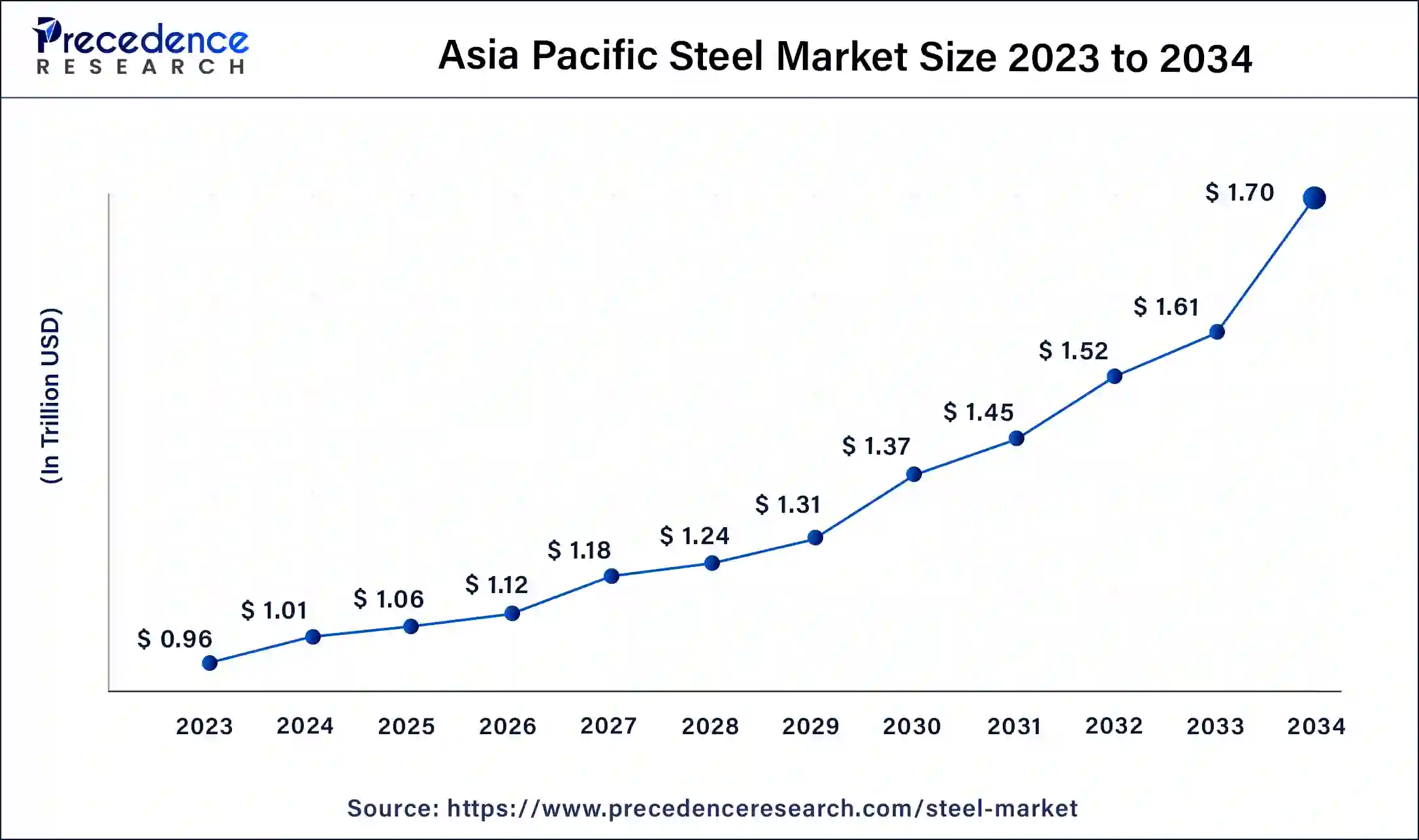
Asia Pacific dominated the steel market in 2025. The growth of the market is attributed to the rising manufacturing and the population's expansion of steel material for household, industrial, and commercial use. The rising adoption of steel material products into the construction and building industry and other infrastructural development due to its durability and high mechanical strength and countries like China and India have a higher consumer base for steel material.
China Steel Market Trends
China is dominant as a result of massive production and domestic consumption shifts. Quality is becoming the focus of policies. China is the largest producer and consumer, dealing with excess capacity by reducing production, banning exports and shifting to high-value steel, as well as experiencing increasing trade containment throughout the world.
- India is the second largest producer of crude steel, with an output of crude steel of 125.32 MT and 121.29 MT of finished steel production in FY23. The steel production in India is anticipated to grow 4-7% to 123-127 MT in FY24.
- In FY23, the production of crude steel is 125.32 MT, and finished steel is 121.29 MT.
- In FY24, the production of crude steel is 143.6 MT, and finished steel is 138.5 MT.
- The consumption of finished steel products is 135.90 MT, and the consumption of steel per capita is 86.7 kgs in FY23.
- While the annual steel production is expected to exceed 300 million tonnes by 2030-31.
North America is expected to have accountable growth during the forecast period. The growth of the steel market is owing to the rising infrastructural development and the continuous investment in the development of real estate and construction activities. Additionally, the region plays a significant role in the manufacturing sector, and the higher availability of the major industrial leaders in countries like the U.S. and Canada is driving the growth of the steel market across the region.
U.S. Steel Market Trends
The U.S. possesses a stable situation with infrastructure and secure domestic markets. Demand remains steady. The Federal infrastructure investments and automotive demand are an advantage to the U.S. as tariffs claim the local producers and increase dependence on scrap-based electric arc furnace steelmaking.
What Are the Driving Factors of The Steel Market in Europe?
Europe is expected to grow at a significant CAGR during the forecast period. Europe is slowly recovering in its steel industry, where there is an anticipated growth in demand in 2026, albeit it is estimated to be still lower than before the pandemic. The market is characterized by high energy prices and stringent environmental policies. The safeguarding and CBAM by the EU are safeguarding the local producers, giving rise to a controlled, sustainability-based market with an emphasis on green steel production technologies.
Germany Market Trends
The steel industry in Germany is also in the process of transformation due to decarbonization, such as production with hydrogen and scrap use. The cost of energy remains very high and constrains production, and the poor construction demand is partly balanced by the increase in the auto and machinery industries. The EU is also using regional sourcing as a way of complying with environmental regulations.
How is the Middle East & Africa Performing in The Steel Market?
The Middle East & Africa are expected to grow at a notable CAGR during the forecast period, due to the development of infrastructure and diversification of the economy. GCC and North African countries are spending a lot of money on construction and energy projects. Efforts such as Saudi Vision 2030 are increasing the demand for long steel products, coupled with increasing the capacity of electric arc furnaces.
Iran Steel Market Trends
Iran is increasing its steel manufacturing power by investing in large-scale production plants to satisfy the increasing demand in the region. Industry 4.0 technologies are also being embraced in the country in an effort to streamline operations and enhance efficiency. These advancements are contributing to the strengthening of Iran in terms of infrastructure-related steel provision to high-growth regional markets.
What Are the Driving Factors of The Steel Market in Latin America?
Latin America is expected to grow at a remarkable CAGR during the forecast period. The steel industry in Latin America is experiencing the negative effects of low-cost imports, especially from China, which affects the local producers. Other countries, such as Brazil and Argentina, are working on industrial fortification, yet issues of political unpredictability, sluggish building sector, and financial insecurities still impact the enhancement and sustainability of the regional steel industry.
Brazil Market Trends
Brazil is also becoming a major exporter of steel, especially to Europe, as it tackles the issue of carbon intensity. More use of electric arc furnace technology is contributing to sustainability. Domestic demand is growing based on growth in the construction and automotive industries, which increases resilience to worldwide competitive forces and regulatory demands.
Steel Market Companies
- Nippon Steel Corporation: Distributes high-grade sheet plates, pipes and stainless steel to the automotive, construction and energy industries with high-quality material performance and reliability.
- NUCOR: It manufactures steel sheet plate used in electric arc furnaces, construction products and fronts the recycling process and sustainable steelmaking efforts in the North American markets.
- Outokumpu: Provides sustainable stainless steel advanced alloys and chromium materials using integrated mining and low-carbon manufacturing for industrial and infrastructure uses.
Other Major Key Players
- POSCO
- ArcelorMittal
- Baosteel Group
- Emirates Steel
- JFE Steel Corporation
- Tata Steel
- Thyssenkrupp
Recent Development
- In April 2026, ArcelorMittal also announced an investment of €1.3 billion in electric arc furnace technology at a plant located in Dunkirk, France. The program is expected to help lower carbon emissions from steel production by nearly three times compared to traditional blast furnaces. This move is another indicator that steel producers no longer consider decarbonization as a secondary issue, but as an essential evolution of the industry.
- In May 2026, Nippon Steel Corporation (Japan) forecast that after acquiring United States Steel Corporation (US), its profits in the U.S. would be significantly boosted. This should follow the trends of the industry in general, with major companies looking to increase the efficiency of their production processes, and develop technology to do so, and the Group will spend some USD 11 billion improving its infrastructure (which involves such things as blast furnaces and rolling infrastructure).
- In March 2026, Zinox El Zenouki plans to invest EGP 350m in a new stainless-steel tableware factory on a 10,000-square-meter site, producing 5 million pieces annually, including utensils and serving sets. Production starts in H1 2026, aiming to reduce imports and boost local tableware production for Egypt. (https://www.dailynewsegypt.com )
- In February 2026, Tata Steel inaugurated a new plant in Ludhiana, Punjab, in March. Punjab Chief Minister Bhagwant Singh Mann stated the facility is Tata's second-largest in India and its biggest investment in the region, featuring electric arc furnace technology and a rolling mill for rebar. (https://gmk.center )
- In August 2024, Bharat Sanchar Nigam Limited (BSNL), a State-owned telecommunication in India, launched the indigenous 4G network at the Visakhapatnam Steel Plant (VSP) in Andhra Pradesh Circle. The installation is the milestone in the BSNL's 4G rollout, delivering high-speed mobile connectivity in the Andhra Pradesh industries.
- In May 2024, JSW Steel Ltd. will roll out zinc-magnesium-aluminum alloy-coated steel and vision to cover 50% of the market share in the segment in one year. The company invested Rs 500 crores in the development of a 0.9 million tonnes per annum capacity unit in Karnataka and Maharashtra facilities in which JSW Magsure will manufactured.
Segments Covered in the Report
By Product
- Flat
- Long
By End-use
- Building & Construction
- Automotive & Aerospace
- Railways & Highways
- Others
By Geography
- North America
- Asia Pacific
- Europe
- Latin America
- Middle East & Africa
For inquiries regarding discounts, bulk purchases, or customization requests, please contact us at sales@precedenceresearch.com
Frequently Asked Questions
Tags





Ask For Sample
No cookie-cutter, only authentic analysis – take the 1st step to become a Precedence Research client
 Get a Sample




 sales@precedenceresearch.com
 Schedule a Meeting
