



Acesulfame Potassium Market Size, Key Companies, Company Market Share, Production Capacity, Raw Material Pricing, Export & Import Analysis, Manufacturing Cost, Competitive Positioning, and Demand Forecast
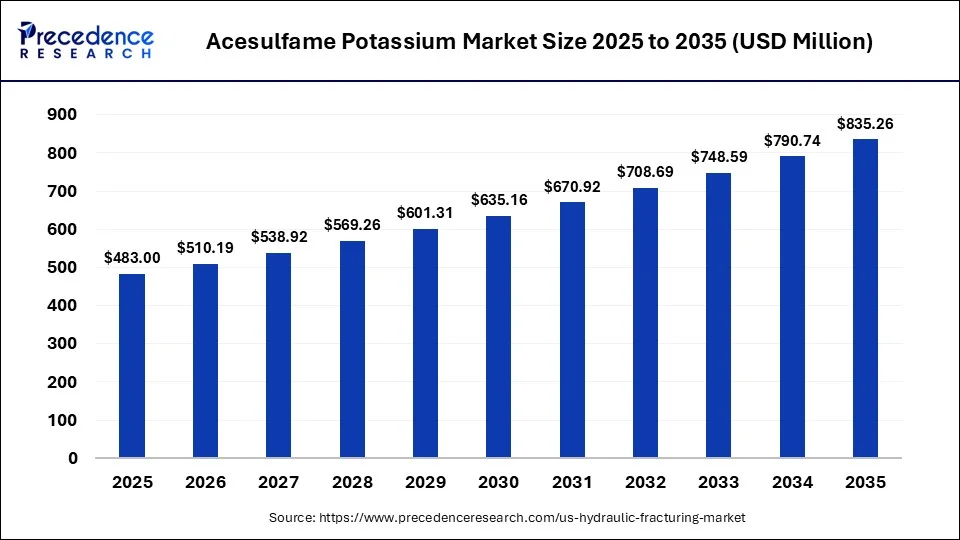
The acesulfame potassium market was valued at USD 510.19 million in 2026, thus expanding at a CAGR of 5.63% by 2035. The market growth is driven by rising demand for low-calorie and sugar-free food and beverages amid growing consumer focus on healthier diets and reduced sugar intake. Key market trends include increasing adoption of high-intensity sweeteners in functional beverages, dairy products, confectionery, and pharmaceuticals. Manufacturers are also focusing on clean-label formulations, improved sweetener blends, and cost-efficient production technologies. Growing demand from emerging economies, expanding processed-food consumption, and product innovation are expected to create new opportunities for market participants through 2035.
Source: https://www.precedenceresearch.com/acesulfame-potassium-market
 Get a Sample
 Table Of Content


Acesulfame Potassium Market Size, Demand, and Trends Analysis 2035
The global acesulfame potassium market is forecasted to expand from USD 510.19 million in 2026 to USD 835.26 million by 2035, growing at a CAGR of5.63% from 2026 to 2035. Ace-K, which is approximately 200 times sweeter than sucrose, continues to benefit from sugar-reduction and reformulation trends across beverages, confectionery, dairy, bakery, sports nutrition, pharmaceuticals, and oral-care products. Powder remains the dominant form, while food-grade Ace-K accounts for the majority of consumption and pharmaceutical-grade products offer higher-value specialty opportunities.
Key Takeaways
- The global acesulfame potassium market is estimated at approximately USD 483.00 million in 2025, with available estimates clustering around the high-USD-200 million range.
Global annual Ace-K demand is estimated at approximately 55,000–65,000 metric tons. - Acesulfame potassium is approximately 200 times sweeter than sucrose, enabling manufacturers to achieve high sweetness with very low inclusion levels.
- Powder is the dominant commercial form of acesulfame potassium and is expected to retain the largest revenue pool.
- Food and beverage applications represent the primary demand pool, particularly beverages, confectionery, dairy, bakery, and sports nutrition.
- China has become the major manufacturing and export center for acesulfame potassium, while North America and Europe remain important consumption and formulation markets.
- Late-2025 indicative Ace-K prices were approximately USD 4.80/kg in China, USD 4.55/kg in the U.S., USD 4.93/kg in Germany, and USD 5.67/kg in India.
- Ace-K demand is increasingly supported by blended sweetener formulations, including combinations with sucralose and aspartame.
- The market is estimated to have 55,000–65,000 metric tons of annual demand, making manufacturing economics, capacity utilization, and procurement costs important competitive factors.
- North America, Europe, and Asia Pacific are expected to generate the largest incremental demand through 2035, with China and India offering particularly attractive volume-growth opportunities.
A Mature High-Intensity Sweetener Market is Being Reshaped by Sugar Reduction, Formulation Blending and Cost-Competitive Asian Supply
The global acesulfame potassium (Ace-K) market is estimated to represent a substantial market size in 2025, with available market estimates indicating a sizeable market presence. A base-case outlook indicates continued market expansion through 2035, reflecting a positive growth trajectory over the forecast period. On a volume basis, the market represents a notable level of annual demand, depending on the inclusion of different grades, forms, and channel sales.
Ace-K is approximately 200 times sweeter than sucrose, allowing manufacturers to use very small quantities while delivering substantial sweetness intensity. Its heat stability, water solubility, and compatibility with other high-intensity sweeteners make it particularly relevant to carbonated beverages, powdered drinks, confectionery, dairy, bakery, tabletop sweeteners, sports nutrition, and pharmaceutical formulations.
The market is structurally different from large-volume commodity chemicals: manufacturing scale, food-grade qualification, purity consistency, regulatory registrations, export capability and long-term customer approvals matter more than simple production capacity. Asia-Pacific, particularly China, has become the dominant manufacturing and export base, while North America and Europe remain important high-value consumption and formulation markets.
The competitive structure is increasingly characterized by a relatively small group of established producers alongside export-oriented Chinese manufacturers, regional suppliers and ingredient distributors. Recent production-process patents also indicate continued efforts to improve yield, impurity control, crystallization and production economics.
Key Coverage
- 2025 market value: approximately USD 483.00 million
- Estimated annual volume: approximately 5565 kt
- 2035 basecase opportunity: approximately USD 835.26 million
- Expected longterm growth: approximately 5.63% CAGR
- Powder remains the dominant commercial form
- Food and beverage represent the primary application pool
- China is the major manufacturing and export center
- Regulatory compliance, purity, and supply reliability are increasingly important competitive filters
Market Size & Forecast - Volume Growth is Steady, but Formulation Complexity Creates a Larger Value Opportunity
The market's historical trajectory reflects a mature ingredient category rather than an explosive emerging market. A commonly cited market benchmark places global sales at a notable market value in 2024, with continued market expansion expected by 2030, reflecting steady growth over the forecast period. A broader 2025-2035 assessment indicates a significant market size in 2025 and further expansion by 2035, reflecting a positive growth trajectory. The variance demonstrates why market sizing must distinguish manufacturer revenue, distributor revenue, regional resale, and end-use value.
The analysis therefore models the market using both USD revenue and metric tons, with pricing normalization preventing inflation or regional channel margins from being mistaken for underlying consumption growth.
Asia-Pacific contributes disproportionately to production and export availability, while North America and Europe represent important premium food, beverage, and pharmaceutical demand centers. China is also among the faster-growing individual markets.
Key Coverage
- 2019-2025 historical reconstruction
- 2025-2030 and 2030-2035 forecasts
- Revenue and volume triangulation
- Regional revenue and consumption
- Producer output versus apparent consumption
- Base, upside and downside scenarios
- Incremental revenue and volume opportunity
Segmentation Analysis - Powder Dominates, While Specialty Grades and Formulation-Ready Supply Offer Higher Value Pools
The market is primarily segmented by form, grade, application, customer type, and geography. Powder represents the dominant form and is expected to retain the largest revenue pool; one market estimate projects powdered Ace-K to reach a significant market value by 2030, compared with slower growth in liquid formats.
Food grade accounts for the overwhelming majority of consumption, while pharmaceutical-grade applications command tighter specifications and higher qualification requirements. Food and beverage remain the core application, particularly carbonated beverages, powdered beverages, confectionery, dairy, bakery, and sports nutrition. Pharmaceutical applications remain smaller but provide attractive specialty demand because taste masking and dosage-form performance can justify tighter specifications.
The full analysis breaks the market into powder particle size, purity or grade, food versus pharmaceutical use, beverage versus solid-food applications, direct industrial procurement versus distributors, and regional consumption, identifying where volume leadership differs from value leadership.
Key Coverage
- Powder/liquid share
- Food/pharmaceutical grade
- Beverage, confectionery, dairy, bakery and other applications
- Regional segment growth
- Highvalue specialty grades
- Customer/channel segmentation
Market Dynamics - Sugar Reduction Supports Demand, but Substitution and Regulatory Scrutiny Limit Pricing Power
The principal demand driver is the continuing reformulation of food and beverage products toward lower-sugar and sugar-free formats. Ace-K's approximately 200× sweetness intensity enables very low inclusion rates, while its heat and acid stability support broad formulation use.
The more important structural trend, however, is blended sweetener formulation. Ace-K is frequently combined with sucralose, aspartame, and other sweeteners to improve sweetness perception and reduce undesirable aftertaste. This means its demand is linked not only to the growth of Ace-K itself but also to the broader development of multi-sweetener formulations.
Counterforces include consumer skepticism toward artificial sweeteners, regulatory reassessments, competition from sucralose, aspartame, saccharin, and newer sweetening systems, and the commoditization of standard food-grade material.
Tentative Leading Company Universe - 20 Market Participants Across Manufacturing, Specialty Supply and Distribution
| Company | Headquarters | Market Position | Core Strength | Major Applications/Segments |
| Nutrinova | Germany/Netherlands | Premium global specialist | Dedicated Ace-K production | Food, beverage, pharma |
| Anhui Jinhe Industrial | China | Large-scale producer | Integrated chemical manufacturing | Food & beverage |
| Jiangsu Vitasweet | China | Major producer | Sweetener manufacturing | Food, beverage, nutrition |
| HYET Sweet | Netherlands/Europe | Specialist supplier | High-intensity sweeteners | Food & beverage |
| Hermes Sweeteners | Europe | Specialist | Sweetener portfolio | Food & beverage |
| Suzhou Hope Technology | China | Export-oriented producer | Ace-K manufacturing | Food ingredients |
| Shandong Minghui Food | China | Regional/export supplier | Food additives | Food & beverage |
| Jiangxi BEIYANG Food Additive | China | Regional producer | Food additive production | Food ingredients |
| Hangzhou Sanhe Enterprise | China | Supplier | Food additives | Food & beverage |
| Hebei Huayang Group | China | Chemical producer | Industrial-scale chemistry | Food additives |
| Changzhou Niutang Chemical | China | Sweetener producer | Integrated sweeteners | Food & beverage |
| Ingredion | U.S. | Global ingredient supplier | Formulation and distribution | Food, beverage, nutrition |
| Celanese | U.S. | Parent/strategic producer | Specialty chemical infrastructure | Food ingredients |
| Prinova | U.S. | Global distributor | Ingredient sourcing/distribution | Nutrition, food, beverage |
| Foodchem International | China | Export supplier | Bulk ingredient distribution | Food & beverage |
| Tate & Lyle | U.K. | Formulation/ingredient player | Sweetening solutions | Food & beverage |
| Akhil Healthcare | India | Regional supplier | Food/pharma ingredients | Pharmaceutical, food |
| Prakash Chemicals Agencies | India | Regional distributor | Chemical distribution | Food ingredients |
| Brenntag | Germany | Global distributor | Chemical/ingredient distribution | Food & industrial |
| Azelis | Belgium | Specialty distributor | Ingredient distribution | Food, pharma, specialty |
How Large is the Acesulfame Potassium Market Today, and Where is the Next Phase of Growth Expected to Come From?
The global Acesulfame Potassium (Ace-K) market is estimated to represent a significant market size in 2025, with annual demand remaining at a substantial level. Available market benchmarks indicate a moderate-growth trajectory through the early-to-mid 2030s. A base-case assessment indicates continued market expansion by 2035, suggesting that growth is likely to be driven less by explosive volume expansion and more by increasing penetration of reduced-sugar formulations, reformulation activity, and continued use of high-intensity sweetener blends. The market therefore exhibits the characteristics of a mature specialty ingredient market: relatively stable underlying demand, but meaningful differences in growth by application, geography, grade, and customer segment.
Our analysis indicates that growth is becoming increasingly mix-driven rather than purely volume-driven. Ace-K's role as a high-intensity sweetener, approximately 200 times sweeter than sucrose, allows manufacturers to achieve substantial sweetness at low inclusion levels, while its compatibility with other sweeteners supports blended formulations designed to improve taste profiles and formulation economics. Our assessment is that beverages will remain a critical demand center, while sugar-reduced foods, tabletop sweeteners, pharmaceutical formulations, oral-care products, and multi-sweetener systems provide additional avenues for incremental demand. Geographic production and consumption are also structurally different, with Asian manufacturing capacity playing an important role in global supply while demand remains distributed across major food, beverage, and ingredient-processing markets.
In our view, the most significant implication is that future market opportunity will depend increasingly on identifying high-growth applications and regional pockets rather than relying on headline market CAGR alone. Producers and distributors able to combine competitive pricing with consistent purity, reliable supply, regulatory compliance, flexible packaging, and formulation support can capture greater value even within a moderate-growth market. The underlying opportunity is therefore not simply to increase Ace-K volumes, but to participate in higher-value grades, customized specifications, regional supply localization, and formulation systems where customer switching costs and qualification requirements are higher.
Which Competitive Capabilities Are Most Likely to Determine Leadership in the Acesulfame Potassium Market?
The acesulfame potassium market remains relatively concentrated around a core group of specialized producers, particularly manufacturers with established food-additive production infrastructure, large-scale Asian manufacturing bases, global regulatory coverage, and established distributor relationships. Competition is shaped less by product differentiation at the basic chemical level and more by cost position, production scale, purity consistency, quality certifications, regulatory compliance, supply reliability, and geographic reach. With the market estimated at approximately 55,000–65,000 metric tons of annual demand, even modest differences in manufacturing economics, capacity utilization, and procurement costs can materially influence competitive positioning.
Our analysis indicates that scale and supply reliability are becoming increasingly important sources of competitive advantage. Because Ace-K is a relatively standardized high-intensity sweetener, buyers can compare suppliers on price, specification consistency, lead times, documentation, and qualification requirements. Our assessment is that manufacturers with efficient production processes and dependable export capabilities are better positioned to compete in high-volume food and beverage applications, while suppliers offering higher-purity grades, customized specifications, smaller order quantities, technical support, and localized inventory can defend stronger customer relationships in specialized segments. This creates a two-tier competitive structure between scale-driven commodity-oriented supply and service- or specification-driven specialty supply.
In our view, the most significant strategic implication is that sustainable competitive advantage will depend on more than nominal production capacity. The ability to maintain consistent quality while controlling conversion costs, respond to regional demand shifts, secure reliable logistics, and meet increasingly diverse customer qualification requirements is likely to determine which suppliers can convert capacity into profitable market share. From our assessment, this creates opportunities for manufacturers to strengthen their position through capacity optimization, geographic diversification, high-purity offerings, regional warehousing, long-term customer contracts, and formulation support rather than relying solely on price competition.
Which Applications and Market Segments Will Drive the Next Phase of Acesulfame Potassium Demand?
Acesulfame Potassium demand is concentrated in food and beverage formulations, where its high sweetness intensity, approximately 200 times that of sucrose, allows manufacturers to reduce sugar content while maintaining targeted sweetness at relatively low inclusion levels. Beverages represent a particularly important demand pool, alongside confectionery, dairy and desserts, bakery products, tabletop sweeteners, pharmaceuticals, oral care, and other specialty formulations. The market is further segmented by powder versus other forms, food versus higher-purity grades, standalone versus blended sweetener systems, end-user type, and geography, creating substantial variation in volume requirements, qualification standards, pricing, and supplier selection.
Our analysis indicates that application growth is likely to be driven more by reformulation requirements and sweetener-system optimization than by Ace-K adoption in isolation. Its use alongside other high-intensity sweeteners can help formulators balance sweetness intensity, taste characteristics, stability, and cost, making blended applications strategically important to future demand. Our assessment is that beverages and mainstream food applications will continue to provide the largest volume base, while pharmaceutical, oral-care, specialty nutrition, and formulation-specific applications can create comparatively attractive opportunities where purity, specification consistency, and technical support carry greater importance than lowest-cost supply.
In our view, the most significant implication is that market attractiveness varies materially across application × grade × geography combinations. High-volume applications can generate scale but may expose suppliers to stronger price competition, whereas specialized grades and technically demanding formulations can offer opportunities for differentiation and customer retention. From our assessment, suppliers that align product specifications, packaging, regulatory documentation, and technical support with the purchasing requirements of specific end-use segments can capture value beyond the underlying market growth rate.
How Are Pricing, Production Economics, and Supply-Chain Dynamics Shaping Profitability in the Acesulfame Potassium Market?
Acesulfame Potassium pricing remains closely linked to manufacturing economics, regional supply concentration, raw-material costs, production scale, logistics, and order specifications. Indicative market benchmarks place late-2025 pricing in major markets at approximately USD 4.8/kg in China, USD 4.55/kg in the U.S., USD 4.93/kg in Germany, and USD 5.67/kg in India, illustrating meaningful regional price differentials even for a relatively standardized sweetener. With global annual demand estimated at approximately 55,000-65,000 metric tons, relatively small changes in production costs, capacity utilization, freight rates, or inventory levels can influence supplier margins and delivered customer pricing.
Our analysis indicates that the market's supply-chain economics are increasingly shaped by the gap between ex-plant production cost and delivered regional cost. Asian manufacturing, particularly China's established production base, provides an important cost and supply advantage, while buyers in distant markets must account for freight, duties, inventory carrying costs, packaging, distributor margins, and supply-security requirements. Our assessment is that this makes landed-cost competitiveness, rather than nominal factory-gate pricing alone, a critical purchasing metric. Differences in order size and packaging requirements can further affect realized pricing, with bulk industrial procurement generally offering greater logistics efficiency than smaller-volume or specialty orders
In our view, the most significant strategic implication is that cost leadership depends on the entire production-to-customer chain rather than manufacturing efficiency alone. Producers with efficient processes, high utilization, dependable raw-material sourcing, export infrastructure, and optimized logistics can protect margins during periods of pricing pressure, while regional distributors and customers can create value through inventory availability and shorter lead times. From our assessment, opportunities are emerging around regional warehousing, supply diversification, long-term procurement contracts, optimized packaging, and localized distribution, particularly where customers prioritize continuity of supply alongside price.
Acesulfame Potassium Market Segments Covered in the Report
By Form
- Powder
- Granules
- Liquid
By Grade
- Food Grade
- Pharmaceutical Grade
- Other
By Application
- Beverages
- Confectionery
- Dairy & Desserts
- Bakery
- Pharmaceuticals
- Oral Care
- Sports & Nutrition
- Others
By Sweetener Combination
- Standalone
- AceK + Sucralose
- AceK + Aspartame
- Other Blends
By End User
- Food & Beverage
- Pharmaceutical
- Nutraceutical
- Oral Care
- Other Industrial Users
By Region
- North America
- Europe
- Asia Pacific
- Latin America
- Middle East & Africa
For inquiries regarding discounts, bulk purchases, or customization requests, please contact us at sales@precedenceresearch.com
Frequently Asked Questions
Tags





Ask For Sample
No cookie-cutter, only authentic analysis – take the 1st step to become a Precedence Research client
 Get a Sample




 sales@precedenceresearch.com
 Schedule a Meeting
