



Acetaminophen Market Size, Segmentation, Key Companies, Regional Outlook, and Forecast 2026-2035
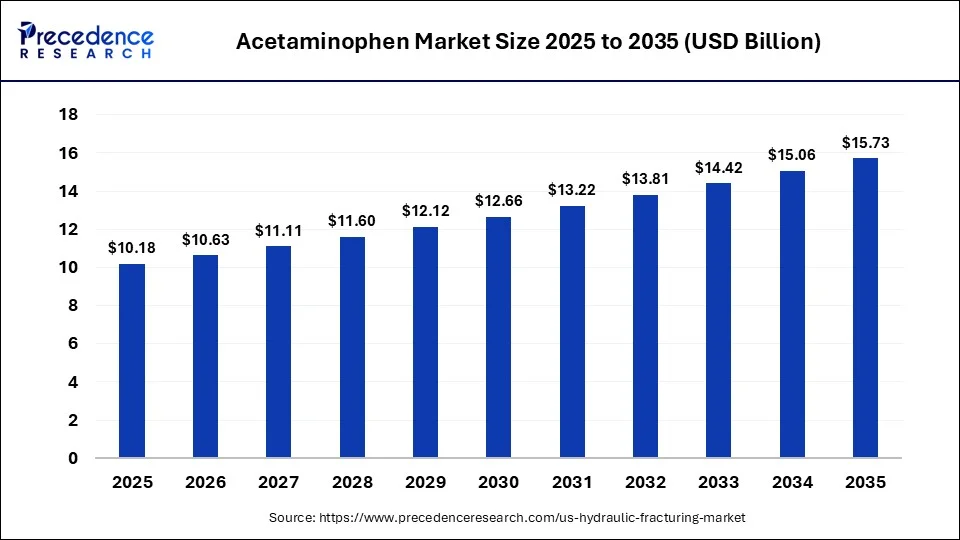
Deepa Pandey is a healthcare and pharmaceutical market research analyst. She researched acetaminophen consumption among prescription drugs and OTC products. She also analyzed trends in pharmaceutical manufacturing, product formulation, distribution through various channels, and regulatory changes in the global pain management sector. Her analysis enables pharmaceutical manufacturers, distributors, healthcare providers, and investors to conduct competitive benchmarking and strategic decision-making. The acetaminophen market reached 10.63 billion in 2026.
Source: https://www.precedenceresearch.com/acetaminophen-market
 Get a Sample
 Table Of Content


Acetaminophen Market Trends, Growth, Demand and Production Forecast
Deepa Pandey has more than 5 years of experience focusing on the healthcare and medicine sector. She believes the rising trend of changing consumer preferences and ongoing pharmaceutical advancements is transforming the acetaminophen industry. The acetaminophen market is forecasted to expand from USD 10.63 billion in 2026 to USD 15.73 billion by 2035, growing at a CAGR of 4.45% from 2026 to 2035. The widespread availability of generic formulations and combination medicines, pediatric formulations, and convenient dosage forms is also helping the market. A rise in the incidence of diseases linked to pain and fever, along with growing self-medication and greater access to healthcare in developing economies, is helping market growth. The acetaminophen market is expanding at a CAGR of 4.45% from 2026 to 2035.
Key Takeaways
- By product type, the acetaminophen-only products segment led the market with a share of 63.85% in 2026.
- By dosage form, the tablets segment led the market with a 45.25% share in 2026.
- By route of administration, the oral segment captured a major revenue share of 87.65% in 2026.
- By application, the pain management segment captured the largest market share of 41.35% in 2026.
- By sales type, the OTC segment led the market with a share of 76.45% in 2026.
- Kenvue (US$15.1B sales) far surpasses Tylenol alone, and the pain relief segment of Haleon achieved £2.56B in sales with 3.0% organic growth, compared to 2.3% company-wide.
- Haleon has the leading stake in the pain relief category with a value of £2.564bn, and an operating margin of 21.9% in the category, in comparison to 20.8% for Cygnet.
- Kenvue is present in over 165 countries with around 1.2 billion people. Each of the ten brands brings in over USD 400 million, and each is a piece of Tylenol's investment portfolio.
- Furthermore, the steady momentum of Bonthapally API's capacity expansion to 34560 tonnes has been another key contributor and has enabled the company to make consistent and significant strides in its API business through higher-value finished dosage products, with a 77% revenue growth in FY25.
- Scale-driven APIs, combination products and pediatric formulations, and injectable generics appear to have good growth potential as market leadership is solid in OTC categories.
How Large Will the Acetaminophen Market Become by 2035?
Expansion of the market is anticipated at a 4.45% CAGR, projected to expand by USD 5.56 billion from 2026 to 2035, as the market is not identified as an emerging market but rather categorized as a mature, high-volume pharmaceutical market. Combination products, hospital applications, injected products, and the digital pharmacy channel are becoming increasingly relevant to this growth. Each is an opportunity to present a product beyond the simple, largely uninteresting, and commoditized acetaminophen tablet that has defined this market for decades.
Key Insight: The market is projected to expand at about a 4.45% CAGR from 2026 to 2035, and combination products, hospital usage, injectables, and digital pharmacy channels will account for an additional 1.53% of expansion of the market.
Which Acetaminophen Product Type Holds the Largest Market Share?
Source: Precedence Research Database
Acetaminophen-only products are dominant, accounting for a 63.85% share in 2026, which will ease to a 61.75% share by 2035 at a 4.08% CAGR, with less inclination to expand, due to the established track record as a well-differentiated and relatively well-known product category. Combination products hold the remaining 36.15% share in 2026, growing to 38.25% by 2035 at a 5.02% CAGR, an increasing growth direction. The shift is driven by manufacturers introducing multi-symptom and multi-ingredient formulations that let a single product address pain, fever, and cold symptoms simultaneously rather than requiring a consumer to buy several separate medicines.
Key Insight: By 2035, combination products gain 2.10% share of total, with growth occurring at a greater 5.02% CAGR compared with acetaminophen-only products, a trend that Haleon is already experiencing in the nine markets it is supporting with its Panadol Dual Action launch.
Which Acetaminophen Dosage Form Accounts for the Largest Demand?
Source: Precedence Research Database
Tablet remains the predominant dosage form, with 45.25% of sales in 2026 increasing only slightly to 43.10% by 2035, representing a 3.95% CAGR. This suggests this dosage form is firmly established and is expected to maintain its market share both in OTC and prescription markets. Liquid suspensions' share stands at 20.15%, which will rise to 21.85% by 2035 at 5.30% CAGR, highlighting the fact that certain applications, such as pediatric and swallowing, are the only practical ones that can be delivered in liquid form.
Key Insight: Pediatric and swallowing are stimulants that boost the share of liquid suspensions to 21.85% at 5.30% CAGR, while tablets remain the main format but are declining and will trade at 43.10% share by 2035.
Which Route of Administration Is Growing Fastest?
Source: Precedence Research Database
Nearly nine-tenths of demand in each year in 2026 and 2035 (87.65% and 85.90%, respectively) will be met by oral administration, which has seen a decline of 1.75 percentage points (4.20% CAGR). This marks its continued dominance, declining only slightly by 1.75 percentage points, or 4.20% CAGR, over the ten years. Parenteral and intravenous delivery have the smallest current market share (9.15%) but will have the highest CAGR (6.65%) and reach 11.30% of the market in 2035. Due to increasing hospital and postoperative use, there is a need for an IV route to reduce time to recovery and facilitate a quicker onset, as a swallow is not required.
Key Insight: Parenteral and intravenous will grow the fastest at 6.65% CAGR, rising by 2.15 percentage points to 11.30% share, for hospital and post-surgical indications where dosage direction by the FDA is already a key determinant of administration.
Which Applications Account for the Largest Acetaminophen Market Share?
Source: Precedence Research Database
The pain management sector is the largest, comprising 41.35% of the sector in 2026, but it will decrease to 39.85% by 2035, at a 4.05% CAGR, 1.50 percentage points below its present size. Fever reduction has the greatest share gain at 2.15 percentage points, with 27.80% of sales in 2016 climbing to 29.95% by 2035 at a CAGR of 5.30%. Possibly connected to continued use of acetaminophen in both pediatric and general consumer applications for their fever reducing effects.
Key Insight: Fever reduction posts the highest share gain in the application category, up by 2.15 percentage points to 29.95% share with 5.30% CAGR.
How Large Is the OTC Versus Prescription Acetaminophen Opportunity?
Source: Precedence Research Database
OTC medicines will continue to maintain the top position, accounting for 76.45% of sales in 2026 and 74.20% in 2035 at 4.13% CAGR, a 2.25 percentage point drop, respectively. The same growth rate in the percentage of prescriptions consumed (5.15% CAGR) is expected for prescription products, projected to gain that same 2.25 percentage points, from 23.55% to 25.80%.
FDA continues to closely monitor acetaminophen in both prescription and nonprescription medications, including blister packs or pumps. It believes that the level of acetaminophen in a consumer's body in any given twenty-four-hour period should not exceed 4,000 milligrams. A limit that applies whether or not the consumer is taking multiple acetaminophen-containing pills or blister packs or pumps at the same time.
Key Insight: The OTC account will come from after losing 2.25 percentage points to prescription products to reach 25.80% share with a 5.15% CAGR.
Which Distribution Channel Is Growing Fastest?
Source: Precedence Research Database
Retail pharmacies held the largest market share of 35.85% in 2026 and is expected to remain the largest individual channel until 2035 with a market share of 32.9%. The increasing number of retail pharmacies and the presence of skilled professionals are major reasons for the segmental growth. Online pharmacies reported the highest market share gain of 4.75% out of the 7 channels and also recorded the highest expected growth rate of 7.05% from 2026 to 2035.
Key Insight: Online pharmacies are posting the best growth rates, with a 7.05% CAGR and a share rise of 4.75 percentage points to 22.40%, providing the channel with the worst growth rate relative to the total, even though it is still the largest individual channel.
Which Acetaminophen End User Represents the Largest Opportunity?
Source: Precedence Research Database
The homecare segment will ensure a larger share than any other end-user group in 2026 with 57.25% of market share. It will ease marginally in 2035, to 55.10% at a 4.05% CAGR. Down 2.15 percentage points, while growth will focus on more clinical end-users. Hospitals will grow slightly more rapidly, from 22.85% to 24.25%, or by 1.40 percentage points, at a 5.15% CAGR. Long-term care and other facilities grow at the highest relative rate of 5.20% at a 4.60% CAGR and a gain of 0.55 percentage point, with the lowest base of the four end-user categories.
Key Insight: The faster growth of homecare (5.15%) and hospital (5.20%) products continues to mirror the institutional-demand products already shown in the previous products-by-route-of-administration/by-application data.
Which Region Will Gain the Most Acetaminophen Market Share?
Source: Precedence Research Database
The Asia Pacific region is expected to experience the highest growth rate in forecast share, increasing by 4.50 percentage points, from 27.85% in 2012 to 32.35% in 2017 at a CAGR of 6.20%. This is by far the fastest growth rate compared to any other region in the forecast period. North America represents the largest share in 2026 (34.65%) but loses the most ground of all regions, growing at a 3.80% CAGR to reach a 32.45% share by 2035. Europe dominates the company for the share of 26.10% decreasing to 24.85% at a CAGR of 3.95%, while 6.45% share of company decreases to 6.05% at a CAGR of 3.75% for the market of Latin America.
Key Insight: The share estimated in Asia Pacific will increase by 4.50 percentage points to 32.35% by the end of the forecast period, moving toward the North America region at 32.45%.
Company & Industry Intelligence
Which Companies Are the Major Players in the Acetaminophen Market?
| Company | Major Brand / Product | Business Type | Acetaminophen Position |
| Kenvue | Tylenol | Consumer Health | Major branded OTC |
| Haleon | Panadol | Consumer Health | Major branded OTC |
| Granules India | Paracetamol API + finished dosage | Pharmaceutical Manufacturing | Integrated API/FD |
| Gland Pharma | Acetaminophen Injection | Injectables | Hospital/generic |
| Hikma Pharmaceuticals | Generic injectable portfolio | Generics | Hospital-focused |
| Perrigo | OTC/private-label products | Consumer Health | Retail/private label |
| Dr. Reddy's Laboratories | Generic portfolio | Generics | Global pharmaceutical |
| Mallinckrodt | Acetaminophen/API history | Specialty Pharma | Specialty/API exposure |
Source: Precedence Research Database
Land-based manufacturers, private label manufacturers, injectable manufacturers, API manufacturers, and generic manufacturers are all part of the competitive landscape in unique ways within their value chain. Kenvue, the major player behind the Tylenol brand, holds a major branded OTC position. Haleon holds a major OTC position as the dominant player behind Panadol, the other consumer brand. Granules India is an integrated API & finished-dosage player with its own manufacturing facilities for paracetamol, and Gland Pharma is the hospital & generic injectables player with acetaminophen injection expertise.
Key Insight: Kenvue and Haleon sit in the branded OTC space with Tylenol and Panadol, respectively, while Granules India, Gland Pharma, Hikma, Perrigo, Dr. Reddy's, and Mallinckrodt complement the branded OTC tier in unique, generic, injectable, API, and private-label ways, respectively.
What Is the Financial Scale of the Leading Acetaminophen Companies?
| Company | 2025 Financial Metric | Numerical Value |
| Kenvue | Net Sales | USD 15.1 Bn |
| Kenvue | Countries | >165 |
| Kenvue | People Served | ~1.2 Bn |
| Kenvue | Employees | >20,000 |
| Haleon | Revenue | £11.0 Bn |
| Haleon | Pain Relief Revenue | £2.564 Bn |
| Haleon | Pain Relief Organic Growth | 2.30% |
| Haleon | Overall Organic Revenue Growth | 3.00% |
| Hikma | 2025 Core Revenue | USD 3.349 Bn |
| Granules India | FY25 Revenue | INR 44.816 Bn |
Source: Precedence Research Database
Kenvue's net sales were USD 15.1 billion, operating in over 165 countries and serving more than 1.2 billion people in its customers' homes. With more than 20,000 employees, this doesn't reflect the company's consumer-health portfolio, only Tylenol. Those total revenues were recorded by Haleon as its total revenue. The pain relief revenue segment generated £2.564 billion of the total revenues. On the other hand, Aman sees overall revenue grew by 2.3% organic and 3.0% organic in the Pain Relief category, respectively.
Key Insight: Kenvue (US$15.1B sales) significantly outweighs Tylenol alone, while Haleon's pain relief segment delivered £2.56B revenue with 3.0% organic growth versus 2.3% company-wide.
How Strong Is Haleon's Pain-Relief Business?
| Haleon Metric | 2025 Figure |
| Total Revenue | £11.0 Bn |
| Pain Relief Revenue | £2.564 Bn |
| Pain Relief Organic Growth | 2.30% |
| Operating Profit | £2.4 Bn |
| Operating Profit Margin | 21.90% |
| Organic Revenue Growth | 3.00% |
| Brands Maintaining/Gaining Share | 60.00% |
| Pain Relief Category Position | #1 |
| Panadol Dual Action Markets | 9 |
Source: Precedence Research Database
Haleon is more relevant to this market as Panadol is among the world's biggest paracetamol-based brands. The company's own published metrics provide a good idea of the vital role that product occupies within the company's business. With total revenue of £11.0 billion, pain relief represented £2.564 billion, growing organically at 2.3% and actually decreasing slightly compared to the overall group organic growth of 3.0%. Operating profit for the group came in at £2.4 billion, at 21.9%, which was a very good operating profit margin on a portfolio that size.
Key Insight: Haleon has the number one position in the pain relief category with a stake of £2.564bn, and has an operating margin of 21.9% in the category, compared to 20.8% for Cygnet.
How Large Is Kenvue's Global Consumer-Health Platform?
| Kenvue Metric | 2025 Figure |
| Net Sales | USD 15.1 Bn |
| Countries | >165 |
| People Served | ~1.2 Bn |
| Employees | >20,000 |
| Net Sales Outside North America | ~50% |
| Consumer Health Segments | 300.00% |
| Company History | 140 years |
| New Product Innovations Since 2020 | >100/year |
| Major Brands With $400M+ Revenue | 10 |
Source: Precedence Research Database
Tylenol is a great source of traffic for Kenvue because they have the broad self-care portfolio, and the acetaminophen portfolio's overall size is nothing to sneeze at. In 2025, Kenvue's net sales amounted to USD 15.1 billion and were served to over 1.2 billion consumers across over 165 countries via over 20,000 locations around the world. About 50% of net sales originate outside North America, giving evidence that Tylenol doesn't reside within a purely domestic business model but rather in a truly global business model. All-inclusive, Kenvue has three distinct segments of business within the consumer health industry.
Key Insight: Kenvue's platform comprises more than 165 countries and approximately 1.2 billion people. Ten brands bring in more than USD 400 million apiece, with each holding a place in Tylenol's investment mix.
What is the Scale of Paracetamol Manufacturing in India?
| Granules India Metric | Figure |
| FY25 Consolidated Revenue | INR 44.816 Bn |
| Bonthapally Paracetamol API Capacity | 34,560 TPA |
| Paracetamol API Grades | 5 |
| Paracetamol API Batch Size | 5.2 tonnes |
| Gagillapur Finished-Dosage Capacity | 21.6 Bn units/year |
| PFI Capacity | 24,000 TPA |
| Jeedimetla API Capacity | 4,800 TPA |
| Jeedimetla PFI Capacity | 1,440 TPA |
| Finished Dosage Share of Revenue | 77% |
| FY25 Finished Dosage Growth | 18% |
Source: Precedence Research Database
Granules India operates across active pharmaceutical ingredient (API) manufacturing and finished-dosage production. This is very significant in terms of cost and controlling the quality of the product as it moves from APIs to the consumers. Bonthapally has a capacity of 34,560 tonnes per annum of Paracetamol API on five different Paracetamol grades in a batch size of 5.2 tonnes, with consolidated revenue recorded at INR 44.816 billion in FY25. It has an additional 21.6 billion finished dosage capacity per year at Gagillapur and 24,000 tonnes per annum of PFI (pharmaceutical formulation intermediate) capacity.
Key Insight: Granules India's Bonthapally API capacity of 34,560 TPA is also a main driver, which has led the company to make steady inroads from its own API into higher-value finished dosage products, with a combined 77% increase in revenue in FY25.
What Does the Acetaminophen Supply Chain Look Like?
| Supply-Chain Stage | Main Product | Representative Companies |
| API Manufacturing | Paracetamol API | Granules, API manufacturers |
| Pharmaceutical Intermediate | PFI/intermediates | Granules and other manufacturers |
| Finished Dosage | Tablets/capsules/liquids | Generic manufacturers |
| Injectable Manufacturing | IV acetaminophen | Gland, Hikma, and others |
| Branded OTC | Tylenol/Panadol | Kenvue/Haleon |
| Private Label | Store brands | Perrigo/contract manufacturers |
| Wholesale Distribution | Bulk medicines | Distributors |
| Retail | Pharmacies/supermarkets | Retail chains |
| Digital Distribution | Online pharmacy | E-pharmacy platforms |
Source: Precedence Research Database
There is very high commercial importance for API manufacturing as all downstream products are a direct function of this API. Granules is one such dedicated API manufacturer, which produces Paracetamol API. Pharmaceutical intermediate production, including PFI and associated intermediates, is of high importance as it is an essential intermediate between raw API and final product. The importance of finished dosage manufacturing, including tablets, capsules, and liquids by generic manufacturers, is very high, considering transaction volume through this stage.
Key Insight: The four pillars of API manufacture, finished dosage manufacture, distribution of branded OTC, and retail distribution are all of great commercial significance. Each pillar is a load-bearing element of the supply chain that leads to very few dominant brands and API producers.
How Is the Acetaminophen Market Divided Between Branded and Generic Products?
| Competitive Category | Position | Primary Buyer | Competitive Advantage |
| Branded OTC | Very Strong | Consumers | Brand recognition |
| Generic OTC | Very Strong | Consumers/retailers | Price |
| Private Label | Strong | Retailers | Margin + pricing |
| Generic Prescription | Strong | Hospitals/pharmacies | Cost |
| Injectable Generic | Growing | Hospitals | Clinical application |
| API | Highly Competitive | Pharmaceutical manufacturers | Scale + quality |
| Combination Products | Expanding | Consumers | Differentiation |
| Pediatric Formulations | Expanding | Parents/caregivers | Administration convenience |
Source: Precedence Research Database
It is a very competitive market with branded/OTC and generic/OTC with high market share as per brand strength and price competitiveness. Private Label and Generic Prescription drugs continue to do well, buoyed by retail margins and the cost benefit to hospitals/pharmacies. Demand for specialized, differentiated healthcare solutions is driving growth of injectable generics, combination products, and pediatric formulations. Furthermore, the API market is a fiercely competitive space, in which size and standards play a major role in a pharmaceutical company's success.
Key Insight: Scale-driven APIs, combination products, pediatric formulations, and injectable generics show potential for good growth as market leadership firmly resides in OTC categories.
What Are the Major Acetaminophen Combination-Product Opportunities?
| Combination Type | Commercial Position | Main Application |
| Acetaminophen + Ibuprofen | Expanding | Pain + fever |
| Acetaminophen + Naproxen | Emerging/Expanding | Longer-duration pain relief |
| Acetaminophen + Caffeine | Established | Headache |
| Acetaminophen + Cold/Flu Ingredients | Established | Multi-symptom relief |
| Acetaminophen + Opioid | Established prescription | Moderate/severe pain |
| Pediatric Combinations | Niche | Fever/cold symptoms |
| Multi-Symptom OTC | Large established category | Cold/flu |
Source: Precedence Research Database
Acetaminophen combined with ibuprofen has an expanding commercial niche for the treatment of both pain and fever. Acetaminophen combined with naproxen has an emerging and expanding niche for the treatment of longer-lasting pain, with naproxen having a longer half-life to complement acetaminophen's rapid onset of action. Acetaminophen/caffeine is well established in the headache class, with acetaminophen/cold and flu ingredients, a combination that is best known to the general population, in the multi-symptom position.
Key Insight: Half-length combination acetaminophen-ibuprofen is already gaining acceptance at the market level with Haleon's Panadol Dual Action, which already sees 9 markets.
What Are the Major Acetaminophen Product and Formulation Statistics?
Source: Precedence Research Database
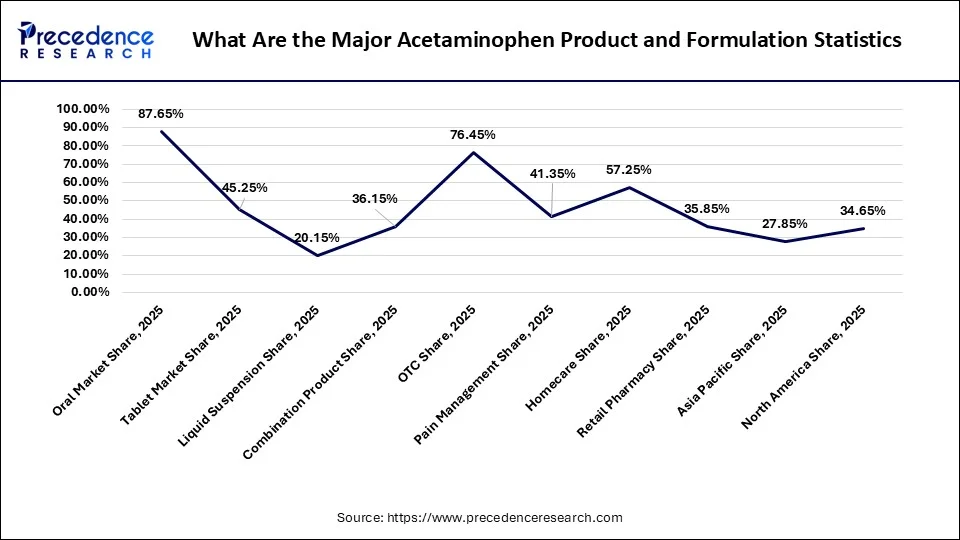
Oral formulations are predominant, with an 87.65 market share, indicating high consumer preference for oral dosage forms. OTC products make up 76.45% of the market, further highlighting the value and significance of self-care and OTC treatments.
Tablets are the leading formulation with 45.25%, and combination products have a significant 36.15% share as multi-benefit therapies are demanded. The healthcare market is dominated by homecare, accounting for 57.25% of the market; North America (34.65%) is a leading regional market contributor, and Asia Pacific (27.85%) is the key region.
Key Insight: Oral products, OTC products, tablets, and homecare products are the biggest growth and demand segments of the market, while combination therapy accounts for the third-largest but growing segment.
What Regulatory Statistics Are Important for the Acetaminophen Market?
| Regulatory Metric | Numerical / Defined Value |
| FDA Adult Maximum Daily Amount | 4,000 mg |
| FDA Age Threshold for General 4,000 mg Statement | 12+ years |
| Adult Maximum Single IV Dose in FDA Backgrounder | 1,000 mg |
| Adult/Adolescent IV Maximum Daily Dose ≥50 kg | 4,000 mg |
| Adult/Adolescent <50 kg Maximum | 75 mg/kg/day, up to 3,750 mg |
| Pediatric 2-12 Years Maximum | 75 mg/kg/day |
| Neonates up to 28 Days Maximum | 50 mg/kg/day |
| Infants 29 Days-2 Years Maximum | 60 mg/kg/day |
Source: Precedence Research Database
For people over the age of 12, the FDA recommends 4,000 milligrams per day as the maximum daily dose for adults. The FDA backgrounder also indicates an IV dose ceiling of 1,000 milligrams for an adult and an even lower IV dose ceiling of 75 milligrams per kilogram per day, up to 3,750 milligrams in total, for an adult weighing less than 50 kilograms for intravenous use specifically. For pediatrics aged two to 12 years, the maximum is 75 milligrams/kg/day; for the neonate whose age is up to 28 days, the maximum is 50 milligrams/kg/day; for infants aged 29 days to 2 years, the maximum is 60 milligrams/kg/day. This is information on recommended doses based on regulation, not on market demands.
Key Insight: Dosing guidelines are dramatically reduced as children age and fall below 50 mg/kg for neonates. This is why FDA cautions against only focusing on the dose from one medication, and wants all acetaminophen to be accounted for across all medicines a person might take.
Which Acetaminophen Segments Gain the Most Share Through 2035?
Source: Precedence Research Database
The expected growth rate is at a slightly higher level for online pharmacies, growing from 17.65% in 2025 to 22.40% by 2035 (+4.75 pp), driven by a migration towards online healthcare acquisition. Besides, Asia Pacific is expected to grow its share at a significant rate from 27.85% to 32.35% (+4.50 pp), which will make this region a key growth area. Increased demand for advanced treatments will drive prescription products, parenteral/IV therapies, and combination products to take share.
Key Insight: Online pharmacies, online growth in APAC, and advanced treatment formats will sustain future growth, whereas the traditional retail pharmacy channels will shrink.
Buyer Intelligence
Who Are the Main Buyers in the Acetaminophen Market?
| Buyer | Products Purchased | Primary Procurement Requirement | Purchasing Frequency |
| Retail Pharmacies | Tablets, capsules, liquids | Availability + price | Very High |
| Hospital Pharmacies | IV + oral | Quality + supply continuity | High |
| Pharmaceutical Manufacturers | API | Cost + quality | Very High |
| Private-Label Retailers | Finished dosage | Price + compliance | Very High |
| Online Pharmacies | OTC medicines | Availability + fulfillment | Very High |
| Clinics | Oral/injectables | Clinical availability | High |
| Long-Term Care | Tablets/liquids | Administration + reliability | High |
| Distributors | Bulk products | Price + supply | Very High |
Source: Precedence Research Database
Retail pharmacies' tablets, capsules, and liquids have a very high purchasing frequency and meet high availability and price requirements, due to the high volume and frequent use of acetaminophen. IV formulations are purchased more often than the oral ones, as the completeness of the hospital stock is more important than on a retail shelf, as well as the quality. Aditi believes that, compared to the fast-growing digital channel throughout the analysis, online pharmacies are purchasing OTC medicines at a very high frequency, where availability and speed of fulfillment are a priority.
Key Insight: Quantity and clinical reliability are the top priorities for hospitals and clinics. Price and availability are the most important for their retail, private-label, and distribution buyers.
Which Factors Influence Acetaminophen Procurement Decisions?
| Procurement Factor | Importance |
| Regulatory Compliance | Very High |
| API Quality | Very High |
| Product Availability | Very High |
| Supply Continuity | Very High |
| Manufacturing Cost | Very High |
| Batch Consistency | Very High |
| Manufacturing Certifications | Very High |
| Delivery Reliability | High |
| Dosage-Form Portfolio | High |
| Geographic Supply Network | High |
| Packaging/Label Compliance | High |
| Private-Label Capability | High |
Source: Precedence Research Database
There are seven factors critical to procurement decisions with very high importance, including regulatory compliance, API quality, product availability, supply continuity, manufacturing cost, batch consistency, and manufacturing certifications.
That concentration of very-high-importance factors around quality, compliance, and reliability rather than around price alone reflects how tightly regulated pharmaceutical manufacturing is compared with an ordinary consumer product. Furthermore, a single batch-consistency failure or certification lapse can halt an entire supply relationship regardless of price competitiveness.
The following five attributes carry a moderate importance level, still important but not as quintessential to the buyer's final decision as the top five attributes. These include delivery reliability, breadth of portfolio of dosage forms, geographic supply network strength, packaging label compliance, and private labeling manufacturing capability.
Key Insight: Seven different attributes are relatively high in terms of importance, including all compliance, quality, availability, and manufacturing consistency factors and not just price.
What are the Main Commercial Opportunities for Acetaminophen Manufacturers?
| Opportunity | Growth Potential | Main Buyer |
| Combination Products | Very High | Consumer Health |
| IV Acetaminophen | High | Hospitals |
| Pediatric Liquids | High | Consumers/Hospitals |
| Private-Label OTC | High | Retailers |
| API-to-Finished-Dosage Integration | High | Pharmaceutical Companies |
| Online Pharmacy Distribution | Very High | Consumers |
| Emerging-Market Distribution | Very High | Distributors |
| Contract Manufacturing | High | Pharmaceutical Brands |
| Premium Formulations | Moderate-High | Consumers |
| Regional API Manufacturing | High | Pharmaceutical Companies |
Source: Precedence Research Database
Combination products are the most promising field, as there is very high growth potential in this field due to high market demand for these products. IV acetaminophen has favorable growth potential in the hospital environment because it is gaining popularity for treating acute pain in the inpatient setting. As pediatric product demand increases from both patients and clinicians for convenient formulations and administration, pediatric liquids are expected to grow.
Key Insight: Combination products offer the best promise for growth, and hospital - based IV products, pediatrics, private-label OTCs, and integrated manufacturing present good growth targets.
Acetaminophen Competitive Landscape
| Company | Category | Major Strength | Strategic Focus |
| Kenvue | Branded OTC | Tylenol | Brand + consumer distribution |
| Haleon | Branded OTC | Panadol | Pain-relief innovation |
| Granules India | API + Finished Dosage | Paracetamol | Vertical integration |
| Gland Pharma | Injectables | Acetaminophen injection | Hospital products |
| Hikma | Generics | Injectable/generic portfolio | Institutional market |
| Perrigo | Private Label/OTC | Consumer health | Retail/private label |
| Dr. Reddy's | Generics | Global manufacturing | Generic medicines |
| Mallinckrodt | Specialty/API | Hospital/API exposure | Specialty pharma |
Source: Precedence Research Database
Acetaminophen is a well-established and large market segment among drugs, characterised by a high and stable demand in all countries. New avenues for industry expansion are shifting from a reliance on standard products to high-volume products towards specialized product formats, and commercial opportunities with higher levels of differentiation.
Kenvue and Haleon have solid competitive positions, backed by proven consumer-health brands and a broad international presence. A key virtue is vertical integration in the supply chain, notes Granules India. The company's consumer-health arm is present in over 165 countries, and Haleon's Pain Relief business turned in revenue in 2025 of £2.564 billion. The company's annual API production capacity of paracetamol is 34,560 tonnes, further signaling the commitment to and the significance of the company's manufacturing facilities in the global supply chain.
Now it's a market in flux, certainly moving past just acetaminophen by volume. New growth avenues include combination medicine differentiation, hospital-controlled injectables, pediatric formulations, private-label manufacturing, digital sales channels, and integrated API-to-finished-dose manufacturing. In the coming years, companies with large-scale production, product differentiation, and good distribution networks will enjoy a better competitive position.
Key Insight: Growth focuses on differentiation and size, as well as innovation and distribution, are key to success.
Expert Insights
The acetaminophen products market is morphing from a traditional analgesics business into a known and growing consumer healthcare and pharmaceutical chain. This is enabled by availability, product development, and hefty scale generic business. I think that some of the best possibilities are in the area between affordable formulations, combination products, and pharmaceutical manufacturing efficiency. The desire for pain and fever control among consumers, an increase in self-care approach, and access to OTC drugs are expected to continue to be among the major factors that affect competitiveness in the coming years.
Our Experts
Primary market research was conducted by Deepa Pandey, followed by methodology development and analysis of market segmentation, regional trends, competitive developments, and forecasts, which laid the foundation of the report.
Aman was responsible for sourcing and validating regulatory filings, company financial information, pharmaceutical production data, trade statistics, and other independently sourced quantitative datasets to build the evidence base behind the Market Estimations.
Aditi carefully read the entire research paper, did the quality check, validated the findings, applied refinement of content, corrected the content for inconsistencies, and gave the final report, ensuring accuracy and clarity.
Acetaminophen Market Segment
Product Type
- Acetaminophen-Only Products
- Acetaminophen Combination Products
Dosage Form
- Tablets
- Liquid Suspensions
- Capsules
- Suppositories
- Other Forms
Route of Administration
- Oral
- Parenteral/Intravenous
- Rectal & Other Routes
Application
- Pain Management
- Fever Reduction
- Cold & Flu
- Postoperative/Inpatient Care
- Other Applications
Sales Type
- OTC
- Prescription
Distribution Channel
- Retail Pharmacies
- Hospital Pharmacies
- Online Pharmacies
- Drug Stores & Supermarkets
- Other Channels
End User
- Homecare Settings
- Hospitals
- Clinics
- Long-Term Care & Other Facilities
Region
- North America
- Europe
- Asia Pacific
- Latin America
- Middle East & Africa
For inquiries regarding discounts, bulk purchases, or customization requests, please contact us at sales@precedenceresearch.com
Frequently Asked Questions





Ask For Sample
No cookie-cutter, only authentic analysis – take the 1st step to become a Precedence Research client
 Get a Sample
.webp)



 sales@precedenceresearch.com
 Schedule a Meeting
