



Adaptive Learning Software Market Size, Share and Trends 2026 to 2035
Adaptive Learning Software Market (By Component: Software Platforms/Solutions, Adaptive lesson engines; By Deployment Mode: Cloud/SaaS Deployment, On-Premises Deployment, Hybrid Deployment; By End-User: Education & Academic Institutions, Corporate & Workforce Training, By Application/Use Case, Academic Learning & K-12/Higher Ed) - Global Industry Analysis, Size, Trends, Leading Companies, Regional Outlook, and Forecast 2026 to 2035
Source: https://www.precedenceresearch.com/adaptive-learning-software-market
 Get a Sample
 Table Of Content


What is the Adaptive Learning Software Market Size?
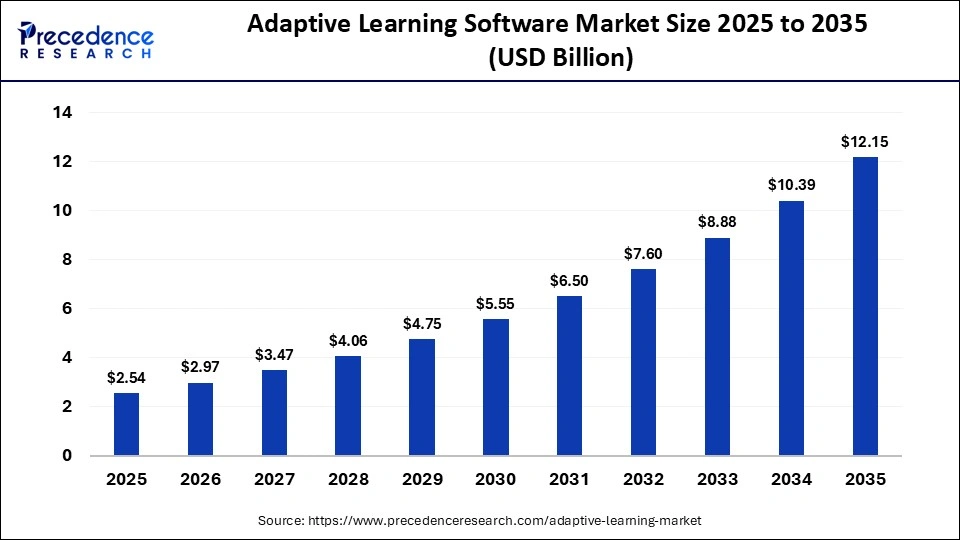
The global adaptive learning software market size was calculated at USD 2.54 billion in 2025 and is predicted to increase from USD 2.97 billion in 2026 to approximately USD 12.15 billion by 2035, expanding at a CAGR of 16.94% from 2026 to 2035.The market is witnessing robust growth, driven by the increasing demand for personalized educational experiences and the integration of advanced technologies in learning environments. Key drivers include the rising adoption of e-learning platforms and the need for scalable learning solutions that cater to diverse learner needs, ultimately enhancing educational outcomes.
Market Highlights
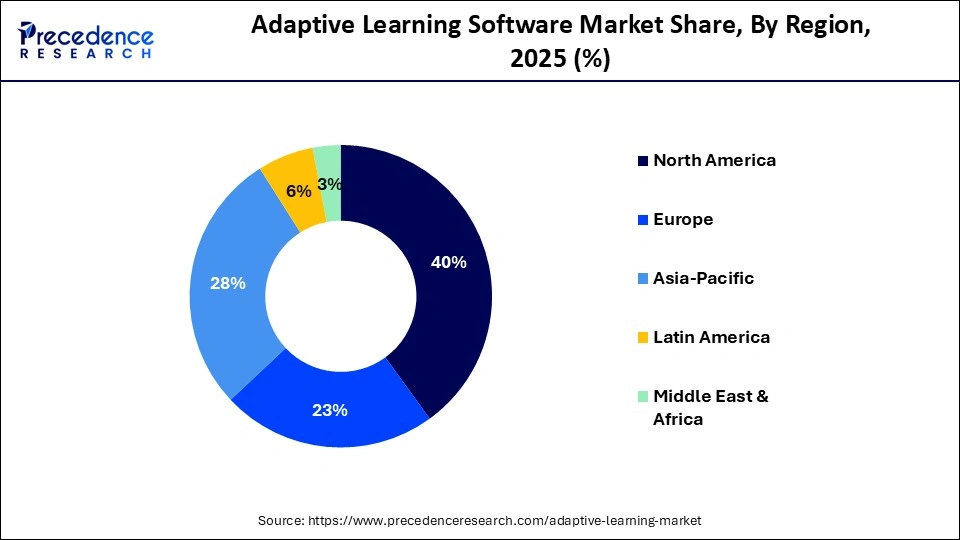
- North America dominated the global adaptive learning software market with the largest share of approximately 40% in 2025.
- Asia-Pacific is expected to grow at the fastest CAGR in the market during the forecast period
- By component, the software platforms/solutions segment held a dominant position in the market with the largest share of
- approximately 68% in 2025.
- By component, the services segment is expected to grow at the fastest CAGR in the market between 2026 and 2035.
- By deployment mode, the cloud/SaaS deployment segment accounted for a considerable revenue share of approximately 65% in the market in 2025.
- By deployment mode, the hybrid deployment segment is expected to grow with the highest CAGR in the adaptive learning software market during the studied years.
- By end-user, the education & academic institutions segment led the global market with a share of approximately 42% in 2025
- By end-user, the corporate & workforce training segment is expected to expand rapidly in the market in the coming years
- By application/use case, the academic learning & K-12/higher Ed segment led the global market with a share of approximately 36% in 2025
- By application/use case, the certification & skill development segment is expected to expand rapidly in the market in the coming years
Adaptive Learning Software: Personalized Education at Digital Speed
The adaptive learning software market is rapidly expanding as education and training providers shift toward personalized, data-driven learning experiences. These platforms dynamically adjust content, pace, and assessment based on individual learner assessment based on individual leaner performance and behaviour. Rising adoption across K-12, higher education, and corporate training is accelerating market growth. Increased demand for measurable learning outcomes and flexible digital education also contributes to market growth.
Role of AI in Adaptive Learning Software
Integrating artificial intelligence (AI) in the core engine powering adaptive learning software enables real-time personalization and predictive insights. Machine learning (ML) algorithms analyze learner interactions to tailor content pathways and recommend targeted interventions. AI-driven analytics help educators identify knowledge gaps, engagement levels, and learning risks early. Natural language processing and generative AI further enhance feedback mechanisms and interactive learning experiences.
Key Market Trends in the Adaptive Learning Software Market
- Hyper-Personalized Learning Paths: Hyper-personalized learning paths utilize data analytics to tailor educational experiences to individual learner needs, preferences, and goals. By assessing a learner's unique strengths and weaknesses, these paths can adapt in real-time, ensuring that each learner receives the most relevant and effective resources for their growth.
- Upskilling and Reskilling Programs: Upskilling and reskilling programs are essential in today's fast-paced job market, allowing employees to enhance their current skills or acquire new ones to meet evolving industry demands. Companies often implement these programs to empower their workforce, improve retention, and ensure that their teams remain competitive and adaptable.
- Competency-based Models: Competency-based models focus on the learner's ability to demonstrate mastery of skills and knowledge rather than simply progressing through a predetermined sequence of courses. This approach not only fosters a deeper understanding of the material but also encourages learners to take ownership of their education by moving at their own pace.
- Cloud-based Learning Solutions: Cloud-based learning solutions provide access to educational resources and platforms from anywhere with an internet connection, significantly enhancing flexibility and convenience. These solutions often facilitate collaboration, enabling learners to connect and engage with peers and instructors in real-time, enriching the learning experience.
- Learner Engagement: Learner engagement is crucial in maintaining motivation and interest in educational programs, leading to better retention rates and outcomes. By incorporating interactive elements, personalization, and real-world applications into the learning process, educators can create a more dynamic and compelling environment that captivates learners.
Market Scope
| Report Coverage | Details |
| Market Size in 2025 | USD 2.54 Billion |
| Market Size in 2026 | USD 2.97 Billion |
| Market Size by 2035 | USD 12.15 Billion |
| Market Growth Rate from 2026 to 2035 | CAGR of 16.94% |
| Dominating Region | North America |
| Fastest Growing Region | Asia Pacific |
| Base Year | 2025 |
| Forecast Period | 2026 to 2035 |
| Segments Covered | Component, Deployment Mode, End-User, Application/Use Case ,and region |
| Regions Covered | North America, Europe, Asia-Pacific, Latin America, and Middle East & Africa |
Segmental Insights
Component Insights
Which Component Segment Dominated the Adaptive Learning Software Market?
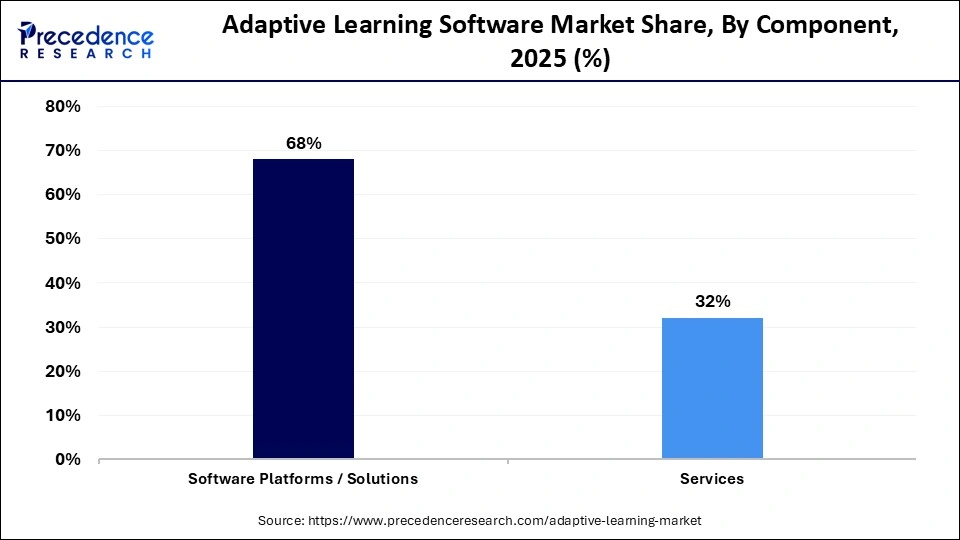
The software platforms/solutions segment dominated the market by holding a share of approximately 68% in 2025, as they are directly required to deliver customized content, provide real-time evaluation, and learner analytics. Such platforms combine AI-based recommendation systems, learner profiling, and adaptive assessments to keep changing learning trajectories. They are very appealing to educational institutions and enterprises due to their scalability and the possibility of integrating with existing LMS and ERP systems.
The increased need for information-based learning outputs and performance tracking is another aspect that enhances the use of platforms. Constant upgrades, retraining of AI models, and content increase are factors that ensure vendors keep their customers engaged in the long-term basis.
The services segment is expected to grow at the fastest CAGR in the market between 2026 and 2035, as services provide customization, integration, and constant support. Platform implementation, curriculum alignment, and AI model tuning are aspects of professional services that are increasingly used in institutions and enterprises. Managed services, such as analytics monitoring and performance optimization, are becoming a trend as users need an outcome-based learning solution. Other services offered with training and change management facilitate easy adoption by educators and employees.
Deployment Mode Insights
How the Cloud/SaaS Deployment Segment Dominated the Adaptive Learning Software Market?
The cloud/SaaS deployment segment held a major revenue share of approximately 65% in the market in 2025, because it is scalable, economical, and accessible. Cloud systems provide real-time data processing, ongoing updates of content, and real-time cross-geographical cooperation. Organisations save infrastructure costs and enable faster implementation schedules. Combining AI and big data analytics is more effective with cloud execution and favors advanced personalization. Effective data protection systems and regulatory capabilities also strengthen the use of cloud-based tools.
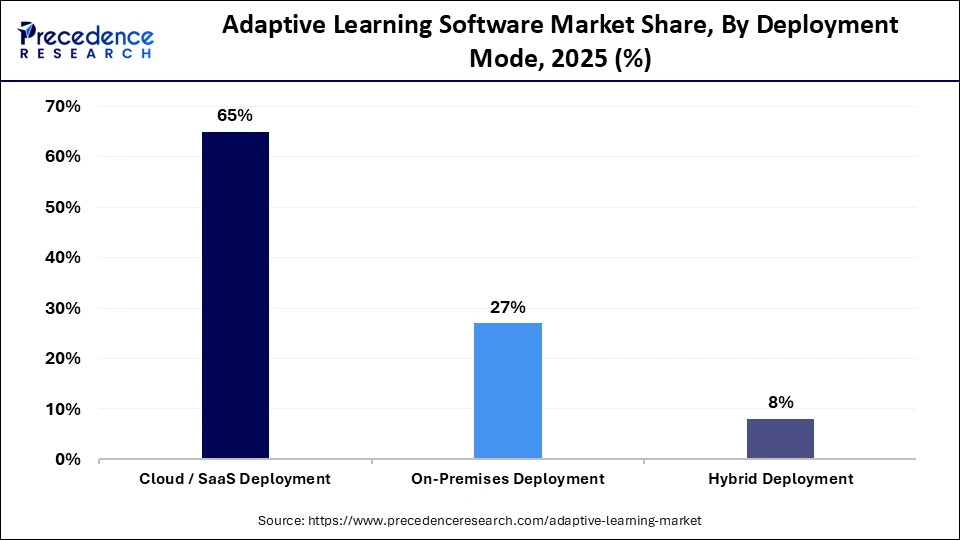
The hybrid deployment segment is expected to grow with the highest CAGR in the market during the studied years, due to the ability to store sensitive data within the facility and benefit from AI-based analytics services. Hybrid structures are preferred by large institutions of higher learning, government, and controlled businesses due to the need to comply with and tailor to their requirements accordingly. Gradual deployment towards full infrastructure migration is also facilitated by hybrid deployment, eliminating the need for total migration of the infrastructure.
End-User Insights
Which End-User Segment Led the Adaptive Learning Software Market?
The education & academic institutions segment led the global market with a share of approximately 42% in 2025, driven by the need for schools and universities to cater to different learning styles, enhance student performance, and decrease dropout rates. AI-based evaluations are becoming more popular in K-12 and higher education institutions to monitor improvement and individualize teaching. The segment is a predictable source of revenue due to the presence of long-term contracts and large user bases.
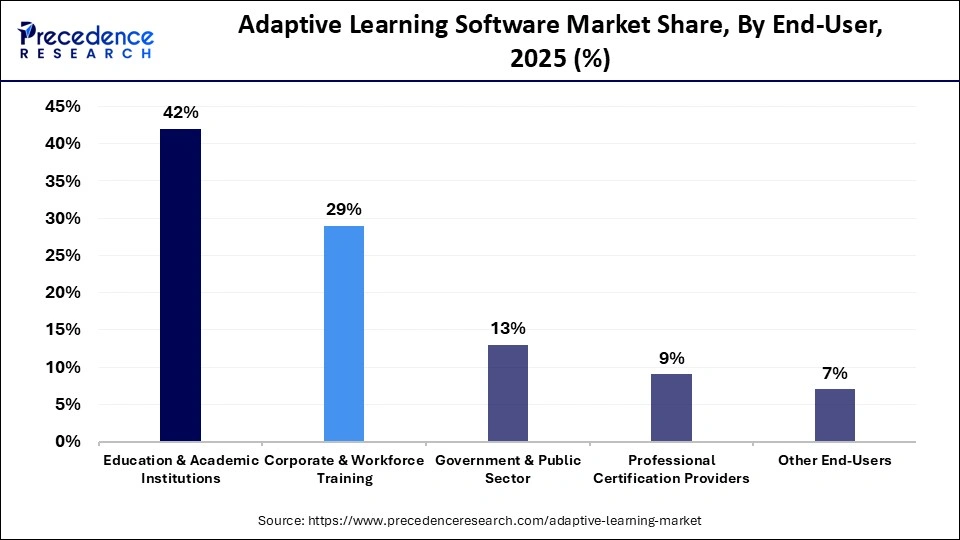
The corporate & workforce training segment is expected to expand rapidly in the market in the coming years, because organizations focus on upskilling and reskilling. Adaptive learning solutions facilitate individualized staff training according to job roles and performance shortfalls. Business is benefited by better training performance, lower expenditure, and quantifiable ROI. AI-based analytics enable HR and L&D departments to monitor the competency development in real-time. The need to build remote and hybrid work models is also increasing demand in this segment.
Application/Use Case Insights
Why the Academic Learning & K-12/Higher Ed Segment Dominated the Market?
The academic learning & K-12/higher Ed segment accounted for the highest revenue share of approximately 36% in the adaptive learning software market in 2025, driven by the environment as adaptive technologies are widely used and at a young age. These solutions aid teachers in modifying teaching according to learners' performance, their interests, and learning rates. AI-based platforms facilitate formative assessment, customized homework, and remedial education. Government bodies support digital classrooms, and the growing interest in enhancing basic learning outcomes perpetuates the segment's dominance.
The certification & skill development segment is expected to witness the fastest growth in the market over the forecast period, because adaptive platforms tailor learning platforms to certifications in IT, healthcare, finance, and new technology. Learners have the advantage of focused learning, adaptive testing, and accelerated learning skills. Adaptive-based learning certifications are becoming more widely accepted by employers as a workforce preparedness measure. The shifting trend towards lifelong learning also propels the segment's growth.
Regional Insights
How Big is the North America Adaptive Learning Software Market Size?
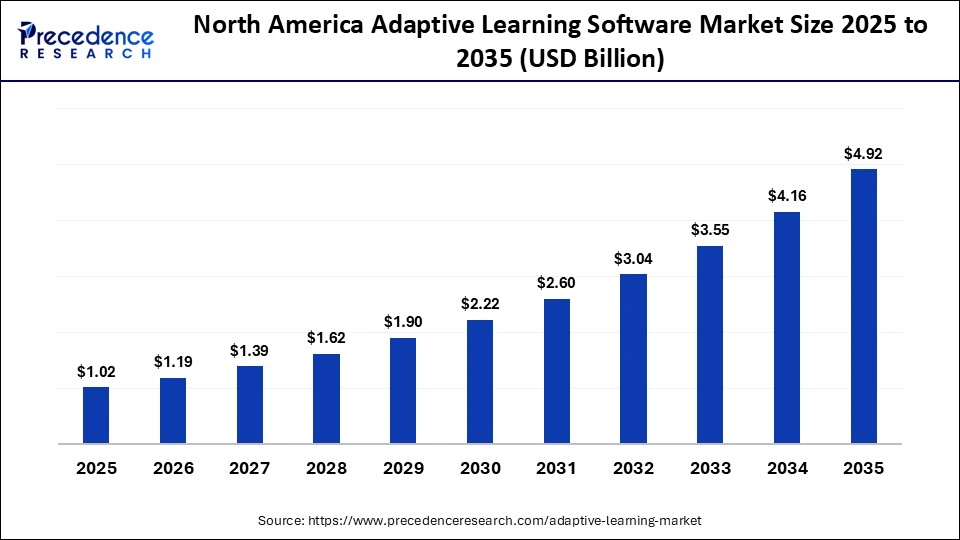
The North America adaptive learning software market size is estimated at USD 1.02 billion in 2025 and is projected to reach approximately USD 4.92 billion by 2035, with a 17.04% CAGR from 2026 to 2035.
Why North America Dominated the Adaptive Learning Software Market?
North America held the largest revenue share of approximately 40% in the market in 2025, driven by the increasing demand for personalized education. Significant investments in educational technology are fostering innovations that enhance the learning experience. Governments' focus on improving educational outcomes and aligning skills with workforce demands is further propelling market expansion. As a result, the regional landscape of adaptive learning is becoming more competitive, with local providers emerging alongside global players.
What is the Size of the U.S. Adaptive Learning Software Market?
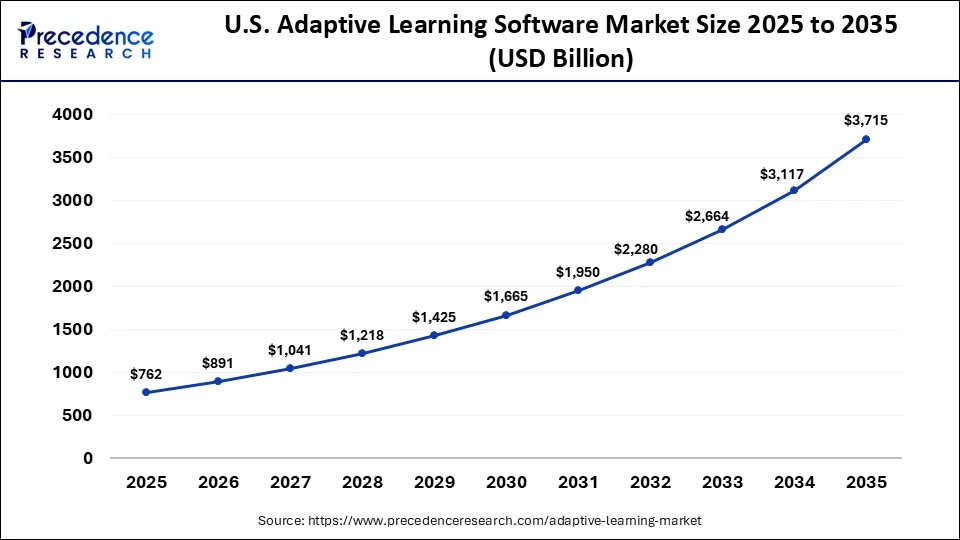
The U.S. adaptive learning software market size is calculated at USD 762.00 billion in 2025 and is expected to reach nearly USD 3,715.00 billion in 2035, accelerating at a strong CAGR of 17.04% between 2026 and 2035.
U.S. Market Trends
The U.S. holds a prominent position in the market, largely due to its advanced technological infrastructure and significant investments in educational technologies. Educational institutions, including colleges and K-12 schools, are increasingly adopting adaptive learning platforms to offer personalized learning experiences that cater to individual student needs.
This trend is supported by a strong push for data-driven approaches to education, where analytics play a crucial role in tailoring content and improving learning outcomes. Moreover, the presence of leading technology companies and startups in Silicon Valley fosters innovation in educational tools, contributing to the expansion of adaptive learning solutions.
How is Asia-Pacific Growing in the Adaptive Learning Software Market?
Asia-Pacific is expected to host the fastest-growing market in the coming years, driven by the growing demand for tailored educational experiences. These technologies enable real-time content adjustments based on individual learner performance and behavior, fostering a more engaging and effective learning journey. Hyper-personalized learning paths, which adapt based on learners' strengths and weaknesses, and the emphasis on upskilling and reskilling to meet workforce demands, augment the market. Additionally, the rise of cloud-based learning solutions enhances accessibility and flexibility, allowing learners to collaborate and connect in dynamic environments.
India Market Trends
India is one of the fastest-growing economies in the world, characterized by a vibrant demographic landscape with a significant youth population driving demand for education and technology. The country's education sector is undergoing a transformative shift towards personalized and digital learning, fueled by the growing adoption of adaptive learning software. Strong government initiatives such as the National Education Policy (NEP) aim to enhance the quality and accessibility of education, encouraging innovation and technology integration in classrooms.
Moreover, the increasing prevalence of smartphones and internet access across urban and rural areas facilitates the expansion of e-learning platforms, allowing educators to reach diverse learners effectively. Business investment in upskilling and reskilling programs is also on the rise, as companies recognize the need to equip their workforce with the requisite skills to meet the demands of a dynamic job market. Overall, India's market presents significant opportunities for growth, targeted interventions, and improved educational outcomes tailored to the diverse needs of the population.
Adaptive Learning Software Market Value Chain Analysis
- Raw Material Sourcing
This stage involves sourcing foundational digital inputs such as cloud infrastructure, data storage systems, AI frameworks, and content assets like curricula, multimedia modules, and datasets. Major contributors include cloud and AI technology providers that enable scalable, secure, and high-performance platforms.
Key Players: AWS, Microsoft Azure, Google Cloud, NVIDIA, OpenAI
- Component Fabrication
Component fabrication focuses on software development, including AI algorithms, learning engines, user interfaces, analytics dashboards, and content management systems. Vendors integrate ML models, assessment tools, and personalization engines to build adaptive functionality.
Key Players: Pearson, McGraw-Hill, Blackboard, D2L, Docebo
- Testing and Certification
At this stage, platforms undergo functionality testing, cybersecurity validation, interoperability checks, and compliance with education standards and data privacy regulations. Certification ensures alignment with regional education frameworks and enterprise IT requirements.
Key Players: ETS, ISO-certified testing bodies, TÜV Rheinland, UL Solutions
- Installation and Commissioning
This phase includes platform deployment, LMS integration, customization for institutions or enterprises, and initial user onboarding. Vendors often collaborate with IT service providers to ensure seamless integration with existing digital ecosystems.
Key Players: SAP, Oracle, IBM, Accenture, Cognizant
- Distribution and Sales
Adaptive learning solutions are distributed through direct enterprise sales, institutional contracts, SaaS subscriptions, and partnerships with education providers. Digital marketplaces and value-added resellers also play a growing role in market reach.
Key players: Coursera for Business, Udemy Business, LinkedIn Learning, Skillsoft
- Product Lifecycle Management
Lifecycle management involves continuous updates, AI model retraining, performance analytics, customer support, and feature enhancements based on learner data. Ongoing optimization ensures relevance, scalability, and improved learning outcomes over time.
Key Players: Instructure, Anthology, Cornerstone OnDemand, SAP SuccessFactors
Recent Developments
- In February 2026, OpenAI launched a new Codex app to provide enterprises with tools for autonomous AI-driven coding. This development comes as organizations increasingly consider integrating AI technology to enhance their software development processes and improve efficiency. The tool allows developers to spend less time typing and more time reviewing and directing.(source: https://www.infoworld.com)
- In August 2025, Unlox launched an integrated learning platform combining AI-driven guidance, dedicated hardware, and cloud-based virtual labs. The platform was built to address gaps in accessibility, personalization, and practical skill-building in higher education and professional training. (Source: https://cio.economictimes.indiatimes.com)
Who are the Major Players in the Global Adaptive Learning Software Market?
The major players in the adaptive learning software market include Pearson Education, John Wiley & Sons, Inc, McGraw-Hill Education, Follett Corporation, Curriculum Associates, Istation Corporate, Dreambox, Realizeit, CogBooks, ScootPad.
Segments Covered in the Report
By Component
- Software Platforms/Solutions
- Adaptive lesson engines
- Analytics & reporting modules
- Content recommendation engines
- Services
- Implementation & integration
- Content customization & training
- Support & consultin
By Deployment Mode
- Cloud/SaaS Deployment
- On-Premises Deployment
- Hybrid Deployment
By End-User
- Education & Academic Institutions
- Corporate & Workforce Training
- Government & Public Sector
- Professional Certification Providers
- Other End-Users
By Application/Use Case
- Academic Learning & K-12/Higher Ed
- Employee Training & Upskilling
- Certification & Skill Development
- Language & Professional Training
- Other Use Cases
By Region
- North America
- Europe
- Asia-Pacific
- Latin America
- Middle East & Africa
For inquiries regarding discounts, bulk purchases, or customization requests, please contact us at sales@precedenceresearch.com
Frequently Asked Questions





Ask For Sample
No cookie-cutter, only authentic analysis – take the 1st step to become a Precedence Research client
 Get a Sample



 sales@precedenceresearch.com
 Schedule a Meeting
