



Self-Supervised Learning Market Size, Companies, Trends, Competitive Landscape, and Industry Outlook
Self-Supervised Learning Market (By End Use: Healthcare, BFSI, Automotive & Transportation, Software Development (IT), Advertising & Media, Others; By Technology: Natural Language Processing (NLP), Computer Vision Speech Processing) - Global Industry Analysis, Size, Trends, Leading Companies, Regional Outlook, and Forecast 2026 to 2035
Source: https://www.precedenceresearch.com/self-supervised-learning-market
 Get a Sample
 Table Of Content


What is the Self-Supervised Learning Market Size?
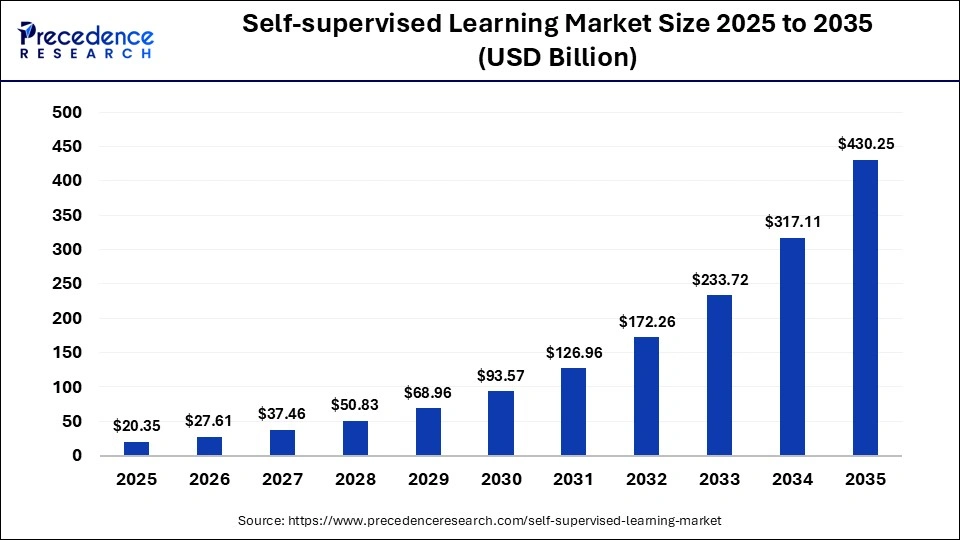
The global self-supervised learning market size is predicted to increase from USD 27.61 billion in 2026 to approximately USD 430.25 billion by 2035, expanding at a CAGR of 35.68% from 2026 to 2035. The wide adoption of self-supervised learning powered by machine learning techniques in fields like natural language processing and computer vision allows them to train AI models and reduces dependency on labeled datasets. Growth is driven by increasing enterprise demand for scalable AI training methods that can leverage large volumes of unstructured data while lowering data preparation costs and development timelines.
Market Highlights
- North America dominated the market, holding more than 37% of the market share in 2026.
- Asia Pacific is expected to grow at the fastest CAGR from 2026 to 2035.
- By end use, the BFSI segment held the major market share of 20% in 2026.
- By end use, the advertising & media segment in the market is expected to grow at the fastest CAGR between 2026 and 2035.
- By technology, the natural language processing segment held the major market share of 41% in 2026.
- By technology, the speech processing segment is expected to grow at a notable CAGR from 2026 to 2035.
Self-Supervised Learning:Introduces Optimized Business Performance
The self-supervised learning market is driven by cost-effective and time-saving training approaches that deliver high accuracy by extracting supervisory signals directly from input data. These models are widely used across natural language processing, computer vision, image processing, and image synthesis applications. Self-supervised systems demonstrate a strong capability to predict masked or missing data, learn temporal relationships, and infer occluded information from available inputs, enabling robust representation learning. These systems employ training techniques such as autoencoders, autoregressive modeling, masking strategies, and relationship prediction, with autoregressive models supporting audio-based NLP tasks including speech-to-text and text-to-speech.
Adoption of self-supervised learning is improving business performance by reducing data labeling costs and accelerating model deployment across enterprise AI workflows. Organizations are leveraging these models to enhance automation, decision support, and predictive analytics across large unstructured datasets. Integration with cloud platforms and scalable compute infrastructure is further enabling cost-efficient training at scale. In parallel, institutions and educators are increasingly supported by initiatives from organizations such as OpenAI, which focus on advancing AI research, education, and access to AI tools across emerging markets, including India.
How Does AI Impact the Self-Supervised Learning Market?
AI chatbots take the lead in interactions, and AI educational offerings tailor their lessons to a specific learner. The self-supervised learning market is accelerated by deep learning, which enables semi-supervised learning to train AI models for regression and classification tasks. Generative AI operates in phases such as training, tuning, generation, evaluation, and iterative refinement to continuously improve model performance and accuracy.
Advances in foundation models are expanding the scale and applicability of self-supervised learning across language, vision, and multimodal use cases. AI-driven automation of feature extraction and representation learning is reducing development time and computational overhead for complex models. In parallel, integration of self-supervised approaches with enterprise AI workflows is improving adaptability, robustness, and real-world deployment efficiency.
Major Trends in the Self-Supervised Learning Market
- Advancements in Computer Vision: These include real-time video analysis, vision transformers, Generative Adversarial Networks (GANs), Explainable AI (XAI), 3D vision, depth estimation, and edge computing. These innovations introduce enhanced data privacy through federated learning, further expanding the self-supervised learning market.
- Generative Models: Advancements in these models help to resolve challenges, such as the emerging need for vast training data and achieving robust perception in complex situations. The increasing use of robotics, AI, deep learning, and edge computing devices results in improved perception.
Segmental Insights
End-Use Insights
How Does the BFSI Segment Dominate the Self-Supervised Learning Market in 2026?
The BFSI segment dominated the market in 2026, owing to the critical role of self-supervised learning, AI, and ML in fraud detection, customer service, regulatory compliance, and wealth management. It is important in both internal operations and customer-facing applications. Several applications became crucial to meet the customers' needs for seamless digital banking experiences.
The advertising & media segment is expected to grow at the fastest CAGR in the self-supervised learning market during the forecast period due to the increased use cases of machine learning models, like self-supervised learning, in improving customer experience, interacting with customers, detecting fraud, and more. These models aim to build brand awareness, increase long-term customer engagement, and acquire new customers. Self-supervised representations can support audience analysis, content understanding, and personalization when adapted to advertising and media applications.
Technology Insights
What Made Natural Language Processing the Dominant Segment in the Self-Supervised Learning Market in 2026?
The natural language processing segment dominated the market in 2026, owing to the major impact of self-supervised learning on NLP tasks. It reduces annotation costs and improves business performance. The main applications include pre-training models, such as contrastive learning, BERT, GPT, and pseudo-supervised and semi-supervised methods.
The speech processing segment is estimated to grow at the fastest rate in the self-supervised learning market during the predicted timeframe due to the increased use of diffusion models by researchers to create synthetic speech with new speaker variations. The generative and synthetic augmentation reduces word error rate when used for self-supervised learning pre-training. This machine learning technology is adopted by healthcare, finance, and edge computing industries for fraud detection and high-fidelity clinical documentation through voice analysis.
Regional Insights
How Big is the North America Self-Supervised Learning Market Size?
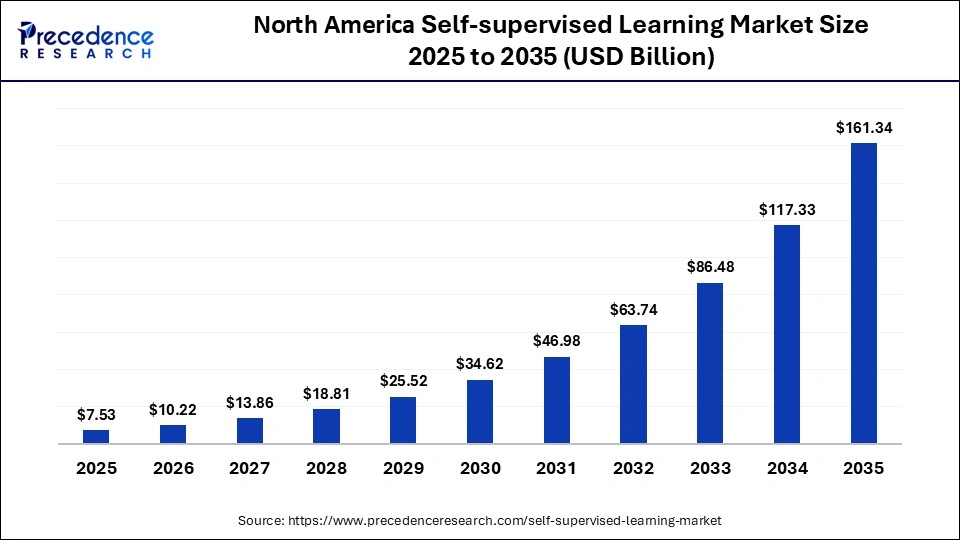
The North America self-supervised learning market size is estimated at USD 10.22 billion in 2026 and is projected to reach approximately USD 161.34 billion by 2035, with a 35.86% CAGR from 2026 to 2035.
How Does North America Dominate the Self-Supervised Learning Market in 2026?
North America dominated the market in 2026, owing to funding and initiatives by the governments for AI research, the rising demand for efficient AI training models, and advanced cloud computing capabilities. In August 2025, Google pledged $1 billion to transform AI learning for U.S. students. Moreover, the CEOs of Microsoft and Google planned to increase AI access for students and support for AI in announcing tools, education, training, and funding. The U.S. Department of Health and Human Services (HHS) announced a request for information to harness AI to reduce healthcare costs and make America healthy again.
- In December 2025, the U.S. Department of Commerce's National Institute of Standards and Technology (NIST) launched centers for AI in manufacturing and critical infrastructure.
What is the Size of the U.S. Self-Supervised Learning Market?
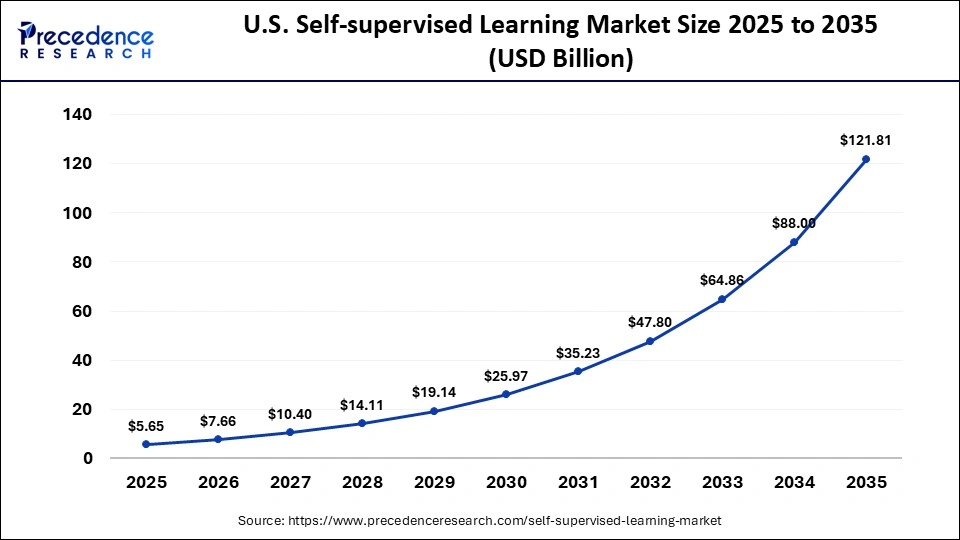
The U.S. self-supervised learning market size is calculated at USD 7.66 billion in 2026 and is expected to reach nearly USD 121.81 billion in 2035, accelerating at a strong CAGR of 35.95% between 2026 and 2035.
U.S. Self-Supervised Learning Market Analysis
The U.S. advances in the self-supervised learning industry due to reduced labeling burden, high computational capacity, cloud scalability, and faster model deployment across enterprise and research environments. The U.S. government released a technology assessment on AI and healthcare, including field background content from the National Academy of Medicine. Strong adoption across healthcare, finance, and defense analytics is accelerating real-world deployment of self-supervised models at scale. Availability of advanced cloud infrastructure and specialized AI hardware is enabling training on large unstructured datasets with lower marginal cost. In parallel, growing collaboration between federal agencies, academic institutions, and technology companies is reinforcing continued innovation and commercialization in the U.S. self-supervised learning market.
What Is the Potential of the Self-Supervised Learning Market in the Asia Pacific?
Asia Pacific is expected to grow at the fastest CAGR in the market during the forecast period due to the large-scale telecommunications and e-commerce sector, the demand for cost-effective training, and rapidly growing AI-driven personalized learning platforms. In August 2025, the government of Andhra Pradesh launched the Bharat Biodesign Research and Innovation (Brain) program to boost healthcare innovation. There is great importance of policies and interventions, including the Universal Health Coverage in the Asia Pacific and beyond, with self-care strategies.
Rising deployment of self-supervised learning across telecom networks, fraud detection systems, and recommendation engines is accelerating enterprise-level adoption. In parallel, increasing public investment in digital health, smart cities, and national AI roadmaps is strengthening long-term demand for scalable, low-label AI training approaches across the region.
India Self-Supervised Learning Market Trends
India witnesses a strategic adoption of AI and ML models across various sectors like BFSI, education, and healthcare, driving the expansion of the self-supervised learning market. The Ministry of Health accelerated the deployment of AI across national healthcare programs. The Indian government initiatives like the IndiaAI Mission and the Centres of Excellence for AI are expanding access to research, computing power, and supporting institutions and startups.
Growing availability of large, unstructured datasets from digital public infrastructure is improving the effectiveness of self-supervised model training. Additionally, rising participation of startups and system integrators is accelerating commercialization of self-supervised learning solutions across enterprise and public-sector applications in India.
How did Europe hold a Notable Share in the Self-Supervised Learning Market?
Europe is expected to grow at a notable rate in the market due to digital transformation across various sectors, such as BFSI, automotive, and healthcare, and the increased adoption of self-supervised learning techniques. The report published by the European Commission examined the role of AI in future healthcare delivery and reviewed the potential of AI to improve diagnostic accuracy, service efficiency, and patient care. The EC focuses on the practical measures to support ethical, safe, and effective AI integration, including data governance standards.
Germany Self-Supervised Learning Market Analysis
Germany advances in the healthcare industry due to the huge adoption of self-supervised learning systems across different industries, such as automotive, BFSI, manufacturing, and healthcare, the national AI strategy, and the high-tech agenda for the year 2026. Germany aims to become a global leader in AI through the national AI strategy and measures such as regional future centers and learning and experimentation spaces. They support the expansion of the self-supervised learning market through their support for the implementation of AI by small- and medium-sized enterprises.
Is Self-Supervised Learning Driving the Next Wave of AI Growth in Latin America?
Latin America is expected to show notable growth during the forecast period. Traditional supervised learning demands vast amounts of labeled data, which is expensive and scarce. SSL enables AI to learn from unlabeled data, which is abundant in the region, thus making it ideal for industries such as agriculture, healthcare, and finance. Open-source AI is acting as a practical foundation for expansion, enabling developers in the region to accept SSL techniques without huge, upfront investment.
Brazil Market Trends
The Brazilian market is driven by the need to determine vast, unlabeled data in sectors such as healthcare and finance. Brazil's broader AI/ML market is seeing high acceptance rates. The expansion of cloud-driven ML services enables small and medium-sized enterprises to accept sophisticated AI models without huge infrastructure investment.
Why is MEA Emerging as a Key Market for Self-Supervised Learning?
The Middle East and Africa region is expected to grow at a notable CAGR in the foreseeable future. A major barrier to AI acceptance in the region is the shortage of high-quality annotated data. SSL addresses this by enabling models to generate their own labels from raw information, making it a cost-effective solution for data-intensive sectors such as healthcare, agriculture, and finance.
UAE Market Trends
The UAE market is driven by the demand for efficient AI models that use vast unlabeled data in sectors such as healthcare, finance, and autonomous systems. The UAE government's proactive stance, including the "National Strategy for the Future of Work," encourages the integration of AI along with smart learning solutions, propelling SSL adoption.
Major Players in the global Self-supervised Learning Market
- Meta: Meta is providing open-source foundational models, libraries, and research that allow AI to learn from unlabelled data. Their contributions aim at scaling computer vision, audio-visual recognition, and natural language processing to decrease dependence on expensive, manual data annotation.
- Google: Google provides a robust suite of tools, models, and research frameworks for self-supervised learning, aiming to reduce the demand for labeled data, enhance model efficiency, and improve performance in computer vision, medical imaging, and natural language processing.
- Microsoft: Microsoft leverages unlabelled data to train large-scale foundation models in natural language processing, computer vision, and multimodal understanding. Its offerings are available via Azure AI services, open-source models on GitHub, and even research-driven innovations designed to decrease dependence on manual data labeling.
- Amazon Web Services
- OpenAI
- IBM Corporation
- NVIDIA
- Tesla
- Databricks & DataRobot
- Hugging Face
- Anthropic & Mistral AI
Recent Developments
- In January 2026, researchers from the Arizona State University tackled the challenge of understanding the fundamental characteristics of wireless signals, which is crucial for improving communication systems, yet extracting robust information from raw data remains a significant hurdle. The research introduced LWM-Spectro, a foundation model designed to interpret wireless baseband signal spectrograms, and the development of a transformer-based model, pre-trained on a vast dataset of I/Q signals.(Source: https://quantumzeitgeist.com)
- In December 2025, IBM collaborated with Pearson to establish new AI-powered learning tools for globally expanded individuals, educational institutions, businesses, and public organizations.(Source: https://newsroom.ibm.com)
Self-Supervised Learning Market Segments
By End Use
- Healthcare
- BFSI
- Automotive & Transportation
- Software Development (IT)
- Advertising & Media
- Others
By Technology
- Natural Language Processing (NLP)
- Computer Vision
- Speech Processing
By Region
- North America
- Latin America
- Europe
- Asia-pacific
- Middle East and Africa
For inquiries regarding discounts, bulk purchases, or customization requests, please contact us at sales@precedenceresearch.com
Frequently Asked Questions





Ask For Sample
No cookie-cutter, only authentic analysis – take the 1st step to become a Precedence Research client
 Get a Sample




 sales@precedenceresearch.com
 Schedule a Meeting
