

Life science AI and machine learning Market Size, Share and Trends 2026 to 2035

Life science AI and machine learning Market (By Product Type: AI Analytics Platform, Machine Learning Software Tools, AI-Integrated Imaging & Diagnostics Systems, Bioinformatics & Computational Biology Platforms, Ancillary Tools & Accessories; By Deployment Type: On-Premise, Cloud-Based, Hybrid; By Application: Drug Discovery & Development, Genomics & Precision Medicine, Medical Imaging & Diagnostics, Clinical Trial Optimization, Other Life Science Applications; By Technology/Mode of Action: Machine Learning Algorithms, Deep Learning/Neural Networks, Computer Vision-Based Analysis, Natural Language Processing (NLP), Other AI Techniques; By End-User: Pharmaceutical & Biotech Companies, Hospitals & Clinical Labs, Academic & Research Institutes, CROs/Clinical Research Organizations, Other End-Users) - Global Industry Analysis, Size, Trends, Leading Companies, Regional Outlook, and Forecast 2026 to 2035

Last Updated : 12 Dec 2025  |  Report Code : 7217  |  Category : ICT   |  Format : PDF / PPT / Excel

List of Contents

What is the Life science AI and machine learning Market Size?

The global life science AI and machine learning market is growing rapidly as AI-driven tools transform drug discovery, diagnostics, and precision medicine.The market for life science AI and machine learning is driven by precision research needs, automation, advanced diagnostics, and the rising adoption of intelligent drug-discovery and clinical decision-support systems.
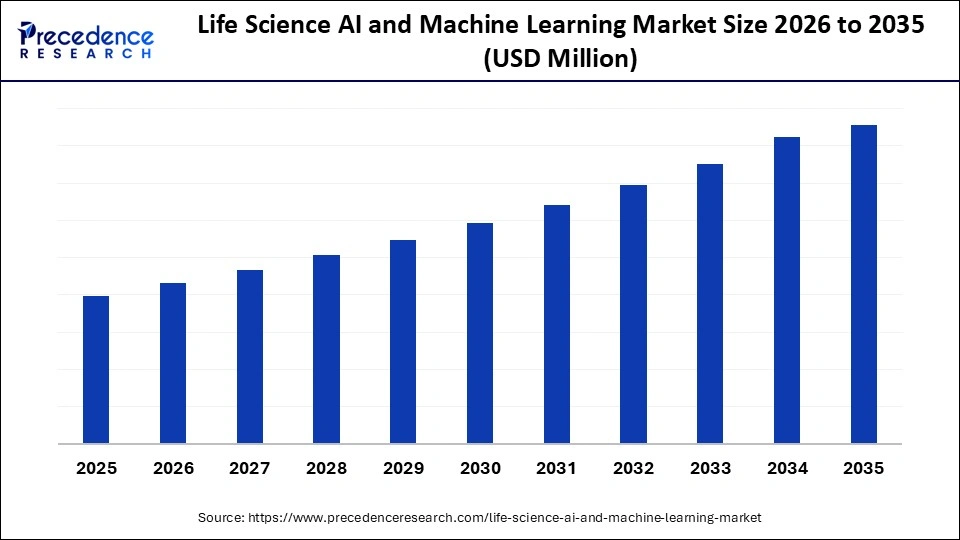
Life Science AI and Machine Learning Market Size 2026 to 2035

Market Highlights

  • North America led the life science AI and machine learning market with a 38% market share in 2025.
  • The Asia Pacific is expected to expand the fastest CAGR between 2026 and 2035.
  • By product type, the AI analytics platforms segment captured around 35% of market share in 2025.
  • By product type, the machine learning software tools segment is growing at the highest CAGR between 2026 and 2035.
  • By deployment type supported, the on-premise segment held more than 50% of the market share in 2025.
  • By deployment type supported, the cloud-based segment is growing at a strongt CAGR between 2026 and 2035.
  • By application, the drug discovery & development segment contributed the 40% of the market share in 2025.
  • By application, the genomics & precision medicine segment is expanding at the highest CAGR between 2026 and 2035.
  • By technology/mode of action, the machine learning algorithms segment captured 35% of market share in 2025.
  • By technology/mode of action, the deep learning / neural networks segment is expected to expand at the highest CAGR between 2026 and 2035.
  • By end-user, the pharmaceutical & biotech companies segment held a 45% share in the life science AI and machine learning market during 2025.
  • By end-user, the CROs / clinical research organizations segment is poised to grow at a notable CAGR between 2026 and 2035.

Life science AI and machine learning Market Explained: Tools, Platforms, and Data-Driven Research

The life science AI and machine learning market encompasses advanced computational technologies designed to analyse complex biological data, accelerate drug discovery, enhance clinical decision-making, and optimize research workflows across biotechnology, pharmaceuticals, genomics, proteomics, medical imaging, and healthcare analytics.

AI/machine learning growth is projected to continue at exponential rates as more and more organisations leverage AI/machine learning tools to shorten drug development cycles, identify biomarkers more quickly, develop precision-based diagnostics, and create more efficient laboratory workflows. The massive amounts of genomic data being generated, along with an investment push in digital health infrastructure and the ongoing demand for improved predictive analytics, will further propel the adoption of these technologies in the market.

Pharmaceutical companies are increasingly utilising AI/machine learning-enabledsoftware solutions to reduce their R&D timelines, while providers are utilising these models to improve how they identify patients at risk of disease and optimise treatment plans. Growth in regulatory support for digital health, along with advancements in transparency around ML model architecture, will reinforce growth in the life sciences ecosystem worldwide.

Artificial Intelligence's Contribution to the Future of Life Sciences Innovations

The use of AI and machine learning to improve how research, diagnostics and drug development are conducted is seeing significant interest in the life sciences, expected to lead to several breakthroughs and change the way these activities are conducted in the life sciences industry. Deep learning techniques can evaluate biological data (e.g., genomic sequences, imaging,proteomics) at an unprecedented level of accuracy and assist researchers in identifying markers for disease and predicting treatment response. Drug discovery is being transformed through AI systems by automating molecule screening, improving predictor models of drug-target interactions, and providing tools to design more effective clinical trial parameters and protocols to speed up the drug discovery process.

Cloud-based AI systems support collaborative efforts between researchers to integrate laboratory workflows, automate and streamline what was once done manually and create a more reproducible science environment. As a result of all of the technologies described above, researchers can make faster and better decisions about a patient's therapy, develop more specialized therapies, and maintain an organized laboratory environment with better operations.

  • As of December 2025, Excelsior Sciences raised USD 95 million to build out its AI-based drug development engine, which allows for accelerated small-molecule drug discovery by enabling reduced manual screening times.

Artificial Intelligence in Life Sciences: The Next Frontier for Research and Development

  • Reimagining Drug Discovery: AI is enabling researchers to accelerate the process of early discovery by intelligently identifying targets, quickly screening compounds for candidates, and using generative de novo design to design new molecules. Through this technology, researchers can now create breakthrough molecules much faster and with better accuracy than ever before.
  • Revolutionizing Value of Pre-Clinical Research: By providing researchers with accurate safety assessment information for their molecules before they reach the clinic, AI-generated preclinical simulations and Integrated pharmacokinetic/pharmacodynamics models, as well as predictive toxicity modelling tools, provide critical insights that allow them to evaluate potential compounds more efficiently and effectively, therefore, reducing the need for time-consuming and costly trial-and-error experiments.
  • Enhanced Clinical Research Efficiency: AI-enhanced trial recruitment and patient adherence tracking capabilities, as well as real-time data capture capabilities provided through machine learning, allow researchers to improve their quality of clinical results by being smarter, faster, and more reliable.
  • Drug Development and Manufacturing: AI provides more efficient and cost-effective ways to control processes, monitor the manufacturing process through predictive modes, and design optimized production models.
  • Broader Applications across Life Science: Comprehensive AI platforms are able to manage all aspects of data governance, automate workflow, tag and harmonize all types of data seamlessly, as well as classify and search for powerful capabilities from any data source or platform within the life sciences ecosystem.

Market Scope

Report Coverage Details
Dominating Region North America
Fastest Growing Region Asia Pacific
Base Year 2025
Forecast Period 2026 to 2035
Segments Covered Product Type, Deployment Type, Application, Technology/Mode of Action, End-User, and Region
Regions Covered North America, Europe, Asia-Pacific, Latin America, and Middle East & Africa

Life science AI and machine learning Market Segment Insights

Product Type Insights

AI Analytics Platforms: This segment led the market with a 35% share in 2025, as they are becoming increasingly important tools for data-driven decision-making in drug discovery, diagnostics, and precision healthcare workflows. AI analytics platforms include predictive engines and clinical decision support systems. Together, these tools provide faster research cycles, reduced development risk, and automated pattern recognition. In life science research environments, they are relied on to manage large, complex biological datasets and generate timely insights.

Machine Learning Software Tools: The segment is set to be the fastest-growing during the forecast period, as the life sciences industry moves to more flexible and customizable modelling environments, leading to an increase in the use of machine-learning software tools in the field. This software supports both supervised and unsupervised learning models, along with advanced optimization methods and scalable model deployment pipelines, enabling scientists to quickly develop and improve algorithms across the full range of biological applications.

The increased use of machine learning software tools is also attributed to their ability to automate the design of experiments, improve the interpretation of results from generated data, and support integration into a cloud-based ecosystem, enabling scientists to rapidly create prototypes and improve algorithms based on biological data.


Deployment Type Insights

On-Premise: The solutions in this segment led the life science AI and machine learning market with a 50% share during 2025. When compared to the deployment models because they are the most attractive to pharmaceutical and clinical organizations that place a high value on maintaining strict regulatory compliance and data governance. On-premises provides organizations with maximum control over their most sensitive types of data (e.g., genomic, clinical imaging datasets); therefore, they can establish, implement, and maintain robust cybersecurity and compliance with their internal validation standards. In addition to these attributes, on-premise systems excel for those organisations that undertake high-performance computing projects, require secure environments for sensitive operations, and use machine learning / AI for low-latency processing applications.

Life Science AI and Machine Learning Market Share, By Deployment Type, 2025 (%)

Cloud-Based: The cloud deployment segment is expected to be the fastest-growing during the forecast period, 2026-2035. Cloud-based solutions are quickly emerging and rapidly growing as life science organizations shift their deployment strategies toward scalable, cost-efficient infrastructure, remote location-project model training/work, and group collaboration. Cloud ecosystems provide seamless integration of Bioinformatics Platforms (BIPs), federated learning, and real-time analytics, and reduce the barrier to entry for large-scale model training and multi-location projects by reducing hardware capital requirements. The ability to scale with fluctuating workloads based on usage and cost, along with the universal accessibility of cloud solutions by remote Project Research Teams, is accelerating the adoption of these solutions within this industry.


Application Insights

Drug Discovery & Development: The segment is set to be the fastest-growing, and it is where most of the current profits are generated from AI. This is because drug discovery uses a combination of existing machine-learning (ML) and deep-learning capabilities to speed up the molecule screening and target identification processes, as well as candidate optimization. Specifically, the use of AI allows researchers to interpret large biological data that can inform the prediction of therapeutic effectiveness as well as decrease the time it takes to run experimental cycles while simultaneously aiding with the precision design of drugs. Through the use of AI models in workflows, pharmaceutical companies can realize substantial reductions in their development costs and shorten their timelines to market. Therefore, this application area is viewed as the strongest and most influential within drug discovery and development.

Life Science AI and Machine Learning Market Share, By Application , 2025 (%)

Genomics & Precision Medicine: The segment is set to grow at the fastest rate during the forecasted period, with rapid expected growth of genomics and precision medicine, the increased dependence on AI technology for variant detection and biomarker discovery in addition to the need to provide patients with personalized treatment options will require both sectors to expand their capabilities through the incorporation of new tools that will better enable machine learning and deep learning in analysing the massive amounts of omics data related to each patient's genetic profile. With the ability to deliver continuing improvements in sequencing throughput, risk-prediction tools, and developing platforms that support personalized patient care, the ability to increase both research and clinical-related applications of personalized medicine will continue to create momentum and expansion opportunities.


Technology/Mode of Action Insights

Machine Learning Algorithms: This segment dominates the market for life science AI and machine learning with a 35% share due to major applications of AI and ML technology in the life sciences, including for biomarker analysis and diagnostic classification. Machine learning algorithms offer flexibility and ease of interpretation, making them a natural choice for use in the clinical environment, where providing explainable results is crucial to the decision-making process. Providing ML algorithms with the ability to efficiently process data, identify patterns, and develop predictive models will support the entire workflow within the discovery, diagnostic and population health analytics sectors. These capabilities solidify the position of ML algorithms as the leading technology within the life sciences industry on a daily basis.

Life Science AI and Machine Learning Market Share, By Technology / Mode of Action, 2025 (%)

Deep Learning / Neural Networks: This segment is set to be the fastest-growing in the market for life science AI and machine learning with a high expected CAGR during the forecasted period. The technology is rapidly evolving as a result of its outstanding performance in image analysis, genomic pattern detection, and biological data analysis, which is referred to as high-dimensional biological data analysis. Deep learning approaches, such as neural networks, provide a superior level of accuracy in disease classification, structural prediction, and phenotype mapping compared to traditional ML Algorithms. They can be trained with both raw and unstructured data, which, in addition, enables a rapid improvement and integration into advanced imaging systems. As a result, deep learning continues to be one of the fastest-growing technological pillars of the life sciences AI ecosystem.


End-User Insights

Pharmaceutical & Biotech Companies: These firms dominated the market with a 45% share due to their increased use of Artificial Intelligence (AI) in R&D, pipeline optimization, and clinical success rates. These firms invest heavily in AI-based modeling tools, automation, trial simulations, and precision therapeutics design. Additionally, the size of their data universe combined with regulated requirements and the speed of the innovation cycle, are all aspects that are driving the continuous implementation of advanced analytics within the drug discovery, development, and manufacturing environments.

CROs / Clinical Research Organizations: Contract research organizations (CROs) are set to grow at the fastest rate during the period between 2026-2035, since CROs are quickly ramping up their adoption of AI as they manage global clinical trials, data management, and outsourced research services for pharmaceutical and biotechnology clients. AI technology allows them to streamline protocol development, automate monitoring, enhance patient recruitment analytics, and accurately forecast clinical trial results. With Sponsors requesting increased speed and data-driven trial conduct, CROs have begun using machine learning to create efficiencies, offer predictive insights, and improve operational transparency.


Life science AI and machine learning Market Regional Insights

North America is dominating the life science AI and machine learning market, with a 38% share, due to a robust ecosystem of biotech innovators, especially emerging from large firms in the United States. The early adoption of digital biology platforms, a large collection of clinical data from both home and overseas, and the continued expansion of automation in R&D workflows are leading to a massive boost in the market. The region benefits from well-established research institutions that support high levels of scientific output and early experimentation with AI-enabled tools. Regulatory bodies are also providing increasing support for AI-based diagnostic solutions, which encourages broader integration of automated analytics and predictive modeling into clinical and laboratory settings.

Life Science AI and Machine Learning Market Share, By Region, 2025 (%)

North America invests heavily in precision medicine initiatives, creating strong demand for AI systems that analyse genomic, proteomic, and clinical datasets. Cloud-based computational tools are used extensively across the ecosystem, allowing researchers to scale workloads and collaborate efficiently. Interoperability frameworks support data exchange between technology companies, research institutions, and healthcare organizations. Active collaboration between academia and biotechnology companies further strengthens the market.


The U.S. is at the forefront of life science AI/ML products and is the major drive for continued innovation. In terms of U.S. life science AI/ML products, the key is the advanced AI drug discovery pipelines and also the programs utilizing large-scale genomic sequences, which provide a great opportunity for many technology companies to embed their products into laboratory and clinical workflows.

In July 2025, the National Science Foundation (NSF) announced a USD100 million investment to fund several new national AI-research institutes underscoring renewed government commitment to advancing artificial intelligence research across domains, including life sciences. The U.S. is focused on automation in wet laboratories, is testinggenerative AI technologies early on, and is providing a robust venture funding environment that will help facilitate nationwide adoption of these technologies in the pharmaceutical, biotechnology, and diagnostics categories.


The Asia Pacific region is becoming one of the most advanced areas globally in the adoption of life science AI and machine learning. Development is being supported by the rapid growth of biotechnology research capacity and the expansion of digital health frameworks across individual countries. Many healthcare systems in the region are integrating machine learning into genomics, proteomics, and clinical decision support systems, which increases the accuracy of diagnostics and strengthens personalized medicine efforts. As these technologies mature, laboratories and hospitals generate larger datasets that can be used to train more advanced predictive models.

Several countries in the Asia Pacific have expanded their research infrastructure to support this shift. New hospital databases, precision health networks, and national genomic programs generate high-volume, high-quality datasets. These resources enable researchers to develop AI tools for variant interpretation, biomarker discovery, and population-scale disease studies. The region's commitment to data-driven healthcare is creating a strong foundation for sustained AI adoption.

China Life science AI and machine learning Market Trends

China has been a key contributor to the rapid growth of the Asia Pacific region through its investment in a national genomics program, rapidly expanding AI-based pharmaceutical R&D efforts, and broad investments in intelligent biomanufacturing. China is currently scaling up its high-performance computing capabilities (HPC) by developing integrated biomedical data hubs to support the transition to intelligent biomanufacturing. China is currently adopting automation for the majority of activities within the field of cell biology labs to allow for faster models and greater accuracy for clinical predictions.


Europe is advancing steadily in the life science AI and machine learning market through strong regulations on the ethical use of AI, advanced research networks, and established leadership in computational biology. The investment in data privacy frameworks in Europe will help ensure the safe development of machine learning models for diagnostics and translational research in the future. European countries will benefit from AI-enabled automation and large public health datasets, and, through their various multilateral research partnerships, will be able to cross borders to drive innovation and enhance collaborative efforts across Europe. Additionally, the ability to integrate predictive modeling into clinical workflows, molecular imaging, and drug-target discovery is becoming increasingly integrated within Europe.

Germany Life science AI and machine learning Market Trends

Germany has become a leader in Europe due to its strong bioinformatics expertise, its well-established network of medical research institutes, and the high level of automation adopted by life science laboratories. The country benefits from advanced laboratory systems that support large-scale data processing, automated screening, and high-throughput experimentation. Germany research environment is strengthened further by close collaboration between academia and industry. These partnerships help develop high capability in predictive biology, molecular modeling, and precision therapeutics. There is also a strong national focus on AI-guided diagnostic techniques, which improve accuracy in clinical assessments and support the expansion of data-driven medicine across the country.


Middle Eastern and African governments are creating new opportunities for digital health and expanding the use of AI and machine learning in the life sciences sector by building national programmes that generate structured, research-grade datasets. Countries such as Saudi Arabia are advancing the Saudi Human Genome Program, which sequences large population cohorts and supplies variant data for ML-driven biomarker discovery and disease risk models. The UAE is implementing the National Genome Strategy alongside the Abu Dhabi Genome Program, both of which integrate genomic sequencing with hospital information systems and create datasets to support AI-enabled clinical decision-making tools. Qatar continues to expand the Qatar Genome Programme, which links whole genome data with phenotypic records to train predictive models for hereditary and metabolic diseases.

Governments are also promoting biotechnology research through state-backed centres that focus on molecular biology, vaccine development, and sequencing. These include national facilities within South Africa's Medical Research Council Genomics Centre, which uses high-throughput sequencing to support infectious disease surveillance and computational biology studies. Egypt's Human Genome Project adds another source of standardized genomic data for AI-assisted variant interpretation and precision medicine. As these programmes scale, they increase the volume of structured clinical and genomic information available for AI training across the region.

UAE Life science AI and machine learning Market Trends

The UAE has established itself as the focal point for rapid advances across the Middle East and Africa, supported by national strategies that prioritise AI integration, genomic science, and large-scale digital health modernization. The National Genome Strategy, launched in 2023 and the Abu Dhabi Genome Program initiated in 2021, form the core of this progress. These initiatives generate population-scale sequencing data and embed genomic insights into clinical workflows across hospitals in Abu Dhabi and Dubai. The country's Artificial Intelligence Strategy 2031, announced in 2017, provides the policy framework that guides the deployment of machine learning tools in healthcare, research, and public health surveillance.

The UAE also serves as a platform for multinational biotechnology collaborations. Research institutions in Abu Dhabi and Dubai partner with global firms to develop algorithms for genomic interpretation, oncology biomarker analysis, and computational drug discovery. Projects linked to the Mohammed Bin Rashid University of Medicine and Health Sciences, the NYU Abu Dhabi Genome Technology Center, and the Cleveland Clinic Abu Dhabi research programmes support AI-assisted modelling in areas such as hereditary blood disorders, metabolic disease, and rare disease diagnostics.


Top Key in Players' Life science AI and machine learning Market and their Offerings

  • IBM Watson Health
  • Google DeepMind / Google Life Sciences (Verily)
  • Microsoft Healthcare AI
  • NVIDIA Corporation
  • Amazon Web Services (AWS) AI/ML for Life Sciences
  • SAS Institute
  • IQVIA
  • Thermo Fisher Scientific
  • Illumina AI Platforms
  • Roche Diagnostics AI Solutions
  • Philips Healthcare AI
  • Siemens Healthineers
  • GE Healthcare
  • Schrödinger, Inc.
  • Exscientia
  • BenchSci
  • PathAI
  • Tempus Labs
  • Insilico Medicine
  • BioNTech AI-Driven Research Platforms

Recent Developments

  • In January 2025, at SXSW, Unilever revealed that AI, machine-learning, and big-data modelling now power its R&D, enabling faster, smarter development of new personal-care products from whole-body deodorants to premium body-washes.(Source: https://www.fiercebiotech.com)
  • In May 2025, Wiley and Amazon Web Services (AWS) announced a collaboration to deploy a generative-AI agent that enables full-text scientific-literature search, giving researchers access to detailed content beyond abstracts.(Source: https://www.businesswire.com)
  • In January 2025, NVIDIA partnered with IQVIA, Illumina, Mayo Clinic, and Arc Institute to leverage AI and accelerated computing to transform $10 trillion healthcare and life sciences industry for genomics, drug discovery, and advanced healthcare solutions.(Source: https://nvidianews.nvidia.com)
  • In December 2024, ACG Inspection launched its Life Sciences Cloud, an end-to-end AI-powered inspection and traceability platform designed to deliver manufacturing quality, supply-chain transparency, and regulatory compliance for pharmaceutical firms.(Source: https://www.business-standard.com)

Life science AI and machine learning Market Segments Covered in the Report

By Product Type

  • AI Analytics Platform
    • Predictive analytics engines
    • Clinical decision support AI
  • Machine Learning Software Tools
    • Supervised/unsupervised ML frameworks
    • Model training & optimization tools
  • AI-Integrated Imaging & Diagnostics Systems
    • AI-enabled imaging devices
    • Automated diagnostic sensors
  • Bioinformatics & Computational Biology Platforms
    • Genomics/omics analysis platforms
    • Cloud-based computing suites
  • Ancillary Tools & Accessories
    • AI workstations
    • Data storage & processing hardware

By Deployment Type

  • On-Premise
  • Cloud-Based
  • Hybrid

By Application

  • Drug Discovery & Development
  • Genomics & Precision Medicine
  • Medical Imaging & Diagnostics
  • Clinical Trial Optimization
  • Other Life Science Applications

By Technology/Mode of Action

  • Machine Learning Algorithms
  • Deep Learning/Neural Networks
  • Computer Vision-Based Analysis
  • Natural Language Processing (NLP)
  • Other AI Techniques

By End-User

  • Pharmaceutical & Biotech Companies
  • Hospitals & Clinical Labs
  • Academic & Research Institutes
  • CROs / Clinical Research Organizations
  • Other End-Users

By Region

  • North America
  • Europe
  • Asia-Pacific
  • Latin America
  • Middle East and Africa

For inquiries regarding discounts, bulk purchases, or customization requests, please contact us at sales@precedenceresearch.com

Frequently Asked Questions

The major players in the life science AI and machine learning market include IBM Watson Health, Google DeepMind / Google Life Sciences (Verily), Microsoft Healthcare AI, NVIDIA Corporation, Amazon Web Services (AWS) AI/ML for Life Sciences, SAS Institute, IQVIA, Thermo Fisher Scientific, Illumina AI Platforms, Roche Diagnostics AI Solutions, Philips Healthcare AI, Siemens Healthineers, GE Healthcare, Schrödinger, Inc., Exscientia, BenchSci, PathAI, Tempus Labs, Insilico Medicine, and BioNTech AI-Driven Research Platforms.

The driving factors of the life science AI and machine learning market are the precision research needs, automation, advanced diagnostics, and the rising adoption of intelligent drug-discovery and clinical decision-support systems.

North America region will lead the global life science AI and machine learning market during the forecast period 2026 to 2035.

Ask For Sample

No cookie-cutter, only authentic analysis – take the 1st step to become a Precedence Research client

Meet the Team

With over 14 years of experience, Aditi is the powerhouse responsible for reviewing every piece of data and content that passes through our research pipeline. She ensures the accuracy, relevance, and clarity of insights we deliver. Her expertise spans ICT, automotive, and several cross-domain industries.

Learn more about Aditi Shivarkar

Related Reports





