List of Contents
What is the Life Science Robotics Market Size?
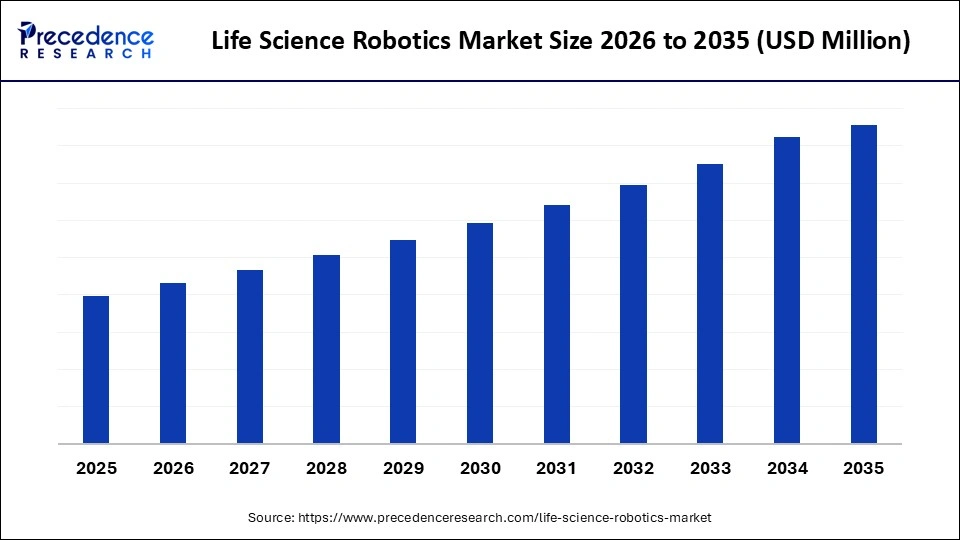
The global life science robotics market is witnessing rapid growth as labs, pharma companies, and research institutes adopt advanced robotic systems to enhance precision, efficiency, and throughput across R&D, drug discovery, and clinical workflows.The market is driven by rising research & development investments, which support the development of more advanced and precise robotic systems. Concurrently, the increasing demand for healthcare services, driven by an aging global population, is contributing to market growth.
Market Highlights
- North America accounted for the highest market share of 36% in 2025.
- The Asia Pacific is expected to grow at the fastest CAGR from 2026 to 2035.
- By product type, the laboratory automation robots segment held the major market share of 30% in 2025.
- By product type, the bioprocessing and cell culture robots segment is growing at a strong CAGR from 2026 to 2035.
- By deployment type, the on-premise segment contributed the biggest market share of 52% in 2025.
- By deployment type, the cloud-based segment is expanding at the fastest CAGR between 2026 and 2035.
- By application, the drug discovery & development segment led the market with a 38% share in 2025.
- By application, the clinical diagnostics & lab automation segment is poised to grow at a solid CAGR from 2026 to 2035.
- By technology/mode of action, the robotic process automation (RPA) segment dominated the market with a 35% of market share in 2025.
- By technology/mode of action, the AI and machine learning-driven robotics segment is growing at a strong CAGR between 2026 and 2035.
What is the Life Science Robotics Market?
The life science robotics market comprises robotic systems, automation platforms, and AI-enabled technologies used across pharmaceutical, biotechnology, clinical laboratory, and academic research settings to improve precision, efficiency, throughput, and reproducibility in life-science workflows. These solutions automate tasks such as liquid handling, sample preparation, high-throughput screening, cell culture, genomics and proteomics analysis, clinical diagnostics, and bioprocessing operations. The market encompasses laboratory robots, collaborative robots, autonomous mobile robots, analytical robotics platforms, and integrated AI-driven automation systems.
How is AI Impacting the Life Science Robotics Market?
Artificial intelligence (AI) plays a transformative role in the life science robotics market by enabling robotic systems to learn, adapt, and make autonomous decisions. This is changing processes from R&D to manufacturing and quality management. AI enhances the capabilities of life science robotics beyond simple pre-programmed instructions, bringing greater efficiency, precision, and safety. AI-driven robotic systems, like the da Vinci Surgical System, assist surgeons in performing minimally invasive procedures with improved precision, flexibility, and control. Additionally, AI algorithms integrated with robotic devices and sensors help analyze medical images and patient data for ongoing health monitoring.
Life Science Robotics Market Outlook
The life science robotics market is expected to grow rapidly from 2026 to 2035. This growth is mainly driven by the need for increased operational efficiency, precision, and scalability in research and manufacturing, especially for complex biologics and cell therapies, with a focus on reducing human error in critical tasks.
This trend is advancing smarter and autonomous systems for tasks like drug discovery and diagnostics, along with an increase in Cobots for human-robot collaboration, and the growth of mobile and autonomous platforms for logistics, ensuring precision and personalized medicine.
The market is expanding worldwide as labs and biopharma companies adopt automation to improve accuracy, throughput, and efficiency across drug discovery, diagnostics, and genomics. Emerging regions, especially Asia-Pacific, Latin America, and the Middle East, offer strong opportunities driven by growing biotech ecosystems, increased R&D investment, and the push to modernize laboratory infrastructure.
Major investors in the market include venture capital firms, strategic corporate investors from biotech and pharmaceutical companies, and technology-focused funds backing automation and AI-driven laboratory solutions. Their capital accelerates product development, scales manufacturing, supports global commercialization, and fuels innovation that expands the reach and capabilities of robotic platforms in life science applications.
Startups like Automata and Opentrons are developing modular, cost-effective automation solutions for smaller research laboratories. Also, emerging companies are leveraging AI to create general-purpose autonomous machines.
Market Scope
| Report Coverage | Details |
| Dominating Region | North America |
| Fastest Growing Region | Asia Pacific |
| Base Year | 2025 |
| Forecast Period | 2026 to 2035 |
| Segments Covered | Product Type, Deployment Type, Application, Technology/Mode of Action, and Region |
| Regions Covered | North America, Europe, Asia-Pacific, Latin America, and Middle East & Africa |
Life Science Robotics Market Segment Insights
Product Type Insights
The laboratory automation robots segment led the market while holding a 30% share in 2025. This is mainly due to their vital role in pharma, biotech, and diagnostics, where they handle large sample volumes with high accuracy. Overall, these robots accelerate drug discovery, support personalized medicine, address skilled labor shortages, and integrate with AI for autonomous labs. Liquid handling robots have gained immense popularity, facilitating high-throughput screening and sample preparation. Moreover, laboratory automation robots reduce human error, enhance consistency, and increase throughput, which is essential for diagnostics and research.
The bioprocessing & cell culture robots segment is expected to grow at the fastest CAGR during the forecast period. The growth of this segment is driven by rising chronic disease cases and aging populations, which boost demand for complex biologics and robust cell culture systems. Customized treatments require precise, high-throughput systems for cell analysis and production, where robotics excel. Additionally, AI and machine learning integration allows real-time monitoring, predictive feeding, and data-driven decision-making, making processes smarter, more efficient, and more accurate to meet global healthcare needs.
Deployment Type Insights
The on-premise segment dominated the market with a 52% share in 2025, mainly due to strict regulatory requirements, the need for enhanced data security, and the demand for continuous, real-time performance in critical applications. On-premise solutions ensure uptime reliability and allow organizations to manage security protocols internally, maintaining tight control and protecting sensitive information in compliance with regulations. Moreover, having full control over infrastructure is vital in the highly regulated life sciences industry, boosting the adoption of on-premises robotic solutions.
The cloud-based segment is expected to grow at the highest CAGR throughout the forecast period, mainly due to its ability to provide unlimited computing power, scalable data management, and advanced AI and machine learning capabilities. These features accelerate R&D and improve operational efficiency. Cloud platforms offer flexible, on-demand infrastructure, allowing companies to expand robotic operations as necessary without large upfront investments in physical IT infrastructure. Additionally, life sciences developers are able to perform large-scale simulations and create digital twins of robotic processes on cloud infrastructure.
Application Insights
The drug discovery & development segment dominated the market, holding a 38% share in 2025, driven by increased funding for novel drug discovery & development. Robotics and AI significantly speed up complex tasks like high-throughput screening, sample handling, and data analysis, reducing errors, lowering costs, and accelerating the development of new therapies, especially for cancer patients. This makes robotics crucial for pharma efficiency and innovation. The growing need for targeted cancer therapies is driving AI and robotic applications for oncological drug development by improving reliability, shortening development timelines, and reducing costs.
The clinical diagnostics & lab automation segment is expected to grow at the fastest rate in the upcoming period. This growth stems from the increasing demand for faster, more accurate, high-throughput diagnostic testing, as robotic systems automate manual processes and enable labs to process more samples more rapidly. The global rise in chronic conditions and infectious diseases drives the need for more diagnostic tests, with AI and machine learning integration making diagnostics more advanced and effective.
Technology/Mode of Action Insights
The robotic process automation (RPA) segment led the market with a 35% share in 2025. This is mainly because it effectively streamlines data-heavy, regulated, and repetitive digital administrative tasks at a lower infrastructure cost than traditional physical robotics. RPA ensures consistent, error-free execution of predefined rules and maintains detailed audit trails, which are essential for compliance with strict regulations like GxP, FDA, and EMA. This makes deployment easier and faster compared to implementing complex physical robotics systems.
The AI & machine learning-driven robotics segment is expected to experience the fastest growth in the coming years. AI and ML technologies enable robots to perform complex tasks with unmatched precision, adaptability, and autonomy, capabilities impossible with traditional pre-programmed robots. In life sciences, precision is critical, and AI-powered surgical robots enhance patient outcomes and reduce recovery times. AI and ML robots also automate labor-intensive research tasks, accelerate drug discovery, and reduce human error.
Life Science Robotics Market Regional Insights
North America dominated the market with a 36% share in 2025. The region's dominance in the market is attributed to its advanced R&D infrastructure, significant investments in the life science sector, and a favorable regulatory environment. The region's high demand for automation to increase efficiency and address labor shortages, along with the presence of many leading companies such as Boston Dynamics, Danaher, and Thermo Fisher, supports market growth. Additionally, robust government support, a strong healthcare infrastructure, and a high concentration of innovative robotics companies and academic institutions in the U.S. and Canada continue to drive technological advancements and market growth.
The U.S. stands as a global leader in the market, driven by its robust pharmaceutical industry, significant investments in research & development, and advanced technological infrastructure. It serves as a hub for innovation, particularly in AI-enabled laboratory systems, surgical robotics, and biomanufacturing automation. The country is home to major market companies, including Thermo Fisher Scientific and Clarapath Inc., contributing to market growth. The country's extensive network of top-tier universities, research institutions, and high-tech robotics firms, coupled with a favorable regulatory environment and strong demand for automation in drug discovery, diagnostics, and genomics, positions the U.S. as the key driver of market growth.
Asia Pacific is expected to be the fastest-growing region in the market. The regional market growth is mainly driven by rapid technological progress, strong government support and initiatives, an aging population, and rising demand for automation to improve efficiency. These factors lead to substantial investments and the rapid adoption of robotic systems in the healthcare and pharmaceutical industries. Governments in countries such as China, Japan, South Korea, and India actively support the adoption of robotics through policies, research grants, and smart manufacturing initiatives, contributing to market growth.
India Life Science Robotics Market Trends
India is a rapidly expanding market with significant potential, driven by the need for healthcare automation, an increasing patient population with chronic diseases, and government initiatives such as Make in India. Moreover, there is a rising demand for medical robotics, especially for minimally invasive surgeries and hospital automation. The expanding healthcare infrastructure also supports market growth in India.
Europe is expected to grow at a notable rate in the market. This growth is attributed to a strong research and innovation infrastructure, substantial government support, and a growing demand for automation. Key countries such as Germany, Italy, and France are known for their robust manufacturing capabilities and high robot density. The European Union is actively fostering robotics development through major investment programs like Horizon Europe, along with previous initiatives such as FP7 and SPARC. These programs have allocated hundreds of millions of euros in grants for robotics R&D, helping accelerate the commercialization of new technologies.
Germany Life Science Robotics Market Trends
Germany is a key player in the European market. The country is known for its excellence in precision manufacturing and automation, along with its high robot density. Leading companies like KUKA and ABB excel in both industrial and emerging humanoid/service robotics sectors. Government initiatives and funding for research and development through programs like Horizon Europe support innovation in human-robot collaboration and laboratory automation, making Germany a major supplier of advanced robotic systems for life sciences.
What Potentiates the Life Science Robotics Market in South America?
The market in Latin America is driven by rising demand for automation in healthcare, increasing investments in deep technology and research, and supportive government policies. Latin American governments have heavily invested in STEM education, creating a large and growing pool of skilled engineers and technical professionals in countries like Brazil, Mexico, and Argentina. This is complemented by a strong effort within the healthcare and life sciences sectors to adopt automation to boost efficiency, improve accuracy, and lower operational costs.
Brazil Life Science Robotics Market Trends
Brazil is an emerging market in Latin America, experiencing rising demand for service robots, especially in healthcare, logistics, and agriculture. The adoption of robotics in Brazil is driven by the need to improve efficiency, address labor costs, and enhance patient care. Government support and a favorable regulatory framework for technology companies are attracting foreign investment and driving market growth.
The Middle East & Africa (MEA) is experiencing a significant rise in the market, mainly due to strong government investments in healthcare infrastructure and research and development, rising chronic disease rates, and strategic efforts to diversify the economy through technological progress. The need for greater efficiency and a lack of skilled workers are driving the adoption of automation solutions in healthcare and research environments. Countries in this region are heavily investing in advanced healthcare systems and research, supported by national initiatives and financial incentives.
UAE Life Science Robotics Market Trends
The UAE is a key contributor in the Middle East & Africa, driven primarily by significant investments in healthcare infrastructure and technological advancements as part of its economic diversification efforts. There is increasing focus on developing advanced technologies, such as robotics, to enhance healthcare service delivery and operational efficiency. The UAE's growing healthcare infrastructure and the demand for high-quality healthcare services are likely to support market growth.
Life Science Robotics Market Value Chain
Top Companies in the Life Science Robotics Market and Their Offerings
- Danaher Corporation
- Becton, Dickinson and Company (BD)
- Roche Diagnostics
- Siemens Healthineers
- Abbott Laboratories
- Qiagen
- Hudson Robotics
- Kawasaki Robotics
- Yaskawa Electric Corporation
- ABB Robotics
- Siemens Digital Industries
- SPT Labtech
- Biosero
- Automata Tech
Recent Developments
- In May 2025, Life Science Robotics launched ARUS, a robotic ultrasound solution for pregnancy scans, at NNFM 2025 – Nordic Network of Fetal Medicine. Designed to assist sonographers, ARUS aims to reduce work-related musculoskeletal disorders (WRMSDs) while advancing ultrasound scanning in fetal medicine.(Source: https://www.lifescience-robotics.com)
- In March 2025, Alcon and LENSAR, Inc. announced that the companies had entered into a definitive merger agreement through which Alcon intends to acquire LENSAR. This acquisition includes ALLY Robotic Cataract Laser Treatment System, LENSAR's proprietary Streamline software technology, and LENSAR's legacy laser system, building Alcon's femtosecond laser-assisted cataract surgery offering.(Source:https://investor.alcon.com)
- In November 2024, Tata Elxsi, in partnership with DENSO Robotics Europe and AAtek, launched the Robotics and Automation Innovation Lab at its Frankfurt office. The state-of-the-art facility will drive advancements in robotics across sectors like medical devices, pharmaceuticals, life sciences, and food science, focusing on modular automation, product development, and simplifying maintenance for global automation needs.(Source: https://www.tataelxsi.com)
Life Science Robotics MarketSegments Covered in the Report
By Product Type
- Laboratory Automation Robot
- Liquid-handling robots
- Pipetting & dispensing robots
- Analytical & Testing Robots
- High-throughput screening robots
- Sample preparation robots
- Bioprocessing & Cell Culture Robots
- Cell-handling robots
- Automated culture systems
- AI-Integrated Robotics Platform
- Autonomous decision-making robots
- Predictive analytics-enabled systems
- Disinfection & Sterilization Robots
- UV disinfection robots
- Chemical sterilization robots
- Ancillary Robotic Tools & Accessorie
- Robotic arms & grippers
- Workstations & storage modules
By Deployment Type
- On-Premise
- Cloud-Based
- Hybrid Deployment
By Application
- Drug Discovery & Development
- Genomics & Proteomics
- Clinical Diagnostics & Lab Automation
- Cell Therapy & Regenerative Medicine
- Other Applications
By Technology/Mode of Action
- Robotic Process Automation (RPA)
- AI & Machine Learning-Driven Robotics
- Vision-Guided Robotics Systems
- Collaborative Robotics (Cobots)
- Other Robotics Technologies
By Region
- North America
- Europe
- Asia-Pacific
- Latin America
- Middle East & Africa
For inquiries regarding discounts, bulk purchases, or customization requests, please contact us at sales@precedenceresearch.com
Frequently Asked Questions

Ask For Sample
No cookie-cutter, only authentic analysis – take the 1st step to become a Precedence Research client