



AI Supercomputer Market Trends, Companies, Revenue / Sales Performance, Subscriber Growth, Pricing Strategies, Cloud Adoption, Infrastructure Expansion, Competitive Landscape, and Industry Outlook
AI Supercomputer Market (By Component: Hardware, Software, Services; By Deployment Model: On premises, Cloud based, Hybrid; By Processor Type: GPU based systems, Custom AI accelerators; By Compute Architecture: Centralized AI supercomputers, Modular scale out AI clusters; By Cooling Technology: Air cooling, Immersion cooling; By End User: Cloud service providers, Government and defense, Academic and research institutes, Enterprises, Healthcare and life sciences, Financial services, Others; By Application: AI model training, AI inference, Scientific research, Drug discovery, Autonomous systems, Climate and weather modeling, Others; By System Scale: Below 100 PFLOPS, 100 PFLOPS to 500 PFLOPS, Above 1 EFLOPS) - Global Industry Analysis, Size, Trends, Leading Companies, Regional Outlook, and Forecast 2026 to 2035
Source: https://www.precedenceresearch.com/ai-supercomputer-market
 Get a Sample
 Table Of Content


What is the AI Supercomputer Market Size in 2026?
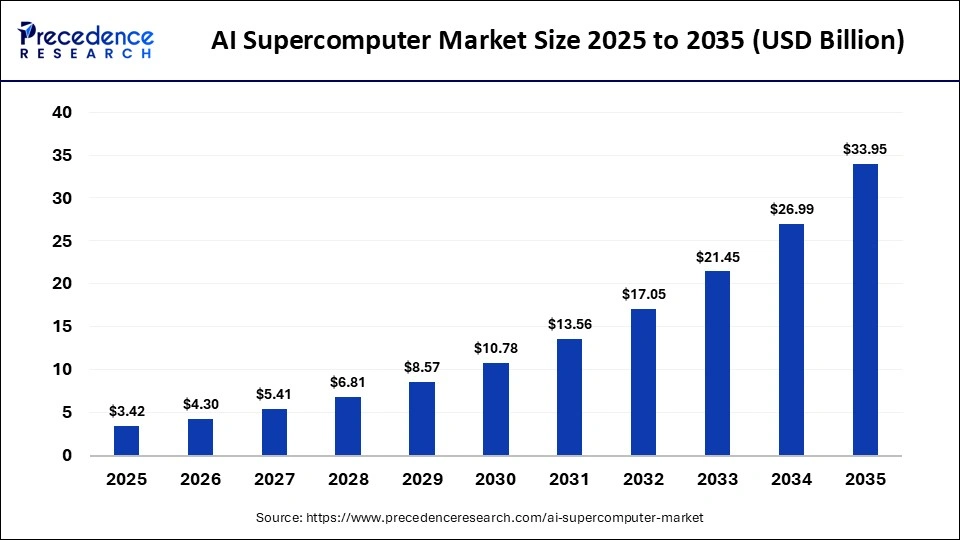
The global AI supercomputer market size accounted for USD 3.42 billion in 2025 and is predicted to increase from USD 4.30 billion in 2026 to approximately USD 33.95 billion by 2035, expanding at a CAGR of 25.80% from 2026 to 2035. The market is a rapidly growing framework of high-performance computing, created to act as a supporter of AI workloads, like deep learning and generative AI, and high-scale statistics of large data volumes. The systems include powerful processors, high-performance interconnections, and a massively parallel computing ability to allow organizations to handle large amounts of data and train complex AI frameworks.
Key Takeaways
- North America dominated the global AI supercomputer market, holding a share of 41.80% in 2025.
- Asia-Pacific is expected to grow at the fastest CAGR in the market during the forecast period.
- By component, the hardware segment held a dominant position in the market with a share of 68.40% in 2025.
- By component, the services segment is expected to grow at the fastest CAGR of 28.60% in the market between 2026 and 2035.
- By deployment model, the cloud based segment led the global market by holding a share of 29.60% in 2025 and is expected to grow with the highest CAGR of 26.90% in the market during the studied years.
- By processor type, the GPU based systems segment registered its dominance over the market with a share of 61.70% in 2025.
- By processor type, the custom AI accelerators segment is expected to account for the fastest growth with a CAGR of 32.70% during the predicted timeframe.
- By computer architecture, the centralized AI supercomputers segment held the largest AI supercomputer market share of 47.60% in 2025. 
- By computer architecture, the modular scale out AI clusters segment is expected to expand rapidly in the market with a CAGR of 29.70% in the coming years.
- By cooling technology, the air cooling segment contributed the biggest market share of 49.70% in 2025.
- By cooling technology, the immersion cooling segment is expected to witness the fastest growth in the market with a CAGR of 33.60% over the forecast period.
- By end user, the cloud service providers segment accounted for the highest market share of 34.80% in 2025. 
- By end user, the healthcare and life sciences segment is expected to gain the highest market share with a CAGR of 31.40% between 2026 and 2035.
- By application, the AI model training segment registered its dominance over the market with a share of 36.70% in 2025.
- By application, the drug discovery segment is expected to show the fastest growth with a CAGR of 32.10% over the forecast period.
- By system scale, the 100 PFLOPS to 500 PFLOPS segment held a major market share of 34.60% in 2025.
- By system scale, the above 1 EFLOPS segment is expected to grow with the highest CAGR of 31.80% in the market during the studied years.
Which Factors Influence the AI Supercomputer Market?
The AI supercomputer industry is growing at a spectacular rate because organizations are adopting the high-performance computing infrastructure to facilitate the use of elaborate artificial intelligence (AI) programs. These systems offer computing capabilities needed to train large-scale models, simulate complex systems, and process large-scale data in real-time.
Next-generation supercomputers are actively being invested in governments, research institutions, and technology companies to increase the national capabilities of innovation and accelerate scientific discovery processes. With the ever-growing use of AI in the world of industries, AI supercomputers are turning out to be very important instruments for solving various complex problems that need unprecedented processing power.
What is the Role of AI in the AI Supercomputer Market?
The development of AI is strongly connected to the changes in supercomputing technologies. Current AI frameworks, in particular deep neural networks and generative-based frameworks, demand huge amounts of computation that can only be facilitated by large-scale computing systems. With AI supercomputers, researchers can now train models with billions or even trillions of parameters, and innovation is rapidly accelerating in areas such as natural language processing, drug discovery, and climate modelling.
Moreover, increased hardware accelerators, memory systems, and optimised software frameworks, based on AI specificity, are facilitating quicker and more effective training procedures. These innovations are transforming the future of computing research and the implementation of AI in enterprise.
AI Supercomputer Market Trends
- Sovereign AI: One of the biggest trends in the AI supercomputer industry is sovereign AI because nations are pursuing the development of their own AI in their country's infrastructure. Governments are also investing in national-level supercomputing facilities to enable national security, research, and technological competitiveness.
- Domination of the Private Sector and Scaling: The growth of AI supercomputing is taking a leading role by technology companies and cloud providers. Massive AI clusters are being constructed by large tech companies that could accommodate the development of next-generation AI models.
- Bottlenecks in Performance and Power: Although the market is expanding at a very high pace, the key issue it encounters is the limitation in terms of performance and energy usage.
- Cross-fertilization of AI and High-Performance Computing (HPC): The passage of AI and classic HPC is changing the architecture of the current supercomputers. Traditional HPC systems that were meant to be used in scientific simulations are being modernized to handle machine learning and AI workloads.
- AI Supercomputing in the Cloud: AI supercomputing capabilities are also being deployed using cloud-based infrastructure as an important deployment model. Cloud providers provide computing environments that can be scaled to provide an organization with access to powerful AI clusters without having to construct physical infrastructure.
- Hardware Advancements: The hardware technologies are rapidly improving the work of AI supercomputers. New graphics processing unit (GPU), tensor processing unit (TPU), and special AI accelerators are making more complex machine learning models capable of being trained and inferred faster.
Market Scope
| Report Coverage | Details |
| Market Size in 2025 | USD 3.42 Billion |
| Market Size in 2026 | USD 4.30 Billion |
| Market Size by 2035 | USD 33.95 Billion |
| Market Growth Rate from 2026 to 2035 | CAGR of 25.80% |
| Dominating Region | North America |
| Fastest Growing Region | Asia Pacific |
| Base Year | 2025 |
| Forecast Period | 2026 to 2035 |
| Segments Covered | Component, Deployment Model, Processor Type, Compute Architecture, Cooling Technology, End User, Application, System Scale, and Region |
| Regions Covered | North America, Europe, Asia-Pacific, Latin America, and Middle East & Africa |
Segmental Insights
Component Insights
Which Component Segment Dominated the AI Supercomputer Market?
The hardware segment dominated the market with a share of 68.40% in 2025, since these systems are highly dependent on sophisticated processors, high-performance memory, high-speed interconnections, and specialized storage infrastructure. The use of AI supercomputers requires organizations to have powerful computing clusters capable of training models at high levels on large-scale simulations. The hardware segment is also getting boosted by continuous innovation in GPUs, high-bandwidth memory, and networking technologies.
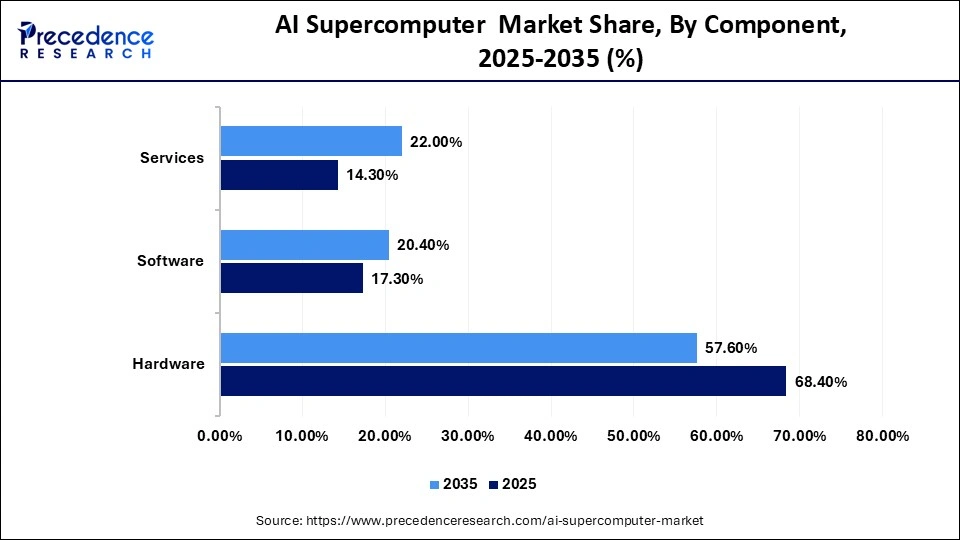
The services segment is expected to show the fastest growth in the forecasted period, with a CAGR of 28.60% in the market, since organizations are adopting the use of external competence to implement and operate the AI supercomputer infrastructure more. Services also cover system integration, infrastructure consulting, AI, workload optimization, and maintenance. Many enterprises lack the technical knowledge to manage the work of large AI clusters, which increases the demand to hire special support services.
Deployment Model Insights
How the Cloud based Segment Dominated the AI Supercomputer Market?
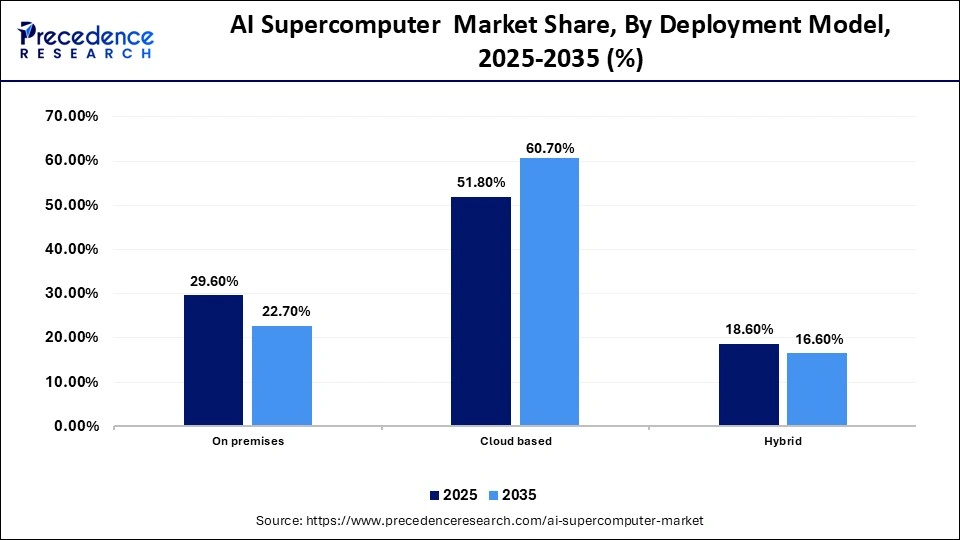
The cloud based segment held the largest revenue share of 51.80% in the market in 2025, and is expected to gain the highest market share with a CAGR of 26.90% between 2026 and 2035, as it offers scalable computing solutions without huge capital spending. Cloud computing infrastructure is available on demand, giving organizations access to AI-based HPC. Amazon Web Services, Microsoft, and Google are the largest cloud providers that are spending a lot of money on AI supercomputing clusters that are embedded in cloud settings. These services allow businesses, research institutions, and startups to execute more complex AI workloads and train large language models of large size.
Processor Type Insights
What Made GPU based Systems Dominate the AI Supercomputer Market?
The GPU based systems segment contributed the biggest revenue share of 61.70% in the market in 2025, as the system can run highly parallel computing tasks using GPUs. GPU-based systems are very effective in training deep learning models and large-scale AI calculations. There are also NVIDIA and Advanced Micro Devices companies that have created custom AI GPUs that can operate in an HPC setting. These processors have allowed training of complex models, such as large language models and generative AI systems, faster.
The custom AI accelerators segment is expected to witness the fastest growth in the market with a CAGR of 32.70% over the forecast period, because they can provide a performance advantage on a limited number of AI loads. Technological firms are coming up with proprietary chips that will be used in machine learning and deep learning applications. An example is that Google has built its Tensor Processing Units (TPUs), and Amazon also has AI accelerators such as Inferential and Trainium.
Compute Architecture Insights
How the Centralized AI Supercomputers Segment Dominated the AI Supercomputer Market?
The centralized AI supercomputers segment registered its dominance with a share of 47.60% in 2025, as they offer a huge computing power under one integrated infrastructure framework. The systems are generally installed in national research laboratories, large businesses, and hyperscale data centres. Centralized architectures allow the effective management of large computing clusters and high-speed interconnects.
The modular scale out AI clusters segment is expected to expand rapidly in the market with a CAGR of 29.70% in the coming years, as they provide high flexibility and scalability over conventional supercomputing systems. Additional computing nodes can be added to an organization in a gradual manner, as the workload on the AI grows. This architecture can be used to distribute the training of large AI models over a set of computing nodes.
Cooling Technology Insights
Which Cooling Technology Segment Led the AI Supercomputer Market?
The air cooling segment led the market with a share of 49.70% in 2025, as air cooling requires a well-known infrastructure. In the conventional data centre cooling, advanced airflow management and high-capacity cooling units are used. Air-cooled environments are still used in many organizations since they are simpler to maintain and incur less start-up cost. Air cooling systems have also been optimized by improving airflow and designing the servers.
The immersion cooling segment is expected to grow with the highest CAGR of 33.60% in the market during the studied years, because AI supercomputers produce a very large thermal load. In immersion computing, computing parts are immersed in non-conductive cooling liquids that are specialized. The heat dissipation performance of immersion cooling is much higher than when using traditional cooling techniques. It also minimizes the amount of energy used and the lifespan of the hardware.
End User Insights
Why Did the Cloud Service Providers Segment Dominate the AI Supercomputer Market?
The cloud service providers segment registered its dominance over the global market with a share of 34.80% in 2025, as cloud service providers require hyperscale data centers, which offer AI computing infrastructure to companies across the globe. Amazon Web Services, Microsoft, and Google, among other companies, are constructing large AI supercomputing clusters to deliver generative AI and machine learning loads.
The healthcare and life sciences segment is expected to grow at the fastest CAGR of 31.40% in the market between 2026 and 2035, because the number of people who are adopting AI in biomedical studies is on the rise. Genomic sequencing, disease modelling, and the development of personalized medicine use AI supercomputers. Research institutions and pharmaceutical firms are also using high-performance computing to hasten drug discovery and clinical research. Medical imaging and genomics have large datasets that need massive computing capabilities.
Application Insights
How the AI Model Training Segment Dominated the AI Supercomputer Market?
The AI model training segment accounted for a considerable revenue share of 36.70% in the market in 2025, due to the increasing demand for sophisticated machine learning capabilities. Organizations across various sectors are leveraging supercomputers to develop and train models that can process vast amounts of data quickly and efficiently. This capability is essential for applications ranging from natural language processing to computer vision, driving the need for advanced computational power. As companies continue to innovate and refine their AI models, the reliance on HPC resources is expected to grow.
The drug discovery segment is expected to account for the highest growth with a CAGR of 32.10% in the coming years, fueled by the need for rapid advancements in healthcare and pharmaceuticals. Researchers are increasingly utilizing AI-driven simulations and modeling to identify potential drug candidates more efficiently than traditional methods. With the ability to analyze immense datasets, these supercomputers can accelerate the discovery of new treatments, significantly reducing the time required to bring drugs to market.
System Scale Insights
Which System Scale Segment Dominated the AI Supercomputer Market?
The 100 PFLOPS to 500 PFLOPS segment held a dominant market share of 16.80% in 2025, due to its widespread use in computing capability and mid- to large-scale organizations and research centres. Within this range of performance, many AI research laboratories and cloud providers implement systems. Their popularity is the balance between performance, scalability, and cost efficiency.
The above 1 EFLOPS segment is expected to expand rapidly in the market with a CAGR of 31.80% in the coming years, as such systems are capable of doing more than one billion and one hundred billion computations in a second, which allows exceedingly complicated AI models and simulations. Exascale computing infrastructure is a highly funded area by governments and significant technology companies. These systems facilitate research in higher science, climate projections, and the development of next-generation AI.
Regional Insights
North America AI Supercomputer Market Size and Growth 2026 to 2035
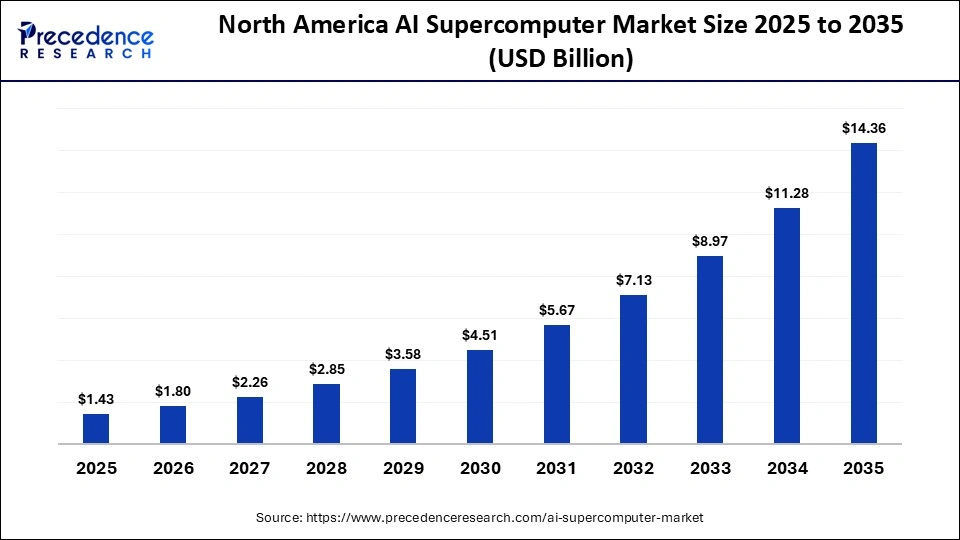
The North America AI supercomputer market size is estimated at USD 1.43 billion in 2025 and is projected to reach approximately USD 14.36 billion by 2035, with a 25.95% CAGR from 2026 to 2035.
Why North America Dominated the AI Supercomputer Market?
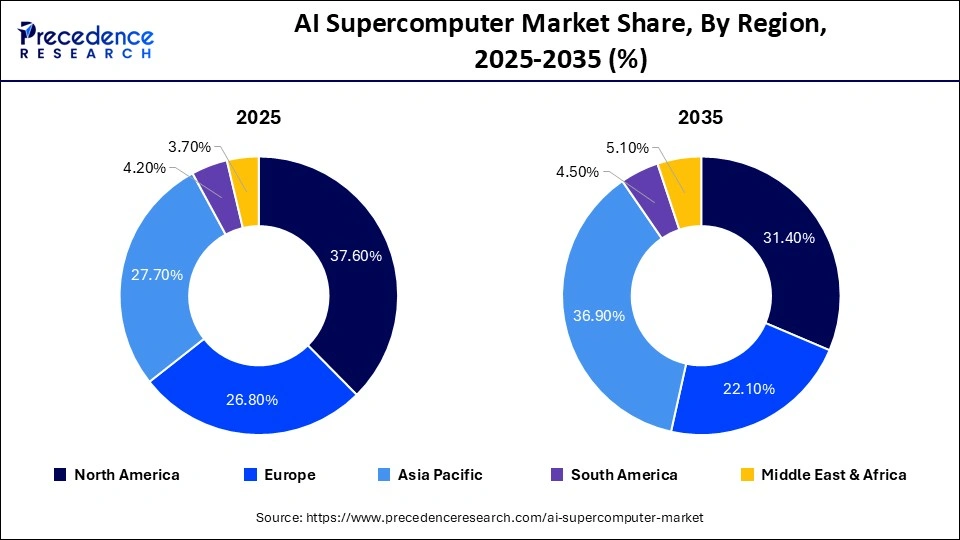
North America held a major market share of 41.80% in 2025, because of the well-developed technological infrastructure and large investment in AI research. The industry has several major technology firms and cloud computing providers in the region, which are running AI computing facilities in large volumes. Government programs that promote research in HPC and AI also bolster the development in the region. National laboratories and universities of the region are busy with the development of sophisticated AI systems and computing structures.
U.S. AI Supercomputer Market Size and Growth 2026 to 2035
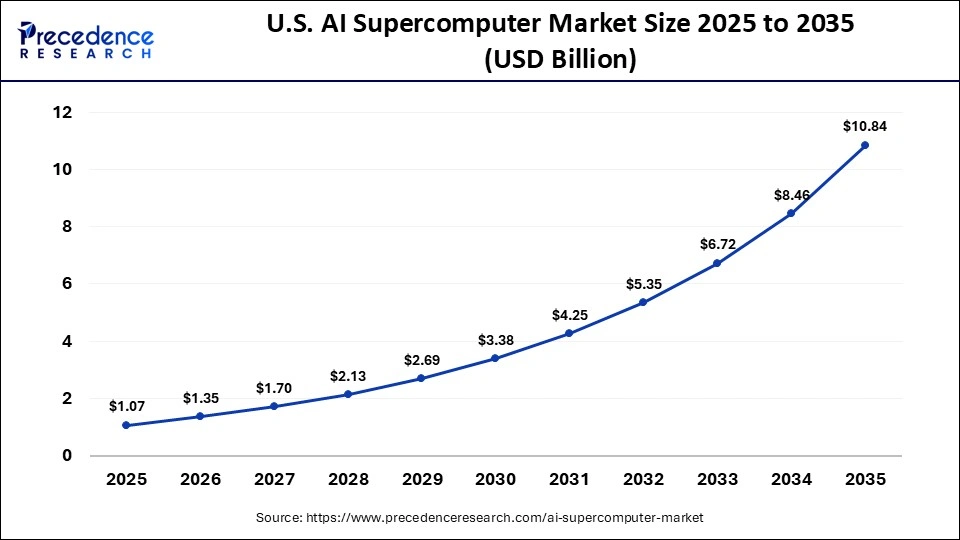
The U.S. AI supercomputer market size is calculated at USD 1.07 billion in 2025 and is expected to reach nearly USD 10.84 billion in 2035, accelerating at a strong CAGR of 26.06% between 2026 and 2035.
Country-Level Analysis
The U.S. leads the market in North America, as it has a well-developed technology ecosystem. Organizations like the U.S. Department of Energy and the largest technology companies provide the major AI supercomputing projects. Funding agencies within the government promote the construction of the next-generation supercomputing sites. It is also home to numerous supercomputers globally, which are the fastest and are applicable in scientific and AI studies.
Why is Asia-Pacific the Fastest-Growing Region in the AI Supercomputer Market?
Asia-Pacific is expected to experience the fastest growth during the predicted timeframe, as the rapid digital transformation and rise in the adoption of AI have turned this region into the fastest-growing market. Governments of the region are spending a lot of money on HPC infrastructures to enhance the power of technology. Various nations are creating national research centers and supercomputers for AI.
Country-Level Analysis
On the national level, China, Japan, and India are the key contributors to the regional growth. China is investing massively in the local development of AI chips and the supercomputing network. Japanese HPC technologies are still being developed with national research programmes and advanced research institutes.
AI Supercomputer Market Companies
- NVIDIA
- Hewlett Packard Enterprise
- Dell Technologies
- Lenovo
- Supermicro
- IBM
- Fujitsu
- Oracle
- Microsoft
- Amazon Web Services
- AMD
- Intel
- Eviden
- GIGABYTE
Recent Developments
- In January 2026, NVIDIA introduced the Rubin AI supercomputing platform, a next-generation architecture designed to support large-scale AI workloads. The platform integrates multiple advanced chips that function together to deliver HPC for both AI training and inference. It was engineered to enhance efficiency while reducing operational costs for hyperscale data centers and enterprise environments.(Source: https://nvidianews.nvidia.com)
- In October 2025, the U.S. Department of Energy announced the deployment of two new AMD-powered AI supercomputers at Oak Ridge National Laboratory. These systems were designed to support HPC tasks such as scientific simulations, machine learning research, and national security applications. The initiative is part of a broader collaboration between government agencies and technology companies aimed at advancing supercomputing capabilities.(Source: https://www.energy.gov)
Segments Covered in the Report
By Component
- Hardware
- Software
- Services
By Deployment Model
- On premises
- Cloud based
- Hybrid
By Processor Type
- GPU based systems
- CPU based systems
- TPU based systems
- FPGA based systems
- Custom AI accelerators
By Compute Architecture
- Centralized AI supercomputers
- Distributed AI supercomputers
- Modular scale out AI clusters
By Cooling Technology
- Air cooling
- Direct liquid cooling
- Immersion cooling
By End User
- Cloud service providers
- Government and defense
- Academic and research institutes
- Enterprises
- Healthcare and life sciences
- Financial services
- Others
By Application
- AI model training
- AI inference
- Scientific research
- Drug discovery
- Autonomous systems
- Cybersecurity
- Climate and weather modeling
- Others
By System Scale
- Below 100 PFLOPS
- 100 PFLOPS to 500 PFLOPS
- 500 PFLOPS to 1 EFLOPS
- Above 1 EFLOPS
By Region
- North America
- Latin America
- Europe
- Asia-pacific
- Middle and East Africa
For inquiries regarding discounts, bulk purchases, or customization requests, please contact us at sales@precedenceresearch.com
Frequently Asked Questions
Tags





Ask For Sample
No cookie-cutter, only authentic analysis – take the 1st step to become a Precedence Research client
 Get a Sample




 sales@precedenceresearch.com
 Schedule a Meeting
