



Asia Pacific Thermal Interface Materials Market Size, Share and Trends 2026 to 2035
Asia Pacific Thermal Interface Materials Market (By Product: Elastomeric Pads, Tapes & Films, Greases & Adhesives, Metal Based, Phase Change Materials, and Others; By Application: Computer, Telecom, Medical Devices, Consumer Durables, Industry Machinery, Automotive Electronics, and Others) Industry Size, Share, Growth, Trends 2025-2035
Source: https://www.precedenceresearch.com/asia-pacific-thermal-interface-materials-market
 Get a Sample
 Table Of Content


The Asia Pacific thermal interface materials market size accounted for USD 1.85 billion in 2025 and is predicted to touch around USD 5.55 billion by 2035, growing at a CAGR of 11.61% from 2026 to 2035. The market in the Asia Pacific is mainly driven by large-scale electronics production, industrial growth, and the rising electric vehicle (EV) industry.
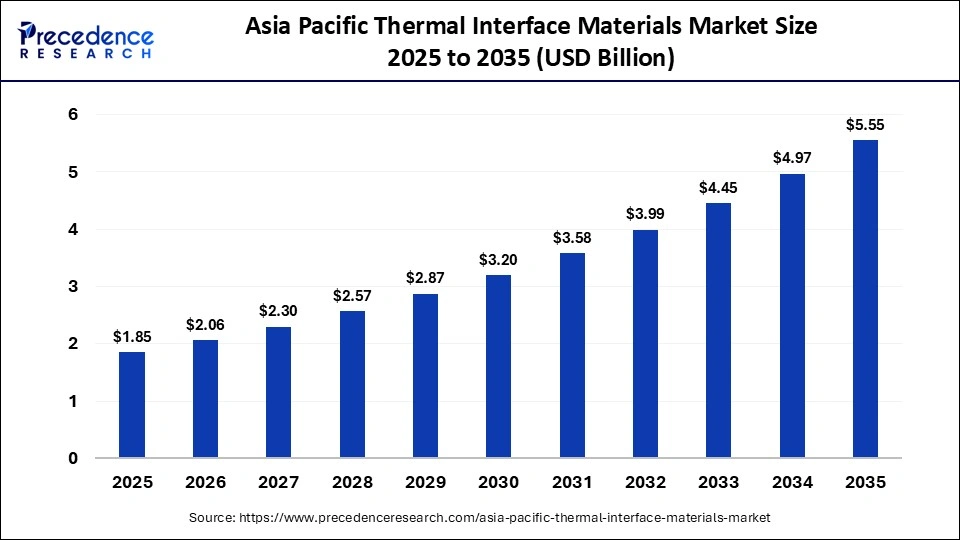
Asia Pacific Thermal Interface Materials Market Statical Scope
| Reports Attributes | Statistics |
| Market Size in 2025 | USD 1.85 Billion |
| Market Size in 2026 | USD 2.06 Billion |
| Market Size by 2035 | USD 5.55 Billion |
| CAGR 2026 to 2035 | 11.61% |
| Base Year | 2025 |
| Forecast Period | 2026 to 2035 |
The Asia-Pacific region is crucial in the global TIM market, driven by rapid urban growth and extensive domestic production in the semiconductor, consumer electronics, and EV sectors. Countries such as China, South Korea, and Taiwan are responsible for most of the world's semiconductor parts, smartphones, and computers. The strong push for EVs in China demands large amounts of thermal gap fillers and greases for battery management systems.
Local initiatives and campaigns and semiconductor development in Vietnam are quickly enhancing the regional supply chain. Thermal greases, adhesives, and gap-filler pads are the most commonly used materials to ensure the longevity of operations in data centers and telecommunications systems.
Asia Pacific Thermal Interface Materials Market, By Product, 2025
| Segments | Shares (%) |
| Elastomeric Pads | 24.30% |
| Tapes & Films | 16.80% |
| Greases & Adhesives | 21.40% |
| Metal Based | 12.90% |
| Phase Change Materials | 15.20% |
| Others | 9.40% |
- Elastomeric Pads - The elastomeric pads segment, with a share of 24.30% in 2025, leads the Asia Pacific Thermal Interface Materials (TIM) market as they are easy to assemble, handle without mess, and help avoid degradation of interface resistance compared to traditional thermal greases. They are particularly popular in consumer electronics and automotive applications in manufacturing hubs like China, Taiwan, and India.
- Tapes & Films - The tapes and films segment, with a share of 16.80% in 2025, is essential in the Asia Pacific Thermal Interface Materials (TIM) market, driven by the region's large electronics manufacturing ecosystem. These materials are favored for their simple application, cost-effectiveness, and ability to ensure even heat distribution in compact, high-density devices.
- Greases & Adhesives - The greases and adhesives segment, with a share of 21.40% in 2025, is very important in the Asia-Pacific (APAC) Thermal Interface Materials (TIM) Market due to their unmatched capability to eliminate tiny air gaps and thermal transfer in the rapidly growing consumer electronics, telecommunications, and electric vehicle (EV) sectors in the region.
Asia Pacific Thermal Interface Materials Market, By Application, 2025
| Segments | Shares (%) |
| Computer | 24.80% |
| Telecom | 17.30% |
| Medical Devices | 9.60% |
| Consumer Durables | 15.70% |
| Industry Machinery | 11.80% |
| Automotive Electronics | 14.50% |
| Others | 6.30% |
- Computer - The computer segment, with a share of 24.80% in 2025, dominates the Asia Pacific Thermal Interface Materials (TIM) market, as increasing power densities and miniaturization necessitate continuous heat dissipation to avoid throttling and hardware damage. The rapid growth of semiconductor manufacturing and strong production of PCs and data centers support this critical demand.
- Telecom - The telecom segment, with a share of 17.30% in 2025, is crucial to the Asia Pacific Thermal Interface Materials Market, driven by extensive deployment of 5G infrastructure and significant manufacturing of telecom equipment. As 5G hardware operates at higher power densities, TIMs are essential for effective heat dissipation to prevent overheating, ensuring reliability across base stations and devices.
- Medical Devices - In the Asia Pacific Thermal Interface Materials market, the medical devices segment, with a share of 9.60% in 2025, plays a vital role as it needs reliable thermal management for precise diagnostics, patient safety, and the durability of devices, especially with the increasing regional demand for advanced healthcare. Materials like Phase Change Materials and thermally conductive Elastomeric Pads help prevent essential diagnostic and therapeutic equipment from overheating.
Competitive Landscape
The Asia Pacific region is at the forefront of the global Thermal Interface Materials (TIMs) market. This market is highly fragmented and competitive, featuring major multinational chemical and material companies alongside niche electronic suppliers. The growth is driven by large-scale electronics manufacturing, 5G infrastructure, and electric vehicle production in China, Taiwan, and India.
- Henkel AG & Co. KGaA is a leading global player that provides a wide range of thermal greases, adhesives, gap fillers, and phase-change materials under the Loctite and Bergquist brands, which are widely used in consumer electronics and automotive assemblies.
- Dow offers a complete range of silicone-based thermal management solutions, including reworkable gap fillers, silicone compounds, and thermally conductive gels.
- 3M Company focuses on thermal tapes, pads, and films that are designed for high-density, compact electronic assemblies.
- Parker Hannifin Corporation delivers high-performance thermal gap fillers, pads, and putties that aim to eliminate air gaps, reduce thermal impedance, and enhance heat transfer in telecom and industrial machinery.
- Laird Performance Materials, now part of DuPont, provides advanced electromagnetic and thermal interface materials, including dispensable gels, elastomeric pads, and grease alternatives.
- Shin-Etsu Chemical Co., Ltd. is a prominent manufacturer from Japan that specializes in highly engineered silicone thermal greases, sheets, and thermally conductive fluids, which are widely used in the semiconductor and LED sectors.
- Indium Corporation offers high-performance solder thermal interface materials and pure indium metal pads (like Heat-Spring) that are perfect for high-power computing and microprocessors.
Segments Covered in the Report
By Product
- Elastomeric Pads
- Tapes & Films
- Greases & Adhesives
- Metal Based
- Phase Change Materials
- Others
By Application
- Computer
- Telecom
- Medical Devices
- Consumer Durables
- Industry Machinery
- Automotive Electronics
- Others
For inquiries regarding discounts, bulk purchases, or customization requests, please contact us at sales@precedenceresearch.com
Frequently Asked Questions





Ask For Sample
No cookie-cutter, only authentic analysis – take the 1st step to become a Precedence Research client
 Get a Sample




 sales@precedenceresearch.com
 Schedule a Meeting
