



Atmospheric Water Generator Market Size, Production Volume, Technology Adoption, Equipment Lifecycle Analysis, Pricing Trends, and Market Positioning
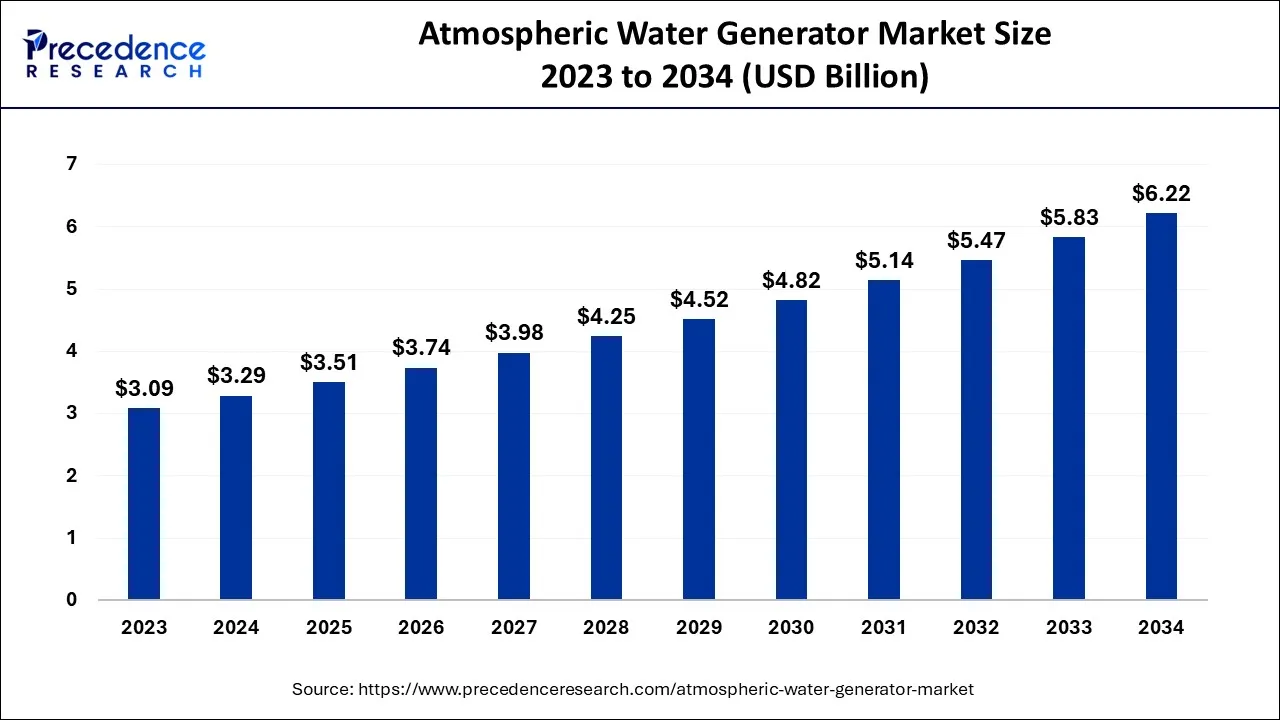
The atmospheric water generator market size stood at USD 3.51 billion in 2025 and is projected to reach approximately USD 6.59 billion by 2035, registering a CAGR of 6.5%. The market growth is driven by growing water scarcity, rising demand for safe and clean drinking water, increasing government initiatives, technological advancements, and growing adoption of atmospheric water generators across industrial, commercial, and residential applications.
Source: https://www.precedenceresearch.com/atmospheric-water-generator-market
 Get a Sample
 Table Of Content
What is the Atmospheric Water Generator Market Size?
The global atmospheric water generator market size is calculated at USD 3.51 billion in 2025 and is predicted to increase from USD 3.74 billion in 2026 to approximately USD 6.59 billion by 2035, expanding at a CAGR of 6.5% from 2026 to 2035. Growing water pollution and rising scarcity of fresh drinking water are major factors driving the market's growth during the forecast period.
Atmospheric Water Generator Market Key Takeaways
- Asia Pacific generated more than 37% of revenue share in 2025.
- North America is expected to grow at a CAGR of 8.5% from 2026 to 2035.
- By product, the cooling desiccation segment captured more than 99% of the revenue share in 2025.
- By product, the wet desiccation segment is predicted to grow at a CAGR of 7.8% from 2026 to 2035.
- By capacity, the more than 1000 liters segment dominates the global market.
- By application, the industrial segment generated more than 73% of the revenue share in 2025.
- By application, the commercial segment is projected to grow at a CAGR of 8.7% from 2026 to 2035.
Market Overview
The atmospheric water generator produces drinkable, fresh, and clean water through the condensation of vapors in the air. In recent years, technological advancements in water generation technology have brought a cost-effective, efficient, and sustainable solution for the concerns related to water scarcity in the form of atmospheric water generators.
The atmospheric water generator uses thermodynamics, mechanical cycles, and an electronic control system to produce adequate water. The basic structure of an atmospheric water generator consists of a purifier, water filter, compressor, water condenser, air filter, carbon filter, and water tank.
The invention of advanced generators for various industries has been the center of attention for major market players. New product launches with the deployed smart system are boosting the growth of the global atmospheric water generator market.
Technological Advancement
Technological advancements in the atmospheric water generator market feature condensation techniques, advanced filtration systems, hybrid systems, thermoelectric cooling, low-energy technologies, and IoT integration. The hybrid system merges technologies such as traditional energy sources and solar power sustainable performance of AWG. Integration of smart devices and internet of things (IoT) controls AWG parameters. It also monitors performance regularly. Thermoelectric cooling is a popular method used to find a low-temperature surface. Sorption-based atmospheric water harvesting (SAWH) reduces energy consumption.
The condensation techniques are an innovative technique, discovered by wet desiccation, which obtains moisture from the air and extracts water through condensation and heating. The advanced filtration systems enhance the filtration system using automatic variable filtration and upgraded filtration technology. Material science is also contributing to the atmospheric water generator market by inventing new materials, such as superabsorbent materials, that can soak up moisture from the air in dry conditions. This helps in water harvesting.
Atmospheric Water Generator Market Growth Factors
The global atmospheric water generator market is expected to grow at a CAGR of 9% during the forecast period. Rising awareness for quality drinking water across the globe is one of the major factors boosting the global atmospheric water generator market growth. Creative ideas, public support and rising government financing for designing and developing advanced atmospheric water generators are promoting the market's growth.
However, the high installation cost of atmospheric water generators is hindering the market's growth. The scarcity of fresh drinking water is another major factor boosting the market's growth during the forecast period. According to UNICEF, almost two-thirds of the world's population faces water shortages for at least one month each year.
The rising concerns related to freshwater scarcity will boost the demand for atmospheric water generators across the globe. Moreover, strategic business activities, including partnerships, mergers, and acquisitions by major companies, are supplementing the market's growth.
Market Trends
- Manufacturers are focusing on reducing electricity consumption because energy use remains a major barrier to wider AWG adoption.
- Solar integration with atmospheric water generators can lower operating costs and reduce dependence on conventional electricity.
- Researchers are investing in advanced moisture capture materials to improve water output even in low humidity environments. The materials include metal organic frameworks, hydrogels and hygroscopic materials.
- The growing interest in decentralized applications such as AWGs is driving demand for remote communities, emergency response, and portable water supply.
Market Outlook
- Industry growth overview - The atmospheric water generator market is expanding as water scarcity, urbanization, and declining freshwater availability increase demand for decentralized water sources.
- Global expansion - the atmospheric water generator expansion id strongest, particularly in Asia Pacific, where population growth and rising water demand are creating opportunities for market growth.
- Major Investor - Investment is focused on renewable powered AWGs, advanced condensation systems and scalable water farms. Major investors in the market include
- Startup ecosystem - The startup ecosystem is entering the market with compact, energy efficient, and solar powered systems designed for homes, businesses and remote communities.
Market Scope
| Report Coverage | Details |
| Market Size by 2035 | USD 6.59 Billion |
| Market Size in 2025 | USD 3.51 Billion |
| Market Size in 2026 | USD 3.74 Billion |
| Growth Rate from 2026 to 2035 | CAGR of 6.5% |
| Largest Market | Asia Pacific |
| Fastest Growing Market | Europe |
| Base Year | 2025 |
| Forecast Period | 2026 to 2035 |
| Segments Covered | Product, Capacity, Application and Region |
| Regions Covered | North America, Europe, Asia-Pacific, Latin America and Middle East & Africa |
Market Dynamics
Drivers
Rising government initiatives for producing safe drinking water
Underground water or even bottled water can affect human health with the presence of multiple microorganisms. Some microorganisms, including viruses and protozoa, can result in serious diseases, including hepatitis, diarrhea, and cholera. The rising health concerns have increased the demand for safe and clean drinking water.
Governments across the globe are focused on enhancing the standards for water treatment. Along with this, governments are continuing the implementation of various initiatives by which they can offer safe and clean drinking water in order to reduce the risks of diseases. Atmospheric water generators hold the potential to produce clean and purified water for drinking.
Considering the rising public health concerns, the demand for atmospheric water generators will increase from the government and private sector during the forecast period. Several European governments are focused on developing an alternative to expensive packaged bottled water; this will bring a plethora of opportunities for key players to expand their businesses in European countries.
Restraint
High electricity consumption
The effective operation of atmospheric water generators requires a continuous energy supply. The high energy consumption, however, hampers the growth of the global market by limiting the purchasing capacity of small-scale industries. Moreover, the majority of environmental concerns are directly associated with high energy consumption. However, the development of energy-efficient atmospheric water generators is observed as a potential solution to this restraining factor.
Opportunity
Deployment of smart technologies in the atmospheric water generators
Manufacturers in the global atmospheric water generator market are focused on technological generator advancements. The deployment of smart technologies in the generators can be helpful for users to manage the operations with accurate monitoring without human intervention. The deployed smart technology, such as IoT, holds the potential to collect data associated with the generator on a routine basis.
The deployment of the Internet of Things (IoT) or artificial intelligence (AI) in the atmospheric water generator is observed to enhance productivity with ease for the users; subsequently, this will grow the demand for atmospheric water generators in the global market.
Segmental Insights
Product Insights
The cooling desiccation segment holds almost 99% of the share in the global atmospheric water generator market. Governments across the globe are focused on providing safe and clean drinking water in order to reduce the cases of diseases associated with contaminated water. Cooling desiccation allows the purification or filtration of water produced from the humidity or vapors. The rising requirement for clean water has increased the importance of cooling desiccation systems.
The wet desiccation segment is expected to grow at a CAGR of 7.8% during the forecast period. Wet desiccation is primarily used in manufacturing plants for water treatment, the rising installation of water generators in industrial areas will boost the growth of the wet desiccation segment during the forecast period. The wet desiccation technology deploys concentrated brine solution, which is a salt-based solution. The risk of corrosion in the atmospheric water generator hampers the development of a wet desiccation segment.
Capacity Insights
The more than 1000 liters water capacity segment holds the dominant share of the global atmospheric water generator market. Commercial places have a massive demand for atmospheric water generators; these generators can produce more than 1000 liters of fresh water daily. Manufacturers involved in the market are focused on designing and developing atmospheric water generators that produce fresh water of up to five thousand liters daily. At the same time, a home-based structure requires a compact atmospheric water generator which is expected to produce up to 50-60 liters per day. The rising installation of atmospheric water generators in residential areas will boost the growth of up to 60 liters of water capacity segment during the forecast period.
Application Insights
The industrial segment accounts for over 73% of the revenue share in the global atmospheric water generator market. The growing food and beverage industry across the globe has an enormous demand for freshwater supplies; this factor is fueling the growth of the industrial segment. Moreover, rising industrialization has a massive requirement for water supply. Manufacturing industries require water supply during the production process for diluting, fabricating, washing, and cooling purposes.
Water acts as a primary raw material in various industries, including the medical, electronics and food industries. Considering the rising demand for water supply from manufacturing industries, the installation of atmospheric water generators at manufacturing plants will grow during the forecast period.
The commercial segment is expected to grow at a CAGR of 8.7% during the forecast period due to the rising installation of atmospheric water generators in malls, schools, institutions, and other commercial structures in order to offer cost-effective fresh drinking water. The residential application segment in the global atmospheric water generator market holds a significant share. Changing lifestyles and growing awareness about clean drinking water are paramount factors to boost the demand for the installation of atmospheric water generators in residential societies or areas.
Regional Insights
Asia Pacific Atmospheric Water Generator Market Size and Growth 2026 to 2035
The Asia Pacific atmospheric water generator market size is exhibited at USD 1.30 billion in 2025 and is projected to be worth around USD 2.48 billion by 2035, growing at a CAGR of 6.67% from 2026 to 2035.
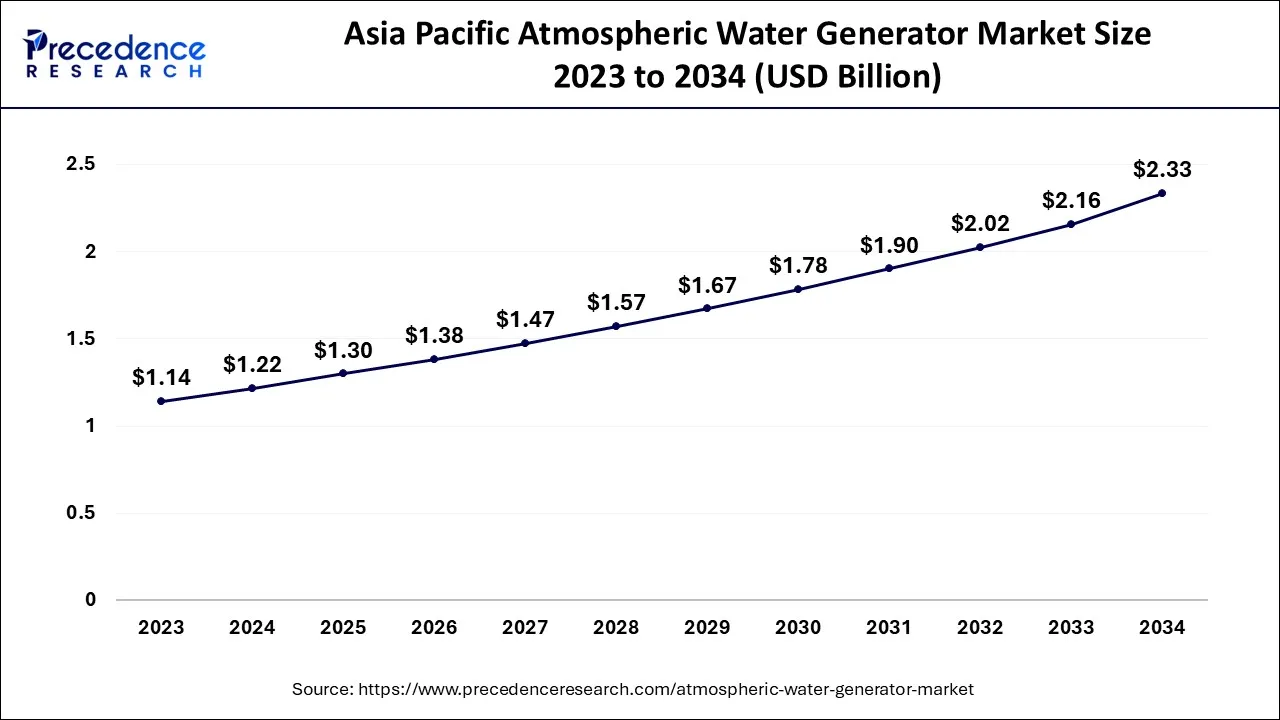
Asia Pacific captured for 37% of the global revenue share in the atmospheric water generator market. The rising concerns about drinking water scarcity are the leading factor in boosting the market's growth in the region. The presence of significant players in China and India is supplementing the revenue share for the region. The rising cases of diseases associated with contaminated water in underdeveloped countries will offer lucrative demand for the installation of atmospheric water generators in the Asia Pacific during the forecast period.
Asia Pacific is dominating the atmospheric water generator market. With the largest population, the demand for alternative water supply also rises. The water scarcity due to increased urbanization and industrialization is demanding sustainable water solutions in this regional market. Within the Asia Pacific, China is contributing the most to the water sources.
China Market Trends
China accounts for the largest share of the atmospheric water generator market in Asia-Pacific in 2025. The growth is driven by increasing demand for decentralized water solutions. China benefits from strong manufacturing capabilities that can help lower equipment costs and improve supply chains. The country is heavily investing in advanced atmospheric water harvesting research; for example, Tsinghua University is developing innovative materials to improve moisture capture efficiency, which also supports market growth. Smart infrastructure development and water conservation initiatives are further creating new opportunities for market growth.
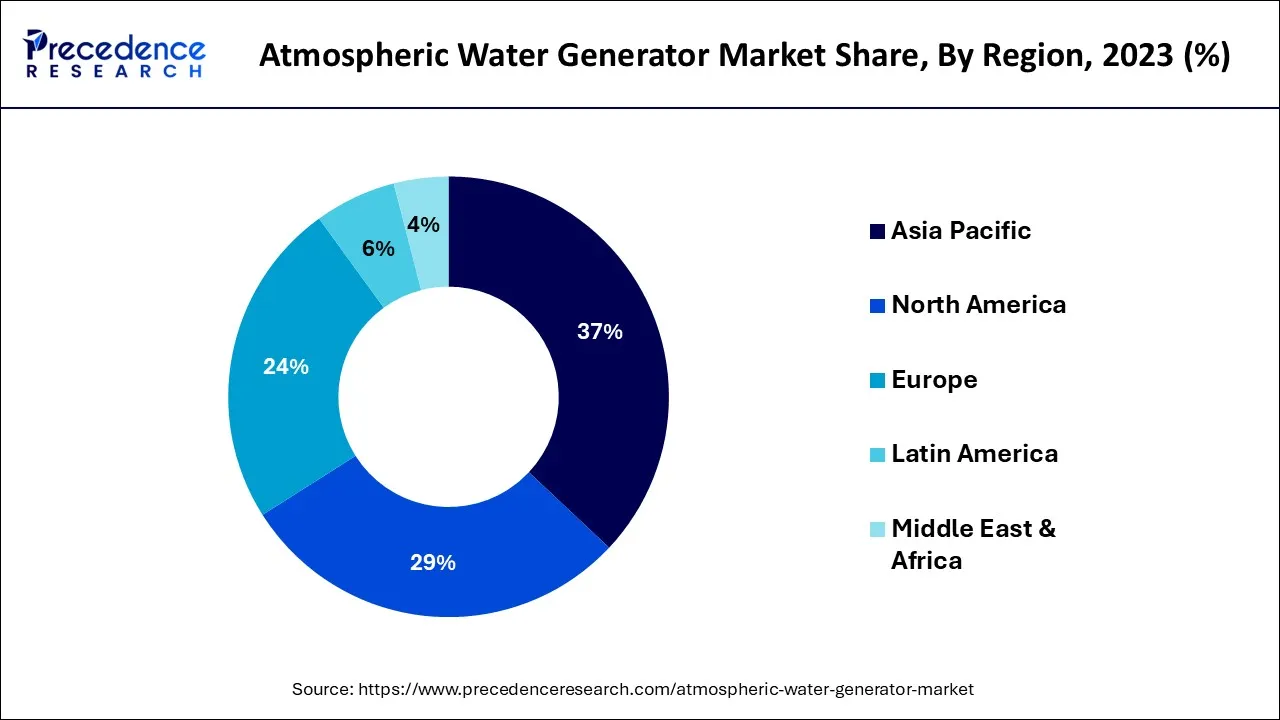
North America is projected to grow at a CAGR of 8.5% during the forecast period. The advancements in water generation technology are the major factor driving the market's growth in the region. Rapid industrialization and the presence of major companies in the United States are leading factors to fuel the atmospheric water generator market growth in North America. Europe is another fastest-growing marketplace for atmospheric water generators owing to the rising focus on the development of advanced solutions to address global warming. The growth of the atmospheric water generator market in Europe is attributed to the presence of pollutants in the underground water.
The depletion of fresh water supplies in Latin America and the Middle East is considered to boost the development of atmospheric water generation technology. Several governments are encouraging water generation from the air; this factor is propelling the market's growth. In a world where atmospheric water generation technology is not uncommon, economically weaker African countries are yet to catch the technology to resolve their water scarcity problem.
U.S. Market Trends
The United States represents the largest share of the atmospheric water generator market in North America. The growth is driven by water stress in states such as California and Nevada, along with decentralized and emergency water systems. Industrial applications, commercial buildings and residential users are also adopting the atmospheric water generator (AWG) technology. The country benefits from the adoption by the U.S. Department of Defence (DoD) to use them for military logistics and disaster management. The country's growth is further supported by technology commercialization and increasing demand for reliable alternative water sources.
What are the Advancements in the Atmospheric Water Generator Market in Europe?
Europe is witnessing significant growth in the market. This growth and development are due to the region's stringent environmental regulations, such as the EU Green Deal, which are aimed at water conservation and sustainability, alongside increasing public awareness of water scarcity issues. Countries like Germany and the Netherlands are leading players in the region, implementing numerous policies that encourage the adoption of innovative water technologies.
Germany Atmospheric Water Generator Market Trends
Germany leads the European atmospheric water generator market in 2025 due to a strong emphasis on research and development, which is fostering innovation in AWG technologies. Commercial buildings, industrial facilities, and environmentally focused projects offer promising applications of atmospheric water generators. Growing industrial activities in the country, coupled with high water output offered by the cooling condensation AWGs, help to boost market potential. The country's strong engineering base further supports development of premium AWG solutions.
What are the Key Trends in the Atmospheric Water Generator Market in Latin America?
Latin America is expected to witness a substantial amount of growth during the forecasted years. This is due to the region's rapid depletion of freshwater resources along with consecutive years of drought, which is thus expected to propel the demand for atmospheric water generators in the near future. In addition to that, evolving consumer preferences, quality requirements, and energy efficiency are projected to open up new opportunities in the region.
Brazil Atmospheric Water Generator Market Trends
Brazil accounts for the largest share of the Latin American atmospheric water generator market in 2025, due to its large geographic area, uneven water availability and recurring drought conditions in some regions. The presence of industrial effluents, such as heavy metals in water bodies, on account of the discharge of industrial wastewater into waterways without proper disposal, is expected to propel the market. The Brazilian atmospheric water generator market is witnessing steady growth with future demand supported by water security concerns and interest in alternative water technologies.
How is the Middle East and Africa Region Growing in the Atmospheric Water Generator Market?
The Middle East and Africa region is set to experience steady growth in the market. This growth is driven by the urgent need for sustainable water solutions in arid regions, and various government initiatives that are aimed at addressing water shortages. Countries like the UAE and South Africa are leading players, adopting advanced technologies to combat water scarcity. The competitive landscape is evolving, creating various opportunities for growth and innovation.
UAE Atmospheric Water Generator Market Trends: The UAE is a particularly proactive country in the region, as it is making various investments in innovative water technologies and partnerships. The country is also focusing on sustainable practices to enhance water availability. The market is also supported by broader water sustainability initiatives and industry events in the UAE that spotlight innovative water-from-air technologies and attract global solution providers.
Supply Chain Analysis
- Raw Material Sourcing: Raw materials such as stainless steel, aluminium, copper, plastics, insulation materials, refrigerants, filters and electronic components are sourced from reliable suppliers to ensure high-quality and durability. Raw material pricing and availability directly affect production cost.
- Key Players: Watergen, Genesis Systems, SkySource, Airrow, and Drinkable Air
- Component Fabrication and Machining : In this stage, suppliers manufacture compressors, condensers, evaporator coils, fans, filters, control boards and housings. These components are assembled into complete AWG units, with machining and fabrication.
- Key Players: Watergen, Genaq, Genesis Systems, EcoloBlue, and Maithri Aquatech.
- Testing and Certification : The finished AWGs undergo performance, electrical safety, leakage and durability testing. Certification ensures the product meets quality and safety standards as per industry standards before entering the global market.
- Key Players: NSF International, Water Quality Association (WQA), SGS, Intertek, and UL Solutions
- Maintenance and After-Sales Service : After installation, AWGs require regular maintenance and inspection. Companies provide support through service centres, replacement parts and technical assistance.
- Key Players: Watergen, Genaq, EcoloBlue, Akvo Atmospheric Water Systems, and Rayfish Bioenergy
- Product Lifecycle Management: Manufacturers continuously upgrade machine design and introduce new features to extend product life. Effective product lifecycle management ensures the equipment remains competitive and aligned with evolving industry standards.
Competitive Landscape
The atmospheric water generator market is moderately competitive, with established companies competing through water output, energy efficiency, purification quality and system reliability. The leading companies in the market include Watergen, SOURCE Global, Atmospheric Water Solutions, GENAQ Technologies, Air2Water Solutions, Akvo, Mayaqwa. Diseño Web, Water Technologies International, Inc., Energy and Water Development Corp., Tsunami Products Inc. and SkyWater Air Water Machines. Companies are strengthening their market position by expanding through residential, commercial and industrial applications while developing solar powered and digitally monitored systems.
For future growth in the atmospheric water generator market, companies should prioritize energy efficient designs, lower production costs, solar integration and stronger purification systems.
Top Companies in the Atmospheric Water Generator Market and Their Offerings
- Watergen (Watergen Ltd) - A Israel based one of the leading companies in atmospheric water generation and focuses on producing drinking water directly from air. It offers residential, commercial AWG systems using its GENiun technology.
- SOURCE Global - A United States based company that develops solar powered Hydropanels that collect moisture from the atmosphere and convert it into drinking water.
- GENAQ Technologies S.L. - A Spain based company specializes in the research, development, and manufacturing of atmospheric water generators. It offers multiple AWG models and customized systems.
- EcoloBlue, Inc. - A United States based atmospheric water technology company offering systems for homes, offices, businesses and other settings. Its products include the EB30 series and EcoloBlue 100.
- Akvo Atmospheric Water Systems - It offers atmospheric water generator systems to high capacity industrial and commercial applications.
Atmospheric Water Generator Market Companies
- Drinkable Air Technologies
- Atmospheric Water Generator, LLC
- Island Sky Corporation
- GENAQ Technologies S.L.
- Clean Wave Products
- Eshara Waters
- Dew Point Manufacturing
Recent Developments
- In March 2026, Aeronero company launched its Aeronero 2.0 product line featuring patented atmospheric water generation (AWGs) solutions. The equipment is designed to address water stress and provide clean, sustainable drinking water. The Aeronero 2.0 series is highly scalable, offering units that range from small 20 litre per day units for kitchen applications to heavy duty industrial systems generating 5,00 litres daily.
- In April 2025, in a first-of-its-kind sustainability push by a major Indian bank installed an atmospheric water generator (AWG) across five of its key offices to produce potable drinking water directly from atmospheric moisture.
- In January 2025, a Californian company, Spout, launched a countertop kitchen gadget that transforms humidity from the air into drinking water, drawing on technology used by NASA.
- In October 2024, developers working with Acquaria just broke ground on a USD 26 million project in Hawaii that will see 1,000 homes installed with aquaria devices, eventually producing 260 gallons of water a day.
- In February 2023, a global leader in atmospheric water generator designing and production technology, Water Technologies International, announced that its wholly owned subsidiary ‘Water Zone' has signed an agreement with a significant distributor in Florida to deliver DI resin tanks to hospital chains throughout Florida. The agreement aims to achieve new business growth in 2023 in the commercial DI water business.
- In January 2023, New York-based Airiver announced the official launch of its atmospheric water generator in the U.S. marketplace. This new product by Airiver is a sustainable water generator that consumes low power and allows the generation of water from the air in an eco-friendly way.
- In December 2022, the Davao City government and Inday Sa Dagat Advocacy Foundation jointly launched their first air-to-water atmospheric water generator to create fresh drinking water from the humidity in the air. The atmospheric water generator installed in Davao city has three separate chambers. Each chamber produces two thousand liters of water by making it six thousand liters of water every day.
- In October 2022, Brian Bell Group launched two new solar powered water generators in the market. The desalination water maker solutions and atmospheric water generators are two new products launched by the company. The company aims to generate a noticeable revenue by launching these new products.
- In April 2022, an innovator in patented water solutions, Oxydus, launched its crowdfunding campaign. The unique approach by Oxydus aims to resolve the problems with atmospheric water generators.
- In June 2022, Chennai metro stations installed atmospheric water generators. Forty-one metro stations in Chennai have installed atmospheric water generators to provide fresh drinking water to passengers.
- In May 2022, an Israel-based company in water generator technology, Watergen, announced a strategic joint venture with SMV Jaipuria Group, India. The partnership aims to bring the Watergen's technology to India. Throughout the league, both companies will introduce new atmospheric water generator products in India that create safe and fresh drinking water.
Segments Covered in the Report
By Product
- Cooling Condensation
- Wet Desiccation
By Capacity
- Up to 60 Liters
- 60-500 Liters
- 500-1000 Liters
- More Than 1000 Liters
By Application
- Industrial
- Commercial
- Residential
By Region
- North America
- Europe
- Asia-Pacific
- Latin America
- The Middle East and Africa
For inquiries regarding discounts, bulk purchases, or customization requests, please contact us at sales@precedenceresearch.com
Frequently Asked Questions





Ask For Sample
No cookie-cutter, only authentic analysis – take the 1st step to become a Precedence Research client
 Get a Sample




 sales@precedenceresearch.com
 Schedule a Meeting
