



Automated Guided Vehicle Market Size, Key Companies, Company Product Portfolio, OEM Production, Aftermarket Demand, Export Dependency, Cost Structure, Adoption Rates, Company Expansion Strategies, and Competitive Landscape
Automated Guided Vehicle Market (By Type: Unit Load Carriers, Tow Vehicles, Pallet Trucks, Forklift Trucks, Assembly Line Vehicles; By Navigation Technology: Magnetic Guidance, Laser Guidance, Inductive Guidance, Vision Guidance, Natural Navigation, Others; By Application; By Industry; By End User; By Component Type; Hardware, Software, Service; By Battery Type: Lead Battery, Lithium-ion Battery, Nickel-based Battery, Others) - Global Industry Analysis, Size, Trends, Leading Companies, Regional Outlook, and Forecast 2026 to 2035
Source: https://www.precedenceresearch.com/automated-guided-vehicle-market
 Get a Sample
 Table Of Content


What is the Automated Guided Vehicle Market Size?
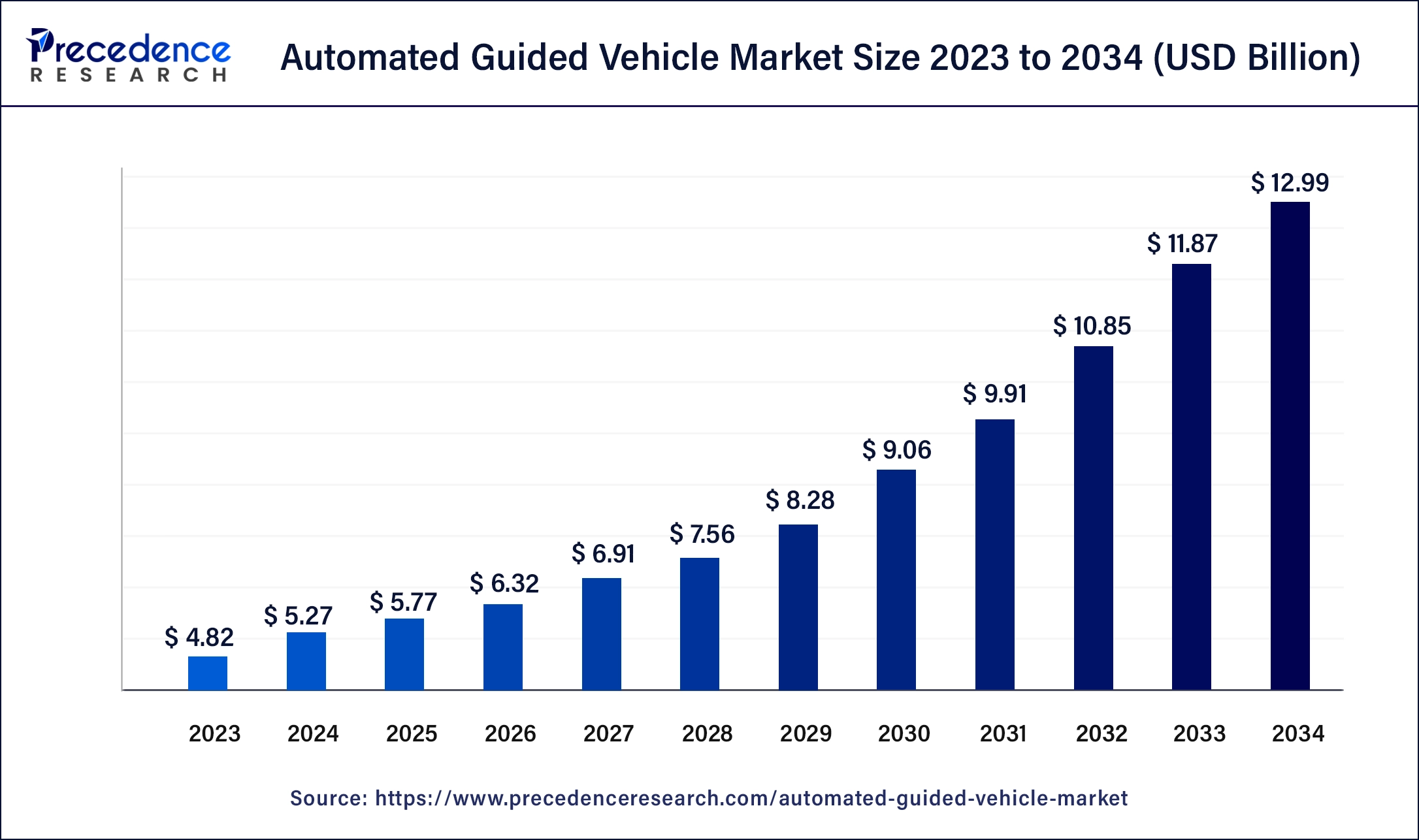
The global automated guided vehicle market size is calculated at USD 5.77 billion in 2025 and is predicted to increase from USD 6.32 billion in 2026 to approximately USD 14.04 billion by 2035, expanding at a CAGR of 9.3% from 2026 to 2035. This expansion is due to the growing demand for automation across various industries and the rising labor costs.
Market Highlights
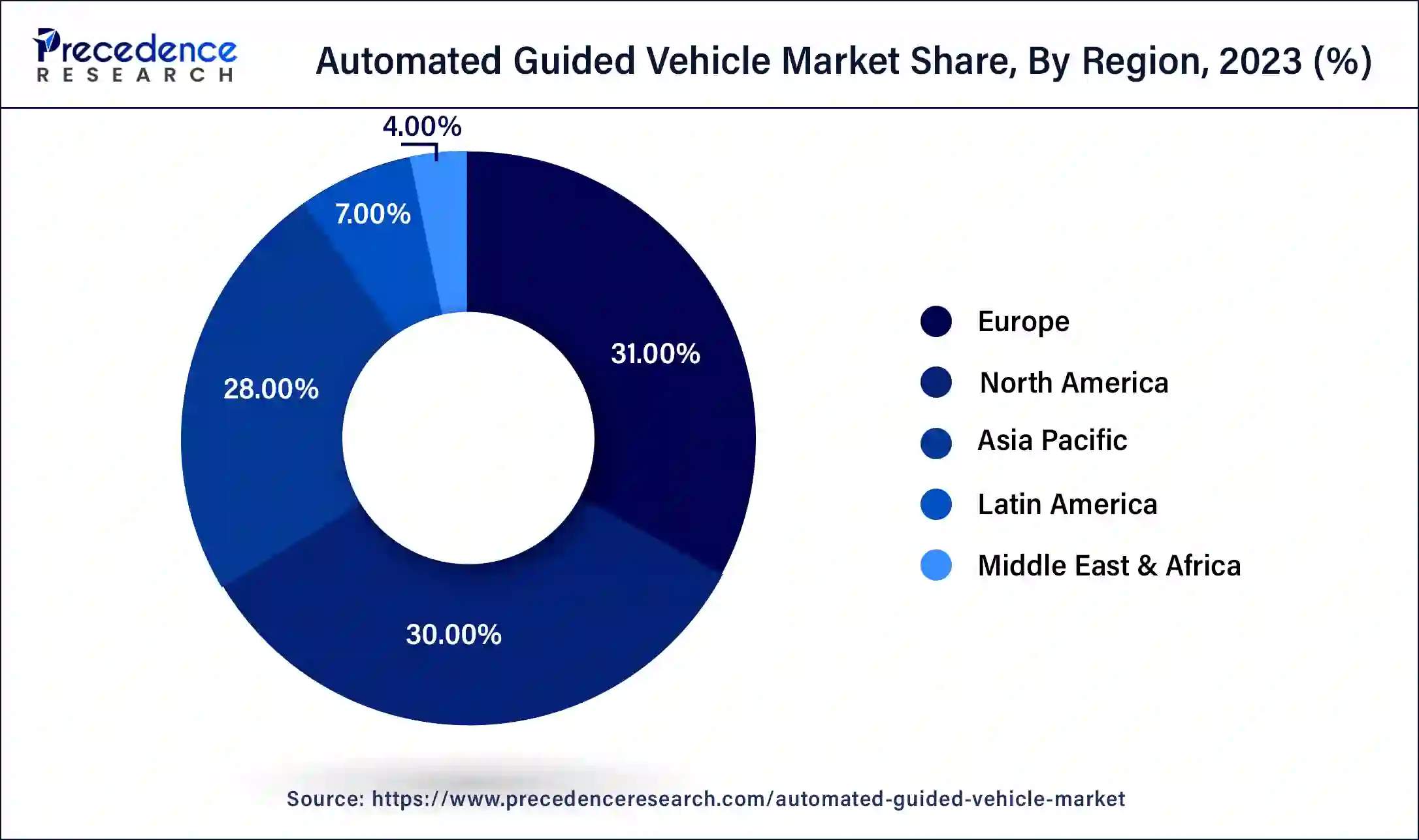
- Europe led the global market with the highest market share of 31% in 2025.
- Asia Pacific region is expanding at a CAGR of 11.2% during the forecast period 2026 to 2035.
- The natural navigation segment is expanding at a CAGR of 17.5% from 2026 to 2035.
- The wholesale and distribution sector is growing at a notable CAGR of 9.3%.
- By application, the logistics and warehousing segment accounted for a revenue share of around 41% in 2025.
- The assembly segment is expected to drive growth at a CAGR of 13.1% from 2026 to 2035.
- By component, the hardware segment dominated the market in 2025 and accounted for a revenue share of over 70%.
- The service segment is growing at a CAGR of 9.3% from 2026 to 2035.
- By battery type, the lead battery segment has captured a revenue share of around 61% in 2025.
- The lithium-ion battery segment is expanding at a CAGR of 15.9%.
Market Overview
The automated guided vehicle market is experiencing strong growth, driven by increasing demand for automation in manufacturing, warehousing, and logistics operations. Companies are adopting the automated guided vehicle approach to improve operational efficiency, reduce labor dependency, and enhance workplace safety. Rapid expansion of e-commerce and omni-channel retail has significantly increased the need for automated advancements in navigation systems, sensors, and fleet management software, which are improving the performance and flexibility.
How does AI contribute to the Expansion of the Automated Guided Vehicle Market?
AI has equipped automated guided vehicles with several features to make them capable of handling strategic and complicated tasks. AI has enhanced the core capabilities of these vehicles by making them more adaptable, smarter, and capable of complicated decision-making. AI has contributed to this enhancement through machine learning for better decision-making, deep learning to adapt to dynamic environments, and computer vision for accuracy and efficiency. Moreover, other forms include natural language processing for facilitating communication, sensor fusion for knowing the surroundings, and reinforcement learning for optimal decision-making.
What are the Automated Guided Vehicles?
Automated Guided Vehicles (AGVs) are self-guided machines designed to autonomously transport materials in industrial environments, including warehouses, factories, and other facilities. Rather than relying on human operators, AGVs utilize a combination of sensors, software, and navigation technology to follow predetermined routes, such as magnetic tape and painted lines. Companies like Mitsubishi Electric have integrated AGVs in their smart factories to enhance productivity and allow workers to focus on higher-value tasks. Warehouses heavily depend on integrating AGVs with Warehouse Management Systems (WMS). The application of AGVs has expanded beyond factories into various industries, including warehousing, automotive, food, medicine, e-commerce, and aerospace.
Automated Guided Vehicle Market Growth Factors
- Factors such as rising production volumes, shorter delivery times, increasing product variety, and persistent skilled labor shortages compel companies to design their internal material flows for greater efficiency and flexibility. AGVs are reliable for managing repetitive and monotonous transport tasks.
- The automated guided vehicle market is experiencing growth due to the increasing demand for automation technologies across different industries. This market expansion is driven by improvements in the accuracy, safety, and productivity of AGVs.
- Advancements in LiDAR, machine vision, and AI-based navigation are enabling AGVs to perform complex tasks with greater precision and adaptability. The adoption of AGV-as-a-Service (AGVaaS) is lowering barriers for small and medium enterprises, making automation more accessible without significant upfront investments.
- The rapid expansion of e-commerce and omni-channel retail has significantly increased the demand for automated advancements in navigation systems, sensors, and fleet management software, enhancing overall performance and flexibility.
- The demand for automation in material handling across various industries, the rise in popularity of online sales channel, the transition from mass production to mass customization, and enhanced workplace safety norms are some of the factors driving the automated guided vehicle market growth.
- The automated guided vehicle market is growing due to an increase in demand for automation technologies in different types of industries. The market is also driven by improvements in accuracy, safety, and high productivity of automated guided vehicles. Moreover, the low labor costs help to boost the market growth of automated guided vehicle market.
- However, the automated guided vehicle market's growth is hampered by high initial investment costs and a lack of flexibility. Furthermore, the integration of industry 4.0 is expected to give lucrative growth prospects for market players in the automated guided vehicle market.
- The industries such as food & beverage, automotive, aerospace, manufacturing, retail, logistics, and other end-use industries are all using automated guided vehicles. The demand for industrial equipment is driven by lower labor costs and increased productivity. As industries have become more technology driven and automated, the need for automated guided vehicles is likely to rise.
- The factors such as increasing automation in material handling process and increased production and efficiency of automated guided vehicles is boosting the market growth. On the other hand, risks associated with automated guided vehicles restrict the growth of automated guided vehicles market. The technological advancements are creating lucrative opportunities for the growth and development of automated guided vehicle market.
Market Outlook
- Industry Growth Overview: The AGV Industry has been experiencing consistent growth driven by an increasing number of automated solutions, labor shortages, and the growth of smart factories. Companies focus on using AGV solutions to improve their efficiency in material handling, accuracy in operations, and safety within the workplace.
- Sustainability: Businesses focused on sustainability are increasingly turning to AGVs as a powerful method of achieving their goals. In particular, there has been an increasing interest in the use of Energy-Efficient AGVs that utilize regenerative braking, optimized route algorithms, and recyclable components.
- Start-Up Ecosystem: Start-up companies have had an impact on the AGV Industry by offering service-centric solutions driven by artificial intelligence-based navigation and modular-designed AGVs, as well as cloud-based fleet management solutions. Start-ups have been able to develop needs-based solutions quickly and efficiently, providing small to medium-sized enterprises with cost-effective automation solutions that would not otherwise be available to them.
Powerful Partnerships Driving Innovation in the Automated Guided Vehicle Market
- In October 2025, Saudi Arabia launched an innovative autonomous vehicle program, which is a transformative project for the Kingdom. It was achieved through a collaboration among global tech leader Uber, Transport General Authority (TGA) of Saudi Arabia, and Chinese autonomous-driving pioneer WeRide. This program is operational at Princess Noura University and the Roshn Front shopping mall. It aims to reduce traffic congestion and provide a more sustainable, convenient transportation solution for Riyadh's residents. (Source: https://www.arabwheels.sa)
- In July 2026, Bosch and CARIAD concluded a collaboration in the automated driving alliance and delivered a level 2 driving system for the mass market. These project partners have created an AI-based software stack that is ideal to integrate into various vehicle classes. It can be integrated into both electric and combustion-engine platforms, and from compact cars to premium models. The system was tested with development vehicles in North America, Europe, and Japan. In addition, these project partners also equipped vehicle fleets from logistics providers, service vehicles, and leasing companies that are in daily use globally. (Source: https://www.volkswagen-group.com)
Market Scope
| Report Coverage | Details |
| Market Size in 2025 | USD 5.27 Billion |
| Market Size in 2026 | USD 6.32 Billion |
| Market Size by 2035 | USD 14.04 Billion |
| Growth Rate from 2026 to 2035 | CAGR of 9.3% |
| Largest Market | Europe |
| Fastest Growing Market | Asia Pacific |
| Base Year | 2025 |
| Forecast Period | 2026 to 2035 |
| Segments Covered | Type, Navigation Technology, Application, Industry, End User, Component, Battery, and region |
| Regions Covered | North America, Europe, Asia-Pacific, Latin America and Middle East & Africa |
Market Dynamics
Driver
How will Automation Investments Drive the Automated Guided Vehicle Market?
Manufacturers are expected to prioritize projects that align with long-term operational goals and clear payback potential. The industrial teams that stay competitive make investments in automated guided vehicles and autonomous mobile robots. Manufacturers are adopting mixed fleets rather than replacing existing robots. It will boost the priorities of organizations toward flexibility and long-term return on their automation investments.
Restraint
What are the Challenges Facing Warehouse Manufacturers in the Automated Guided Vehicle Market?
The industry is under intense pressure with worsening labor shortages, surging growth of global e-commerce, and rising real estate costs. The design of automated guided vehicles for modern warehouse environments is more complex than ever. Engineers must pack more functionality in the form of motors, sensors, compute, and power without sacrificing reliability or thermal performance. Wide fluctuations are observed when automated guided vehicles are expected to run for longer hours in ambient temperatures.
Opportunity
What is the Future of the Automated Guided Vehicle Market?
The use of automated guided vehicles and autonomous mobile robots is becoming vital due to the immense potential of these autonomous vehicles to transform logistics chains. Logistics is an essential component of the goods cycle, which unites several stakeholders. The operations like warehousing, product design, transport, handling, primary packaging, and outer packaging need to be agile and efficient. Automated guided vehicles that are equipped with powerful AI and sensors can perform numerous tasks within warehouses.
Segments Insights
Industry Insights
How does the Manufacturing Segment Dominate the Automated Guided Vehicle Market in 2025?
The manufacturing segment dominated the market in 2025, owing to the immense role of automated guided vehicles in manufacturing to enhance safety and productivity. They are redefining versatility and efficiency in the manufacturing industry. They are enhancing operations and transforming them across diverse manufacturing settings.
The logistics segment is expected to grow at the fastest CAGR in the market during the forecast period due to the key role of automated guided vehicles in transforming logistics operations by introducing efficiency, precision, and adaptability in inventory management and material handling. The adoption of Industry 4.0 technologies evolves logistics, while automated guided vehicles have become a central point of smart logistics systems.
Application Insights
What made Logistics and Warehousing the Dominant Segment in the Automated Guided Vehicle Market in 2025?
The logistics and warehousing segment dominated the market in 2025, owing to the integral connection of automated guided vehicles to the connected ecosystems of smart warehouses. They enable seamless coordination between systems, machines, and human operators. The integration of IoT sensors into these vehicles enables their communication with warehouse management systems and enterprise resource planning platforms.
The assembly segment is estimated to grow at the fastest rate in the market during the predicted timeframe due to the performance of automated guided vehicles as flexible assembly lines. They can create deviations for additional operations, quality checks, product customizations, etc.
Type Insights
Which Type of Automated Guided Vehicle dominated the Market in 2025?
The tow vehicle segment dominated the market in 2025, driven by the logistics, manufacturing, and warehousing sectors' digital transformation. Towing AGVs are an important part of lean manufacturing and streamlined logistics, reducing manual labor and decreasing the risk related with moving bulky or hazardous goods. In sectors such as automotive steel production, manufacturing, and aerospace, towing vehicles ensure a reliable, repeatable supply of components to assembly lines and storage areas.
The unit load carrier segment is expected to grow at a significant rate during the forecast period, due to its role in pallet and rack transportation in warehouses. Unit load carriers are mainly used in distribution centers, warehousing, and manufacturing area for tasks like pallet movement, loading or unloading, and storage. They are vital for high-throughput applications where reducing human intervention is important for productivity and traceability.
Navigation Technology Insights
Which Navigation Technology Dominated the Automated Guided Vehicle Market in 2025?
The laser guidance segment held the largest share of the automated guided vehicles market in 2025, as it is fast, accurate and reliable. This navigation technology is traditionally utilized in automated forklifts that are fostering warehouse efficiency all around the world. This navigation method provides high precision and reliability as well as freedom to change the driving route quite easily, making laser guidance suitable for a wide range of industrial and warehousing applications.
The magnetic guidance segment is seen to grow at a notable rate during the predicted timeframe. Magnetic guidance AGVs keep being in strong demand in industries where a fixed path and high precision transport are needed. These AGVs follow embedded magnetic strips or wires, thus ensuring the movement that is independent of the distance.
On the other hand, the others segment is estimated to be the most opportunistic segment during the forecast period. The wire-guided and other types of automated guided vehicles comprise the others segment of the navigation technology.
End Use Industry Insights
Which End-Use Segment Dominated the Automated Guided Vehicle Market in 2025?
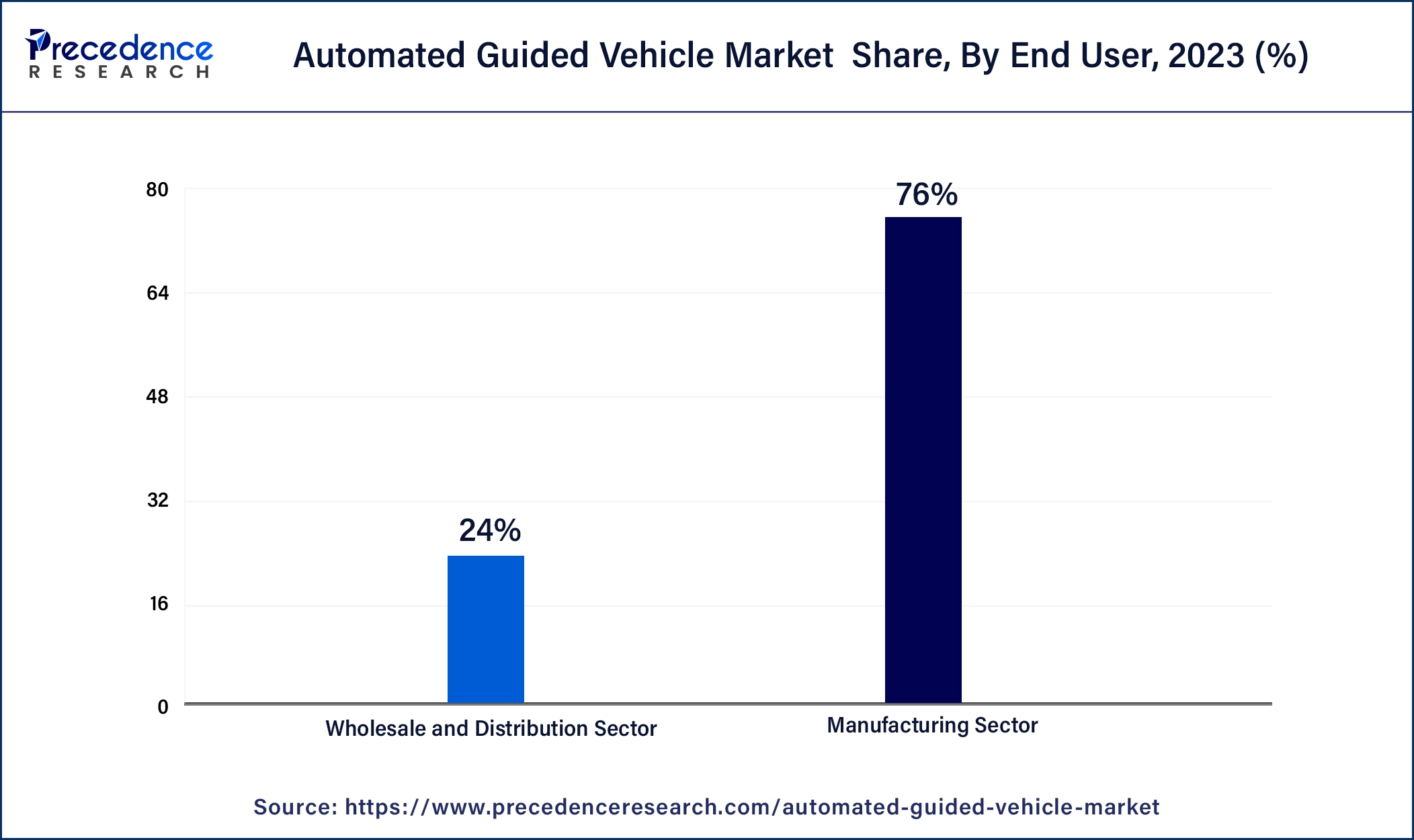
The manufacturing segment dominated the market with the largest share in 2025, driven by growing demand for improved efficiency and productivity in the manufacturing sector. AGVs, which seamlessly transport materials and products within a facility. This lowers the need for manual labor and reduces errors during material handling. The growing automotive, electronics, pharmaceutical, FMCG, and heavy engineering sectors are driving the demand for reliable AGV for manufacturing.
The aerospace segment is growing at the fastest rate during the forecast period, driven by a range of benefits that make it an ideal choice for automating material handling and logistics processes. The aerospace sector is known for its precision, complexity, and rigorous safety standards. To complete the demands of this sector, manufacturers and aerospace facilities have turned to automated guided vehicle solutions to improve efficiency, lower human error, and ensure the highest levels of safety.
Component Type Insights
How did the Hardware Segment Dominate the Automated Guided Vehicle Market in 2025?
The hardware segment dominated the market in 2025, owing to the features of automated guided vehicles, including a combination of hardware, software, and control systems. These systems handle tasks such as replenishing inventory while minimizing delays, labor costs, and errors, transporting raw materials, and moving finished products.
The service segment is anticipated to grow at the fastest rate in the market during the upcoming period due to the importance of automated guided vehicle maintenance best practices. These include regular inspection and cleaning, preventative maintenance, predictive maintenance, and corrective maintenance.
Battery Type Insights
Which Segment by Battery Type Dominated the Automated Guided Vehicle Market in 2025?
The lead battery segment dominated the market in 2025, owing to the ideal nature of lead batteries for 12-volt systems to enable the global shift toward autonomous and electric vehicles. Lead batteries ensure cost competitiveness, reliability, sustainability, and safe chemistry.
The lithium-ion battery segment is predicted to grow at a rapid rate in the market during the studied period due to the advantages of lithium batteries for automated guided vehicles and autonomous mobile robots. They deliver higher energy density, no memory effect, longer life, faster charging, and better efficiency.
Key Companies Share Insights
The market is moderately fragmented with the presence of several local companies. These market players are striving to gain higher market share by adopting different marketing strategies, such as new product launch, investments, partnerships, and mergers & acquisitions. The companies are also spending on the development of improved products. Moreover, they are also focusing on competitive pricing.
- In October 2019, the Hit Robotic Group (HRG) launched new product line of automated guided vehicles for simultaneous localization and mapping.
The various developmental strategies such as new product launches, acquisition, partnerships, joint venture, and mergers fosters market growth and offers lucrative growth opportunities to the market players.
Regional Insights
Which Region Dominated the Automated Guided Vehicle Market in 2025?
The Europe AGV market dominated in 2025, fueled by the rising demand for automation in logistics and manufacturing. The escalating labor costs, along with a shortage of skilled workers, have accelerated the adoption of AGVs, particularly in sectors such as e-commerce, automotive, and pharmaceuticals. Growth in the European market is also driven by ongoing advancements in Artificial Intelligence and the Internet of Things within AGV technology.
Europe Automated Guided Vehicle Market Size and Growth 2026 to 2035
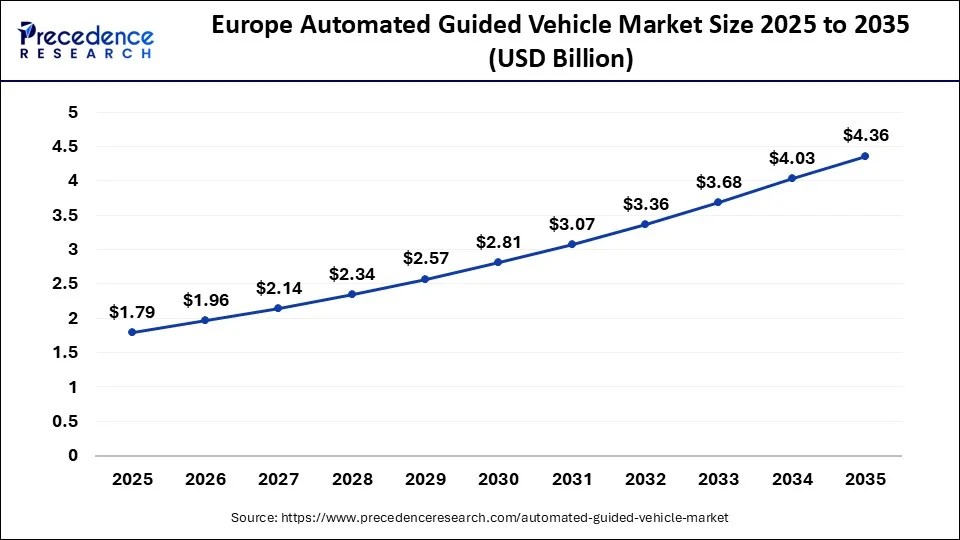
The Europe automated guided vehicle market size is exhibited at USD 1.63 billion in 2025 and is projected to be worth around USD 4.36 billion by 2035, poised to grow at a CAGR of 9.31% from 2026 to 2035.
France Automated Guided Vehicle Market Trends
In France, one of Europe's largest industrial economies, the adoption of AGVs is increasing across various industries, especially in logistics, automotive, aerospace, and food and beverage sectors. This growth is propelled by the rising demand for automation, escalating e-commerce activity, and advancements in Industry 4.0 technologies. The French government supports Industry 4.0 initiatives through programs like La French Fab, encouraging the adoption of smart technologies in manufacturing. AGVs play a crucial role in smart factories, facilitating more flexible, efficient, and scalable operations.
Germany is a major contributor to the European automated guided vehicle market due to its strong industrial and manufacturing base, extensive adoption of Industry 4.0 technologies, and high demand for automation in warehouses and factories. The country's focus on advanced logistics, automotive production, and smart factory initiatives further drives the deployment of AGVs across sectors.
North America Automated Guided Vehicle Market Trends
North America represents one of the largest and most developed global markets for automated solutions. A robust economy, substantial port traffic, growing e-commerce activities, and key manufacturing indices drive the demand for AGVs. For instance, Daifuku Airport America, a subsidiary of Daifuku North America, Inc., is a leader in the AGV sector, having sold over 20,000 AGVs since entering the business in 1961.
U.S. Automated Guided Vehicle Market Trends
The demand for Automated Guided Vehicles continues to grow in the U.S., as warehouses, fulfillment centers, and factories across the U.S. look to automate material handling operations. Factors such as labor shortages, increasing order complexity, and the need for faster cycle times have made AGVs critical infrastructure for modern logistics. U.S.-based AGV manufacturers offer unique strengths, whether it's AI-powered fleet orchestration, heavy-duty material handling, or flexible deployment strategies.
Asia Pacific Automated Guided Vehicle Market Trends
The Asia-Pacific region is witnessing the fastest growth in the AGV market during the forecast period, due to rapid expansions in manufacturing, e-commerce, and logistics. Countries such as China, Japan, South Korea, India, and Southeast Asian economies are heavily investing in automation. Companies in Asia-Pacific are adopting not only basic AGVs but also Autonomous Mobile Robots (AMRs) equipped with LiDAR, AI perception, and dynamic routing capabilities.
India Automated Guided Vehicle Market Trends
India automated guided vehicle market is driven by an increasing demand for automation across various industries, along with enhanced safety, accuracy, and productivity. Reducing labor costs within organizations further contributes to this market growth. However, challenges like high initial investment costs and limited flexibility for non-repetitive tasks can hinder market expansion.
China dominates the regional market, driven by extensive manufacturing operations, rapid adoption of smart factory technologies, and strong government support for industrial automation. Japan also contributes to the market, driven by its advanced robotics ecosystem in the automotive industry and high demand for precision material handling solutions.
Middle East and Africa Automated Guided Vehicle Market Trends
The Middle East and Africa Automated Guided Vehicles market is undergoing a phase of transformation as manufacturers, warehouses, retailers, and logistics operators adopt automation to enhance efficiency, reduce labor dependency, and modernize material handling operations. The rising adoption of e-commerce, coupled with the growth of smart factory initiatives, is driving the demand for scalable and intelligent automation solutions like AGVs.
UAE Automated Guided Vehicle Market Trends
UAE Automated Guided Vehicles market is growing significantly. This demand is primarily fueled by the region's emphasis on Industry 4.0 and industrial automation, which help decrease labor costs and increase productivity. Additionally, the expansion of the food and beverage e-commerce industry is contributing to market growth. This growth directly leads to warehouse automation, which optimizes operations and positively influences the market. In September 2024, MEPEQ launched its line of state-of-the-art Automated Guided Vehicles (AGVs), featuring Autonomous Mobile Robots (AMRs) that provide seamless transportation solutions for packaging materials within factories.
Latin America Automated Guided Vehicle Market Trends
The relocation of manufacturing capacity to Latin America and the Caribbean, particularly in Mexico, is creating a structural surge in demand for AGVs. The demand in Latin America is driven by the region's expanding manufacturing and logistics sectors, the increasing need for warehouse automation, and initiatives to boost operational efficiency. Furthermore, rising investments in industrial infrastructure and the adoption of advanced technologies are enhancing the deployment of AGVs across key industries.
Brazil Automated Guided Vehicle Market Trends
In Brazil, demand for AGV is emerging mainly within the automotive assembly and food processing sectors. Local manufacturers are modernizing existing facilities to remain competitive in the global export market. The focus is on robust, cost-effective navigation software capable of operating reliably in environments with varied infrastructure quality.
Government Initiatives in the Automated Guided Vehicle Market
China
- In April 2026, the Chinese Government took a significant step toward building nationwide standards for autonomous vehicles. Estimates reported that there will be 500,000 robotaxis on Chinese roads by 2030, rising to 1.9 million by 2035. (Source: https://environmentalhealthsafetybrief.sidley.com)
United States
- In December 2025, the US Department of Transportation (DOT) planned to modernize America's transportation infrastructure, streamlining regulatory oversight, ensuring safety, bridging funding gaps, tapping private sector expertise, and improving efficiency with improved technologies to address both emerging needs and current challenges. The DOT aims to achieve these goals by prioritizing public safety, diversifying funding approaches, and focusing on regulatory agility. (Source: https://www.deloitte.com)
Germany
- In April 2026, the German Government reported that Germany aims to reach net greenhouse gas neutrality by 2045, targeting to reduce emissions by at least 65% by 2030 and 88% by 2040, and aiming to achieve net-negative emissions by post 2050. The first national climate law of this country contains annual emission budgets for individual sectors such as transport and industry until 2030. Budgets align with European greenhouse gas emission reduction plans. (Source: https://www.cleanenergywire.org)
Brazil
- In June 2026, the Brazilian government decided to allow duty-free imports for CKD (Completely Knocked Down) and SKD (Semi Knocked Down) kits for electric vehicles in the second half of 2026, which will be assembled by automakers in Brazil. This is expected to mainly benefit BYD's vertically integrated, affordable new energy vehicles, and GM's Chevrolet, which relies on scaling a mix of hybrid and all-electric models. (Source: https://www.electrive.com)
Saudi Arabia
- In October 2025, Saudi Arabia introduced a game-changing autonomous vehicle program and reported its efforts towards modernizing urban mobility in Riyadh. It was a part of the Kingdom's Vision 2030, and this revolutionary initiative launched self-driving cars to the streets of Riyadh. (Source: https://www.arabwheels.sa)
Value Chain Analysis of the Automated Guided Vehicle Market
- Manufacturing Sensors and Integrating Components: In this phase, the components that enable AGV (automatic guided vehicle) systems are produced. This includes developing navigation sensors, lithium-ion batteries, safety scanners, control systems, and implementing embedded software throughout the production process.
Key Players: SICK AG, Omron Corporation, and Rockwell Automation. - Integration of the AGV System with Other Systems and Assembly of AGVs: Integrators play a critical role in developing and providing customized AGV systems. Integrators will integrate hardware components, navigation software programs, fleet management applications, and safety protocols to make customized AGV solutions.
Key Players: Daifuku Co., Ltd., KION Group, and Toyota Industries. - AGV Deployment, Aftermarket and Lifecycle Support: After an AGV has been deployed, it will require many services, including installation, route optimization, software upgrades, predictive maintenance, and operator training.
Key Players: JBT Corporation and Murata.
Competitive landscape
The overall competitive landscape of the automated guided vehicle market is dynamic, characterized by continuous innovation and strategic partnerships. Companies are increasingly focused on enhancing the interoperability, adaptability, and intelligence of AGV systems to meet evolving market demands. New entrants are emerging, targeting specialized applications with innovative AGV solutions; however, they face challenges in competing with the established production and distribution networks of market leaders. The competitive landscape remains vibrant, with leaders like Toyota setting the pace, followers like JBT and Daifuku pushing technological boundaries, and new entrants seeking differentiation through innovation.
Top Companies in the Automated Guided Vehicle Market & Their Offerings
- Swisslog Holding AG: Offers a range of automated transport vehicles, including the CarryPick mobile rack system and specialized pallet AGVs for seamless warehouse integration.
- AGVE Group: Provides a diverse lineup of standard and custom-built AGVs, from small 50kg load carriers to massive vehicles capable of moving 65 tonnes.
- JBT: Specializes in heavy-duty, purpose-built AGVs for industrial environments, offering specific solutions for forked, towing, and unit load applications.
- Hyster-Yale Materials Handling, Inc.: Focuses on "robotic" lift trucks that automate their standard manual hardware, such as tow tractors and pallet trucks, using LiDAR-based navigation.
- Toyota Advanced Logistics: Operates primarily through Bastian Solutions to deliver autonomous tuggers, forklifts, and vision-guided vehicles tailored for high-speed distribution.
- KION GROUP AG: Delivers a full spectrum of automated transport through brands like Dematic and STILL, covering everything from narrow-aisle trucks to heavy pallet movers.
- Heartland Automation LLC: Specializes in versatile autonomous mobile robots and tuggers designed to replace manual delivery carts in lean manufacturing cells.
- E&K Automation GmbH: Now known as ek robotics, they engineer high-tech transport robots, including heavy-load carriers and the VARIO MOVE series for flexible pallet handling.
- Daifuku: Features the SmartCart line of flexible, magnetic-guided carts alongside heavy-duty unit load AGVs for large-scale manufacturing assembly lines.
- SSI Schaefer: Offers the WEASEL system, a compact AGV designed specifically for transporting bins, cartons, and small goods without the need for complex infrastructure.
Recent Developments
- In April 2026, Volkswagen Group launched its largest-ever product offensive in China and an agentic AI roadmap for China. It was also reported that more than 20 electrified vehicles will be launched in the market in 2026 alone, and that will expand to 50 models by 2030.(Source: https://www.volkswagen-group.com)
- In April 2026, Volkswagen Group launched four world premieres such as the ID. AURA T6, the Volkswagen ID. UNYX 09, JETTA's all-electric show car JETTA X, and the AUDI brand's second serial production car, the E7X in China, for China. The company also reported that from 2027, there will be an integration of intelligent driving and cockpit control by the next-generation China Electronic Architecture (CEA) 2.0 into a unified system. It will be integrated across all powertrain types, empowered by Agentic AI. (Source: https://www.volkswagen-group.com)
- In April 2026, Volkswagen Group introduced an “Agentic AI for all” roadmap for China and reported that from 2026, onboard AI agents will be featured on vehicles based on Volkswagen's China Electronic Architecture. They enable human-like, highly intuitive interaction between customer and vehicle while ensuring robust personal data protection. (Source: https://www.volkswagen-group.com)
- In March 2026, Toyota Material Handling Europe launched a new automated guided vehicle (AGV) system developed to handle a range of warehouse transport tasks and pallet types. The system combines the industry's SAI125CB automated counterbalance stacker with its T-ONE control software platform, allowing coordination across automated and mixed fleets.
- In November 2025, BYD launched the 2026 M9 multi-purpose vehicle (MPV), known as the BYD Xia in China. It was priced between 206,800 and 269,800 yuan, and prices started from prices start from 196,800 yuan. This new model introduced improved fuel economy, a larger battery, and upgraded driver assistance systems. (Source: https://carnewschina.com)
- In May 2025, the AC7 and DC7 Motor Controllers, which are powerful new generation of AC and DC motor controllers used for AGVs and AMRs, were announced and launched by Kollmorgen, who is one of the leaders in navigation and controls technology for automated guided vehicles (AGVs) and autonomous mobile robots (AMRs). These innovations offer flexibility as well as durability and enhanced performance, which are the requirements of the newest, most advanced autonomous vehicle applications.
- In May 2025, to reduce the complexities and costs associated with the infrastructure charging, a new automated overhead charging system, named Weplug, was developed by Westfalia Technologies. With the help of driver driver-inserted adapter, the 50 kW DC fast charger which utilizes gantry-based robotic arm, is connected to EVs.
- In February 2025, with the production of Automated Guided Vehicles (AGVs) at Kenitra, Morocco, the performance of the Automotive manufacturing giant Stellantis is enhancing. A total of 1,000 units per year of AGVs will be produced by the group's Kenitra factory, according to the reports of Faro de Vigo. Furthermore, the industrial autonomy and supporting local sourcing of the company's Kenitra plant will be enhanced, as per the reports of Wandaloo (Source: https://www.automation.com)
(Source: https://www.electrive.com)
(Source: https://www.moroccoworldnews.com)
Segments Covered in the Report
By Type
-
- Unit Load Carriers
- Tow Vehicles
- Pallet Trucks
- Forklift Trucks
- Assembly Line Vehicles
By Navigation Technology
-
- Magnetic Guidance
- Laser Guidance
- Inductive Guidance
- Vision Guidance
- Natural Navigation
- Others
By Application
-
- Logistics and Warehousing
- Transportation
- Cold Storage
- Wholesale & Distribution
- Cross-docking
- Assembly
- Packaging
- Trailer Loading and Unloading
- Raw Material Handling
- Others
- Logistics and Warehousing
By Industry
-
- Food & Beverage
- Automotive
- Manufacturing
- Retail
- Logistics
- Others
By End User
-
- Manufacturing Sector
- Automotive
- Aerospace
- Electronics
- Chemical
- Pharmaceuticals
- Plastics
- Defense
- FMCG
- Tissue
- Others
- Wholesale and Distribution Sector
- E-commerce
- Retail Chains/Conveyance Stores
- Grocery Stores
- Hotels and Restaurants
- Manufacturing Sector
By Component Type
-
- Hardware
- Software
- Service
By Battery Type
-
- Lead Battery
- Lithium-ion Battery
- Nickel-based Battery
- Others
By Region
- North America
- Europe
- Asia-Pacific
- Latin America
- Middle East & Africa
For inquiries regarding discounts, bulk purchases, or customization requests, please contact us at sales@precedenceresearch.com
Frequently Asked Questions





Ask For Sample
No cookie-cutter, only authentic analysis – take the 1st step to become a Precedence Research client
 Get a Sample




 sales@precedenceresearch.com
 Schedule a Meeting
