



Automotive Electronics Market Size, Key Companies, Company Product Portfolio, Production Output, Market Penetration, Sales Analysis, Export Performance, Operational Efficiency, and Customer Demand
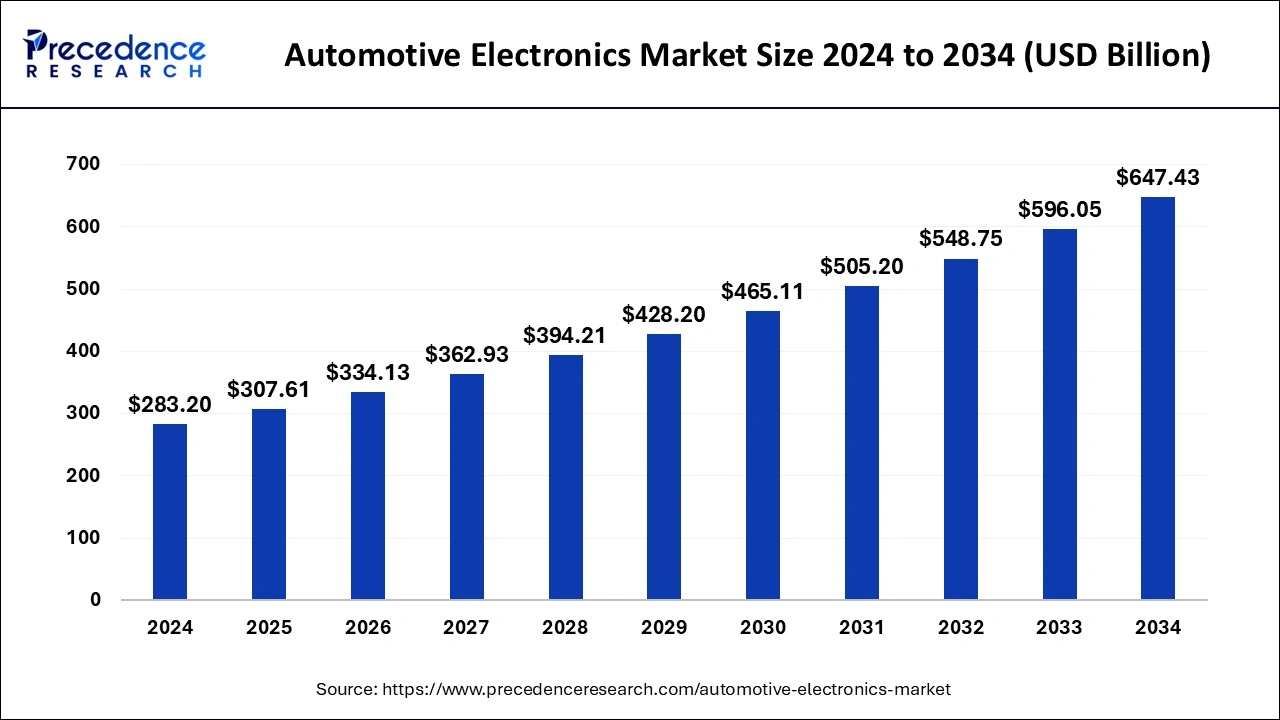
The global automotive electronics market is projected to grow from USD 334.13 billion in 2026 to USD 680.56 billion by 2035, registering a CAGR of 8.26%. Growth is fueled by the rapid adoption of electric vehicles (EVs), advanced driver assistance systems (ADAS), connected vehicle technologies, and AI-powered automotive electronics that enhance safety, automation, and driving efficiency. Asia Pacific leads the market due to its strong automotive manufacturing base and EV adoption, while North America is expected to witness the fastest growth, driven by investments in connected, autonomous, and software-defined vehicles.
Source: https://www.precedenceresearch.com/automotive-electronics-market
 Get a Sample
 Table Of Content


What is the Automotive Electronics Market Size?
The global automotive electronics market size is accounted at USD 307.61 billion in 2025 and predicted to increase from USD 334.13 billion in 2026 to approximately USD 680.56 billion by 2035, expanding at a CAGR of 8.26% from 2026 to 2035. The automotive electronics market is driven by the increasing popularity of electric vehicles, advanced driver assistance systems, and connected vehicle technologies.
Key Takeaways
- By region, Asia Pacific dominated the global Market in 2025.
- By region, North America is expected to grow at the fastest CAGR during the forecast period.
- By type, the current-carrying devices segment dominated the market in 2025.
- By type, the sensors segment is expected to grow at the fastest rate during the forecast period.
- By sales channel, the OEM segment contributed the biggest revenue share in 2025.
- By sales channel, the aftermarket segment is expected to witness the fastest growth over the forecast period.
- By application, the safety systems segment accounted for the highest revenue share in 2025.
- By application, the ADAS segment is expected to grow at the fastest CAGR during the forecast period.
Automotive Electronics: Driving Innovation and Enhanced Vehicle Functionality
Automotive electronics are customized electronics designed for use in vehicles. These types of electronics can be exposed to, and are thus rated at, more severe temperature ranges when compared with regular electronics. Over the last decade, vehicle sensor improvements have led to pioneering autonomous driving mechanism that permits better visibility and consciousness. The special cutting-edge features in the modern vehicles include adaptive cruise control, park assistance, lane-keep support, traffic-sign identification and pedestrian recognition among others. Multiple features presented by original equipment manufacturers (OEMs) such as mechanized emergency braking organization, lane departure warning and airbag system among others have suggestively reduced road accidents across the world. Automotive electronics along with the existence of connected features and comprehensive computing technologies are improving automobile competences. These developments have been probable due to the substantial progress of electronic component in recently manufactured vehicles.
How Can AI Revolutionize the Automotive Electronics Market?
Artificial intelligence is a major and necessary trend in technology. There are various ways in which AI is being integrated into how they operate on the road and how vehicles are built. AI in cars aims to provide drivers, increase fuel efficiency, and improve with enhanced connectivity features. In addition, AI is applied in cars in various ways, such as robots that use AI to quickly assemble cars, driver-assistance systems that activate under certain scenarios, and sensors that help automotive vehicles navigate their surroundings. AI-based infotainment systems allow in-vehicle configurations such as mirror and seat settings tailored to the driver's needs and preferences. In addition, to prevent road accidents, AI solutions offer drivers real-time information on potential hazards, which is expected to drive the demand for the automotive electronics market in the coming years.
Automotive Electronics Market Growth Factors
- Rising adoption and incorporation of automotive electronics in recent vehicles to carry improved comfort and safety boosts the growth of automotive electronics industry
- The escalating automotive production right away influences the revenue sales and volume of electronic components
- Increasing focus of automotive manufacturers on increasing safety of vehicles
- Growing popularity of Driver-Assisted technology.
- Launch of electric vehicles
Future of Automotive Electronics
Increasing speed of modernization in the automotive electronics industry is expected to pave the way for customers to better exploit their time in transportation to enjoy innovative services. As a result, customers will have additional time to participate in personal activities. Thus, an electronically smart automobile will consist of enhanced features. It is more relaxed, secure, and energy efficient. New reports and investigation on smart cars assert that higher than 65% of new cars will consist of smart technology by the end of 2022. As per a report published by BI Intelligence, around 94 million smart cars will be shipped by the end of 2022. And, approximately 82% of all cars transported by 2022 will be equipped with connected technology. This would result in a CAGR of nearly 35% from the present 21 million connected automobiles.
Automotive Electronics Market Trends
- Developing Connectivity in Vehicles: Connectivity was an innovation in the past year. Vehicles are rising into space with the Internet of Vehicles, which allows for smooth communication with other infrastructure, cars, and devices. This country's vehicle technology improves safety and traffic management. Telematics systems serve real-time vehicle data, as infotainment setups develop in-car experiences.
- The electrification Update: Power electronics play a significant role here, using wide-bandgap semiconductors and advanced algorithms to improve the charging effectiveness and expand the battery life. Wireless charging solutions are receiving attention that enable vehicles to charge without any cables with the assistance of electric field coupling.
- Advanced Autonomous Encouraging Technologies: Technologies such as radar, LiDAR, and computer vision processors check objects and make real-time decisions. The AI-linked systems process data to lower human error, which assists with features such as lane departure warnings and parking help. Sensor chips grab the eco-friendly data, which combines hyperspectral imaging for ideal tracking.
- Expanding Automotive Cybersecurity: The solutions include intrusion detection systems, encryption rules, and protection of over-the-air updates. Such counters protect communication and prevent unauthorized access. The automotive cybersecurity industry is meant to grow mainly as incidents focus on the development of mobility assets.
- Inventions in Vehicle and Sensors Interference: Sensor chips deliver real-time data for protective highlighters, which have novel interlinks such as gesture recognition, touchscreens, and augmented reality heads-up displays that show lower distractions. Predictive highlights and vice assistants serve intuitive control. The sensor chip industry is meant for growth, which is being driven by the demand for multi-sensor packages.
Market Outlook
- Industry Growth Overview- The market is experiencing strong growth driven by rising adoption of advanced driver-assistance systems (ADAS), electric and hybrid vehicles, and connected car technologies. Technological advancements in sensors, infotainment, and vehicle safety are further boosting industry expansion.
- Global Expansion- The automotive electronics market is expanding globally due to increasing demand for electric and connected vehicles, adoption of advanced driver-assistance systems (ADAS), and growing investments in R&D. Technological innovations and supportive automotive infrastructure are driving growth across major regions.
- Startup Ecosystem- The startup ecosystem in automotive electronics is thriving, with companies innovating in electric vehicle components, ADAS, sensors, and connected car technologies. Strong venture capital funding, collaborations with OEMs, and rising demand for smart mobility solutions are driving rapid growth.
Market Scope
| Report Highlights | Details |
| Market Size in 2026 | USD 334.13 Billion |
| Market Size in 2025 | USD 307.61 Billion |
| Market Size by 2035 | USD 680.56 Billion |
| Growth Rate from 2026 to 2035 | CAGR of 8.26% |
| Base Year | 2025 |
| Forecast Period | 2026 to 2035 |
| Segments Covered | Type, Sales Channel, Application |
| Regional Scope | North America, Europe, Asia Pacific, Latin America, Middle East & Africa (MEA) |
Market Dynamics
Driver
Growing Adoption of Vehicle Safety Technologies
The automotive electronics market is expanding at a rapid pace due to the increasing need for sophisticated and advanced vehicle safety electronics. The demand for intelligent safety and driver assistance systems in cars is also very high. Advanced sensors, cameras, and electronic control units are becoming part of the automakers' products in a bid to make their vehicles more efficient and safer. These technologies help to enhance driving comfort and reliability and decrease road accidents.
Restraint
High Development and Integration Costs
The high costs of advanced electronic systems development and integration are a major restraint to the automotive electronics market. Expensive production costs are due to the high technology in the sensors, semiconductors, software platforms, and electronic control units of today's vehicles. The cost of additional testing, cybersecurity, and system integration further increases manufacturing costs. Such price increases make vehicles more expensive and make them less affordable in price-sensitive and emerging markets.
Opportunity
Expanding Electric Vehicle Adoption
The automotive electronics market is presenting tremendous growth opportunities as a result of the growing adoption of electric vehicles. Electric vehicles contain advanced electronic systems to control different parts of the EV, including battery management, motor control, thermal management, and energy optimisation. EV uptake is being stimulated by government incentives, environmental issues, and battery technology. OEMs are advancing in their smart, connected, and energy-efficient EV design, incorporating increasingly electronic functions.
Segment Insights
Type Insights
The Current Carrying Devices Segment Held the Largest Share of the Market in 2025
The current-carrying devices segment held a dominant position in the automotive electronics market in 2025 and is expected to have a significant role in conducting electrical power and signals in vehicles. Car components such as wires, connectors, switches, and fuses are essential for the car to operate. The need for the electrification of vehicles and their content of electronics went up further.
The sensors segment is expected to witness strong growth during the forecast period, with sensors being ubiquitous in modern vehicles for safety, automation, and efficiency. With an abundance of sensors used in battery monitoring, engine management, and autonomous driving, ADAS is a prime example of their use. The adoption market is rising due to the government's safety regulations and preference for adopting intelligent vehicles from the consumers' side.
The electronic control unit segment is expected to witness steady growth during the forecast period due to an increase in demand for vehicle safety, vehicle automation, and connected technologies. Advanced functions in the vehicle can be realised, such as collision avoidance, ADAS, and engine optimisation, with the help of sensors. The government's regulations on vehicle safety are leading to an increase in the use of wider sensors.
Component Insights
The current carrying devices segment has held a major market share of 42% in 2025.
The current-carrying devices segment dominated the global automotive electronics market due to high cost of components including connectors and wiring harness. Furthermore, government initiatives comprising Make in India and influences such as fewer labor costs and intensifying disposable income in evolving economies have led to an upsurge in the production of passenger cars and light commercial vehicles.
Sales Channel Insights
The OEM Segment Dominated the Automotive Electronics Market in 2025
The OEM segment dominated the market in 2025 as it was the most popular among customers for the genuinely manufactured automotive electronic components. In the development process, vehicle manufacturers are increasingly relying on various sophisticated electronic systems for quality, safety, and reliability. The benefit of using OEM parts is that they are easily serviced and repaired under warranty, and consumers like that.
The OEM segment contributed the highest market share of 71% in 2025.
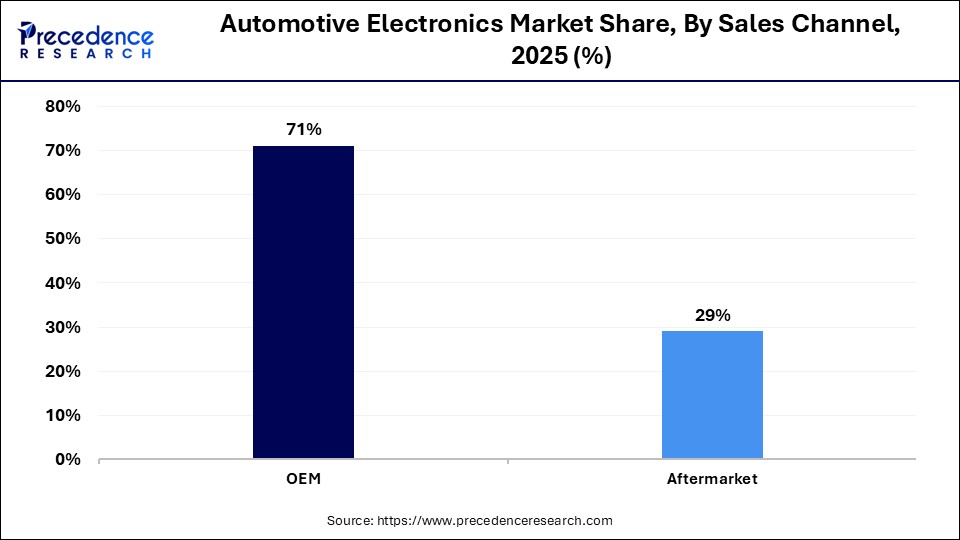
The aftermarket segment is expected to grow significantly during the forecast period, driven by increasing vehicle age and high demand for replacement electronic components. Purchasing customers are also enhancing the level of infotainment, safety, and connectivity attributes in vehicles. The rise of e-commerce in the automotive component industry makes the products more accessible.
Application Insights
The Safety Systems Segment Dominated the Market in 2025
The safety systems segment was dominant in the automotive electronics market in 2025, with increased regulations and awareness of safety in automobiles. New cars are fitted with airbags, ABS, and ELDers, and other high-tech safety devices. Electronic safety systems have become more popular, as the number of roads turning into accidents increases.
The ADAS segment is expected to grow steadily during the forecast period due to the increasing demand for intelligent driving assistance and autonomous driving technologies. New technologies like lane-keeping assist, adaptive cruise control, and collision avoidance are installed in today's cars. Government regulations for safety are also driving the adoption of ADAS.
The body electronics segment is projected to grow at a healthy pace owing to the growing trend of smart, comfort, and convenience electronics in the automotive industry. Electronic lighting, climate control, power windows, and power seat controls are gaining popularity. Consumers are driving the adoption of a high-end car experience.
The infotainment segment is expected to experience considerable growth during the forecast period, as connected and digital in-vehicle experiences become in demand. The touch screen display, navigation system, and voice assistant with smartphone connectivity are features that consumers want more than ever. Car makers are providing advanced infotainment systems to enhance the user experience.
Regional Insights
Asia Pacific Automotive Electronics Market Size and Growth 2026 to 2035
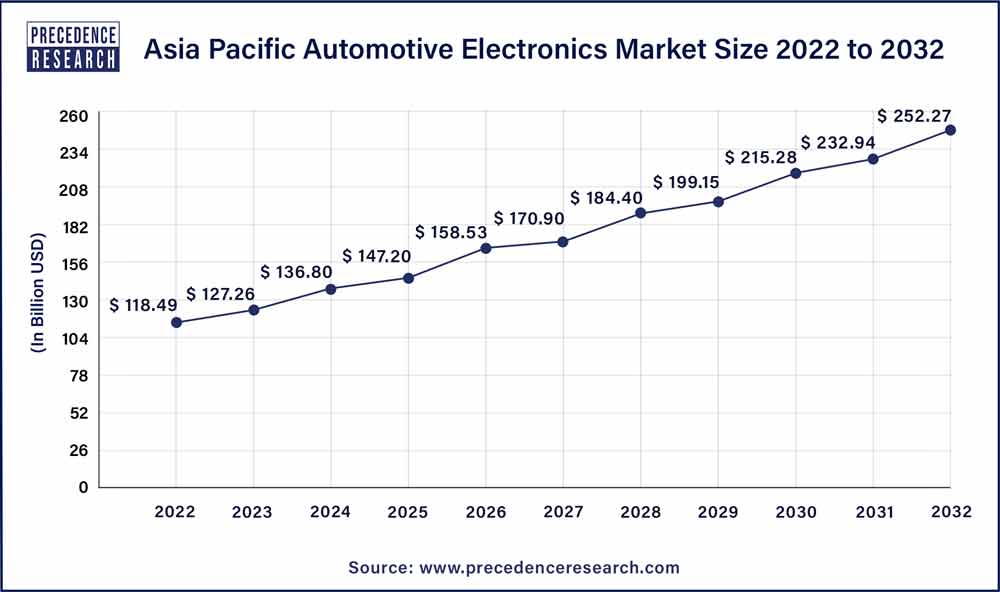
The Asia Pacific automotive electronics market size is evaluated at USD 129.20 billion in 2025 and is predicted to be worth around USD 289.88 billion by 2035, rising at a CAGR of 8.42% from 2026 to 2035.
How did the Asia Pacific Dominate the Market in 2025?
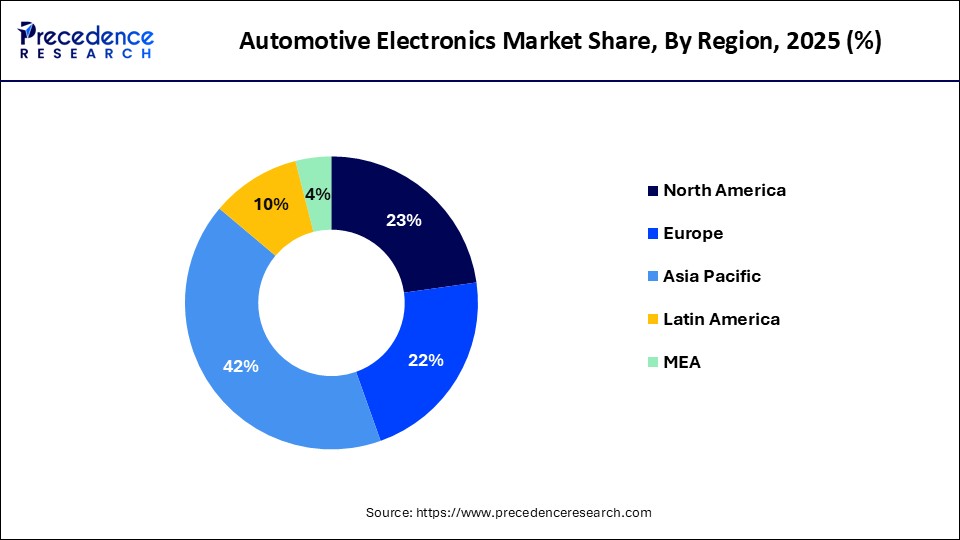
Asia Pacific dominated the global automotive electronics market in 2025 due to its huge infrastructure of automotive manufacturing and robust electronics manufacturing capabilities. The region is home to top automakers and component manufacturers. The demand for automotive electronics keeps increasing due to the increasing number of EVs and connected vehicles. Government programs for car electrification and Smart mobility help to further boost the market.
China Market Trends
China's market is anticipated to grow significantly, driven by the fast-growing EV market and the growth in automotive production. Government policies encouraging new energy vehicles and intelligent transportation provide the market with a boost. The rising innovation in the semiconductor manufacturing industry and the automotive electronics industry also serves as a trend to support this market.
What are the Key Drivers of the Market in North America?
North America is expected to grow at the fastest rate in the automotive electronics market with the increased penetration of electric, connected, and autonomous vehicles. Advanced safety systems are a big focus of automakers' investments, as are software-defined vehicles. With a strong interest in the premium vehicle with intelligent electronic functions market, the industry is on the rise. The market will continue to grow at a fast pace, with more and more of them becoming electrified with Government support.
U.S. Market Trends
U.S. market is anticipated to grow significantly, driven by the rising production of electric vehicles and the growing integration of ADAS technologies. The major auto and tech companies are investing in connected and autonomous vehicle technology. There is ongoing demand for enhanced safety, infotainment, and digital cockpit solutions for consumers.
Consistent Investment & Expansion of Automotive Industry Support Europe
Europe is expected to witness significant automotive electronics market growth throughout the forecast period due to the high demand for vehicle safety and emission regulations, which are encouraging the adoption of advanced automotive electronics. Car manufacturers are developing smart safety, connectivity, and driver assistance features in new vehicles. Continued growth of investment in vehicles for electric transportation will further fuel market growth. The automotive industry in the region is still innovating, supporting the growth of the region.
Germany Market Trends
Germany market is anticipated to grow significantly, as Germany has a strong automotive manufacturing industry. The car makers are investing in connected mobility and autonomous systems as well as EVs. With the continued development of Industry 4.0 and smart manufacturing, electronics production is now possible.
Growing Demand & Government Support Propel Latin America
Latin America is expected to witness significant growth in the automotive electronics market driven by an increase in vehicle manufacturing activities and production. Soaring demand for safer and connected vehicles is driving the adoption of electronics. Automotive assembly plants and components continue to get investments. The government is trying to encourage industrial development, creating new opportunities.
Brazil Market Trends
Brazil's market is anticipated to grow significantly, due to the high demand for advanced automotive technologies and the high production of automobiles. Car manufacturers are investing in the technology of connected vehicles and electronics. Government support for industrial modernization is promoting market development.
Breakthroughs in Electric Vehicles Drive the Middle East and Africa
The Middle East and Africa region is expected to witness significant growth in the automotive electronics market, driven by growing demand for connected and high-quality vehicles, which is driving the growth of automotive electronics adoption. Governments are encouraging the development of transport infrastructure and the improvement of vehicle safety. With the rise of electric vehicles, new opportunities are opening up for electronics companies. A further rise in automotive sales throughout the region will propel the market growth further.
Saudi Arabia Market Trends
Saudi Arabia market is anticipated to grow significantly, driven by rising investments in smart mobility and electric vehicle infrastructure. The country's Vision 2030 is the driver of the automotive industry modernization and digital transformation. The number of connected and luxury vehicles continues to rise, and so are advanced electronic systems. The market is moving ahead with investments in intelligent transportation and automotive technology.
Government Initiatives for the Automotive Electronics Market
- Union Cabinet officially accepted the PLI-Auto Scheme in 2021, which has a budget of RS 25,938 crore for a period of 5 years between 2022 and 2027. The PLI-Auto scheme will develop the production of Advanced Automotive Technology (AAT) Products. This program will also support applying and marketing in-depth localization for AAT items and allow the creation of worldwide as well as domestic supply chains. (Source: https://heavyindustries.gov.in)
- The Electronics Component Manufacturing Scheme was informed in April 2025 that it has a total outlet of Rs 22,919 crore, which is similar to about USD 2.7 billion. It has a period of 6 years, which has an optional one-year gestation period. This program's goal is to construct a rigid and self-growing ecosystem for the electronics component production in the country. (Source: https://www.pib.gov.in)
- In September 2024, the Ministry of Heavy Industry, Government of India, which was accepted by the Union Cabinet, is chaired by Hon'ble PM Shri Narendra Modi, who has revealed a scheme titled PM Electric Drive Revolution in Innovative Vehicle Enhancement (PM-DRIVE) Scheme with the help of a Gazette notification. (Source: https://www.india.gov.in)
Investment Landscape
- In October 2025, HARMAN, a wholly owned subsidiary of Samsung Electronics Co., Ltd. and a top leader in linked automotive technologies, revealed its latest investment of Rs 345 crore (USD 42 million) to expand its automotive electronics production facility in Chakan, Pune, India. (Source: https://news.harman.com)
- In July 2026, MCE Holdings Bhd (MCE) revealed the MCE Auto Hub, a RM50 million high-level production facility in UMW High Value Manufacturing Park at Serendah, which will develop the group's power, manufacturing, engineering and research and development potential. (Source: https://sme.asia)
Collaboration Landscape
- In July 2026, materials producers BYD and Covestro, one of the globe's top new energy vehicle manufacturers, have revealed the signing of a Memorandum of Understanding (Mo) to discover their long-time strategic partnership. (Source: https://fuelcellsworks.com)
- In January 2026, Ottawa Infotainment and Pektron have disclosed a strategic partnership to serve a United Strategy to develop Vehicle Architectures. This merger has marked a meaningful beginning in OI's upgradation, to develop from IVI software and cockpit into a huge electrical and electronics architecture that assists in the further generation of Software Defined Vehicles (SDVs). (Source: https://www.pektron.com)
- In June 2026, Coretura, which is a software-defined vehicle (SDV0 stage company funded by Volvo Group and Daimler Truck, has officially signed an engineering partnership with Accenture. (Source: https://newsroom.accenture.com)
Trade Analysis
- In the period from July 2024 to June 2025, the buyers have globally imported 1,850 shipments of Automotive Electronics.
- Such shipments were being streamlined by 1,850 express and bought by 1,027 checked worldwide buyers, which has shown a 2% development as compared to the last year.
- Vietnam, the United States, and South Korea developed as the leading three Automotive Electronics importing countries.
- Vietnam, China, and South Korea are the top 3 exporting countries.
- Vietnam has officially shipped 19,651 shipments, which is being followed by China with 17,066 shipments, and lastly by South Korea with 7,744
- shipments, ranking as the biggest worldwide automotive electronics exporters. (Source: https://www.volza.com)
Value Chain Analysis
Vehicle Assembly and Integration
- Vehicle assembly and integration in automotive electronics involves connecting electronic control units (ECUs), sensors, and high-speed networks.
- These components are incorporated into the vehicle's electrical/electronic (E/E) architecture.
- Proper integration is essential for enhancing safety, performance, and enabling advanced vehicle features.
Testing and Quality Control
- Testing and quality control in automotive electronics ensure components and systems are safe and reliable.
- Includes verification for compliance with industry regulations and standards.
- Conducted through environmental, electrical, and functional testing to guarantee performance and durability.
Aftermarket Services and Spare Parts
- Aftermarket services and spare parts for automotive electronics provide third-party components, repair, and diagnostic solutions.
- Serve as alternatives to Original Equipment Manufacturer (OEM) parts for maintenance, upgrades, and repairs.
- The aftermarket industry is diverse, offering everything from raw materials to finished parts and advanced diagnostic solutions for both conventional and electric vehicles.
Competitive Landscape
The automotive electronics market is made up of global automotive technology firms, semiconductors, and electronic component suppliers, competing with each other by making constant innovations and entering into strategic alliances. Bosch, Continental, Denso, Infineon Technologies, NXP Semiconductors, and STMicroelectronics are the key players in the market that have an extensive presence in the global market. The companies are developing their product lines through investments in ADAS, EV electronics, semiconductor technology, connected vehicle platforms, and software-defined vehicle solutions.
Moreover, competitive positioning of market players through tie-ups with car makers, investments in India through R&D, and a manufacturing base is increasing. Companies are capitalizing today on smart connectivity, on automotive semiconductors and power electronics, important for safety and advanced safety systems, to cater to the changing industry requirements.
Top Vendors and their Offerings
- Hella GmbH & Co. KGaA- Provides automotive lighting solutions, sensors, and electronic control units (ECUs) for safety, driver assistance, and energy-efficient systems.
- Altera (Intel)- Supplies programmable logic devices (FPGAs) and system-on-chip solutions for vehicle networking, infotainment, and advanced driver-assistance systems (ADAS).
- Broadcom Ltd- Offers automotive semiconductors, connectivity solutions, and networking chips for in-vehicle communication and safety systems.
- Infineon Technologies- Provides microcontrollers, power semiconductors, sensors, and safety solutions for electric vehicles, ADAS, and vehicle networking.
- Panasonic Corporation- Supplies automotive batteries, infotainment systems, sensors, and electronic components supporting electric and connected vehicles.
Automotive Electronics Market Companies
Due to prevalent electronics systems in automobile operations, manufacturers have been able to enhance the driving performance, riders' and driver's comfort and fuel efficiency. Number of electronics components is increasingly growing with time due to need to recover everything from fuel effectiveness and driver security. As a consequence, more mechanisms are getting converted from mechanical systems to electronic ones.
Prominent market participants are emphasizing on tactics such as novel product launch, business development, collaborations and acquisition to withstand the strong market rivalry. Leading competitors contending in global automotive electronics market are as follows:
- Hitachi Automotive Systems, Ltd
- Microchip Technology, Inc
- NXP Semiconductors N.V
- Texas Instruments Incorporated
In order to better recognize the current status of acceptance of automotive electronics, and policies adopted by the foremost countries, Precedence Research predicted the future evolution of the Automotive Electronics market. This research study offers qualitative and quantitative insights on Automotive Electronics market and assessment of market size and growth trend for potential market segments.
Latest Announcements by Market Leaders
- In September 2024, to advance vehicle safety and performance through innovative solutions in automotive electronics, Supratik Roy joined Marelli UM Electronics Systems as Chief Operations Officer. They had a distinguished career in the automotive electronics market.
Recent Developments
- In July 2025, the company revealed a cooperation agreement that is estimated to cost USD 16.5 billion for the development of high-tech semiconductors for automobiles between Tesla and Samsung Electronics. The focus of the partnership is to develop bespoke AI processors for Tesla's Full Self-Driving (FSD) system.
- In May 2025, Denso and Rohm formed a partnership to speed silicon-carbide (SiC) power device production for automotive use. The joint initiative will lower the manufacturing costs of SiC devices by 40% by 2027, helping to boost EV growth.
Segments Covered in the Report
By Type
- Sensors
- Electronic Control Unit
- Current Carrying Devices
By Sales Channel
- OEM
- Aftermarket
By Application
- Body Electronics
- ADAS
- Infotainment
- Safety Systems
- Powertrain Electronics
By Geography
- North America
- U.S.
- Canada
- Europe
- Germany
- France
- United Kingdom
- Rest of Europe
- Asia Pacific
- China
- Japan
- India
- Southeast Asia
- Rest of Asia Pacific
- Latin America
- Brazil
- Rest of Latin America
- Middle East & Africa (MEA)
- GCC
- North Africa
- South Africa
- Rest of Middle East & Africa
For inquiries regarding discounts, bulk purchases, or customization requests, please contact us at sales@precedenceresearch.com
Frequently Asked Questions





Ask For Sample
No cookie-cutter, only authentic analysis – take the 1st step to become a Precedence Research client
 Get a Sample




 sales@precedenceresearch.com
 Schedule a Meeting
