



Automotive Tire Market Trends, Leading Companies, Company Revenue / Sales Performance, Manufacturing Capacity, Production Cost, Supply Chain Performance, Pricing Analysis, Competitive Landscape, and Industry Outlook
The global automotive tire market is expected to grow from USD 158.62 billion in 2026 to USD 252.34 billion by 2035, at a CAGR of 5.26%. Growth is driven by rising vehicle production, increasing EV adoption, smart tire technologies, and demand for safer, fuel-efficient, and sustainable tires. Asia Pacific leads the market due to its strong automotive manufacturing base and growing vehicle ownership.
Source: https://www.precedenceresearch.com/automotive-tire-market
 Get a Sample
 Table Of Content


Automotive Tire Market Size and Forecast 2026 to 2035
The global automotive tire market size accounted for USD 151.07 billion in 2025 and is predicted to increase from USD 158.62 billion in 2026 to approximately USD 252.34 billion by 2035, expanding at a CAGR of 5.26% from 2026 to 2035. The market is experiencing robust growth, driven by rising automobile production, technological advancements, and increased safety regulations.

Market Highlights
- In terms of revenue, the automotive tire market is valued at $252.34 billion in 2025.
- It is projected to reach $252.34 billion by 2035.
- The automotive tire market is expected to grow at a CAGR of 5.26% from 2026 to 2035.
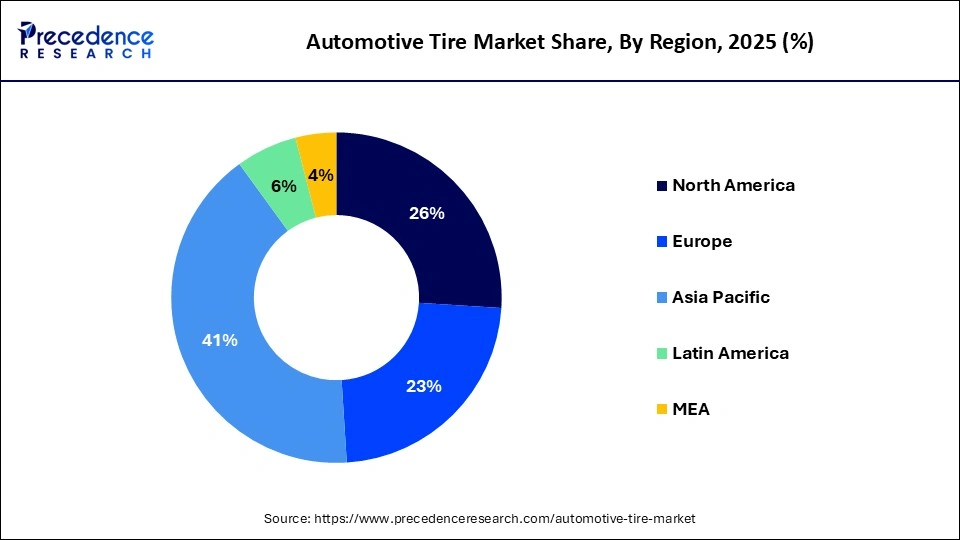
- Asia Pacific dominated the global market with the largest market share of 41% in 2025.
- By vehicle type, the passenger vehicles segment contributed the highest market share of 47% in 2025.
Market Overview
Tires are the most crucial component of an automotive vehicle. The demand of automotive tire is significantly driven by the rise in production and sales of automotive vehicles globally. In 2024, the global automotive production was 93 Mn. In addition, introduction of electric vehicles have significantly surged the vehicle demand across the globe. Declining prices of various electric vehicle parts for example transmission, battery, and alternator fuel the adoption of electric vehicles across the globe. Safety regulations along with technological advancements in the manufacturing process propel market growth. Use of advanced materials for automotive tires to enhance their performance and life are the prime motive of tire manufacturers. For instance, in November 2019, Bridgestone developed first polymer ‘Susym' that bonds resins and rubber on their molecular level. The company aimed to increase the application of polymer in tire making owing to its advanced and attractive features.
On the contrary, volatile prices along with stringent government regulations for the availability of the raw materials projected to restrict the market growth. Nonetheless, integration of sensor technology in the tire manufacturing has uplifted the tire market to the next level. Intelligent tires have created numerous opportunities for industry players to boost their market position.
AI in the Market
The tire industry of the automotive sector is being transformed by AI in several ways-from design to manufacturing and post-sale performance. In R&D, AI simulation speeds up tire development, striking an optimum balance among material combinations in durability, safety, and energy efficiency. Manufacturing sees AI with quality controls, predictive maintenance, scheduling, and workflow automation, thereby improving productivity and eliminating defects. AI is, thus, enhancing demand forecasting and shipment tracking, and inventories in the supply chain. Smart tire sensors keep an eye on tire pressure, wear, and temperature in real-time, providing critical insights into predictive maintenance and safety risk mitigation.
Market Trends
- The rising demand and growth for EV vehicles and major brands are developing tires developing tires especially for EVs with features which improves energy efficiency.
- Integration of sensors to monitor pressure, temperature, tread wear, and road conditions in real time is in high demand and lead to growth.
- Use of sustainable materials, renewable energy in manufacturing and recyclable tire designs increases the demand for the market.
Automotive Tire Market Growth Factors
- Elevation of global vehicle ownership and the production in turn tremendously increases the demand for tires from OEM and aftermarket.
- Increasing preference for high-performance, fuel-efficient, and safe tires encourages new designs and materials.
- Rapid growth of electric vehicles furnishes increased demand for specific low-rolling resistance tires capable of withstanding arresting pressures.
- Sustainability regulations vote for a gradual adoption of environmentally friendly materials and recycling programs in tire manufacturing.
- Logistics growth and e-commerce growth increase the demand for tires, which are durable and economical for commercial fleets.
Market Scope
| Report Coverage | Details |
| Market Size by 2035 | USD 252.34 Billion |
| Market Size in 2026 | USD 158.62 Billion |
| Market Size in 2025 | USD 151.07 Billion |
| Market Growth Rate from 2026 to 2035 | CAGR of 5.26% |
| Largest Market | Asia Pacific |
| Base Year | 2025 |
| Forecast Period | 2026 to 2035 |
| Segments Covered | Season Tire Type, Rim Size, Vehicle Type, Distribution Channel, and Regions |
| Regions Covered | North America, Europe, Asia-Pacific, Latin America, and Middle East & Africa |
Segments Insights
Vehicle Type Insights
Which Vehicle Type Segment Held the Dominating Share of the Automotive Tire Market in 2025?
The passenger vehicles segment, by vehicle type, held the dominating share of the market with a significant revenue share of nearly 47% in the year 2024. The increased acceptance rates, as well as new developments, have enhanced their demand in the market. Moreover, a significant rise in passenger vehicle production and sales is the prime factor that drives the segment growth.
As per International Organization of Motor Vehicle Manufacturers (OICA) statistics 2019, passenger vehicles captured nearly 74% of the total vehicle production. In addition, several advancements, such as driver assistance systems, sensors, and other vehicle technologies, boost the demand for passenger vehicles worldwide. Furthermore, increasing demand for semi-luxury and luxury cars due to the rise in purchasing power of people is predicted to boost the demand for passenger vehicles over the forecast period. Thus, all these factors enhanced the safety and performance of passenger vehicles, contributing to the market growth.
Passenger vehicles led the global automotive tire market with a significant revenue share of nearly 47% in the year 2024. A significant rise in passenger vehicle production and sales is the prime factor that drives the segment growth. As per International Organization of Motor Vehicle Manufacturers (OICA) statistics 2019, passenger vehicles captured nearly 74% of the total vehicle production. In addition, several advancements such as driver assistance system, sensors, and other vehicle technology boost the demand for passenger vehicles worldwide. Furthermore, increasing demand for semi-luxury and luxury cars due to rise in purchasing power of people is predicted to boost the demand for passenger vehicles over the forecast period.
Meanwhile, accelerating demand of online and retail business have triggered the sales of light commercial vehicles. In addition, the current trend of the recreational vehicle along its increased adoption for travel & tourism in western countries expected to uplift the market for light commercial vehicles. Improves logistics & transportation sector have also created prominent growth in demand for light commercial vehicles. The aforementioned factors projected to boost the sales of light commercial vehicles during the forecast period.
Passenger cars dominated the market as customers go for fuel-efficient, safe, and tires of premium quality. Radial-and tubeless tire-related innovations and the growth in the sales of EVs led the segment in both OEM and aftermarket channels.
LCVs stand as the fastest-growing segment due to growth in e-commerce and last-mile delivery demands. The demand for materials logistics and construction fleet for tough tires that bear loads, and good efficiency further drives growth, along with stricter standards regarding road safety and emissions.
Distribution Channel Insights
Aftermarket dominated the market, due to the need to replace tires frequently because of operational wear, different road conditions, and consumers opting for premium and specialized tires, which keeps the disruption. In addition, aftermarket stature is further reinforced by the convenience offered by e-commerce platforms and safety regulations.
OEM is the fastest-growing segment, propelled by the production of vehicles increasing all over the world, wherein manufacturers intend to equip the cars with technically advanced, efficient, as well as durable tires. Conversely, the rising production of EVs also stimulates OEM tire demand, which can provide better performance and efficiency.
Regional Insights
Asia Pacific Automotive Tire Market Size and Growth 2026 To 2035
The Asia Pacific automotive tire market was exhibited at USD 61.94 billion in 2025 and is expected to be worth around USD 99.37 billion by 2035, at a CAGR of 4.84% from 2026 to 2035.
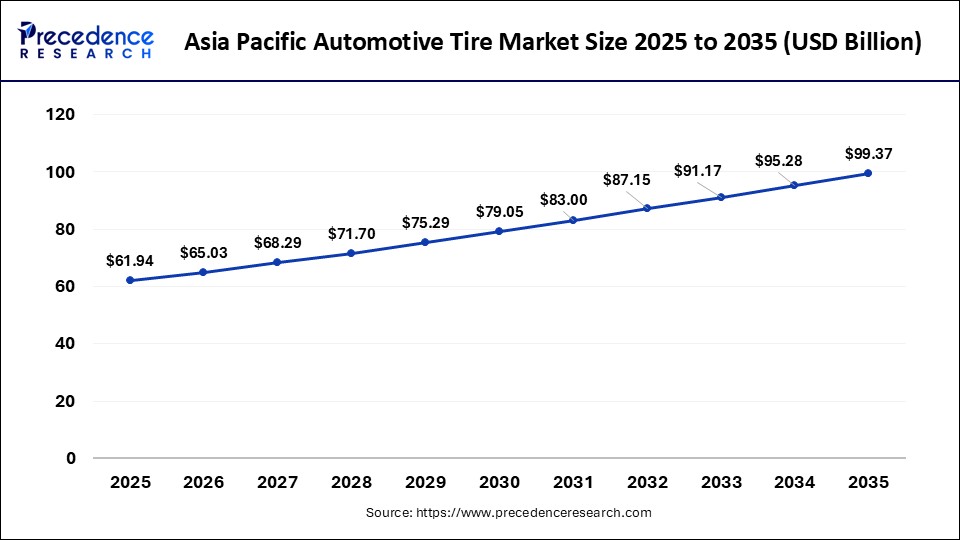
The Asia Pacific is the major automotive tire market with revenue contribution of around 41% in 2025 and analyzed to exhibit accelerating growth during the forecast period. Some of the fastest developing countries in the region such as India and China drive the market growth significantly in the region. Low labor cost, increased standard of living, high domestic consumption, and large population base are the prime factors behind the lucrative growth of automotive tire in China and India. In addition, increased number of accidents also triggers market for aftermarket sales of tire. According to The Economic Times article published on June 2019, tire replacement is likely to witness better growth of nearly 7-8% compared to Original Equipment Manufacturers (OEMs) in the coming years particularly in passenger vehicle segment.
China Market Trends
The Chinese market is driven by the growing production of automobiles and the increasing sales of electric vehicles. The Chinese government makes constant efforts and regulations to promote the indigenous manufacturing of automotive parts, including tires. China is one of the world's largest tire production and consumption markets.
Europe is the most prominent region in automotive and automotive parts sales. Strong demand from larger markets is likely to drive the sales of new cars in the region. Furthermore, the region is famous for sports activities such as car racing that again propels the demand for advanced and intelligent tires for sports cars.
Germany Market Trends
The German market is growing due to the presence of key players, favorable government support, and the growing demand for advanced automobiles. Key players, such as LANG GmbH & Co. KG, Hankook Tire Motorsports, and Falken Tyres, are major contributors to the market. The increasing automotive sales in Germany also contribute to market growth. According to ACEA, Germany produced 21% of cars sold in the EU.
North America is expected to grow significantly in the automotive tire market during the forecast period. The increasing demand and use of vehicles in North America is increasing the demand for automotive tires. At the same time, the use of advanced technologies, tries that can detect the pressure and temperature, is also being developed. Moreover, the use of electric vehicles is also driving their demand. Thus, this promotes the market growth.
U.S. Automotive Tire Market Trends
The automotive industries in the U.S. consist of advanced technologies. Hence, with the help of these technologies, new developments are being conducted to enhance the safety and performance of the automotive tires. Thus, sensors that can monitor the temperature and pressure in tires are being developed. This, in turn, increases the collaboration between them.
Canada Automotive Tire Market Trends
The production as well as the sale of vehicles in Canada is increasing, which in turn increases the demand for automotive tires. Furthermore, the growing use of electric vehicles also contributes to the same. Thus, this increases the production of automotive tries to meet the rising demand.
What are the Key Trends of the Automotive Tire Market in Latin America?
Latin America is expected to grow at a notable CAGR during the forecast period, due to the increasing investments in manufacturing and the growing ownership of SUVs. Countries, such as Mexico, Brazil, and Argentina are at the forefront of manufacturing automotive tires. The rapidly expanding vehicle fleets, increasing aftermarket demand, and rising vehicle modernization efforts augment the market.
Brazil Market Trends
The increasing domestic vehicle production, growing demand for high-passenger vehicles, and the presence of key players drive the market in Brazil. Brazil is home to several key players, such as Continental AG, Bridgestone, Pirelli, and Michelin. The country has a suitable manufacturing infrastructure, encouraging foreign players to establish their manufacturing setup in the country.
Will the Middle East and Africa Grow in the Automotive Tire Market?
The Middle East and Africa region is expected to grow at a considerable CAGR in the upcoming period, due to the increasing demand for autonomous vehicles, stringent vehicle safety regulations, and increasing local manufacturing. The rising disposable incomes, favorable trade policies, and the presence of key players propel the market. Government bodies develop stringent regulations related to the rolling resistance requirements of automotive tires.
UAE Market Trends
The UAE market is driven by the growing preference for tires that deliver consistent performance, extended durability, and enhanced safety. UAE law mandates the use of tires that must match the vehicle manufacturer's recommended size and type. The use of heat-resistant tires is highly recommended by the UAE government.
Key Companies & Market Share Insights
Even though there are numerous international as well as regional players present in the global automotive tire market, the market is highly consolidated in nature. Top four companies that include Michelin Group, Goodyear Tire & Rubber Company Bridgestone Corporation, and Continental AG capture nearly half of the market revenue. The manufacturers face intense competition in terms of price owing to presence of several regional players in the market. Furthermore, cheaper tires offered by the Chinese players likely to negatively impact the profit margin of other industry players. Thus, major players are largely focused towards offering advanced tires that offer excellent driving experience and enhanced safety. Apart from this, leading tire manufacturers are also investing prominently in the developing countries because of low labor cost that further decreases the overall production cost.
Value chain Analysis
- Raw Material Sourcing (Steel, Plastics, Electronics): The strategic process of identifying, evaluating, and procuring from trustworthy suppliers all the primary materials, such as steel, plastics of all types and qualities, or electronic components, to be used in manufacturing products.
- Component Manufacturing (Engines, Transmissions, etc.): This is about producing a myriad of high-grade components, such as engines and transmissions, by specialized companies for the supply to automobile manufacturers or other suppliers.
- Vehicle Assembly and Integration: Assembly combines every individual piece and sub-assembly on an assembly line, concurrently, perhaps with robotic precision, to produce an entire working vehicle.
- Testing and Quality Control: A thorough process whereby the vehicle and its components are inspected and tested for compliance with severe engineering, safety, and performance standards before being permitted to go to market.
- Distribution to Dealers and OEMs: Logistics for transporting finished vehicles and part supplies from the manufacturer to the retail dealership and other OEMs.
Automotive Tire Market Compnaies
- Continental AG
- Bridgestone Corporation
- Pirelli Tyre C. S.p.A. (China National Chemical Corporation)
- MICHELIN
- Toyo Tire Corporation
- Hankook Tire & Technology Co., Ltd.
- The Goodyear Tire & Rubber Company
- The Yokohama Rubber Co., Ltd
- Sumitomo Rubber Industries Ltd
- Nokian Tyres plc
Recent developments
- In May 2025, JK Tyre & Industries Ltd. began producing its new passenger car tyre, the 'UX Royale Green', at its Chennai facility, utilizing ISCC Plus-certified sustainable materials. This initiative represents the launch of India's first passenger car tyre created with globally certified renewable and recycled raw materials. The ISCC Plus certification, part of the International Sustainability and Carbon Certification framework, ensures the traceability of responsibly sourced inputs throughout the entire value chain. This action aligns with JK Tyre's larger strategy to incorporate circular economy principles into its manufacturing processes.
- In January 2025, Continental Tires unveiled the PC6 tires and the Gen3 Truck Radial at the Continental Track Day event in Chennai. Designed specifically for Indian roads, the PC6 tires utilize Macroblock Technology to enhance corner stability and silica to provide excellent wet and dry grip. Additionally, ContiSeal technology is introduced to enhance tire safety by sealing up to 85 percent of tread punctures from objects that are up to 5 mm in diameter. The PC6 incorporates this new macroblock technology, delivering outstanding grip and cornering performance, specifically crafted for SUVs and premium vehicles.
- In march 2025, A new, non-destructive, rapid tire deflation test system has been launched by Koala Technologies (KTL). Te.Sense Bloom is fully compliant with FMVSS 110 and emerging EV stability test standards, and serves as a reusable tool to help OEMs and tire manufacturers optimize their test programs and reduce waste. The first US specification kit has been delivered to the Transportation Research Center in Ohio for initial evaluations.
Segments Covered in the Report
This report analyses and projects market revenue and growth trend at global, regional, and country levels and offers an analysis of the modern industry developments in each of the sub-segments from 2026 to 2035. The global automotive tire market report is categorized on the basis of season tire type, rim size, vehicle type, distribution channel, and region:
By Vehicle Type
- Commercial Vehicle
- Light Commercial
- Heavy Commercial
- Passenger Car
- Electric Vehicle
By Distribution Channel
- Aftermarket
- OEM
By Region
- North America
- US
- Canada
- Mexico
- Rest of North America
- South America
- Brazil
- Argentina
- Rest of South America
- Europe
- Western Europe
- Germany
- Italy
- France
- Netherlands
- Spain
- Portugal
- Belgium
- Ireland
- UK
- Iceland
- Switzerland
- Poland
- Rest of Western Europe
- Eastern Europe
- Austria
- Russia & Belarus
- Turkiye
- Albania
- Rest of Eastern Europe
- Western Europe
- Asia Pacific (APAC)
- China
- Taiwan
- India
- Japan
- Australia and New Zealand
- ASEAN Countries (Singapore, Malaysia)
- South Korea
- Rest of APAC
- Middle East and Africa (MEA)
- GCC Countries
- Saudi Arabia
- United Arab Emirates (UAE)
- Qatar
- Kuwait
- Oman
- Bahrain
- South Africa
- Egypt
- Rest of MEA
- GCC Countries
For inquiries regarding discounts, bulk purchases, or customization requests, please contact us at sales@precedenceresearch.com
Frequently Asked Questions
Tags





Ask For Sample
No cookie-cutter, only authentic analysis – take the 1st step to become a Precedence Research client
 Get a Sample




 sales@precedenceresearch.com
 Schedule a Meeting
