



Batteries for Humanoid Robots Market Size, Segmentation, Regional Analysis, Battery Integration, Technology Development, Company and Competitive Intelligence, Market Challenges.
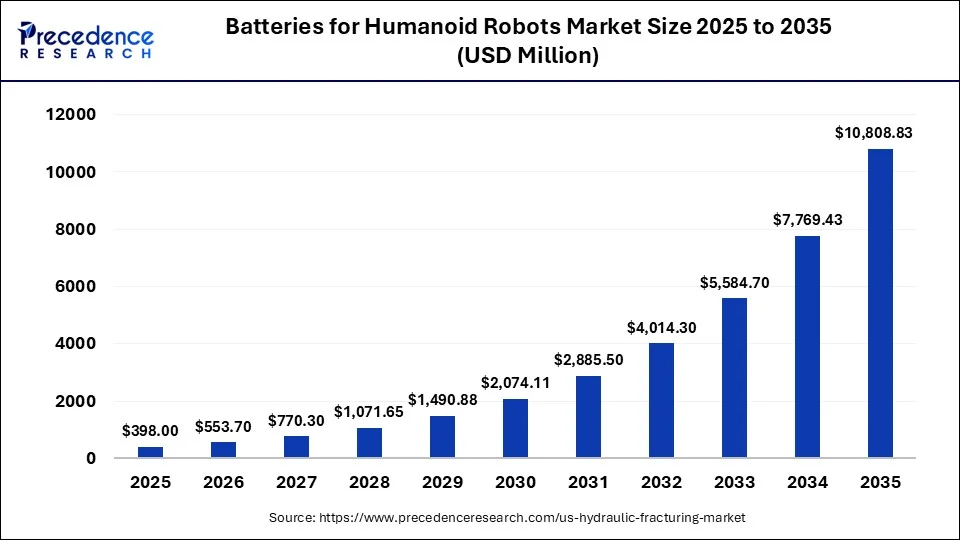
The batteries for humanoid robots market was valued at USD 398 million in 2025, expanding at a CAGR of 39.12% during the forecast period from 2026 to 2035. The driving factor for the market is the rapid commercial transition of robots from laboratory prototypes into paid industrial, factory, along with warehouse deployments. Our healthcare research analyst, Laxmi Narayan, analysed this value. He researched e several critical areas in the emerging batteries for humanoid robots market, aiming to overcome the current "runtime wall" and power constraints.
Source: https://www.precedenceresearch.com/batteries-for-humanoid-robots-market
 Get a Sample
 Table Of Content


Batteries for Humanoid Robots Market Growth, Innovations, and Market Size Forecast 2035
The primary driving factor for the humanoid robot battery market is the runtime gap, the critical mismatch between current liquid lithium-ion batteries that restrict robots to roughly two hours of dynamic operation and the commercial target of a full eight-hour work shift. The batteries for humanoid robots market is forecasted to expand from USD 553.70 million in 2026 to USD 10,808.83 million by 2035, growing at a CAGR of 39.12% from 2026 to 2035. The market is driven by early volume production and deployments by industry leaders such as Tesla Optimus, Apptronik, and Boston Dynamics, which are actively pulling forward demand for specialized power cells.
Key Takeaways
- By battery chemistry, the lithium-ion segment led the market with a 54.85% share in 2025.
- By battery capacity, the 2–4 kWh segment captured a major revenue share of 38.45% in 2025.
- By battery form factor, the pouch cells segment captured the largest market share of 36.85% in 2025.
- By battery technology, the conventional Li-ion segment led the market with a share of 48.65% in 2025.
- By application, the industrial humanoid robots segment led the market with a share of 42.65% in 2025.
- By robot power requirement, the medium power segment led the market with a share of 44.65% in 2025.
- By end user, the manufacturing companies segment led the market with a share of 36.85% in 2025.
Introduction
The batteries for humanoid robots market covers rechargeable energy-storage systems specifically programmed to power bipedal humanoid robots across industrial, logistics, domestic, healthcare, and service applications. Demand is increasingly determined by the robot's energy density, peak power output, thermal management, pack weight, charging speed, cycle life, safety, along with physical integration constraints. Based on the supplied 39.12% CAGR, the market is projected to expand from USD 398 million in 2025 to approximately USD 10.9 billion by 2035.
Analyst View
The exceptionally high forecast CAGR thus reflects the fact that the humanoid battery market is starting from a relatively small installed base while humanoid production and deployment are beginning to scale. Moreover, the International Federation of Robotics began collecting dedicated humanoid-robot statistics in 2026, reflecting the sector's transition toward measurable commercial deployment.
Recent industry data indicates that battery performance is already a major constraint. TrendForce reports that most current humanoids operate for nearly 2-4 hours, with many battery systems below 2 kWh, while higher-energy-density batteries and even hot-swappable systems are being developed to extend operating time.
Market Segmentation By Battery Chemistry
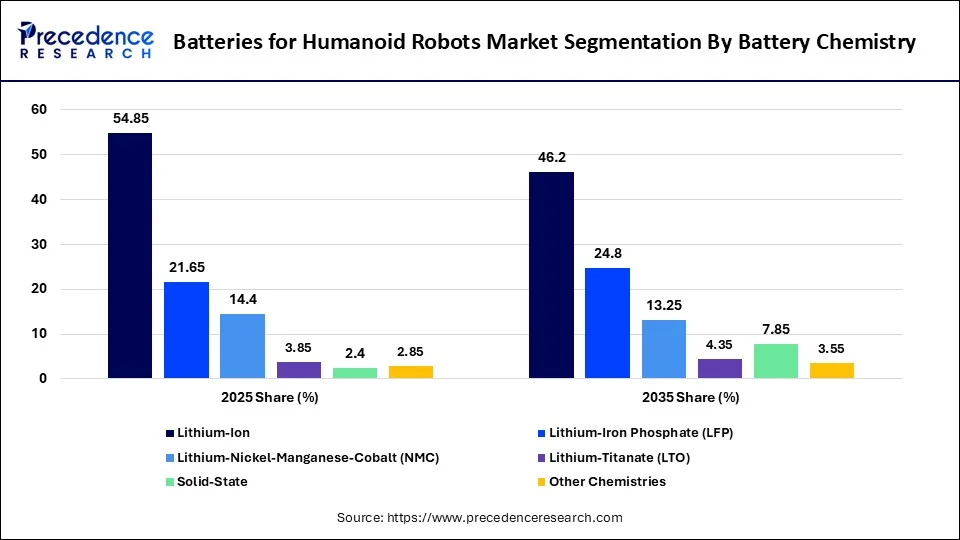
Lithium-ion remains the largest supplied chemistry in 2025 at 54.85%, as they provide a high energy density and even high power output within strict size and weight limits. Solid-state batteries expand from 2.40% to 7.85% and then record the highest chemistry CAGR at 52.45% as they solve critical power and space, alongside safety bottlenecks that traditional liquid lithium-ion batteries cannot match.
Analyst View
The chemistry mix reflects a trade-off between energy density, cost, safety, and cycle life. NMC remains attractive where mass along with volume are tightly constrained, while LFP can become more competitive where safety, cost, and durability carry greater weight. CATL's technology portfolio continues to demonstrate the divergence: the firm identifies NCM's high energy density as a major advantage meanwhile positioning LFP around safety and fast charging. Solid-state is the major long-term technology shift. Further, Samsung SDI reports an all-solid-state design targeting 900 Wh/L and also a mass-production roadmap for 2027.
Market Segmentation By Battery Capacity
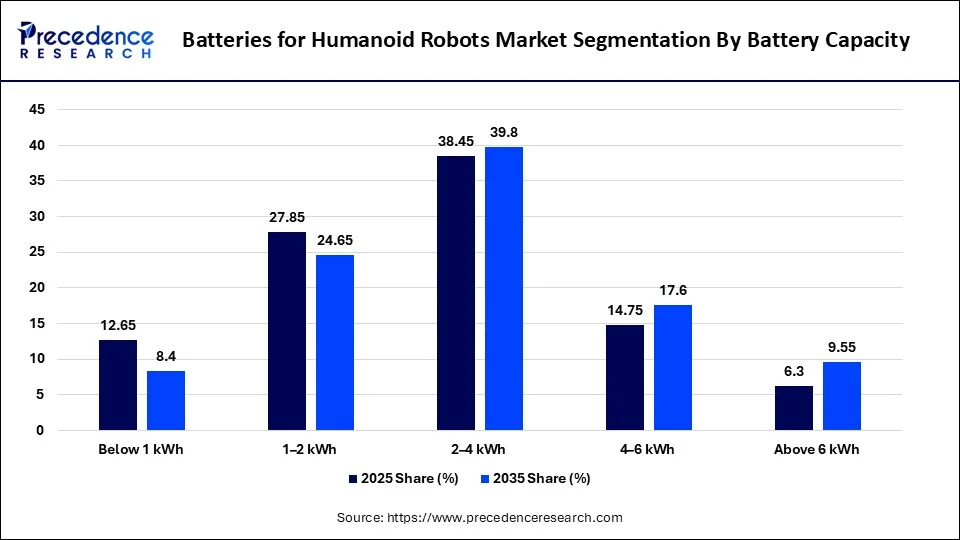
The 2-4 kWh category is the largest in 2025 at 38.45%, striking the optimal balance between providing roughly 2 to 4 hours of dynamic operational runtime and then keeping total pack weight low enough for bipedal locomotion. However, batteries above 6 kWh show the fastest growth at 47.85% CAGR, with their share rising from 6.30% to 9.55% due to the demand to eliminate short runtimes and support intensive, continuous operations.
Analyst View
Actual humanoid specifications show why capacity requirements are growing. The figure F.03 battery uses 2.3 kWh and is programmed to provide up to five hours of runtime at peak performance, while its system supports 2 kW fast charging with active cooling. The figure also reports a 94% rise in energy density across three generations of its battery technology.
A recent academic review of state-of-the-art humanoids identified examples ranging from 0.864 kWh for Unitree H1 to 4.32 kWh for Figure 01, illustrating the wide variation in current battery architectures.
Market Segmentation by Battery Form Factor
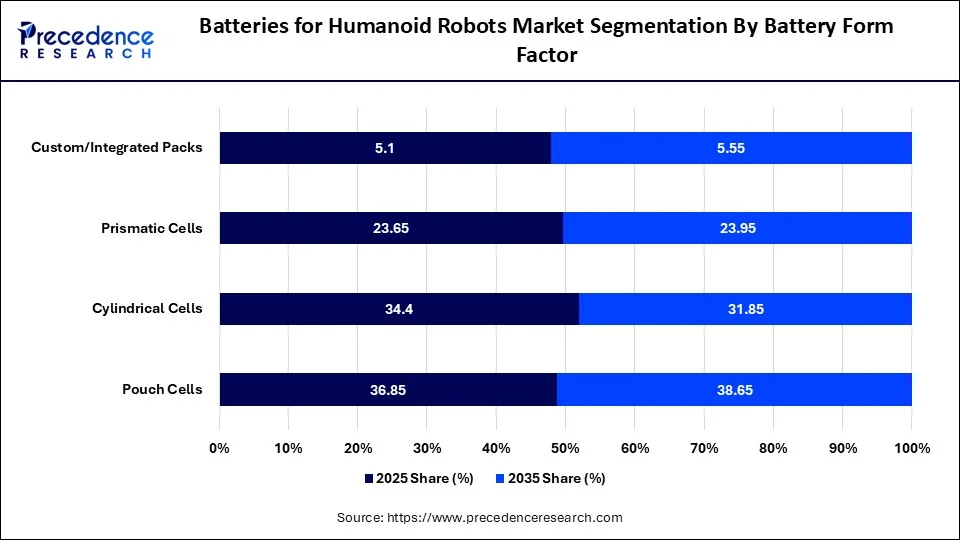
Pouch cells hold the largest share at 36.85%, supported by packaging flexibility along with the ability to fit battery modules into irregular humanoid-body geometries. Thus, their flexible, thin form factor enables them to fit efficiently inside tight spaces such as robotic limbs and torsos.
Analyst View
Humanoid robots impose different packaging constraints from EVs because battery mass must be positioned around the torso and center of gravity while leaving space for actuators, cooling systems, and sensors. Figure F.03 development illustrates this trend: the firm moved from external rectangular modules to a battery integrated directly into the robot's torso.
LG Energy Solution explicitly markets both cylindrical along with pouch battery formats for humanoid, quadruped, serving, and even logistics robots, with emphasis on lightweight construction, high energy density, lifespan, safety, and power output.
Market Segmentation By Battery Technology
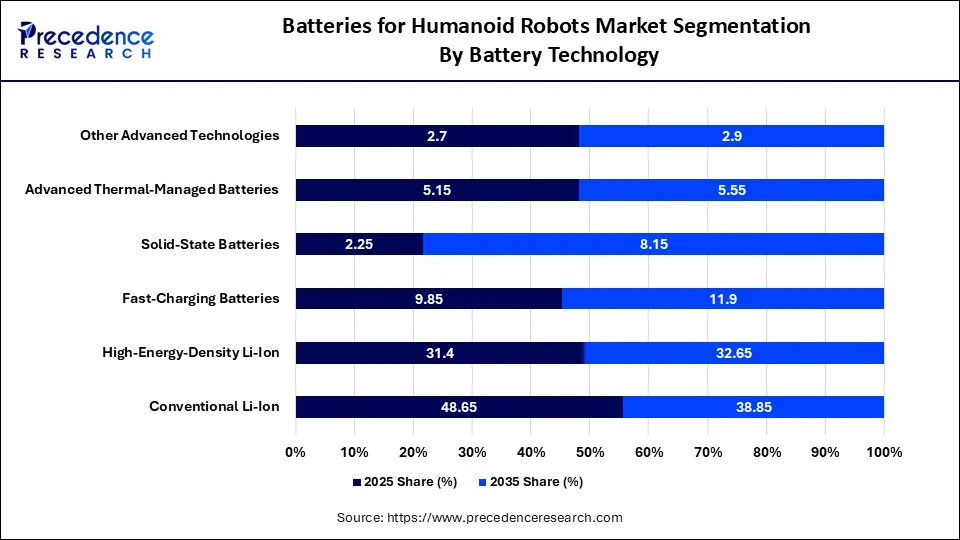
Conventional lithium-ion accounts for 48.65% of the 2025 market they are a mature technology with established supply chains, high energy density, and then the ability to manage high-power demands at a lower cost than emerging alternatives.
Analyst View
Battery technology development is shifting simultaneously along three dimensions, more energy per kilogram, higher power delivery, along with shorter charging time. CATL's battery technology portfolio states the direction of development, with its technology platform thus reporting cell energy density of up to 330 Wh/kg and even advanced CTP architectures designed to increase volumetric utilization.
For humanoids, fast charging is particularly important as a robot's economic value depends on productive operating hours rather than simply battery capacity. Further, this makes battery cooling, high-rate charging, and even battery swapping strategic options to simply increasing pack size.
Market Segmentation By Application
Industrial humanoid robots account for the largest share at 42.65% because heavy-duty bipedal movement, along with real-time AI processing, demands high energy density, instant power bursts, and even strict workplace safety. Major producers expect millions of commercial units in factories over the next decade. Domestic and personal assistance has the highest application CAGR at 46.80% as aging populations, rising labor shortages, and advances in AI are driving massive demand for home-assistance and eldercare robots that need safe, reliable, and versatile power sources.
Analyst View
Industrial deployment remains the principal near-term battery need source because manufacturing environments provide structured tasks and measurable productivity results. The broader commercial opportunity is nevertheless expanding rapidly. IFR thus describes humanoids as being developed for manufacturing, along with service environments where human-oriented environments can potentially be served by general-purpose robots.
The battery requirement differs substantially by application. Thus, warehouse robots may prioritize change duration and rapid swapping, while healthcare and domestic systems place greater emphasis on safety, quiet operation, low mass, and thermal stability.
Market Segmentation by Robot Power Requirement
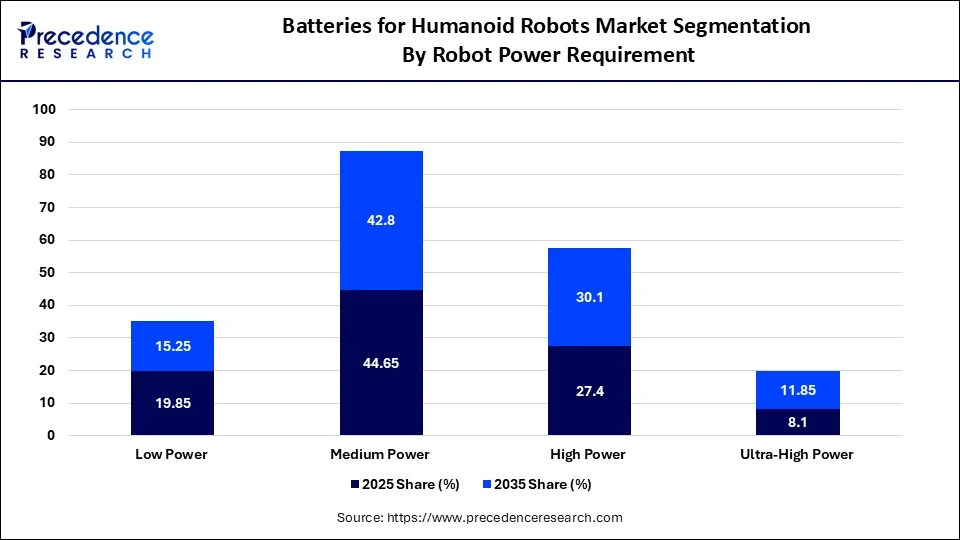
Medium-power humanoids represent 44.65% of the 2025 market as they strike the optimal balance between continuous operational runtime, payload capacity, along with tight physical space constraints. Low-power units lack the juice for dynamic multi-hour shifts, thus making medium-power the sweet spot.
Analyst View - Robot Power Requirement
Humanoid battery systems must supply both continuous energy along with high instantaneous power, as locomotion, balance correction, and even joint actuation can create rapidly changing loads. This makes peak power and thermal management almost as essential as nominal capacity. The evolution of robot batteries states this requirement. Figure's F.03 system combines 2.3 kWh capacity with 2 kW charging and even active cooling, while LG Energy Solution identifies high power output alongside energy density as well as safety as key robot-battery characteristics.
Market Segmentation by End User
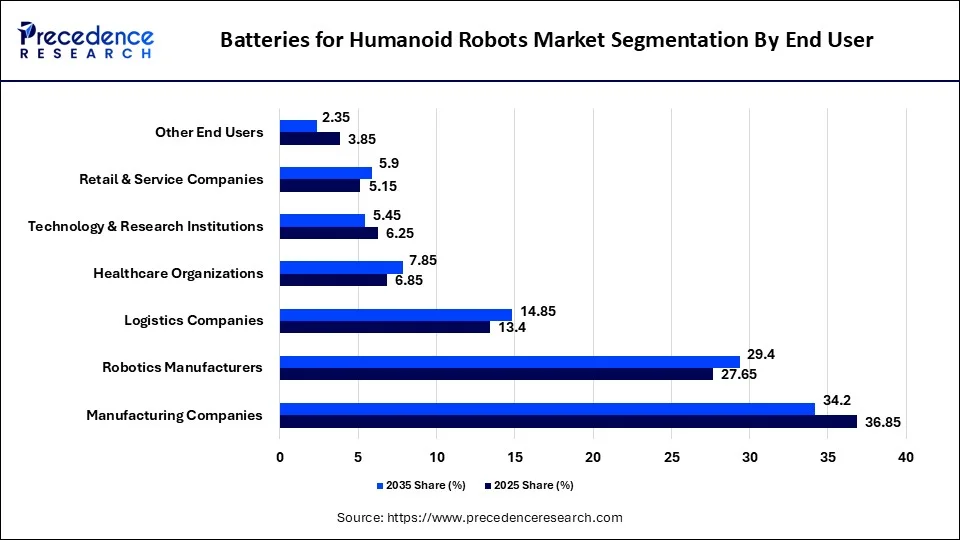
Manufacturing firms remain the largest end-user group at 36.85% because industrial deployments need to overcome a critical "runtime gap" from a 2-hour limit to an 8-hour shift.
Analyst View
The battery supply chain will increasingly be influenced by robot producers rather than only final robot users. As humanoid platforms become standardized, robotics OEMs will have stronger requirements around pack geometry, BMS software, safety certification, charging protocols, serviceability, and cell sourcing. LG Energy Solution's dedicated robotics battery portfolio is evidence that major battery producers are already treating robotics as a distinct application rather than simply extending EV battery technology into another end market.
Market Segmentation By Battery Integration
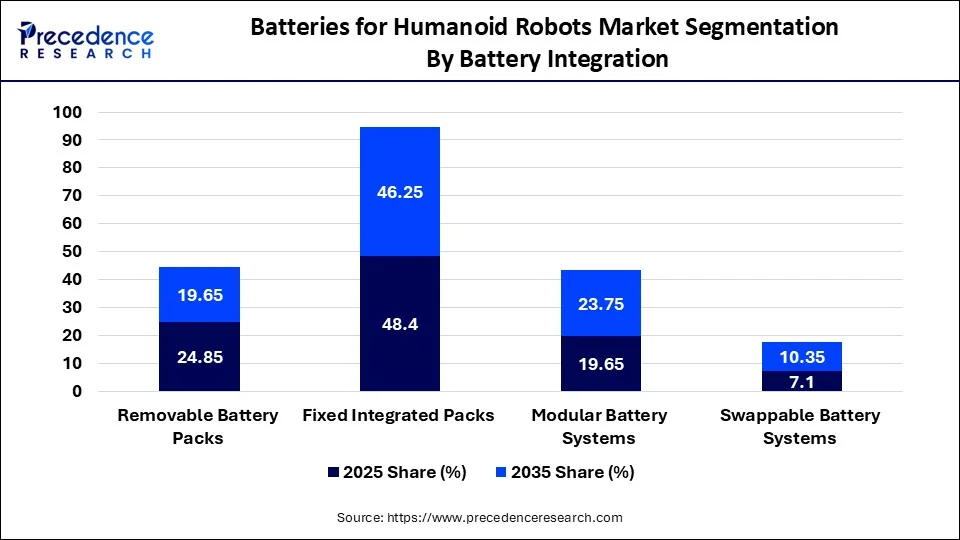
Fixed integrated packs dominate the current market at 48.40% because they maximize internal space efficiency and enhance dynamic balance. Swappable battery systems have the highest CAGR at 50.05%, rising from 7.10% to 10.35% because they remove the critical two-hour runtime bottleneck and enable non-stop, 24/7 industrial operations.
Analyst View
Battery swapping is becoming an important option to simply increase battery capacity. TrendForce determines hot-swappable batteries as one of the two principal approaches for extending humanoid operating time beyond the current 2–4-hour range, along with higher-energy-density batteries. It specifically identifies Agility Robotics' Digit and Apptronik's Apollo as examples of hot-swappable approaches. For industrial fleets, this swapping can also decrease the amount of time robots spend away from productive operation, along with potentially reducing the need for oversized batteries.
Regional Market Segmentation
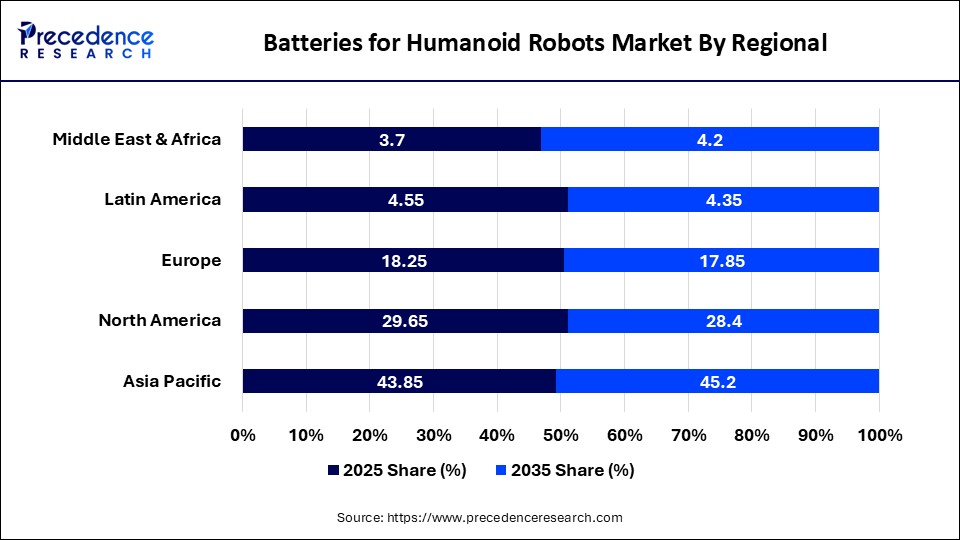
Asia Pacific is the largest supplied regional market at 43.85% in 2025, rising to 45.20% by 2035 as it combines dominant manufacturing supply chains, massive industrial automation deployment, along with aggressive government backing. Countries such as China, Japan, and South Korea host dense domestic ecosystems for lithium-ion and next-gen batteries, actuators, and precision electronics. Moreover, this proximity shortens supplier qualification cycles and even lowers overall production costs.
Analyst View
Asia Pacific's position is supported by the overlap between humanoid robotics and the region's established battery and EV supply chains, along with electronics supply chains. McKinsey's 2026 analysis identifies China's strong EV ecosystem as an advantage for humanoid component supply, as many high-impact humanoid components overlap structurally with the EV value chain.
The supply-chain advantage is already visible in manufacturing. CATL deployed humanoid robots at scale in battery-pack production in China in 2025, which includes end-of-line and direct-current resistance testing.
Humanoid Robot Battery Benchmark Data
| Robot | Battery Energy | Reported Runtime | Battery/Technology Indicator |
| Figure 03 | 2.3 kWh | Up to 5 hours | Integrated battery; 2 kW fast charging |
| Tesla Optimus Gen 2 | 2.3 kWh | ~2 hours | High-nickel lithium battery |
| Boston Dynamics Atlas | 3.8 kWh | ~1 hour | Custom lithium-ion |
| Figure 01 | 4.32 kWh | ~2 hours | NCM lithium-ion |
| Unitree H1 | 0.864 kWh | ~2.5 hours | LFP lithium-ion |
| Apptronik Apollo A1 | 3.2 kWh | ~4 hours | NCM lithium-ion |
| AgiBot A2 Ultra | 0.7 kWh | ~1.5 hours | Lithium-ion |
Note: Specifications are recorded values compiled in a recent technical review and producer disclosures; operating time varies materially with speed, payload, workload, and operating conditions. Figure F.03 specifications are directly reported by the figure.
Analyst View
The benchmark states that there is no single optimal battery size for humanoids. A robot performing low-intensity manipulation can function with a smaller pack, while high-load locomotion and industrial work demand substantially more energy and power. The resulting design problem is therefore not simply “larger battery,” but energy density, power density, cooling, pack integration, and charging strategy. Unitree's G1, for instance, uses a 13-string lithium battery, a 9,000 mAh quick-release battery, and nearly two hours of stated battery life.
Battery Technology Requirements
| Requirement | Why It Matters for Humanoid Robots | Market Implication |
| High Energy Density | Reduces battery mass for a given runtime | Supports longer operation without increasing robot weight |
| High Power Output | Supports motors and dynamic movements | Important for industrial and high-load robots |
| Fast Charging | Reduces downtime | Supports multi-shift operation |
| Thermal Management | Controls heat during discharge/charging | Enables higher power density |
| High Cycle Life | Robots may operate for thousands of cycles | Reduces replacement cost |
| Compact Packaging | Torso space is limited | Favors customized cells/modules |
| Safety | Robots operate around people | Increases demand for advanced BMS and thermal protection |
| Modular Architecture | Enables servicing and capacity scaling | Supports fleet maintenance |
| Battery Swapping | Eliminates long charging downtime | Important for continuous industrial deployment |
Analyst View
Battery specifications for humanoids are increasingly becoming a system-engineering problem rather than a cell-only problem. Figure's move toward an integrated battery and LG Energy Solution's robotics-specific cell or module, or pack portfolio demonstrates the increasing significance of application-specific engineering.
Competitive & Company Intelligence
Figure AI
Figure has taken a vertically integrated approach to humanoid batteries. Its F.03 battery was engineered along with manufactured in-house at BotQ. Figure reports a 94% increase in energy density across three generations, integration of the battery directly into the torso, and substantially enhanced safety and abuse tolerance. The F.03 offers 2.3 kWh, up to five hours of runtime at peak performance, and even 2 kW fast charging with active cooling.
Analyst View
The figure states an important competitive trend: humanoid developers may increasingly program battery packs around their own robot architecture rather than simply buying standardized EV modules. This creates opportunities for suppliers capable of custom cells, BMS, thermal systems, and lightweight structural packaging.
LG Energy Solution
LG Energy Solution maintains a dedicated robotics battery portfolio covering humanoid and quadruped robots, serving along with logistics robots. Its robotics offering involves cylindrical and pouch formats and cell, module, and pack configurations. The firm identifies lightweight or compact design, high energy density, safety, long lifespan, and even high power output as key robotics requirements.
Analyst View
The dedicated robotics portfolio indicates that large battery producers increasingly view robotics as a separate application market. The ability to supply multiple form factors can be mainly valuable because humanoid architectures remain heterogeneous.
Samsung SDI
Samsung SDI is developing solid-state batteries with a declared energy-density target of 900 Wh/L. The firm has described an anode-free architecture along with a solid electrolyte system and has targeted mass production of all-solid-state batteries for 2027.
Analyst View
Solid-state technology is mainly relevant to humanoids because reducing battery volume and even weight can directly enhance mobility and payload economics. However, the commercial opportunity depends on achieving manufacturability, cycle life, cost, and safety performance at production scale.
CATL
CATL's technology portfolio spans LFP, NCM, fast-charging, along with high-energy-density battery systems. Its technology platform reports cell energy density up to 330 Wh/kg, while its Qilin architecture has recorded NCM energy density of up to 265 Wh/kg. CATL is also already utilizing humanoid robots in its own battery manufacturing operations. In December 2025, the firm reported deployment of humanoids in battery-pack testing processes, including high-voltage connector operations and even end-of-line testing.
Analyst View
CATL states the two-way relationship between the markets: battery technology allows humanoids, while humanoids can also become automation tools inside battery manufacturing. This vertical relationship may speed up robotics adoption among battery manufacturers while thus, simultaneously creating real-world testing environments for humanoid platforms.
Unitree Robotics
Unitree's G1 states the current focus on compact, removable power systems. The producer reports a 13-string lithium battery, a nearly 35 kg robot weight including the battery, a quick-release 9,000 mAh battery, nearly two hours of battery life, along with a 54V/5A charger.
Analyst View
Unitree's architecture states the relevance of removable batteries during the early commercialization phase. As fleet operators begin demanding longer continuous operation, modular or swappable packs can offer an alternative to increasing onboard battery mass.
Supply-Chain & Manufacturing Intelligence
| Supply-Chain Layer | Key Requirement |
| Cathode Materials | High energy density and power performance |
| Anode Materials | Fast charging and cycle life |
| Cell Manufacturing | High consistency and safety |
| Cell Format | Pouch, cylindrical or prismatic optimization |
| Battery Modules | Compact packaging and structural integration |
| BMS | Real-time monitoring and safety |
| Thermal Management | Heat removal during high-load operation |
| Pack Engineering | Weight and center-of-gravity optimization |
| Charging Systems | High-power and rapid charging |
| Swapping Systems | Rapid pack replacement |
| Recycling/Second Life | Lifecycle economics |
Analyst View
China's existing EV ecosystem gives regional suppliers a structural advantage in cell manufacturing, materials, along with pack integration. McKinsey notes that humanoid component supply chains have substantial overlap with EV supply chains and that China holds significant capacity across several important humanoid components. This means the competitive landscape is unlikely to consist only of specialist robotics-battery companies. Major EV battery producers, advanced-material suppliers, and established cell manufacturers can participate directly.
Growth Drivers
Rapid Humanoid Production
Humanoid robot deployment is moving from laboratory demonstrations toward industrial pilots along with commercial applications. Reuters reported that nearly 7,000 humanoid robots were sold globally in 2025, while Bank of America Global Research estimated potential shipments of 90,000 units in 2026 along with 1.2 million by 2030. These figures are forecasts rather than realized shipment data and even should be treated accordingly.
Increasing Runtime Requirements
Current robots commonly offer only a few hours of operating time. Higher-capacity batteries, higher-energy-density chemistries, along with battery swapping, are therefore central to commercialization.
Industrial Automation
Manufacturing is currently the largest supplied application category at 42.65%, creating a strong initial market for batteries optimized for repetitive and high-duty-cycle operation.
High-Performance AI Computing
Humanoids increasingly combine onboard AI computing, vision systems, sensors, and multiple high-torque actuators. These subsystems raise continuous electrical consumption beyond the requirements of locomotion alone.
Battery Swapping
The supplied 50.05% CAGR for swappable battery systems thus reflects the commercial value of minimizing downtime.
Solid-State Development
Solid-state batteries have the highest supplied technology CAGR at 53.10%, driven by their potential for higher volumetric energy density along with improved safety.
Key Market Challenges
| Challenge | Impact on Market |
| Limited battery runtime | Restricts continuous robot utilization |
| Battery weight | Reduces payload and mobility efficiency |
| Thermal generation | Limits high-power operation |
| High charging requirements | Creates infrastructure and downtime issues |
| Rapid robot architecture changes | Makes battery standardization difficult |
| High cost of advanced cells | Raises robot system cost |
| Safety requirements | Requires sophisticated BMS and thermal protection |
| Limited commercial-scale deployments | Creates uncertainty around volume requirements |
| Chemistry trade-offs | Energy density, cost and safety cannot all be maximized simultaneously |
| Recycling/service requirements | Adds lifecycle management complexity |
Analyst View
The largest challenge is uncertainty around the final operating profile of mass-market humanoids. TrendForce notes that robot architecture, mechanical systems, joint design, and onboard AI remain rapidly evolving, thus making it difficult to finalize standardized battery requirements. Moreover, battery suppliers therefore demand flexible architectures capable of supporting changing voltage, cooling, capacity, and mechanical-integration requirements.
Strategic Outlook 2026-2035
The batteries for humanoid robots market is entering a phase in which battery performance can directly determine the commercial viability of humanoid platforms. Moreover, the supplied forecast indicates expansion from USD 398 million in 2025 to nearly USD 10.81 billion by 2035, corresponding to a 39.12% CAGR.
The market's structure is anticipated to change substantially over the forecast period:
- Lithium-ion remains the principal technology but loses share.
- LFP gains share because of safety, durability, and cost.
- Solid-state moves from an emerging technology toward a meaningful market segment.
- Pouch batteries gain share because of packaging flexibility.
- 2–4 kWh batteries remain the largest capacity class.
- 6 kWh systems grow fastest as higher-duty applications emerge.
- High-energy-density and fast-charging technologies gain importance.
- Logistics, healthcare, and domestic applications grow faster.
- Industrial robots remain the largest application.
- Asia Pacific maintains its leading regional position.
- Modular and swappable systems gain importance.
- Robotics OEMs become increasingly important battery buyers.
The commercial trajectory will ultimately depend on how fast humanoids move from pilot deployments to repeatable, high-utilization production environments. Thus, recent developments offer evidence of this transition: Figure has developed a purpose-built integrated battery, LG Energy Solution holds a dedicated robotics portfolio, CATL has deployed humanoids in battery manufacturing, along with solid-state developers are advancing toward commercial production.
Final Analyst View
The strategic battleground is changing from simply supplying lithium-ion cells to developing robot-optimized energy systems. The most valuable battery architectures will demand a balance of energy density, peak power, charging speed, weight, thermal performance, cycle life, safety, and mechanical integration.
The supplied segmentation shows a clear technology transition: solid-state batteries grow at 52.45% by chemistry as well as 53.10% by technology, while swappable systems grow at 50.05%. These rates indicate that the next generation of humanoid robots is likely to demand fundamentally different battery architectures from today's early platforms.
For battery producers, the opportunity extends beyond cell supply into custom pack engineering, BMS, thermal management, fast-charging systems, modular packs, along with swapping infrastructure. For humanoid OEMs, battery architecture will increasingly become a source of differentiation as every improvement in energy density or charging time can potentially translate into greater operating time, payload capacity, and fleet productivity.
Expert Insights
The batteries for humanoid robots market is a fast-growing, highly specialized niche within the broader energy storage and robotics sectors, currently valued in the tens of millions for dedicated small-scale builds but projected to scale into a multi-billion-dollar opportunity as commercial humanoid production accelerates. I believe that the market is projected to split focus between high energy density for endurance and extreme fast-charging or swapping capabilities, such as automated battery swapping and high silicon-based or niobium-based anodes to minimize operational downtime.
Our Experts
The primary market research process was carried out by Laxmi Narayan, Senior Research Associate, who also designed the methodology and conducted market segmentation, regional trend analysis, competitive analysis, recycling technology analysis, and forecasts, laying the foundation for the analytical part of the report.
Aman Singh, Head of Research, has gathered and checked regulatory policies, information on recycling capacity, company financial information, production information, commodity price information, and numerous other quantitative information sources, which are obtained independently, thereby increasing the quality of evidence supporting calculations of the market values.
Aditi Shivarkar, VP Research, has validated and refined the research material, verified facts, corrected inconsistencies, and completed the research document, making it accurate and to the point.
Batteries for Humanoid Robots Market Segmentation
By Battery Chemistry
- Lithium-Ion
- Lithium-Iron Phosphate (LFP)
- Lithium-Nickel-Manganese-Cobalt (NMC)
- Lithium-Titanate (LTO)
- Solid-State
- Other Chemistries
By Battery Capacity
- Below 1 kWh
- 1–2 kWh
- 2–4 kWh
- 4–6 kWh
- Above 6 kWh
By Battery Form Factor
- Pouch Cells
- Cylindrical Cells
- Prismatic Cells
- Custom or Integrated Packs
By Battery Technology
- Conventional Li-Ion
- High-Energy-Density Li-Ion
- Fast-Charging Batteries
- Solid-State Batteries
- Advanced Thermal-Managed Batteries
- Other Advanced Technologies
By Application
- Industrial Humanoid Robots
- Logistics & Warehousing
- Healthcare & Elderly Care
- Domestic & Personal Assistance
- Retail & Hospitality
- Education & Research
- Defense & Security
- Other Applications
By Robot Power Requirement
- Low Power
- Medium Power
- High Power
- Ultra-High Power
By End User
- Manufacturing Companies
- Robotics Manufacturers
- Logistics Companies
- Healthcare Organizations
- Technology & Research Institutions
- Retail & Service Companies
- Other End Users
By Battery Integration
- Removable Battery Packs
- Fixed Integrated Packs
- Modular Battery Systems
- Swappable Battery Systems
By Region
- Asia Pacific
- North America
- Europe
- Latin America
- Middle East & Africa
For inquiries regarding discounts, bulk purchases, or customization requests, please contact us at sales@precedenceresearch.com
Frequently Asked Questions





Ask For Sample
No cookie-cutter, only authentic analysis – take the 1st step to become a Precedence Research client
 Get a Sample




 sales@precedenceresearch.com
 Schedule a Meeting
