



Bioreactors Market Size, Key Companies, Company Market Share, Patient Volume, Treatment Adoption Rates, Pricing Analysis, Regulatory Landscape, Competitive Positioning, and Demand Forecast
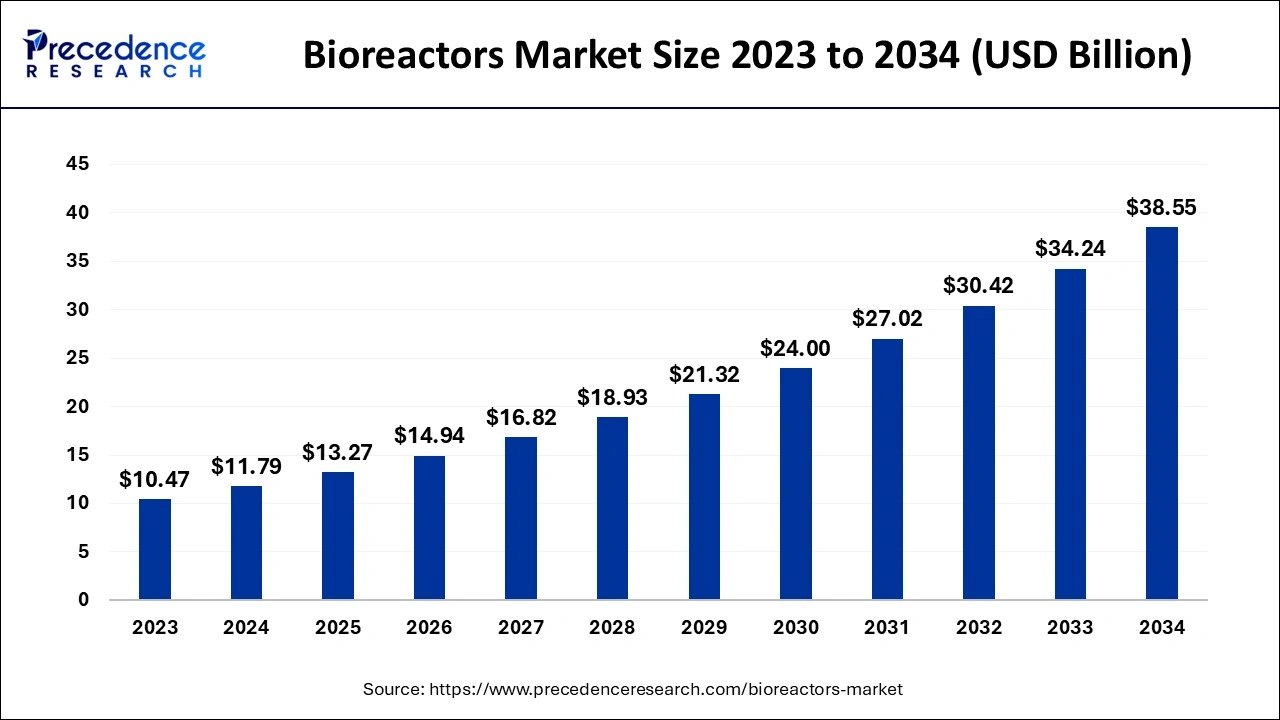
The global bioreactors market is anticipated to reach USD 42.53 billion by 2035, expanding at a 12.35% CAGR, driven by growth in biopharmaceuticals, cell and gene therapies, and next-generation bioprocessing technologies.
Source: https://www.precedenceresearch.com/bioreactors-market
 Get a Sample
 Table Of Content


What is the Bioreactors Market Size?
The global bioreactors market size was estimated at USD 13.27 billion in 2025 and is predicted to increase from USD 14.94 billion in 2026 to approximately USD 42.53 billion by 2035, expanding at a CAGR of 12.35% from 2026 to 2035. The market growth is driven by technological advancement, focus on closed-loop reclamation, biomedical funding, and demand for new biologics.
Key Takeaways
- By region, North America led the bioreactors market in 2025.
- By region, Asia-Pacific is expected to grow at the highest CAGR during the forecast period.
- By product type, the reusable bioreactors segment dominated the market with the largest share in 2025.
- By product type, the single-use bioreactors segment is expected to grow the fastest during the forecast period.
- By cell, the mammalian cells segment dominated the market in 2025.
- By cell, the bacterial cells segment is expected to grow rapidly during the forecast period.
- By molecule, the vaccines segment dominated the market in 2025.
- By usage, the commercial production segment dominated the market in 2025.
- By usage, the developmental, preclinical and clinical segment is expected to rise with the highest CAGR during the forecast period.
- By end-use, the biopharmaceutical (biopharma) manufacturers segment led the market with a share in 2025.
- By end-use, the research and development (R&D) organizations segment is anticipated to grow fastest during the forecast period.
Market Overview
The global bioreactors market is supported by increased biopharmaceutical production and demand for new biologics. The growth is driven by a rising ageing population with chronic diseases, enabling innovation in treatment techniques promoted by R&D investment. The bioreactors market is replacing traditional stainless-steel vessels with flexible single-use bioreactors, which reduce operational costs, validation times, and cross-contamination risks. Technological tools enable real-time monitoring and autonomous control of parameters such as pH, oxygen, temperature, and bio-nutrients.
A major biomedical innovator focuses on expanding vaccine production and improving mammalian cell culture to build a connected, efficient bioprocessing infrastructure poised for growth. Single-use systems allow multi-product facilities and contract manufacturing organizations to optimize space and speed up emerging therapeutics such as monoclonal antibodies, recombinant proteins, and gene treatments. The healthcare sector is experiencing a technological conversion with the adoption of process analytical technology (PAT) and automation software. This digital shift is crucial for maximizing biomass and maintaining batch quality during industrial and commercial scaling.
How is Digital Integration and AI Contributing to the Development of the Bioreactors Sector?
AI and digital transition are transforming bioreactors from passive elements into autonomous systems in the market. The integration of intelligent robotics and digital twins with machine learning enables the prediction of cell structural changes, simulation of scale-up, and yield estimation. Modern biomanufacturing practices use process analytical technology (PAT), including in-line Raman spectroscopy and optical examinations, to monitor cell concentration and control metabolites in real time.
During mammalian cell culture, this digital shift reduces human error, increases yields, and ensures consistent superiority. AI generates adaptive, closed-loop controls to adjust operational efficiency and gas sparging in response to bioreactor metabolic needs. AI-driven microfluidic selections accelerate early-stage testing and yield optimal scale-up formulations, shortening the transition speed from lab to large-scale manufacturing.
Bioreactors Market Trends
- Global Evolution to Modular Single-Use Platforms: Commercial bioprocessing is shifting from traditional multi-story stainless-steel systems to pre-sterilized, disposable fluid routes. The modular single-use platform reduces cleaning and utility costs and reduces cross-contamination hazards.
- Industrial Transformation Toward Continuous Perfusion Manner: Biomanufacturing facilities focus on continuous upstream processing using cell-retention devices. These perfusion systems eliminate waste, yield therapeutic proteins, enhance productivity, biomass yields, and reduce the footprint.
- Bioprocessing Through Real-Time PAT Integration: Modern vessel designs quickly implement multi-parameter process analytical technology (PAT) by altering manual sampling with in-line Raman spectroscopy and multi-wavelength investigations align with real-time metabolic yields.
- Focus On Fragile Cell and Gene Therapies: The rise of personalized medicines drives the requirement for small, closed-loop bioreactor systems with moderate impellers, rocking platforms, and fluidic beds to protect shear-stress-complex cell culture membranes throughout ex vivo expansion.
- Eco-Design Material Innovation and Circular Reclamation: In bioprocessing, major equipment vendors are focusing on developing recyclable, bio-based polymer films and closed-loop reclamation partnerships that use chemical recycling and clean incineration to reduce environmental impact.
- Commercial Modification into Large-Scale Cellular Agriculture: Bioreactor equipment fabricators are rapidly implementing medical-grade cultivation technology into large-scale, food-grade systems for the agricultural sector. This modification supports cultivation practices to meet competitive prices.
Bioreactors Market Growth Factors
Monoclonal antibiotics have a great demand in various nations across the globe, due to which the bioreactors market is expected to see significant growth during the forecast. As the amount of funds received through government organizations and private organizations have grown in recent times in order to develop different types of vaccines for various diseases, the market will show subsequent growth. Single-use bioreactors also have a good demand, and it will generate a large amount of revenue in the long run.
The Pharmaceutical industry and the biotechnology sector make maximum use of bioreactors. As both of these industries are developing and increasing, the bioreactors market is also expected to grow. Technological development is also expected to play an instrumental role in the use of advanced bioreactors and various equipment of advanced nature. Cultivation parameters can be monitored through the help of screens, and all of these advanced features will lead to the growth of the market. Quality data can be collected and gathered through the use of such developments, and it also leads to less human intervention.
Advanced bioreactors are receiving more funds, and the market players are also engaged in the manufacturing of these bioreactors. Constant research and development activities in the field of bioreactors will help in the growth of the market. Clinical trials and preclinical trials have increased. Research and development activities for microbial applications and cell culture have also grown in recent times. All of these factors will lead to the growth of the market during the forecast period.
As there has been an increase in different types of chronic diseases across the globe like diabetes, cancer and cardiovascular diseases, the need for various therapies associated with all of these diseases will lead to the growth of the bioreactors market. The introduction of novel therapies for treating cancer will also create more demand for bioreactors.
- The outbreak of the COVID-19 pandemic led to increased use of bioreactors.
- As there was a growing demand for effective therapeutics, the market for bioreactors grew drastically. The manufacturing of preventive vaccines also needed a large number of bioreactors.
- Different pharmaceutical industries were engaged in the manufacturing of vaccines in order to meet the demands of the population due to which the capacities of their manufacturing units were also increased, and the purchases of bioreactors had also increased.
- Personalized medicines are in great demand and the use of these medicines will create more demand for bioreactors.
- Technological advancements will help in generating greater revenues.
- The biotechnology industry and the pharmaceutical industry are showing rapid growth due to which the bioreactors market will grow significantly.
Market Outlook
- Industry Growth Overview: Biologics, monoclonal antibodies, gene therapies, and vaccines keep adding to the rapid growth of bioreactor demand in the world.
- Sustainability Trends: Single-use adoption will save on water, cleaning needs, and total energy use.
- Major investors: Sartorius AG, Thermo Fisher Scientific Inc., Danaher Corporation, GE Healthcare, and Merck KGaA promote growth.
Market Report Coverage and Key Metrics
| Report Coverage | Details |
| Market Size in 2025 | USD 13.27 Billion |
| Market Size in 2026 | USD 14.94 Billion |
| Market Size by 2035 | USD 42.53 Billion |
| Growth Rate from 2026 to 2035 | CAGR of 12.35% |
| Base Year | 2025 |
| Forecast Period | 2026 to 2035 |
| Segments Covered | Product Type, Cell, By Molecule, Usage, End-Use, and Region |
| Regions Covered | North America, Europe, Asia-Pacific, Latin America and Middle East & Africa |
Bioreactors Market Dynamics
Driver
Exponential Expansion in Biopharmaceutical and Transition to Single-Use Modular Technologies
The market is driven by the growth of the global biopharmaceutical pipeline, with a focus on complex therapies such as monoclonal antibodies, bi-specific proteins, and mRNA vaccines, along with the integration of advanced cell and gene therapies. Traditional large stainless-steel setups are less suitable for these low-volume, high-value products. The industry is transforming to modular, single-use bioreactors for high-volume and high-value production. Single-use modular technologies use pre-sterilised plastic bio-bags, reducing water, chemicals, energy use, and the risk of cross-contamination. The biopharmaceutical sector focuses on streamlining validation processes, increasing flexibility for multi-product infrastructure and contract manufacturing organizations, and accelerating the advancement and launch of new treatments.
Restraint
Restrictions on Facility Capitalization and Validating Polymeric Materials
Market growth is restrained by high capital costs associated with engineering and commissioning advanced bioprocessing facilities to meet stringent international regulations that require detailed validation to ensure drug safety and batch purity. These challenges create financial hurdles and operational delays, especially for smaller biotechnology startups and new market competitors, mostly in disposable systems.
Opportunity
Development of Bioprocessing through Advanced Process Analytical Technology (PAT) and Autonomous AI
The market is moving towards digitalising bioprocessing through smart ecosystems driven by AI and machine learning. The opportunity to implement process analytical technology (PAT) in bioreactors replaces offline testing with real-time monitoring of key parameters, including cell density, nutrients, gases, and byproducts. This data feeds into automation software to adjust processes and optimize precursor, creating self-regulating, closed-loop bioreactors. These systems enable vendors to have a competitive edge by allowing consistent quality, reducing errors, and maximising yields in high-volume production.
Market Segmentation Analysis
Product Type Insights
What Made the Reusable Bioreactors Segment Dominate the Bioreactors Market?
The reusable bioreactors segment led the market in 2025 because it functions as a key pillar of high-volume industrial biotechnology, where reusable bioreactors are designed for durability and high performance for heavy-duty stainless-steel vessels. These systems endure high pressures, vigorous mixing, and numerous automated clean-in-place and steam-in-place sterilization cycles promoted by substantial investment and funding. Leading companies focus on developing these systems with durable seals and electropolished walls for effective operation in large tanks. Additionally, reusable bioreactors provide economies of scale for steady, high-volume manufacturing by maintaining stability and low variable costs.
The single-use bioreactors segment is expected to grow at the fastest CAGR in the upcoming years, driven by the need to lower costs by removing water-for-injection, chemicals, and sterilization energy. The biomanufacturing infrastructure is increasingly adopting single-use bioreactors by using disposable liners and bio-bags to replace stainless-steel systems. Each run uses a gamma-irradiated fluid path, reducing cross-contamination risk and reducing turnaround from days to hours. Single-use bioreactors enable CMOs and multi-product facilities to switch drugs, optimize space, and shorten clinical timelines. These segments are inclined towards innovations such as advanced multilayer films, upgraded structural platforms, and magnetically attachable impellers that reduce particulates.
Cell Insights
How did the Mammalian Cells Segment hold the Largest Share in the Bioreactors Market?
The mammalian cells segment dominated the market in 2025, due to its role in manufacturing complex proteins with human-like modifications during upstream bioprocessing. Growing fragile cell lines, including Chinese hamster ovary (CHO) cells, baby hamster kidney (BHK) cells, and human embryonic kidney (HEK) cells, requires precise hardware, because mammalian cells lack rigid walls and are susceptible to shear stress. The implementation of specialised bioreactors with low-shear impellers, micro-sparging for oxygen transfer, and PAT sensors maintains optimal situations. This environmental control ensures cell viability and proper glycoform folding for humanized antibodies, clotting factors, and gene therapy vectors.
The bacterial cells segment is expected to expand rapidly in the market during the forecast period, as this system is standard for cost-effective large-scale production of simpler, non-glycosylated therapeutic proteins, such as insulin, growth hormones, enzymes, and vaccine subunits. The bacterial cells are optimised for rapid, high-density biomass development using resilient hosts, Escherichia coli and Bacillus subtilis. Bacterial cells require specialized fermentation equipment with superior agitation, gas sparging, and heat transfer capabilities to achieve their high oxygen consumption (OUR). The bioreactors' seals enable efficient cooling to manage heat generated by rapid cell division, which supports the move towards modern bioreactors with rugged dual-impeller setups to improve gas dispersion and prevent stagnation in dense cultures.
Molecule Insights
Why Did the Vaccines Segment Hold the Highest Bioreactors Market Share?
The vaccines segment held the highest market share in 2025 because the biomanufacturing sector requires operational flexibility, maintenance of sterility, and stringent biosafety standards. This field depends on advanced automation software for consistent quality and validation, especially in complex viral-vector, subunit, and mRNA lines. Bioreactor platforms are moving away from microcarrier cell lines toward insect cell-baculovirus systems and cell-free nucleic acid solutions, fueling market expansion. The vaccine formulation requires equipment features such as clean-lock sampling valves, hermetic exhaust filtration, and automated containment checks before adding viral seeds, which help protect against infectious disease.
Usage Insights
Which Usage Segment Led the Bioreactors Market?
The commercial production segment led the bioreactors market in 2025, driven by a focus on higher output, resource efficiency, and consistent manufacturing quality to meet stringent GMP standards. Commercial facilities that use large bioreactors are automated, contained systems that employ process analytical technology (PAT), automated sampling, and predictive control to minimise human intervention and maintain control for extended periods. The commercial sector focuses on a stable supply chain, reliable cultivation systems, mechanical performance, precise gas controllers, and uniform fluid dynamics, which boost market growth.
The development, preclinical, and clinical segment is expected to show the fastest growth over the forecast period, representing core testing phases for molecular pipelines, focusing on operational performance, rapid data collection, and purity over volume. In initial discovery, scientists employ automated mini-bioreactor arrays for high-throughput screening of media, cellular optimization, and the characterization of critical process parameters (CPP). The clinical sector focuses on maintaining consistent geometric ratios across scales, allowing models for gas transfer and tip speed to be applied from 250 ml mini-bioreactors to 2,000 L systems using disposable model platforms. Additionally, this transition depends on a scalable solution and advanced analytics to ensure uniform transfer and yield ultra-pure, well-documented small batches for regulatory support.
End-Use Insights
How the Biopharmaceutical (Biopharma) Manufacturers Segment Dominated the Bioreactors Market?
The biopharmaceutical (biopharma) manufacturers segment held the highest market share in 2025, driven by growing adoption of smart biomanufacturing technology like machine learning, digital twins, and continuous perfusion to lower operational costs in the biopharmaceutical sector. Global biopharma titans invest heavily in advanced upstream infrastructure, merging stainless-steel facilities with modular, decentralized single-use systems for domestic supply and drug discovery. Biopharmaceutical procurement influences bioreactor market trends, favouring hardware with resilient supply chains and identical interfaces to meet FDA/EMA-compliant validation requirements.
The research and development (R&D) organizations segment is expected to witness rapid growth over the forecast period, due to biotechnological innovation focused on early discovery, new modalities, and process optimization through the support of academic institutions, contract research organizations, and R&D groups. The R&D organization is moving towards versatile, small benchtop bioreactors that switch easily between microbial fermentations, cell lines, and tissue-engineering platforms. By integrating advanced analytical tools, such as in-line mass spectrometers, biomass sensors, and Raman spectroscopy, to analyse cellular metabolic pathways, the market growth is expected. The ongoing research in cellular agriculture, alternative proteins, and tissue regeneration drives demand for next-gen bioreactors.
Market Regional Analysis: North America, Europe, Asia-Pacific
Significant growth rate to be registered in the North American region for the bioreactors industry. Prominent manufacturers are present in the North American region due to which the market growth will be substantial. The number of patients suffering with chronic diseases have also grown in recent times and the geriatric population is also increasing, due to which the demand for bioreactors will be more in the North American region.
The amount of expenditure made on research and development activities is also increasing in the North American region, and this will drive market growth in the forecast period. The facilities provided for conducting research and development activities are also favourable and it will show a significant increase. Such activities are supported by government investments as the demand for various vaccines has increased.
The development of the same after the outbreak of the COVID-19 pandemic has also grown. Good opportunities for the growth of the market will be provided by the North American region in the coming years.
Why did North America Dominate the Bioreactors Market?
North America held a major market share in 2025, driven by regional biotechnology firms, top academic institutions, and leading biopharmaceutical manufacturers. The region is adopting specialised low-shear, single-use bioreactors, AI-driven automation, and process analytical technology (PAT) to optimize cellular expression. North America invests in next-generation pipelines and gene therapies promoted by personalized cancer treatments and mRNA platforms. Strong domestic policies, venture capital, and advanced CMOs support North America's leadership in upstream innovation and modular manufacturing.
U.S. Market Trends
The U.S. market dominates in bioprocessing innovation with startup hubs and pharmaceutical players. The domestic industry is moving towards software-driven AI to boost cellular yields. The United States serves as a testing ground for advanced cell and gene therapies, booming in automation and benchtop systems. Additionally, federal investments in biosecurity and supply resilience preferred hybrid processing, blending continuous and flexible, single-use systems across the U.S.
How is Asia-Pacific Growing in the Bioreactors Market?
Asia-Pacific is expected to host the fastest-growing market in the coming years, driven by government investments, policy modifications, and expanded local manufacturing infrastructure. Asia-Pacific is a vital bioprocessing hub for affordable biosimilars, vaccines, and biologics to combat chronic diseases, sustaining high demand for advanced cell culture vessels and microbial fermentation equipment. Regional industries invest in large stainless-steel bioreactors and implement modular disposable systems for flexibility. Additionally, Asia Pacific benefits from lower costs, a skilled workforce, and international research collaborations.
China Market Trends
China's market growth is shaped by state-led strategies aimed at achieving biologics self-reliance. The domestic procurement market demands large fermentation lines for cost efficiency and is seeing rising use of domestically manufactured single-use systems. China shifted towards capacity expansion, supporting domestic biosimilars and antibodies for an ageing population. The rapid growth of CMOs is strengthening China's position as a competitive exporter of cell culture hardware.
Why is Europe Witnessing the Significant Growth in the Bioreactors Market?
Europe is expected to experience significant growth over the studied period, with a leader in high-quality engineering and pharmaceutical innovation, known for strict GMP compliance and robust clinical validation. European equipment leaders combine inline Raman spectroscopy and optical sensors for quality and mass drugs with flexible single-use systems. Regional growth is fueled by a focus on sustainability, which drives eco-friendly, recyclable polymers and energy-efficient designs, and aligns with investments in R&D, chronic disease treatments, and viral route validation.
Germany Market Trends
Germany's market represents a vital hub for high-precision engineering, which is linked to automation, robotics, and Industry 4.0. The domestic biopharma and manufacturers focus on system reliability and batch quality, driving in-line Raman spectroscopy and sensor use across Germany. The stringent regulations enable the development of eco-friendly polymeric bio-bags, complying with quality and validation-ready hardware, making Germany an emerging exporter of control units and software.
What Drives the Latin America Bioreactors Market?
Latin America is expected to show lucrative growth during the forecast period, driven by government support for advanced treatments in the pharmaceutical and biotechnology sectors. The rising regional demand for biologics, vaccines, and biosimilars requires sophisticated bioprocessing systems to ensure efficiency and quality. Bioreactors provide a controlled, flexible, and cost-effective solution for large-scale cell growth and biologic production to meet Latin America's healthcare needs and reduce import necessity.
Brazil Market Trends
Brazil is Latin America's main gateway to the market, driven by government-led Productive Development Partnerships (PDPs). Limited capital favours modular, single-use bioreactors that avoid the expense of utility systems, enabling domestic facilities to meet automation compliance. Brazil invests in local infrastructure for insulin, vaccines, and monoclonal antibodies to reduce reliance on imports.
Why is the Bioreactors Market Within the Middle East and Africa Growing?
The Middle East and Africa region is growing significantly due to the cultivation industry and state-backed investments for healthcare and vaccine self-sufficiency. MEA is adopting modular, pre-validated single-use bioreactors for water purification and clean-steam facilities, funded by government and private groups to support local bioprocessing. Additionally, the region's adoption of advanced technology and rising immunisation needs are shaping it into a sophisticated manufacturing hub.
South Africa Market Trends
South Africa's market is a main hub for vaccine invention, adoption of pre-sterilized, disposable cultivation systems, and pandemic readiness in Africa. The country adopting a flexible, single-use approach allows producers to quickly change between viral strains and proteins, dropping cross-contamination risks. South Africa's growth is supported by tech-transfer centres and global biomedical funding for mRNA and viral vector platforms.
Value Chain Analysis of the Bioreactors Market
- R&D: Research and laboratory development of therapeutic molecules to meet targeted medical requirements efficiently.
Key Players: Sartorius AG, Thermo Fisher Scientific, Merck KGaA, Danaher (Cytiva) - Clinical Trials and Regulatory Approvals: Human testing is done to guarantee safety, efficacy, and compliance with global health authorities.
Key players: IQVIA, Parexel, WuXi AppTec, Labcorp - Preparation of Formulations and Final Dosage: The active ingredients are combined with the excipients to produce stable and useful medicines.
Key players: Catalent, Lonza, Patheon (Thermo Fisher), AbbVie, Roche - Packaging and Serialization: Final Containment traceability systems to prevent counterfeiting, supply chain transparency.
Key players: West Pharmaceutical Services, Gerresheimer AG, Amcor - Distribution to Hospitals, Pharmacies, or Bioreactors: Special logistics that are used to distribute finished drugs or essential manufacturing parts reliably.
Key players: AmerisourceBergen (Cencora), McKesson, Cardinal Health
Market Competitive Landscape: Leading Companies and Strategies
The bioreactors market is highly competitive, led by major players like Sartorius, Thermo Fisher, Danaher, and Merck KGaA. These firms are moving toward creating proprietary, closed-loop systems joining vessel controllers, automation software, in-line sensors, and patented single-use films for global pharma companies.
Medium and small firms such as Eppendorf, Getinge, ABEC, Solaris Biotechnology, and Bioengineering offer flexible benchtop networks and custom bioreactors compatible with third-party software. As biomedical shifts to automated continuous processing, on acquiring cloud analytics startups and ultra-pure, low-leachable plastics for the cell and gene therapy infrastructure.
Bioreactors Market Companies
- GE Healthcare: Provides Xcellerex single-use bioreactors, WAVE, and FlexFactor systems capable of providing scalable, flexible, and fast workflows of manufacturing biopharmaceuticals.
- Merck KGaA: Offers Mobius disposable bioreactors, customized process systems, and BioContinuum software that supports automated, intensified upstream bioprocessing at different development phases.
- Eppendorf AG: Offers BioBLU rigid single-use bioreactors, DASGIP parallel systems, and BioFlo controllers to scale up fermentation and cell culture laboratory applications.
Other Major Key Players
- Sartorius AG
- Thermo Fisher Scientific Inc.
- BBI-Biotech GmbH
- Bioengineering AG
- Danaher Corporation
- Getinge
- Infos HT
- Solaris Biotech Solutions
Recent Developments in the Bioreactors Market (2025–2026)
- In October 2025, VFL Sciences, based in Chennai, launched GreatFlo PBR laboratory Photo Bioreactors at IKMC 2025 in Hyderabad. Designed for user-friendliness, it features a 7” touch screen, adjustable 0-100% light intensity via 10 LED modules, and a settable 24-hour Day/Night cycle. Customization options are available, and the systems are locally produced. (Source: https://www.biospectrumindia.com)
- In March 2025, Cytiva is expanding its Xcellerex X-platform with 500-L and 2000-L bioreactors, enabling easier scale-up of advanced therapeutics manufacturing from 50 L to 2000 L. The flexible single-use system enhances operational efficiency, lowers costs, reduces risks, and accelerates progress from early clinical development to commercial manufacturing. (Source: https://www.biopharminternational.com )
- The biotechnology company Freeline entered in a partnership with another organization, Pall corporation in the year 2019. This partnership was formed for the implementation of the bioreactor system of iCELLis with Freeline organization's AAV platform of manufacturing.
- Sartorius Stedim biotech into a partnership with Repligen corporation in 2019 for the introduction of the next Gen bioreactors that are perfusion enabled.
Segments Covered in the Report
By Product Type
- Single-Use
- Reusable
By Cell
- Mammalian Cells
- Bacterial Cells
- Yeast Cells
- Others
By Molecule
- Monoclonal Antibodies
- Vaccines
- Recombinant Proteins
- Stem Cells
- Gene Therapy
- Others
By Usage
- Developmental, Preclinical & Clinical
- Commercial Production
By End-Use
- Research and Development (R&D) Organizations
- Biopharmaceutical (biopharma) Manufacturers
- Contract Manufacturing Organizations (CMOS)
By Geography
- North America
- Europe
- Asia-Pacific
- Latin America
- The Middle East and Africa
For inquiries regarding discounts, bulk purchases, or customization requests, please contact us at sales@precedenceresearch.com
Frequently Asked Questions
Tags





Ask For Sample
No cookie-cutter, only authentic analysis – take the 1st step to become a Precedence Research client
 Get a Sample
.webp)



 sales@precedenceresearch.com
 Schedule a Meeting
