



Business Intelligence Software Market Size, Key Companies, Company Product Portfolio, Digital Transformation, Technology Investment, Adoption Rates, Customer Acquisition, Company Market Share, and Market Outlook
Business Intelligence Software Market (By BI Technology: Cloud BI, Mobile BI, Social BI; By Function: Executive Management, Marketing, Sales, Operations, Finance, Human Resources, Supply Chain; By Deployment: Cloud, On-Premise; By Enterprise: Large Enterprises, Smes; By End user: BFSI, Manufacturing, Healthcare, Retail, IT and Telecom, Others) - Global Industry Analysis, Size, Trends, Leading Companies, Regional Outlook, and Forecast 2026 to 2035
Source: https://www.precedenceresearch.com/business-intelligence-software-market
 Get a Sample
 Table Of Content


What is the Business Intelligence Software Market Size?
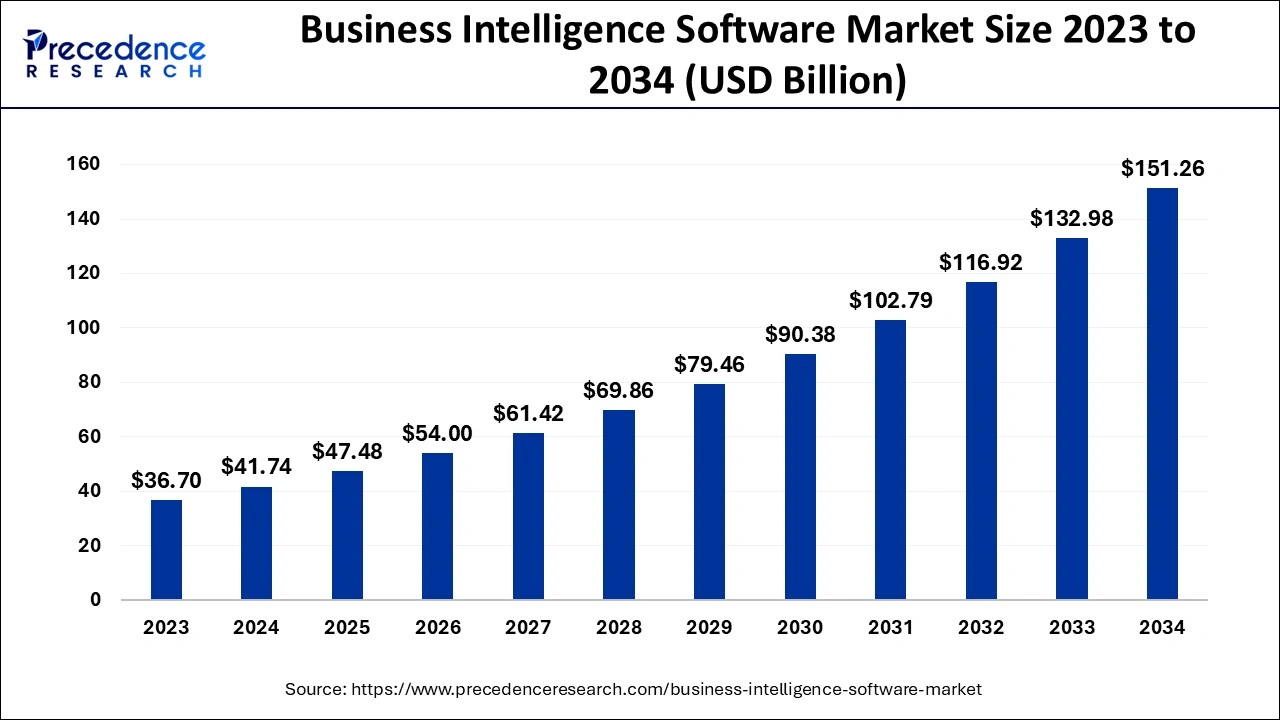
The global business intelligence software market size is calculated at USD 47.04 billion in 2025 and is predicted to increase from USD 47.48 billion in 2026 to approximately USD 168.06 billion by 2035, expanding at a CAGR of 13.47% from 2026 to 2035.
Business Intelligence Software Market Key Takeaways
- In terms of revenue, the market is valued at $47.48 billion in 2026.
- It is projected to reach $168.06 billion by 2035.
- The market is expected to grow at a CAGR of 13.47% from 2026 to 2035.
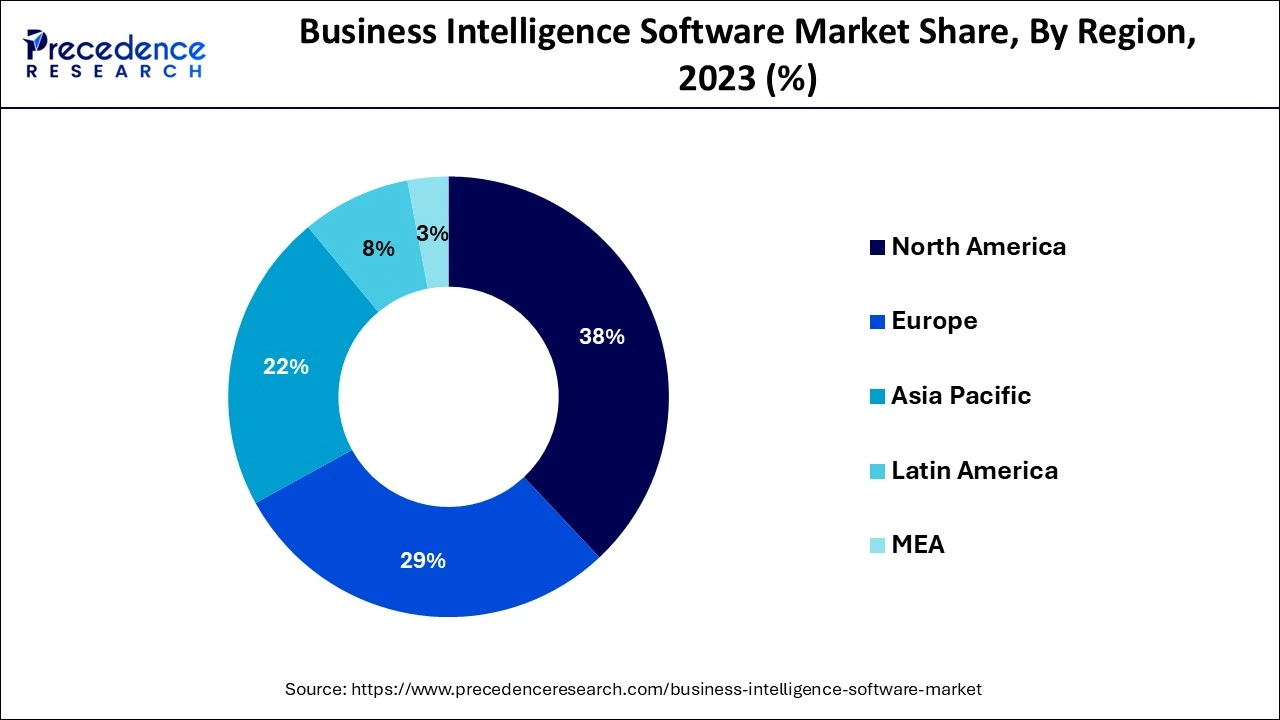
- North America dominated the global business intelligence software market with the largest market share of 38% in 2025.
- Asia Pacific is anticipated to grow at the fastest CAGR in the market during the forecast period of 2026 to 2035.
- By BI technology, the cloud BI segment contributed the highest market share of 53% in 2025.
- By BI technology, the mobile BI segment is anticipated to grow significantly in the market during the forecast period.
- By function, the executive management segment stood dominant over the global market in 2025.
- By function, the human resources segment is expected to grow at the fastest CAGR in the market during the forecast period.
- By deployment, the cloud segment registered the largest share of the market in 2025.
- By deployment, the on-premise segment is anticipated to grow at the fastest CAGR during the forecast period.
- By enterprise size, the large enterprise segment led the global market in 2025.
- By enterprise size, the small & medium-sized enterprise segment is anticipated to grow at the fastest CAGR in the market during the forecast period.
- By end-user, the BFSI segment held the largest share of the market in 2025.
- By end-user, the healthcare segment is projected to grow rapidly in the market over the forecast period.
Business Intelligence Software Market Market Overview
Business intelligence software refers to a set of tools that analyzes data and helps businesses enhance their decision-making. Organizations are using the software widely, which helps them to gather data from various internal and external sources like cloud applications, spreadsheets, and others. The market is witnessing significant growth due to its exceptional features that help businesses generate more revenue and expand their operations throughout the industry.
How is AI Revolutionizing the Business Intelligence Software Market?
The rise in technologies like artificial intelligence (AI) and machine learning (ML) has become one of the crucial factors transforming the business intelligence software market. AI tools are known for their data analyzing capabilities, which are widely used by companies to develop their business. The adoption of AI is significantly helping companies by reducing time consumption with enhanced operational efficiency. AI is gaining more popularity due to its predictive maintenance capabilities, which help companies predict future market trends and act accordingly to gain more revenue. The rising demand is leading to many investments in these technologies in the upcoming years.
Business Intelligence Software Market Growth Factors
- The rapid growth in big data generation from various sources has provided many opportunities, which stands out as a major growth factor in the business intelligence software market.
- The rapid adoption of BI tools in the finance sector has become a crucial growth factor that helps them maintain accurate insights that might help them in their business.
- The rising use adoption of BI tools is leading to innovation in tools that can be used by the non-tech population, which also stands out as a potential growth factor.
- The growth of mobile BI applications is also one of the emerging market trends that are creating several opportunities in the market.
Top 5 business intelligence tools in 2024
| Name | Key Features |
| SAP business objects | This tool provides a comprehensive analysis and reporting of role-based dashboards for ERP, CX, and CRM integration. |
| MicroStrategy | The tool delivers high-speed data analytics, cloud solutions, and dashboarding with hyperintelligence and extensive data source connectivity. |
| SAS Augmented Analytics | The tool offers advanced predictive analysis and data integration with contextual insights via text analytics. |
| Yellowfin BI | The tool is a combination of visualization, Machine Learning, and collaboration with intuitive filtering and no-code/low-code development for accessible analytics. |
| QlikSense | The tool features an advanced analytics engine with AI-driven insights for seamless, device-agnostic data exploration. |
Transforming Data into Direction
The business intelligence software market is undergoing rapid transformation as enterprises across industries shift from data storage to data-driven decision-making. The rise in digital transformation, cloud computing, and advanced analytics is pushing organisations to adopt BI tools that not only collect data but also convert insights into action. Key trends include the integration of AI and machine learning into business intelligence (BI) platforms, enabling automated analytics and predictive forecasting. The growing importance of real-time dashboards, self-service BI, and mobile-based reporting is further expanding the accessibility of intelligent data to non-technical users, empowering teams across finance, operations, marketing, and HR to drive strategic goals.
Business Intelligence Software Market Outlook
- Industry Growth Overview: The market is witnessing significant growth due to its exceptional features that help businesses generate more revenue and expand their operations throughout the industry.
- Global Expansion: The market is in a period of rapid expansion, driven by the growing need for data-driven decision-making and the integration of advanced technologies like AI and machine learning.
- Major investors: Major investors in the business intelligence (BI) software market are tech giants like Microsoft, IBM, SAP, Oracle, and Google, as well as private equity firms that invest in companies like TIBCO and Informatica.
- Startup Ecosystem: The market startup ecosystem is a dynamic sector fuelled by the growing need for data-driven insights across industries, with key trends including AI/ML integration, cloud-based solutions, and advanced analytics.
Market Scope
| Report Coverage | Details |
| Market Size by 2035 | USD168.06 Billion |
| Market Size in 2025 | USD 47.04 Billion |
| Market Size in 2026 | USD 47.48 Billion |
| Market Growth Rate from 2026 to 2035 | CAGR of 13.47% |
| Largest Market | North America |
| Base Year | 2025 |
| Forecast Period | 2026 to 2035 |
| Segments Covered | BI Technology, Function, Deployment, Enterprise, End user, and Region |
| Regions Covered | North America, Europe, Asia-Pacific, Latin America and Middle East, & Africa |
Market Dynamics
Drivers
Increasing demand for data-driven decision-making
The increasing competitiveness in multiple industries is one of the crucial factors that lead to the adoption of BI tools. The business intelligence software market is gaining significant popularity as it enhances the operations within the companies that analyze data and make decisions accordingly. This also increases the reliability of the companies, which helps them in making decisions without any second thoughts. Companies are using these tools widely.
Rapid digital transformation
The growth in digital technologies has led to the adoption of advanced tools that can be used with the help of smart devices and internet connections. The business intelligence software market is witnessing significant improvement due to the rising shift towards digital operations that use cloud applications and other similar tools to analyze and store data. Digital transformation also become popular as it provides real-time insights that play a crucial role for businesses. Companies are willing to invest in digital operations, which might help them enhance their consumer experience with the help of various BI tools.
Restraint
Data security concerns
The increasing use of BI tools also poses potential threats which can significantly affect the business intelligence software market growth. The business intelligence market has managed to grow efficiently, but there are some factors related to data privacy and security that can restrain market growth. Data breaches have become a concerning factor that can potentially lead to data loss, which could also lead to financial loss for the companies.
Opportunity
Increasing investments in analytics
The rapid growth of small and medium-sized companies is one of the crucial factors that is leading towards investments in data infrastructure. The business intelligence software market has witnessed growth due to the rising growth of companies adopting advanced analytics. This is also expected to generate significant employment in the information and technology industry. The investments are also led by the factor that helps the companies experience self-service BI tools that enable the use without a deep knowledge of the topic.
Rising demand for personalized services
The rising competitiveness in businesses is leading to the adoption of multiple factors and technologies that help companies stand out in their respective market. The business intelligence software market is gaining significant importance due to the rising use of BI tools that help companies get detailed data analysis. This plays a crucial role in adopting personalized data-driven marketing strategies that can make a significant impact in their industry. The rising partnerships and collaborations are anticipated to generate more business.
Segment Insights
BI Technology Insights
The cloud BI segment marked its dominance over the global market in 2025. The technology uses cloud computing to deliver business intelligence services. The dominance of the segment is attributed to the technology that can be accessed from anywhere with the help of internet connectivity. These services are becoming popular in small and medium-sized businesses as they provide cost-effective services. The business intelligence software market is gaining popularity as there is a rising focus on investments in improving data privacy, which can help in increasing reliability.
The mobile BI segment is anticipated to grow significantly in the market during the forecast period of 2024 to 2034. Mobile BI directly provides access through smart devices like phones and tablets. The business intelligence software market is witnessing significant popularity due to the rising trend of remote work, where these services provide real-time monitoring without the need for traditional desktops. There is a rising focus on these technologies that can help improve speed and responsiveness.
Function Insights
The executive management segment stood dominant over the global market in 2025. The software focuses on tools that help in improving the insights required for business performance. These technologies are used by key players in companies like CEOs and senior executives. The business intelligence software market is gaining significant investments due to the rising need for decision-making needs. These tools are gaining significant popularity due to their capabilities, which help analyze future trends and find new opportunities for the growth of the country.
The human resources segment is expected to grow at the fastest CAGR in the market during the forecast period of 2024 to 2034. The software focuses on the management of HRs and managers who work on recruitment and employee management. The business intelligence software market is gaining significant popularity due to the rising focus on employee-focused work environments. Additionally, the rapid changes in work modes like hybrid and remote play a crucial role in providing new opportunities in HR-based software.
Deployment Insights
The cloud segment registered the largest share of the market in 2025. The dominance of the business intelligence software market is attributed to the rising use of cloud services, which provide flexible services without the need for physical infrastructure. This provides multiple opportunities for new startups, which can help them in managing their financial costs. Many companies are adopting these services, which gives service providers an upper hand in expanding their business.
The on-premise segment is anticipated to grow at the fastest CAGR during the forecast period of 2025 to 2034. The growth of the business intelligence software market is attributed to the well-established base of on-premise services, which can help companies store their data safely. Many companies are adopting these services, which can help them customization depending on their specific needs. Large-sized companies mostly use these services, which can help them keep control over their data and ensure security.
Enterprise-Size Insights
The large enterprise segment led the global market in 2025. The business intelligence software market is gaining significant popularity due to the rising need for advanced analytics in finance and marketing. The dominance of the segment is attributed to the higher investment capacity of these companies, which can acquire advanced technologies.
The small & medium-sized enterprise segment is anticipated to grow at the fastest CAGR in the market during the forecast period of 2024 to 2034. The growth in the business intelligence market is driven by the rising affordability of cloud BI solutions, which enables these companies to use them for analytics that can help them expand their business. The rise in data-based decision-making is one of the major factors that cause small-sized companies to opt for these services.
End-User Insights
The BFSI segment held the largest share of the market in 2025. The BI software is used by financial institutions to focus on various aspects of the institution. The business intelligence software market is gaining significant popularity due to the rising need for security that can control and store complex data.
The healthcare segment is projected to grow rapidly in the market over the forecast period. This growth is driven by the rising need for patient data security. Digitalization in healthcare has changed the healthcare approach, which focuses on deploying services that can help store patients' electronic records.
Regional Insights
What is the U.S. Business Intelligence Software Market Size?
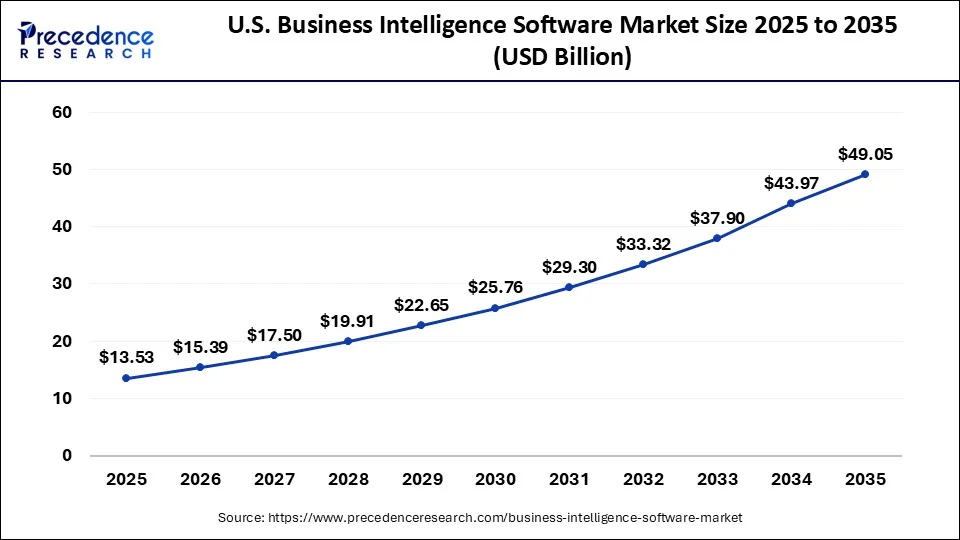
The U.S. business intelligence software market size is exhibited at USD 15.39 billion in 2026 and is projected to be worth around USD 49.05 billion by 2035, growing at a CAGR of 13.75% from 2026 to 2035.
North America dominated the global business intelligence software market in 2025. The dominance of the region is attributed to the well-established base of advanced technologies that provide services throughout the world. Countries like the United States and Canada mainly focus on data-driven solutions which provides investment opportunities in the region. Additionally, the rising focus on healthcare advancement is anticipated in the upcoming years.
North America remains the dominant region in the global business intelligence software market, owing to a strong technological foundation and the early adoption of digital tools across various sectors. The United States stands as the powerhouse with companies like Microsoft, Oracle, Tableau, and IBM consistently investing in next-gen analytics platforms.
Key contributing countries in the North American business intelligence software market are the U.S and Canada. The U.S. government's push towards digitising public infrastructure, combined with robust private sector investment, has created fertile ground for BI adoption. Federal initiatives supporting smart cities, healthcare analytics, and defence digitisation are driving demand. On the other hand, Canada is focused on enterprise software innovation and government incentives for cloud adoption.
The major contributing factors to the North American BI software market include:
- High penetration of cloud computing
- Strong startup and innovation ecosystem
- Government digital initiatives, like promoting public data accessibility
- Mature IT infrastructure and talent availability
- Rising demand for real-time decision-making tools in healthcare, BFSI, and retail sectors
U.S. Business Intelligence Software Market Trends
Key contributing countries in the North American business intelligence software market are the U.S and Canada. The U.S. government's push towards digitising public infrastructure, combined with robust private sector investment, has created fertile ground for BI adoption. Federal initiatives supporting smart cities, healthcare analytics, and defence digitisation are driving demand.
Europe is expected to grow at a notable CAGR over the forecast period. The growth of the region can be attributed to the growing focus on data-driven decision-making, along with the extensive adoption of cloud-based solutions. Also, there is a growing trend towards self-service BI tools that enable non-technical users to access and analyze vast amounts of data.
What Factors Led the Dome Camera Segment to Lead the Night Vision Surveillance Cameras Market in 2025?
Asia Pacific is anticipated to grow at the fastest CAGR in the market during the forecast period of 2026 to 2035. The growth of the region is attributed to the rising digitalization in emerging economies like China, India, and Japan. The companies in the region are focusing on adopting data analytics, which can help them in improving their businesses. The business intelligence software market is anticipated to grow efficiently due to the rising support from the government, which is focusing on adopting digital infrastructure.
Asia Pacific is currently the fastest-growing region in the business intelligence software market. Countries like China, India, Japan, South Korea, and Australia are heavily investing in digital ecosystems that rely on intelligent data interpretation.
India Business Intelligence Software Market Trends
The growth of the market in India is driven by growing demand for data analytics and the rise of AI-powered BI solutions. The integration of AI and ML into BI tools is boosting their functionality, leading to greater demand. Also, the country's large pool of technically skilled labourers offers the expertise required to develop and implement BI solutions.
Germany Business Intelligence Software Market Trends
The growth of the market in Germany can be driven by an ongoing push for digitalization across the German economy, such as government initiatives such as Industry 4.0 and the Digital Hub Initiative. The country also benefits from a highly skilled workforce and heavy investments.
Value Chain Analysis
- Data Sourcing: This is an initial stage that involves accessing, storing, and managing raw data from various sources.
- Data Engineering and Analysis: This stage emphasizes preparing the data from the previous stage for analytics.
- Situation Awareness: This stage involves converting analytical insights into visual and easy-to-understand reports, dashboards, and key performance indicators (KPIs).
- Decision Support and Evaluation: The final stage involves evaluating the decisions' outcomes and iterating on the process.
Business Intelligence Software Market Companies
- Microsoft: A comprehensive platform including Power BI Desktop for report creation and data modeling, and the Power BI service for cloud-based collaboration and sharing.
- Qlik Sense: A BI platform featuring an associative data engine for free-form data exploration, AI-powered insights, and self-service analytics.
Other Major Key Players
- Oracle
- IBM Corporation
- Yellowfin International Pty Ltd (Yellowfin)
- SAP SE
- Board International
- MicroStrategy Incorporated.
- Tableau Software, LLC (Salesforce, Inc.)
- Sisense Ltd
Recent updates on business intelligence software
AI and Natural Language Processing Transform BI Tools
- On 15 March 2025, the combination of natural language processing and artificial intelligence is transforming business intelligence (BI) tools. These developments make data analysis more approachable for non-technical users by allowing users to engage with data in conversational language. Platforms such as datalab and Sirius BI are spearheading this shift by providing automated data preparation and AI-driven insights, which improve decision-making procedures throughout enterprises.
Emphasis on Data Governance and Shelf Service Analytics
- On 5 April 2025, a change toward self-service analytics and strong data governance is occurring in the BI landscape. To guarantee trustworthy insights, organizations are giving top priority to data security governance frameworks and quality. Business users can now create reports and dashboards on their own thanks to self-service BI tools, which also encourage a data-driven culture and lessen dependency on IT departments.
Latest Announcement Made by Market Leader
- In November 2024, IBM was named a leader in the Gartner Magic Quadrant for custom software development services. The company said, ‘the recognition highlights our ongoing efforts in cloud development services and our commitment to driving innovation through generative AI and cloud-native solutions.
Recent Developments
- On 10 January 2025, Databricks announced the acquisition of database startup Neon, aiming to enhance its Lakehouse architecture and provide seamless integration of transactional and analytical data. This move is expected to bolster Databricks' capabilities in delivering real-time insights.
- On 21 February 2025, Workday introduced its "Everyday AI" initiative, focusing on embedding AI into its enterprise software to automate routine tasks and improve user experience. The initiative underscores Workday's commitment to leveraging AI for enhanced decision-making in HR and finance.
- On 25 March 2025, SAS unveiled new features in its Viya platform, including AI agents and enhanced digital twin simulations, during the SAS Innovate 2025 event. These advancements aim to provide more accurate forecasting and decision support for businesses across various industries.
- In May 2025, India's TechNova Analytics launched a new BI platform tailored for small and medium enterprises (SMEs), offering AI-powered dashboards and affordable pricing to promote data adoption in Tier 2 cities.
- In May 2025, China's Alibaba Cloud announced a business venture integrating BI with cloud-based e-commerce insights, allowing businesses to analyse user behaviour and optimise marketing spend in real-time.
- In May 2025, South Korea's LG CNS unveiled a smart BI solution for manufacturing that uses machine learning to predict equipment failure and production anomalies.
- In September 2024, Zoho released Zoho Analytics 6.0, adding AI and machine learning capabilities, including a custom ML model-building studio, OpenAI integration, and expanded data connectors to enhance data analytics and insights.
- In April 2024, Tech Mahindra and Microsoft launched a unified workbench on Microsoft Fabric to help organizations streamline data workflows, enhance business agility, and improve operational efficiency with AI and machine learning integration.
Segments Covered in the Report
By BI Technology
- Cloud BI
- Mobile BI
- Social BI
By Function
- Executive Management
- Marketing
- Sales
- Operations
- Finance
- Human Resources
- Supply Chain
By Deployment
- Cloud
- On-Premise
By Enterprise
- Large Enterprises
- Smes
By End user
- BFSI
- Manufacturing
- Healthcare
- Retail
- IT and Telecom
- Others
By Region
- North America
- Asia Pacific
- Europe
- Latin America
- Middle East and Africa
For inquiries regarding discounts, bulk purchases, or customization requests, please contact us at sales@precedenceresearch.com
Frequently Asked Questions





Ask For Sample
No cookie-cutter, only authentic analysis – take the 1st step to become a Precedence Research client
 Get a Sample




 sales@precedenceresearch.com
 Schedule a Meeting
