
Complementary and Alternative Medicine Market Size, Key Companies, Company Market Share, Patient Volume, Treatment Adoption Rates, Pricing Analysis, Regulatory Landscape, Competitive Positioning, and Demand Forecast
Complementary and Alternative Medicine Market (By Intervention: Traditional Alternatives/Botanicals, Mind Healing, Body Healing, Sensory Healing, External Energy; By Distribution Channel: E-Sales, Direct Sales, Distance Correspondence, Others) - Global Industry Analysis, Size, Trends, Leading Companies, Regional Outlook, and Forecast 2026 to 2035
Source: https://www.precedenceresearch.com/complementary-and-alternative-medicine-market
 Get a Sample
 Table Of Content


What is the Complementary and Alternative Medicine Market Size?
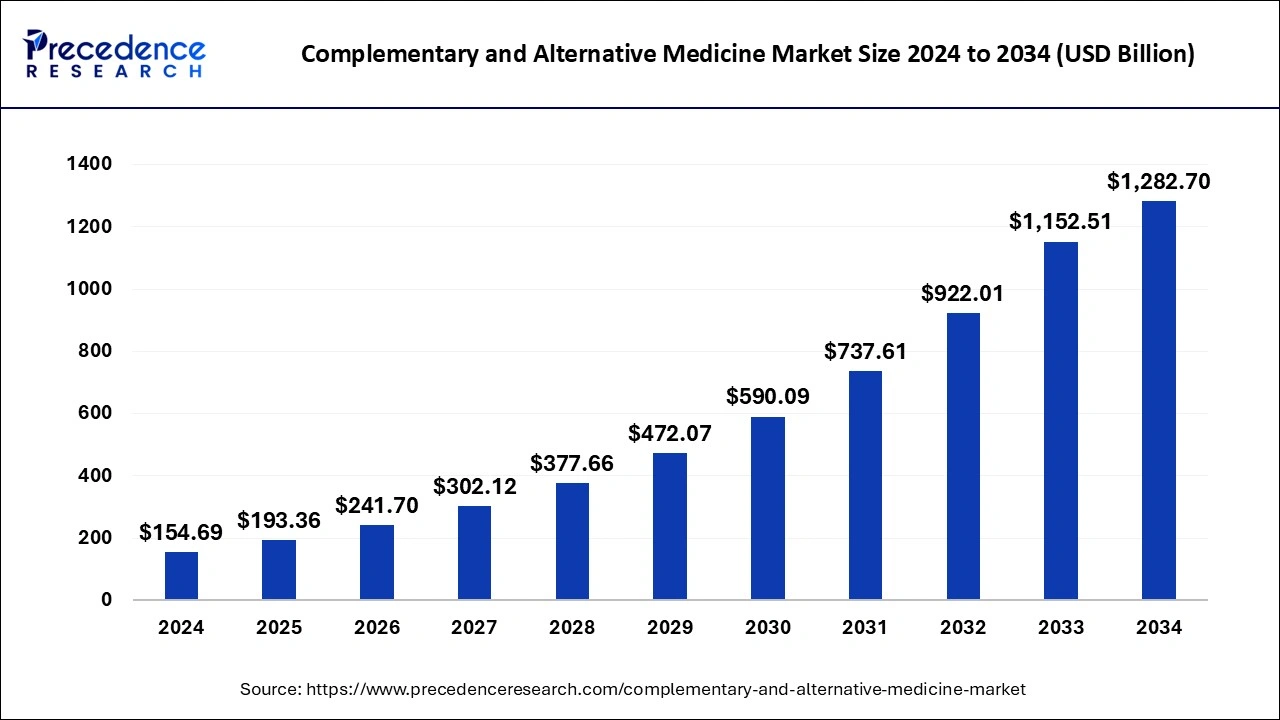
The complementary and alternative medicine market was valued at USD 193.36 billion in 2025 and is expected to grow from USD 241.70 billion in 2026 to approximately USD 1,412.89 billion by 2035, at a CAGR of 22.00% between 2026 and 2035. This growth trajectory reflects rising consumer awareness of CAM therapies and expanding government initiatives supporting their broader clinical application.
Complementary and Alternative Medicine Market Key Takeaways
- Europe led the global market with a 34% share in 2025.
- By intervention, the traditional alternatives and botanicals segment held the largest share at 38% in 2025.
- By intervention, the external energy segment is projected to post the strongest CAGR over the forecast period.
- By distribution channel, direct sales accounted for the largest revenue share at 72% in 2025.
- By distribution channel, distance correspondence is expected to grow at the fastest rate over the projected period.
What is Complementary and Alternative Medicine?
Complementary and alternative medicine (CAM) refers to a diverse group of medical and healthcare practices and products that fall outside the scope of conventional medicine, including natural product therapies, mind-body approaches, manipulative and body-based therapies, and alternative medical systems. These approaches appeal to consumers seeking holistic wellness solutions that address the whole person rather than isolated symptoms. Demand for integrative medicine has grown further as patients increasingly turn to CAM when conventional treatments fail to resolve chronic health conditions.
What are the Key Impacts of AI on the Complementary and Alternative Medicine Market?
Artificial intelligence is having a substantial impact on the CAM industry, influencing the full value chain from treatment personalization to diagnostics and research acceleration. Algorithms trained on patient data are being used to design individualized treatment plans, support more precise diagnostics, and structure clinical trials for stronger patient recruitment outcomes. AI-powered tools are also helping businesses improve sales forecasting, inventory management, and consumer behavior analysis for CAM products. Together, data-driven decision-making and predictive analytics are improving treatment effectiveness, strengthening care delivery, and deepening customer engagement across integrative medicine providers.
Complementary and Alternative Medicine Market Growth Factors
- Rising consumer awareness of natural and holistic wellness therapies is the primary driver behind growing demand for CAM.
- Consumers are increasingly seeking treatments that are non-invasive, personalized, and low-stress, accelerating CAM adoption across global markets.
- Governments worldwide are actively supporting and regulating the integration of CAM therapies into national healthcare systems, easing market entry for providers.
- Expanding insurance coverage for alternative therapies helps build consumer confidence and driving broader adoption.
- An aging population and the rising burden of chronic disease are increasing demand for preventive and supportive care delivered through CAM practices.
Complementary and Alternative Medicine Market Trends
- Functional medicine is emerging as a defining trend within the market, with personalized approaches such as Ayurvedic diagnostics, gut microbiome analysis, and Traditional Chinese Medicine gaining traction among consumers.
- India has emerged as a regional leader through its Ayurveda, Yoga and Naturopathy, Siddha, Unani, Sowa Rigpa, and Homeopathy (AYUSH) framework, which continues to be embedded into the national healthcare system through initiatives such as the National AYUSH Mission.
- Scientific validation and commercialization of African herbal medicine is gaining momentum. Artemisia annua, long used across Africa to treat fevers, remains the source of artemisinin, a core ingredient in modern antimalarial treatment, underscoring the commercial potential of traditional botanicals.
- Digital wellness and mindfulness platforms, including Calm, Headspace, and Insight Timer, continue to expand rapidly, bringing meditation and mindfulness practices to hundreds of millions of consumers through mobile applications, a key growth channel for holistic wellness adoption.
Complementary and Alternative Medicine Market Outlook
- Industry Growth Overview: The CAM market is set for rapid growth through the forecast period, driven by rising consumer preference for holistic wellness, herbal products, and non-invasive treatment options, alongside growing consumer awareness across North America, Europe, and Asia Pacific and deeper integration of CAM into mainstream healthcare systems.
- Sustainability Trends: Sustainability is becoming a core focus within CAM practices, with rising demand for ethically sourced botanicals, organic herb extracts, and environmentally responsible production. Providers are investing in traceable supply chains and plant-based formulations to align with tightening compliance standards from regulators including the EU and FDA.
- Global Expansion: Leading CAM brands are expanding into emerging markets across Southeast Asia, the Middle East, and South America, where cultural acceptance and affordability support strong uptake alongside existing traditional healthcare systems. Brands such as Himalaya and Gaia Herbs continue to scale distribution as demand for traditional wellness and herbal products grows.
- Investor Activity: Venture capital and private equity investors continue to enter the CAM space, drawn by steady growth, low capital intensity, and strong consumer loyalty. Firms including Sequoia Capital and TPG Growth are backing nutraceutical and herb-based brands with clinical support, digital retail capabilities, and scalable growth models.
- Startup Ecosystem: The CAM startup landscape remains highly active, particularly around personalized herbal blends, telehealth-based alternative therapy delivery, and AI-driven wellness platforms. Companies such as Mindbodygreen (U.S.) and Jiva Botanicals (India) are gaining attention for combining traditional remedies with region-specific consumer insight and evidence-backed positioning.
Future Outlook and Strategic Recommendation
Emerging Business Models
Rising demand for complementary medicine is prompting healthcare providers to establish dedicated integrative medicine departments and services within existing clinical settings. As the broader healthcare sector continues to evolve globally, providers are increasingly focused on mobile health solutions, telemedicine-enabled care delivery, and personalized, genome-informed treatment approaches, developments with strong potential to reshape CAM delivery, improve patient satisfaction, strengthen organizational efficiency, and reduce overall care costs.
Strategic Recommendation for Stakeholders
Recent WHO guidance recommends incorporating CAM practitioners into formal healthcare systems where appropriate, to improve the safety and effectiveness of patient use of complementary therapies. Scaling the market further will require sustained funding, stronger research infrastructure, broader adoption of open science practices, and the integration of traditional, complementary, and integrative medicine (TCIM) content into professional healthcare education to reduce lingering bias. Companies should also prioritize the integration of advanced technology to strengthen patient compliance and outcomes.
Market Scope
| Report Coverage | Details |
| Market Size in 2025 | USD 193.36 Billion |
| Market Size in 2026 | USD 241.70 Billion |
| Market Size by 2035 | USD 1,412.89 Billion |
| Growth Rate from 2026 to 2035 | CAGR of 22.00% |
| Largest Market | Europe |
| Base Year | 2025 |
| Forecast Period | 2026 to 2035 |
| Segments Covered | By Intervention, and By Distribution Channel |
| Regions Covered | North America, Europe, Asia-Pacific, Latin America, and Middle East & Africa |
Segments Insights
Intervention Insights
The traditional alternatives and botanicals segment accounted for approximately 38% of market share in 2025. Herbs and other botanicals remain the most widely accepted form of alternative medicine globally, with rising demand for herbal medicines, supplements, homeopathic products, and other natural formulations reinforcing this segment's significance over the past several decades. Botanicals are also increasingly used alongside conventional medicine and diet as part of broader disease management strategies within integrative medicine.
The external energy segment, meanwhile, is expected to be the most opportunistic segment over the forecast period, supported by growing demand for magnetic resonance therapy and bio-magnetic therapy. Rising acceptance of external energy interventions among physicians, patients, and naturopaths continues to reinforce this segment's growth.
Distribution Channel Insights
The direct sales channel held approximately 72% of market share in 2025, supported by strong growth in medical tourism and expanded government funding directed toward improving treatment facilities and promoting alternative medicine. Ayurveda and acupuncture practitioners in particular rely heavily on direct sales, reinforcing this channel's dominant position, while growing documentation of successful acupuncture treatment approaches continues to support broader patient adoption.
Distance correspondence is expected to be the fastest-growing distribution channel over the forecast period, driven by rising demand for remote education, yoga training, meditation programs, and mind-healing instruction among practitioners and consumers alike.
Regional Insights
Europe Complementary and Alternative Medicine Market Size and Growth 2026 to 2035
The Europe complementary and alternative medicine market size is estimated at USD 65.74 billion in 2025 and is predicted to be worth around USD 493.21 billion by 2035, at a CAGR of 22.33% from 2026 to 2035.
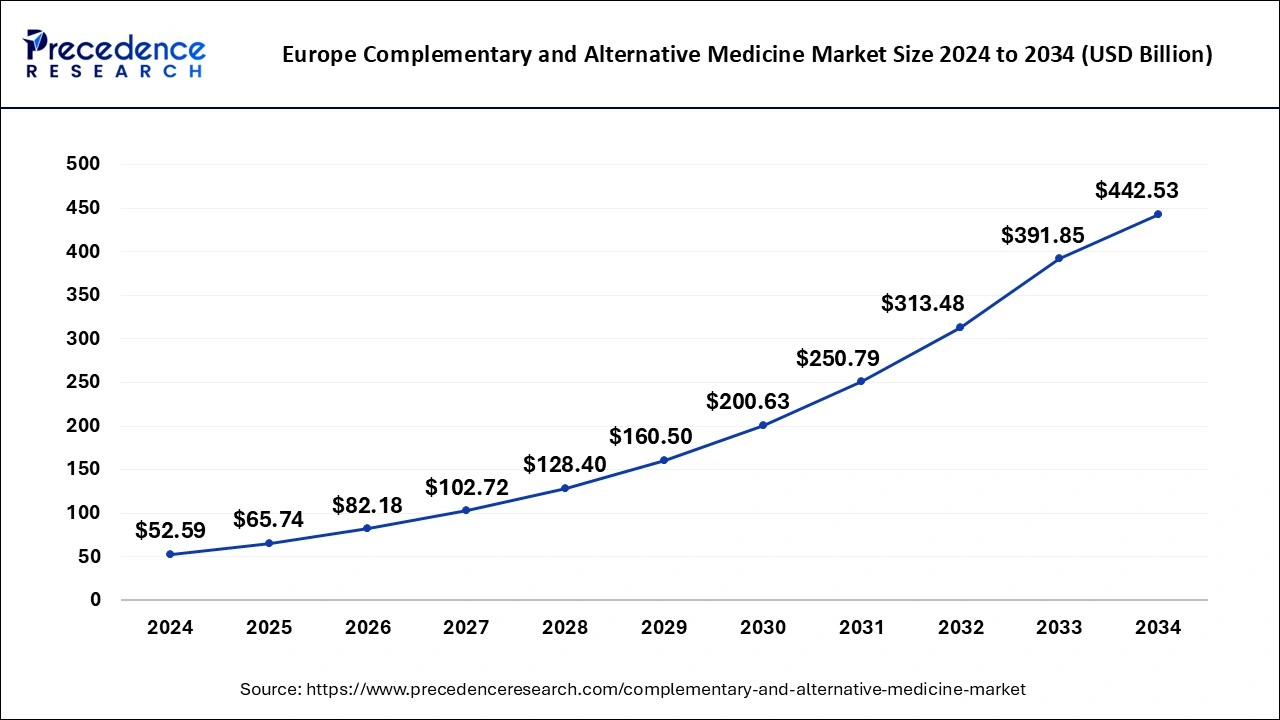
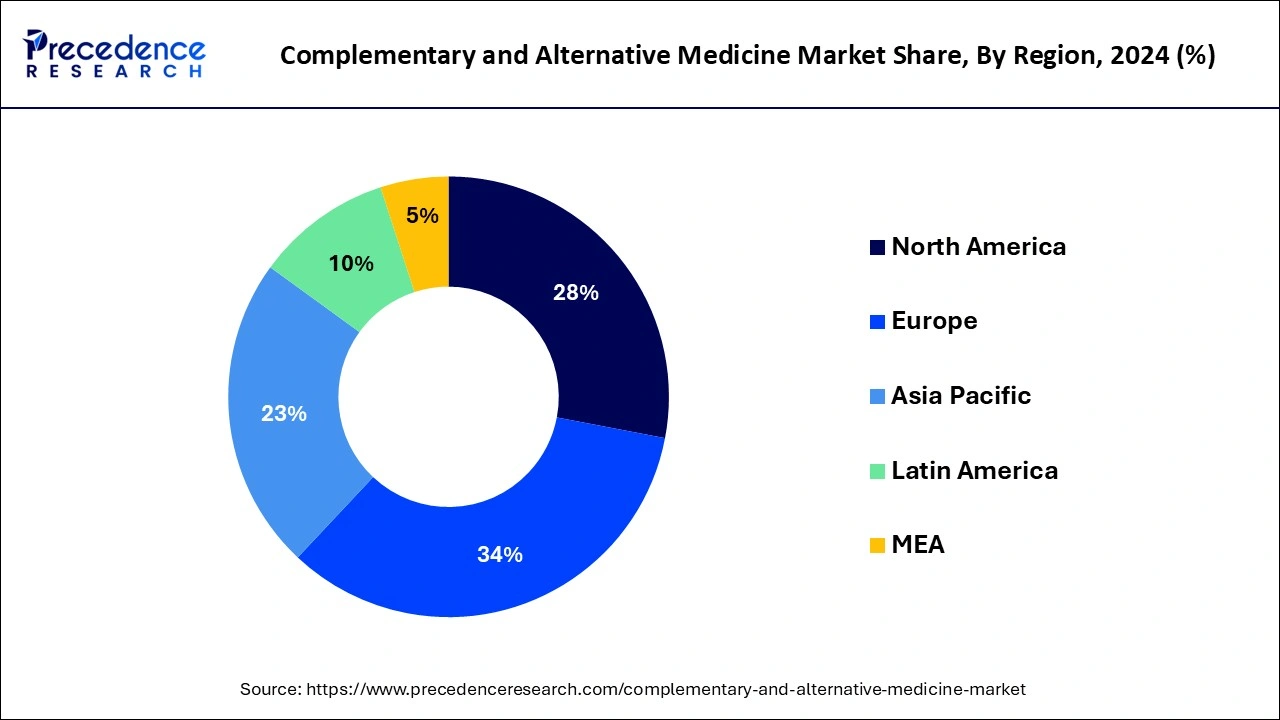
Europe led the global market with a share exceeding 34% in 2025, supported by rising consumer adoption of alternative medicine and declining reliance on conventional pharmaceuticals. Growing awareness of the long-term risks associated with chemical-based medicines has shifted consumer preference toward herbal, Ayurvedic, and naturopathic treatments, while rising adoption of yoga and acupuncture is expected to sustain Europe's leadership position throughout the forecast period. The region has also seen a marked increase in hospitals offering CAM therapies over the past two decades.
The Middle East and Africa region is projected to be the fastest-growing market over the forecast period, driven by a rapid increase in the number of alternative medicine practitioners and rising regional demand for herbal medicines.
UAE - Luxury Wellness Takes the Lead
The UAE continues to lead regional growth, supported by expanding wellness tourism, a growing luxury spa culture, and increasing government acceptance of alternative therapies. High-income consumer spending and rising imports of herbal products have further reinforced steady market development.
United Kingdom Complementary and Alternative Medicine Market Trends
The U.K. reports strong CAM utilization, particularly for chronic and musculoskeletal conditions. Public awareness and the availability of skilled practitioners remain the primary drivers of demand across the healthcare and wellness sectors, while the country's research capabilities and supportive regulatory environment continue to facilitate CAM integration into conventional healthcare.
How is Asia-Pacific performing in the Complementary and Alternative Medicine Market?
Asia Pacific is experiencing the fastest regional growth, driven by government programs promoting traditional healing systems and rising consumer preference for herbal and plant-based products. Growing awareness of preventive health, combined with deepening collaboration between modern and traditional medicine sectors, continues to drive adoption, while technological advancement and digitalization are helping bring the region's native CAM practices closer to global markets.
India Complementary and Alternative Medicine Market Trends
India's CAM market continues to expand rapidly, supported by strong government backing for traditional systems including Ayurveda, homeopathy, and naturopathy. Education initiatives and the establishment of institutions promoting integrative medicine are strengthening the country's CAM infrastructure, while rising consumer trust in natural remedies and access to indigenous medicinal resources position India as a major global player in this space.
What are the Driving Factors of the Complementary and Alternative Medicine Market in North America?
Growth in the region is driven by rising consumer acceptance of natural therapies, deeper integration of CAM into conventional healthcare, and the expansion of digital wellness platforms. Growing awareness of preventive health and stress management further supports demand, while stronger collaboration between healthcare providers and CAM practitioners is improving both accessibility and patient trust across North America.
U.S. Complementary and Alternative Medicine Market Trends
The U.S. market reflects a wide range of regional practices alongside growing mainstream acceptance of CAM within the broader healthcare system. Urban markets are seeing the most significant shifts, supported by well-trained practitioners and wellness-focused consumers. Expanding digital health solutions and personalized therapy offerings continue to be key growth drivers nationwide.
Herbal Healing at its Finest in Germany: Outlook & Insights of the Market
Germany remains at the forefront of the European CAM market, supported by strong consumer trust in herbal and homeopathic medicine. The country's regulated CAM framework and its integration into hospitals and pharmacies provide a solid foundation for sustained growth and continued clinical acceptance.
Value Chain Analysis
- Research and Development: Fine-tune the whole process of discovering and developing so that new products are brought to market faster, and the best CAM formulations are picked.
Key players: Pfizer, Novartis, Roche, Johnson & Johnson - Clinical Trials and Regulatory Approvals: Make processes more efficient and faster by ensuring compliance and, at the same time, keeping the doctors' and patients' needs in mind.
Key players: Parexel, IQVIA, Charles River Laboratories, FDA - Formulation and Final Dosage Preparation: More output with the same or even better quality through manufacturing, less cost, and guaranteed consistency in product outcomes.
Key players: Alembic Pharmaceuticals - Packaging and Serialization: Renovate the whole supply chain to make it more transparent, secure, and authentic.
Key Players: Amcor, Gerresheimer, Schott AG, Tracelink, Optel Group - Distribution to Hospitals, Pharmacies: Setting up an efficient and quick delivery system which will keep the product in good condition and ensure its availability at all times.
Key players: McKesson Corporation, Cencora (formerly AmerisourceBergen), Cardinal Health - Patient Support and Services: Make patient care come alive, and adherence and satisfaction through personalized management of alternative therapy.
Key players: Complementary and Alternative Medicine (CAM) practitioners, Pure Encapsulations, The Healing Company Ltd
Competitive Landscape
The competitive landscape remains moderately fragmented, comprising established market leaders, specialized providers, and value-focused participants. Pure Encapsulations, LLC, Columbia Nutritional, and Nordic Nutraceuticals are among the key players competing through product innovation, technology capabilities, and expanding visibility across core application segments and global markets. Providers are shaping the market's future by integrating complementary therapies with conventional healthcare, advancing personalized wellness through AI-driven digital platforms, and building a stronger evidence base for integrative medicine practices.
Complementary and Alternative Medicine Market Companies
- John Schumacher Unity Woods Yoga Centre
- The Healing Company Ltd.
- Columbia Nutritional
- Nordic Nutraceuticals
- Herb Pharm
- Sheng Chang Pharmaceutical Company
- Pure Encapsulations, LLC.
- RamamaniIyengar Memorial Yoga Institute
- AYUSH AyurvedicPte Ltd.
Recent Developments
- In September 2025, the National Institute of Mental Health and Neurosciences (NIMHANS), in collaboration with the Ministry of AYUSH, Government of India, inaugurated AYUSH-MANN, a month-long initiative aimed at improving public awareness regarding the integrative approaches used in the treatment of mental health and neurological disorders.
- In November 2025, SOUKYA International Holistic Health Centre obtained six acres of land adjacent to its existing campus in Hoskote, Bengaluru, to develop a 100-bedded AYUSH hospital. The total anticipated project cost amounts to Rs. 125 crore, which includes Rs. 50 crore allocated for land acquisition and Rs. 75 crore designated for construction and development. The hospital is intended to offer integrated care for chronic, rare, and complex medical conditions by combining Allopathy, Ayurveda, Homeopathy, Naturopathy, Siddha, Unani, and Yoga, supplemented by complementary therapies.
- In June 2025, a collaboration between AIIMS Bhopal with Patanjali Research Foundation Trust was announced, where they signed a Memorandum of Understanding (MoU) for merging Indian systems of medicine and modern healthcare. In this collaboration, the ancient Ayurvedic knowledge will be integrated with the allopathic medical science for developing and delivering effective and comprehensive healthcare solutions, as well as to encourage joint innovation, research, and education, will be the main goal of this collaboration. (Source: https://www.msn.com)
- In March 2025, a meeting was organized by the Italian Embassy with a leading advocate of Ayurveda and a renowned Ayurveda expert, Giosun, to improve the economic and cultural ties between Italy and India. Furthermore, various distinguished professionals also attended this meeting, which included Prof. Domenico Delfino, Dr. Nancy Joseph, and Dr. Andrea Geracci. Thus, in turn, emphasized the increasing interest of Italy in the field of Ayurveda as well as India's ancient system of holistic wellbeing & healing. (Source: https://www.tribuneindia.com)
Segments Covered in the Report
By Intervention
- Traditional Alternatives/Botanicals
- Ayurveda
- Traditional Japanese Medicines
- Traditional Chinese Medicines
- Traditional Mongolian Medicines
- Bach Flower Therapy
- Others
- Mind Healing
- Spiritual Mind Treatment
- Autosuggestion
- Neuro-linguistic Programming
- Transcendental Meditation
- Hypnotherapy
- Others
- Body Healing
- Acupuncture
- Acupressure
- Chiropractic
- Alexander Technique
- Cupping Therapy
- Osteopathy
- Osteomyology
- Yoga
- Auriculotherapy
- Pilates
- Others
- Sensory Healing
- Music Therapy
- Aroma Therapy
- Sound Therapy
- Sonopuncture
- External Energy
- Magnetic Therapy
- Reiki
- Radionics
- Chakra Healing
- Therapeutic Touch
By Distribution Channel
- E-Sales
- Direct Sales
- Distance Correspondence
- Others
By Geography
- North America
- U.S.
- Canada
- Europe
- U.K.
- Germany
- France
- Asia-Pacific
- China
- India
- Japan
- South Korea
- Malaysia
- Philippines
- Latin America
- Brazil
- Rest of Latin America
- Middle East & Africa (MEA)
- GCC
- North Africa
- South Africa
- Rest of the Middle East & Africa
For inquiries regarding discounts, bulk purchases, or customization requests, please contact us at sales@precedenceresearch.com
Frequently Asked Questions




Ask For Sample
No cookie-cutter, only authentic analysis – take the 1st step to become a Precedence Research client
 Get a Sample
.webp)


 sales@precedenceresearch.com
 Schedule a Meeting