



Intelligent Building Automation Technologies Market Size is USD 106.89 Billion in 2026
Intelligent Building Automation Technologies Market (By Type: Security Systems, Life Safety Systems, Facility Management Systems, Building Energy Management System; By Application: Residential, Commercial, Industrial; By Region: North America, Europe, Asia-Pacific, Latin America, Middle East & Africa) Industry Size, Share, Growth, Trends 2026 to 2035.


The intelligent building automation technologies market size was estimated at USD 97.35 billion in 2025 and is predicted to increase from USD 106.89 billion in 2026 to approximately USD 247.95 billion by 2035, expanding at A CAGR of 9.8% from 2026 to 2035. Rising investment in the digitalization of buildings and demand for energy conservation are driving the intelligent building automation technologies market growth.
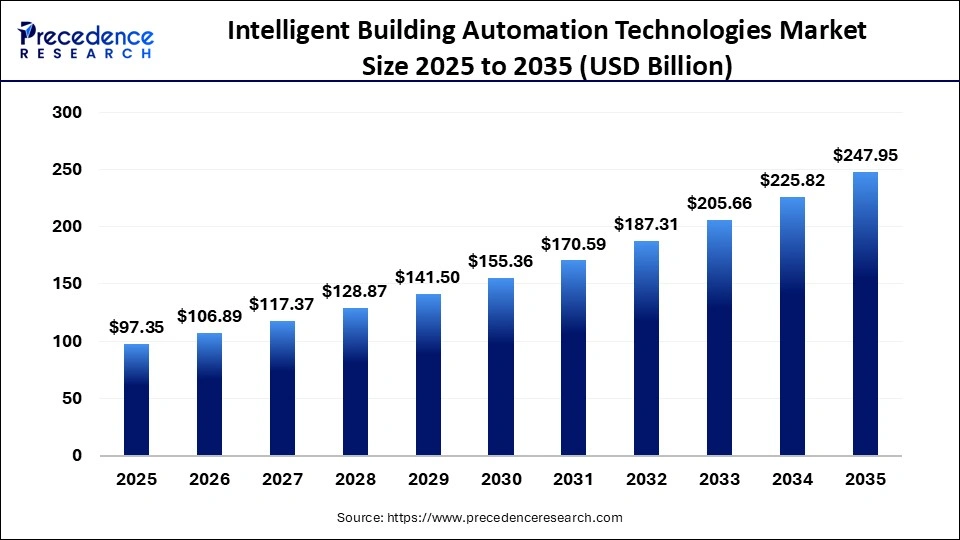
Intelligent Building Automation Technologies Market Statical Scope
| Reports Attributes | Statistics |
| Market Size in 2025 | USD 97.35 Billion |
| Market Size in 2026 | USD 106.89 Billion |
| Market Size by 2035 | USD 247.95 Billion |
| CAGR 2026 to 2035 | 9.8% |
| Base Year | 2025 |
| Forecast Period | 2026 to 2035 |
The market for intelligent building automation technologies encompasses smart technologies integrated into buildings. These technologies are designed to automate and optimize the management of various systems, such as heating, ventilation, air conditioning (HVAC), lighting, security, energy, and other crucial functions. They operate using a network of sensors, controllers, and software platforms. One of the main benefits of intelligent building automation is its energy efficiency.
Automated systems continuously monitor energy consumption patterns and environmental conditions, allowing for real-time adjustments that help minimize energy waste.
The growth of the intelligent building automation technologies market can be attributed to the increasing demand for building automation systems, which aim to balance maximum efficiency with productivity and occupant comfort. These systems integrate energy management, lighting, safety, and security into a single, user-friendly platform. As the concept of smart buildings gains global acceptance, BAS that can meet the complex needs of these intelligent structures becomes increasingly essential.
The rising use of renewable energy sources and growing consumer awareness of environmental protection are also expected to drive the intelligent building automation technologies market. Additionally, there is an increasing awareness of life safety and security, as people recognize the financial losses associated with natural disasters or man-made events, such as floods, earthquakes, terrorist attacks, or construction fires. Implementing these solutions can help reduce the severity of financial losses by optimizing rescue operations and protecting human lives in such situations.
Governments play a crucial role in promoting smart buildings by establishing policies and regulations that support sustainable practices. They also provide financial incentives and grants to encourage investments in smart technologies. Collaboration between the public and private sectors further accelerates the adoption of smart building solutions by facilitating the sharing of resources, knowledge, and expertise.
Several key trends are transforming the future of building automation and smart buildings, driven by technological advancements, increasing demands for efficiency, and the need for sustainability. The use of Internet of Things (IoT) devices, including advanced sensors and smart meters, is essential for the real-time monitoring and control of building systems. Energy management and sustainability are significant factors driving the adoption of intelligent building automation technologies, as these systems help reduce energy consumption, decarbonize buildings, and ensure compliance with regulatory requirements.
Intelligent Building Automation Technologies Market Share, By Region, 2025 (%)
| Regions | Shares (%) |
| North America | 39.0% |
| Europe | 25.0% |
| Asia Pacific | 23.0% |
| Latin America | 7.0% |
| Middle East & Africa | 6.0% |
- North America – It leads globally and, with a 39.0% share, benefits from advanced infrastructure, early technology adoption, and strong investments.
- Europe – It emphasizes energy efficiency and, with a 25.0% share, follows due to moderate growth and regulatory variations.
- Asia Pacific – It is rapidly expanding and, with a 23.0% share, is driven by urbanization and smart city initiatives.
- Latin America – It is emerging gradually and, with a 7.0% share, is limited by lower infrastructure investment and adoption rates.
- Middle East & Africa – It is developing steadily and, with a 6.0% share, faces constraints from economic and technological barriers.
Intelligent Building Automation Technologies Market Share, By Type, 2025 (%)
| Segments | Shares (%) |
| Security Systems | 36% |
| Facility Management Systems | 27% |
| Building Energy Management System (BEMS) | 22% |
| Life Safety Systems | 15.0 |
- Security Systems – It leads the market and, with a 36.0% share, is driven by rising demand for surveillance, access control, and safety across smart buildings.
- Facility Management Systems – It supports operational efficiency and, with a 27.0% share, remains secondary due to slower adoption compared to security-focused solutions.
- Building Energy Management System (BEMS) – It is expanding with sustainability trends and, with a 22.0% share, is driven by the need for energy optimization and cost savings.
- Life Safety Systems – It ensures compliance and safety and, with a 15.0% share, is limited by its niche and regulatory-driven adoption.
Intelligent Building Automation Technologies Market Share, By Application, 2025 (%)
| Segments | Shares (%) |
| Commercial | 42% |
| Residential | 33% |
| Industrial | 25% |
- Commercial – It drives major adoption and, with a 42.0% share, benefits from high investment in smart offices, malls, and infrastructure.
- Residential – It is growing in smart homes and, with a 33.0% share, is constrained by cost sensitivity and slower consumer adoption.
- Industrial – It supports automation needs and, with a 25.0% share, lags due to complex integration and lower priority compared to core operations.
Top Companies in the Intelligent Building Automation Technologies Market
- Siemens Building Technologies Inc. (Switzerland)
- Schneider Electric (France)
- Honeywell International Inc. (U.S.)
- Johnson Control Inc. (U.S.)
- United Technologies Corporation (U.S.)
- ABB Limited (Switzerland)
- Azbil Corporation (Japan)
- Eaton Corporation (Ireland)
- General Electric (U.S.)
- Ingersoll Rand Inc. (U.S.)
Segments Covered in the Report
By Type
- Security Systems
- Life Safety Systems
- Facility Management Systems
- Building Energy Management System
By Application
- Residential
- Commercial
- Industrial
By Region
- North America
- Europe
- Asia Pacific
- Latin America
- Middle East & Africa
| Application | 2025 | 2026 | 2027 | 2028 | 2029 | 2030 | 2031 | 2032 | 2033 | 2034 | 2035 |
|---|---|---|---|---|---|---|---|---|---|---|---|
| Commercial | 40.89 | 44.68 | 48.82 | 53.35 | 58.30 | 63.70 | 69.60 | 76.05 | 83.09 | 90.78 | 99.18 |
| Residential | 32.13 | 35.70 | 39.67 | 44.07 | 48.96 | 54.38 | 60.39 | 67.06 | 74.45 | 82.65 | 91.74 |
| Industrial | 24.34 | 26.51 | 28.87 | 31.44 | 34.24 | 37.29 | 40.60 | 44.20 | 48.12 | 52.39 | 57.03 |
| Region | 2025 | 2026 | 2027 | 2028 | 2029 | 2030 | 2031 | 2032 | 2033 | 2034 | 2035 |
|---|---|---|---|---|---|---|---|---|---|---|---|
| North America | 37.97 | 41.15 | 44.60 | 48.33 | 52.35 | 56.71 | 61.41 | 66.49 | 71.98 | 77.91 | 84.30 |
| Europe | 24.34 | 26.62 | 29.11 | 31.83 | 34.81 | 38.06 | 41.62 | 45.52 | 49.77 | 54.42 | 59.51 |
| Asia Pacific | 22.39 | 25.33 | 28.64 | 32.35 | 36.51 | 41.17 | 46.40 | 52.26 | 58.82 | 66.16 | 74.38 |
| Latin America | 6.81 | 7.48 | 8.22 | 9.02 | 9.90 | 10.88 | 11.94 | 13.11 | 14.40 | 15.81 | 17.36 |
| Middle East & Africa | 5.84 | 6.31 | 6.81 | 7.35 | 7.92 | 8.54 | 9.21 | 9.93 | 10.69 | 11.52 | 12.40 |
Research Methodology
Related Databooks
March 2026
March 2026
April 2026
April 2026


 sales@precedenceresearch.com
 +1 804-441-9344
 Download Databook
 Schedule a Meeting