



Middle East Microgrid Market Size is USD 8.21 Billion in 2026
Middle East Microgrid Market (By Power Source: CHP, Natural Gas, Solar PV, Diesel, Fuel Cell, Others; By Connection: Remote, Grid Connected, Hybrid; By End Use: Government, Education, Commercial, Utility, Defense, Others) Industry Size, Share, Growth, Trends 2026 to 2035.


The Middle East microgrid market size was estimated at USD 7.45 billion in 2025 and is expanding at a CAGR of 10.20% from 2026 to 2035. The market is driven by the rising energy requirement, the random power cuts, and the reliability issue of the electricity supply.
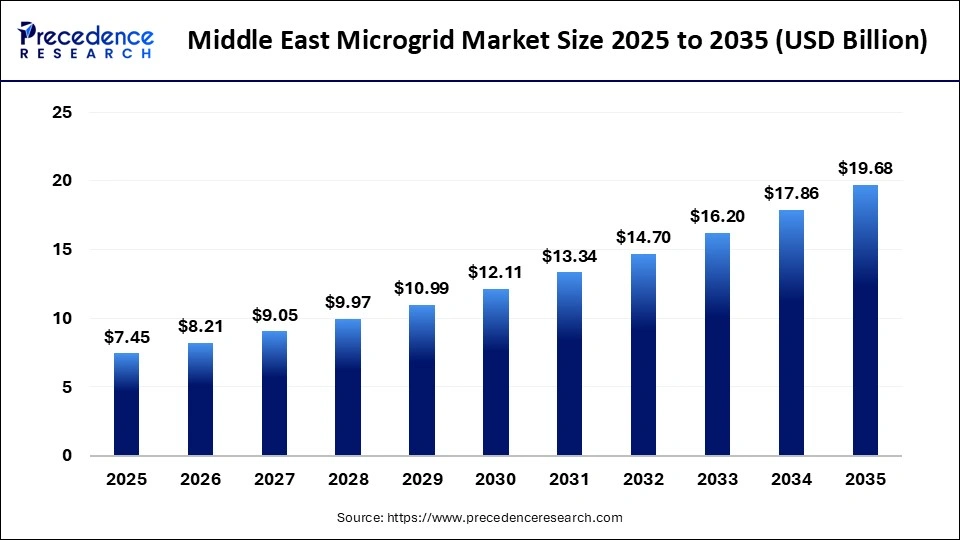
Middle East Microgrid Market Statical Scope
| Reports Attributes | Statistics |
| Market Size in 2025 | USD 7.45 Billion |
| Market Size in 2026 | USD 8.21 Billion |
| Market Size by 2035 | USD 19.68 Billion |
| CAGR 2026 to 2035 | 10.20% |
| Base Year | 2025 |
| Forecast Period | 2026 to 2035 |
The Middle East microgrid market is characterized by the establishment, commissioning, and operation of small power grids capable of functioning both independently and alongside the main grid. These microgrids integrate renewable energy sources, power storage systems, and smart technologies to provide a reliable, economical, and sustainable electricity supply.
Market growth is propelled by favorable solar irradiation, declining costs of renewable technologies, and robust policy support through incentives, public-private partnerships, and concessional financing. The integration of advanced technologies such as battery energy storage systems , smart inverters, and artificial intelligence - enabled energy management platforms enhances operational flexibility and efficiency.
Middle East Microgrid Market Share, By Country, 2025
- Saudi Arabia- The microgrid market in Saudi Arabia is experiencing notable expansion as the nation seeks to enhance its energy resilience, reliability, and sustainability. The adoption of microgrids within the country is gaining momentum due to their capacity to deliver localized and reliable power.
Middle East Microgrid Market Share, By Power Sources, 2025, (%)
| Segments | Shares (%) |
| Solar PV | 34% |
| Natural gas | 18% |
| CHP | 15% |
| Diesel | 12% |
| Fuel Cell | 11% |
| Others | 10% |
- Solar PV- solar photovoltaic systems hold a 34% share, driven by abundant solar resources and strong commitments to renewable energy initiatives.
- Natural gas- The natural gas segment accounts for an 18% share, remains a reliable and readily accessible energy source, and provides critical baseload generation in both industrial and urban settings.
- CHP- Combined heat and power generation supports sustainability objectives by utilizing diverse fuels and captures a 15% share of the market.
- Diesel- Diesel is frequently employed in hybrid microgrids to reinforce intermittent renewable energy sources, as well as for backup and remote power generation, representing a 12% market share.
- Fuel Cell - Emerging use in clean energy and backup power applications, with a 11% share, supports the market but remains below leading segments.
- Others - Includes various smaller and niche applications, with a 10% share, result in moderate overall contribution.
Middle East Microgrid Market Share, By Connection Types, 2025, (%)
| Segments | Shares (%) |
| Remote | 40% |
| Grid-connected | 30% |
| Hybrid | 30% |
- Remote - remote systems dominate the market with a 40% share, reflecting high demand for off-grid power solutions in rural and remote areas.
- Grid-connected - Grid-connected systems integrate with existing infrastructure and account for a 30% share, facilitated by their ability to switch between grid power and local generation.
- Hybrid - Hybrid microgrids combine multiple energy sources, are rapidly growing, and hold a 30% share.
Middle East Microgrid Market Share, By End-Use Applications, 2025, (%)
| Segments | Shares (%) |
| Government | 24% |
| Commercial | 22% |
| Education | 18% |
| Utility | 15% |
| Defense | 11% |
| Others | 10% |
- Government- the government sector leads with a 24% share. Growth of the segment is driven by significant public sector investments and infrastructure development initiatives.
- Commercial- The commercial sector accounts for a 22% share. This growth is propelled by the need for uninterrupted power, cost management, and sustainability efforts.
- Education- the education segment is growing due to rising deployment in universities, schools, and research campuses, with 18% share.
- Utility- The utility segment is driven by the demand for enhanced grid reliability and reduced transmission losses, and holds 15% share.
- Defense - Emerging use in defense, with a 11% share, supports the market but remains below leading segments.
- Others - Includes various smaller and niche applications, with a 10% share, result in moderate overall contribution.
Top Companies in the Middle East Nanocatings Market
- ABB Ltd.
- Schneider Electric SE
- Siemens AG
- General Electric Company
- Honeywell International Inc.
- Hitachi Energy Ltd.
- Eaton Corporation plc
- ENGIE SA
- Yokogawa Electric Corporation
- Tesla Inc.
Segments Covered in the Report
By Power Source
- CHP
- Natural Gas
- Solar PV
- Diesel
- Fuel Cell
- Others
By Connection
- Remote
- Grid Connected
- Hybrid
By End Use
- Government
- Education
- Commercial
- Utility
- Defense
- Others
| Power Source | 2025 | 2026 | 2027 | 2028 | 2029 | 2030 | 2031 | 2032 | 2033 | 2034 | 2035 |
|---|---|---|---|---|---|---|---|---|---|---|---|
| CHP | 0.97 | 1.08 | 1.22 | 1.37 | 1.53 | 1.71 | 1.91 | 2.13 | 2.38 | 2.66 | 2.95 |
| Natural Gas | 1.57 | 1.71 | 1.86 | 2.03 | 2.22 | 2.42 | 2.64 | 2.88 | 3.15 | 3.43 | 3.74 |
| Solar PV | 2.24 | 2.59 | 2.94 | 3.34 | 3.79 | 4.30 | 4.87 | 5.52 | 6.24 | 7.06 | 7.87 |
| Diesel | 1.27 | 1.31 | 1.36 | 1.40 | 1.43 | 1.45 | 1.47 | 1.55 | 1.62 | 1.70 | 1.77 |
| Fuel Cell | 0.67 | 0.76 | 0.86 | 0.98 | 1.10 | 1.25 | 1.42 | 1.60 | 1.82 | 2.05 | 2.32 |
| Others | 0.75 | 0.76 | 0.81 | 0.86 | 0.92 | 0.98 | 1.04 | 1.09 | 1.17 | 1.23 | 1.02 |
| Connection | 2025 | 2026 | 2027 | 2028 | 2029 | 2030 | 2031 | 2032 | 2033 | 2034 | 2035 |
|---|---|---|---|---|---|---|---|---|---|---|---|
| Remote | 3.43 | 3.74 | 4.07 | 4.44 | 4.84 | 5.27 | 5.74 | 6.25 | 6.81 | 7.41 | 8.07 |
| Grid Connected | 2.16 | 2.42 | 2.72 | 3.04 | 3.41 | 3.82 | 4.27 | 4.78 | 5.35 | 5.98 | 6.69 |
| Hybrid | 1.86 | 2.05 | 2.26 | 2.49 | 2.75 | 3.03 | 3.34 | 3.68 | 4.05 | 4.47 | 4.92 |
Research Methodology
Related Databooks
March 2026
April 2026
April 2026
April 2026


 sales@precedenceresearch.com
 +1 804-441-9344
 Download Databook
 Schedule a Meeting