


Dental Microscope Market Size, Key Companies, Company Product Portfolio, Hospital Procurement Trends, Manufacturing Capacity, Sales Performance, Regulatory Approvals, Company Market Share, and Forecast
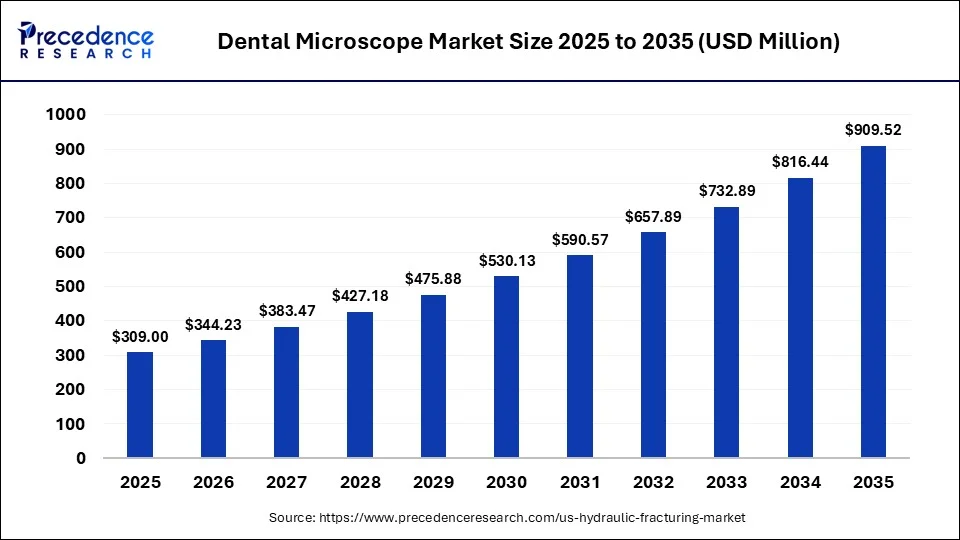
The dental microscope market reached USD 344.23 million in 2026. The market growth is attributed to the rising prevalence of dental disorders and the increasing use of magnification in endodontics, restorative dentistry, periodontics, prosthodontics, implantology, and dental surgery. These trends were analyzed by Deepa Pandey, Senior Research Analyst, to curate this report. Her research benefits stakeholders, including medical device manufacturers, distributors, software and integration partners, healthcare organizations, and dental specialists.
Source: https://www.precedenceresearch.com/dental-microscope-market
 Get a Sample
 Table Of Content


Dental Microscope Market Analysis, Demand, and Growth Rate Forecast 2035
The dental microscope market is forecasted to expand from USD 344.23 million in 2026 to USD 909.52 million by 2035, growing at a CAGR of 11.4% from 2026 to 2035. Growing demand for advanced dental equipment, the rising need for accurate diagnosis and treatment, and increasing awareness of aesthetic dental appearance drive the market. Deepa Pandey, who has over 5 years of experience in healthcare market research, noted that researchers are focusing on developing dental microscopes with enhanced magnification, digital systems and monitors, and high-quality lighting systems.
Key Takeaways
- Dental microscopes are priced in the range of $10,000 to $50,000 depending on their basic features.
- By product, the surgical microscopes segment dominated the market with a share of 56.98% in 2025.
- By modality, the portable systems segment held the largest market share of 63.05% in 2025.
- By illumination, the LED systems contributed the biggest market share of 61.22% in 2025.
- The market is growing into two complementary growth engines, including the installed base among first-time users and increasing revenue per existing installation through technological upgrades.
- Carl Zeiss Meditec generated revenue of €2.23 billion in FY2024/25, of which €503.9 million was generated from the Microsurgery segment.
- North America held a major market share of 41.23% in 2025.
- The market's future is driven by 4K and high-resolution imaging, AI-assisted image interpretation, and cloud-based case documentation.
How is the Dental Microscope Market Growing?
The dental microscope market was valued at approximately USD 309 million in 2025 and is projected to increase at a CAGR of 11.4% during the forecast period. Our analysis indicates that this trajectory reflects a combination of new-unit adoption and replacement demand, rather than a simple increase in the number of microscopes installed. The replacement opportunity rises among older installed systems, encouraging customers to leverage LED illumination, apochromatic optics, variable working distances, integrated cameras, digital connectivity, and improved ergonomic suspension systems.
Our analysis indicates that premiumization is likely to be a material contributor to revenue growth because technological upgrades can increase value per installation even when unit-volume growth is comparatively moderate. Publicly visible 2025 pricing benchmarks spanning approximately USD 10,000 to USD 50,000 demonstrate a wide value-to-premium spectrum, with published configurations ranging from approximately USD 10,800 for more basic specialist systems to around USD 25,000 for high-end integrated-camera configurations. In our view, this pricing dispersion indicates that manufacturers are competing not only on magnification but increasingly on the combined value of optical performance, visualization, imaging, documentation, ergonomics, and workflow integration.
In our view, the most significant strategic implication is that the market is developing two complementary growth engines: expanding the installed base among first-time users and increasing revenue per existing installation through technology-led upgrades. This creates opportunities for manufacturers to address different purchasing thresholds through entry, professional, and premium configurations, while replacement cycles provide an additional source of relatively recurring capital-equipment demand. The commercial risk is that higher ASPs could lengthen replacement cycles or restrict adoption among price-sensitive practices; therefore, the ability to demonstrate clinical, ergonomic, and workflow-related value will remain important to sustaining premium pricing.
Segmentation Analysis
Surgical Systems and Endodontic Workflows Anchor the Revenue Pool
The market can be analyzed across product, modality, illumination, application, end user, and geography.
By product, surgical microscopes represent the largest revenue segment, with one current estimate assigning them a 56.98% share in 2025. Operating microscopes constitute the second major category and are expected to expand as dental practices broaden microscope-assisted procedures beyond conventional endodontic applications.
By modality, portable systems represented approximately 63.05% of 2025 revenue in one market estimate, reflecting demand for flexible deployment across operatories and practices. Fixed installations remain relevant for premium clinics, hospitals, education centers, and high-volume specialist environments.
By illumination, LED systems accounted for approximately 61.22% of 2025 market revenue in the same estimate. LED adoption is supported by long operating life, brightness, color rendering, and lower maintenance requirements.
By application, endodontics accounted for approximately 36.95% of market revenue in 2025, while implantology is among the faster-growing applications.
By end user, dental clinics are becoming increasingly important as microscopy moves beyond hospitals and academic institutions. Dental clinics held the largest market share of 42.11% in 2025.
What are the Growth Factors and Challenges of the Dental Microscope Market?
Drivers
- Complex dental procedures: Narrow root canals, accessory canals, microfractures, and minimally invasive restorative procedures benefit from enhanced visualization. The American Association of Endodontists notes that dental microscopes can provide magnification of up to approximately 25× and support visualization during diagnosis and endodontic treatment.
- Ergonomic dentistry: Clinician posture is increasingly important because dental professionals spend long periods performing precision procedures. Premium microscopes increasingly emphasize adjustable binoculars, working distance, arm movement, and upright operating positions.
- Digital documentation: Integrated cameras allow treatment documentation, education, patient communication, and case review. Modern systems increasingly function as visualization-and-documentation platforms rather than standalone optical instruments.
- Expansion into non-endodontic applications: Periodontics, implantology, restorative dentistry, prosthodontics, and aesthetic procedures broaden the addressable market.
Restraints
The primary barriers include high acquisition cost, training requirements, chairside workflow changes, space requirements, and clinician learning curves. A 2025 survey of endodontists and postgraduate endodontic students found that 26.1% reported using a dental operating microscope, while 41.1% reported using no magnification system, illustrating continuing penetration headroom. The most common expected cost-recovery period was 1–2 years.
What is the Role of Premium Optics and Digital Integration in the Pricing of Dental Microscopes?
Dental microscope pricing is configuration-driven rather than commodity-driven. Public pricing evidence indicates a broad USD 10,000 to USD 50,000 market range. The pricing of dental microscopes depends on optical quality and apochromatic design, magnification range, the number of magnification steps, and working-distance flexibility. The pricing for modern systems largely depends on advanced illumination systems, integrated camera resolution, 3D/heads-up capability, and digital connectivity. Other aspects that affect the pricing of dental microscopes include ergonomic accessories and training and after-sales support.
What are the Technological Advancements in the Dental Microscope Market?
The technology frontier is shifting from magnification to integrated visualization and digital workflow capabilities. Premium systems increasingly combine apochromatic optics, high-intensity LED illumination, integrated 4K imaging, fluorescence, cross-polarization, digital patient communication, and networked documentation.
For example, the EXTARO 300 combines a 4K camera with Fluorescence, TrueLight, and NoGlare visualization and supports a 200–430 mm adjustable working distance, while the M320 D integrates a 4K camera, LED illumination, and an optional MultiFoc objective offering 200–300 mm working-distance adjustment. These specifications indicate that manufacturers are increasingly competing on the breadth of the clinical workflow enabled by the microscope rather than on magnification range alone.
Our analysis indicates that digital visualization is becoming a commercially meaningful layer of differentiation because it expands the microscope's role from an individual clinician's optical instrument into a shared clinical, documentation, and communication platform. The emergence of 3D visualization reinforces this shift: Seiler's 3D dental surgical microscope provides 2× to 28× magnification, 1080p at 60 fps visualization, and a heads-up display, allowing clinicians to work from a monitor rather than conventional eyepieces. Similarly, the expansion of the Flexion portfolio into twin-LED illumination, selective filters, 3D visualization, and imaging demonstrates that innovation is increasingly occurring at the intersection of optics, illumination, and digital visualization rather than within optics alone. Our assessment is that these capabilities can support premium positioning when they deliver demonstrable improvements in visualization, documentation, ergonomics, or clinical workflow; however, individual features are unlikely to create durable differentiation unless they translate into measurable user value.
In our view, the most significant strategic implication is the widening separation between conventional microscope upgrades and platform-oriented premium systems. Manufacturers competing primarily on magnification and illumination may face increasing pressure as integrated imaging, visualization modes, and workflow connectivity become more important purchasing criteria. From our assessment, this creates an opportunity for suppliers to differentiate through feature integration, modular upgradeability, and application-specific workflows, while also creating a risk that increasingly sophisticated configurations raise acquisition costs and lengthen purchasing decisions. The commercial significance of each technology therefore needs to be assessed against its incremental ASP, adoption potential, and relevance to specific dental procedures rather than technical sophistication alone.
How does the Competitive Landscape Reshape the Dental Microscope Market?
| Company | Headquarters | Market Position | Core Strength |
| Carl Zeiss Meditec/ZEISS | Germany | Global premium | Advanced optics, digital visualization |
| Leica Microsystems | Germany | Global premium | Optics, ergonomics, imaging |
| Zumax Medical | China | Global challenger | Dental microscope breadth/value |
| Global Surgical Corporation | U.S. | Dental specialist | Dental microscopy |
| Seiler Medical | U.S. | Specialist | Dental and 3D microscopy |
| Labo America/LABOMED | U.S. | Specialist | Dental operating microscopes |
| Karl Kaps | Germany | Specialist | Precision dental/surgical optics |
| CJ-Optik | Germany | Specialist | Dental optics and ergonomics |
| SOCO Precision Instrument | China | Asian challenger | Dental precision equipment |
| ALLTION | China | Asian manufacturer | Dental/surgical microscopy |
| ARI Medical Technology | China | Emerging supplier | Medical/dental optical equipment |
| Foshan SOCO Precision Instrument | China | Dental specialist | Microscopy and dental equipment |
| Bondent / Semorr | China | Dental platform | Microscopy and integrated dental products |
| Optomic | Spain | Specialist | Dental microscope systems |
| Seliga Microscopes | U.S. | Specialist | Surgical/dental microscopy |
| SurgiTel/General Scientific | U.S. | Magnification specialist | Dental magnification ecosystem |
| Möller-Wedel Optical | Germany | Optical specialist | Surgical microscopy |
| Meiji Techno | Japan/U.S. | Optical specialist | Microscopy technology |
The dental microscope market is characterized by three broad competitive groups: global optical/medical-technology companies, specialized dental microscope manufacturers, and cost-competitive Asian manufacturers. The competitive universe identified in the analysis comprises 18 companies, spanning Germany, the U.S., China, Spain, and Japan. However, company-level market share cannot be reliably derived from public disclosures because dental-microscope-specific revenue is generally not reported separately from broader corporate portfolios.
Our analysis indicates that competitive positioning is increasingly determined by the combination of optical performance, dental-specific functionality, ergonomics, digital integration, and price-value positioning rather than corporate scale alone. The presence of specialist manufacturers and global technology companies suggests that category expertise and dental workflow relevance can offset differences in overall corporate scale. Our assessment is that the competitive structure is therefore better understood as a capability-based market with distinct premium, specialist and value-oriented positioning layers rather than as a straightforward scale-driven hierarchy.
In our view, the most significant strategic implication is the growing pressure on premium players to demonstrate measurable differentiation while value-oriented challengers expand the range of technically credible alternatives. The competitive opportunity is not necessarily limited to matching headline magnification specifications; manufacturers can differentiate through optical quality, ergonomic design, 3D or digital visualization, imaging, application breadth, service infrastructure, and channel reach. At the same time, the fragmented structure creates opportunities for specialists to strengthen their position through focused dental portfolios and for emerging suppliers to compete where price accessibility and product breadth are more influential purchasing criteria. The current company universe should therefore be interpreted as a competitive landscape rather than a validated market-share ranking.
Corporate Scale Does Not Directly Translate Into Dental Microscope Share
A defensible public company-level market-share ranking is constrained by the limited disclosure of dental-microscope-specific sales. Carl Zeiss Meditec, for example, generated €2.23 billion in revenue in FY2024/25, including €503.9 million from its Microsurgery strategic business unit, but this figure covers broader microsurgery rather than dental microscopes specifically.
This distinction is strategically important: dental microscope competition is influenced more by installed dental microscope base, specialist distribution, optical reputation, dentist training networks, product ASP, application coverage, and replacement relationships than by overall corporate healthcare revenue.
What is the Product Portfolio and Technology Benchmarking of the Dental Microscope Market?
The leading product portfolios increasingly comprise:
- Fixed and portable microscopes
- 3-, 5-, and 6-step magnification systems
- Continuous zoom
- LED and dual-LED illumination
- Fluorescence and selective filters
- 4K imaging
- 3D heads-up visualization
- Variable working distance
- Floor, wall and ceiling mounting
- Patient communication software
- Treatment documentation
- Training and livestreaming
This creates a clear competitive shift: optical magnification is becoming a baseline capability, while visualization modes, ergonomics, digital documentation, and workflow integration determine premium positioning.
Regional Analysis
How Do Several Regions Contribute to the Dental Microscope Market?
North America accounted for the highest market share of 41.23% in 2025. The difference reflects variations in market definitions and estimation periods, but both indicate North America's established position. This dominance is attributed to the presence of a favorable dental ecosystem and reimbursement policies for medical devices.
Europe remains important because of its concentration of premium optical engineering and specialist manufacturers. Germany is particularly significant in high-end dental microscopy.
Asia Pacific represents the major expansion opportunity. Current estimates identify the region as the fastest-growing major geography, with approximately 8.93% CAGR from 2026 to 2035, supported by expanding dental infrastructure, urban clinics, dental chains, and increasing availability of technologically advanced but lower-cost equipment.
What are the Regulatory and Sustainability Frameworks of the Dental Microscope Market?
In the United States, surgical microscope classifications under 21 CFR 878.4700 include Class I devices with 510(k)-exempt classifications for applicable product codes, subject to exemption limitations and other regulatory requirements.
However, configurations incorporating additional functions, such as fluorescence-assisted caries detection or specific imaging capabilities, can involve more detailed intended-use and labeling considerations. A recent FDA document for a dental surgical microscope describes magnification and illumination functions and specifies fluorescence as an adjunctive aid for dental caries detection.
Sustainability is primarily linked to LED longevity, energy efficiency, serviceability, equipment refurbishment and replacement-cycle management, rather than consumable-intensive environmental exposure.
Who are the Customers of Dental Microscopes?
The principal customers are:
- Endodontists
- Periodontists
- Implantologists
- Restorative dentists
- Prosthodontists
- Oral and maxillofacial surgeons
- Dental hospitals
- Academic institutions
- Dental training centers
- Multi-location dental groups
Purchasing decisions are influenced by optical clarity, ergonomics, illumination, magnification, camera integration, warranty, service network, training, and total cost of ownership.
Endodontics remains the anchor application because of the small operating field and the need to identify fine anatomical structures. However, implantology, restorative dentistry, and microsurgical procedures provide important incremental growth pools.
White-Space Analysis of the Dental Microscope Market: The Largest Untapped Pools Lie Beyond Traditional Endodontics
According to our Senior Researcher, Aman Singh, several commercially relevant white spaces include:
- 3D and Heads-up Microscopy: Moving clinicians away from eyepiece-dependent workflows can address ergonomics, assistant participation, and training.
- Mid-Market Digital Systems: There is room between premium systems priced above USD 30,000 and basic optical microscopes for configurations combining strong optics, LED illumination, and 4K documentation at more accessible ASPs.
- Asia Pacific: Faster regional growth creates opportunities for localized manufacturing, distributor expansion, and lower-cost premium systems.
- Dental-Chain Deployment: Multi-clinic groups create opportunities for standardized microscope platforms, centralized training, and service contracts.
- Digital Documentation: Integrated imaging can create additional value through patient education, case acceptance, specialist consultation, teaching, and clinical records.
What is the Future Outlook of the Dental Microscope Market?
The next phase of the dental microscope industry is expected to move from simply achieving higher magnification toward delivering better visualization, better ergonomics, integrated imaging, and connected clinical workflows.
Stakeholders focus on technology themes, such as:
- 4K and higher-resolution imaging
- 3D heads-up visualization
- Fluorescence-assisted visualization
- AI-assisted image interpretation
- Digital patient communication
- Cloud-based case documentation
- Ergonomic suspension systems
- Variable/continuous magnification
- Portable systems
- Integrated training platforms
The market's future profit pools are likely to emerge where optical hardware, digital imaging, workflow software, training, and service support converge.
Key Strategic Questions Addressed
- How large is the dental microscope market in 2025, and how rapidly will it expand through 2030?
- What portion of the market is generated by surgical versus operating microscopes?
- How quickly are portable and fixed systems gaining share?
- What is the economic impact of 4K imaging and 3D visualization on ASP?
- Which dental specialties generate the highest microscope demand?
- How much penetration headroom remains among endodontists and general dentists?
- What factors determine microscope replacement cycles?
- How do premium optical systems justify their higher ASPs?
- Which manufacturers compete primarily on technology, specialization, or price?
- How fragmented is the dental microscope competitive landscape?
- Which companies have the broadest dental-specific portfolios?
- How are Chinese manufacturers changing the global price/performance curve?
- Which applications beyond endodontics offer the largest incremental opportunity?
- How will 3D, fluorescence, and digital documentation change microscope adoption?
- Where are the highest-value geographic and product white spaces through 2030?
Experts Insights
Our Senior Researcher, Aditi Shivarkar, suggests that the dental microscope market is experiencing a shift from conventional installed systems to technologically advanced microscopes with higher resolution capacities and digital workflows. Healthcare professionals are becoming aware of the need to provide extensive, personalized care to patients, encouraging them to adopt dental microscopes. Key players mainly focus on integrated imaging, advanced illumination, digital documentation, and 3D visualization.
An important market key performance indicator is microscope penetration among addressable dental professionals, rather than market revenue alone. Combining penetration, installed base, replacement cycle, procedure utilization, and demonstrable ROI provides a more informative view of the market's underlying growth potential.
Our Experts
- The primary research process was carried out by Deepa Pandey, Senior Research Analyst, who also designed the methodology and did market segmentation and regional analysis.
- Aman Singh, Head of Research, has gathered and checked regulatory policies, competitive analysis, and company financial information, which were obtained independently, thereby increasing the quality of evidence supporting the calculations of the market values.
- Aditi Shivarkar, VP Research, has validated and refined the research material, verified facts, corrected inconsistencies, and completed the research document, making it accurate and to the point.
Dental Microscope Market Segmentation
By Product
- Surgical Microscopes
- Operating Microscopes
By Modality
- Portable Systems
- Fixed Systems
- By Illumination
- LED
- Other Illumination Systems
By Application
- Endodontics
- Implantology
- Periodontics
- Restorative Dentistry
- Prosthodontics
- Other Applications
By End User
- Dental Clinics
- Dental Hospitals
- Academic Institutions
- Dental Training Centers
- Multi-location Dental Groups
- Other End Users
By Region
- North America
- U.S.
- Canada
- Europe
- Germany
- UK
- France
- Italy
- Spain
- Rest of Europe
- Asia Pacific
- China
- Japan
- India
- South Korea
- Rest of Asia Pacific
- Latin America
- Brazil
- Mexico
- Rest of Latin America
- Middle East & Africa
- GCC Countries
- South Africa
- Rest of Middle East & Africa
For inquiries regarding discounts, bulk purchases, or customization requests, please contact us at sales@precedenceresearch.com
Frequently Asked Questions
Tags





Ask For Sample
No cookie-cutter, only authentic analysis – take the 1st step to become a Precedence Research client
 Get a Sample
.webp)



 sales@precedenceresearch.com
 Schedule a Meeting