



Digital Twin in Marine Market Trends, Companies, Revenue / Sales Performance, Manufacturing Yield, Fab Capacity, Export & Import Dynamics, Supply Chain Analysis, Competitive Landscape, and Growth Forecast
Digital Twin in Marine Market (By Offering: Platform & Solutions, Services, Fastest Growing: Services; By End User: Ship Operators, Shipbuilders, Ports & Terminals / Offshore & Energy; By Component/Type: Vessel Digital Twin, Port Operation Twin, Offshore Twin, Subsea Twin, Hybrid/Other Twins; By Application: Operations Monitoring, Predictive Maintenance, Asset Management, Safety & Compliance, Crew Training) - Global Industry Analysis, Size, Trends, Leading Companies, Regional Outlook, and Forecast 2026 to 2035
Source: https://www.precedenceresearch.com/digital-twin-in-marine-market
 Get a Sample
 Table Of Content


What is Digital Twin in Marine Market Size in 2026?
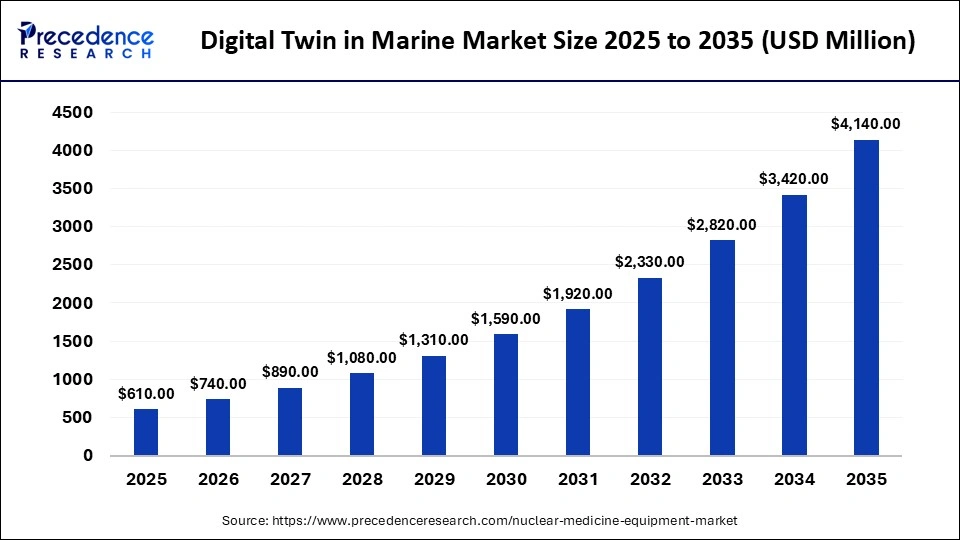
The global digital twin in marine market size was calculated at USD 610.00 million in 2025 and is predicted to increase from USD 740.00 million in 2026 to approximately USD 4,140.00 million by 2035, expanding at a CAGR of 21.10% from 2026 to 2035. The market is driven by demand for real-time monitoring, predictive maintenance, and improved vessel efficiency.
Key Takeaways
- Asia Pacific dominated the market with a share of 38% in 2025.
- North America is expected to grow at a significant CAGR in the market during the forecast period.
- By offering, the platform & solutions segment holds a dominant position in the market, while holding a 60% share in 2025.
- By offering, the services segment is expected to grow at the fastest CAGR between 2026 and 2035.
- By end user, the ship operators segment accounted for a major revenue share of 45% in 2025.
- By end user, the shipbuilders segment is expected to grow at a notable rate in the market during the studied years.
- By component/type, the vessel digital twin segment led the global market with a share of 30% in 2025.
- By component/type, the offshore twin segment is expected to expand rapidly in the market during the coming years.
- By application, the operations monitoring segment registered its dominance in the global market with a share of 35% in 2025.
- By application, the predictive maintenance segment is expected to witness the fastest growth in the market over the forecast period.
Market Overview
The digital twin in marine market deals with developing and putting into practice digital duplicates of marine resources like commercial vessels, navy craft, offshore platforms, and harbor infrastructure. These digital twins are reflections of physical resources in real time as they combine information about sensors on board, IoT sensors, navigation systems, and operational software into simulation platforms on clouds. Simulation-based decision-making during ship building, retrofitting, and management of port traffic is also supported by ongoing technological advances. The market is expanding due to the growing need for operational efficiency, cost reduction, and improved maritime safety. Rising fuel prices and stricter environmental regulations are driving shipping companies to adopt digital solutions, including digital twin technologies, to optimize performance and ensure compliance.
Digital Twin in Marine Market Trends
- The growing adoption of predictive maintenance solutions helps minimize vessel downtime, optimize maintenance schedules, and extend asset lifespans through real-time performance monitoring and AI-based failure prediction.
IoT-enabled digital twins combined with cloud computing are in high demand, allowing real-time data synchronization, remote vessel operation, and centralized fleet management across the global shipping industry. - Digital twins are increasingly used in the marine sector to optimize fuel consumption and monitor emissions, supporting compliance with stringent environmental regulations and enhancing sustainability in commercial shipping operations.
- Smart port initiatives leverage digital twins to manage traffic flow, optimize berth allocation, and improve cargo handling efficiency, boosting overall port operational effectiveness.
- Shipbuilders and marine equipment manufacturers are using digital twins during design, construction, and testing phases to simulate performance, reduce development cycles, and lower engineering costs.
- As connectivity grows, there is an increased emphasis on securing digital twin ecosystems and protecting critical vessel and port infrastructure from cyber threats, driving investments in resilient and secure platforms.
How is AI Impacting the Digital Twin in Marine Market?
Artificial intelligence is significantly revolutionizing the digital twin in marine market by converting inanimate virtual models into intelligent self-learning structures. AI works with large amounts of real-time data gathered using onboard sensors, navigation, propulsion, and environment monitoring devices to generate active and constantly updated digital models of a ship and offshore equipment. Moreover, AI-based insights can be used to enhance effective decision-making in fleet management and offshore operations by giving true performance forecasts and risk evaluations. AI helps to empower digital twins across the maritime sector with regard to operational efficiency, automation, and data-driven strategies.
Market Scope
| Report Coverage | Details |
| Market Size in 2025 | USD 610.00 Million |
| Market Size in 2026 | USD 740.00 Million |
| Market Size by 2035 | USD 4,140.00 Million |
| Market Growth Rate from 2026 to 2035 | CAGR of 21.10% |
| Dominating Region | Asia Pacific |
| Fastest Growing Region | North America |
| Base Year | 2025 |
| Forecast Period | 2026 to 2035 |
| Segments Covered | Offering, End User, Component/Type, Application, and region |
| Regions Covered | North America, Europe, Asia-Pacific, Latin America, and Middle East & Africa |
Segment Insights
Offering Insights
Why Did the Platform & Solutions Segment Dominate the Digital Twin in Marine Market?
The platform & solutions segment holds a dominant position in the market while capturing the largest share of 60% in 2025. This is because of the increased demand for integrated, scalable, and data-driven solutions for maritime management. Such systems offer a holistic feature of vessel monitoring in real-time, predictive maintenance analytics, optimization of fuel efficiency, emissions tracking, and performance simulation. Marine operators are moving to centralized digital ecosystems to merge IoT connectivity, AI-based analytics, cloud computing, and user-friendly dashboards into one space. Moreover, adherence to the international maritime safety and environmental standards has spurred the implementation of cutting-edge digital twin systems that can automatically report and assess the risks.
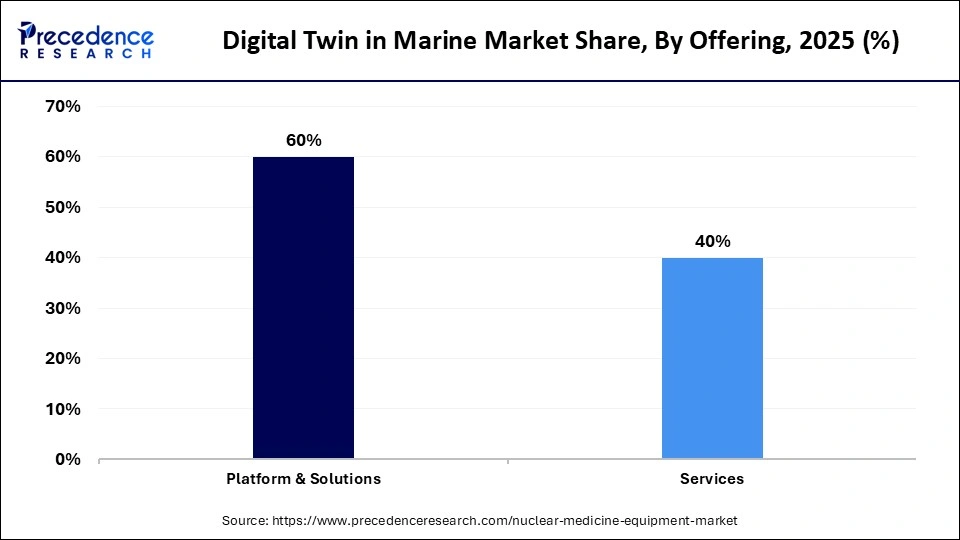
The services segment is expected to grow at the fastest CAGR in the market between 2026 and 2035. The growth of the segment is driven by the growing demand for consulting, implementation, integration, and lifecycle support services. Digital twin's implementation in the maritime environment requires professional abilities in integrating a system, cybersecurity, compliance with regulations, and modeling maritime data. In addition, services such as predictive model calibration, software optimization, updates, and performance monitoring are essential to ensure the accuracy and reliability of digital twin systems. The rise of increasingly advanced and networked digital twins has also driven demand for managed services to support seamless operation and system maintenance.
End User Insights
What Makes Ship Operators the Leading Segment in the Digital Twin in Marine Market?
The ship operators segment led the global market with a major share of 45% in 2025 and is expected to sustain its leading position in the coming years. This is mainly due to their crucial role in ensuring that the fleet is efficient, controlled in terms of costs, and compliant with regulatory requirements. Digital twin helps ship operators to keep track of vessel health in real time, engine operation, fuel efficiency, and plan voyages. Predictive maintenance enabled by digital twin allows operators to anticipate some equipment failures in advance, hence lowering downtime and expensive emergency maintenance. Centralized fleet monitoring systems also enhance coordination between vessels and shore-based control centers, improving operational visibility and overall transparency.
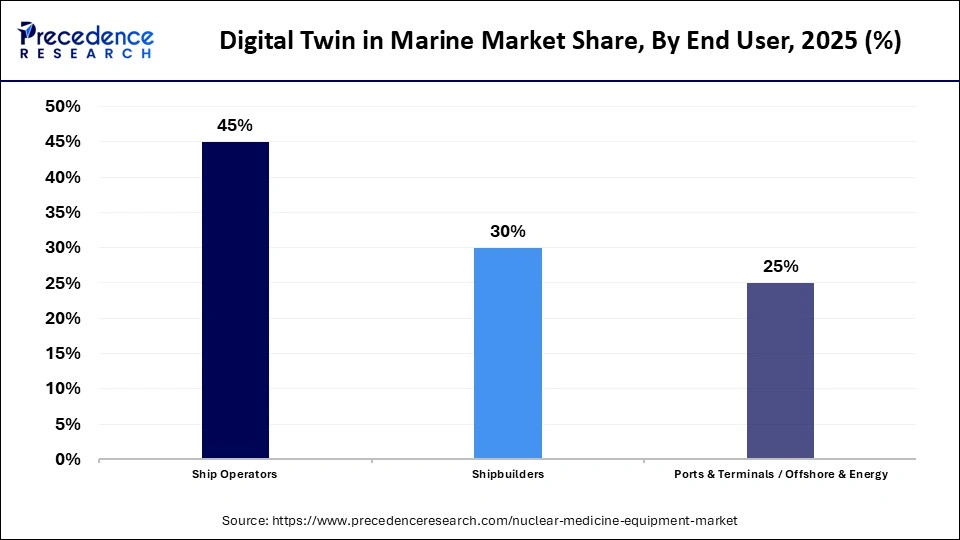
The shipbuilders segment is expected to grow at a notable rate during the forecast period due to the increasing adoption of digital twins in vessel design, engineering, and construction. Shipbuilders are increasingly adopting digital twin models in virtual prototyping, structural analysis, hydrodynamic simulations, and lifecycle performance forecasting. This helps reduce design defects, shorten development cycles, and optimize material usage. By simulating real-world operating conditions, shipbuilders can enhance vessel efficiency, extend lifecycle performance, and ensure that vessels meet operational requirements once deployed.
Component/Type Insights
How Does the Vessel Digital Twin Segment Lead the Digital Twin in Marine Market?
The vessel digital twin segment registered its dominance in the global market with a share of 30% in 2025 because of its wide use in commercial shipping fleets. Vessel digital twins create live virtual models by integrating sensor data from engines, propulsion, navigation, and onboard systems. Ship operators use these models to optimize fuel consumption, monitor structural integrity, improve voyage planning, and ensure regulatory compliance. Growing demands to reduce emissions and enhance operational transparency have driven the adoption of vessel-level digital twins across cargo ships, tankers, cruise liners, and naval vessels. These solutions also support lifecycle management, design verification, and decommissioning processes, improving efficiency and safety throughout a vessel's operational life.
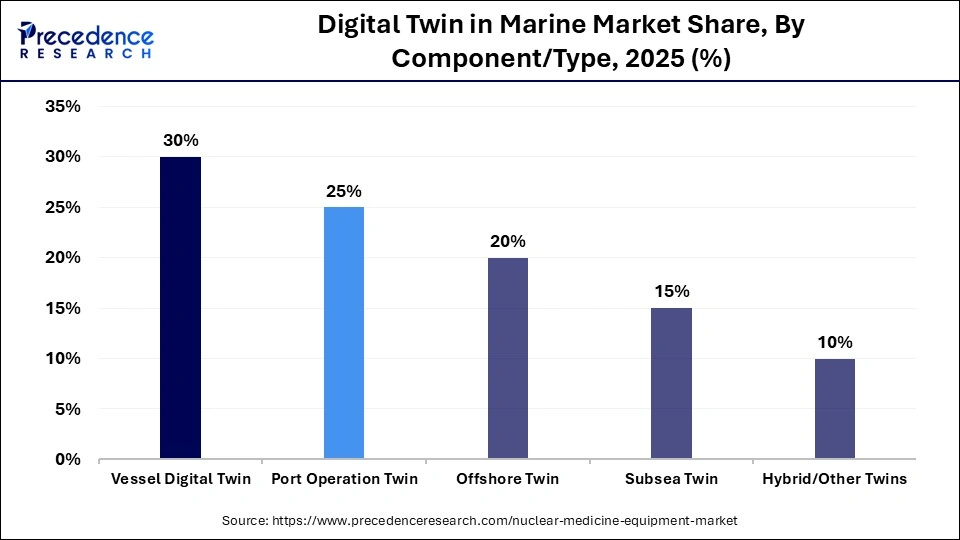
The offshore twin segment is expected to grow at the fastest rate in the market over the forecast period because of the increase in investment in offshore energy and infrastructure developments. Offshore installations, including wind turbines, underwater systems, and floating production platforms, operate under harsh marine conditions where equipment failures can cause significant financial and environmental impacts. Digital twins enable continuous monitoring of structural stress, corrosion, environmental conditions, and equipment performance. They also support safety testing and facilitate better decision-making in extreme or high-risk situations, enhancing operational reliability and reducing potential hazards.
Application Insights
Why Did the Operations Monitoring Segment Lead the Digital Twin in Marine Market?
The operations monitoring segment led the market with a share of 35% in 2025 because of the high demand for performance visibility in real-time. Maritime operators use digital twins to monitor vessel speed, fuel consumption, efficiency of route, weather effects, and engine operations on a continuous basis. Increased transparency leads to better decision-making, minimizes wastage of fuel, and facilitates the need to report on emissions. Additionally, the demand for operations monitoring solutions has increased to identify inefficient routing and cargo handling practices, reinforcing the segment's dominance.
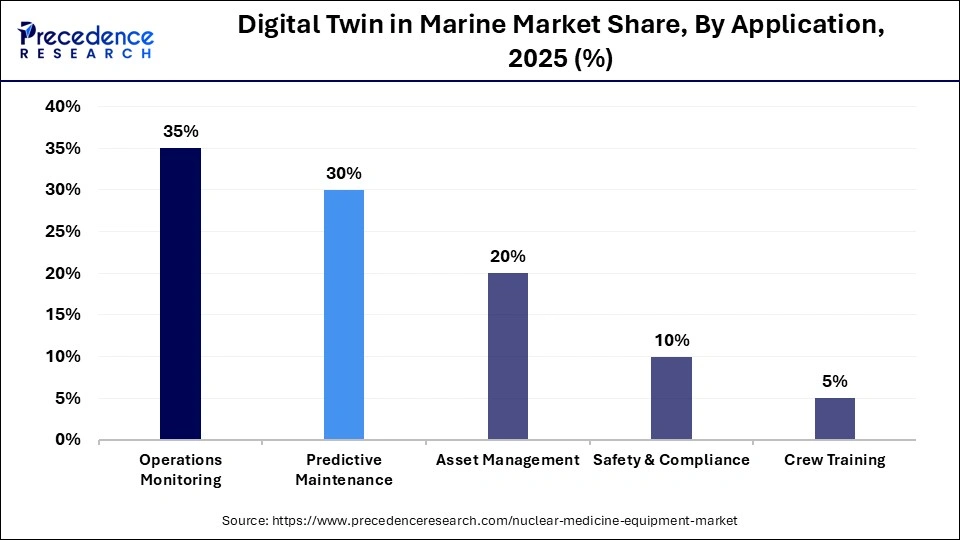
The predictive maintenance segment is expected to expand rapidly in the coming years due to the growing interest in the reduction of unplanned downtime. Digital twins use past and real-time equipment data to predict component wear, identify anomalies, and perform pre-emptive maintenance. This minimizes the emergency repairs, increases the life of the assets, and saves operational costs. Enhanced fault detection is achieved through the growing use of AI-driven analytics, machine learning algorithms, and sensor fusion. Given the strict safety requirements for vessels and offshore assets, predictive maintenance further improves reliability and ensures regulatory compliance.
Region Insights
Asia Pacific Digital Twin in Marine Market Size and Growth 2026 to 2035
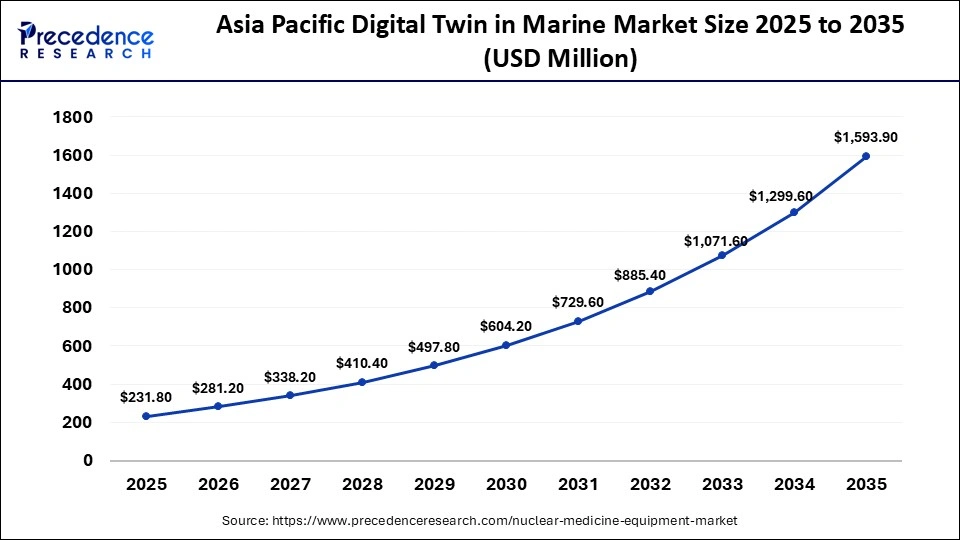
The Asia Pacific digital twin in marine market size is estimated at USD 231.80 million in 2025 and is projected to reach approximately USD 1,593.90 million by 2035, with a 21.26% CAGR from 2026 to 2035.
Why is Asia Pacific Considered the Fastest-Growing Region in the Digital Twin in Marine Market?
Asia Pacific is expected to grow at the fastest CAGR throughout the forecast period because of the expansion of the maritime sector, growing shipbuilding activities, and increasing digitalization efforts. China, South Korea, Japan, Singapore, and India are some of the countries that are making high investments in smart shipping technologies and port modernization programs. The region covers a significant portion of the global shipbuilding industry, making the integration of digital twins essential in vessel design and construction processes. Growing offshore wind power projects and expanding maritime trade routes are also driving the need for advanced monitoring solutions to manage and optimize these critical assets.
Why Did North America Lead the Global Digital Twin in Marine Market?
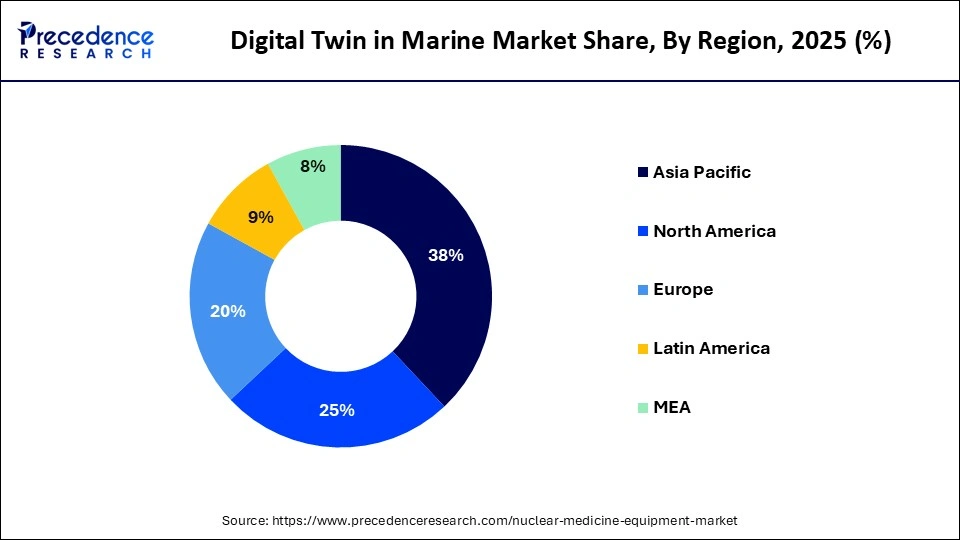
North America dominated the global digital twin in marine market by holding a share of around 38% in 2025. This is because the region is an early adopter of digital twin technology. The region benefits from robust digital infrastructure in maritime and the presence of leading solution providers. The area enjoys advanced shipbuilding capabilities, modern fleet management, and significant investments in IoT, AI, and cloud-based analytics platforms. Digital twin technologies have been actively adopted in the United States and Canada across naval fleets, commercial shipping, offshore oil and gas platforms, and ports to enhance operational efficiency and regulatory compliance. Strict environmental policies aimed at reducing maritime emissions have further accelerated the implementation of real-time monitoring and predictive analytics solutions.
Digital Twin in Marine Market Companies
- Siemens (Germany)
- Dassault Systemes (France)
- ABB (Switzerland)
- Wärtsilä (Finland)
- Kongsberg Digital (Norway)
- Hexagon AB (Sweden)
- Schneider Electric (France)
- Aveva (UK)
- Cadmatic (Finland)
- NAPA (Finland)
- Bentley Systems (U.S.)
- Digital Twin Marine (Singapore)
- Prevu3D (Canada)
- SailPlan (Norway)
- BMT (UK)
Recent Developments
- In December 2025, Kongsberg Digital entered into a multi-year enterprise agreement with Var Energi to implement its AI-based Kognitwin digital twin system in offshore energy assets. The contract facilitated superior operations and maintenance planning using predictive analytics and AI-based decision support processes. (Source: https://kongsbergdigital.com)
- In November 2025, Siemens and HD Hyundai signed a memorandum of understanding to modernize the process of shipbuilding in the U.S. through the application of the Siemens Xcelerator platform in all shipyards. The focus of the collaboration was on empowering digital twin-based design, combined with PLM and model-based systems engineering to increase production efficiency, automation, and workforce development. (Source: https://news.siemens.com)
- In January 2025, Kongsberg rebranded its maritime digital twin business under Kongsberg Maritime, combined with technologies developed by Kongsberg Digital. The step enhanced its strategic priorities on marine decarbonization, digitalization, and enhanced twin-based solutions of fleet and offshore asset management. (Source: https://www.kongsberg.com)
Segments Covered in the Report
By Offering
- Platform & Solutions
- Services
- Fastest Growing: Services
By End User
- Ship Operators
- Shipbuilders
- Ports & Terminals / Offshore & Energy
By Component/Type
- Vessel Digital Twin
- Port Operation Twin
- Offshore Twin
- Subsea Twin
- Hybrid/Other Twins
By Application
- Operations Monitoring
- Predictive Maintenance
- Asset Management
- Safety & Compliance
- Crew Training
By Region
- North America
- Europe
- Asia-Pacific
- Latin America
- Middle East & Africa
For inquiries regarding discounts, bulk purchases, or customization requests, please contact us at sales@precedenceresearch.com
Frequently Asked Questions





Ask For Sample
No cookie-cutter, only authentic analysis – take the 1st step to become a Precedence Research client
 Get a Sample




 sales@precedenceresearch.com
 Schedule a Meeting
