



Downstream Processing Market Size, Key Companies, Company Market Share, Patient Volume, Treatment Adoption Rates, Pricing Analysis, Regulatory Landscape, Competitive Positioning, and Demand Forecast
Deepa Pandey, a Healthcare Industry Expert, highlights that the downstream processing market has reached USD 40.54 billion in 2026 and is on track to reach USD 124.98 billion by 2035, advancing at a CAGR of 13.39%. Key downstream processing market companies shaping the market include Boehringer Ingelheim, Danaher Corporation, Sartorius Stedium Biotech S.A. while major growth segments span By Product, Application, Technique.
Source: https://www.precedenceresearch.com/downstream-processing-market
 Get a Sample
 Table Of Content


What is the Downstream Processing Market Size?
The global downstream processing market size was estimated at USD 35.56 billion in 2025 and is predicted to increase from USD 40.54 billion in 2026 to approximately USD 124.98 billion by 2035, expanding at a CAGR of 13.39% from 2026 to 2035.
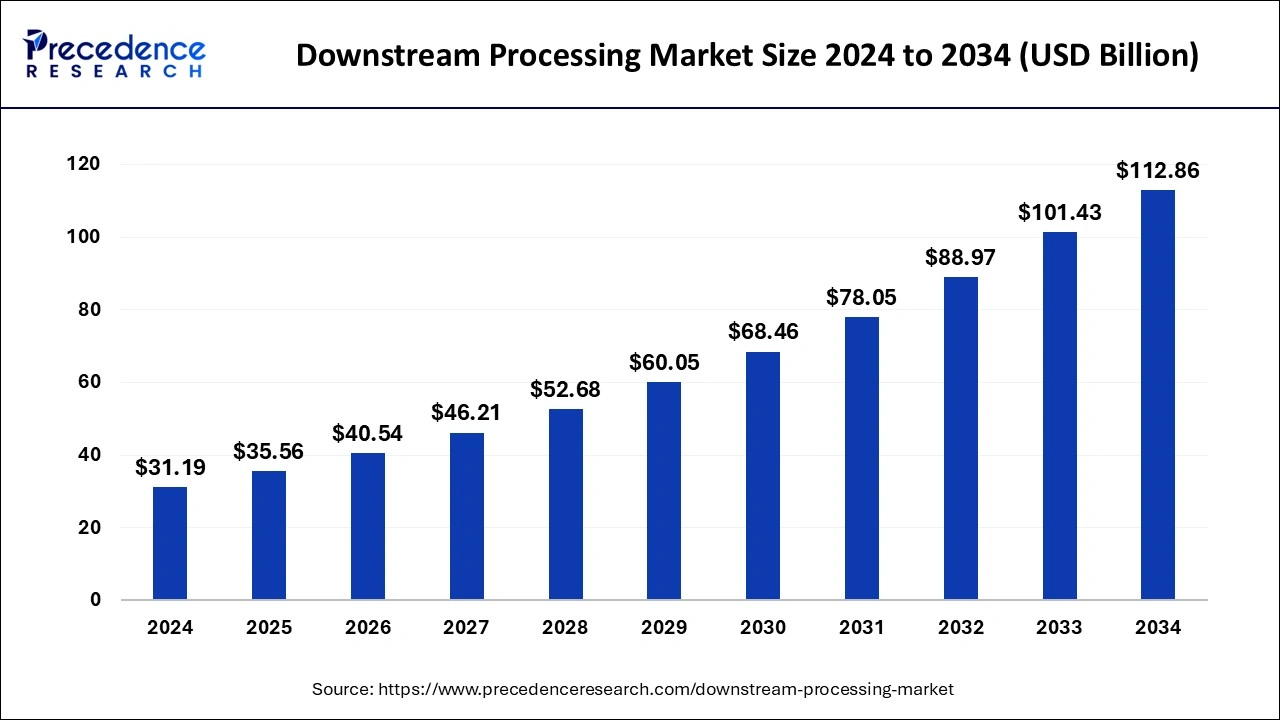
Downstream Processing Market Key Takeaways
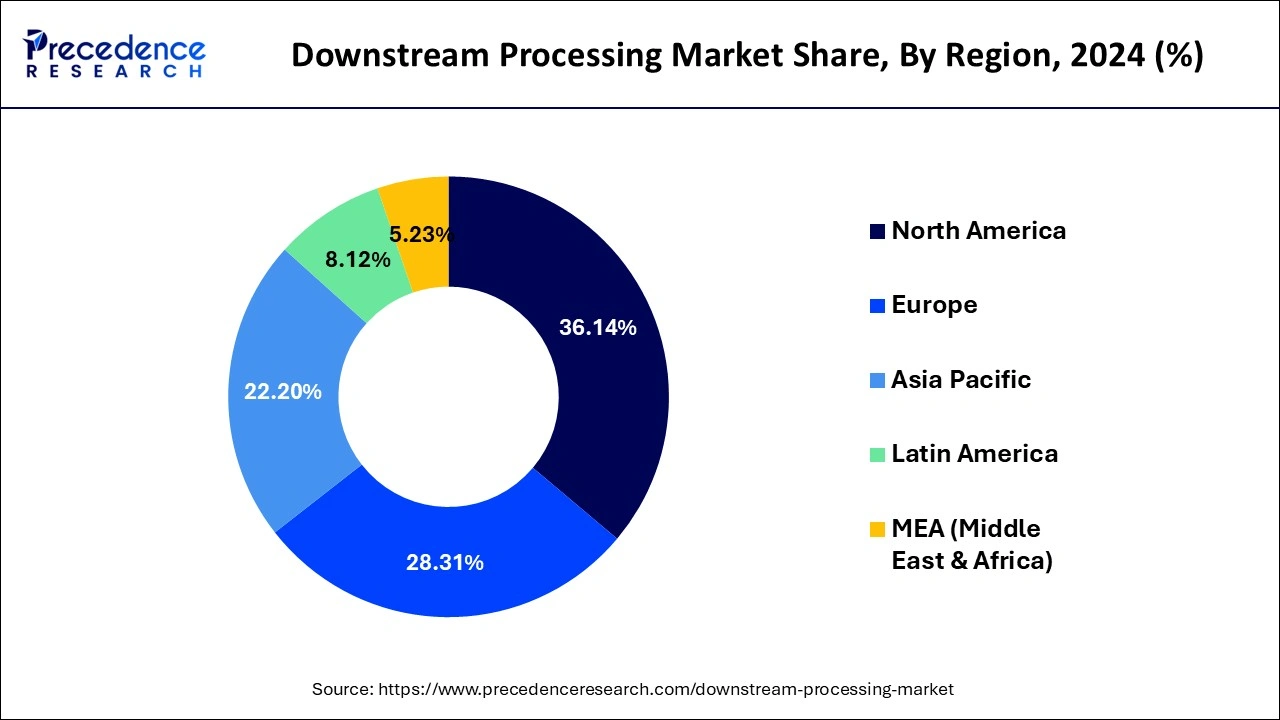
- North America dominated the global market with a major market share of 36.14% in 2025.
- Asia-Pacific is expected to expand at the fastest CAGR between 2026 and 2035.
- By Application, the antibiotic production segment generated a revenue share of 34% in 2025.
- By Technique, the monoclonal antibody medication segment contributed more than 42% of revenue share in 2025.
- By Product, the thalassemia segment has held the biggest revenue share of 43% in 2025.
Downstream Processing Market Growth Factors
Since past few years higher productivity upstream processes are flourishing greater speeds and capacities in downstream techniques for the protein purification. This is evidently observed in the extensively employed affinity supports comprising Protein A as the precise binding ligand. Downstream processing means retrieval and refinement of biosynthetic products from natural sources including animal tissue or plant tissue. For instance, downstream processing is a significant phase in the antibiotics manufacture like penicillin. The process encompasses separation and purification of antibiotics from an array of mediums. Downstream technology is increasingly being employed in both industrial-scale and laboratory applications due to a upward need for biologics, which is anticipated to lift the downstream processing market growth during years to come.
Further, cumulative demand for biosynthetic products for secondary use in pharmaceutics is the vital influence propelling the downstream processing sector. Currently, naturally sourced pharmaceuticals progressively perceive demand on account of their less risk of side-effects. A stablesurge in the sale for drug quality or recombinant products is pushing the embracing downstream processing considerably. Furthermore,escalation in the perception of the large molecules and biologics is foreseen to elevate the acceptance of downstream methodologies.
Market Scope
| Report Highlights | Details |
| Market Size in 2025 | USD 35.56 Billion |
| Market Size in 2026 | USD 40.54 Billion |
| Market Size by 2035 | USD 124.98 Billion |
| Growth Rate from 2026 to 2035 | CAGR of 13.39% |
| Fastest Growing Market | Asia Pacific |
| Largest Market | North America |
| Base Year | 2025 |
| Forecast Period | 2026 to 2035 |
| Segments Covered | Vehicle Class, Architecture, and Region |
| Regions Covered | North America, Europe, Asia-Pacific, Latin America, and Middle East & Africa |
Segment Insights
Application Insights
Among different application segment, the antibiotic production appeared as most dominating application in 2025 with a revenue share of 34%. They are employed in the treatment of numeral illnesses such as cancers and number of infectious ailments. Particulβ-lactam antibiotics such as penicillin and cephalosporin are some of the most frequently commercialized antibiotics classes across the globe. Natural penicillin and cephalosporin are produced at an industrial scale via bioprocessing methods and are harvested with the help of downstream processing.
Technique Insights
The purification using chromatography segment held a 42% revenue share in 2025. This technique is employed is in the purification and separation of the highest value products. This is a crucial stage technique that can be engaged at any stage of downstream processing till the concluding step of purification. Additionally, solid-liquid separation division is projected to record the fastest growth rate during years to come.
Product Insights
In 2025, the chromatography segment conquered the global downstream processing market revenue with a maximum share of around 43%. Numerous companies offer safe and integrated solutions that work proficiently throughout the vigorous stages from process development till production scale. Technological progressions have resulted in the development of single-use chromatography, which is deliberated a vibrant invention in the sector of bio pharmacy and is projected to observe encouraging progress throughout the prognosis timeframe. Nonetheless, filters sector is estimated to show the firmest growth rate in downstream processing market in the upcoming period.
Regional Insights
North America Leads the Downstream Processing Market with Strong Biopharmaceutical Demand
In 2025, North America acquired a maximum market share of 36.14% in the downstream processing sector and is projected to maintain this strong hold throughout the valuation period. This growth market is impelled by the accumulative demand for biopharmaceuticals and snowballing Research and development spending in the biopharmaceutical sector. Emergent markets like Asia Pacific deliver innovative growth openings to performers in the market. However, requirement for trained professionals and more cost of instruments are estimated to confine market growth during next few years. Further,absence of single-use choices, purification bottleneck, and harm to the health of capable professionals are few foremost problems in the downstream processing marketplace.
U.S. Downstream Processing Market Size and Growth 2026 to 2035
The U.S. downstream processing market size was estimated at USD 9.12 billion in 2025 and is predicted to be worth around USD 33.75 billion by 2035, at a CAGR of 13.98% from 2026 to 2035.
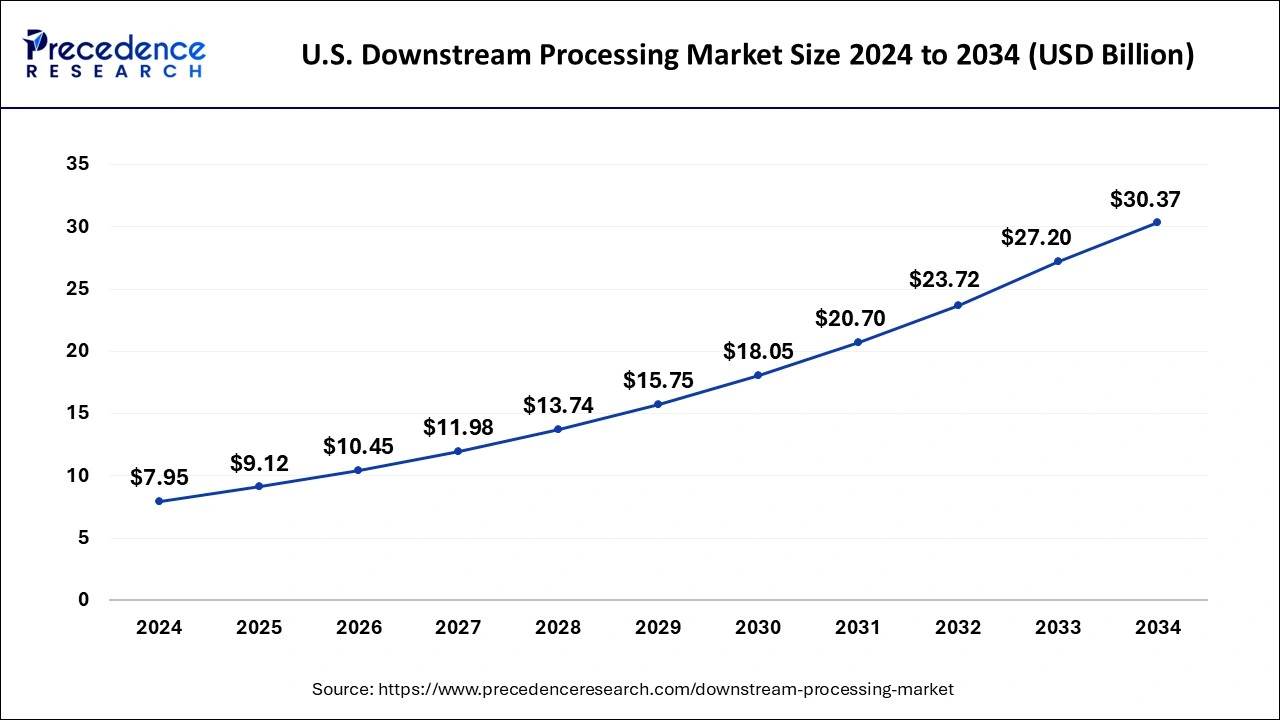
U.S. Market Trends
The U.S. plays a distinctive role within the region, mainly due to its strong focus on investigational cell and gene therapies with innovation and advanced process controls. The U.S. government emphasizes transitioning from traditional batch testing to Quality by Design frameworks and Process Analytical Technology. The U.S. FDA drives the investments, directing model-based approaches to lower operational cost and enhance downstream recovery.
Asia Pacific to Witness the Fastest Growth in the Downstream Processing Market
Asia Pacific region is anticipated to record a substantial growth rate of 18% throughout the prediction period. Nations such as India, China, Japan, and South Korea, are projected to motivate the requirement for downstream processing produces in the impending years. In addition, growth in these markets will be powered by cumulative government support, noteworthy investments by significant marketplace performers, emerging R&D infrastructure, and budding academic fineness and expertise among others.
India Market Trends
India plays a dominant role within the region, mainly due to its dominance in high-performance pharmaceutical production. The government emphasizes evolution from consumptive models to sustainable, regenerative bio manufacturing to scale up the bio economy. The Production Linked Incentive Scheme by the Government of India also offers financial support to advance domestic manufacturing of pharmaceuticals and bulk drugs.
How will Europe be considered Notable growth in the Market?
Europe is experiencing notable growth in the global market. This growth mainly stems from the stringent pharmaceutical purity regulations along with a strong shift towards sustainable and single-use manufacturing technologies. Europe is increasingly investing in process automation and continuous processing systems to enhance yields and save operational costs. Next-generation downstream strategies are developed for separating complex biomolecules like mRNA and proteins, necessitating specialized and multi-step downstream processing.
Germany Market Trends
Germany is a key contributor within the region, mainly characterized by its well-known regulatory standards and well- established infrastructure for biologics. The German government also emphasizes green and sustainable development, which drives technological advancements in filtration, separation, and membrane sciences, accelerating the adoption of next-generation and energy-efficient downstream unit operations.
How will Latin America Emerge in the Market?
Latin America is emerging as a significantly growing region in the global market, due to an increasing prevalence of chronic diseases, the necessity for cost-effective biosimilar and targeted government investments to lower expensive imported medications. Major economic hubs of the region, like Brazil, Argentina, and Mexico, followed strict regulatory mandates for the approval and distribution of biosimilars, thereby increasing the investments in local manufacturing capacities.
Brazil Market Trends
Brazil represents a vital role within the region, mainly due to its strong focus on the extraction, purification, and modification of high-value bioproducts from its rich agricultural and biodiversity assets. ANVISA regulatory modernization also ensures compliance. The National Bioeconomy Development Plan transforms raw natural materials into sustainable products across the pharmaceutical and cosmetic sectors.
How will the Middle East and Africa grow in the Market?
The Middle East and Africa are significantly growing region in the global market, due to increasing investments in local vaccine manufacturing and the emerging strategies to minimize reliance on expensive drug imports. Countries within the region, like South Africa, Kenya, and Nigeria, are the major investment destinations, and these regions are reducing marginalization to essential medicines and preventing global drug shortages by expanding localized bioprocessing. Favorable foreign direct investment policies also support advanced biotechnology hubs.
Saudi Arabia Market Trends
Saudi Arabia is a key contributor within the region, as it acts as a powerhouse in downstream petrochemical processing in the region. The government, with its capabilities to convert crude oil directly into valuable base oils, specialty chemicals, and pharmaceutical feedstocks, is contributing to market adoption. The government also invests in commodity exports to advanced downstream specialty products.
Downstream Processing Market Companies
- BoehringerIngelheim
- Danaher Corporation
- Sartorius Stedium Biotech S.A
- GE Healthcare
- Merck Millipore
- Eppendorf AG
- 3M Company
- Thermo Fisher Scientific Inc
- Finesse Solutions Inc
- Lonza Group
Segments Covered in the Report
By Product
- Centrifuges
- Dryers
- Chromatography Systems
- Filters
- Evaporators
- Others
By Application
- Antibodies Production
- Antibiotic Production
- Hormone Production
- Enzyme Production
- Vaccine Production
By Technique
- Purification by Chromatography
- Solid-liquid Separation
- Centrifugation
- Filtration
- Cell Disruption
- Concentration
- Formulation
By Regional Outlook
- North America
- U.S.
- Canada
- Europe
- U.K.
- Germany
- France
- Asia Pacific
- China
- India
- Japan
- South Korea
- Middle East & Africa
- Latin America
For inquiries regarding discounts, bulk purchases, or customization requests, please contact us at sales@precedenceresearch.com
Frequently Asked Questions





Ask For Sample
No cookie-cutter, only authentic analysis – take the 1st step to become a Precedence Research client
 Get a Sample
.webp)



 sales@precedenceresearch.com
 Schedule a Meeting
