



Endoscopy Devices Market Size, Key Companies, Company Product Portfolio, Hospital Procurement Trends, Manufacturing Capacity, Sales Performance, Regulatory Approvals, Company Market Share, and Forecast
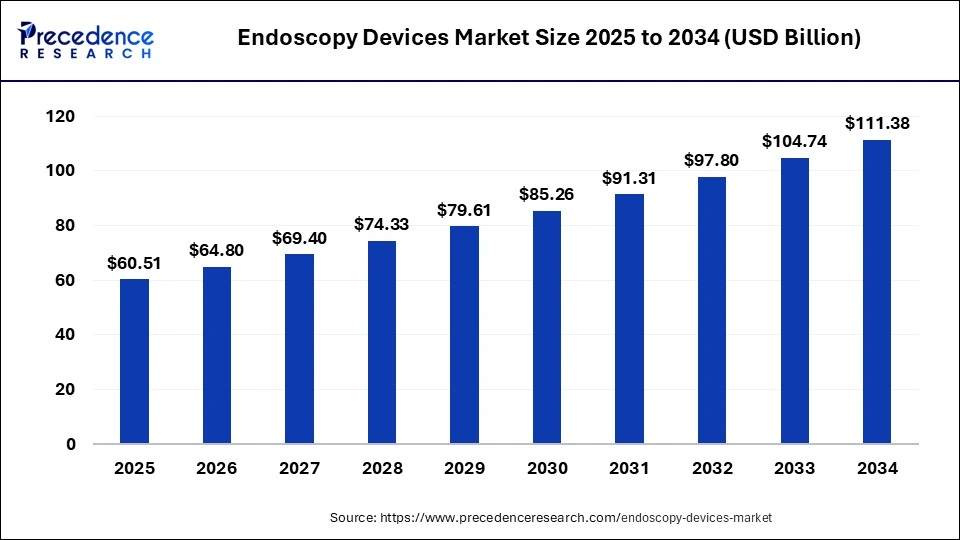
The global endoscopy devices market is projected to grow from USD 64.80 billion in 2026 to USD 118.22 billion by 2035, registering a CAGR of 6.93%. Growth is driven by the rising preference for minimally invasive procedures, increasing geriatric population, growing prevalence of gastrointestinal, urological, respiratory, and gynecological disorders, advancements in AI-enabled imaging and visualization systems, and expanding adoption of robotic-assisted and high-definition endoscopy technologies.
Source: https://www.precedenceresearch.com/endoscopy-devices-market
 Get a Sample
 Table Of Content


What is the Endoscopy Devices Market Size?
The global endoscopy devices market size is calculated at USD 60.51 billion in 2025 and is predicted to increase from USD 64.80 billion in 2026 to approximately USD 118.22 billion by 2035, growing at a CAGR of 6.93% from 2026 to 2035.
Key Takeaways
- By product, the endoscopy visualization systems segment has held a 37% revenue share in 2025.
- By end user, the hospitals segment has accounted 48% revenue share in 2025.
- By application, the gastrointestinal (GI) endoscopy segment has captured a revenue share of around 55.2% in 2025.
- The urology endoscopy application segment is growing at a strong rate.
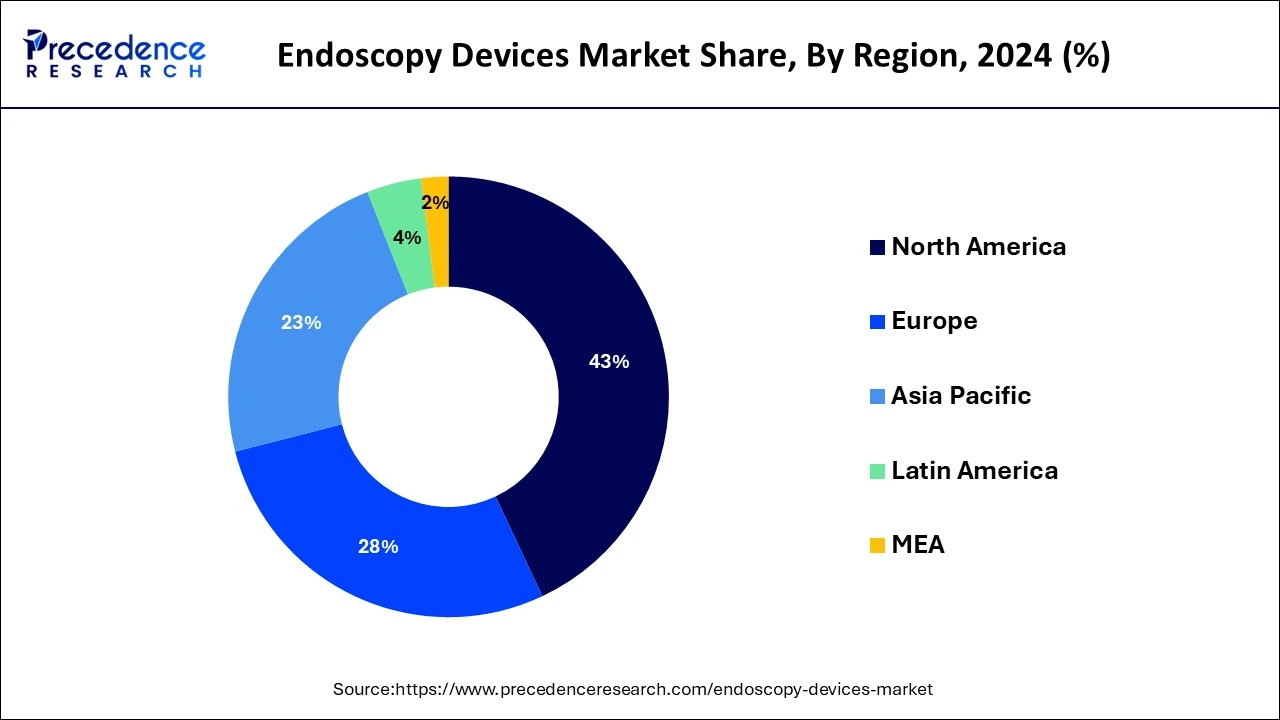
- The North America region has generated a revenue share of around 43% in 2025.
- The Asia Pacific region is poised to grow at a CAGR of 6.9% between 2026 to 2035.
Endoscopy Devices Market Growth Factors
Rise in preference for minimally invasive endoscopic procedures along with an increase global geriatric population are the key factors boosting the demand for endoscopy devices. The market for endoscopes is also being driven by a surge in the prevalence of urological, gastrointestinal, respiratory, and gynecological disorders that requires endoscopic procedures for proper treatment &diagnosis. An increase in the adoption of endoscopes as well as visualization systems in healthcare industry coupled with the technological advancements in the similar field further aids to the growth of the market.
In addition, proliferation in the prevalence of age-related problems together with increase in demand for endoscopy devices in therapeutic & diagnostic procedures is the other important factor that propels the market growth. Implementation of such devices in treatment and diagnosis of health problems is necessary as it allows minimal intervention that further results in shorter recovery time.
Geriatric population is the most common group prone to medical problems that require endoscopic procedures such as gall stones, intestinal perforation, endometriosis, pelvic abscess, and liver abscess. According to a research conducted by Population Reference Bureau, in 2018, there were nearly 52 Million people with age 65 years or above in the United States and projected to cross the number of 95 Million by 2060. The aforementioned factor anticipated to boost the need for endoscopic procedures, thereby escalating the demand for endoscopy devices during the forecast period.
Market Outlook
- Industry Overview: The industry is composed of device OEMs, large diversified medtech firms and niche endoscopy specialists, component suppliers, optics, CMOS/CCD sensors, fiber bundles, flexible insertion tubes, contract manufacturers, sterilization/reprocessing equipment providers, distributors, and hospital procurement teams. Key industry dynamics include consolidation as large players expand portfolios through acquisition, competitive pressure from lower-cost suppliers, and the rise of single-use endoscope entrants challenging traditional reusable device economics.
- Sustainability Trend: Sustainability in endoscopy balances infection control and patient safety against environmental impact. Single-use endoscopes and disposables reduce cross-contamination risk and reprocessing resource use water, energy, and chemicals, but create medical waste challenges. The sustainability trend, therefore, focuses on lifecycle assessments, recyclable or medical-grade degradable materials for disposables, and greener reprocessing technologies that decrease energy and chemical consumption for reusable endoscopes.
- Manufacturers are exploring circular models, remanufacturing, validated reconditioning programs, and take-back schemes for high-value components to reduce embodied carbon. Hospitals increasingly evaluate total environmental impact alongside clinical performance, prompting device makers to report on recyclability, packaging reduction, and carbon intensity of manufacturing.
- Major Investment Themes: Investors and corporates are targeting diagnostic accuracy, infection control, and cost-efficiency. Investment themes include single-use endoscopy platforms to address infection risk and reprocessing costs, advanced imaging modules and optics with higher resolution, fluorescence, spectral imaging, AI/ML solutions for automated polyp and lesion detection and reporting, integrated therapeutic endoscopy tools, endoscopic submucosal dissection accessories, endoscopic suturing, and disposable consumables with improved material profiles.
- Sustainable Ecosystems and Startups: A healthy ecosystem combines OEMs, hospital systems, regulatory expertise, and startups that focus on narrow but high-impact problems: low-cost single-use scopes for resource-constrained settings, AI lesion-detection algorithms, compact video processors for point-of-care, and eco-friendly disposable materials. Incubators linked to clinical centers accelerate validation and pilot programs, while partnerships with sterilization specialists ensure operational compatibility.
- Startups that succeed typically secure early clinical champions, demonstrate clear workflow or safety advantages, and design for regulatory pathways. Collaborative pilots that evaluate both clinical outcomes and environmental metrics are becoming a differentiator for investment and procurement decisions.
Market Scope
| Report Coverage | Details |
| Market Size in 2025 | USD 60.51 Billion |
| Market Size in 2026 | USD 64.80 Billion |
| Market Size by 2035 | USD 118.22 Billion |
| Growth Rate from 2026 to 2035 | CAGR of 6.93% |
| Largest Market | North America |
| Base Year | 2025 |
| Forecast Period | 2026 to 2035 |
| Segments Covered | Product, Application, Hygiene, End User, Regions |
| Regions Covered | North America, Europe, Asia-Pacific, Latin America, and Middle East & Africa |
Segment Insights
Product Insights
Endoscopy visualization systems captured the highest value share 37% in the year 2025. This is attributed to the rising preference for high definition (HD) visualization system by medical professionals, as it helps in treatment &diagnosis of complex diseases that include GI disorders, cancer, urinary disorders, and lung disorders during minimally invasive surgical procedures. Presently, manufacturers offer HD visualization systems that are capable of switching images from 3D to 2D and vice versa also impact positively on the market growth of segment.
The endoscopes segment projected to exhibits lucrative growth rate of nearly 9.5% over the analysis period. Flexible endoscopes dominated the segment with the highest value share in 2025 due to rising preference of safety, better ergonomics, and efficacy over rigid endoscopes. However, endoscopy visualization components register notable growth over the forecast period, wherein HD monitors accounted for the largest value in 2025.
End-use Insights
Hospitals segment encountered to be the largest end-user in the year 2025, as it is the primary health center in majority of countries. Further, the total number of endoscopic surgeries takes place at hospitals is comparatively higher than other healthcare systems, such as specialty clinics or ambulatory surgical centers (ASCs). Consequently, the demand of endoscopy devices at hospitals is higher compared to other end-use segments. Furthermore, the segment expected to maintain its dominance in the forthcoming years owing to rising investment from governments of various regions for the development of hospitals. This subsequently predicted to boost the demand for endoscopy devices in the coming years.
Application Insights
The gastrointestinal endoscopy segment dominated the market in 2025. This dominance is due to its global clinical applications in colorectal cancer screening, management of GI bleeding, and the integration of AI and wireless capsule endoscopy. Procedures have progressively shifted from invasive surgeries to advanced endoscopic therapies. Rapid shift to high-definition electronic endoscopes and the development of steerable video capsule endoscopes to prevent cross-contamination continue to drive market expansion.
The urology endoscopy segment is expected to have the fastest growth during the forecast period, driven by the increasing prevalence of urological diseases and a strong shift toward minimally invasive diagnostic and therapeutic procedures. Advancements in miniature scanners and optical fibers make single-use scopes highly effective for early disease characterization. The integration of AI-assisted imaging, 3D visualization, and robotic-assisted surgical platforms allows urologists to perform complex procedures.
Hygiene Insights
The reprocessing segment held market dominance in 2025. This dominance is due to its reusable endoscopes, which risk transmitting multidrug-resistant organisms through their narrow lumens to maintain hygiene and prevent cross-contamination. Additionally, automated endoscope reprocessors lower human error and standardize the cleaning with automation systems. Clean and disinfect cycles require large amounts of high-level disinfectants and test strips, representing recurring market demand.
The single-use segment is anticipated to have the fastest growth during the forecast period. This is mainly due to the increasing challenges of cross-contamination and hospital-acquired infections associated with reusable devices. Using single-use scopes mitigates the costly and time-consuming sterilization cycles with improved workflow efficiency in emergency rooms and remote locations. Single-use models are highly utilized in high-risk procedures, like immunocompromised patients, and in specialties including urology and pulmonology.
Regional Insights
What is the U.S. Endoscopy Devices Market Size?
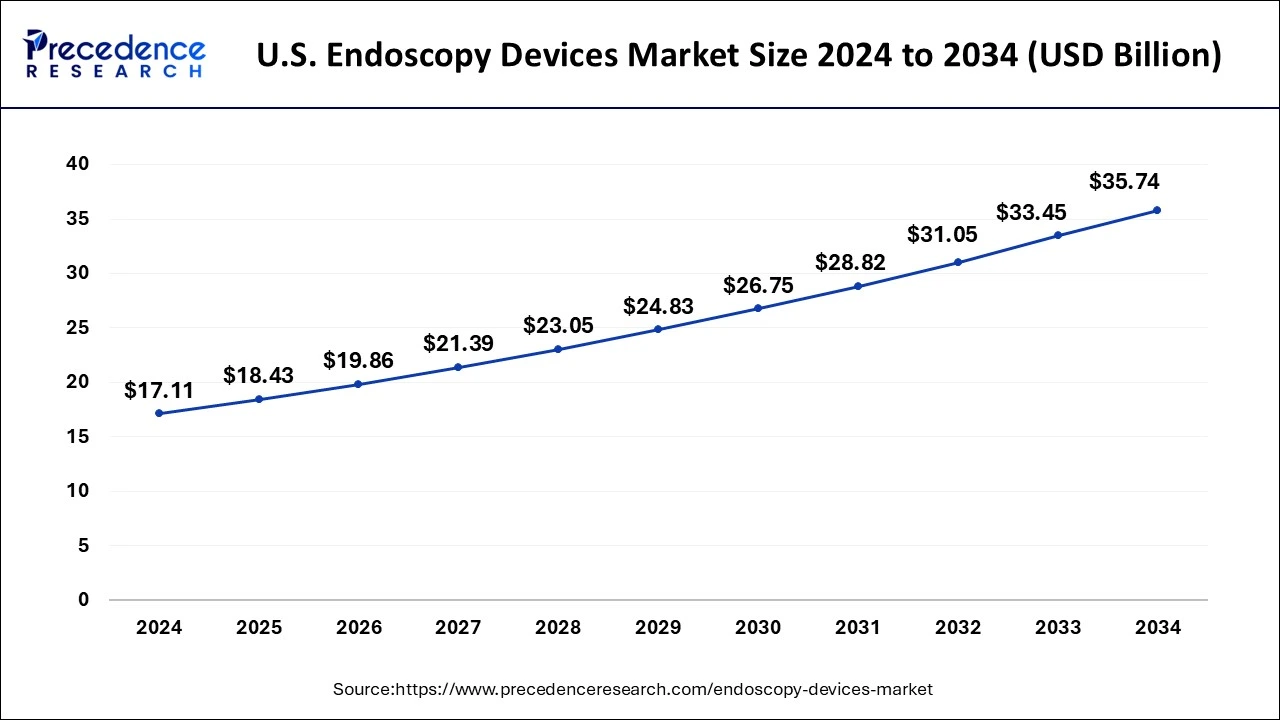
The U.S. endoscopy devices market size was exhibited at USD 18.43 billion in 2025 and is projected to be worth around USD 38.10 billion by 2035, growing at a CAGR of 7.53% from 2026 to 2035.
In 2025, North America accounted for the largest revenue share 43% owing to increase in preference for minimally invasive surgeries, rise in the prevalence of diseases such as colon & bladder cancers, and increase in geriatric population. Additionally, rising adoption of robot-assisted endoscopes used for surgical and diagnostic procedures is further positively influencing the market growth in the region. However, the Asia Pacific anticipated as the most opportunistic region during the forecast period. Increasing economies of China and India estimated to be the significant contributors for the market growth in this region.
The Asia Pacific region is projected to witness strong growth over the forecast period 2026 to 2035.
The U.S. Market Trends
The U.S. plays a dominant role within the region, mainly due to its high-value medical innovation. This is further supported by high healthcare spending and an aging population, as well as broad commercial insurance. Key players include Olympus and Boston Scientific, with policies like the FDA's Unique Device Identification (UDI), with improving safety and coverage for preventive GI screenings and AI-enhanced detection platforms.
How will Asia Pacific grow in the Endoscopy Devices Market?
Asia Pacific is anticipated to have the fastest growth during the forecast period, mainly due to its chronic gastrointestinal diseases and improved healthcare infrastructure in emerging economies like China and India. This growth is further fostered by government cancer screening programs, heightened public health awareness, and the adoption of minimally invasive surgeries. Governments are continuously updating medical access laws and investing in training to address a shortage of specialized endoscopists and thereby supporting healthcare modernization by aligning with global quality expectations.
India Market Trends
India is a key contributor within the region, mainly characterized by its expanding role as a high-volume expansion and a manufacturing center evolving from import dependence to indigenous production, with increasing gastrointestinal disorders and the expansion of ambulatory surgical centers. The Production-Linked Incentive (PLI) Scheme and establishment of Medical Device Parks, with a goal of reducing import reliance and manufacturing costs.
How is Technology Transforming the Endoscopy Equipment and Software Market in Europe?
Europe is expected to show significant growth during the forecast period. It is driven by an aging population and a high need for minimally invasive procedures. The rising concerns over infection control, mainly post-COVID-19, are driving a strong change toward disposable, single-use endoscopic devices. Robotic systems are being accepted to enhance the precision, stability, and even navigation of flexible endoscopes in complex procedures, mainly for hard-to-reach areas.
Germany Market Trends
It includes the growth of AI-driven imaging, high-definition 4K visualization, and a change toward disposable, single-use endoscopes to enhance hygiene, alongside a strong need for robotic-assisted endoscopic systems. There is a rapid adoption of 4K imaging and AI-driven image enhancement modules to determine polyps and lesions in real-time.
How is Latin America Growing in the Endoscopy Equipment and Software Market?
Latin America is expected to show notable growth during the forecast period, due to greater healthcare investment, enhanced access to endoscopic procedures, and a high-expansion potential for medical devices. A significant change from open surgeries to minimally invasive procedures is fueling the need for specialized, smaller, and even more flexible diagnostic or therapeutic tools.
Brazil Market Trends
Strong preference for procedures with shorter hospital stays along with faster recovery times, mainly among the aging population in Brazil. Increasing acceptance of AI-based diagnostic analytics, IoT-enabled devices, and smart surgical video platforms for real-time lesion identification.
Will the Middle East and Africa Grow in the Endoscopy Equipment and Software Market?
The Middle East and Africa region is expected to grow at a considerable CAGR in the upcoming period. It is driven by high gastrointestinal disease prevalence along with strategic healthcare modernization initiatives in countries such as Saudi Arabia and the UAE. The market is witnessing a change towards, and increased investment in, robotic-assisted endoscopes, 4K/3D imaging, and capsule endoscopy to improve patient outcomes, mainly in private healthcare sectors.
UAE Market Trends
The UAE market is driven by high need for minimally invasive surgeries, increasing obesity and diabetes rates, and medical tourism. AI and machine learning are increasingly integrated into diagnostic endoscopy to enhance procedural accuracy and workflow efficiency.
Country-level
Gulf states can act as regional hubs for advanced endoscopic care and training, while countries with constrained budgets may adopt pragmatic models mobile outreach clinics with single-use scopes or regionalised.
| Company | Country | Revenue |
| Boston scientific corp | U.S. | US $ 16.47 billion |
| Karlz stores SE | Germany | Euro 2.18 billion |
| Ambu A/S | Denmark | DKK 4013 million |
| CONMED corporation | U.S. | Specific endoscopy revenue not listed |
| Olympus Corporation | Japan | Had a large portfolio |
Market Value Chain Analysis
- Raw Material Sourcing: Raw material sourcing focuses on high-precision optics and imaging sensors, CMOS/CCD chips, biocompatible polymers for insertion tubes and distal tips, high-performance LEDs or laser light sources, small-form electronics PCBs, connectors, and materials for disposable components that meet sterility and biocompatibility standards. Procurement strategies emphasize supplier qualification, traceability, and long-term contracts for critical optical and electronic components to avoid production disruptions.
- Technological Advancements: Technological advances transforming endoscopy include high-definition and ultra-high-definition imaging, digital enhancements, narrow band imaging, fluorescence, autofluorescence, miniaturized CMOS sensors enabling smaller scopes, single-use endoscope manufacturing techniques, and AI algorithms for real-time polyp detection and characterization. Robotics and articulated endoscopic platforms extend therapeutic capabilities, enabling complex intraluminal procedures with finer control.
Endoscopy Devices Market Companies
- Karl Storz GmbH & Co. KG: A global leader in endoscopes, medical instruments, and visualization equipment.
- Richard Wolf GmbH: A major provider of products for endoscopy and extracorporeal shock wave treatment.
- PENTAX Medical: A leading global provider of endoscopic imaging solutions, particularly in the gastrointestinal (GI) and pulmonology fields
- Medtronic Plc (Covidien): While Medtronic is a massive global medical technology company with a diverse portfolio, its acquisition of Covidien significantly expanded its presence in surgical instruments and technologies.
- Machida Endoscope Co., Ltd.: Historically, Machida was a significant Japanese manufacturer of flexible and rigid endoscopes.
- Olympus Corporation: Olympus Corporation provides a comprehensive portfolio aimed at pulmonology, gastroenterology, and surgical endoscopy. It offers advanced imaging systems, flexible and rigid endoscopes, AI-powered software, system integration solutions, and endotherapy devices.
- Fujifilm Holdings Corporation: Fujifilm Holdings Corporation focuses on high-definition imaging, AI-based diagnostics, and therapeutic devices for gastroenterology, pulmonology, and endoluminal surgery. Its offerings are built around advanced visualization technologies, which includes Multi-LED lighting and proprietary image-enhancing modes.
- Stryker Corporation: Stryker Corporation provides a comprehensive portfolio of advanced endoscopy equipment and software designed for minimally invasive surgery, specializing in high-definition visualization, fluorescence imaging (SPY), 4K camera platforms (1588 AIM), and integrated operating room (OR) hubs. Its solutions improve surgical precision, smoke evacuation, and workflow efficiency.
Segments Covered in the Report
By Product
- Endoscopes
- Flexible Endoscopes
- Colonoscopes
- Upper Gastrointestinal Endoscopes
- Sigmoidoscopes
- Bronchoscopes
- Pharyngoscopes
- Laryngoscopes
- Nasopharyngoscopes
- Duodenoscopes
- Rhinoscopes
- Other Flexible Endoscopes
- Rigid Endoscopes
- Arthroscopes
- Laparoscopes
- Cystoscopes
- Urology Endoscopes
- Neuroendoscopes
- Gynecology Endoscopes
- Other Rigid Endoscopes
- Disposable Endoscopes
- Capsule Endoscopes
- Robot Assisted Endoscope
- Flexible Endoscopes
- Endoscopy Visualization Systems
- High Definition (HD) Visualization Systems
- 3D Systems
- 2D Systems
- Standard Definition (SD) Visualization Systems
- 3D Systems
- 2D Systems
- Ultrasound Devices
- High Definition (HD) Visualization Systems
- Endoscopy Visualization Components
- Insufflators
- Camera Heads
- High-definition Monitors
- Light Sources
- Video Processors
- Suction Pumps
- Operative Devices
- Access Devices
- Energy Systems
- Hand Instruments
- Suction & Irrigation Systems
- Snares
- Wound Retractors
By Application
- Urology Endoscopy
- Gastrointestinal (GI) Endoscopy
- Obstetrics Endoscopy
- Laryngoscopy
- Laparoscopy
- Bronchoscopy
- Arthroscopy
- Otoscopy
- Mediastinoscopy
- Other Applications
By Hygiene
- Single-Use
- Reprocessing
- Sterilization
By End-Use
- Ambulatory Surgical Centers
- Hospitals
- Other End-uses
By Region
- North America
- Latin America
- Europe
- Asia-pacific
- Middle and East Africa
For inquiries regarding discounts, bulk purchases, or customization requests, please contact us at sales@precedenceresearch.com
Frequently Asked Questions
Tags





Ask For Sample
No cookie-cutter, only authentic analysis – take the 1st step to become a Precedence Research client
 Get a Sample
.webp)



 sales@precedenceresearch.com
 Schedule a Meeting
