



Energy Drinks Market Trends, Companies, Revenue / Sales Performance, Food Production, Processing Capacity, Sales Volume, Distribution Performance, Competitive Landscape, and Industry Outlook
Energy Drinks Market (By Type: General Energy Drinks, Energy Shots; By Soft Drink Category: Traditional/Conventional, Natural/Organic; By Packaging: Cans, Bottles; By Distribution Channel: Off-Trade (Retail: Supermarkets/Convenience), Online Retail) - Industry Analysis, Size, Trends, Leading Companies, Regional Outlook, and Forecast 2026 to 2035
Source: https://www.precedenceresearch.com/energy-drinks-market
 Get a Sample
 Table Of Content


What is the Energy Drinks Market Size?
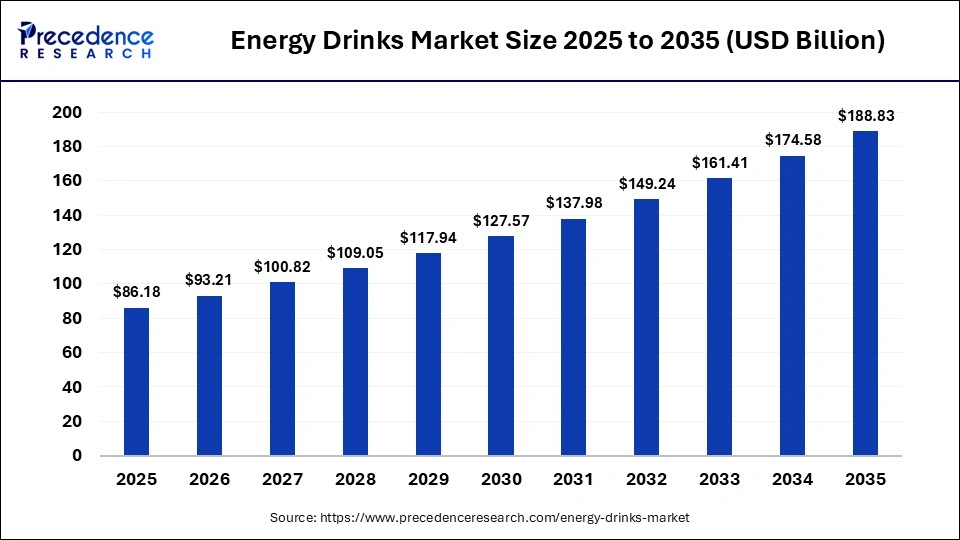
The global energy drinks market size was calculated at USD 86.18 billion in 2025 and is predicted to increase from USD 93.21 billion in 2026 to approximately USD 188.83 billion by 2035, expanding at a CAGR of 8.16% from 2026 to 2035. The rise of energy drinks is driven by their associated health benefits, such as improved physical performance and mental alertness, reduced fatigue, and increased concentration.
Market Highlights
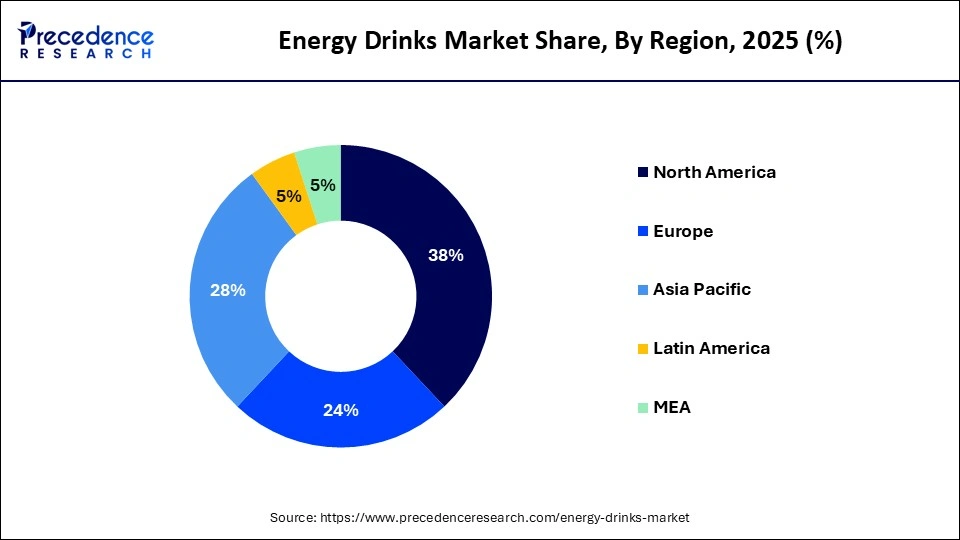
- North America dominated the market in 2025, with a revenue share of approximately 38%.
- Asia Pacific is expected to grow at the fastest CAGR of 8.5% from 2026 to 2035.
- By type, the general energy drinks segment dominated the market in 2025, with a revenue share of approximately 75%.
- By type, the energy shots segment in the market is growing at the fastest CAGR of 7.6% from 2026 to 2035.
- By soft drink category, the traditional/conventional segment dominated the energy drinks market in 2025, with a market share of approximately 86%.
- By soft drink category, the natural/organic segment is expected to grow at a notable rate of 7.4% in the market in 2025.
- By packaging, the cans segment dominated the market in 2025, with a revenue share of approximately 82%.
- By packaging, the bottles segment is poised to grow at the fastest CAGR of 7.6% from 2026 to 2035.
- By distribution channel, the off-trade segment dominated the energy drinks market in 2025, with a revenue share of approximately 78%.
- By distribution channel, the online retail segment is growing at a strong CAGR of 7.5% from 2026 to 2035.
Energy Drinks: Contributing to Metabolic Shifts
The energy drinks market comprises beverages formulated with ingredients like caffeine, taurine, vitamins, and herbal extracts designed to enhance mental alertness and physical performance. It includes ready-to-drink energy drinks, energy shots, and sugar-free and natural/organic variants distributed through retail and online channels. This market is driven by rising working populations, fitness enthusiasts, and lifestyle consumers seeking quick energy boosts, with innovation focused on healthier and functional formulations.
According to the Centers for Disease Control and Prevention (CDC), there is a great role for teachers, school staff, coaches, athletic trainers, school nutrition staff, parents, and community members in educating students about the dangers and benefits of energy drinks and sports drinks. CDC also reported on healthy beverages such as water, fat-free/low-fat milk, and 100% juice, which are recommended to be provided by school nutrition staff for students.
What Are the Benefits of AI in the Energy Drinks Market?
Artificial intelligence is contributing to product development, design, marketing strategies, process optimization, and quality assurance in the energy drinks market. AI algorithms enable the evaluation of taste through sensory data, customer reviews, and emerging trends that drive further innovation. AI-powered robotic systems are used in laboratories for automating and refining research and production.
Advanced demand forecasting models are helping manufacturers optimize ingredient sourcing, inventory planning, and production scheduling across multiple SKUs. AI-driven marketing analytics are enabling precise consumer segmentation, pricing optimization, and campaign performance tracking in competitive retail environments. In addition, quality control systems using computer vision are improving consistency by detecting packaging defects, fill-level deviations, and labeling errors in real time.
- In December 2024, AI Energy, powered by Cognizin, launched a revolutionary formula with Cognizin Citicoline to support cognitive function and brain health.
Energy Drinks Market Trends
- Expansion of E-Commerce Platforms: People living in Western nations such as the U.S. and Germany are rapidly adopting online shopping platforms to purchase food and beverage items, including processed foods and energy drinks.
- Growing Use of Eco-Friendly Packaging Solutions: Leading brands are widely adopting eco-friendly bottles for storing energy drinks.
- Investments: The top companies dealing in this sector are investing rapidly to advance R&D activities, strengthen the supply chain, and expand their businesses globally.
Energy Drinks Market Trends
- Innovative Brands: A shift towards developing brands with zero-calorie/zero-sugar formulations, novel fruit flavors, attractive packaging, wellness, and nutrition boosts the expansion of the energy drinks market.
- Expanding Shelf Space by Retailers: This shift transforms consumer experiences and their behavior due to improved access to energy drinks and trusted wellness.
Market Scope
| Report Coverage | Details |
| Market Size in 2025 | USD 86.18 Billion |
| Market Size in 2026 | USD 93.21 Billion |
| Market Size by 2035 | USD 188.83 Billion |
| Market Growth Rate from 2026 to 2035 | CAGR of 8.16% |
| Dominating Region | North America |
| Fastest Growing Region | Asia Pacific |
| Base Year | 2025 |
| Forecast Period | 2026 to 2035 |
| Segments Covered | Type, Soft Drink Category, Packaging, Distribution Channel, and Region |
| Regions Covered | North America, Europe, Asia-Pacific, Latin America, and Middle East & Africa |
Market Dynamics
Driver
Opening of New Manufacturing Units
The leading companies of energy drinks are constantly engaged in establishing new production centers. These production units are established to increase the manufacturing capacity of energy drinks for the end-users, which in turn boosts the growth of the market.
Restraint
Side Effects of Energy Drinks
Although energy drinks are bundled with several essential nutrients, but it causes numerous problems in the brain, thereby negatively impacting the market.
Opportunity
Adoption of Energy Drinks by Sports Persons
The increasing popularity of non-sugar energy drinks among athletes is anticipated to create several growth opportunities for the market players in the upcoming years.
Segmental Insights
Type Insights
How does the General Energy Drinks Segment Dominate the Energy Drinks Market in 2025?
The general energy drinks segment dominated the market in 2025 with a revenue share of approximately 75%, owing to the increased consumer preference for natural and clean-label products over synthetic products. One of the leading companies, named Red Bull GmbH, has sold a total of 12.670 billion cans globally in 2024, including Red Bull Sugarfree, the original Red Bull Energy Drink, Red Bull Zero, and Red Bull Editions. The other major players in the energy drinks market, like PepsiCo, Inc., achieved 2.6% of net revenue performance in the third quarter of 2025.
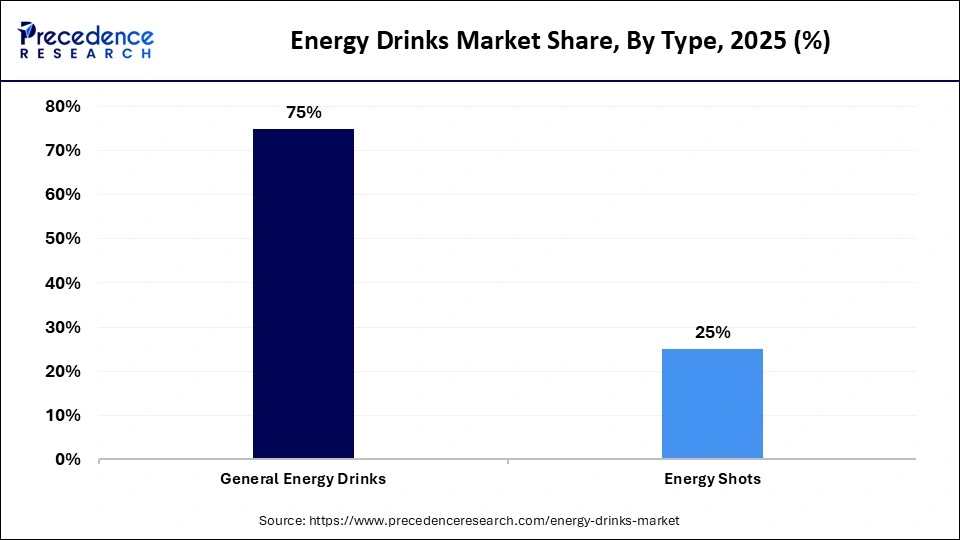
The energy shots segment is expected to grow at the fastest CAGR of 7.6% in the energy drinks market during the forecast period due to the increased focus on cognitive health and wellness and the growing number of health-conscious consumers. There is a strong demand for energy drinks in China, India, and Brazil from the Coca-Cola Company, which has sold 2% more drinks in the first quarter of 2025. According to the reports of the Coca-Cola Company, sales of energy drinks rose 3% in Europe, the Middle East, and Africa, while smart pricing boosts profits in Latin America.
Soft Drink Category Insights
What made Traditional/Conventional the Dominant Segment in the Energy Drinks Market in 2025?
The traditional/conventional segment dominated the market in 2025 with a revenue share of approximately 86%, owing to the affordable alternatives and popularity of brands from the major market players like the Coca-Cola Company and Pepsico. The adoption of functional beverage brands by companies is backed by strategic acquisitions among food and beverage companies. In November 2025, Monster Beverage Corporation reported that its net sales rose 16.8% to $2.20 billion in the third quarter of 2025 for the company's high-performance, wellness, and total body fuel energy drinks.
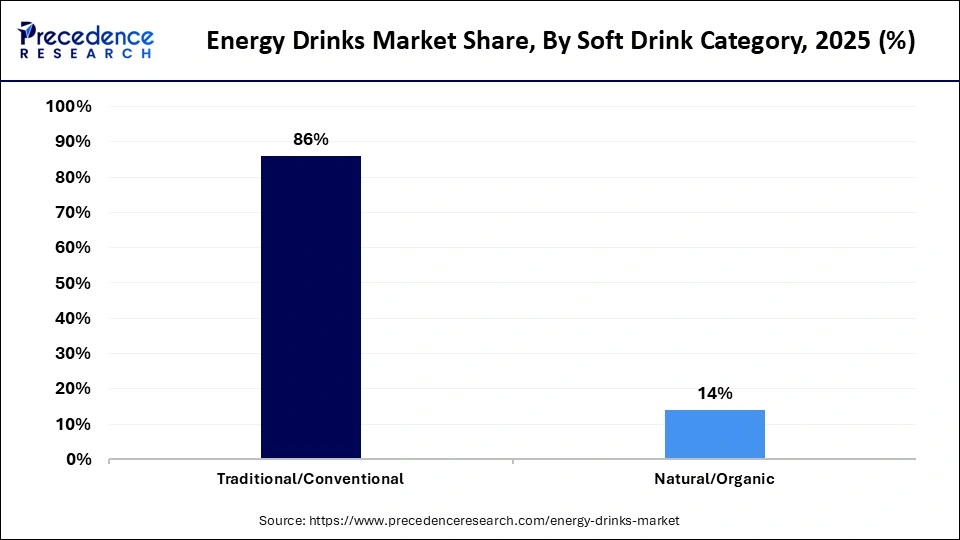
The natural/organic segment is estimated to grow at the fastest rate of 7.4% in the energy drinks market during the predicted timeframe due to a surging demand for zero-sugar options and naturally sweetened products. The growing health awareness and rising concerns about diabetes boost the demand for natural energy drinks. The other growth drivers are expanded product lines, enhanced packaging, integration of social media, and expanded markets.
Packaging Insights
How did the Cans Segment Dominate the Energy Drinks Market in 2025?
The cans segment dominated the market in 2025 with a revenue share of approximately 82%, owing to the core role of can packaging, including product integrity, integration of smart packaging, and manufacturing innovation. The National Beverage Corp. is committed to delivering creative product designs, innovative packaging, and novel flavors. This leading company has a strong portfolio of juices, sparkling waters, energy drinks, and carbonated soft drinks.
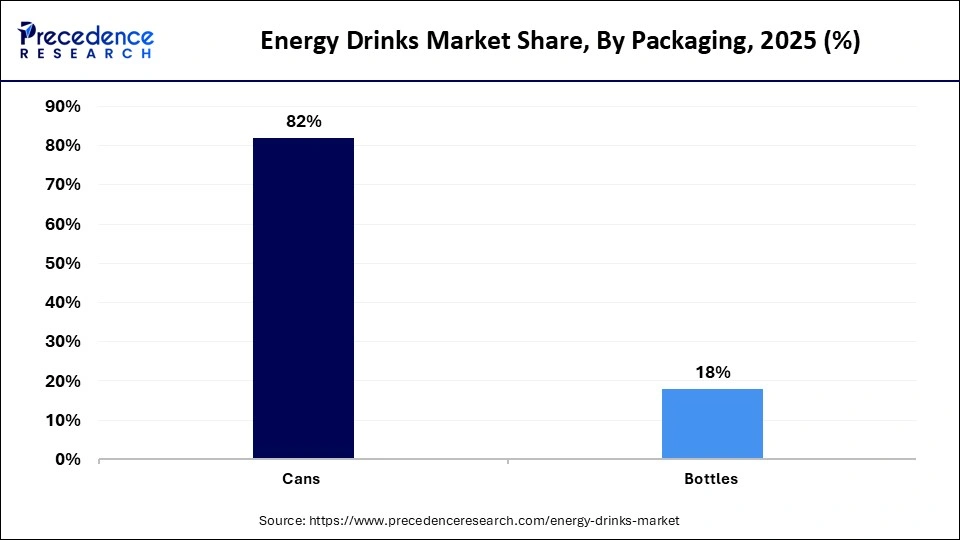
The bottles segment is anticipated to grow at a notable rate of 7.6% in the energy drinks market during the upcoming period due to convenience, resealability, sustainability, and smart and interactive branding associated with bottle packaging. It requires lower production costs and meets stricter regulations. PET (polyethylene terephthalate) bottles are gaining momentum in the global rigid plastic packaging, led by the growing demand for healthy beverages.
Distribution Channel Insights
Why did the Off-Trade Segment dominate the Energy Drinks Market in 2025?
The off-trade segment dominated the market in 2025 with a revenue share of approximately 78%, owing to the easy access to a wide range of brands and the growth of the e-commerce sector. The primary off-trade distribution channels are categorized into supermarkets, hypermarkets, convenience stores, and online platforms. They allow consumers to purchase single units or in bulk, which will be suitable during travel, at home, and at work.
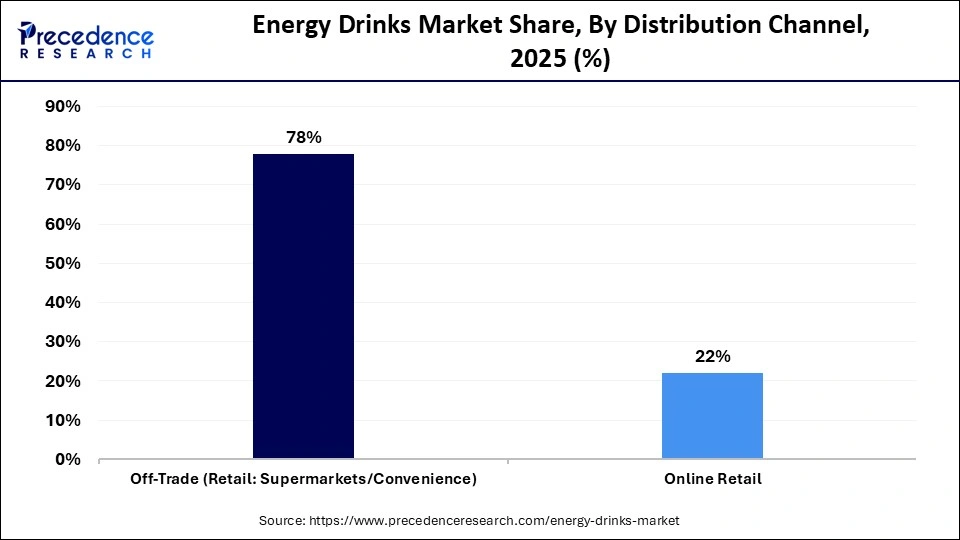
The online retail segment is predicted to grow at a rapid rate of 7.5% in the energy drinks market during the studied period due to the popularity of major e-commerce platforms like Amazon and Flipkart that are used to reach rural and underserved areas. The online retail channels are driven by direct-to-consumer models, subscription models, and quick commerce platforms like Blinkit or Zepto. The leading brands of several companies, like Red Bull GmbH, Monster Beverage Corporation, and PepsiCo, Inc., use their own websites to collect data, personalize marketing, and offer exclusive flavors.
Regional Insights
How Big is the North America Energy Drinks Market Size?
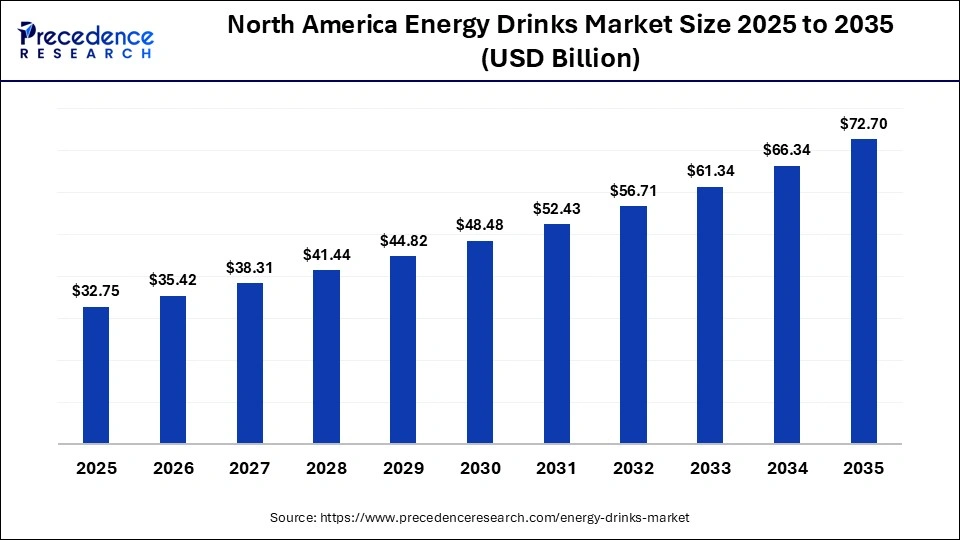
The North America energy drinks market size is estimated at USD 32.75 billion in 2025 and is projected to reach approximately USD 72.70 billion by 2035, with a 8.30% CAGR from 2026 to 2035.
How Did North America Dominate the Energy Drinks Market in 2025?
North America dominated the market in 2025 with a revenue share of approximately 38%, owing to the presence of strong distribution channels, a well-established retail infrastructure, and rapid product innovation. Leading brands such as PepsiCo are pursuing sustainable packaging strategies focused on reducing material usage, supporting recycling systems, and advancing circular economy practices for packaging materials. The Coca-Cola Company, headquartered in North America, has announced plans to deliver 25% of its global product volume in reusable packaging by 2030.
Strong brand competition and frequent new product launches are encouraging continuous innovation in formulation, packaging design, and sustainability positioning. High consumer awareness of health, functionality, and environmental impact is influencing purchasing decisions and accelerating premium product adoption. In parallel, advanced retail analytics and omnichannel distribution strategies are enabling faster market penetration and improved shelf visibility across North America.
What is the Size of the U.S. Energy Drinks Market?
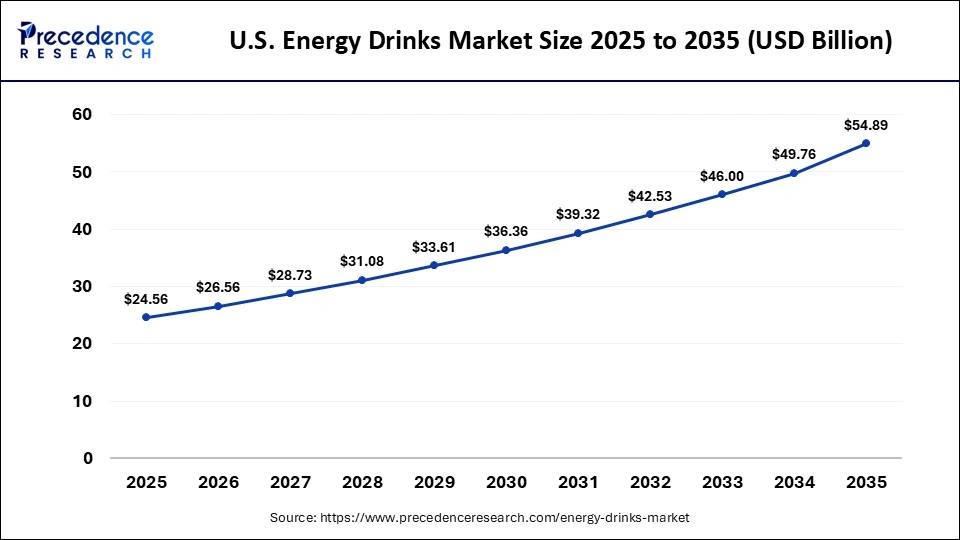
The U.S. energy drinks market size is calculated at USD 24.56 billion in 2025 and is expected to reach nearly USD 54.89 billion in 2035, accelerating at a strong CAGR of 8.37% between 2026 and 2035.
U.S. Energy Drinks Market Analysis
The U.S. industry for energy drinks advances with digital marketing, partnerships between sports organizations, and the expansion of supermarkets and convenience stores. In September 2025, Red Bull announced the launch of a $1.7 billion facility in Concord, North Carolina, which is expected to can $3 billion of energy drinks annually and distribute throughout the U.S.
Rising demand for functional beverages among young adults and working professionals is sustaining high consumption volumes across urban and suburban markets. Strong penetration of convenience retail and on-the-go consumption channels is reinforcing frequent purchase behavior and brand visibility. In parallel, investments in domestic manufacturing capacity are improving supply chain resilience and supporting faster product rollout across the U.S. market.
What is the Potential of the Energy Drinks Market in the Asia Pacific?
Asia Pacific is expected to grow at the fastest CAGR of 8.5% in the market during the forecast period due to growing health consciousness, strong preference for low-calorie, sugar-free, and natural or organic products, and rising demand for quick energy-boosting drinks among working professionals. Ball Beverage Packaging is strengthening its commitment to India, positioning the country as a strategic manufacturing and innovation hub for the Asia Pacific region through investments of US$ 115 million across its Taloja and Sri City facilities.
Rapid urbanization and expanding middle-class populations are increasing consumption of ready-to-drink functional beverages across major Asia Pacific economies. Growth of modern retail formats and e-commerce platforms is improving product availability and brand penetration beyond metropolitan areas. In parallel, localization of manufacturing and packaging capacity is enhancing supply chain efficiency and supporting faster product launches across the region.
India Energy Drinks Market Analysis
India is expanding due to the rising trends of esports, professional gaming, and the shift to healthy food and beverages. In June 2025, Reliance Retail Ventures and Reliance Consumer Products Ltd. planned to invest between ₹6,000 and ₹8,000 crore to expand beverage manufacturing capacity over the next year.
Rising youth demographics and increasing consumption of functional and energy beverages are strengthening demand across urban consumption hubs. Expansion of domestic manufacturing capacity is improving supply reliability and supporting faster regional distribution. In parallel, strong retail integration and brand-led product launches are accelerating market penetration across India. In August 2024, Pakka Limited and Brawny Bear launched date energy bars with compostable packaging.
What are the Advancements in the Energy Drinks Market in Europe?
Europe is witnessing significant market growth, driven by rising health awareness and the demand for functional beverages. Regulatory frameworks in various countries are also rapidly evolving in order to create and introduce new product formulations, which is expected to further boost market growth. The region is also characterized by a diverse consumer base that is increasingly seeking innovative flavors and healthier options. Countries such as Germany, France, and the UK are leading players.
Germany Market Trends
The country's market landscape is marked by a mix of global giants and local players, each competing for the highest market share through unique product offerings. The presence of stringent regulations regarding labeling and health claims is further helping in shaping product development strategies.
What are the Key Trends in the Energy Drinks Market in Latin America?
Latin America is expected to have significant growth in the market, fueled by increasing urbanization, a young population, and rising disposable incomes. Regulatory bodies in the region are also becoming more supportive of energy drink innovations, which is expected to further enhance market dynamics and boost market adoption. Countries like Brazil and Argentina are leading players, where lifestyle changes are driving consumption.
Brazil Market Trends
The region's growth and development are characterized by a mix of established players and new entrants, all focusing on unique flavors and health-oriented formulations. The presence of key players and local brands is helping in shaping the market, ensuring a diverse range of products for consumers.
How is the Middle East and Africa Region Growing in the Energy Drinks Market?
The Middle East and Africa region is expected to have significant market growth throughout the forecast years, driven by increasing consumer interest in energy-boosting beverages, particularly among younger demographics. Regulatory frameworks are also seen to be gradually adapting to accommodate the rising demand, which is expected to boost market expansion even more. Countries such as the UAE, Saudi Arabia, and South Africa are leading players.
Saudi Arabia Market Trends
The region's market landscape is evolving at a steady pace. The presence of key players and local brands is helping in fostering innovation and variety, catering to the unique preferences of consumers in this region.
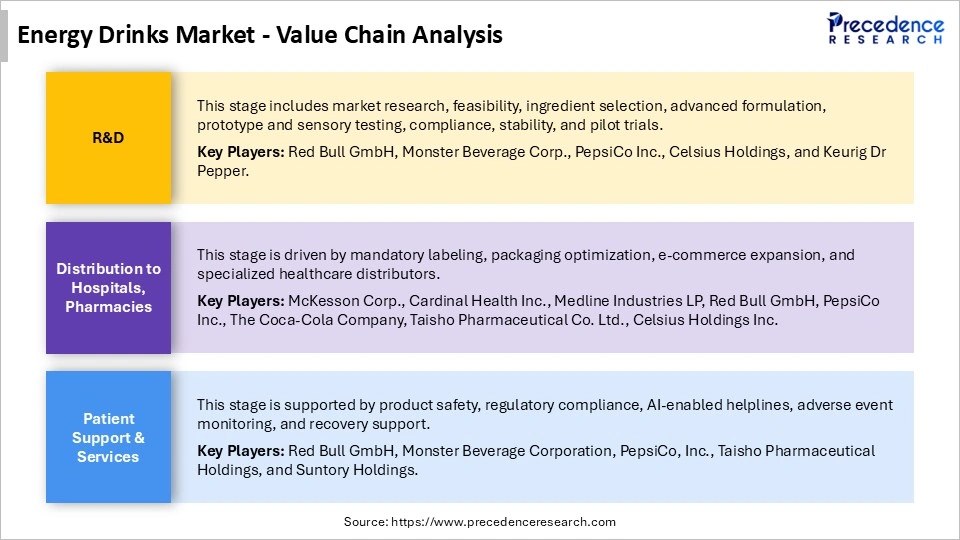
Energy Drinks Market Value Chain Analysis
Who are the Major Players in the Global Energy Drinks Market?
The major players in the energy drinks market include Red Bull GmbH, Monster Beverage Corporation, PepsiCo, Inc., The Coca-Cola Company, Rockstar (PepsiCo), National Beverage Corp, Arizona Beverage Company, Living Essentials Marketing (5-Hour Energy), Vital Pharmaceuticals (Bang Energy), Celsius Holdings, Inc., Lucozade Ribena Suntory Limited, Otsuka Pharmaceutical Co., Ltd., NOS Energy (Hondas/PepsiCo), and Amway Corp.
Recent Developments
- In May 2026, Gong Cha announced the launch of a new range of energy drinks. These energy drinks will be launched in June 2026 for the consumers of the U.S. region.(Source: https://www.qsrmagazine.com)
- In March 2026, Dunkin launched the Dunkin Zero. Dunkin Zero is a non-sugar energy drink that is available in six varieties, including Blackberry Tangerine, Tropical Mango, Juicy Peach, Glamberry, Sunzest, and Blushpop. (Source: https://news.dunkindonuts.com)
- In March 2026, Three Sixty unveiled a new energy drink. These drinks are totally sugar-free and come in various flavors such as açaí, passion fruit, dark berry, and lemon. (Source: https://www.thespiritsbusiness.com)
- In January 2026, Phorm Energy launched the Silver Lightning. Silver Lightning is a new series of energy drinks introduced for football players and MMA fighters in the U.S. (Source: https://www.convenience.org )
- In January 2026, BLU Energy Drink announced the launch of a new range of energy drinks globally. These energy drinks are manufactured using real sugarcane sugar, which helps in providing essential vitamin B in human beings. (Source: https://www.bevnet.com)
- In February 2025, Red Bull GmbH announced the launch of its summer edition white peach energy drink, aiming to enhance its portfolio of flavored energy drinks.(Source: https://www.foodbev.com)
- In August 2025, PepsiCo, Inc. made a strategic partnership with Celsius Holdings, Inc. that will boost the move of Celsius Holdings' Alani Nu brand into the PepsiCo distribution system in the U.S. and Canada, for which PepsiCo acquired $585 million.(Source: https://www.pepsico.com)
Segments Covered in the Report
By Type
- General Energy Drinks
- Energy Shots
By Soft Drink Category
- Traditional/Conventional
- Natural/Organic
By Packaging
- Cans
- Bottles
By Distribution Channel
- Off-Trade (Retail: Supermarkets/Convenience)
- Online Retail
By Region
- North America
- Europe
- Asia-Pacific
- Latin America
- Middle East & Africa
For inquiries regarding discounts, bulk purchases, or customization requests, please contact us at sales@precedenceresearch.com
Frequently Asked Questions
Tags





Ask For Sample
No cookie-cutter, only authentic analysis – take the 1st step to become a Precedence Research client
 Get a Sample




 sales@precedenceresearch.com
 Schedule a Meeting
