



Europe Biosolids Management Market Size, Share and Trends 2026 to 2035
Europe Biosolids Management Market (By Process/Treatment Method: Anaerobic Digestion, Aerobic Digestion (including Heat Drying), Composting, Land Application, Incineration/Thermal Treatment, Landfilling, and Nutrient Removal/Recovery; By Product Type/Quality: Class A (Pathogen-Free, Safe for Unrestricted Use), Class A EQ (Exceptional Quality), Class B (Less Stringent, Limited-Use), and Class AB/Intermediate; By Application: Agricultural Land Application, Non-Agricultural Land Application, Energy Recovery, and Other Uses; By End-User: Municipalities (Wastewater Authorities), Industrial Facilities, Farmers/Agricultural Businesses, and Landscapers/Land Restoration Entities) Industry Size, Share, Growth, Trends 2025-2035
Source: https://www.precedenceresearch.com/europe-biosolids-management-market
 Get a Sample
 Table Of Content


The Europe biosolids management market size was estimated at USD 420 million in 2025 and is projected to be worth around USD 698.61 million by 2035, growing at a CAGR of 5.22% from 2026 to 2035. The European market is driven by strict EU environmental rules, the drive for circular economy practices, and a growing need for sustainable, organic fertilizers.
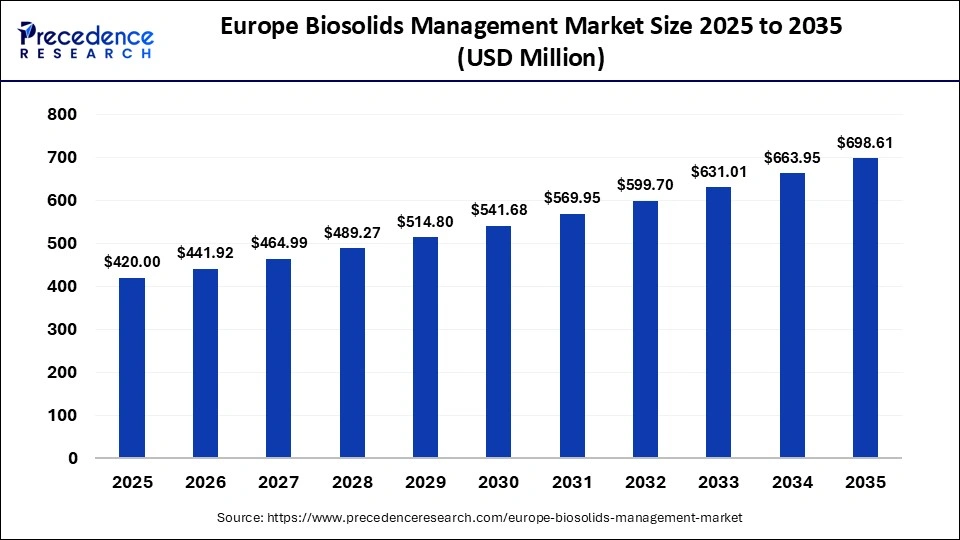
Europe Biosolids Management Market Statical Scope
| Reports Attributes | Statistics |
| Market Size in 2025 | USD 420 Million |
| Market Size in 2026 | USD 441.92 Million |
| Market Size by 2035 | USD 698.61 Million |
| CAGR 2026 to 2035 | 5.22% |
| Base Year | 2025 |
| Forecast Period | 2026 to 2035 |
The market is important as it converts municipal and industrial wastewater sludge into valuable products like agricultural fertilizers and biogas, which directly support the EU's circular economy objectives and strict landfill reduction requirements. Biosolids offer a dependable, local source of organic matter and vital nutrients such as phosphorus, helping to solve regional shortages of raw fertilizer materials. Advanced treatment techniques like anaerobic digestion enable wastewater facilities to recover energy and produce biogas, which helps lower municipal operating expenses and cut greenhouse gas emissions.
Regulations like the Urban Waste Water Treatment Directive require the sustainable management and safe reuse of sludge, which helps prevent water pollution and reduces dependence on traditional landfills. Initiatives linked to the European Green Deal, such as the Horizon Europe "Soil Deal for Europe," specifically promote sustainable soil management and the restoration of degraded lands using high-quality organic amendments.
Europe Biosolids Management Market, By Process/Treatment Method, 2025
| Segments | Shares (%) |
| Anaerobic Digestion | 24.80% |
| Aerobic Digestion (including Heat Drying) | 18.60% |
| Composting | 16.20% |
| Land Application | 15.40% |
| Incineration/Thermal Treatment | 11.30% |
| Landfilling | 5.70% |
| Nutrient Removal/Recovery | 8.00% |
- Anaerobic Digestion - Anaerobic digestion (AD), with a share of 24.80% in 2025, plays a dominant role in Europe's biosolids market by turning waste management from a cost into a profitable circular economy model. It does this by generating renewable energy (biogas/biomethane) while also stabilizing sewage sludge into nutrient-rich, pathogen-free biosolids suitable for agricultural use.
- Aerobic Digestion (including heat drying) - In the European biosolids management market, the aerobic digestion (and heat drying) segment, with a share of 18.60% in 2025, is essential as it transforms wet sewage sludge into safe, Class A, pathogen-free organic fertilizers and pellets. This segment is key to fulfilling strict EU environmental requirements and advancing the region's circular economy objectives.
- Composting - The composting segment, with a share of 16.20% in 2025, is vital in the Europe Biosolids Management Market as it converts municipal sewage sludge into stable, odor-free, Class A organic fertilizer. This process is crucial for adhering to strict EU environmental standards, addressing severe soil degradation, and promoting the regional circular economy.
Europe Biosolids Management Market, By Product Type/Quality, 2025
| Segments | Shares (%) |
| Class A (Pathogen-Free, Safe for Unrestricted Use) | 31.70% |
| Class A EQ (Exceptional Quality) | 20.90% |
| Class B (Less Stringent, Limited-Use) | 34.10% |
| Class AB/Intermediate | 13.30% |
- Class A (Pathogen-Free, Safe for Unrestricted Use) - The Class A segment, with a share of 31.70% in 2025, is leading the Europe Biosolids Management Market due to its complete pathogen reduction and vector attraction standards, which are necessary to comply with tightening regional regulations. It converts municipal waste into a versatile, high-value product that can be safely utilized in agriculture and horticulture without restrictive land-use limitations.
- Class A EQ (Exceptional Quality) - The Class A EQ (Exceptional Quality) segment, with a share of 20.90% in 2025, holds significant importance in the Europe Biosolids Management Market as it guarantees adherence to strict European organic regulations, mitigates public resistance to sludge, and allows for unrestricted land application as a clean fertilizer.
Europe Biosolids Management Market, By Application, 2025
| Segments | Shares (%) |
| Agricultural Land Application | 44.90% |
| Non-Agricultural Land Application | 20.80% |
| Energy Recovery | 23.70% |
| Other Uses | 10.60% |
- Agricultural Land Application - The agricultural land application segment, with a share of 44.90% in 2025, dominates the Europe Biosolids Management Market as it supplies vital macro and micronutrients for crops, reducing the need for costly, energy-consuming synthetic fertilizers. This segment is a key factor in Europe's transition to a sustainable, closed-loop circular economy.
- Non-Agricultural Land Application - The non-agricultural land application segment, with a share of 20.80% in 2025, plays a significant role in the Europe biosolids management market by offering a safe and controlled way to dispose of treated sludge that doesn't meet the strict quality standards for food-crop agriculture. It serves as an essential safety outlet for municipalities facing increased urban wastewater production.
Europe Biosolids Management Market, By End-User, 2025
| Segments | Shares (%) |
| Municipalities (Wastewater Authorities) | 46.80% |
| Industrial Facilities | 18.50% |
| Farmers/Agricultural Businesses | 25.90% |
| Landscapers/Land Restoration Entities | 8.80% |
- Municipalities (Wastewater Authorities) - Municipalities and wastewater authorities, with a share of 46.80% in 2025, are the leading drivers of the European biosolids management market. They produce consistent amounts of sewage sludge and manage public funds, driving regional treatment methods like Class A/B stabilization, anaerobic digestion for biogas, and land application. Their choices directly implement EU circular economy policies.
- Industrial Facilities - The industrial facilities segment, with a share of 18.50% in 2025, is crucial in the European biosolids management market as high-volume, organic-rich effluents from industries such as food processing and pulp & paper need specialized sludge treatment. Industrial biosolids require advanced processing to meet Europe's strict environmental regulations.
Competitive Landscape
The European biosolids management market is somewhat consolidated, driven by strict EU regulations that promote circular economies, pathogen reduction, and phosphorus recovery. Major companies mainly concentrate on advanced treatment technologies like anaerobic digestion and thermal hydrolysis to transform municipal sludge into renewable energy and agricultural fertilizers.
- Veolia Environnement S.A. (France) is a global leader in environmental services, providing extensive sludge valorization solutions. Their offerings include municipal treatment, advanced digestion, and odor control technologies, which convert biosolids into organic fertilizers and biogas.
- Suez S.A. (France) is a key player in the European market, operating numerous treatment plants. They focus on converting municipal sludge into agricultural biosolids and recovering vital nutrients such as phosphorus, in line with circular economy principles.
- REMONDIS SE & Co. KG (Germany) is among the largest recycling and water management firms globally, emphasizing thermal sludge utilization and recycling sewage sludge into high-quality phosphate fertilizers.
- Cambi ASA (Norway) is a global leader in Thermal Hydrolysis Process (THP) technology. Cambi's systems prepare sludge for anaerobic digestion, significantly boosting biogas production and eliminating pathogens, ensuring the resulting biosolids are safe for land application.
Segments Covered in the Report
By Process/Treatment Method
- Anaerobic Digestion
- Aerobic Digestion (including Heat Drying)
- Composting
- Land Application
- Incineration/Thermal Treatment
- Landfilling
- Nutrient Removal/Recovery
By Product Type/Quality
- Class A (Pathogen-Free, Safe for Unrestricted Use)
- Class A EQ (Exceptional Quality)
- Class B (Less Stringent, Limited-Use)
- Class AB/Intermediate
By Application
- Agricultural Land Application
- Non-Agricultural Land Application
- Energy Recovery
- Other Uses
By End-User
- Municipalities (Wastewater Authorities)
- Industrial Facilities
- Farmers/Agricultural Businesses
- Landscapers/Land Restoration Entities
For inquiries regarding discounts, bulk purchases, or customization requests, please contact us at sales@precedenceresearch.com
Frequently Asked Questions





Ask For Sample
No cookie-cutter, only authentic analysis – take the 1st step to become a Precedence Research client
 Get a Sample




 sales@precedenceresearch.com
 Schedule a Meeting
