



Europe Medical Electronics Market Size, Share and Trends 2026 to 2035
Europe Medical Electronics Market (By Product: Therapeutics, Diagnostics, and Others; By Application: Hospitals, Ambulatory Centers, Homecare, and Others) Industry Size, Share, Growth, Trends 2025-2035
 Get a Sample
 Table Of Content


The Europe medical electronics market size was estimated at USD 26.88 billion in 2025 and is projected to be lead around USD 63.05 billion by 2035, growing at a CAGR of 8.90% from 2026 to 2035. The market in Europe is mainly driven by an aging population, the rise of chronic diseases, and fast-paced technological progress.
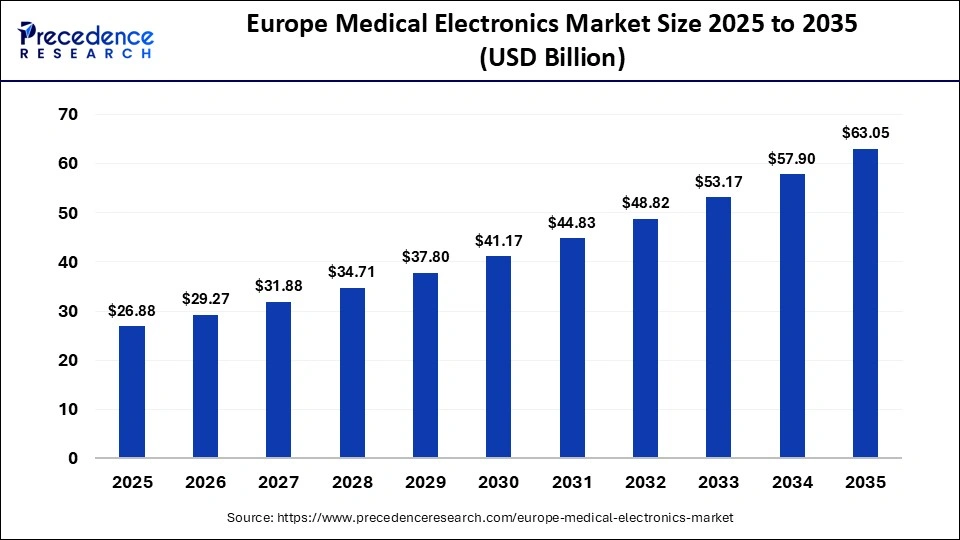
Europe Medical Electronics Market Statical Scope
| Reports Attributes | Statistics |
| Market Size in 2025 | USD 26.88 Billion |
| Market Size in 2026 | USD 29.27 Billion |
| Market Size by 2035 | USD 63.05 Billion |
| CAGR 2026 to 2035 | 8.90% |
| Base Year | 2025 |
| Forecast Period | 2026 to 2035 |
The market is crucial as it holds a significant share globally, caters to an aging demographic, and upholds strict safety standards. It fosters innovation in health technology in key areas like Germany and France. The increasing number of elderly people boosts the need for long-term care, management of chronic illnesses, and home healthcare devices. Europe holds a significant share of the worldwide medical technology market, supported by substantial healthcare investments in leading countries.
Strict regulations such as the Medical Device Regulation (MDR) ensure product safety and enhance trust among consumers and healthcare professionals. The swift shift towards smaller, digital, and connected remote-monitoring tools leads to better patient outcomes.
Europe Medical Electronics Market, By Product, 2025 (%)
| Segments | Shares (%) |
| Diagnostics | 48.00% |
| Therapeutics | 44.00% |
| Others | 8.00% |
- Therapeutics - The therapeutics segment, with a share of 44.00% in 2025, is a vital part of the Europe Medical Electronics Market as it tackles rising chronic illness, promotes advanced technology integration, and helps in healthcare decentralization. Important aspects include managing the aging population, facilitating accurate interventions, and adapting to value-based care.
- Diagnostics - The diagnostics segment, with a share of 48.00% in 2025, plays a dominant role in the Europe medical electronics market due to early disease detection, supporting an aging population, and promoting digital health integration. Key aspects include managing chronic illnesses, reducing hospital expenses, and adhering to high clinical data standards.
Europe Medical Electronics Market, By Application, 2025 (%)
| Segments | Shares (%) |
| Hospitals | 57.00% |
| Homecare | 19.00% |
| Ambulatory Centers | 18.00% |
| Others | 6.00% |
- Hospitals - The hospital segment, with a share of 57.00% in 2025, accounts for the largest revenue share in the Europe medical electronics market as it is the main purchaser of high-value diagnostic imaging, complex patient monitors, and surgical systems, driven by significant public healthcare funding, an aging population, and strict safety regulations.
- Ambulatory Centers - The ambulatory centers segment, with a share of 18.00% in 2025, is important in the Europe medical electronics market as it fosters rapid growth through cost-effective care, addresses the needs of an aging population, and benefits from favorable reimbursement policies.
- Homecare - The homecare segment, with a share of 19.00% in 2025, is crucial in the Europe medical electronics market as it reduces public healthcare costs, manages an aging population, and uses new technology for chronic disease management. Key factors include cost savings, demographic pressures, and technological integration.
Competitive Landscape
The medical electronics market in Europe is somewhat consolidated, with major international and regional OEMs and specialized semiconductor/component suppliers leading the way. Key players in the industry include Koninklijke Philips N.V., Siemens Healthineers AG, and Medtronic plc.
- Koninklijke Philips N.V. (Netherlands) provides diagnostic imaging (MRI, CT, ultrasound), patient monitoring systems, telehealth platforms, and enterprise diagnostic informatics.
- Siemens Healthineers AG (Germany) offers advanced diagnostic imaging (PET, CT, MRI), laboratory diagnostics, robotic-assisted endovascular systems, and advanced therapy solutions.
- Medtronic plc (Ireland/Global) specializes in cardiac rhythm management devices, pacemakers, deep brain stimulators, insulin delivery electronics, and surgical navigation tools.
- Abbott Laboratories (US/Europe Presence) supplies continuous glucose monitoring (FreeStyle Libre), point-of-care diagnostic analyzers, and cardiac electrophysiology/neuromodulation devices.
- GE HealthCare (US/Europe Presence) provides ultrasound machines, mobile X-ray units, patient monitors, and AI-enabled diagnostic software imaging assistants.
- Core silicon and component vendors (e.g., STMicroelectronics, NXP Semiconductors) offer low-power microcontrollers, biosensors, customized analog chips, and connectivity ICs that power portable and wearable medical devices.
Segments Covered in the Report
By Product
- Therapeutics
- Diagnostics
- Others
By Application
- Hospitals
- Ambulatory Centers
- Homecare
- Others
For inquiries regarding discounts, bulk purchases, or customization requests, please contact us at sales@precedenceresearch.com
Frequently Asked Questions





Ask For Sample
No cookie-cutter, only authentic analysis – take the 1st step to become a Precedence Research client




 sales@precedenceresearch.com
 Schedule a Meeting



