



Europe Revenue Cycle Management Market Size, Share and Trends 2026 to 2035
Europe Revenue Cycle Management Market (By Product: Software and Services; By Type: Integrated and Standalone; By Delivery Mode: Web-based, Cloud-based, and On-premise; By End-use: Physician Back Offices, Hospitals, Diagnostic Laboratories, and Other) Industry Size, Share, Growth, Trends 2025-2035
 Get a Sample
 Table Of Content


The Europe Revenue cycle management market size is calculated at USD 40.73 Billion in 2025 and is predicted to attain around USD 114.61 Billion by 2035, expanding at a CAGR of 10.9% from 2026 to 2035. The Market is mainly driven by the digitization of healthcare systems and the need to improve clinical billing and claims processes.
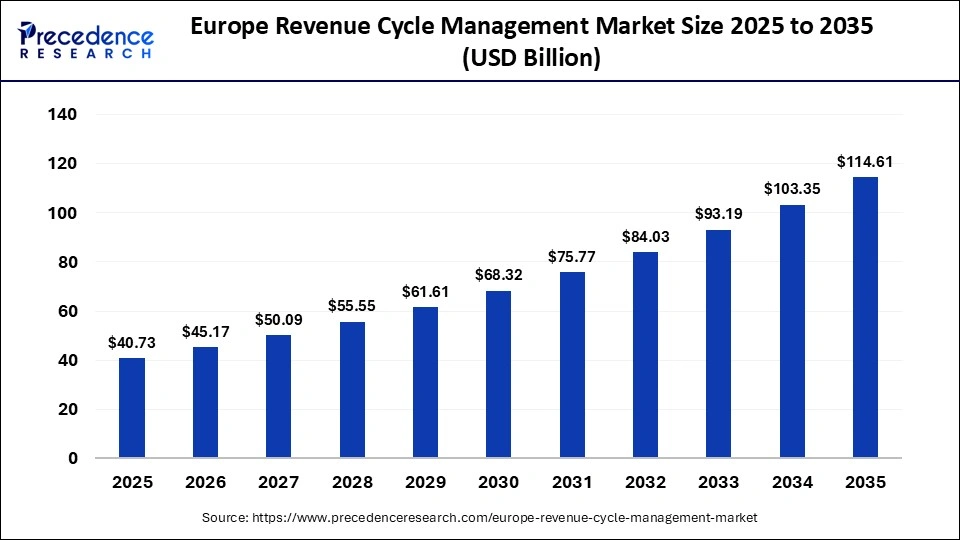
Europe Revenue Cycle Management Market Statical Scope
| Reports Attributes | Statistics |
| Market Size in 2025 | USD 40.73 Billion |
| Market Size in 2026 | USD 45.17 Billion |
| Market Size by 2035 | USD 114.61 Billion |
| CAGR 2026 to 2035 | 10.9% |
| Base Year | 2025 |
| Forecast Period | 2026 to 2035 |
The market is crucial as it updates financial operations in healthcare, increases cash flow, and addresses administrative challenges. By automating medical billing, claims processing, and denial management, it helps European healthcare providers, including the U.K.'s NHS and Germany's Statutory Health Insurance, stay profitable despite increasing patient numbers and complex coding rules. With support from initiatives like the European Commission's Digital Single Market Strategy, countries are quickly moving from outdated healthcare IT systems to cloud-based solutions. Automated RCM solutions reduce coding errors and lower claim denials, allowing more funds for clinical resources.
As European healthcare shifts to value-based care, smart RCM platforms are essential for tracking clinical results against financial payments. Standardizing billing systems enables smooth cooperation among various hospital networks and private insurers, ensuring regional compliance. Key regions like Germany and the U.K. are at the forefront of this market, focusing on RCM to provide high-quality care while managing budget limitations and an aging population.
Europe Revenue Cycle Management Market, By Product, 2025 (%)
| Segments | Shares (%) |
| Software | 61.80% |
| Services | 38.20% |
- Software - The software sector, with a share of 61.80% in 2025, leads the Europe Revenue Cycle Management (RCM) market. This is crucial as healthcare systems in key areas like Germany, the UK, France, and the Nordics depend on it to automate complex billing processes, reduce heavy administrative tasks, and link financial data directly with Electronic Health Records (EHRs).
- Services - In the Europe Revenue Cycle Management (RCM) market, the services sector, with a share of 38.20% in 2025 (which includes outsourced billing, coding, and denial management), plays a vital role by addressing significant staffing shortages, minimizing revenue loss from complicated cross-border billing, and managing operational costs. Outsourcing helps healthcare providers deal with complex, localized payer reimbursement policies without needing to maintain in-house expertise.
Europe Revenue Cycle Management Market, By Type, 2025 (%)
| Segments | Shares (%) |
| Integrated | 67.30% |
| Standalone | 32.70% |
- Integrated - The integrated segment, with a share of 67.30% in 2025, dominates the European Revenue Cycle Management (RCM) market as it offers comprehensive platforms that eliminate data silos, reduce administrative tasks, and ensure smooth data transfer across hospital departments. By merging functions like patient registration, coding, billing, and claims management into a single system, healthcare providers can reduce errors and speed up reimbursement processes.
- Standalone - The standalone segment, with a share of 32.70% in 2025, is crucial in the European Revenue Cycle Management (RCM) market as it offers specialized, niche functions (like claims and denial management or medical coding). This allows smaller, independent healthcare providers or payers to use targeted, flexible tools without needing to invest in or overhaul complete, costly end-to-end software systems.
Europe Revenue Cycle Management Market, By Delivery Mode, 2025 (%)
| Segments | Shares (%) |
| Cloud-based | 49.80% |
| Web-based | 26.40% |
| On-premise | 23.80% |
- Web-based - The web-based segment, with a share of 26.40% in 2025, is crucial in the European Revenue Cycle Management (RCM) market as it provides the centralized access, scalability, and seamless interoperability needed to manage complex cross-border billing, reduce administrative costs, and uphold strict data privacy standards like GDPR.
- Cloud-based - The cloud-based segment, with a share of 49.80% in 2025, plays a dominant role in the Europe Revenue Cycle Management (RCM) market as it offers scalability, cost-effectiveness, and secure interoperability necessary for updating outdated regional healthcare systems. It allows for real-time access to patient data, smooth integration of Electronic Health Records (EHR), and ensures compliance with GDPR.
Europe Revenue Cycle Management Market, By End-use, 2025 (%)
| Segments | Shares (%) |
| Hospitals | 44.70% |
| Physician Back Offices | 22.90% |
| Diagnostic Laboratories | 18.60% |
| Other | 13.80% |
- Physician Back Offices - The physician back-office segment, with a share of 22.90% in 2025, is essential in the Europe Revenue Cycle Management (RCM) market as it streamlines complex coding and billing tasks, reduces claim denials, and compensates for shortages in administrative staff. By speeding up reimbursements, these systems enable independent practices to handle more patients without needing to increase expensive in-house administrative teams.
- Hospitals - The hospital segment, with a share of 44.70% in 2025, leads the Europe Revenue Cycle Management (RCM) market as hospitals produce the highest volume of claims, deal with intricate billing for both public and private insurance, and manage costly clinical infrastructure. Automating this process helps prevent revenue loss and optimizes budgets to support large clinical teams.
Competitive Landscape
The European Revenue Cycle Management (RCM) market is very competitive mainly due to the move towards digital healthcare systems and improved administrative efficiencies in key regions like Germany, the U.K., and France. The market is led by major health-tech companies and specialized RCM providers that offer cloud solutions and AI automation.
- Oracle provides a fully integrated, cloud-based ERP and financial management solution. Their enterprise analytics include interoperability tools aimed at modernizing complex billing and financial processes for large health systems.
- Optum (Optum360) offers a wide range of full-cycle RCM services. Their services are notable for their advanced AI models that optimize claims and unify payer-provider data, which helps in managing denials effectively.
- Epic Systems leads in hospital installations with their combined clinical and financial platforms. Their fully integrated module keeps patient engagement and billing/claims organized within one system.
- Solventum (previously known as 3M Health Information Systems) focuses on improving clinical documentation (CDI) and Computer-Assisted Coding (CAC). Their AI-driven coding automates processes to improve accuracy and lower claim denials.
- Experian Health emphasizes patient engagement, front-end financial clearance, and identity verification. Their platform uses predictive analytics to assist hospitals in assessing a patient's likelihood to pay before receiving care.
- R1 RCM serves as a complete RCM outsourcing partner. They provide extensive revenue cycle management services tailored for large hospitals and complex health networks.
Segments Covered in the Report
By Product
- Software
- Services
By Type
- Integrated
- Standalone
By Delivery Mode
- Web-based
- Cloud-based
- On-premise
By End-use
- Physician Back Offices
- Hospitals
- Diagnostic Laboratories
- Other
For inquiries regarding discounts, bulk purchases, or customization requests, please contact us at sales@precedenceresearch.com
Frequently Asked Questions





Ask For Sample
No cookie-cutter, only authentic analysis – take the 1st step to become a Precedence Research client
.webp)



 sales@precedenceresearch.com
 +1 804-441-9344
 Schedule a Meeting



