



Financial Smart Cards Market Trends, Companies, Revenue / Sales Performance, Subscriber Growth, Pricing Strategies, Cloud Adoption, Infrastructure Expansion, Competitive Landscape, and Industry Outlook
Financial Smart Cards Market (By Application: Payment Cards, Identification Cards, Access Control Cards, Healthcare Cards; By Card Type: Contactless Cards, Contact Cards, Dual-Interface Cards; By Technology: EMV, Magnetic Stripe, Smart Card with Secure Chip; By End Use: Banking, Retail, Government, Healthcare) - Global Industry Analysis, Size, Trends, Leading Companies, Regional Outlook, and Forecast 2026 to 2035
Source: https://www.precedenceresearch.com/financial-smart-cards-market
 Get a Sample
 Table Of Content


What is the Financial Smart Cards Market Size in 2026?
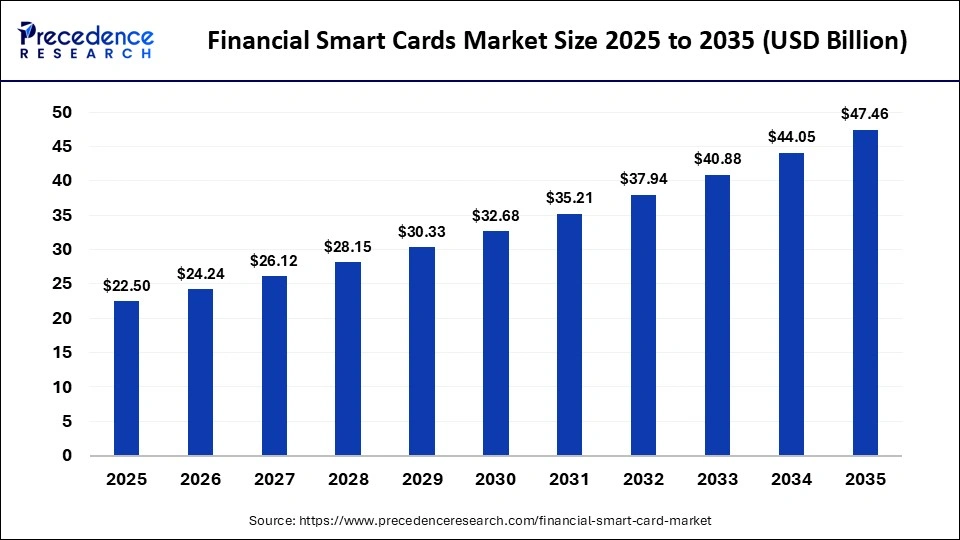
The global financial smart cards market size accounted for USD 22.50 billion in 2025 and is predicted to increase from USD 24.24 billion in 2026 to approximately USD 47.46 billion by 2035, expanding at a CAGR of 7.75% from 2026 to 2035. The market is driven by increasing demand for secure, contactless payments and advanced authentication technologies to enhance security and user convenience.
Key Takeaways
- North America dominated the market with a major market share in 2025.
- By application, the payment cards segment accounted for the largest market share in 2025.
- By application, the identification cards segment is projected to grow at a solid CAGR between 2026 and 2035.
- By card type, the contactless cards segment generated the biggest market share in 2025.
- By card type, the contact cards segment is expected to expand at the fastest CAGR between 2026 and 2035.
- By technology, the EMV segment captured the highest market share in 2025.
- By technology, the magnetic stripe segment is poised to grow at a healthy CAGR between 2026 and 2035.
- By end use, the banking segment held a major market share in 2025.
What is the Financial Smart Cards Market?
The financial smart cards market comprises integrated circuit cards with embedded microprocessors or memory chips that store and process data for secure transactions and identification. These pocket-sized plastic cards support secure, contactless, or contact-based transactions. They are more secure than traditional magnetic stripes because they use encryption, EMV standards, and sometimes biometrics. They are used for credit, debit, and prepaid transactions. The market is driven by high demand for secure transaction methods, increasing cashless transactions, adoption of contactless technology, and the need to prevent fraud.
How is AI Revolutionizing the Financial Smart Cards Market?
Artificial intelligence (AI) is revolutionizing the global market by enhancing security through real-time, behavioral AI-driven fraud detection, enabling personalized user experiences, and facilitating biometric authentication. AI analyzes transactional patterns in real time, identifying anomalies and flagging suspicious activity, reducing false positives, and providing a proactive approach to stopping fraud. AI-powered behavioral biometrics analyze unique user patterns to create a dynamic profile, enhancing security beyond traditional passwords and reducing unauthorized access. AI helps manage high-frequency transactions in real time, optimize payment routing, and facilitate faster dispute resolution.
Major Trends in the Financial Smart Cards Market
- Rise of Contactless and Dual-Interface Cards: Driven by the need for faster, hygienic transactions, NFC-enabled contactless payments are growing. Many banks are moving to dual-interface cards that allow both dipping and tapping, providing versatility during infrastructure upgrades.
- Demand for Integration of Biometric Authentication: To combat high-level fraud, smart cards are integrating fingerprint sensors directly onto the card. This ensures that only authorized transactions are performed, significantly enhancing security for high-value transactions.
- Adoption of Sustainability and Eco-Friendly Materials: Responding to consumer demand and corporate ESG goals, manufacturers are transitioning from traditional PVC to recycled plastics and bio-based materials to reduce the environmental impact of plastic waste.
- Rise in Invisible and Multi-Application Cards: Smart cards are becoming more integrated into digital ecosystems, acting as both payment tools and keys for transit or building access to facilitate secure, tokenized payments.
Market Scope
| Report Coverage | Details |
| Market Size in 2025 | USD 22.50 Billion |
| Market Size in 2026 | USD 24.24 Billion |
| Market Size by 2035 | USD 47.46 Billion |
| Market Growth Rate from 2026 to 2035 | CAGR of 7.75% |
| Dominating Region | North America |
| Base Year | 2025 |
| Forecast Period | 2026 to 2035 |
| Segments Covered | Application, Card Type, Technology, End Use, and Region |
| Regions Covered | North America, Europe, Asia-Pacific, Latin America, and Middle East & Africa |
Segment Insights
Application Insights
What Made Payment Cards the Dominant Segment in the Financial Smart Cards Market?
The payment cards segment dominated the market in 2025, primarily due to the widespread adoption of EMV (Europay, MasterCard, and Visa) chips, enhanced security features through biometric integration, and a rising demand for contactless transactions. The incorporation of fingerprint scanners into payment cards has significantly improved security, leading to increased adoption. Retailers and financial institutions are moving away from cash, which has accelerated the issuance of smart debit and credit cards, further reinforcing this dominance.
The identification cards segment is expected to experience the fastest growth. This is mainly driven by the convergence of national ID programs, e-passports, and financial inclusion initiatives that require high-security, tamper-proof, and contactless identification. These cards are increasingly functioning as smart identity documents, enabling citizens to access banking services, perform secure contactless payments, and complete digital transactions, effectively merging identification and financial applications. The adoption of advanced security features is rapidly increasing for secure access and financial transactions.
Card Type Insights
How Did the Contactless Cards Segment Lead the Financial Smart Cards Market?
The contactless cards segment led the market with the largest share in 2025, largely due to rapid adoption in retail, transportation, and banking sectors, thanks to their superior transaction speed, convenience, and hygiene. Many contactless cards now feature EMV chip technology, which provides secure and encrypted transactions that help prevent fraud, further encouraging their adoption in banking. The widespread availability of contactless-enabled Point-of-Sale terminals is facilitating quick adoption across retail, transportation, and hospitality sectors, thereby reducing global cash dependency and fostering increased usage.
The contact cards segment is expected to grow at the fastest rate during the forecast period. This growth is primarily attributed to their significance in secure EMV chip transactions and their reliability in high-value, secure environments. The existing, widely established infrastructure for contact-based card readers, such as ATMs and POS systems, ensures that contact cards remain a dependable choice. These cards provide robust security against fraud, making them indispensable alongside the rise of contactless technology. Overall, the adoption of these cards is expected to grow significantly due to their crucial role in high-value and secure transactions.
Technology Insights
Why Did the EMV Segment Dominate the Financial Smart Cards Market?
The EMV segment dominated the market in 2025, driven by the intense demand for fraud prevention, the global shift towards contactless payments, and regulatory mandates. Contactless EMV cards are becoming standard for speed and security, as global transactions increasingly utilize chip technology. EMV chips generate unique transaction codes, which drastically reduce counterfeiting, skimming, and card cloning compared to magnetic stripes. Financial institutions are pressured to adopt EMV technology, with many regions implementing a liability shift that places the responsibility for fraud on merchants who do not support EMV.
The magnetic stripe segment is expected to expand at the fastest CAGR during the forecast period, mainly due to its essential role as a cost-effective fallback in hybrid, multi-technology cards. Additionally, hybrid cards combine traditional magnetic stripes with NFC or EMV chips, providing backward compatibility in developing regions while meeting modern security standards elsewhere. Advances in magnetic stripe technology led to the creation of more durable, tamper-resistant cards that are less costly to issue, making them appealing in cost-sensitive environments and extending their relevance in the digital ecosystem.
End Use Insights
Why is the Banking Segment Leading the Financial Smart Cards Market?
The banking segment led the market with the largest share in 2025 and is expected to maintain its growth trajectory during the forecast period. The growth of the segment is driven by enhanced biometric security, expansion in emerging economies, and the rapid transition to contactless and dual-interface cards. The shift toward contactless payments and dual-interface cards is resulting in high replacement volumes. Biometric-enabled smart cards, featuring fingerprint recognition, are experiencing rapid adoption to provide enhanced security for high-value transactions. There is also an increasing focus on eco-friendly, sustainable, and recyclable materials in card manufacturing, which is promoting the issuance of compliant and sustainable cards by banks.
Regional Insights
What Made North America the Dominant Region in the Financial Smart Cards Market?
North America dominated the market by capturing a major share in 2025 and is expected to sustain its growth trajectory during the forecast period. This is primarily due to its advanced financial infrastructure, high adoption rates of contactless payments, and growing demand for secure, hybrid, and occasionally biometric-enabled payment solutions. Stringent security regulations and a high incidence of credit card fraud have driven the adoption of advanced EMV chip technology and, more recently, biometric-enabled smart cards. Moreover, there has been an increased federal, state, and corporate usage of smart cards for secure physical and logical access. Increased integration of both contact and contactless interfaces is boosting the market.
The U.S. Financial Smart Cards Market Trends
The U.S. plays a distinctive role within the region, mainly due to high adoption in banking, a shift towards contactless payments, and a strong focus on cybersecurity to combat fraud. The U.S. has experienced a rapid increase in contactless transactions, leading to widespread issuance of dual-interface cards, moving beyond simple EMV functionality. Major companies influencing the market, some with significant U.S. presence, include Thales, IDEMIA, Giesecke+Devrient, CPI Card Group, and HID Global, focusing on increased adoption of eco-friendly, recycled, and metal cards.
How is the Opportunistic Rise of Asia Pacific in the Financial Smart Cards Market?
Asia Pacific is expected to experience an opportunistic growth in the market, mainly due to rapid digitalization and government initiatives pushing for cashless economies, which are expanding the use of secure contactless payment cards across banking and retail sectors. The region's large and growing middle‑class population, increasing smartphone penetration, and strong adoption of digital payments are accelerating financial inclusion and demand for smart card solutions. Additionally, integration with advanced technologies such as NFC, biometric authentication, and mobile wallet connectivity is enhancing user convenience and security, creating attractive opportunities for smart card providers in markets like China, India, and Southeast Asia.
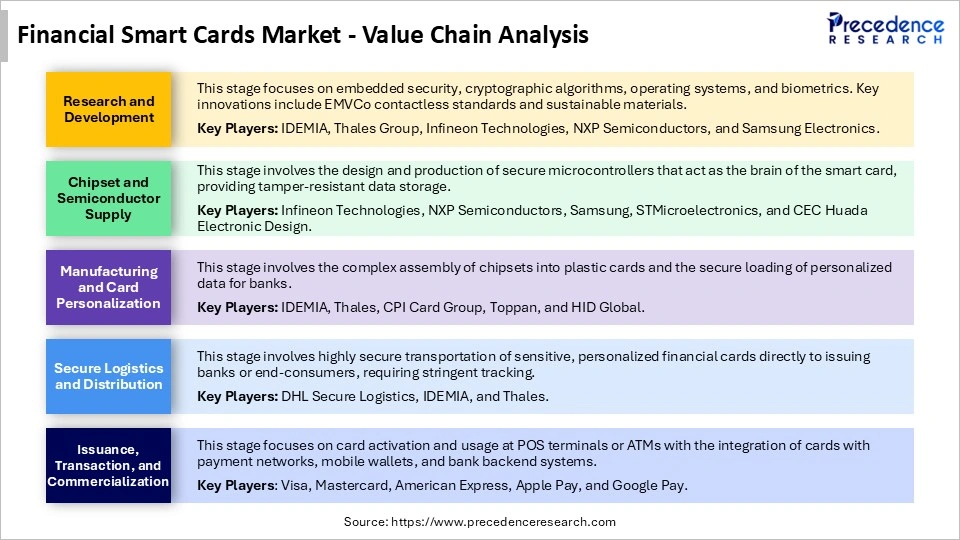
Financial Smart Cards Market Value Chain Analysis
Financial Smart Cards Market Companies
- Thales Group
- IDEMIA
- Giesecke+Devrient (G&D)
- Infineon Technologies AG
- NXP Semiconductors N.V.
- CPI Card Group Inc.
- Samsung Electronics Co., Ltd.
- Sony Corporation
- HID Global Corporation
- Watchdata Technologies Ltd.
- Eastcompeace Technology Co., Ltd.
- Valid S.A.
- CardLogix Corporation
- Identiv, Inc.
- STMicroelectronics N.V.
Recent Developments
- In December 2025, SoFi Technologies, Inc. launched the SoFi Smart Card, an all-in-one account offering enhanced spending control, attractive rewards, and high-interest savings. Exclusively available to eligible SoFi Plus members, it combines the benefits of debit and credit cards without incentivizing overspending on nonessentials. CEO Anthony Noto emphasized that the Smart Card helps users manage their finances effectively.(Source: https://www.businesswire.com)
- In July 2025, Citi introduced the Citi Strata Eliteâ„ Card, a premium credit card providing 12x points on hotels, car rentals, and attractions booked through Citi Travel, along with various travel, dining, and entertainment perks. Head of U.S. Consumer Cards, Pam Habner, noted the card's convenience and its American Airlines integrations for frequent flyers.(Source: https://www.citigroup.com)
- In September 2025, Float unveiled its Business Accounts, promising zero fees, instant liquidity, high-interest rates, and CDIC insurance for Canadian businesses. CEO Rob Khazzam highlighted the shift towards simplified, empowered banking, while COO Andrew Dale noted that businesses no longer need to compromise on banking solutions.(Source: https://www.fintech.ca)
Segments Covered in the Report
By Application
- Payment Cards
- Identification Cards
- Access Control Card
- Healthcare Cards
By Card Type
- Contactless Cards
- Contact Cards
- Dual-Interface Cards
By Technology
- EMV
- Magnetic Stripe
- Smart Card with Secure Chip
By End Use
- Banking
- Retail
- Government
- Healthcare
By Region
- North America
- Europe
- Asia-Pacific
- Latin America
- Middle East & Africa
For inquiries regarding discounts, bulk purchases, or customization requests, please contact us at sales@precedenceresearch.com
Frequently Asked Questions





Ask For Sample
No cookie-cutter, only authentic analysis – take the 1st step to become a Precedence Research client
 Get a Sample




 sales@precedenceresearch.com
 Schedule a Meeting
