


Flexible Substrate Market Trends, Leading Companies, Company Revenue / Sales Performance, Manufacturing Yield, Fab Capacity, Export & Import Dynamics, Supply Chain Analysis, Competitive Landscape, and Growth Forecast
According to semiconductor and electronics specialist Laxmi Narayan, the flexible substrate market is valued at USD 1,436.81 million in 2026 and is forecast to reach USD 4,526.94 million by 2035, reflecting a CAGR of 13.60%. Leading flexible substrate market companies, including DuPont de Nemours, Inc., Kaneka Corporation, PI Advanced Materials Co., Ltd., UBE Corporation, are strengthening their presence across key segments such as material, application, end use and region, .
Source: https://www.precedenceresearch.com/flexible-substrate-market
 Get a Sample
 Table Of Content


Flexible Substrate Market Size, Share, Trends, and Growth Forecast 2035
The flexible substrate market is estimated at USD 1,632.22 million in 2027 and is projected to reach USD 4,526.94 million by 2035, expanding at a CAGR of 13.60% from 2026 to 2035. The market was valued at USD 1,436.81 million in 2026, the base year. The market covers the bendable base materials on which displays, circuits, sensors, and thin-film devices are built, including polyimide, PET and PEN films, ultra-thin glass and metal foils.
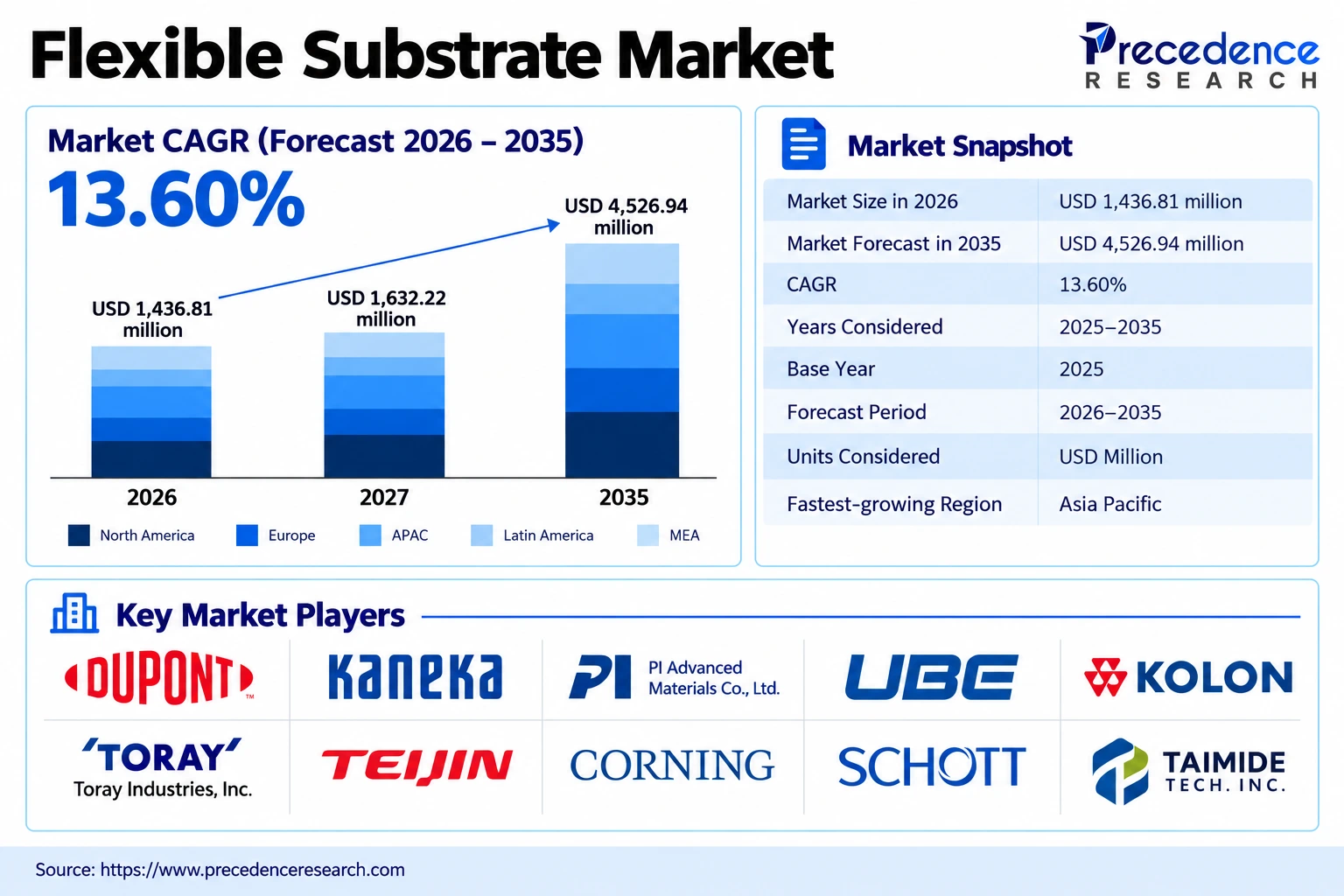
Key Takeaways
Market Size & Growth Outlook
- Market size in 2026: USD 1,436.81 million
- Estimated market size in 2027: USD 1,632.22 million
- Projected market size by 2036: USD 4,526.94 million
- CAGR (2026-2035): 13.60%
Regional Market Spotlight
- Asia Pacific led the market with a 55.20% (USD 698.17 million) share in 2025 and is projected to be the fastest-growing region, at a CAGR of 14.25% from 2025 to 2035.
- North America accounted for 18.70% (USD 236.52 million) of the market in 2025.
- Europe accounted for 16.40% (USD 207.43 million) of the market in 2025.
Segmental Spotlight
- By material, Polyimide (PI) accounted for 43.40% (USD 548.92 million) in 2025.
- By application, Flexible Displays accounted for 38.90% (USD 492.01 million) in 2025.
- By end use, Consumer Electronics accounted for 47.20% (USD 596.99 million) in 2025.
Flexible Substrate Market Size and Forecast, 2025-2035 (USD Million)
Polyimide accounted for the largest material share in 2026, at 43.40%, because it combines heat resistance, dimensional stability, and flexibility for OLED backplanes and flexible printed circuits. Asia Pacific accounted for 55.20% of revenue in 2025, anchored by display panel and flexible circuit production in China, South Korea, Japan, and Taiwan. Demand is driven by foldable smartphones, flexible OLED panels, AI-enabled wearables and the growing electronic content of vehicles. Suppliers are expanding clear polyimide, ultra-thin glass and high-performance laminate capacity to serve next-generation foldable and high-reliability devices.
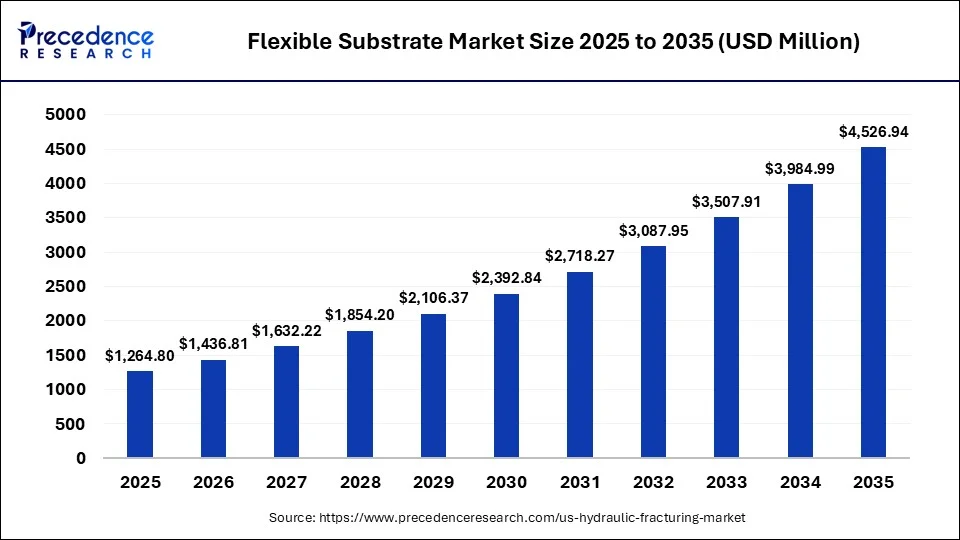
Note: 2025 is the base year; 2026-2035 values are forecasts.
Sources: Expert interviews, secondary sources, Precedence Research database and Precedence Research analysts.
The flexible substrate market is projected to grow from USD 1,436.81 million in 2026 to USD 4,526.94 million by 2035 because foldable and flexible OLED displays, flexible printed circuits and wearable sensors all need base materials that bend without cracking or losing electrical performance. Rising electronic content in smartphones, AI glasses and vehicles adds steady volume, lifting the market to USD 2,392.84 million by 2030 and sustaining a CAGR of 13.60% from 2026 to 2035.
- Analyst View: Our flexible substrate estimate is built from the production of the devices that use these materials: flexible OLED panels, flexible printed circuits, flexible sensors and thin-film solar and battery cells. For each device type, we multiplied unit output by substrate area per unit and by average price per square meter for polyimide, polyester, ultra-thin glass, and metal foil. The total was cross-checked against the film and laminate revenues of leading suppliers and against published estimates, which places our base year slightly above the comparable figure. The growth rate is based on robust demand for flexible displays and circuits, backed by industry figures indicating global production of flexible PCBs reaching about USD 20 billion in 2025, while falling prices of commoditized films cap value growth.
Market Trends
- Foldable and rollable devices are increasing demand for clear polyimide and ultra-thin glass.
- AI smartphones, AI PCs and AI glasses are lifting flexible circuit content per device.
- Liquid crystal polymer substrates are gaining use in high-frequency 5G and antenna circuits.
- Electric vehicles are adding flexible circuits in battery packs and curved interior displays.
- Roll-to-roll processing is lowering costs for printed and flexible electronics.
- Stretchable and skin-mounted sensors are emerging for health monitoring.
Drivers, Restraints and Opportunities
Driver
Foldable smartphones, flexible OLED panels, and wearable devices are increasing the area of flexible substrate used per device. At the same time, AI-enabled phones, PCs, and glasses carry more flexible circuits and sensors. Together, these trends lift both volume and the share of high-value materials such as clear polyimide and ultra-thin glass.
Restraint
High-performance materials such as clear polyimide and ultra-thin glass are costly and difficult to produce at high yield. There are long tests that need to be done to qualify new substrate materials before there is a change of supplier. In addition, pricing pressure on commodity polyester and polyimide films is another issue.
Opportunity
Medical wearables, flexible solar and automotive displays open new markets beyond smartphones. Suppliers that offer thinner, more durable and higher-frequency substrates can win premium programmes. Roll-to-roll production and printed electronics also create room for lower-cost flexible devices in packaging and logistics.
Market Segmentation: 2025 Share and Value
Flexible Substrate Market by Material 2025 Share & Size
| Segments | 2025 Share | 2025 Market Value |
| Polyimide (PI) | 43.40% | USD 548.92 million |
| Polyethylene Terephthalate (PET) | 17.20% | USD 217.55 million |
| Ultra-Thin Glass | 12.60% | USD 159.36 million |
| Polyethylene Naphthalate (PEN) | 8.10% | USD 102.45 million |
| Metal Foils | 7.30% | USD 92.33 million |
| Others (LCP, PEEK, Paper) | 11.40% | USD 144.19 million |
Note: 2025 is the base year.
Sources: Expert interviews, secondary sources, Precedence Research database and Precedence Research analysts.
Polyimide accounted for 43.40% (USD 548.92 million) in 2025 because it withstands the high temperatures of OLED backplane and circuit processing while staying flexible. PET, at 17.20% (USD 217.55 million), serves lower-cost flexible circuits, touch sensors, and printed electronics, while ultra-thin glass, at 12.60% (USD 159.36 million), is gaining share as a cover and substrate material for foldable displays. PEN, at 8.10% (USD 102.45 million), offers better heat and moisture resistance than PET; metal foils, at 7.30% (USD 92.33 million), support thin-film solar and lighting; and other materials such as liquid crystal polymer, PEEK and paper account for 11.40% (USD 144.19 million).
Flexible Substrate Market by Application 2025 Share & Size
| Segments | 2025 Share | 2025 Market Value |
| Flexible Displays | 38.90% | USD 492.01 million |
| Flexible Printed Circuits | 27.60% | USD 349.08 million |
| Flexible Sensors & Wearables | 11.80% | USD 149.25 million |
| Thin-Film Solar & Batteries | 8.20% | USD 103.71 million |
| Flexible Lighting | 6.40% | USD 80.95 million |
| Others | 7.10% | USD 89.80 million |
Note: 2025 is the base year.
Sources: Expert interviews, secondary sources, Precedence Research database and Precedence Research analysts.
Flexible printed circuits, which have a market share of 27.60% (USD 349.08 million), increase thanks to smartphones, AI computers, and electric vehicles, whereas flexible sensors & wearable electronics, with a market share of 11.80% (USD 149.25 million), are expanding due to applications in health monitoring and AI glasses. Flexible solar panels and batteries have a share of 8.20% (USD 103.71 million), flexible lighting is 6.40% (USD 80.95 million), and other applications represent 7.10% (USD 89.80 million).
Flexible Substrate Market By End Use 2025 Share & Size
| Segments | 2025 Share | 2025 Market Value |
| Consumer Electronics | 47.20% | USD 596.99 million |
| Automotive | 15.80% | USD 199.84 million |
| Industrial & Energy | 12.60% | USD 159.36 million |
| Healthcare & Medical | 10.30% | USD 130.27 million |
| Aerospace & Defense | 6.40% | USD 80.95 million |
| Others | 7.70% | USD 97.39 million |
Note: 2025 is the base year.
Sources: Expert interviews, secondary sources, Precedence Research database and Precedence Research analysts.
Consumer electronics accounted for 47.20% (USD 596.99 million) in 2025 because smartphones, tablets, laptops, and wearables use flexible substrates in displays, circuits, and sensors. Automotive, at 15.80% (USD 199.84 million), grows as vehicles add curved displays, flexible circuits in battery packs, and more sensors, while industrial and energy uses, at 12.60% (USD 159.36 million), include flexible solar and industrial sensing. Healthcare and medical devices hold 10.30% (USD 130.27 million), aerospace and defense hold 6.40% (USD 80.95 million), and other uses account for 7.70% (USD 97.39 million), where reliability under bending and temperature cycling is critical.
- Analyst View: We allocated segment values by mapping each device type to the substrate materials it uses and weighing by area and price. Polyimide holds the lead since it serves as the base material for OLED backplanes and flexible circuits; ultra-thin glass, on the other hand, features a costly rate per square meter, which makes it more important revenue-wise in foldable displays. Shares according to application and end use rely on device production figures, wherein smartphones lead the way. We expect ultra-thin glass, clear polyimide and liquid crystal polymer to gain share as foldable devices and high-frequency circuits spread.
Regional Analysis
Flexible Substrate Market by Region 2025 Share & Size
| Region | 2025 Share | 2025 Market Value |
| Asia Pacific | 55.20% | USD 698.17 million |
| North America | 18.70% | USD 236.52 million |
| Europe | 16.40% | USD 207.43 million |
| Latin America | 5.20% | USD 65.77 million |
| Middle East & Africa | 4.50% | USD 56.92 million |
Note: 2025 is the base year.
Sources: Expert interviews, secondary sources, Precedence Research database and Precedence Research analysts.
Asia Pacific accounted for 55.20% (USD 698.17 million) in 2025, driven by display panel, flexible circuits, and device assembly in China, South Korea, Japan, and Taiwan. North America's 18.70% of market share (USD 236.52 million) is driven by the rising demand for aerospace, defense, medical, and wearable devices, while Europe's 16.40% (USD 207.43 million) is attributed to the expansion of automotive electronics and industrial sensing. Latin America, at 5.20% (USD 65.77 million), and the Middle East & Africa, at 4.50% (USD 56.92 million), remain smaller markets that rely mainly on imported flexible components.
Asia Pacific accounted for 55.20% (USD 698.17 million) in 2025 and is the fastest-growing region. South Korea and China dominate the flexible OLED panel segment, while Japan dominates the polyimide films and specialty material segment.
North America held 18.70% (USD 236.52 million) in 2025, owing to the increasing demand in aerospace, defense, medical devices, and wearables, supported by domestic polyimide film and laminate production.
Europe accounted for 16.40% (USD 207.43 million) in 2025. Automotive electronics, industrial sensors, and specialty glass production in Germany support demand.
Latin America accounted for 5.20% (USD 65.77 million) in 2025. Mexico and Brazil drive demand through electronics and automotive assembly.
The Middle East & Africa accounted for 4.50% (USD 56.92 million) in 2025. Demand is tied to imported consumer electronics and emerging solar applications.
- Analyst View: Regional shares follow where flexible substrates are consumed, measured through display panel, flexible circuit, and device production and adjusted for trade flows. Asia Pacific carries the largest weight because most flexible OLED and flexible PCB capacity is located there. We assign Asia Pacific the highest regional growth premium because new display and circuit lines continue to be built in China and South Korea, while North America and Europe grow mainly through aerospace, medical, automotive, and industrial applications.
Top 10 Companies in the Flexible Substrate Market
| Rank | Company Name | Market-Specific Revenue (USD Million) | 2025 Share | Key Products / Business | Headquarters |
| 1 | DuPont de Nemours, Inc. | 162.4 | 12.84% | Kapton polyimide films and Pyralux flexible circuit laminates | United States |
| 2 | Kaneka Corporation | 128.7 | 10.18% | Apical and Pixeo polyimide films | Japan |
| 3 | PI Advanced Materials Co., Ltd. | 104.3 | 8.25% | Polyimide films for flexible circuits and displays | South Korea |
| 4 | UBE Corporation | 71.6 | 5.66% | Upilex polyimide films and varnish | Japan |
| 5 | Kolon Industries, Inc. | 58.9 | 4.66% | Colorless polyimide films for foldable displays | South Korea |
| 6 | Toray Industries, Inc. | 52.4 | 4.14% | PET films and polyimide products | Japan |
| 7 | Teijin Limited | 44.8 | 3.54% | Teonex PEN and Tetoron PET films | Japan |
| 8 | Corning Incorporated | 39.2 | 3.10% | Willow ultra-thin flexible glass | United States |
| 9 | SCHOTT AG | 36.7 | 2.90% | Ultra-thin glass for foldable displays | Germany |
| 10 | Taimide Tech. Inc. | 33.1 | 2.62% | Polyimide films for flexible circuits | Taiwan |
Note: Company revenues and shares are 2025 estimates.
Sources: Company press releases, expert interviews, secondary sources, Precedence Research database and Precedence Research analysts.
DuPont emerged as the leader in the flexible substrate market with 12.84% (USD 162.40 million) of the 2025 sales share, followed by Kaneka with 10.18% (USD 128.70 million) and PI Advanced Materials with 8.25% (USD 104.30 million). DuPont is the market leader owing to its Kapton polyimide films and Pyralux flexible laminates. Kaneka is the market leader because of its polyimide films used in flexible circuits and displays. PI Advanced Materials holds a leadership position in flexible substrates owing to its high-volume production of polyimide films in Korea. The total sales share of the top 10 players accounted for 57.88% (USD 732.10 million), while 42.12% (USD 532.70 million) was captured by Chinese movie production companies, laminate producers, and specialty material providers. Competition is shifting toward clear polyimide and ultra-thin glass for foldable displays, where Kolon, Corning and SCHOTT compete, and toward high-frequency materials such as liquid crystal polymer for advanced circuits.
Recent Developments
- March 2025: DuPont's Pyralux ML series of metal-clad laminates on Kapton polyimide, launched in 2024 for thermal management in aerospace, EV, and AI networking circuits, won a Circuits Assembly New Product Introduction award.
- February 2026: Industry reports indicated that Apple was evaluating clear polyimide film over ultra-thin glass for a foldable iPhone, with Kolon Industries the lead candidate to supply the film and Lens Technology the glass.
- October 2026: The Taiwan Printed Circuit Association projected that the combined global production value of Taiwanese PCB manufacturers will reach about USD 35.7 billion in 2026, surpassing NT$1 trillion milestone for the first time.
Flexible Substrate Market Segments
By Material
- Polyimide (PI)
- Polyethylene Terephthalate (PET)
- Ultra-Thin Glass
- Polyethylene Naphthalate (PEN)
- Metal Foils
- Others (LCP, PEEK, Paper)
By Application
- Flexible Displays
- Flexible Printed Circuits
- Flexible Sensors & Wearables
- Thin-Film Solar & Batteries
- Flexible Lighting
- Others
By End Use
- Consumer Electronics
- Automotive
- Industrial & Energy
- Healthcare & Medical
- Aerospace & Defense
- Others
By Region
- North America (U.S., Canada, Mexico)
- Europe (Germany, U.K., France, Italy, Spain, Rest of Europe)
- Asia Pacific (China, Japan, India, South Korea, Taiwan, Rest of Asia Pacific)
- Latin America (Brazil, Mexico, Rest of Latin America)
- Middle East & Africa (GCC, South Africa, Rest of MEA)
Research Methodology
The flexible substrate market was defined as flexible base materials used to build displays, circuits, sensors, lighting and thin-film energy devices, including polyimide, PET and PEN films, ultra-thin glass, metal foils, and other flexible polymers, counted at material-supplier level. The 2025 base year was built bottom-up from device production volumes, substrate area per device and average price per square meter, and checked top-down against the film, glass and laminate revenues of leading suppliers.
Segment, regional and company values were allocated from device production data, regional manufacturing footprints, and supplier portfolios. Key estimates were verified by cross-checking company disclosures, regulatory and industry data and published third-party estimates, and inputs that could not be reconciled were excluded. All segment, regional and company figures were reconciled to the same 2025 base year, and the 2026-2035 forecast, which applies a constant CAGR from the 2025 base, was recalculated and validated.
Analyst View Overall Market
Flexible substrates are moving from niche materials to core building blocks of consumer and automotive electronics as devices fold, curve and shrink. Our estimate ties demand to the production of flexible displays, circuits and sensors and to substrate area per device, so the forecast follows the physical output of these products. Value growth depends on the shift toward clear polyimide, ultra-thin glass and high-frequency materials, which sell at a premium to commodity films. The main risks are slower foldable adoption, consumer electronics cycles, and price competition from Chinese film producers.
Sources and References
1. DuPont. "DuPont opens new Kapton, Pyralux production line in Circleville, Ohio (via I-Connect007)". 2022-05-09. USD 250 million capacity expansion for polyimide film and flexible circuit materials. https://mail.iconnect007.com/article/131910/dupont-opens-new-kapton-pyralux-production-line-in-circleville-ohio/131913/flex
2. DuPont. "DuPont Pyralux ML wins New Product Introduction award from Circuits Assembly". 2025-03-11. Pyralux ML metal-clad laminates on Kapton polyimide. https://www.dupont.com/news/DuPont-Pyralux-ML-Wins-New-Product-Introduction-NPI-Award-from-Circuits-Assembly.html
3. Taiwan Printed Circuit Association and ITRI (via I-Connect007). "Global flexible PCB output expected to surpass USD 20 billion by 2025". 2025-08-25. Flexible PCB output, application mix and device outlook. https://mail.iconnect007.com/article/146641/global-flexible-pcb-output-expected-to-surpass-20-billion-by-2025-with-ai-glasses-emerging-as-a-new-growth-driver/146638/ein
4. MacTrast (citing The Elec). "Apple looks to surpass rivals with tougher display for foldable iPhone". 2026-02-05. Clear polyimide and ultra-thin glass supply for foldable devices. https://www.mactrast.com/2026/02/apple-looks-to-surpass-rivals-with-tougher-display-for-foldable-iphone/
5. SCHOTT AG. "SCHOTT UTG in foldable displays". Undated. Ultra-thin glass for foldable display covers. https://www.schott.com/en-in/applications/schott-utg-in-foldable-displays
6. Kaneka Corporation. "Polyimide varnish and films for optics". Undated. Kaneka polyimide product portfolio. https://www.elecdiv.kaneka.co.jp/en/products/optics/polyimide-varnish.html
For inquiries regarding discounts, bulk purchases, or customization requests, please contact us at sales@precedenceresearch.com
Frequently Asked Questions





Ask For Sample
No cookie-cutter, only authentic analysis – take the 1st step to become a Precedence Research client
 Get a Sample




 sales@precedenceresearch.com
 Schedule a Meeting