



Flexible Electronics Market Size, Key Companies, Company Market Share, Chip Production Volume, Wafer Capacity, Technology Adoption, Pricing Trends, Competitive Positioning, and Demand Analysis
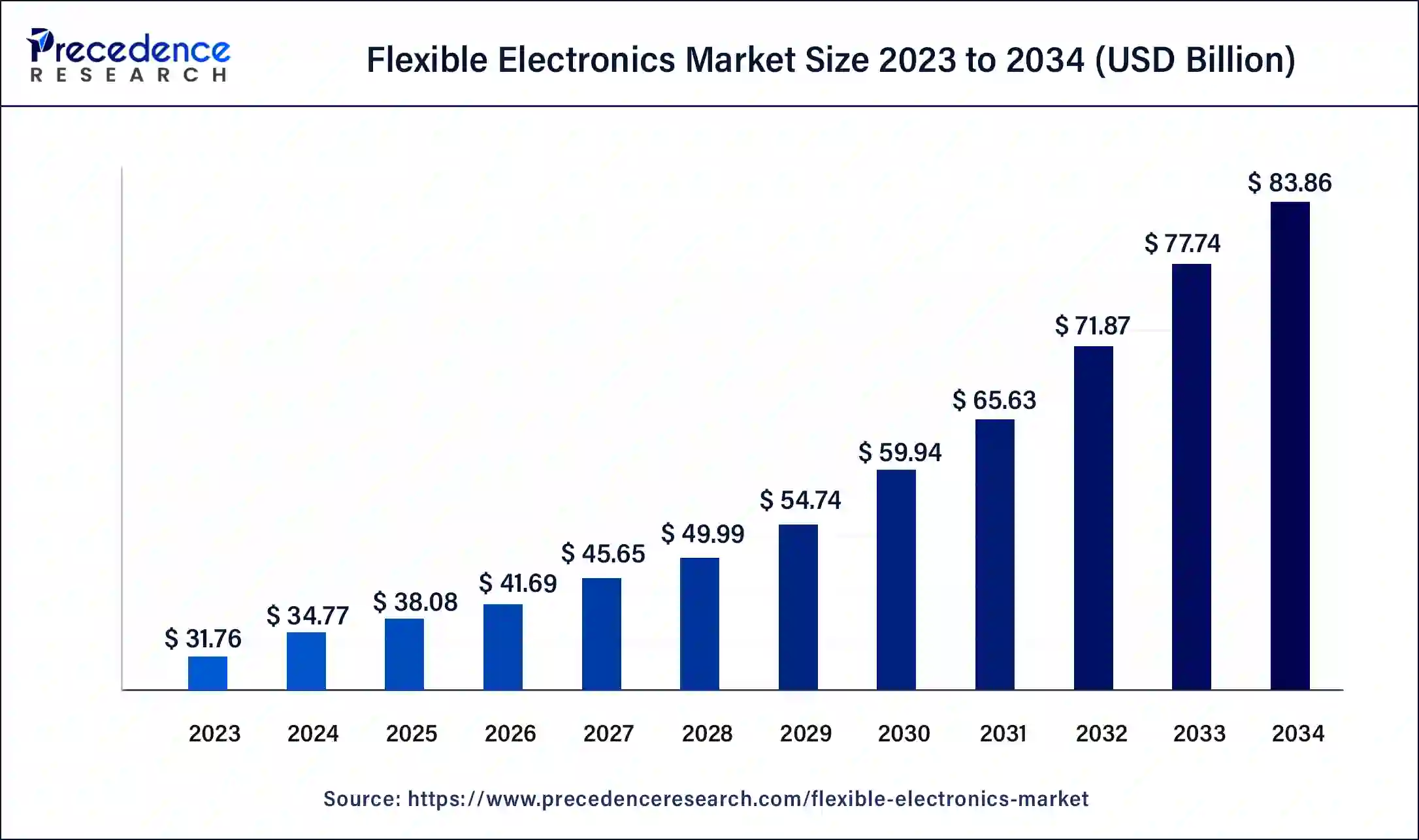
The global flexible electronics market size is estimated at USD 41.69 billion in 2026 and is anticipated to reach around USD 83.86 billion by 2035, expanding at a CAGR of 8.87% from 2026 to 2035. The North America market size accounted for USD 11.47 billion in 2024 and is expanding at a CAGR of 9.23% during the forecast period. The market sizing and forecasts are revenue-based (USD Million/Billion), with 2025 as the base year.
Source: https://www.precedenceresearch.com/flexible-electronics-market
 Get a Sample
 Table Of Content


Flexible Electronics Market Size and Forecast 2026 to 2035
The global flexible electronics market size accounted for USD 38.08 billion in 2025, and is anticipated to hit around USD 41.69 billion by 2026, to approximately USD 89.04 billion by 2035, growing at a CAGR of 8.87% from 2026 to 2035. The urge for flexible electrons is being driven by the demand for portable, lightweight, and acceptable elements that match irregular shapes. Like strong boards, bendable and stretchable materials allow advanced wearable medical devices, which have space-effective automotive sensors and foldable user electronics.
Flexible Electronics Market Key Takeaways
- In terms of revenue, the market is valued at $41.69 billion in 2026.
- It is projected to reach $89.04 billion by 2035.
- The market is expected to grow at a CAGR of 9.20% from 2026 to 2035
- North America dominated the market with the largest market share of 32% in 2025.
- The Asia Pacific is predicted to expanding at a CAGR of 9.6% during the forecast period.
- By application , the displays segment generated the highest market share of 46% in 2025.
- By application, the battery segment is anticipated to grow significantly in the market during the forecast period.
- By verticals,the consumer electronics segment contributed more than 56%f market share in 2025.
- By verticals, the healthcare segment is estimated to grow rapidly in the market during the fastest period.
Technological Advancement
Technological advancements in the flexible electronics market feature sensors, batteries, and flexible displays. The flexible displays promote flexible OLEDs (Organic Light Emitting Diodes), supporting other display devices such as VR headsets and wearables. Sensors and batteries are the most popular advanced technologies providing a space of creation for efficient and compact devices. The innovation in manufacturing is the enhanced techniques used for production to imitate in various other applications. The popular technologies are boosting the market and enabling the brands to collaborate with technological firms to achieve advancement in business.
Market Outlook
- Industry Growth Overview: As electronic devices become smaller and stronger, conventional semiconductor materials have currently reached their physical limits. This has led scientists in this sector to discover a new class of materials named 2D materials, which are only a few atoms thick and are a capable alternative to current semiconductors.
- Global expansion: Flexible electronics show a transformative space of technology that allows electronic devices to move, develop, and adapt to different shapes while managing functionality. Like regular circuits, these systems are constructed on substrates such as paper, plastic, or fabric, which makes them durable, lightweight, and versatile.
- Sustainability Trends: Electronics production remains excessively resource-intensive, which totally depends on plastics, metals, energy-intensive fabrication procedures, and chemicals. As the device volume develops across the Internet of Things (IoT), wearables, and linked devices, producers are discovering manufacturing demands that lessen material usage and the lifecycle of waste.
Flexible Electronics Market Growth Factors
The flexible electronics are gaining traction in the market owing to its flexible and stretchable properties. The flexibility feature facilitates its usage in various substrates such as flex glass, plastics, and paper. The rising demand for the various consumer and industrial products that are uniquely designed and the rising usage of various innovative materials in the consumer goods manufacturing is boosting the demand for the flexible electronics across the globe. The growing demand for the various wearable devices is augmenting the growth of the flexible electronics market. The ability of the flexible electronics to adapt to the various shapes has fostered its adoption in the manufacturing of the various wearable devices across the globe. The rising sales of the internet of things (IoT) devices across the globe is positively contributing towards the market development. The growing demand for the compact and innovative smart consumer electronics among the global consumers is expected to drive the demand for the flexible electronics. Moreover, the rapidly growing printed electronics is influencing the market growth positively.
The growing complexities in designs of various electronic products such as smartphones, tablets, laptops, and smartwatches is propelling the adoption of the flexible electronics in manufacturing of the electronic products. There are wider varieties of devices produced across different verticals such as healthcare, military, aerospace, and various others, which promotes the use of the flexible electronics for the production of different types of flexible and compact electronic devices. The ongoing projects regarding the development of several smart cities in various countries is estimated to boost the demand for the flexible electronics in the forthcoming years. Moreover, the rising penetration of LEDs and OLEDs is significantly driving the growth of the market, as LEDs and OLEDs uses flexible electronics and hence the market is expected to grow at a rapid rate.
Flexible Electronics Market Trends
- Healthcare and Wellness: The healthcare sector benefits from flexible electronics. Each day, users have already used wearable technology, with several admiring the health information that these devices provide. By wearing smart devices, consumers track their steps for the day, heartbeat, exercise tracking, sleep quality, and other wellness-dependent information.
- In-Mold Electronics: In-Mold electronics are a kind of structural electronics that are 3D. They deliver to users the benefits of fast-moving time, fewer elements, and lightweight parts that demand mixing and flexible design opportunities. As such, the design of flexible electronics technology has become more relevant and developed; in-mold electronics are set to rise.
- Structural Electronics: Companies are starting to classify the capability for structural electronics. In contrast to regular electronics, which use a printed circuit board that has a secured shell kept around it, flexible electronics give designers the possibility to keep “smart skins” around their respective electronic products and devices. After printing, structural electronics are electronic circuits that substitute “dumb designs” with structures that are protective.
- Conductive Inks: Flexible electronics have opened a huge industry for conductive inks, which can be used in conjunction with integrated circuits (ICs) and are ideal for 5G convergence. Smoothly, conductive inks enable users to design functional circuits on a variety of substrates such as paper or textiles.
Market Scope
| Report Coverage | Details |
| Market Size by 2035 | USD 83.86 Billion |
| Market Size in 2026 | USD 41.69 Billion |
| Market Size in 2025 | USD 34.77 Billion |
| Market Growth Rate from 2026 to 2035 | CAGR of 8.87% |
| Largest Market | North America |
| Base Year | 2025 |
| Forecast Period | 2026 to 2035 |
| Segments Covered | Application, Verticle, and Region |
| Regions Covered | North America, Europe, Asia-Pacific, Latin America, and Middle East & Africa |
Segments Insights
Application Insights
The displays segment accounted for around 51% of the market share. The extensive usage of the display in the various consumer electronic products such as laptops, smartphones, and tablets is augmenting the market demand. Furthermore, the foldable smartphones are gaining traction in the market, which is further estimated to foster the growth of the global flexible electronics market.
The battery is estimated to be the fastest-growing segment during the forecast period. The proliferation of the technologies like IoT and AI and its adoption in various wearable devices requires compactness and energy efficiency in the products, which fuels the growth of this segment. With the decreasing size of the electronic devices, the demand for the efficient and long lasting compact batteries in also increasing rapidly, and hence this segment is expected to offer lucrative growth opportunities during the forecast period.
Verticals Insights
The consumer electronics segment accounted for more than 56% of the market share in 2025. This is simply attributed to the rapid advancements in the consumer electronics and development of designer products that attracts the consumers and hence boosts the sales of the latest electronic products. The rising demand for the consumer electronics across the globe is the primary driver of the consumer electronics segment.
The healthcare is estimated to be the most opportunistic segment during the forecast period. This is attributed to the rising investments in the research and development of various medical equipment such as patient monitoring devices, self-monitoring devices, and various wearable medical devices. The rising healthcare expenditure coupled with the rising burden of diseases is fostering the adoption of the innovative and technologically advanced healthcare devices across the healthcare units around the globe.
Regional Insights
U.S. Flexible Electronics Market Size and Growth 2026 to 2035
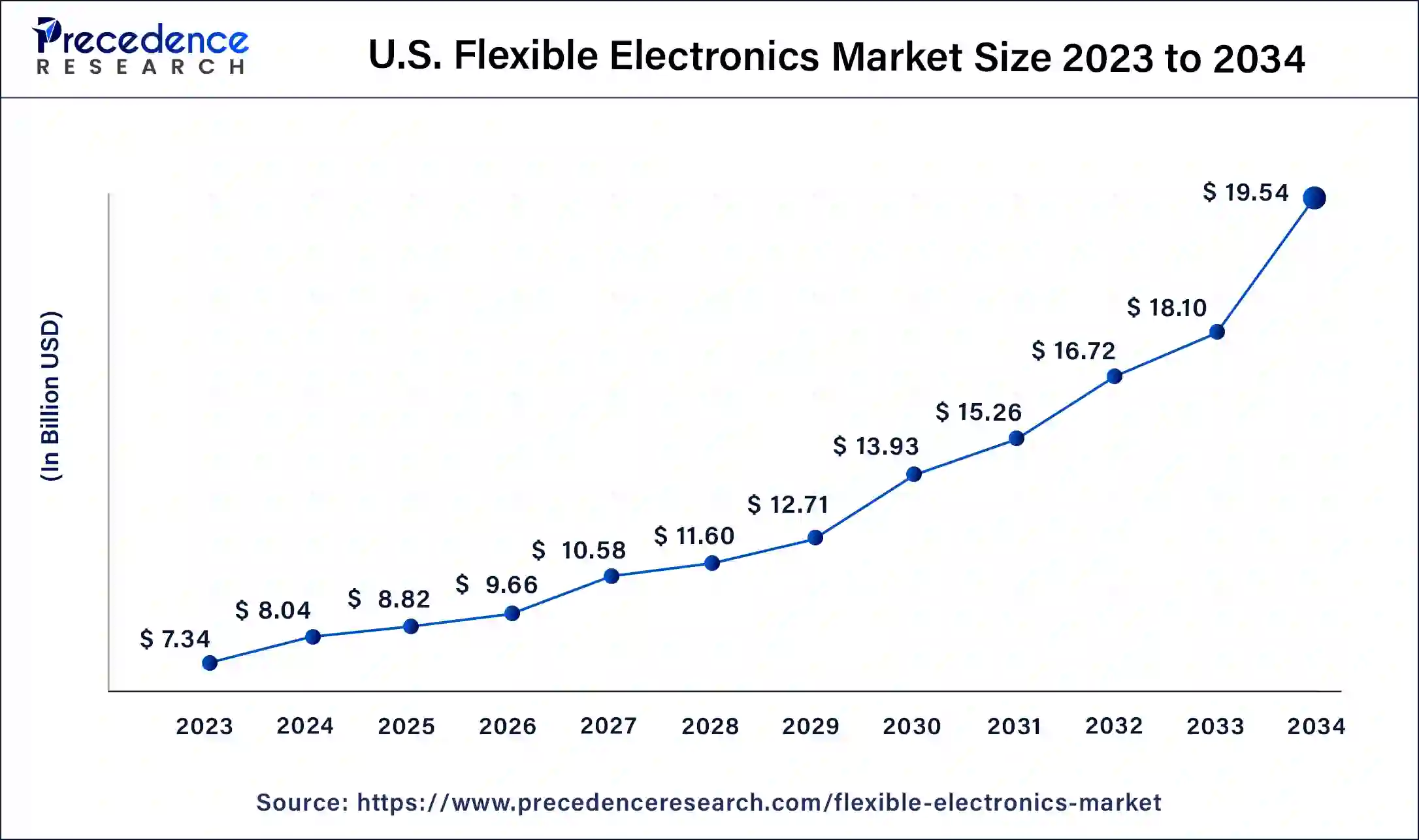
The U.S. flexible electronics market size was anticipated at USD 8.82 billion in 2025 and is expected to be worth around USD 20.47 billion by 2035, growing at a CAGR of 8.78% between 2026 to 2035.
North America accounted for more than 32% of the market share in 2025. The increasing adoption of the flexible electronics across healthcare, automotive, military, and consumer electronics in this region has significantly contributed towards the growth of the market. The higher demand for the innovate technologies in this region has spur the demand for the flexible electronics.
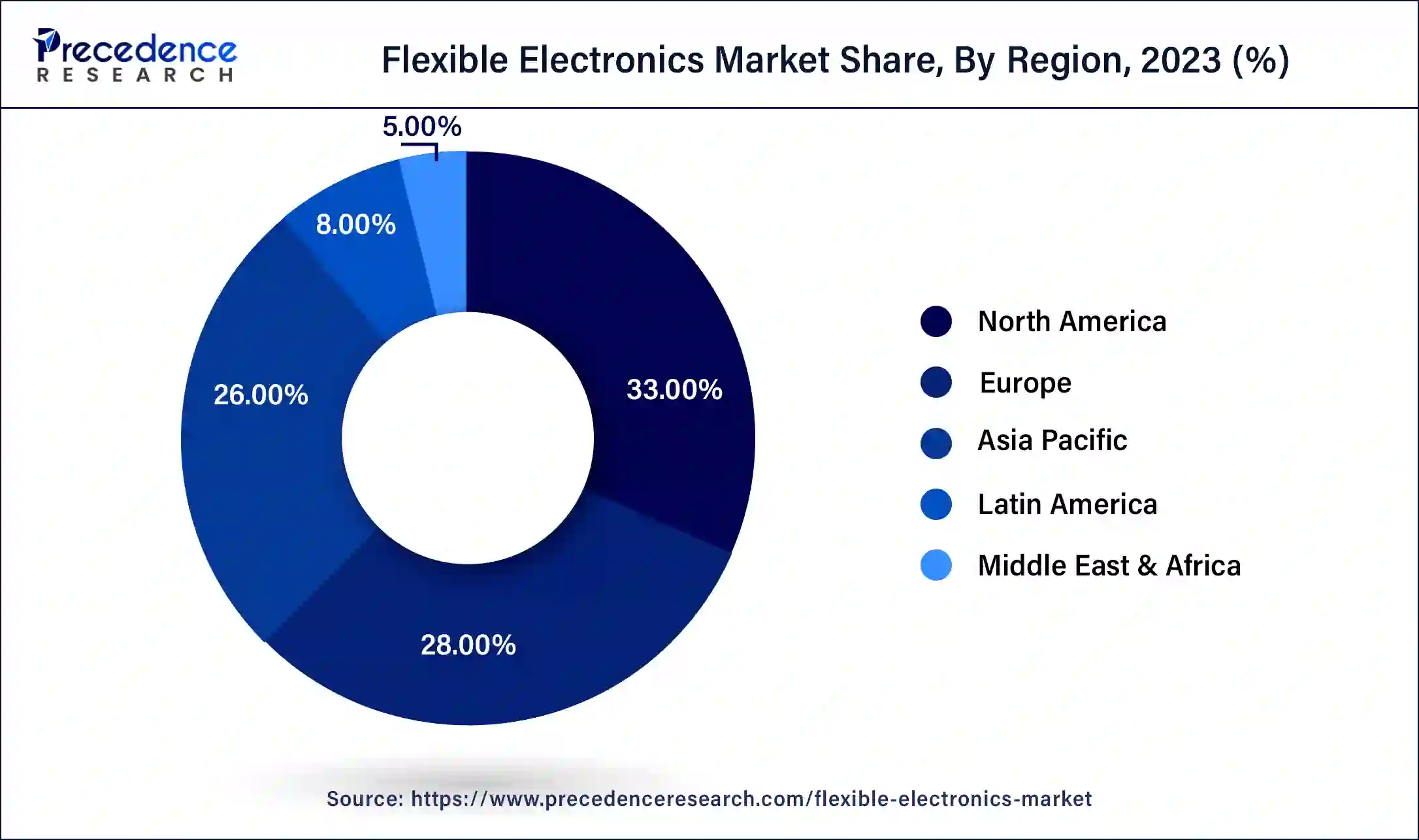
The Asia Pacific region is expected to grow at a CAGR of 9.6% during the forecast period. This is attributable to the presence of numerous top consumer electronics manufacturers in the region. The higher demand for the various affordable consumer electronic products is boosting the consumption of the flexible electronics. Moreover, the rising efforts of the government is attracting FDIs and facilitating various vertical participants to set up their production units in the nations like India, China, and Indonesia owing the availability of cheap factors of production in the region. Therefore, Asia Pacific flexible electronics market is expected to grow at a rapid rate in the forthcoming years.
Currently, Asia Pacific is dominating the flexible electronics market. The region has a strong backbone of manufacturers such as LG and Samsung. The region is highly adapted to various electronic developments and new software processes. The advanced technology contributes to various other factors relevant to innovations. IoT in electronics is mainly used in applications such as industrial automation and smart homes. The demand for wearable devices is attracting a generation of entrepreneurs and customers on a large digital platform. The flexible electronics market has encouraged development and innovations globally.
Europe Held a 28% Market Share in 2025
In Europe, flexible electronics are an ever-developing industry that has smoothly united with advanced materials, production, and a huge range of natural science and engineering communities. From big space electronics to healthcare devices and lastly developing human mixing, there is no shortage of current applications. The latest conference will fully concentrate on growing technologies and development in nature-inspired and functional materials, as well as energy consumption.
Germany Market Analysis
A German technology center has made procedures for heating factors and conductors that can be integrated into metal, plastic, ceramic, or glass, printing sensors, and even into designed layers. Control functions are shifting out of the management cabinet and onto the field devices, and classified cables are mixing into a single multi-function cable. For several years, the industry has been using functions in more adjusted and decentralized ways. The German connector producer Inder is moving one step forward and keeping functions on the layer of components.
How is the Opportunistic Rise of the Middle East & Africa in the Market?
The Middle East & Africa (MEA) held nearly a 5% share of the flexible electronics market in 2025 and is expected to grow in the coming years. Flexible electronics play a significant role in different industries, which develop the versatility and performance of LCD and OLED displays with the assistance of bendable and lightweight forms. They are necessary in IoT devices and printed sensors for wearables, which enable integration into unconventional surfaces.
UAE Market Analysis
The VVDN technologies, which is a worldwide electronics production company, was ready to open its latest production facility in the United Arab Emirates. The latest plant goal is to develop the manufacturing capacity and match with clients across Europe, the United States, and the Middle East and North Africa (MENA) region. The facility is professional in various industries, including medical technology, telecommunications, cameras, industrial automation, and automotive.
What Drives the Market Within Latin America?
Latin America held the flexible electronics market in 2025 and is projected to grow in the coming years, driven by multitude of factors, that uses the growing demand for electronic products and services across different consumer demographics and sectors, as the accessibility of complicated natural resources and an trained workforce, the push of pertinent's rules and regulations and lastly the implementation of both regional and global industries.
Brazil Market Analysis
Multilasr initially works in Brazil, an industry in which consumer electronics and household goods are closely tied to credit availability, income trends, and local currency stability. The brand totally competes with local currency stability and international brands. Apart from this, it also competes with local companies across segments like tablets, smartphones, personal care devices, and small appliances that give importance to a wide product choice and affordability.
Key Companies & Market Share Insights
The market is moderately fragmented with the presence of several local companies. These market players are striving to gain higher market share by adopting strategies, such as investments, partnerships, and acquisitions & mergers. Companies are also spending on the development of improved products. Moreover, they are also focusing on maintaining competitive pricing.
In June 2019, E Ink Holdings made a strategic investment in Plastic Logic HK, for manufacturing a flexible electrophoretic display (EPD) device for the wearable devices.
The various developmental strategies like collaborations, acquisitions, and partnerships fosters market growth and offers lucrative growth opportunities to the market players.
Competitive Landscape
The flexible electronics market is a semi-consolidated one, as it uses a different range of methods to serve overall insights. Integrating qualitative and quantitative strategies ensures a complete understanding of industry dynamics.
Flexible electronics are significant in different sectors, such as aerospace and military, which allow compact and lightweight designs for improved performance and reliability in toxic environments. Other applications include industrial equipment and automotive electronics. The fastest-developing space is medical devices, which are driven by growth in healthcare technology and rising demand for effective and reliable medical machines, showing a demand for more innovative and tailored healthcare solutions.
Flexible Electronics Market Companies
- Samsung Electronics
- Solar Frontier
- Palo Alto Research Center Incorporated
- LG Corporation
- Cymbet Corporation
- Blue Spark Technologies
- Enfucell Flexible Electronics Co. Ltd.
- Imprint Energy
- E Ink Holdings
- AU Optronics
Recent Developments
- In April 2025, Naxnova Technologies launched India's first flexible hybrid printed electronics research and development centre, marking a transformative moment for the country's innovation landscape.
- In January 2023, Renesas Electronics Corporation, a premier supplier of advanced semiconductor solutions, announced a new automotive intelligent power device (IPD) that will safely and flexibly control power distribution within vehicles, addressing the requirements of next-generation architectures.
- In December 2023, Voltera, a leader in printed electronics technology, launched the NOVA, a new platform for printing flexible hybrid electronics. The NOVA uses direct write technology to print circuits on soft, stretchable, and comfortable surfaces.
Segment Covered in the Report
By Application
- Displays
- LCD Displays
- OLED Displays
- Thin-Film Photovoltaics (PV)
- CdTe
- CIGS
- a-Si
- Printed Sensors
- Biosensors
- Image sensors
- Touch Sensors
- Pressure Sensors
- Temperature Sensors
- Gas Sensors
- Humidity Sensors
- Batteries
- Thin-Film Batteries
- Curved Batteries
- Printed Batteries
- Others
- OLED Lighting
- Others
By Circuit Structure
- Single-Sided Flexible Circuit
- Double-Sided Flexible Circuit
- Multilayer Flexible Circuit
- Sculptured Flexible Circuit
- Others
By Verticals
- Healthcare
- Automotive
- Consumer Electronics
- Energy & Power
- Aerospace
- Military
- Others
By Region
- North America
- Latin America
- Europe
- Asia-pacific
- Middle and East Africa
For inquiries regarding discounts, bulk purchases, or customization requests, please contact us at sales@precedenceresearch.com
Frequently Asked Questions





Ask For Sample
No cookie-cutter, only authentic analysis – take the 1st step to become a Precedence Research client
 Get a Sample




 sales@precedenceresearch.com
 Schedule a Meeting
