



Flow Meters Market Size, Key Companies, Company Technology / Innovation, Electronics Manufacturing Output, Supply Chain Metrics, Sales Volume, Technology Adoption, Company Investment Strategies, and Market Analysis
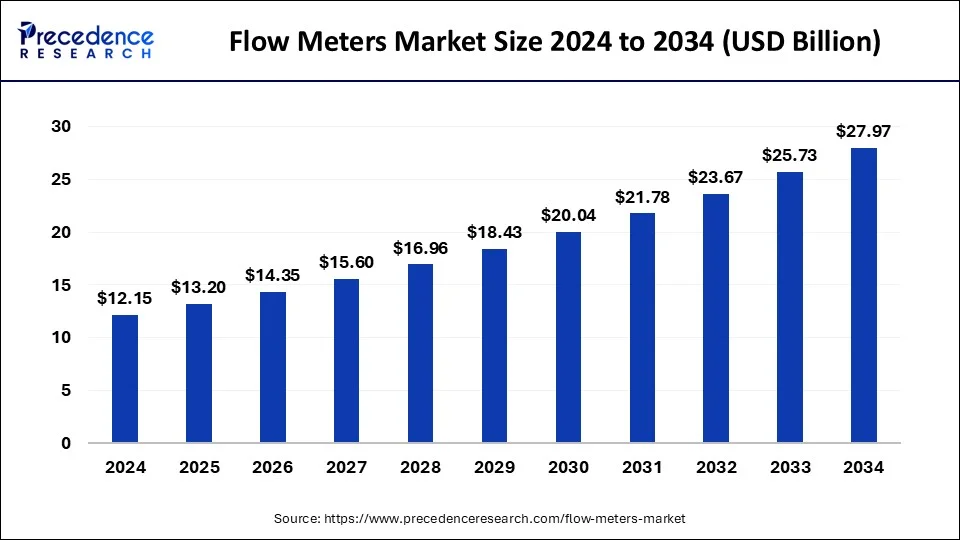
The global flow meters market is projected to grow from USD 14.35 billion in 2026 to USD 30.09 billion by 2035, registering a CAGR of 8.59%. Growth is driven by Industry 4.0, industrial automation, smart water and wastewater infrastructure, and increasing adoption of AI- and IoT-enabled flow measurement solutions. Europe leads the market, while Asia Pacific is expected to witness the fastest growth due to rapid industrialization, infrastructure modernization, and smart utility investments.
Source: https://www.precedenceresearch.com/flow-meters-market
 Get a Sample
 Table Of Content


What is Flow Meters Market Size?
The global Flow Meters market size is estimated at USD 13.20 billion in 2025 and is predicted to increase from USD 14.35 billion in 2026 to approximately USD 30.09 billion by 2035, expanding at a CAGR of 8.59% from 2026 to 2035. The rapid expansion of the flow meters industry is driven by emerging trends like Industry 4.0, industrial automation, and modernisation of smart water and wastewater infrastructure.
Market Highlights
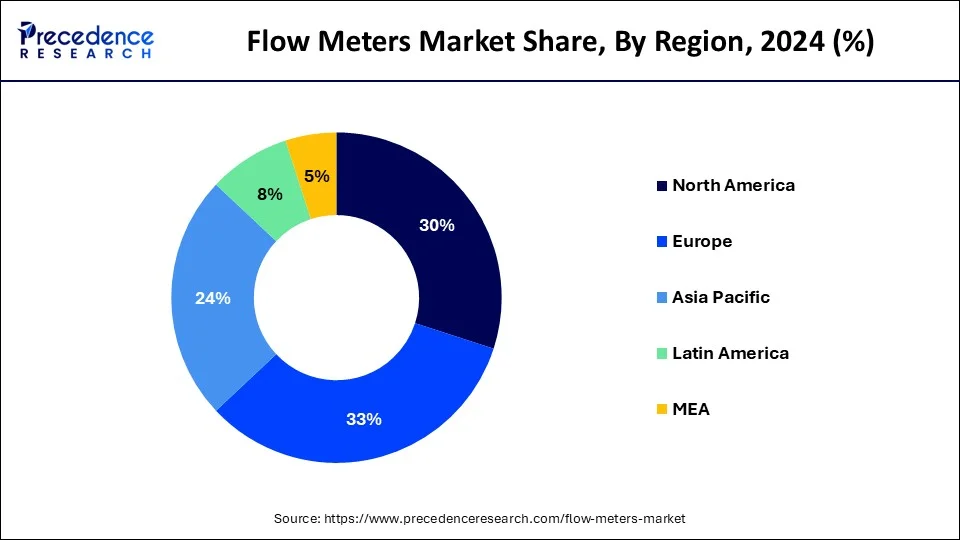
- Europe dominated the global market with the highest market share of 33% in 2025.
- Asia-Pacific is expected to expand at the largest CAGR of 9.1% between 2026 and 2035
- By Product, the differential pressure (DP) segment held the largest market share of 28.34% in 2025.
- By Application, the power generation segment dominated the global risk analytics market in 2025.
- By Application, the oil & gas segment is projected to expand at the fastest CAGR of 9.2% in the projected period.
Which Driving Forces Majorly Boost the Expansion of the Flow Meters Market?
- Manufacturing plants, smart industries, and other related facilities are prioritizing process optimization, real-time data integration, and advanced meter adoption.
- There is a strict focus on water conservation and rising global urbanization, which are encouraging municipalities to upgrade aging pipe networks.
- Modern flow meters are highly equipped with AI, industrial IoT capabilities, predictive maintenance, and standardised protocols.
- The food, beverage, and pharmaceutical manufacturing sectors highly demand non-intrusive, sanitary flow meters to completely avoid fluid contamination.
- Precise fluid tracking ensures exact ingredient mixing and pharmaceutical dosing, meeting strict global health regulations.
How does AI Contribute to the Expansion of the Flow Meters Market?
AI greatly impacts flow meters and measurement automation, ensuring enhanced accuracy and efficiency, intelligent and adaptive systems, remote monitoring and predictive maintenance, and process optimization. The future trends in AI-driven flow meter development are greater intelligence, AI-driven real-time analysis and decision-making, self-healing and diagnostic capabilities, focus on sustainability, open systems and interoperability, and enhanced human-machine interaction. AI is transforming traditional instrumentation into crucial tools for modern industries. AI-powered flow meters play a critical role in shaping a more efficient, smarter, and environmentally conscious future.
Key Government Initiatives for the Flow Meters Market
|
Initiatives and Policy Focus |
Focus Areas |
Key Objectives |
|
Smart Water Management and Leak Reduction |
IoT-enabled Ultrasonic/ Electromagnetic Meters |
Mandating real-time monitoring to reduce non-revenue water (NRW) in municipal networks. |
|
Groundwater Extraction Regulation |
Digital Water Flow Meters with Telemetry |
Requiring industries extracting large volumes to install compliant meters with remote data transmission. |
|
Industrial Decarbonization and ESG |
High-precision Coriolis and Mass Flow Meters |
Promoting accurate measurement of CO2 emissions and process gases to meet net-zero goals. |
|
Hydrogen Blending Mandates |
Advanced Ultrasonic/Coriolis Flow Meters |
Replacing legacy meters with units capable of maintaining the accuracy of hydrogen-blended natural gas. |
|
Agricultural Irrigation Modernization |
Automated Flow Metering and Data Logging |
Linking water subsidies to verified, metered data to manage scarcity and improve efficiency. |
Market Outlook
- Industry growth overview: The flow meter demand is being driven by water treatment, which includes chemical dosing to disinfect, smooth, or neutralize the pollutants in water. Flow meters make sure that the correct volume of water receives the precise amount of chemicals such as alum, chlorine, or lime.
- Global expansion: The increasing populations, urbanisation, climate change, and industrial pressure are keeping growing pressure on water resources, which shows a crucial need for funding in drinking water systems, water reuse projects, wastewater treatment facilities, and irrigation infrastructure.
- Sustainability Trends: One of the most impactful methods for developing water effectiveness is the use of accurate measurement and tracking systems. The flow meters play an important role in sustainable water management by providing precise data for checking leaks, water consumption, and ensuring compliance with eco-friendly regulations.
- Startup Ecosystem: The startup company named Flexnode has constructed prefabricated and liquid-cooled modular data hubs crafted for high-density loads and fast deployment. The company lessens the water application by mixing advanced cooling systems, which include hybrid immersion, manifold microchannel heatsinks, and additive-reduced dry cooling heat exchanger.
Flow Meter Market Trends
- Portability and Miniaturization: Inventions in miniaturization make reliable flow meters more practical and available. Such adjustable devices are receiving attention for temporary installations, such as in cases where space is restricted, and for field testing.
- Sustainable and Green Flow Measurement Solutions: Sustainability drives the energy in current industries. Flow meter producers are developing environment-friendly solutions, such as low-energy-usage devices and materials that have a lower environmental impact, which contribute to a greener future.
- Implementation of Artificial Intelligence (AI): AI-linked algorithms are used in two meters, which allow real-time data analytics and design classification. The flow meter producers are leveraging AI to calibrate, check anomalies, and provide predictive findings for maintenance.
- Multi-Element Measurements in one Single Device: The urge for multi-element measurements is developing, and producers are giving feedback with flow meters that can simultaneously measure variables such as temperature, flow rate, pressure, and density.
- Blockchain Technology for the purpose of Data Integrity: Blockchain is seeking its path into a flow measurement by ensuring the traceability and integrity of measurement data. Producers are discovering blockchain's capability to improve data security and transparency in complicated sectors.
Market Scope
| Report Highlights | Details |
| Market Size in 2025 | USD 13.20 Billion |
| Market Size in 2026 | USD 14.35 Billion |
| Market Size by 2035 | USD 30.09 Billion |
| Market Growth Rate from 2026 to 2035 | CAGR of 8.59% |
| Largest Market | Europe |
| Fastest Growing Market | Asia Pacific |
| Base Year | 2025 |
| Forecast Period | 2026 to 2035 |
| Segments Covered | Product, Application, Region |
| Regions Covered | North America, Europe, Asia-Pacific, Latin America and Middle East & Africa |
Segments Insights
Product Insights
How does the Differential Pressure Segment Dominate the Flow Meters Market in 2025?
The differential pressure segment dominated the market in 2025, owing to rapid integration of industrial automation and growth of smart manufacturing initiatives and industrial IoT platforms. Process automation requires real-time, continuous monitoring of gas, steam, and fluid to maintain operational safety and product quality. Smart infrastructure depends on differential pressure flow meters to provide stable process data to digital control networks.
The positive displacement segment is expected to grow at the fastest CAGR in the market during the forecast period due to the expansion of process automation and Industry 4.0, and infrastructure spending in emerging markets. Global chemical and manufacturing sectors are heavily upgrading modern positive displacement meters with IoT and digital interface integration. They aim to provide high-accuracy, real-time flow data directly to automated systems.
Application Insights
What made Power Generation the Dominant Segment in the Flow Meters Market in 2025?
The power generation segment dominated the market in 2025, owing to the key role of utilities in expanding and modernising accurate gas, fluid, and steam measurement, and meeting rising electricity demands. The applications of flow meters in power generation are also driven by stringent environmental compliance regulations. They have become a basic requirement for grid efficiency and operational safety.
The oil and gas segment is estimated to grow at the fastest rate in the market during the predicted timeframe due to surging investments in oil and gas production and stringent regulatory frameworks for custody transfer and emissions. Oil and gas operators are adopting intelligent flow meters that supply continuous, real-time flow data required by digital control systems. Rising global demand for energy has accelerated significant capacity expansions and capital expenditures.
Regional Insights
What is the Europe Flow Meters Market Size and Growth Rate?
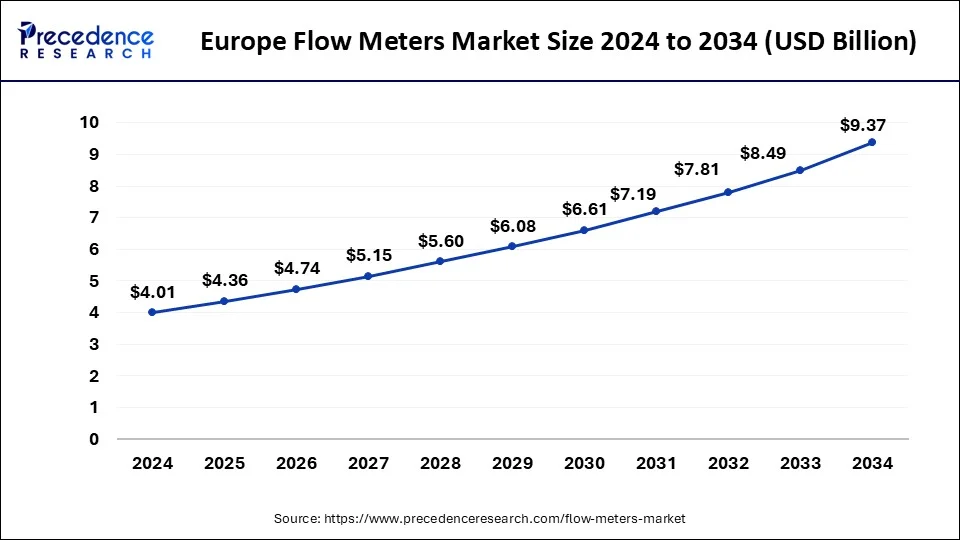
The Europe flow meters market size is accounted for USD 4.36 billion in 2025 and is projected to be worth around USD 10.11 billion by 2035, poised to grow at a CAGR of 8.86% from 2026 to 2035
How does Europe dominate the Flow Meters Market in 2025?
Europe dominated the market in 2025, owing to utility infrastructure modernisation, stringent environmental directives, and the integration of Industry 4.0 automation. Government initiatives are shifting the market toward connected, highly precise, and intelligent monitoring hardware to track energy transitions and combat resource scarcity. The European flow meters industry is undergoing rapid expansion, driven by digitalisation, EU-wide sustainability, and climate mandates. Manufacturers are expected to upgrade flow meters to comply with unified, stricter European calibration rules.
What is the Role of the Flow Meters Market in Germany?
Germany advances in the market due to strong domestic manufacturing and noticeable efforts of domestic instrumentation manufacturers in ensuring a high-precision supply of ultrasonic flow meters. German government is driving massive demand for the flow meters through multi-billion euro industrial decarbonisation subsidies and mandatory utility digitisation laws.
What is the Potential of the Flow Meters Market in the Asia Pacific?
Asia Pacific is expected to grow at the fastest CAGR in the market during the forecast period due to government mandates for water resource and energy management, rapid industrialization, and infrastructure expansion. Government mandates for rigorous environmental regulations, Industry 4.0 automation, and smart water grids are also expanding this regional market. Asia Pacific strongly focuses on the deployment of intelligent flow meters such as ultrasonic and magnetic variants. It aims to enforce industrial and municipal accountability and modernise utility networks.
What makes India expand in the Flow Meters Market?
India is emerging as a premier revenue-generating market in the Asia Pacific region, with developing sectors like water and wastewater management. The national infrastructure schemes, updated regulatory frameworks, and a wave of strict government mandates are accelerating the Indian market for flow meters. India aligns with the certification authority called the International Organization of Legal Metrology (OIML), which allows domestic manufacturers to obtain globally recognized certificates within India.
Which Driving Forces cause the Opportunistic Rise of North America in the Flow Meters Market?
North America is expected to grow notably in the market in the coming years, driven by rapid adoption of IoT and automation technologies across key sectors like oil and gas, water management, and clean energy. New environmental rules boost utilities to adopt ultrasonic and battery-powered smart electromagnetic flow meters to offer real-time flow data. The U.S. Environmental Protection Agency (EPA) mandates related to clean drinking water and industrial wastewater discharge need continuous flow tracking and high accuracy.
How is the Notable Growth of the U.S. in the Flow Meters Market?
The U.S. is growing rapidly in the market due to expanding clean energy deployments and upgrades to aging municipal and energy infrastructure. Federal policies across the U.S. and Canada are driving the transition to IoT-enabled, advanced intelligent flow meters to meet resource management and compliance goals. The deployment of multi-billion-dollar U.S. federal funding and infrastructure investments mandates major upgrades to municipal water grids.
What is the Significance of the Flow Meters Market in Latin America?
Latin America is expected to witness substantial growth in the market during the studied period, propelled by regional regulations shifting to intelligent, real-time smart metering and IoT ecosystems. The infrastructure investments are supported by state-backed entities and federal smart manufacturing standards that are targeting the deployment of millions of units. This has accelerated an immediate growth in ultrasonic, electromagnetic, and mass flow meter integration. The Mexican government is boosting Industry 4.0 mandates across its processing and manufacturing sectors.
Why is Brazil Considered a Significantly Growing Country in the Flow Meters Market?
Brazil experiences a noticeable growth in the market, driven by nationwide industrial energy efficiency upgrades, legal mandates in water sanitation, and strict regulations in gas and oil production. The flow meters market in Brazil is transforming to IoT-enabled, high-precision, and digitally integrated flow systems. Private utility operators and municipalities have driven upgrades in infrastructure.
How does MEA advance in the Flow Meters Market?
MEA is expected to grow at a notable rate in the market, accelerated by digital national mandates, critical water scarcity, and massive expansion of oil and gas infrastructure. Governments prefer factory-integrated digital communication systems to connect flow diagnostics directly to automated central frameworks. Strict regulations and rising municipal water crises have advanced government-backed funding into advanced ultrasonic and electromagnetic flow meters. It aims to audit municipal and chemical wastewater treatment.
How is the Noticeable Expansion of the Flow Meters Market in Saudi Arabia?
Saudi Arabia witnesses a notable growth in the market, driven by water conservation, localized manufacturing, and mega-infrastructure development. The regulatory updates, primary government initiatives, and public investments are shaping the Saudi Arabian flow meters market. Government-led national transformation strategies under Saudi Vision 2030 are driving rapid expansion of Saudi Arabia's flow meters industry.
Government Initiatives taken for the Flow Meter Market
- In October 2025, the Department of Consumer Affairs, Ministry of Consumer Affairs and Food and Public Distribution, informed of the main amendments to the Legal Metrology (Government Approved Test Hub) principal food year 2013. Such modification has marked a major achievement in strengthening India's verification design for measures and weights, ensuring accuracy, transparency and fairness in trade. (Source: https://www.pib.gov.in)
- In December 2025, Jal Jeevan Mission (JJM), which is an flagship initiative started by Government of India known as “Har Ghar Jal” with the help of Functional Household Tap Connections is the main aim of the Jal Jeevan Mission (JJM), that anticipates each rural household are having drinking water supply in its enough quantity which is up to 55 LPCD (litres per capita per day). (Source: https://mahaswsm.in)
International Gas Flow Meter Rules Utilized in India:
- IECEx and ATEX for Toxic Areas: Gas flow meters that are fixed in explosive surroundings need certified features. IECEx and ATEX standards regulate equipment that is used in hazardous areas. Such standards have defined enclosure security, temperature classes, and ignition risk management.
- OIML R 137: OIML R 137 is used for gas meters that are used in industrial measurement and custody transfer. It has defined precision classes, endurance tests, and pressure loss restrictions. Several Indian gas applications and export projects mention OIML-compliant meters.
Regulatory requirements for the Flow Meter Market
Flow meters should align with accuracy rules, undergo regular calibration, and maintain accurate documentation to align with regulatory frameworks. Most of the jurisdictions need certified calibration at particular gaps, specifically ranging from six months to two years, depending on the application.
The basic demands are a hub for counting, traceability, and precision. Flow meters, which are used in billing, custody transfer, or regulatory reporting, should showcase measurement capability within acceptable restrictions.
Supply Chain Analysis - Flow Meters Market
- Research and Development
Focuses on sensor accuracy, smart IoT/IIoT capabilities, material science, and software integration.
Key Players: Emerson Electric Co., Siemens AG, ABB Ltd., Honeywell International, and Bronkhorst. - Component Sourcing and Manufacturing
Production of physical components and electronics with high-precision manufacturing and assembly of technologies.
Key Players: KROHNE Group, Badger Meter Inc., SICK AG, Azbil Corporation, Alicat Scientific, Fuji Electric. - Calibration, Testing, and Certification
Ensures compliance with international standards and industry-specific regulations.
Key Players: ABB, KROHNE, Sierra Instruments, and Manas Microsystems. - Logistics and Distribution
Global logistics management for transporting sensitive instruments, including inventory and supply chain network management.
Key Players: DHL Group, FedEx Logistics, Emerson, and Siemens.
Competitive Landscape
The flow meters market is dominated by top market leaders such as Emerson Electric Co., Endress+Hauser Group, ABB Ltd., Siemens AG, Honeywell International Inc., and Yokogawa Electric Corporation. These market leaders are experiencing momentous growth due to heavy investments in R&D, extensive product portfolios, and advanced industrial IoT capabilities. Leading companies like ABB Ltd. have focused on high-precision, streamlined measurement systems that are deeply integrated with digital IoT platforms. The major developments also include wireless remote monitoring and enhanced predictive diagnostics to support smart city retrofit applications. R&D investments have focused on IoT-enabled predictive analytics, digital transformation, sustainability, and non-intrusive sensor hardware.
Flow Meters Market Companies
- Emerson Electric Co.
- ABB Ltd.
- em-tec GmbH
- General Electric
- Endress+Hauser Management AG
- Hitachi, Ltd.
- Höntzsch GmbH
- Honeywell International, Inc.
- KROHNE Messtechnik GmbH
- VSE Volumentechnik GmbH
- Siemens
- Yokogawa Electric Corporation
Partnerships in the Flow Meter Market
- In June 2026, Axis Solutions will officially enter an operational partnership to make the MAG200 electromagnetic Flow Meter. Such a shift marks a major development of the brand's confidential technology profile in the flow measurement and industrial automation space. (Source: https://www.sahi.com)
- In April 2025, WRICO was delighted to reveal an impactful partnership with its sister company, named Devices & CALIBERATIONS, INC, by developing its potential to assist users with accuracy flow meters, gas detection solutions, and instrumentation calibration. (Source: https://wrico.net)
Recent Developments
- In May 2026, the newest UFC23 sensor integrates the developed resolution and the offset stability with the help of ultra-low standby current, which allows a high-end battery-linked heat, water, gas, and leak detection meter that is crafted across a huge portfolio of smart metering uses. (Source: https://www.prnewswire.com)
- In August 2025, Renesas Electronics Corporation (TSE:6723), which is a leading supplier of ideal semiconductor solutions, revealed the RA4C1 microcontroller 9MCU) group depending on an 80MHz Arm Cortex-M33 processor. (Source: https://www.renesas.com)
- In April 2026, DEEP Robotics launched a quadruped robot, Lynx M20, for water utility inspection, aiming to improve efficiency and safety at water treatment plants. The robot can provide a new pathway for safe, stable operation and digital transformation of water facilities. (Source: https://markets.businessinsider.com )
- In March 2026, Endress+Hauser Group introduced a new Picomag electromagnetic flowmeter specifically designed for OEM and data center liquid cooling systems, featuring deactivated Bluetooth to comply with strict connectivity policies while measuring conductive fluids accurately. (Source: https://www.indexbox.io )
- In July 2025, a new initiative launched by Cargill, Frontline, and others aims to standardize marine fuel procurement in the Amsterdam-Rotterdam-Antwerp (ARA) area. This self-regulatory initiative uses technology to ensure compliance with standards, with Lloyd's Register appointed to audit and verify participants' adherence. (Source: https://www.offshore-energy.biz )
- In August 2024, ABB Ltd. launched the next-generation of electromagnetic flow meters named ProcessMaster and AquaMaster that combine IoT connectivity, high-performance, enhanced industry and utility segments. (Source: https://new.abb.com)
- In March 2024, Emerson reported that its new flow meter solution offers accurate and reliable measurement and optimized performance in challenging applications like high-viscosity, high-temperature, abrasive liquids, while reducing lifecycle costs. (Source: https://www.emerson.com)
Segments Covered in the Report
By Product
- Positive Displacement (PD)
- Differential Pressure (DP)
- Vortex
- Ultrasonic
- Magnetic
- Wireless
- Wired
- Turbine
- Coriolis
- Others
By Application
- Oil & Gas
- Water & Wastewater
- Power Generation
- Chemicals
- Food & Beverage
- Pulp & Paper
- Others
By Region
- North America
- Asia Pacific
- Europe
- Latin America
- Middle East and Africa
For inquiries regarding discounts, bulk purchases, or customization requests, please contact us at sales@precedenceresearch.com
Frequently Asked Questions
Tags





Ask For Sample
No cookie-cutter, only authentic analysis – take the 1st step to become a Precedence Research client
 Get a Sample




 sales@precedenceresearch.com
 Schedule a Meeting
