



Game Localization Services Market, Global Market Size, Share, Trends, Companies, and Forecast 2026-2035
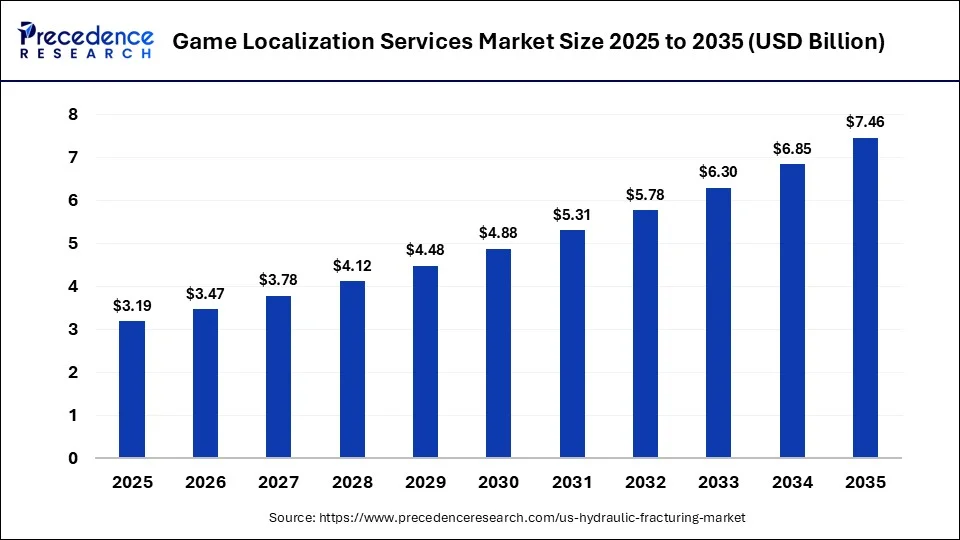
Gautam Mahajan is an ICT market research analyst. He researched game localization workflows, translation and linguistic testing, cultural adaptation, dubbing and subtitling, localization technologies, and regional game launches. His research work provides much-needed assistance to game publishers, game developers, localization providers, and platforms with competitive benchmarking and international game expansion strategies. The game localization services market was expected to reach USD 7.46 billion in 2035.
Source: https://www.precedenceresearch.com/game-localization-services-market
 Get a Sample
 Table Of Content


Game Localization Services Market Demand, Size and Growth Rate Forecast
Gautam Mahajan brings more than 5 years experience to the table in the field of media and gaming market analysis. He believes that game localization services are making for a more technology-oriented phase. Publishers are increasingly publishing across various national territories. Localization has gone beyond translation and involves adaptations for the culture, localized voice, linguistic quality assurance, and region-specific versions. He also states that escalating globalisation of game releases, the need for multilingual gameplay experience, and localisation-ready workflows with AI are key areas that drive market growth. The global game localisation services market was valued at USD 3.47 billion in 2026 and is growing at a CAGR of 8.87% over the forecast period.
Key Takeaways
- By service type, the translation and editing segment led the market with a share of 33.80% in 2026.
- By localization content, the in-game text segment led the market with a 30.60% share in 2026.
- By platform, the mobile games segment captured a major revenue share of 39.6% in 2026.
- By game genre, the action segment captured the largest market share of 20.80% in 2026.
- By localization technology, the human localization segment led the market with a 42.7% share in 2026.
- Localization is becoming embedded earlier in game development, shifting from a final-stage activity to a core development function.
- AI has evolved into a foundational productivity layer, driving efficiency across translation, QA, and content workflows.
- Deep publisher relationships and integrated workflows create high switching costs and support long-term customer retention.
- Specialized expertise, global linguistic networks, and localization infrastructure create significant barriers to entry.
- Future growth will be driven by emerging languages, live-service gaming, AI-powered localization, and cultural intelligence services.
Market Overview & Size
The global game localization services market is estimated at USD 3.47 billion in 2026, at an 8.87% CAGR from 2026 to 2035, to reach around USD 7.46 billion by 2035. This is driven by the ongoing internationalisation of the gaming industry. The importance of localization for the process of global releases and the engagement with players is becoming part of the core phase of global game development.
There's also a change in the market in the commercial sphere. The billable, word-for-word services are slowly being replaced with more comprehensive localisation programs. That includes translation, cultural adaptation, voice and audio localisation, linguistic testing, quality assurance and continuous content updates. Furthermore, AI-powered tools are reducing the time and expense of repetitive language tasks, and human agency is still needed for more creative language tasks and culturally appropriate translations.
- Key Insight: The game localization services market is poised for growth, expanding from USD 3.47 billion in 2026 to an estimated USD 7.46 billion by 2035, with a compound annual growth rate of 8.87%. This growth will likewise represent a transition to managed localization programs globally.
Pricing Analysis - Word Volume, Content Complexity, Language Pair and Voice Requirements Drive Localization Economics
| Pricing Driver | Cost Impact | Commercial Implication |
| Word volume | Very High | Larger RPG/AAA scripts require substantial linguistic capacity |
| Number of target languages | Very High | Multilingual launches multiply translation, review and QA requirements |
| Language pair | High | Less-common languages generally require more specialized resources |
| Voice-over | Very High | Casting, recording, directing and post-production materially increase project value. |
| LQA | High | In-game linguistic testing requires devices, builds and specialist testers. |
| Culturalization | Medium-High | Sensitive content may require market-specific adaptation |
| Localization engineering | Medium-High | Integration with game engines and repositories increases technical requirements. |
| Simultaneous launch | High | Tight schedules create premium capacity requirements |
| Live-service updates | High recurring value | Continuous localization generates repeat revenue |
| AI-assisted workflows | Potentially negative on unit price | Automation can reduce cost per translated word while increasing throughput. |
Source: Precedence Research Database
Game localization pricing isn't exactly like regular document translation. It's influenced by genre, requirements for integration into the game, adaptation to cultural norms, linguistic quality assurance, and voice production layers upon layers. A high volume of words or many target languages both have a very high cost impact, as one large RPG or AAA script requires a lot of linguistic capacity in its own right. Each language that a publisher adds creates additional translation, review, and QA effort rather than just multiplying it. Culturalization and localization engineering is defined as medium-high. Stating actual, but more variable costs are associated with how sensitive the content is, and how much modification needs to be made to the game engine itself.
- Key insights: Word volume, target language count, and voice-over all have a very high cost impact, as they increase work.
Demand-Supply Analysis - Global Game Releases Are Increasing Demand for Specialized Multilingual Capacity
| Demand Driver | Demand Intensity | Supply Requirement |
| AAA global launches | Very High | Large multilingual teams |
| Mobile game expansion | Very High | Fast, scalable text localization |
| Live-service games | Very High | Continuous localization |
| Console releases | High | Translation + LQA + platform compliance |
| PC releases | High | Multilingual text and technical localization |
| Cloud gaming | Emerging | Rapid multilingual content deployment |
| DLC/seasonal content | High | Recurring localization capacity |
| Voice-heavy RPGs | Very High | Casting and recording infrastructure |
| Emerging-market expansion | High | New language specialists |
Source: Precedence Research Database
The most successful accounts of this market come from the individual publishers who want to publish the same game in numerous territories simultaneously. It gives a sense of the scale of that venture to see how widespread the two giant suppliers are in doing it. According to Keywords Studios, the localization operation supports over 80 text languages and over 50 audio languages. Also, a global presence has been developed specifically to provide for follow-the-sun production, in order to keep work rolling over from one time zone to the next without stopping dead in its tracks tonight. Side is quoted as translating over 1,000 linguists, over 90 localizations of game software, and more than 50 million words over the past year.
- Key Insight: The number of words translated by Side alone exceeds 50 million in a year for over 90 language pairs, while the number of AAA launches, mobile expansion, and live-service games is rated very high.
Value Chain & Supply Chain - Translation, Cultural Adaptation, Testing and Publishing Integration Define Value Capture
| Value-Chain Stage | Core Activity | Value Capture |
| Source preparation | Extracting strings and assets | Medium |
| Translation | Converting game text | High |
| Editing/proofreading | Linguistic refinement | High |
| Culturalization | Regional adaptation | Very High |
| Voice localization | Casting/recording/direction | Very High |
| Localization engineering | Game integration | High |
| LQA | Testing in actual builds | Very High |
| Platform compliance | Certification-related testing | High |
| Program management | Coordinating vendors/workflows | Very High |
| Post-launch localization | DLC/live updates | Very High recurring |
Source: Precedence Research Database
The value chain follows publisher and developer, localization program management, translation, editing, culturalization, voice localization, localization engineering, linguistic QA, platform compliance, and release. Source preparation, which involves collecting strings and assets before any translation takes place. Translation and editing or proofreading contribute to translation's high value, the basic linguistic facet required for any localization project.
- Key Insight: Localization delivers value through a structured end-to-end workflow, where source preparation, translation, and editing form the core linguistic foundation that enables high-quality global product releases.
Technology & Innovation - AI Translation and Automation Are Reshaping Localization Workflows
| Technology | Market Impact |
| Neural machine translation | Lower translation cost |
| Generative AI | Faster contextual drafting |
| Translation memory | Higher reuse and consistency |
| Terminology databases | Better franchise consistency |
| Automated LQA | Faster error detection |
| AI voice synthesis | Potentially lower VO production costs |
| Automated string extraction | Faster production setup |
| API integrations | Lower publisher/vendor management burden |
| AI-assisted culturalization | Faster identification of sensitive content |
| Real-time localization pipelines | Supports live-service games |
Source: Precedence Research Database
AI is used for game localization, especially for massive amounts of redundant text that can be localized, such as conversations, user interfaces, descriptions, and others. Instead of localization teams, more AI tools are being integrated into processes for which machine-generated translations are then reviewed, refined, and culturally adapted by professional translators.
Adoption is just beginning to be seen. With the ability to reportedly process 35 languages and over 30 million translated words, Keywords KantanAI has shown how automated translation can be useful at a large scale during game development. Additionally, Side has cited the benefit of cutting up to 40% turnaround time and up to 30% cost without sacrificing human review in its AI-augmented translation process.
- Key Insight: KantanAI has facilitated the processing of 30-plus million words across 35 languages, while Side reports a 30% overall cost reduction on average, as well as a 40% faster turnaround time.
Regulatory & Cultural Environment - Regional Standards Shape Localization Decisions
| Regulatory/Cultural Factor | Impact |
| Age-rating requirements | High |
| Violence/gore restrictions | High |
| Gambling-related content | High |
| Religious/cultural sensitivity | High |
| Political references | Medium-High |
| Sexual content | High |
| Local advertising rules | Medium |
| Data/privacy requirements | Medium |
| Platform certification | High |
| Regional terminology requirements | High |
Source: Precedence Research Database
An age rating, a rating on the violence/gore facet, a reaction on a religious/cultural sensitivity facet, a rating on a sexual content facet, a rating on a platform certification facet, and a rating on a regional terminology facet all have a high impact rate. Stating that may cause a game to be rejected, re-rated, or even pulled from a particular market, not just awkward for a local player. Political references have a medium-high impact. That is particularly the case if the reference may, on some occasions, be considered a serious market access obstacle despite the fact that it was not written politically.
- Key Insight: It is evident that cultural and regulatory compliance is not one issue, but a multi-dimensional requirement that runs through almost every market through which a game is released.
Customer & Application Analysis - AAA, Mobile, PC and Console Games Create Different Localization Economics
| Application | Localization Intensity | Major Requirement |
| AAA console | Very High | Text + voice + LQA |
| AAA PC | Very High | Text + audio + technical QA |
| Mobile games | High | High-volume text + frequent updates |
| RPG/MMORPG | Very High | Extensive dialogue and terminology |
| Action games | High | UI + dialogue + LQA |
| Sports games | High | Recurring annual localization |
| Casual games | Medium | Fast multilingual text |
| Indie games | Medium | Cost-sensitive localization |
| Live-service games | Very High | Continuous updates |
| Cloud gaming | Emerging | Global simultaneous delivery |
Source: Precedence Research Database
A sports game requires a fresh localization pass every season due to the changing sports teams and content. Mobile games or action games, high volume of texts, frequent updates, a localization process including a UI / dialogue / QA component are required, owing to the fast-changing content. Cloud gaming is an emerging category, and is grappling with trying to figure out what global simultaneous delivery at scale means.
- Key Insight: The live-service, RPG/MMORPG, and AAA PC and Console titles have all been defined as very high, and the common characteristic is not the platform. The common element is a larger game volume and more languages.
Competitive Intelligence
Competitive Landscape - Global LSPs and Specialized Game Studios Intensify Competition
This market is made up of 4 competitive tiers with different competitive factors and features the following labels. The first tier is Integrated Game-Service Platforms, encompassing Keywords Studios, Side, Lionbridge Games, Testronic, and QLOC. Vendors providing the widest range of comprehensive sound and localization, plus testing, services all in one place. Second are large multilingual games infrastructure providers, such as TransPerfect, RWS, Welocalize, Acolad, and EC Innovations. They also have other verticals but play a key role in the gaming business. Tier 3 consists of specialized game localization companies, a smaller group that specializes in game content. Tier 4 consists of regional and technical specialists such as companies from Babel Media, Riotloc, Inlingo, DICO, and PTW associated with the technical area and a larger number of companies that focus on a distinct region or niche.
- Key Insight: This is a highly competitive field with 47 companies ranging from integrated global platforms to regional technical suppliers, indicating market fragmentation and many other contenders beyond just the top few large vendors, which lead the headlines for market share
Tentative Leading Company Universe - 20-25 Companies
| Company | Primary Competitive Strength |
| Keywords Studios | Global scale + gaming specialization |
| Side | Localization + audio + LQA |
| Lionbridge Games | Global LSP + gaming |
| TransPerfect | Global language infrastructure |
| QLOC | Game QA + localization + co-development |
| Testronic | Game testing + localization |
| Allcorrect | Game-specialist localization |
| Localsoft | Game localization |
| Local Heroes Worldwide | Game localization |
| Roboto Global | Game localization |
| Effective Media | Game localization |
| Latis Global | Asian/global localization |
| RWS | Global localization infrastructure |
| Welocalize | Enterprise localization |
| Acolad | Global language services |
| EC Innovations | Asian/global language services |
| InlingGame | localization |
| LocDirect | Game localization |
| Riotloc | Game localization |
| DICGame | localization |
| Babel Media | Media/game localization |
| ZOO Digital | Localization technology + media |
| Keywords-associated studios | Integrated game services |
| Pactera EDGE | Technology-enabled localization |
| Appen | AI/data and language capabilities |
Source: Precedence Research Database
- Key Insight: Roughly 20 to 25 companies make up the serious competitive set drawn from a broader 47-company universe. The real differentiation among them clusters around just a few recognizable strengths: gaming-plus-scale, in-house service breadth, global infrastructure, or technical co-development capability, rather than 25 truly distinct strategies.
Market Share & Competitive Ranking - Scale and Gaming Specialization Matter
| Rank | Company | Estimated 2025 Game Text Localization Revenue | Estimated Share |
| 1 | Keywords Studios | $99.6M | 40.5% |
| 2 | Side/PTW | $30.0M | 12.2% |
| 3 | Lionbridge | $18.6M | 7.6% |
| 4 | QLOC | $8.4M | 3.4% |
| 5 | TransPerfect | $8.0M | 3.2% |
| 6 | Allcorrect | $7.2M | 2.9% |
| 7 | ACE Agency | $5.2M | 2.1% |
| 8 | Localsoft | $4.6M | 1.9% |
| 9 | Local Heroes Worldwide | $3.9M | 1.6% |
| 10 | Warlocs | $3.9M | 1.6% |
Source: Precedence Research Database
Aman states that the top ten company-specific best publicly available benchmarks combine the USD 246 million text-localization benchmark with a 2025 game market model, ranking the top ten companies. Keywords Studios will also be well ahead of all other names, with estimated game text-localization revenue of USD 99.6 million and a 40.5% share. Side is valued at around USD 30.0 million and 12.2% market share. Number three is Lionbridge, valued at USD 18.6 million and a 7.6% share.
- Key Insight: At the top, the estimates of the shares of Keywords Studios and Side are quite large, respectively USD 40.5 million and USD 12.2 million.
Competitive Benchmarking - Language Capabilities and Technology Create Advantages
| Company | Gaming Focus | Global Scale | AI/Technology | Audio | LQA |
| Keywords | Very High | Very High | Very High | Yes | Yes |
| Side | Very High | Very High | Very High | Yes | Yes |
| Lionbridge | High | Very High | High | Yes | Yes |
| TransPerfect | Medium | Very High | Very High | Yes | Yes |
| QLOC | Very High | High | High | Limited | Very High |
| Allcorrect | Very High | Medium | High | Selective | Yes |
| Localsoft | High | Medium | Medium | Yes | Yes |
| RWS | Medium | Very High | Very High | Selective | Yes |
Source: Precedence Research Database
Both Keywords and Side hold high focus on gaming, high global scale, and a second-high on AI and technology, and both have full QA with audio and linguistic capabilities. That makes their 1st and 2nd market-share result as presented above. Lionbridge rates high on its gaming focus but very high on its global scale, combining high AI and technology and full audio and QA, which places it firmly as a broad based LSP, rather than a gaming-first name.
- Key Insight: Keywords and Side are the only two vendors that are popular in gaming focus, global scale, and AI/technology, holding the largest market share numbers in the above-ranking list of gaming vendors.
Service Portfolio Benchmarking - Translation, Voice and Testing Define Differentiation
| Service | Keywords | Side | Lionbridge | QLOC | Allcorrect |
| Text translation | Yes | Yes | Yes | Yes | Yes |
| Editing | Yes | Yes | Yes | Yes | Yes |
| Voice-over | Yes | Yes | Yes | Limited | Yes |
| Culturalization | Yes | Yes | Yes | Yes | Yes |
| Localization engineering | Yes | Yes | Yes | Yes | Yes |
| LQA | Yes | Yes | Yes | Yes | Yes |
| Platform compliance | Yes | Yes | Yes | Yes | Yes |
| AI-assisted translation | Yes | Yes | Yes | Yes | Yes |
| Player support | Yes | Yes | Yes | Limited | Limited |
Source: Precedence Research Database
Text translation, editing, voice-over, culturalization, localization engineering, linguistic QA, platform compliance, AI-assisted translation, and player support are the nine broad service lines. They used to compare the top five vendors, and all three vendors have no exception to offering the full range of all nine services. Further reinforcing their status at the top of the competitive tiering discussed above. QLOC and Allcorrect both have 7 of 9 services, but each sports 1 meaningful service. Although QLOC's name implies that it is a holistic audio production company, it rates its voice-over production ability as limited, as will its player support offering.
- Key Insight: While AI-assisted translation is already standard on all of the five vendors. There are significant differences between the vendors in the completeness of their voice-over and player-support features, where Allcorrect and QLOC offer only limited or selected packages compared to Keywords, Side, and Lionbridge's full package options.
Technology & Innovation Benchmarking - AI Is Becoming a Productivity Layer
| Technology | Keywords | Side | TransPerfect | RWS | Specialized Vendors |
| AI translation | Advanced | Advanced | Advanced | Advanced | Growing |
| Translation memory | Advanced | Advanced | Advanced | Advanced | Advanced |
| Automated QA | Advanced | Advanced | Advanced | Advanced | Growing |
| GenAI | Advanced | Advanced | Advanced | Advanced | Emerging |
| Custom terminology | Advanced | Advanced | Advanced | Advanced | Advanced |
| API workflow | Advanced | Advanced | Advanced | Advanced | Medium-High |
| Human-in-loop AI | Yes | Yes | Yes | Yes | Increasing |
Source: Precedence Research Database
Advanced AI translation, TM, automated QA, and AI workflows are also at a very high level of maturity in leading localization providers. These technologies are increasingly facilitating faster, more uniform, and scalable translations with a decreasing amount of manual work. Human-in-the-loop processes are still significant for quality and contextual suitability. On the other hand, niche vendors with limited budgets are also pouring resources into the technologies that will keep them in the game against their larger competitors.
- Key Insight: AI is no longer unique to localization, but an integral part of the various layers of productivity used throughout the localization industry.
Application Competitive Benchmarking - AAA and Live-Service Games Offer the Highest Value
| Segment | Market Attractiveness | Localization Complexity |
| AAA RPG | Very High | Very High |
| MMORPG | Very High | Very High |
| Live-service | Very High | Very High |
| Console AAA | Very High | Very High |
| Mobile | Very High | High |
| PC | High | High |
| Sports | High | High |
| Indie | Medium | Medium |
| Casual | Medium-High | Medium |
Source: Precedence Research Database
Aditi believes mobile was rated very high on approval and high on complexity, as its addressable market is very large. But doesn't have the same breadth of story and voice building that team, tool, and technology AAA masters demand. Both PC and sports score high on complexity and attractiveness, solid but less prominent. Indie rates medium for both; casual ones are medium-high for attractiveness and medium for complexity, smaller and simpler, yet still have value due to their quantity.
Key Insight: All AAA RPG games and MMORPG, live-service, and console games achieve the highest market attractiveness rating and the highest spend on localization, happening in the most difficult segments of this market.
Geographic Competitive Landscape - Asia-Pacific and Europe Are Critical Localization Hubs
| Region | Competitive Position | Key Characteristics |
| Asia-Pacific | Very Strong | Japan, China, South Korea and Southeast Asia |
| Europe | Very Strong | FIGS and Nordic/CEE languages |
| North America | Very Strong | Publisher concentration |
| Latin America | High-growth | Spanish/Portuguese localization |
| Middle East | Emerging | Arabic localization demand |
| India | Emerging | Growing developer ecosystem |
| Southeast Asia | High-growth | Mobile gaming + multilingual demand |
Source: Precedence Research Database
The Asia Pacific does not just come from a single country, but is one of a variety of big game markets in general, with Japan, China, South Korea, and Southeast Asia specifically. Europe's strength lies in the FIGS languages. French, Italian, German, and Spanish, as well as in the demand for Nordic and CCEE languages, and is the result of this linguistic density. On the other hand, newer market rates are both emerging, with the Middle East trailing the growth of Arabic localization demand, and India trailing behind due to a small but expanding developer base.
- Key Insight: Asia-Pacific, Europe and North America all have a very strong rating due to various considerations, with Side's new 2023 Tokyo studio opening following its hubs in Paris, London, Shanghai, Montreal and Los Angeles, faithfully following the same trend.
Delivery & Capacity Benchmarking - Multilingual Talent Determines Scalability
| Provider | Capacity Indicator |
| Keywords | 80+ text languages; 50+ audio languages |
| Side | 1,000+ linguists; 90+ language pairs |
| Side LQA | 400+ active testers; 45+ languages |
| Side Audio | 30+ countries |
| Keywords AI (KantanAI) | 30M+ words / 35 languages through KantanAI case |
| Large global LSPs | Enterprise-scale multilingual infrastructure |
| Boutique studios | Higher specialization but lower absolute capacity |
Source: Precedence Research Database
I believe multilingual talent is key to scalable delivery and capacity benchmarking success. Keywords reports more than 80 languages of text (and more than 50 languages of speech), and Side reports more than 1,000 languages spoken by linguists in more than 90 language pairs overall. Its linguistic QA operation alone boasts more than 400 active testers working across more than 45 languages, and its audio organization has reached more than 30 countries. Boutique Language Providers tend to be more specialized, often with greater depth in a smaller number of languages or genres.
- Key Insight: In comparison to the number of linguists (more than 1,000) and 90-plus language pairs and 400-plus dedicated language QA testers at Side. This facilitates simultaneous global launches, which tend to gravitate towards the handful of vendors that can field that many linguists at a time.
Customer & Channel Benchmarking - Publisher Relationships Create Switching Costs
| Customer Type | Vendor Requirement | Stickiness |
| AAA publisher | Global program management | Very High |
| Mobile publisher | Speed + scalability | High |
| Indie developer | Cost efficiency | Medium |
| Live-service publisher | Continuous pipeline | Very High |
| Console developer | LQA + compliance | Very High |
| RPG developer | Creative localization | Very High |
Source: Precedence Research Database
By playing a key role in development, release, and content update, local providers create closer relationships with publishers over the long-term. For any publisher, relocating their games to the modern-day gaming landscape entails program administration, compliance support, and premium localization solutions. Live-service and console publishers need consistent program administration, compliance, and high-quality localization services. Over the years, the intelligent first person, domain knowledge, and workflows, along with the linguistic assets, build up dependence on current vendors. This generates a lot of switching costs and exerts pressure to maintain customers.
- Key Insight: Deep publisher integration creates high switching costs, making long-term relationships a major competitive advantage.
Strategic Developments - AI, Multilingual Expansion and Gaming Partnerships
The best game localization jobs are found in the areas of the gaming industry where there is future demand, a significant addressable market, and complex development. Because they are continually updated with content and have high service requirements, AAA and live-service localization is still very appealing. Asia's languages and new geographies emerge to help grow localization needs globally, especially in the mobile gaming sector. Furthermore, AI-driven translation, LQA automation, and localization engineering are fueling more opportunities for efficiency gains as well as scaled expansion.
- Key insight: The best value-adds are combinations of recurring demand, market growth, and technology that enables localization services.
M&A Landscape - Localization, QA and Gaming Technology Are Converging
| M&A Target | Strategic Value |
| Game localization studio | Language expertise |
| LQA provider | Testing capacity |
| AI localization platform | Productivity |
| Voice production studio | Audio capabilities |
| Regional language provider | Market access |
| Localization engineering firm | Technical integration |
| Player-support provider | Recurring revenue |
| Gaming co-development firm | Cross-selling |
Source: Precedence Research Database
This market has further evolved into more than just the purchase of another translation company. A linguistic QA provider gives users the testing capability that they may need to build from scratch, and a game localization studio gives them language expertise. The value of an AI localization platform acquisition stems from increasing productivity in all future projects. By acquiring a localization engineering company, the buyer gains localization engineering experience in implementing localized content into a real game build. Cross-selling opportunity can come from a publisher association that otherwise could be purely transactional by a gaming co-development firm.
- Key Insight: Eight distinct acquisition-target categories, spanning localization studios, QA providers, AI platforms, voice studios, and co-development firms, all point toward the same consolidation thesis: that competitive advantage in this market increasingly comes from combining localization with adjacent capabilities rather than scaling pure translation alone.
Company Profiles - What the Leading Vendors Actually Offer
Keywords Studios
One of the most obvious examples of a gaming-services provider is Keywords Studios. Its localization business covers text, audio, and LQA, with the larger firm providing game development, art, audio, QA, marketing, and player engagement services. It openly states the relationships built with big publishers and games companies such as Electronic Arts, Tencent Games, Take-Two, Ubisoft, WB Games, Riot Games, Supercell, Tencent Games, and others.
- Capacity/Capability: 80+ text languages; 50+ audio languages; KantanAI has processed 30M+ words across 35 languages
Side
Side integrates localization, audio, LQA, culturalization, and technical integration. The company offers translation, culturalization, engineering, audio, and LQA services separately. In addition to offices in Paris, London, Shanghai, Montreal, and Los Angeles, it has a new office in Tokyo, opened in 2023. It takes a pragmatic stance on AI, developing gaming models that echo player preferences, project content, and gaming-specific terminology.
- Capacity/Capability: 1,000+ linguists; 90+ language pairs; 50M+ words translated in the prior year; 400+ active LQA testers across 45+ languages; audio production in 30+ countries; AI-augmented workflow reportedly reduces turnaround by up to 40% and cost by up to 30% while retaining human review
Lionbridge
Lionbridge is the model of the global language-service-provider (LSP) which provides its gaming localization services by building on a broader enterprise language infrastructure that extends beyond gaming.
Capacity/Capability: Global LSP infrastructure with dedicated gaming practice
QLOC
QLOC is more focused on Game Development, Porting, QA, and Localization. This will help the company succeed if localization is linked directly with game development instead of, for example, provided as a punctual after-the-fact service.
- Capacity/Capability: Technical gaming specialist combining co-development, QA, and localization
Allcorrect
Represents the specialized game-localization model, with a greater concentration on linguistic services than diversified global LSPs.
- Capacity/Capability: Third-party modelling estimates 2025 game text-localization revenue at approximately $7.2 million
Company Strategic Positioning - Who Is Best Positioned?
| Company | Scale | Gaming Expertise | Localization | AI | Overall Strategic Position |
| Keywords | Very High | Very High | Very High | Very High | Global leader |
| Side | High | Very High | Very High | Very High | Integrated challenger |
| Lionbridge | Very High | High | Very High | High | Global LSP leader |
| TransPerfect | Very High | Medium | Very High | Very High | Technology/LSP leader |
| QLOC | High | Very High | High | High | Technical gaming specialist |
| Allcorrect | Medium | Very High | Very High | High | Specialist challenger |
| RWS | Very High | Medium | Very High | Very High | Enterprise localization leader |
| Localsoft | Medium | High | Very High | Medium | Specialist player |
Source: Precedence Research Database
In all four dimensions, it has Keyword ratings very high with no weak dimension. It gets the clearest aggregate label, global leader, in the whole comparison. Lionbridge is rated at the highest levels on scale and localization, but these are not the only areas in which it is a game expert. It's been rated very high on scale, and the only areas rated very high are on the game side, where it rates very high, but this is not its most defining trait like it is with Keywords or Side.
- Key Insight: All other companies that have a strategic position integrated challenger, technical specialist, or enterprise leader. They are directly related to a single dimension, either gaming expertise, scale, or AI, and are punting the one other dimension in favor of Keywords' consistent strength in all of them.
Opportunity & White-Space Analysis - Where New Growth Pools Are Emerging
As the market for emerging languages and mobile live-service games and technology-driven solutions continues to grow, new growth opportunities emerged in gaming localization. English is far from the only language growing in significance with growing gaming audiences in the world, and markets like Arabic, Southeast Asian languages, and Latin American Spanish are now gaining popularity. New models of localization providers are being devised, and scalability is being enhanced. Due to AI support in translation, voice localization, and real-time. Additionally, cultural intelligence services are becoming more in-demand. That is, helping providers enhance their content before it's actually translated for local markets.
- Key Insight: The next wave of growth will be driven by emerging markets, AI-powered localization, and higher-value cultural advisory services.
Industry Structure - Specialized Expertise Creates Barriers to Entry
| Barrier | Strength |
| Gaming linguistic expertise | Very High |
| Publisher relationships | Very High |
| Global linguist network | Very High |
| LQA infrastructure | Very High |
| Voice-production infrastructure | High |
| Proprietary localization technology | High |
| Game-engine integration | High |
| Simultaneous-launch capacity | Very High |
| Franchise terminology databases | High |
| Regional cultural knowledge | Very High |
Source: Precedence Research Database
To cater to the needs of the gaming localization market, a combination of linguistic skills, cultural adaptability, publisher trust, and global reach is necessary. Establishment of a network of experts (linguists, LQA teams, voice production resources, and regional experts) is a significant time and cost activity. Newcomers are also dealing with difficulties reaching simultaneous launches and engineering technology solutions for specific industries. Such a requirement provides reasonable barriers that make it difficult for new providers.
- Key Insight: Specialized expertise, infrastructure, and publisher trust create substantial barriers that limit new market entrants.
PESTLE Analysis - Regulation and Technology Are Reshaping Market Economics
| Factor | Impact on Game Localization |
| Political | Regional content restrictions |
| Economic | Publisher cost pressure |
| Social | Demand for culturally authentic games |
| Technological | AI/MT/GenAI automation |
| Legal | Age ratings, censorship and IP requirements |
| Environmental | Increasing pressure to reduce production inefficiencies |
Source: Precedence Research Database
Political factors focus on regional content restrictions in particular. They were discussed earlier in the Regulatory section, under the Legal aspects of age rating and censorship. Economic factors focus on publisher cost pressures, the looming feature that pushes publishers to greater localization delivery at lower cost. Technological factors focus on AI, machine translation, and generative AI automation, while Legal factors focus on age rating, censorship, and IP requirements.
- Key Insight: In a real paradox, AI localization in additional volume partly caused a price erosion that outweighed the gains in revenue from text localization, making it the most disruptive PESTLE factor.
Market Attractiveness - Where Should Vendors and Investors Focus?
| Opportunity | Attractiveness | Rationale |
| AAA localization | Very High | High content and service complexity |
| Live-service localization | Very High | Recurring demand |
| Mobile gaming | Very High | Huge global user base |
| Asian languages | Very High | Large gaming ecosystems |
| AI-assisted translation | Very High | Productivity improvement |
| AI voice localization | High | Potential cost disruption |
| LQA automation | Very High | Scale and recurring requirements |
| Culturalization | Very High | High-value human expertise |
| Arabic localization | High | Emerging regional demand |
| Latin American Spanish | High | Large addressable audience |
| Southeast Asian languages | Very High | Mobile gaming growth |
| Localization engineering | High | Technical barriers to entry |
| Player-support localization | High | Recurring revenue |
Source: Precedence Research Database
- Key Insight: As illustrated in the scatterplot of scale opportunities against recur revenues, 8 of the 13 opportunities ranked consistently (Very High) across the board. They are distributed across the various opportunities, including AAA, Asian languages, mobile, AI-assisted translation, QA automation, culturalization, and Southeast Asian languages.
Segmentation Analysis
By Service Type
Source: Precedence Research Database
Translations/editing is the single biggest service line at 33.80% market share in 2026, edging down to 29.70% market share by 2035 at 7.55% CAGR. It continues to serve as the basis for all localization projects, regardless of declines in relative market share. On the other hand, voice-over and dubbing, which jumped from 19.40% to 21.80% market share at 10.15% CAGR, exceeded all major services in terms of growth.
- Key Insight: The 10.15% of the growth year-by-year in the key services comes from the voice-over and dubbing service category, directly driven by narrative-heavy AAA and immersive game titles requiring localized audio.
By Localization Content
Source: Precedence Research Database
In-game text is the biggest category as it takes up 30.60% of the market share in 2026 and is projected to see a 7.70% CAGR at 27.40% market share by 2035. Due to the volumes of dialogue, quests, and instructional text being large in a contemporary game, despite other market segments catching up. Legal and regulatory, increasing its market share from 2.40 % to 3.50 % of total market share at a 12.00 % CAGR. The growing adoption of privacy, rating, and consumer-protection regulations in regions continues to present additional translation requirements for legal content.
- Key Insight: The 12.00% CAGR in legal and regulatory content represents the fastest of all content categories after direct demand for the category from increasing laws, ratings, and consumer protection laws and standards across regions.
By Platform
Source: Precedence Research Database
Extending further in 2026 to 42.80% market share by 2035, mobile games dominate the platform breakdown with 9.70% CAGR. Due to the regular development of new and exciting titles to satisfy the massive mobile user base. Additionally, ever-rising AR/VR Games outplayed other games with 11.30% CAGR to attain the highest market share of 3.40%.
- Key Insight: AR/VR Games show the fastest platform CAGR in the category (11.30%), though their current market share is being held low at 2.70%. Due to the added challenge of multilingual audio and interface, marking the first time release of an AR/VR game on a flat-screen.
By Game Genre
Source: Precedence Research Database
Action games accounted for the highest market segmentation of 20.80% of market share for the 2026 game releases, falling to 19.60% market share by the 2035 game releases at an 8.20% CAGR. Due to their high customer base in the country and their frequent releases on an international scale. Multiplayer online games (MOG), which went from 7.90% to 8.90% of market share, experienced a 10.10% CAGR due to the need to continuously update multiplayer games over multiple languages that are played across the globe.
- Key Insight: Multiplayer online games grow fastest of any named genre at a 10.10% CAGR, climbing to 8.90% market share, due to the constant need for the multiplayer genre to support a variety of languages and communities.
By Localization Technology
Source: Precedence Research Database
In 2026, human localization is the top market share technology with 42.70%, yet it ranks as the fastest eroding market share technology at 5.15% CAGR to 29.80% market share by 2035. As enterprises move ever closer to fully leveraging generative AI and LLMs to eliminate the need for translation and localization functions that have long been performed manually. AI-Assisted Localization takes market share by a significant margin with its top pace of 14.95% CAGR, the fastest of any technology on the entire table, and a vertical that went from 12.30% in 2026 to 25.20% in 2035.
- Key Insight: AI-Assisted Localization is increasing from a 12.30% share in 2026 to 25.20% by 2035.
By Deployment Model
Source: Precedence Research Database
Cloud-Based deployment already led this category in 2026 at 57.40% market share, and it extends that lead sharply further to 69.20% market share by 2035 at a 10.85% CAGR. The distributed development teams and real-time collaboration requirements are driving this industry to adopt cloud at an accelerating rate.
- Key Insight: Cloud-Based is at a 57.40% share of the market in 2026, growing with a CAGR of 10.85.
By End User
Source: Precedence Research Database
Large global releases need extensive multilingual text, audio, and QA services, sustaining the preference of the AAA Game Publishers, which retained the highest end-user market share in 2026 and is projected to lose eight percentage points to 34.10% in 2035 at 8.05% CAGR. While investments in AI-assisted and cloud localization tools are becoming more economical over the years, the quickest growth comes from 10.80% to 13,70%, at the best CAGR of any end user of 11,45%.
- Key Insight: Indie game developers see the fastest growth of any end user, at an 11.45% CAGR, rising from 10.80% to 13.70% market share.
Game Development Stage
Source: Precedence Research Database
Pre-Launch remains the single largest stage for localization spend at 31.70% market share in 2026, easing to 28.80% market share by 2035 at a 7.80% CAGR. Development has 27.60% of the total market share and is projected to rise to 28.50% of the total market share with a 9.20% annual CAGR. Stating that localization is becoming more and more of a mainstream part of the development process and not just the final phase when the game is completed.
- Key Insight: The spend for localizations is also on the move, with the vast majority of localization spend moving towards the very beginning of planning (Live-Service Updates, growing at 10.15% CAGR) and away from the often traditional period of pre-launch (Pre-Production at 11.15% CAGR from the lowest base).
By Region
Source: Precedence Research Database
Asia-Pacific is the region with the highest share of 39.10% in 2026, rising further to 41.80% by 2035 at a CAGR of 9.65%. Due to the combined influence of the large populations of gamers in the region and the authenticity of the languages spoken, along with the continued growth of mobile gaming in the region. Although the share in North America is sliding more heavily against faster-growing regions, it still maintains a 27.40 percent share, down at 8.15 percent CAGR, due to the mature gaming publishers and their high-value AAA titles.
- Key Insight: Asia-Pacific has a huge increase in market share at 39.10%, which is the fastest region to increase at a CAGR of 9.65%.
By Target Language
Source: Precedence Research Database
English is the largest target language in 2026 (18.60%), with the share buyer-wise and slotting down (7.55% CAGR) to 16.40% in 2035. It still constitutes a major source and target language in the global game publishing market despite seeing a relative decline with the growth of target languages.
On the other hand, Arabic is the fastest-growing target language, adding market share from 2.80% to 3.80% at a 12.20% CAGR. This is bolstered by growing gaming adoption all over the Middle East and North Africa region, and is based on a small absolute base that is definitely showing strong growth.
- Key Insight: The regional trend of increasing gaming adoption in Arabic and limiting gaming opportunities in other parts exists fully in this analysis, with Arabic being by far the fastest-growing target language at 12.20% CAGR, with Russian following as the slowest at 6.75% CAGR, representing the gap between the two.
Key Strategic Questions Addressed
1. What will the size of the Game Localization Services market be in 2030 and 2035?
2. What are some of the main drivers for moving from per-word to managed localization program models?
3. How is AI-assisted localization changing unit economics, and why did text-localization revenue reportedly contract from $253M (2024) to $246M (2025) despite rising translated volume?
4. Which categories of services (such as Voice-Over & Dubbing, Localization QA & Testing, Culturalization) will attract the most incremental revenues?
5. How concentrated is the competitive landscape, and what does Keywords Studios' estimated 40.5% share of the text-localization sub-market imply for the rest of the field?
6. What does Side's studio-expansion pattern (Tokyo, Paris, London, Shanghai, Montreal, Los Angeles) reveal about where localization capacity investment is concentrating?
7. Which AI capabilities (KantanAI-style machine-generated-plus-human-review workflows) are becoming a baseline competitive requirement rather than a differentiator?
8. What will Asia-Pacific's regional leadership, worth a 39.1% share and 9.65% CAGR, dictate the overall location of the capacity where localization is concerned over a 10-year market overview?
9. What M&A themes are most likely to reshape the market, given the four-category consolidation thesis (localization + QA + audio + player support + co-development)?
10. Who can provide the highest value localization of their high content requirements, multiple languages, voice needs, and recurring demands – the AAA and live-service vendors?
11. In the face of increasing pressure from per-word decreases, how will the specialized game localization houses (Allcorrect, Localsoft, Local Heroes, etc) compare with a vertically integrated house like Keywords or Side?
12. How much time will it take to get voice localization and generate realistic speech from large amounts of text data to a commercial level?
13. What are the languages with the best growth and with underserved market coverage (such as the Southeast Asian languages, Latin American Spanish, and Arabic)?
14. Compared to the more price-sensitive indie and mobile publishers, how defensible are publisher relationships and switching costs at the AAA publishers?
15. What does the shift toward earlier-stage localization (Pre-Production and Development-stage share both growing faster than Pre-Launch) signal about how publishers are restructuring their production pipelines?
Expert Insights
The localization services market has shifted from translation to culturally intelligent localization. That leverages technology to meet the per-region expectations of the game player. I believe that the opportunity to develop appealing offers at the nexus of multilingual translation, cultural adjustment, voice/localization, linguistic testing, and AI-based workflows is unfolding.
International game launches, global gaming audiences, etc., as well as mobile platforms, digital distribution, and live-service development will fuel the demand for localization in multiple languages and markets. Sellers that can handle simultaneous releases to different countries, localise, and manage consistent quality edits in regular games will have the greater competitive edge in the next 10 years.
Our Experts
- The process of primary market research was led by Gautam Mahajan, while the methodology and analysis of market segmentation, regional trends, competitive dynamics, technology adoption, and forecasts were taken care of.
- Aman was instrumental in compiling and corroborating company-related data, gaming industry data, financial disclosures, regional market indicators, and other datasets that were assembled by him from independent sources, further enriching the body of evidence for the market estimations.
- Aditi checked the entire research paper and made quality checks, validated the findings, refined the content, and corrected omissions and inconsistencies to ensure accuracy and clarity of the paper.
Game Localization Services Market Segmentation List
By Service Type
- Translation & Editing
- Voice-Over & Dubbing
- Subtitling & Captioning
- Localization QA & Testing
- Culturalization
- Legal & Compliance Localization
- Audio Localization
- UI/UX Localization
- Localization Project Management
- Other Services
By Localization Content
- In-Game Text
- User Interface
- Dialogue & Narrative
- Audio & Voice
- Subtitles
- Graphics & Visual Assets
- Marketing & Promotional Content
- Manuals & Documentation
- Legal & Regulatory Content
By Platform
- Mobile Games
- PC Games
- Console Games
- Web Games
- AR/VR Games
- Cloud Gaming Platforms
By Game Genre
- Action
- Adventure
- Role-Playing Games (RPG)
- Strategy
- Simulation
- Sports
- Racing
- Casual & Puzzle
- Multiplayer Online Games
- Other Genres
By Localization Technology
- Human Localization
- Machine Translation
- Machine Translation with Human Post-Editing
- AI-Assisted Localization
- Translation Management Systems
- Automated Localization QA
- Speech Recognition & Synthesis
- Neural Machine Translation
By Deployment Model
- Cloud-Based
- On-Premises
- Hybrid
By End User
- AAA Game Publishers
- Game Developers
- Indie Game Developers
- Gaming Studios
- Mobile Game Publishers
- Localization Agencies
- Esports & Live-Service Game Operators
By Game Development Stage
- Pre-Production
- Development
- Pre-Launch
- Post-Launch
- Live-Service Updates
By Target Language
- English
- Chinese
- Japanese
- Korean
- German
- French
- Spanish
- Italian
- Portuguese
- Russian
- Arabic
- Other Languages
By Region
- North America
- U.S.
- Canada
- Mexico
- Europe
- Germany
- U.K.
- France
- Italy
- Spain
- Poland
- Netherlands
- Sweden
- Rest of Europe
- Asia-Pacific
- China
- Japan
- South Korea
- India
- Australia
- Singapore
- Rest of Asia-Pacific
- Latin America
- Brazil
- Argentina
- Mexico
- Colombia
- Rest of Latin America
- Middle East & Africa
- UAE
- Saudi Arabia
- South Africa
- Rest of Middle East & Africa
References
Precedence Research Database
"Game Localization Services Market - Full Competitive and Strategic Analysis, including Pricing, Demand-Supply, Value Chain, Technology, Regulatory, Competitive Benchmarking, M&A, Company Profiles, and Segmentation Data"
For inquiries regarding discounts, bulk purchases, or customization requests, please contact us at sales@precedenceresearch.com
Frequently Asked Questions





Ask For Sample
No cookie-cutter, only authentic analysis – take the 1st step to become a Precedence Research client
 Get a Sample




 sales@precedenceresearch.com
 Schedule a Meeting
