



Simultaneous Localization and Mapping Market Trends, Companies, Revenue / Sales Performance, Subscriber Growth, Pricing Strategies, Cloud Adoption, Infrastructure Expansion, Competitive Landscape, and Industry Outlook
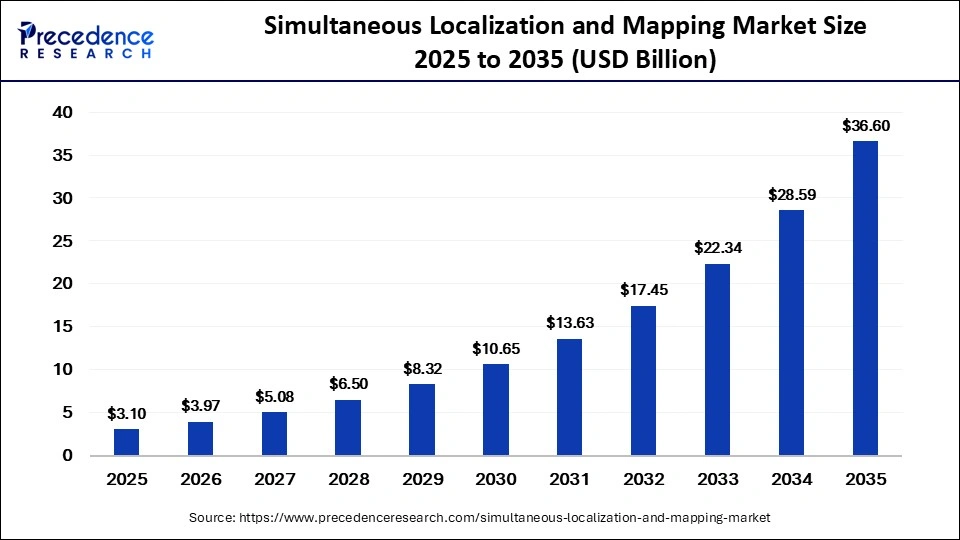
ICT industry specialist Shivani Zoting estimates the simultaneous localization and mapping market at USD 3.97 billion in 2026, with continued technology adoption expected to take the market to USD 36.60 billion by 2035 at a CAGR of 28.00%. Leading simultaneous localization and mapping market providers such as Google LLC, Apple Inc., Intel Corporation, Qualcomm Technologies, Inc. are expanding their capabilities across segments including By Component, By Type, By Application, By End-Use Industry.
Source: https://www.precedenceresearch.com/simultaneous-localization-and-mapping-market
 Get a Sample
 Table Of Content


What is the Simultaneous Localization and Mapping Market Size in 2026?
The global simultaneous localization and mapping market size was calculated at USD 3.10 billion in 2025 and is predicted to increase from USD 3.97 billion in 2026 to approximately USD 36.60 billion by 2035, expanding at a CAGR of 28.00% from 2026 to 2035. The simultaneous localization and mapping market is expanding rapidly, driven by rising adoption in robotics, autonomous vehicles, AR/VR, and drones, enabling real-time navigation and environment mapping in complex, dynamic settings.
Key Takeaways
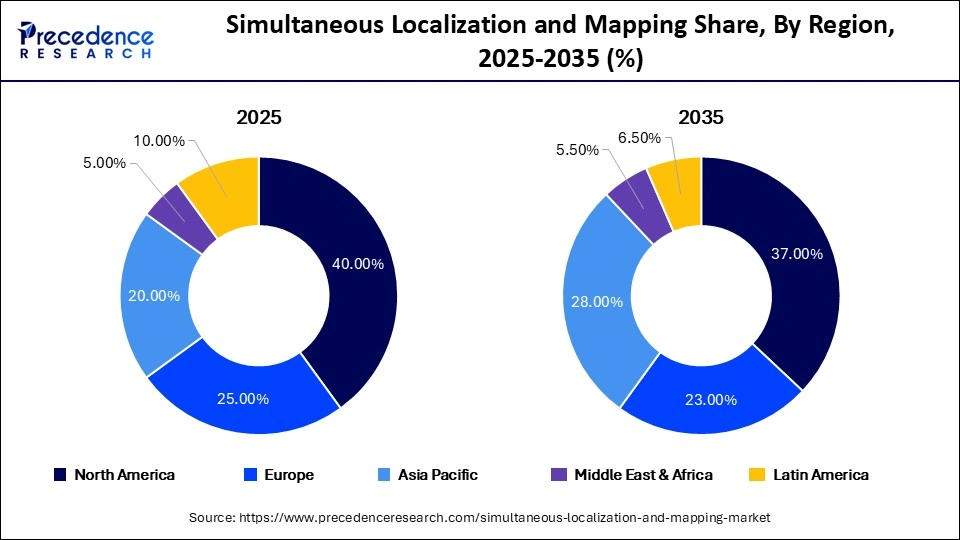
- North America led the simultaneous localization and mapping market in 2025 with a 40% revenue share.
- Asia Pacific is expected to be the fastest-growing region in the market during the forecast period.
- By component, the hardware segment led the market with a 60% share in 2025.
- By component, the software segment is expected to grow at the fastest CAGR in the coming years.
- By type, the 3D SLAM segment led the global market in 2025 with a 40% share.
- By type, the LiDAR-based SLAM segment is expected to grow at the fastest CAGR between 2026 and 2035.
- By application, the autonomous vehicles segment led the global market with a 30% share in 2025.
- By application, the drones/UAVs segment is expected to grow at a significant CAGR in the foreseeable period.
- By end-use industry, the automotive and transportation segment led the global market in 2025 with a 30% share and is expected to grow at the highest CAGR over the forecast period.
Simultaneous Localization and Mapping Market Overview
Simultaneous localization and mapping (SLAM) is a technique utilized in robotics and autonomous vehicles that facilitates the concurrent creation of a map while assessing the vehicle's location within that map. This methodology enables robots to navigate unfamiliar environments by constructing maps and precisely identifying their position using onboard sensors. SLAM algorithms are essential for mapping unknown surroundings and are critical in robotics for estimating a robot's pose, encompassing both its position and orientation. Widely embraced across various industries, SLAM technology continues to evolve through continuous innovation.
Impact of Artificial Intelligence on the Simultaneous Localization and Mapping Market
The integration of artificial intelligence in SLAM technology is crucial for achieving high-precision localization, facilitating the deployment of intelligent mobile robots in various environments, both indoors and outdoors. AI-driven LiDAR technology employs laser pulses to generate detailed and accurate maps, which are vital for precise navigation within SLAM systems. Furthermore, sophisticated AI algorithms analyze sensor data to continuously refine these maps and enhance localization, ensuring the effective operation of SLAM. Overall, the combination of artificial intelligence with SLAM technology greatly improves the functionality and performance of these systems.
Major Market Trends
- Rising adoption in autonomous systems and robotics: SLAM is becoming a core technology for autonomous vehicles, drones, and mobile robots to enable real-time navigation without external infrastructure. Growing use in sectors like logistics, agriculture, and defense is significantly accelerating market demand.
- Growth of visual SLAM (vSLAM) and sensor fusion: There is increasing adoption of camera-based SLAM (vSLAM) combined with LiDAR, IMUs, and other sensors to enhance performance and reliability. Sensor fusion improves accuracy in challenging conditions such as low light, dynamic environments, or GPS-denied areas.
- Advancement through multi-sensor fusion technology: Multi-sensor fusion is emerging as a pivotal area of development in the simultaneous localization and mapping market. Contemporary systems integrate data from various sources, including cameras, LiDAR, IMUs, radar, and ultrasonic sensors, rather than relying on a single type of sensor.
Market Scope
| Report Coverage | Details |
| Market Size in 2025 | USD 3.10 Billion |
| Market Size in 2026 | USD 3.97 Billion |
| Market Size by 2035 | USD 36.60 Billion |
| Market Growth Rate from 2026 to 2035 | CAGR of 28.00% |
| Dominating Region | North America |
| Fastest Growing Region | Asia Pacific |
| Base Year | 2025 |
| Forecast Period | 2026 to 2035 |
| Segments Covered | Component, Type, Application, End-Use Industry, and Region |
| Regions Covered | North America, Europe, Asia-Pacific, Latin America, and Middle East & Africa |
Market Dynamics
Drivers
Rising Adoption of Autonomous Systems and Robotics
The increasing deployment of autonomous vehicles, drones, and mobile robots is a key driver of the simultaneous localization and mapping market. These systems rely on SLAM to navigate and operate in real time without dependence on external positioning systems like GPS. As industries such as logistics, manufacturing, and agriculture automate operations, the demand for accurate and reliable SLAM solutions continues to grow.
Restraint
High Cost, Weather Sensitivity, and Data Processing Complexity
Market growth is hindered by the high costs associated with LiDAR sensors, which restricts the widespread adoption of autonomous vehicles. Additionally, sensor sensitivity to adverse weather conditions such as rain, fog, and snow impacts accuracy. The need for real-time data interpretation further complicates the situation, as it demands advanced algorithms and significant computational power, leading to further operational challenges.
Opportunity
Expansion in AR and VR Applications
The rapid growth of AR and VR technologies is creating significant opportunities for SLAM adoption. SLAM enables real-time environment mapping and spatial tracking, which are essential for immersive and interactive user experiences. As AR/VR expands across gaming, retail, healthcare, and training, the need for advanced SLAM solutions is expected to increase substantially.
Segment Insights
Component Insights
Simultaneous Localization and Mapping Share, By Component, 2025-2035 (%)
| Component | 2025 | 2035 | CAGR (%) |
| Hardware | 60.00% | 55.00% | 28.0% |
| Software | 40.00% | 45.00% | 29.5% |
The Hardware Segment Led the Market With a 60% Share in 2025
The hardware segment led the simultaneous localization and mapping market, capturing approximately 60% share in 2025. This leadership is attributed to a robust demand for advanced hardware solutions such as sensors, cameras, and LiDAR systems, which are essential for real-time SLAM processing and precise data collection. The performance of SLAM is significantly affected by the hardware utilized. For example, cameras capture frames line by line on an image sensor rather than recording the entire frame simultaneously. Additionally, odometry performance, measuring a robot's ability to estimate its position based solely on wheel rotation, highlights the critical role of hardware in enhancing overall SLAM efficiency.
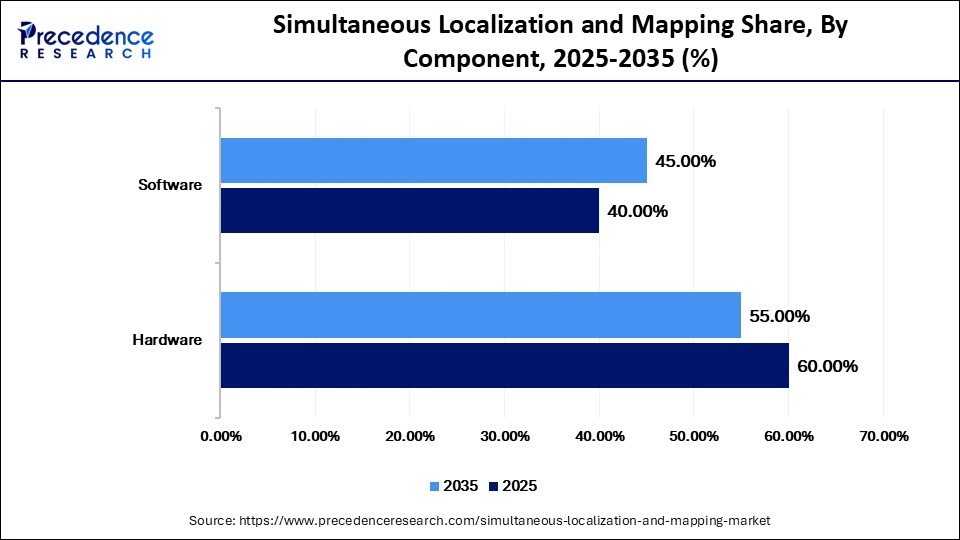
The software segment held a 40% market share in 2025 and is anticipated to grow at the fastest CAGR during the forecast period, driven by continuous advancements in software solutions designed to meet increasing user demands for enhanced accuracy. These state-of-the-art solutions are specifically tailored for challenging environments, such as underground or GPS-denied areas, thereby facilitating their widespread adoption.
Type Insights
Simultaneous Localization and Mapping Share, By Type, 2025-2035 (%)
| Type | 2025 | 2035 | CAGR (%) |
| 2D SLAM | 25.00% | 20.00% | 22.0% |
| 3D SLAM | 40.00% | 45.00% | 30.0% |
| Visual SLAM | 15.00% | 12.00% | 20.0% |
| LiDAR-based SLAM | 20.00% | 23.00% | 32.0% |
The 3D SLAM Segment Held a 40% Market Share in 2025
The 3D SLAM segment dominated the simultaneous localization and mapping market with approximately 40% share in 2025. This is mainly due to its high usage, particularly in autonomous vehicles, drones, and robotics that necessitate high-precision spatial mapping. The 3D SLAM technology presents several benefits, including exceptional measurement accuracy, robust adaptability to different environments, and ease of deployment. These systems can adjust to varying lighting conditions, dynamic environmental changes, and diverse terrains, ensuring reliable navigation capabilities.
The 2D SLAM segment held the second-largest market share of 25% in 2025, driven by its widespread use in smaller robots, indoor navigation, and applications with lower spatial requirements. 2D SLAM algorithms emphasize the creation of dependable maps while ensuring precise pose tracking. Furthermore, 2D LiDAR SLAM offers a more cost-effective solution. These techniques have been extensively implemented in diverse indoor settings and have facilitated the advancement of various robots, including those for cleaning, delivery, disinfection, and navigation, thereby contributing to market growth.
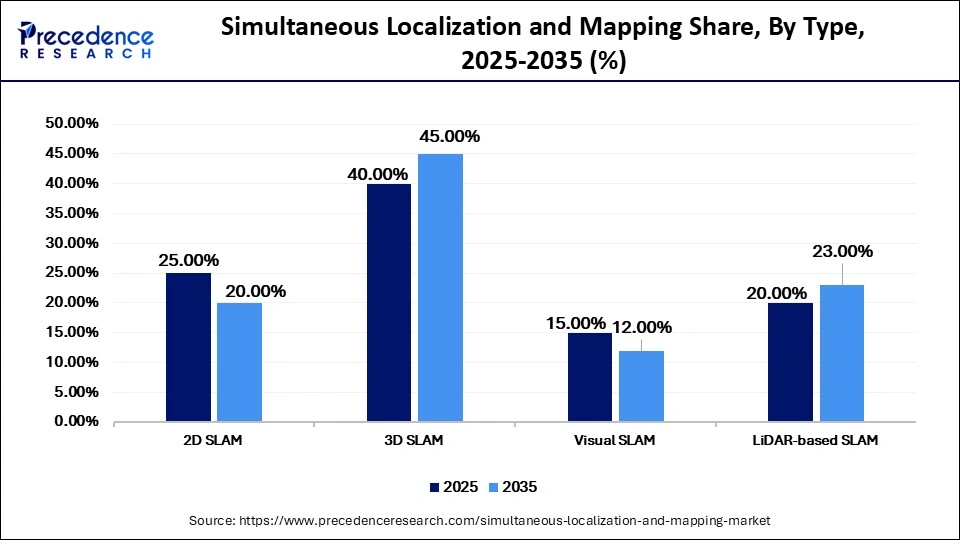
The visual SLAM segment accounted for about 15% market share in 2025, owing to its rising popularity in applications such as AR, robotics, and unmanned vehicles, where cost-effective, camera-based solutions are required. This innovation presents a promising solution to the limitations faced by existing vision and navigation systems, showcasing significant commercial potential. Visual SLAM empowers robots to create a map of unfamiliar environments while concurrently tracking their own position through visual data obtained from cameras, thereby facilitating wider adoption.
The LiDAR-based SLAM segment held about 20% market share in 2025 and is projected to grow at the fastest CAGR over the forecast period, driven by its high accuracy in outdoor applications such as autonomous vehicles, surveying, and drone-based mapping. LiDAR emits eye-safe laser light into the surrounding environment and detects the returning signals reflected from nearby objects. LiDAR SLAM systems have become increasingly popular due to their ability to deliver highly accurate maps and real-time localization across a wide range of applications, including autonomous vehicles, mobile robotics, and indoor mapping for navigation and asset tracking.
Application Insights
Why Did the Autonomous Vehicles Segment Dominated the Market in 2025?
The autonomous vehicles segment dominated the simultaneous localization and mapping market, accounting for 30% revenue share in 2025, driven by the need for real-time, accurate mapping and navigation in self-driving cars. It enables an autonomous vehicle (AV) to generate a map of its environment while concurrently identifying its own location within that map. SLAM facilitates vehicle positioning and builds a comprehensive representation of the surrounding area using sensor data, thereby enhancing its competitive advantage.
The robotics segment held approximately 25% share of the market in 2025, driven by increasing adoption of SLAM technologies in industrial, service, and collaborative robots. SLAM navigation allows machines to operate without a predefined map, adapting to surrounding conditions in real time. Robots can simultaneously use cameras and other sensors to create maps of obstacles in their surroundings and avoid covering the same area twice, which promotes adoption. These devices map homes in real time, detect furniture, and adjust their paths to avoid obstacles, further supporting adoption.
Simultaneous Localization and Mapping Share, By By Application, 2025-2035 (%)
| Application | 2025 | 2035 | CAGR (%) |
| Autonomous Vehicles | 30.00% | 35.00% | 34.0% |
| Robotics | 25.00% | 20.00% | 28.5% |
| Augmented Reality (AR) and Virtual Reality (VR) | 15.00% | 13.00% | 25.5% |
| Mapping and Surveying | 10.00% | 9.00% | 21.0% |
| Drones/UAVs | 10.00% | 12.00% | 32.0% |
| Healthcare and Medical Devices | 5.00% | 4.00% | 19.0% |
| Others | 5.00% | 5.00% | 17.5% |
The drones/UAVs segment held about 10% market share in 2025 and is projected to grow at a significant rate in the coming years, driven by the increasing use of drones for navigation, obstacle avoidance, and data collection across applications, including surveying, agriculture, and delivery services. SLAM is opening the door to faster, smarter, and more autonomous drone operations. SLAM-powered drones can scan inventory, navigate shelves, and automate warehouse management, promoting broader adoption.
The augmented reality (AR) and virtual reality (VR) segment held about 15% market share in 2025, driven by demand for SLAM technology to create immersive experiences with real-time spatial awareness. SLAM is used in AR/VR technologies to capture visual data from the physical environment in the form of points and dots and feed that data into machines. SLAM provides optical input for devices and computers, enabling them to understand what is happening in the physical world.
End-Use Industry Insights
The Automotive and Transportation Segment Led the Market in 2025
The automotive and transportation segment led the simultaneous localization and mapping market with nearly 30% share in 2025 and is projected to sustain its leadership during the forecast period. This is primarily due to the increasing adoption of SLAM technologies in autonomous vehicles and driver-assistance systems. The detailed maps created by LiDAR sensors help autonomous vehicles detect and avoid obstacles such as pedestrians, vehicles, and road debris, ensuring safe road operation. Additionally, SLAM technology enhances the overall performance of autonomous vehicles, making them more reliable and capable of handling diverse driving scenarios, thereby increasing its adoption in the automotive industry.
The manufacturing and warehousing segment held approximately 25% share of the market in 2025, driven by increased use of SLAM for automation, robotics, and inventory management, while warehouses adopt it for real-time navigation and logistics optimization. In warehouse environments, SLAM technology enables autonomous mobile robots to navigate spaces effectively, avoiding obstacles and unexpected challenges. This capability enhances tasks such as item picking and handling. As a result, SLAM robotics is increasing the efficiency, flexibility, and scalability of warehouses.
Simultaneous Localization and Mapping Share, By End-Use Industry, 2025-2035 (%)
| End-Use Industry | 2025 | 2035 | CAGR (%) |
| Automotive and Transportation | 30.00% | 32.00% | 35.0% |
| Manufacturing and Warehousing | 25.00% | 23.00% | 28.0% |
| Healthcare and Life Sciences | 10.00% | 11.00% | 21.5% |
| Defense and Military | 10.00% | 9.50% | 20.0% |
| Retail and Logistics | 10.00% | 9.00% | 17.5% |
| Others | 15.00% | 16.50% | 19.0% |
The healthcare and life sciences segment held about 10% market share in 2025, driven by the expanding use of SLAM in medical robots, rehabilitation devices, and medical imaging systems. SLAM technology maps the surrounding environment while simultaneously using sensor signals to locate the sensor system within that environment. To simplify navigation in minimally invasive abdominal surgery, a laparoscopic navigation system based on SLAM was developed, supporting adoption.
The defense and military segment held about 10% share of the simultaneous localization and mapping market in 2025, driven by the critical role of SLAM in military robots and autonomous systems for mapping and navigating unknown or hazardous environments. It has broad application prospects in the military, particularly in autonomous navigation and control of intelligent unmanned systems, intelligence collection and surveillance, multi-aircraft collaborative operations, soldier simulation training, and enhanced battlefield perception.
Regional Insights
North America Simultaneous Localization and Mapping Market Size and Growth 2026 to 2035
The North America simultaneous localization and mapping market size is estimated at USD 1.24 billion in 2025 and is projected to reach approximately USD 14.82 billion by 2035, with a 28.16% CAGR from 2026 to 2035.
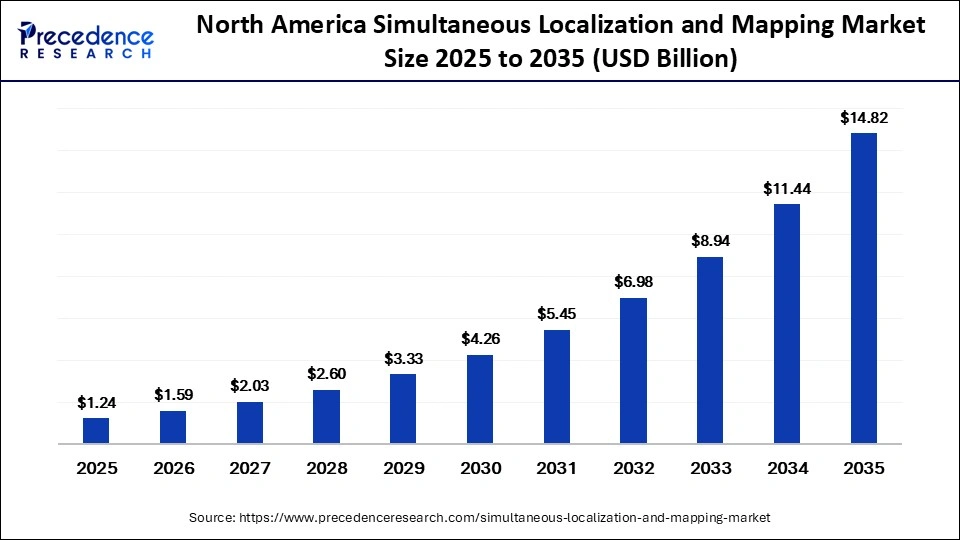
North America Dominated the Market With a 40% Share in 2025
North America dominated the simultaneous localization and mapping market with nearly 40% share in 2025, driven by the rapid adoption of autonomous technologies, significant investments in robotics, and the presence of major players in the SLAM space. Moreover, the region's high concentration of commercial and non-commercial drone camera manufacturers contributed to the market dominance. Rising demand for robots across various industries further strengthens the region's dominance.
U.S. Simultaneous Localization and Mapping Market Size and Growth 2026 to 2035
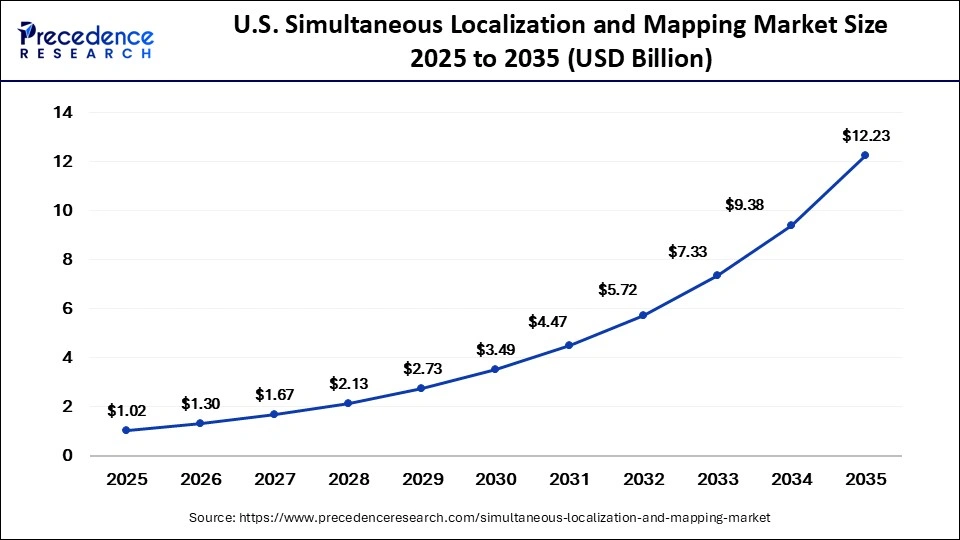
The U.S. simultaneous localization and mapping market size is calculated at USD 1.02 billion in 2025 and is expected to reach nearly USD 12.23 billion in 2035, accelerating at a strong CAGR of 28.20% between 2026 and 2035.
U.S. Market Analysis
The U.S. leads the North American market, driven by a strong adoption of autonomous technologies, robotics, and advanced AR/VR applications across industries such as automotive, defense, and consumer electronics. Additionally, significant investments in AI, computer vision, and RandD by leading technology companies are accelerating innovation and large-scale deployment of SLAM solutions.
Asia Pacific: The Fastest-Growing Region
Asia Pacific held about 20% share of the simultaneous localization and mapping market in 2025 and is projected to grow at the fastest rate in the coming years. This is mainly due to rapid advancements in robotics, autonomous vehicle development, and the increasing use of SLAM in manufacturing. Rapid research, development, and scaled production are influencing both local and global partnership strategies, supporting market growth.
China Market Analysis
The market in China is growing due to rapid expansion in robotics, autonomous vehicles, and smart manufacturing, supported by strong government initiatives and industrial automation. Additionally, increasing investments by domestic technology companies in AI, computer vision, and consumer electronics are accelerating the adoption of SLAM solutions across multiple applications.
How is the Opportunistic Rise of Europe in the Simultaneous Localization and Mapping Market?
Europe held a 25% share of the market in 2025 and is projected to grow at a significant CAGR during the forecast period, driven by the increasing demand for autonomous vehicles, robotics, and precision mapping solutions. The regional market growth is further supported by initiatives promoting automation and smart infrastructure, along with rising demand for robots across various industries.
Simultaneous Localization and Mapping Market Companies
- Google LLC
- Apple Inc.
- Intel Corporation
- Qualcomm Technologies, Inc.
- Roboteam
- Velodyne Lidar, Inc.
- SLAMcore Ltd.
- Omron Corporation
- NVIDIA Corporation
- Hesai Technology
- Clearpath Robotics Inc.
- Mapillary (acquired by Facebook)
- Aptiv PLC
- RoboSense
- Zebra Medical Vision
Recent Developments
- In February 2026, CHC Navigation introduced RS7, a new handheld SLAM scanning solution, at the 2026 CHCNAV Connect Partner Conference. Designed for BIM documentation, indoor surveying, renovation planning, and intricate spatial analysis, the CHCNAV RS7 enables professionals to efficiently capture high-density 3D data and transform it into actionable deliverables using CHCNAV's software and cloud ecosystem.(Source: https://www.gpsworld.com)
- In February 2026, Emesent, a leading provider of autonomous mapping technology, introduced Emesent GX1, an integrated scanner designed for simultaneous localization and mapping as well as real-time kinematic scanning. The company reports that the GX1 offers global accuracy of 5-10 mm for topographic surveying and construction of buildings and infrastructure. This innovative technology can significantly reduce site survey time by up to 95%, transforming tasks that once took weeks into a single day of scanning.(Source: https://www.engineering.com)
Segments Covered in the Report
By Component
- Hardware (Sensors, Cameras, LIDAR, GPS Modules)
- Software (Mapping Algorithms, Localization Algorithms, Integrated SLAM Software)
By Type
- 2D SLAM
- 3D SLAM
- Visual SLAM
- LiDAR-based SLAM
By Application
- Autonomous Vehicles
- Robotics (Industrial, Service, Collaborative Robots)
- Augmented Reality (AR) and Virtual Reality (VR)
- Mapping and Surveying
- Drones/UAVs
- Healthcare and Medical Devices
- Others
By End-Use Industry
- Automotive and Transportation
- Manufacturing and Warehousing
- Healthcare and Life Sciences
- Defense and Military
- Retail and Logistics
- Others
By Region
- North America
- Latin America
- Europe
- Asia-pacific
- Middle and East Africa
For inquiries regarding discounts, bulk purchases, or customization requests, please contact us at sales@precedenceresearch.com
Frequently Asked Questions





Ask For Sample
No cookie-cutter, only authentic analysis – take the 1st step to become a Precedence Research client
 Get a Sample




 sales@precedenceresearch.com
 Schedule a Meeting
