



Indoor Positioning and Indoor Navigation Market Trends, Companies, Revenue / Sales Performance, Subscriber Growth, Pricing Strategies, Cloud Adoption, Infrastructure Expansion, Competitive Landscape, and Industry Outlook
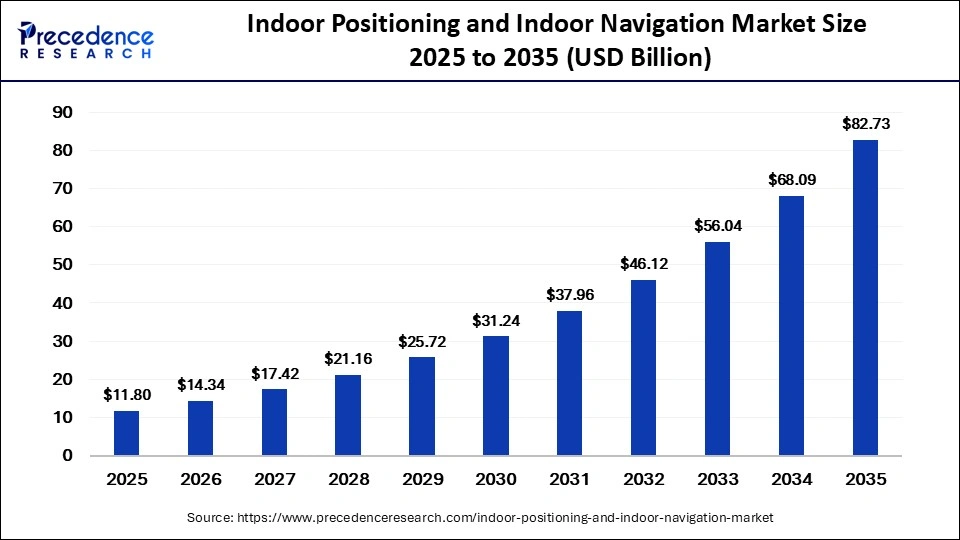
ICT industry specialist Gautam Mahajan estimates the indoor positioning and indoor navigation market at USD 14.34 billion in 2026, with continued technology adoption expected to take the market to USD 82.73 billion by 2035 at a CAGR of 21.50%. Leading indoor positioning and indoor navigation market providers such as Cisco Systems, Inc., Google LLC, Apple Inc., Microsoft Corporation are expanding their capabilities across segments including By Technology, By Component, By Application, By End-Use Industry.
Source: https://www.precedenceresearch.com/indoor-positioning-and-indoor-navigation-market
 Get a Sample
 Table Of Content


What is the Indoor Positioning and Indoor Navigation Market Size in 2026?
The global indoor positioning and indoor navigation market size was estimated at USD 11.80 billion in 2025 and is predicted to increase from USD 14.34 billion in 2026 to approximately USD 82.73 billion by 2035, expanding at a CAGR of 21.50% from 2026 to 2035. Increasing use in retail and transportation, along with advancements in indoor location technology and AI and IoT support, are driving indoor positioning and indoor navigation market growth.
Key Takeaways
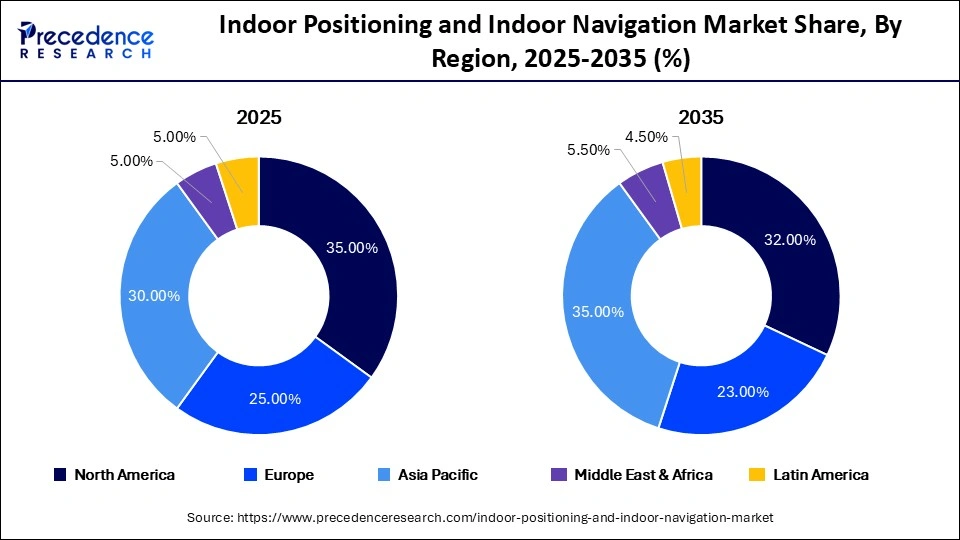
- North America led the indoor positioning and indoor navigation market in 2025 with a 35% revenue share.
- Asia Pacific is observed to grow at the fastest CAGR of 24.5% during the forecast period.
- By technology, the Wi-Fi positioning systems (WPS) segment led the market with a 30% share in 2025.
- By technology, the Bluetooth low energy (BLE) beacons segment is expected to grow at the fastest CAGR of about 22.5% in the coming years.
- By component, the hardware segment led the global market in 2025 with a 40% share.
- By component, the software platforms segment is expected to grow at the fastest CAGR of 23% in the coming years.
- By application, the asset tracking & inventory management segment led the global market in 2025 with a 30% share.
- By application, the proximity marketing & customer engagement segment is observed to grow at the fastest CAGR of 23.5% in the foreseeable period.
- By end-use industry, the retail segment led the global market in 2025 with a 25% share.
- By end-use industry, the healthcare segment is observed to grow at the fastest CAGR of 23% in the coming years.
Indoor Positioning and Indoor Navigation Market Overview
Indoor navigation systems are designed to enhance users' spatial awareness within a venue and provide intuitive directions. An indoor positioning system can detect real-time locations, accurately pinpointing the coordinates of individuals or assets within a building. This technology facilitates precise location tracking in enclosed environments such as airports, shopping malls, hospitals, and warehouses, where GPS often falls short. Additionally, indoor navigation involves determining a user's position along a route within a facility, guiding them to a specific destination, such as a room, floor, or asset. In summary, indoor positioning and navigation together offer valuable resources, delivering effective solutions across a variety of scenarios.
Impact of Artificial Intelligence on the Indoor Positioning and Indoor Navigation Market
Artificial intelligence significantly enhances indoor navigation services by increasing precision, robustness, and situational awareness, effectively addressing the limitations of GPS-based systems. Deep learning algorithms analyse collected data to develop an artificial neural network (ANN)-based model of a building's radio environment, achieving a typical median error of just a few meters. Furthermore, AI can assess real-time conditions, such as foot traffic, closed corridors, and the time of day, and integrate these with historical behaviour patterns to suggest the fastest or most convenient routes. Overall, AI contributes to greater accuracy and effectiveness in the indoor positioning and indoor navigation market.
Major Market Trends
- Rising Adoption of Smart Infrastructure: The increasing implementation of smart buildings, smart retail, and connected infrastructure is driving the demand for indoor positioning and navigation solutions. This trend enhances navigation efficiency, asset visibility, and operational performance in commercial settings.
- Faster Emergency Response and Public Safety: Indoor positioning and navigation solutions facilitate quicker emergency responses during incidents such as fires, medical emergencies, and crowded situations. They guide individuals toward safe exits, enable faster rescues, and help reduce casualties.
- Convergence with AI, Digital Twins, and IoT Platforms: The integration of indoor positioning with AI, digital twins, and IoT platforms is creating opportunities for predictive capabilities, automated processes, and advanced location-based services in connected smart environments.
Market Scope
| Report Coverage | Details |
| Market Size in 2025 | USD 11.80 Billion |
| Market Size in 2026 | USD 14.34 Billion |
| Market Size by 2035 | USD 82.73 Billion |
| Market Growth Rate from 2026 to 2035 | CAGR of 21.50% |
| Dominating Region | North America |
| Fastest Growing Region | Asia Pacific |
| Base Year | 2025 |
| Forecast Period | 2026 to 2035 |
| Segments Covered | Technology, Component, Application, End-Use Industry, and Region |
| Regions Covered | North America, Europe, Asia-Pacific, Latin America, and Middle East & Africa |
Market Dynamics
Drivers
Growing Adoption of Advanced Positioning Technologies
The growing adoption of technologies such as SLAM, BLE beacons, Wi-Fi, and ultra-wideband is fuelling market growth. Their usage in sectors like retail, logistics, healthcare, shopping malls, educational institutions, and airports is steadily increasing in developed nations.
Restraint
Privacy Concerns and High Infrastructure Costs
Privacy concerns, infrastructure expenses, and deployment challenges continue to be significant limitations. Additionally, delays caused by third-party sensors may result in outdated data, and cybersecurity vulnerabilities in software, communication protocols, and databases could jeopardize sensitive real-time location information.
Opportunity
Expansion Through Strategic Growth Initiatives
Companies are increasingly emphasizing inorganic growth strategies, including mergers and acquisitions, to enhance their market presence and expand geographically. Additionally, analytics dashboards can assist organizations in identifying movement patterns, impediments, and operational inefficiencies.
Segmental Insights
Technology Insights
Indoor Positioning and Indoor Navigation Market Share, By Technology, 2025-2035 (%)
| Technology | 2025 | 2035 | CAGR (%) |
| Wi-Fi Positioning Systems (WPS) | 30.00% | 26.00% | 17.5% |
| Bluetooth Low Energy (BLE) Beacons | 25.00% | 27.00% | 22.5% |
| Ultra-Wideband (UWB) | 15.00% | 20.00% | 26.5% |
| Radio Frequency Identification (RFID) | 15.00% | 13.00% | 18.0% |
| Magnetic Positioning | 10.00% | 9.00% | 16.5% |
| Others | 5.00% | 5.00% | 15.0% |
Wi-Fi Positioning Systems (WPS) Segment Dominated With 30% Share in 2025
The Wi-Fi positioning systems (WPS) segment dominated the indoor positioning and indoor navigation market, accounting for approximately 30% share in 2025, due to widespread infrastructure availability and cost-effective deployment across commercial buildings and public spaces. It benefits from the ability to use already installed Wi-Fi infrastructure for indoor positioning. There is no need for additional equipment or extensive infrastructure maintenance, and the system can work with a wide range of existing Wi-Fi access points.
The Bluetooth low energy (BLE) beacons segment held approximately 25.00% share of the market in 2025 and is projected to grow at the fastest CAGR of 22.5% in the upcoming period, driven by their low energy consumption, high accuracy, and strong adoption in retail and proximity marketing. The technology is cost-effective, can be installed with minimal effort, and can determine positions with an accuracy of a few meters. The BLE standard is also highly energy efficient. Beacons can be used for both client-based applications, such as indoor navigation, and server-based applications, such as asset tracking, which supports market adoption.
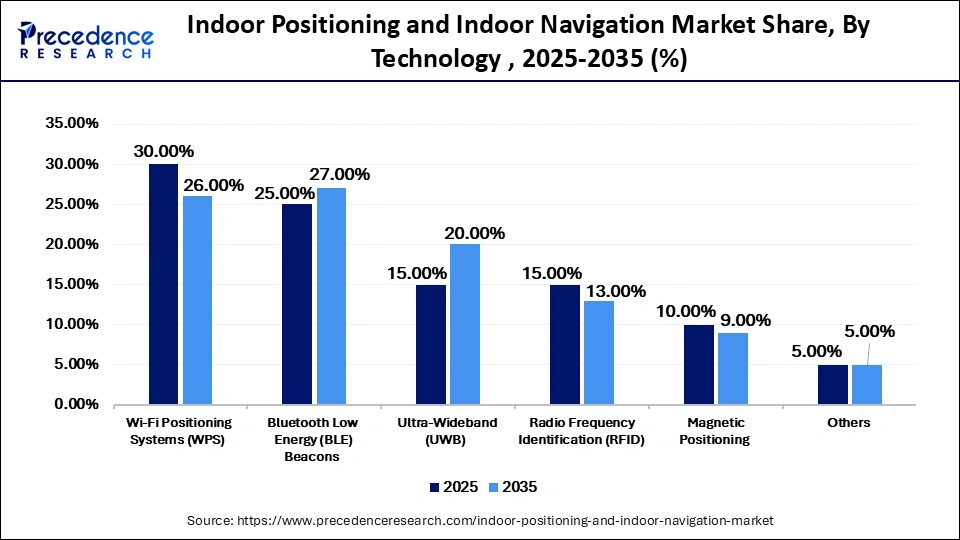
The ultra-wideband (UWB) segment held approximately 15.00% market share in 2025 and is expected to grow at a CAGR of 26.5% during the forecast period due to its high precision in real-time location tracking, especially in industrial and healthcare applications. UWB is a communication technology that spreads information over a wide portion of the frequency spectrum. This allows transmitters to send large amounts of data while consuming very little energy, thereby supporting market adoption.
The radio frequency identification (RFID) segment held nearly 15.00% share in 2025 and is expected to grow at a CAGR of around 18.0% during the forecast period, driven by its widespread use in asset tracking and inventory management, particularly in logistics and manufacturing sectors. The platform consists of software, readers, and RFID tags (transponders) installed inside or outside the building. RFID location tracking is carried out using radio signals that allow the reader to identify and record the data stored in tags.
Component Insights
Indoor Positioning and Indoor Navigation Market Share, By Component, 2025-2035 (%)
| Component | 2025 | 2035 | CAGR (%) |
| Hardware | 40.00% | 38.00% | 18.5% |
| Software Platforms | 35.00% | 38.00% | 23.0% |
| Services | 25.00% | 24.00% | 19.0% |
The Hardware Segment Led the Market with a 40.00% Share in 2025
The hardware (beacons, sensors, tags, access points) segment dominated the indoor positioning and indoor navigation market with a 40.00% share in 2025, due to the need for physical infrastructure such as beacons, sensors, tags, and access points for accurate indoor positioning. Equipped with motion-sensing capabilities, these tags can detect movement and trigger alerts when assets shift position. Such hardware solutions are also used in parking areas to help shoppers locate their vehicles, further supporting segment dominance.
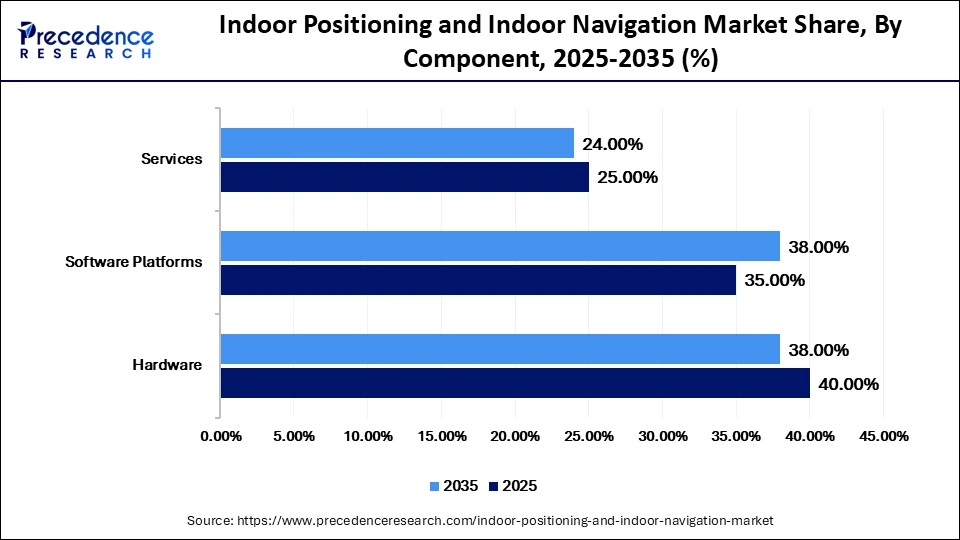
The software platforms segment held about 35.00% share in 2025 and is projected to grow at the fastest CAGR of about 23.0% during the forecast period. This growth is driven by demand for real-time analytics, AI-driven insights, and advanced mapping and navigation capabilities. These platforms are especially useful in large, complex spaces such as warehouses, factories, showrooms, and hospitals. They ingest location information from IoT and other devices, process that information, provide location analytics, and offer APIs and software development kits (SDKs) that enable business applications to leverage location data, thereby promoting adoption.
The services segment held about 25.00% share of the market in 2025 and is expected to grow at a CAGR of 19.0% in the coming years, as services support the deployment, system integration, and maintenance of indoor positioning solutions across industries. They also enable customizable indoor navigation solutions and provide highly detailed and accurate indoor maps, helping users navigate complex spaces with ease.
Application Insights
The Asset Tracking & Inventory Management Segment Led the Market in 2025
The asset tracking & inventory management segment led the indoor positioning and indoor navigation market with about 30.00% share in 2025, driven by high demand in logistics, healthcare, and manufacturing for real-time tracking of assets and inventory. These solutions can transform operations by improving asset visibility, optimizing efficiency, and reducing operational costs, thereby supporting segment dominance.
The indoor navigation & wayfinding segment held about 25.00% market share in 2025 and is expected to grow at a CAGR of 22.0% during the forecast period due to the increasing adoption in airports, malls, hospitals, and large venues for enhanced user experience. These solutions enhance visitor experience through real-time wayfinding, indoor-outdoor transitions, automatic floor detection, and PRM-friendly routes, promoting segment expansion.
Indoor Positioning and Indoor Navigation Market Share, By Application, 2025-2035 (%)
| Application | 2025 | 2035 | CAGR (%) |
| Asset Tracking & Inventory Management | 30.00% | 28.00% | 20.0% |
| Indoor Navigation & Wayfinding | 25.00% | 26.00% | 22.0% |
| Proximity Marketing & Customer Engagement | 15.00% | 16.00% | 23.5% |
| Workforce Management & Safety Monitoring | 15.00% | 15.00% | 21.5% |
| Emergency Response & Security Management | 15.00% | 15.00% | 22.5% |
The proximity marketing & customer engagement segment held about 15% market share in 2025 and is expected to grow at a CAGR of 23.5% in the coming years, driven by retailers' increasing use of indoor positioning for personalized promotions and customer engagement. Proximity marketing uses location technology to reach customers through their mobile devices when they are near a business. It enables businesses to send offers, updates, or notifications to nearby users based on their physical location, supporting adoption.
The workforce management & safety monitoring segment held approximately 15.00% share of the market in 2025 and is expected to grow at a CAGR of 21.5% during the forecast period, as organizations use these solutions to track employee movement, improve safety, and optimize workforce productivity. Worker management and safety monitoring systems enable the systematic registration of workers, recording clock-in and clock-out times, restricting proxy attendance, and reducing malpractices in wage calculation. These solutions can monitor both permanent and non-permanent workers, including attendance and wage calculations, while also promoting worker safety.
End-Use Industry Insights
The Retail Segment Held a 25% Market Share in 2025
The retail segment dominated the indoor positioning and indoor navigation market with a 25% share in 2025, due to its high use of customer navigation, in-store analytics, and proximity-based marketing strategies. Retailers leverage Wi-Fi and BLE solutions to track high-value merchandise and optimize store layouts based on customer movement patterns, strengthening the segment's market lead.
The healthcare segment held approximately 20% share of the indoor positioning and indoor navigation market in 2025 and is projected to grow at the fastest CAGR of 23% during the forecast period. This growth is driven by the rising adoption of indoor positioning for patient tracking, asset management, and workflow optimization. Hospitals utilize RTLS to track critical medical equipment such as wheelchairs, ventilators, and infusion pumps, ensuring they are readily available when needed.
Indoor Positioning and Indoor Navigation Market Share, By End-Use Industry, 2025-2035 (%)
| End-Use Industry | 2025 | 2035 | CAGR (%) |
| Retail | 25.00% | 26.00% | 22.5% |
| Healthcare | 20.00% | 21.00% | 23.0% |
| Transportation & Logistics | 20.00% | 19.00% | 20.5% |
| Manufacturing | 15.00% | 14.00% | 19.5% |
| Hospitality | 10.00% | 10.50% | 21.0% |
| Public Infrastructure | 5.00% | 6.00% | 22.5% |
| Others | 5.00% | 3.50% | 18.0% |
The transportation & logistics segment held about 20.00% share of the market in 2025 and is expected to grow at a CAGR of 20.5% during the forecast period. This is because airports and warehouses use these systems for navigation, baggage tracking, and operational efficiency. Distribution centres use BLE and UWB technologies to monitor inventory movement, reduce stock discrepancies, and optimize order fulfilment, supporting adoption.
The manufacturing segment held about 15% market share in 2025 and is expected to grow at a CAGR of 19.5% in the coming years, due to the increasing use of indoor positioning for asset tracking, process optimization, and worker safety in manufacturing facilities. Factories use acoustic and ultrasound tracking to monitor tools and equipment across production lines, preventing delays and improving workflow efficiency, which supports adoption.
Regional Insights
North America Indoor Positioning and Indoor Navigation Market Size and Growth 2026 to 2035
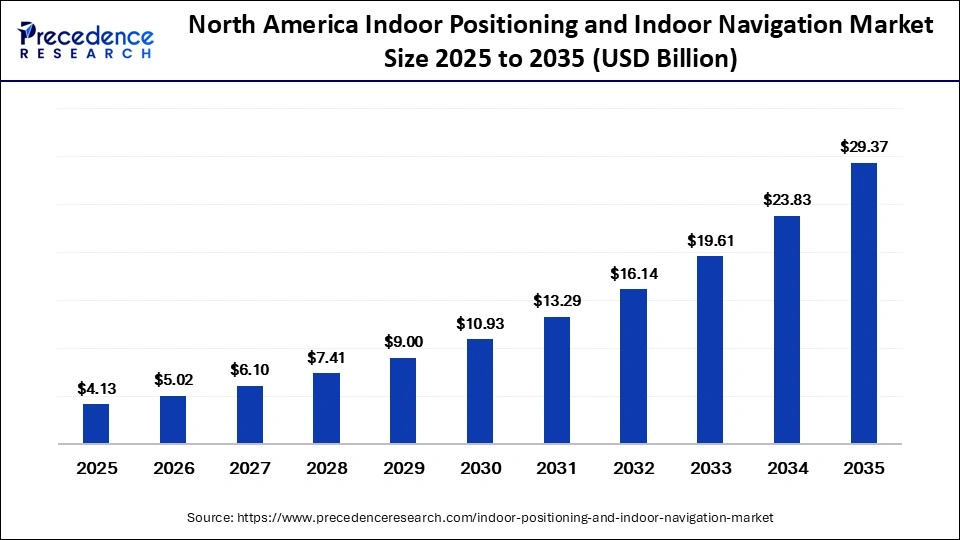
The North America indoor positioning and indoor navigation market size is estimated at USD 4.13 billion in 2025 and is projected to reach approximately USD 29.37 billion by 2035, with a 21.67% CAGR from 2026 to 2035.
North America Dominated the Market with a 35% Share in 2025
North America dominated the indoor positioning and indoor navigation market in 2025, accounting for approximately 35% share. This is mainly due to early technology adoption, the strong presence of key players, and high investment in smart infrastructure. Furthermore, the growing trend of smart buildings and the Internet of Things (IoT) significantly contributes to market growth in the region.
U.S. Indoor Positioning and Indoor Navigation Market Size and Growth 2026 to 2035
The U.S. indoor positioning and indoor navigation market size is calculated at USD 3.10 billion in 2025 and is expected to reach nearly USD 22.17 billion in 2035, accelerating at a strong CAGR of 21.74% between 2026 and 2035.
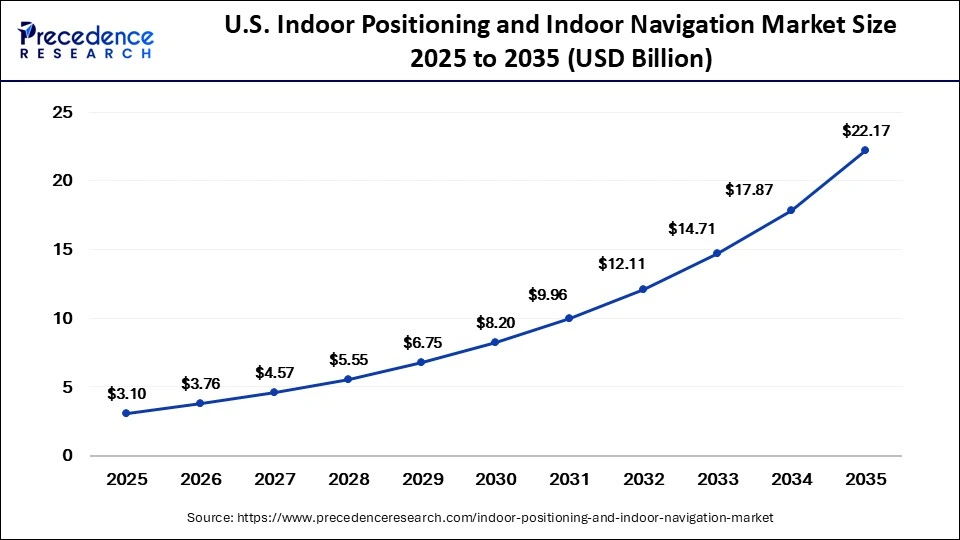
The U.S. leads the North American market due to the proliferation of smartphones and smart devices, which inherently possess the sensors and connectivity features required for indoor positioning. This has fuelled demand for indoor positioning and indoor navigation systems. With individuals spending a substantial amount of time indoors, the market potential for expansion remains significant.
Asia Pacific: The Fastest-Growing Region
Asia Pacific held about 30% share of the market in 2025 and is expected to grow at the fastest CAGR of 24.5% during the forecast period, driven by rapid urbanization, smart city projects, and expanding retail and transportation sectors. Governments and private entities are investing heavily in infrastructure that supports smart technologies, including indoor positioning and navigation systems, which are helping drive market growth.
China is the leading country in the Asia Pacific indoor positioning and indoor navigation market, driven by the rising penetration of mobile computing devices and increasing demand for real-time indoor navigation and asset tracking solutions.
How is the Opportunistic Rise of Europe in the Market?
Europe held a 25% share of the market in 2025 and is expected to grow at a CAGR of 19.5% during the forecast period, driven by smart building initiatives, retail innovation, and digital transformation across industries. Businesses in Europe are increasingly focusing on enhancing customer experience and personalization through indoor positioning and indoor navigation systems. Retailers use these technologies to deliver location-based services, such as targeted advertisements and promotions, enhancing customer engagement and satisfaction.
Germany is leading the European market, driven by technological innovation, changing consumer behaviours, urbanization trends, and increasing demand for location-based services across sectors such as retail, healthcare, and transportation. The competitive landscape is characterized by both established technology giants and specialized navigation solution providers, which is helping the market grow.
Indoor Positioning and Indoor Navigation Market Companies
- Cisco Systems, Inc.
- Google LLC
- Apple Inc.
- Microsoft Corporation
- HERE Technologies
- Zebra Technologies Corporation
- STMicroelectronics N.V.
- Infsoft GmbH
- IndoorAtlas Ltd.
- Navigine Corporation
- Kontakt.io Inc.
- Sewio Networks s.r.o.
- Quuppa Oy
- Ubisense Group plc
- Senion AB
Recent Developments
- In January 2026, DENSO and EPAM announced their partnership at NRF 2026: Retail's Big Show. They showcased how DENSO's Indoor Positioning System (IPS), combined with EPAM's digital twin and spatial intelligence solutions, is revolutionizing retail spaces. This cutting-edge technology provides hyper-accurate, real-time location data, allowing retailers to streamline operations, improve customer engagement, and deliver seamless omnichannel experiences.(Source: https://www.epam.com)
- In September 2025, 4D1 announced the launch of T2, a technology that offers millimeter-level 3D positioning tailored for factories and process-centric industries. This advancement facilitates true indoor autonomy through precise positioning, allowing for AI-driven process optimization and the creation of digital twins.(Source: https://www.therobotreport.com)
Segment Covered in the Report
By Technology
- Wi-Fi Positioning Systems (WPS)
- Bluetooth Low Energy (BLE) Beacons
- Ultra-Wideband (UWB)
- Radio Frequency Identification (RFID)
- Magnetic Positioning
- Others (Infrared, Ultrasound)
By Component
- Hardware (Beacons, Sensors, Tags, Access Points)
- Software Platforms (Location Analytics, Mapping, Navigation Software)
- Services (Consulting, Integration, Maintenance)
By Application
- Asset Tracking & Inventory Management
- Indoor Navigation & Wayfinding
- Proximity Marketing & Customer Engagement
- Workforce Management & Safety Monitoring
- Emergency Response & Security Management
By End-Use Industry
- Retail
- Healthcare
- Transportation & Logistics (Airports, Warehouses)
- Manufacturing
- Hospitality
- Public Infrastructure (Smart Buildings, Smart Cities)
- Others
By Region
- North America
- Latin America
- Europe
- Asia-pacific
- Middle and East Africa
For inquiries regarding discounts, bulk purchases, or customization requests, please contact us at sales@precedenceresearch.com
Frequently Asked Questions





Ask For Sample
No cookie-cutter, only authentic analysis – take the 1st step to become a Precedence Research client
 Get a Sample




 sales@precedenceresearch.com
 Schedule a Meeting
